Comprehensive Analysis: The Profound Effects of Drought on Human Life
VerifiedAdded on 2022/11/25
|6
|1119
|485
Essay
AI Summary
This essay explores the multifaceted effects of drought, a natural disaster characterized by below-average precipitation, leading to severe water shortages and significant negative impacts on human well-being. The essay highlights how drought contributes to malnutrition by diminishing food production and increasing mortality rates, while also facilitating the proliferation of harmful animals and causing dehydration due to increased temperatures. Furthermore, it examines how drought induces migration, breaking family ties and creating congestion in urban areas, as well as leading to a loss of human dignity, increased poverty, and reduced recreational facilities. The essay emphasizes the need for further research and sustainable environmental solutions to mitigate the adverse consequences of drought on health, communities, and families, underscoring the critical role of various stakeholders in addressing this pressing issue.
Running head: EFFECTS OF DROUGHT 1
Effects of drought
Name:
Institution:
Tutor:
Date:
Effects of drought
Name:
Institution:
Tutor:
Date:
Paraphrase This Document
Need a fresh take? Get an instant paraphrase of this document with our AI Paraphraser

EFFECTS OF DROUGHT 2
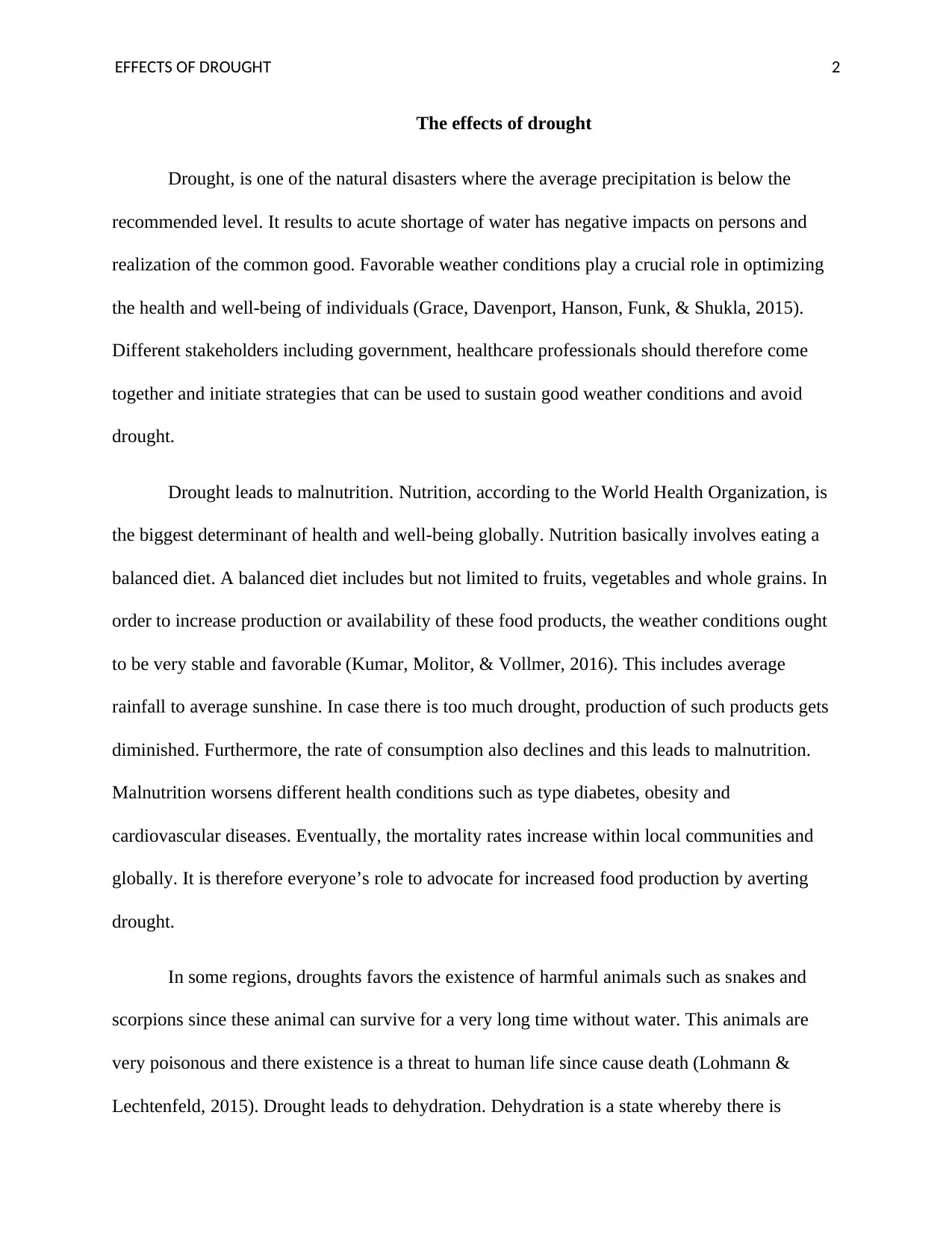
The effects of drought
Drought, is one of the natural disasters where the average precipitation is below the
recommended level. It results to acute shortage of water has negative impacts on persons and
realization of the common good. Favorable weather conditions play a crucial role in optimizing
the health and well-being of individuals (Grace, Davenport, Hanson, Funk, & Shukla, 2015).
Different stakeholders including government, healthcare professionals should therefore come
together and initiate strategies that can be used to sustain good weather conditions and avoid
drought.
Drought leads to malnutrition. Nutrition, according to the World Health Organization, is
the biggest determinant of health and well-being globally. Nutrition basically involves eating a
balanced diet. A balanced diet includes but not limited to fruits, vegetables and whole grains. In
order to increase production or availability of these food products, the weather conditions ought
to be very stable and favorable (Kumar, Molitor, & Vollmer, 2016). This includes average
rainfall to average sunshine. In case there is too much drought, production of such products gets
diminished. Furthermore, the rate of consumption also declines and this leads to malnutrition.
Malnutrition worsens different health conditions such as type diabetes, obesity and
cardiovascular diseases. Eventually, the mortality rates increase within local communities and
globally. It is therefore everyone’s role to advocate for increased food production by averting
drought.
In some regions, droughts favors the existence of harmful animals such as snakes and
scorpions since these animal can survive for a very long time without water. This animals are
very poisonous and there existence is a threat to human life since cause death (Lohmann &
Lechtenfeld, 2015). Drought leads to dehydration. Dehydration is a state whereby there is
The effects of drought
Drought, is one of the natural disasters where the average precipitation is below the
recommended level. It results to acute shortage of water has negative impacts on persons and
realization of the common good. Favorable weather conditions play a crucial role in optimizing
the health and well-being of individuals (Grace, Davenport, Hanson, Funk, & Shukla, 2015).
Different stakeholders including government, healthcare professionals should therefore come
together and initiate strategies that can be used to sustain good weather conditions and avoid
drought.
Drought leads to malnutrition. Nutrition, according to the World Health Organization, is
the biggest determinant of health and well-being globally. Nutrition basically involves eating a
balanced diet. A balanced diet includes but not limited to fruits, vegetables and whole grains. In
order to increase production or availability of these food products, the weather conditions ought
to be very stable and favorable (Kumar, Molitor, & Vollmer, 2016). This includes average
rainfall to average sunshine. In case there is too much drought, production of such products gets
diminished. Furthermore, the rate of consumption also declines and this leads to malnutrition.
Malnutrition worsens different health conditions such as type diabetes, obesity and
cardiovascular diseases. Eventually, the mortality rates increase within local communities and
globally. It is therefore everyone’s role to advocate for increased food production by averting
drought.
In some regions, droughts favors the existence of harmful animals such as snakes and
scorpions since these animal can survive for a very long time without water. This animals are
very poisonous and there existence is a threat to human life since cause death (Lohmann &
Lechtenfeld, 2015). Drought leads to dehydration. Dehydration is a state whereby there is

EFFECTS OF DROUGHT 3
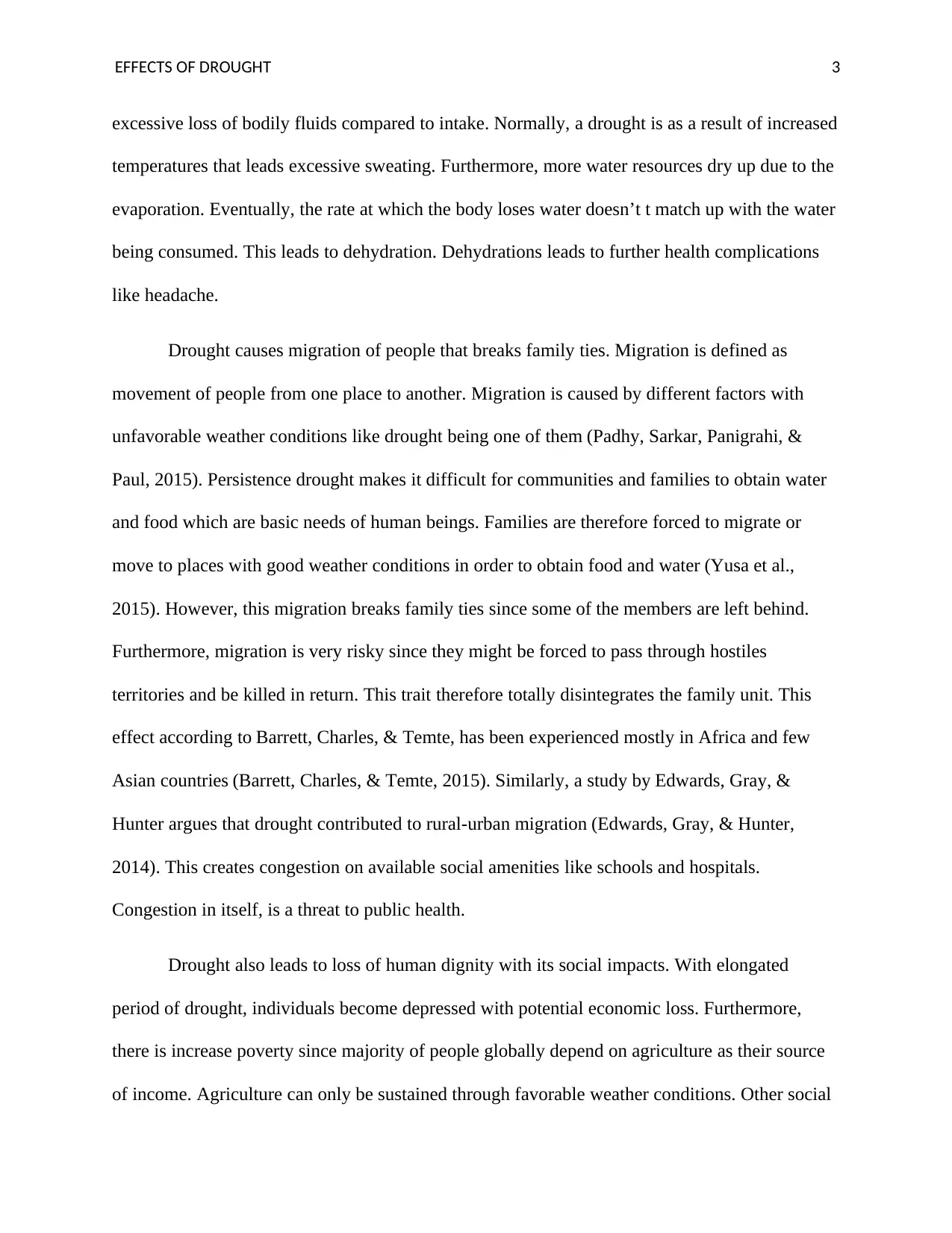
excessive loss of bodily fluids compared to intake. Normally, a drought is as a result of increased
temperatures that leads excessive sweating. Furthermore, more water resources dry up due to the
evaporation. Eventually, the rate at which the body loses water doesn’t t match up with the water
being consumed. This leads to dehydration. Dehydrations leads to further health complications
like headache.
Drought causes migration of people that breaks family ties. Migration is defined as
movement of people from one place to another. Migration is caused by different factors with
unfavorable weather conditions like drought being one of them (Padhy, Sarkar, Panigrahi, &
Paul, 2015). Persistence drought makes it difficult for communities and families to obtain water
and food which are basic needs of human beings. Families are therefore forced to migrate or
move to places with good weather conditions in order to obtain food and water (Yusa et al.,
2015). However, this migration breaks family ties since some of the members are left behind.
Furthermore, migration is very risky since they might be forced to pass through hostiles
territories and be killed in return. This trait therefore totally disintegrates the family unit. This
effect according to Barrett, Charles, & Temte, has been experienced mostly in Africa and few
Asian countries (Barrett, Charles, & Temte, 2015). Similarly, a study by Edwards, Gray, &
Hunter argues that drought contributed to rural-urban migration (Edwards, Gray, & Hunter,
2014). This creates congestion on available social amenities like schools and hospitals.
Congestion in itself, is a threat to public health.
Drought also leads to loss of human dignity with its social impacts. With elongated
period of drought, individuals become depressed with potential economic loss. Furthermore,
there is increase poverty since majority of people globally depend on agriculture as their source
of income. Agriculture can only be sustained through favorable weather conditions. Other social
excessive loss of bodily fluids compared to intake. Normally, a drought is as a result of increased
temperatures that leads excessive sweating. Furthermore, more water resources dry up due to the
evaporation. Eventually, the rate at which the body loses water doesn’t t match up with the water
being consumed. This leads to dehydration. Dehydrations leads to further health complications
like headache.
Drought causes migration of people that breaks family ties. Migration is defined as
movement of people from one place to another. Migration is caused by different factors with
unfavorable weather conditions like drought being one of them (Padhy, Sarkar, Panigrahi, &
Paul, 2015). Persistence drought makes it difficult for communities and families to obtain water
and food which are basic needs of human beings. Families are therefore forced to migrate or
move to places with good weather conditions in order to obtain food and water (Yusa et al.,
2015). However, this migration breaks family ties since some of the members are left behind.
Furthermore, migration is very risky since they might be forced to pass through hostiles
territories and be killed in return. This trait therefore totally disintegrates the family unit. This
effect according to Barrett, Charles, & Temte, has been experienced mostly in Africa and few
Asian countries (Barrett, Charles, & Temte, 2015). Similarly, a study by Edwards, Gray, &
Hunter argues that drought contributed to rural-urban migration (Edwards, Gray, & Hunter,
2014). This creates congestion on available social amenities like schools and hospitals.
Congestion in itself, is a threat to public health.
Drought also leads to loss of human dignity with its social impacts. With elongated
period of drought, individuals become depressed with potential economic loss. Furthermore,
there is increase poverty since majority of people globally depend on agriculture as their source
of income. Agriculture can only be sustained through favorable weather conditions. Other social
⊘ This is a preview!⊘
Do you want full access?
Subscribe today to unlock all pages.

Trusted by 1+ million students worldwide

EFFECTS OF DROUGHT 4
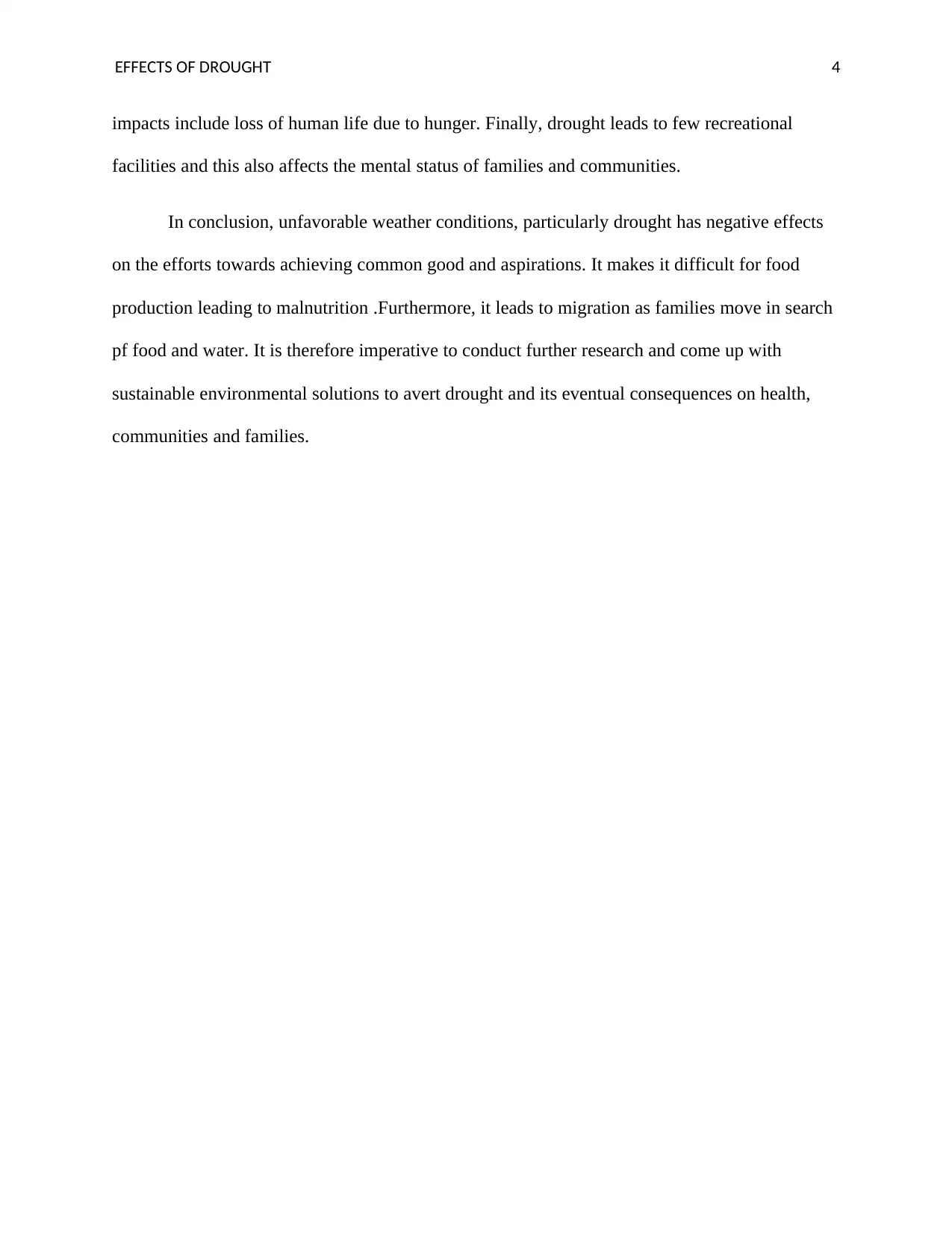
impacts include loss of human life due to hunger. Finally, drought leads to few recreational
facilities and this also affects the mental status of families and communities.
In conclusion, unfavorable weather conditions, particularly drought has negative effects
on the efforts towards achieving common good and aspirations. It makes it difficult for food
production leading to malnutrition .Furthermore, it leads to migration as families move in search
pf food and water. It is therefore imperative to conduct further research and come up with
sustainable environmental solutions to avert drought and its eventual consequences on health,
communities and families.
impacts include loss of human life due to hunger. Finally, drought leads to few recreational
facilities and this also affects the mental status of families and communities.
In conclusion, unfavorable weather conditions, particularly drought has negative effects
on the efforts towards achieving common good and aspirations. It makes it difficult for food
production leading to malnutrition .Furthermore, it leads to migration as families move in search
pf food and water. It is therefore imperative to conduct further research and come up with
sustainable environmental solutions to avert drought and its eventual consequences on health,
communities and families.
Paraphrase This Document
Need a fresh take? Get an instant paraphrase of this document with our AI Paraphraser

EFFECTS OF DROUGHT 5
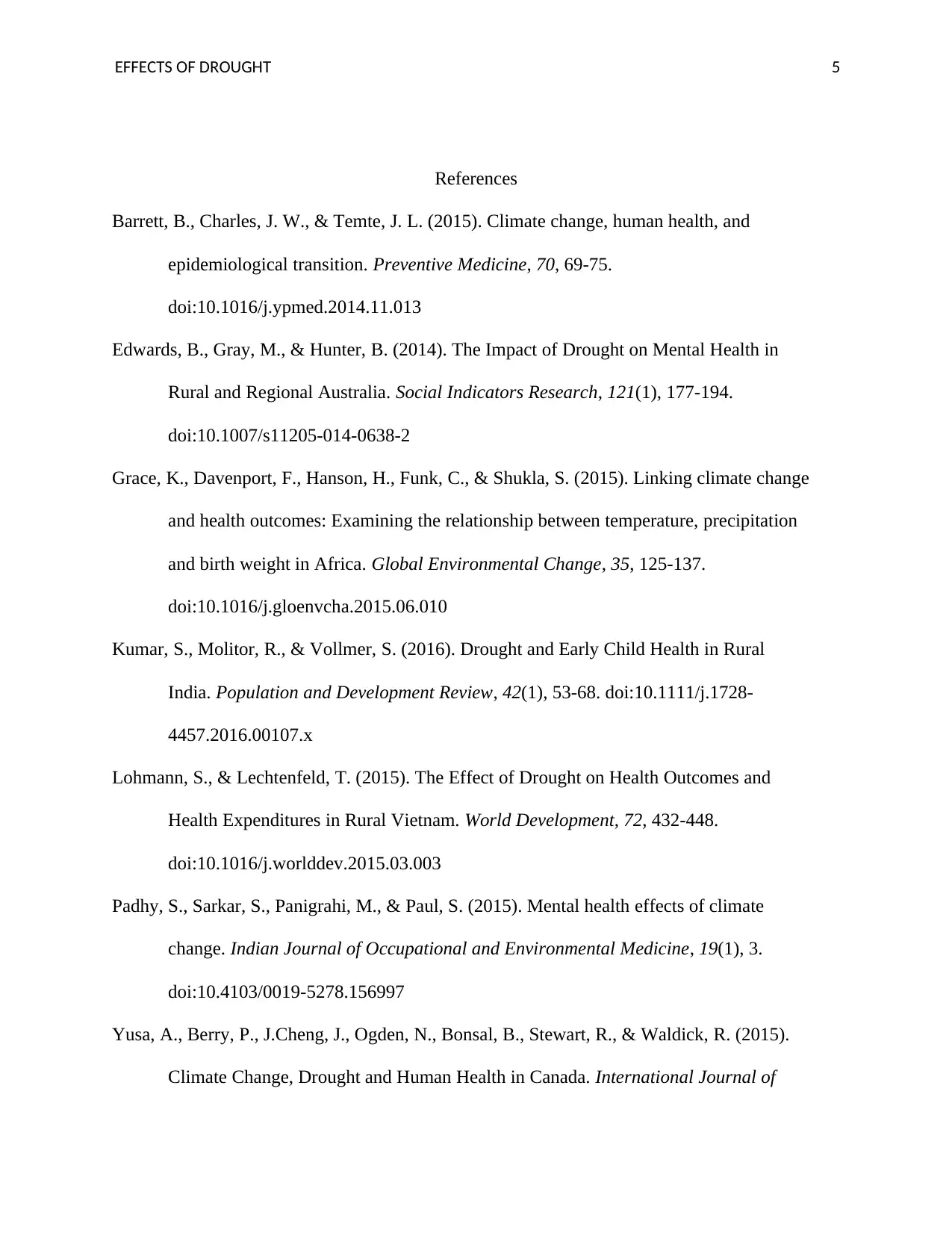
References
Barrett, B., Charles, J. W., & Temte, J. L. (2015). Climate change, human health, and
epidemiological transition. Preventive Medicine, 70, 69-75.
doi:10.1016/j.ypmed.2014.11.013
Edwards, B., Gray, M., & Hunter, B. (2014). The Impact of Drought on Mental Health in
Rural and Regional Australia. Social Indicators Research, 121(1), 177-194.
doi:10.1007/s11205-014-0638-2
Grace, K., Davenport, F., Hanson, H., Funk, C., & Shukla, S. (2015). Linking climate change
and health outcomes: Examining the relationship between temperature, precipitation
and birth weight in Africa. Global Environmental Change, 35, 125-137.
doi:10.1016/j.gloenvcha.2015.06.010
Kumar, S., Molitor, R., & Vollmer, S. (2016). Drought and Early Child Health in Rural
India. Population and Development Review, 42(1), 53-68. doi:10.1111/j.1728-
4457.2016.00107.x
Lohmann, S., & Lechtenfeld, T. (2015). The Effect of Drought on Health Outcomes and
Health Expenditures in Rural Vietnam. World Development, 72, 432-448.
doi:10.1016/j.worlddev.2015.03.003
Padhy, S., Sarkar, S., Panigrahi, M., & Paul, S. (2015). Mental health effects of climate
change. Indian Journal of Occupational and Environmental Medicine, 19(1), 3.
doi:10.4103/0019-5278.156997
Yusa, A., Berry, P., J.Cheng, J., Ogden, N., Bonsal, B., Stewart, R., & Waldick, R. (2015).
Climate Change, Drought and Human Health in Canada. International Journal of
References
Barrett, B., Charles, J. W., & Temte, J. L. (2015). Climate change, human health, and
epidemiological transition. Preventive Medicine, 70, 69-75.
doi:10.1016/j.ypmed.2014.11.013
Edwards, B., Gray, M., & Hunter, B. (2014). The Impact of Drought on Mental Health in
Rural and Regional Australia. Social Indicators Research, 121(1), 177-194.
doi:10.1007/s11205-014-0638-2
Grace, K., Davenport, F., Hanson, H., Funk, C., & Shukla, S. (2015). Linking climate change
and health outcomes: Examining the relationship between temperature, precipitation
and birth weight in Africa. Global Environmental Change, 35, 125-137.
doi:10.1016/j.gloenvcha.2015.06.010
Kumar, S., Molitor, R., & Vollmer, S. (2016). Drought and Early Child Health in Rural
India. Population and Development Review, 42(1), 53-68. doi:10.1111/j.1728-
4457.2016.00107.x
Lohmann, S., & Lechtenfeld, T. (2015). The Effect of Drought on Health Outcomes and
Health Expenditures in Rural Vietnam. World Development, 72, 432-448.
doi:10.1016/j.worlddev.2015.03.003
Padhy, S., Sarkar, S., Panigrahi, M., & Paul, S. (2015). Mental health effects of climate
change. Indian Journal of Occupational and Environmental Medicine, 19(1), 3.
doi:10.4103/0019-5278.156997
Yusa, A., Berry, P., J.Cheng, J., Ogden, N., Bonsal, B., Stewart, R., & Waldick, R. (2015).
Climate Change, Drought and Human Health in Canada. International Journal of

EFFECTS OF DROUGHT 6
Environmental Research and Public Health, 12(7), 8359-8412.
doi:10.3390/ijerph120708359
Environmental Research and Public Health, 12(7), 8359-8412.
doi:10.3390/ijerph120708359
⊘ This is a preview!⊘
Do you want full access?
Subscribe today to unlock all pages.

Trusted by 1+ million students worldwide
1 out of 6
Related Documents
Your All-in-One AI-Powered Toolkit for Academic Success.
+13062052269
info@desklib.com
Available 24*7 on WhatsApp / Email
Unlock your academic potential
Copyright © 2020–2026 A2Z Services. All Rights Reserved. Developed and managed by ZUCOL.