Resource Efficiency in Workplace: Regulations, Analysis, and Targets
VerifiedAdded on 2021/12/29
|8
|2274
|23
Report
AI Summary
This report provides a comprehensive analysis of resource efficiency within a workplace setting, focusing on environmental regulations, current resource usage, and opportunities for improvement. Part A identifies and analyzes relevant environmental regulations and initiatives, including those related to water usage, waste disposal, and atmospheric emissions, along with resources available to businesses for waste reduction and efficient resource utilization. Part B involves a practical assessment of the organization's resources and practices, including measurements of electricity and water consumption, waste management procedures, and purchasing strategies. The report sets efficiency targets based on the findings, and provides detailed data on water and electricity usage, waste generation, and purchasing practices. Additionally, the report outlines a waste audit, reviews packaging from suppliers, and proposes strategies to reduce waste and improve environmental performance. It also includes a case study on improving tourism, hospitality, and events for community well-being. The assignment concludes by providing actionable recommendations for improving resource efficiency and achieving sustainability goals.
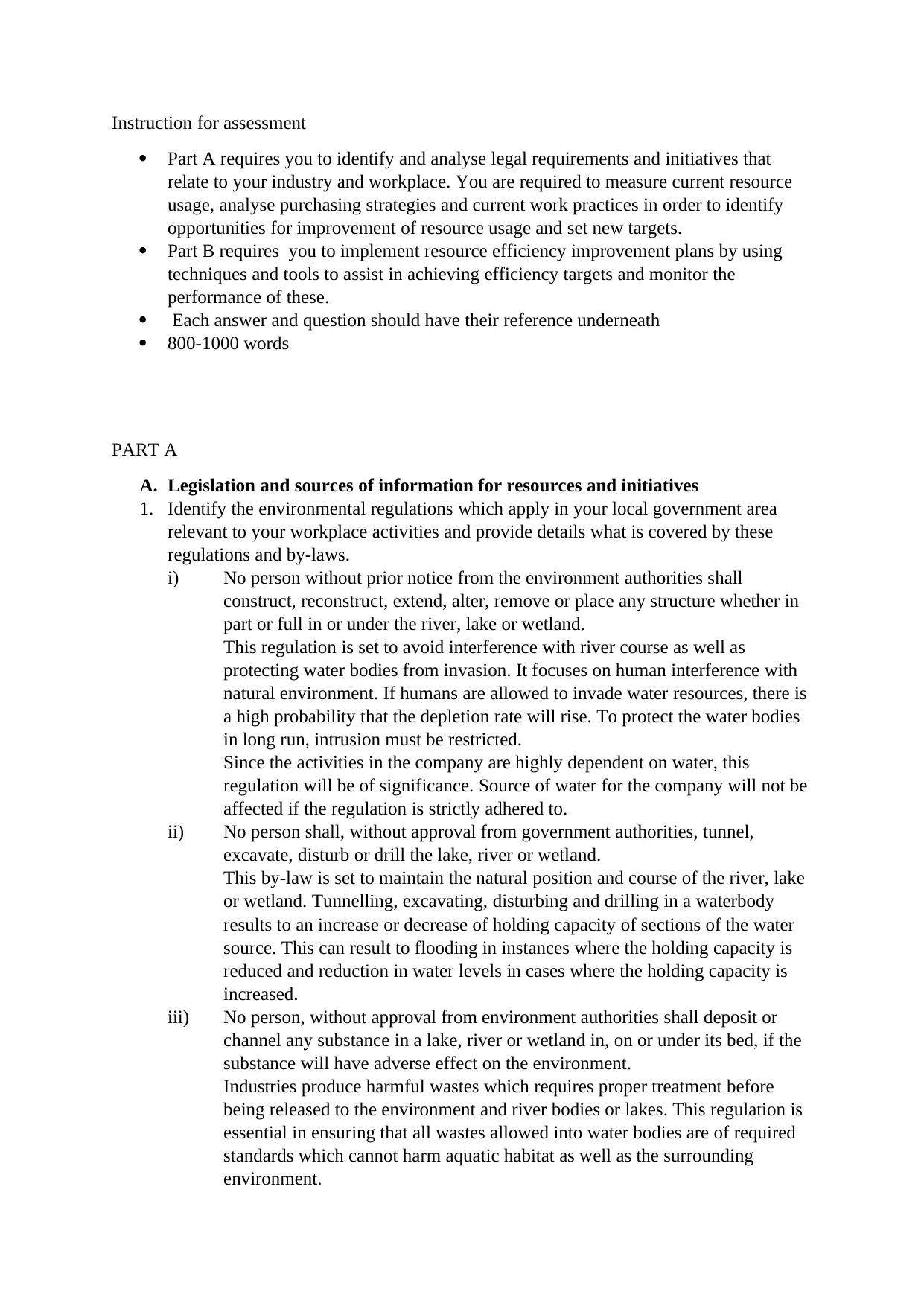
Instruction for assessment
Part A requires you to identify and analyse legal requirements and initiatives that
relate to your industry and workplace. You are required to measure current resource
usage, analyse purchasing strategies and current work practices in order to identify
opportunities for improvement of resource usage and set new targets.
Part B requires you to implement resource efficiency improvement plans by using
techniques and tools to assist in achieving efficiency targets and monitor the
performance of these.
Each answer and question should have their reference underneath
800-1000 words
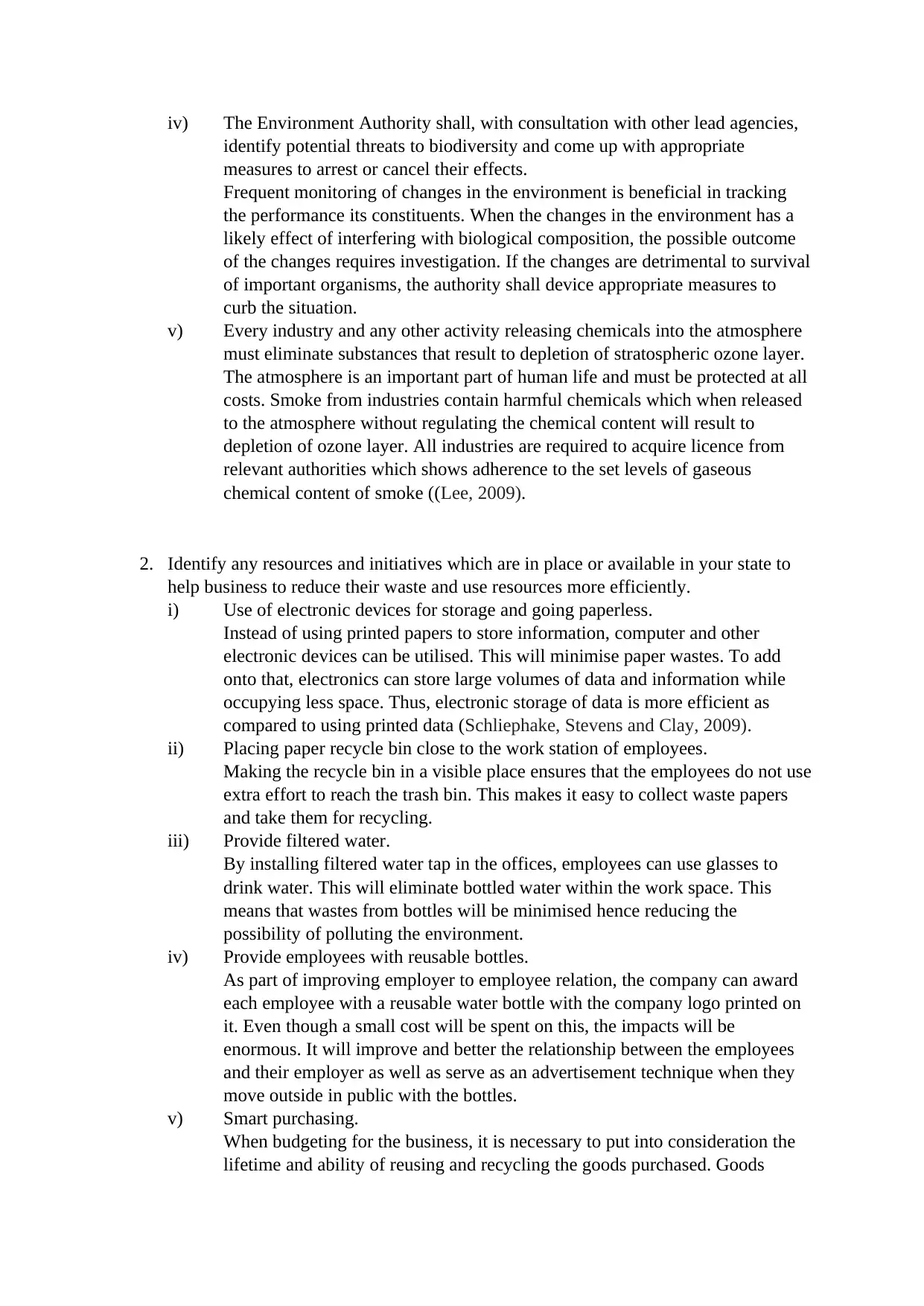
PART A
A. Legislation and sources of information for resources and initiatives
1. Identify the environmental regulations which apply in your local government area
relevant to your workplace activities and provide details what is covered by these
regulations and by-laws.
i) No person without prior notice from the environment authorities shall
construct, reconstruct, extend, alter, remove or place any structure whether in
part or full in or under the river, lake or wetland.
This regulation is set to avoid interference with river course as well as
protecting water bodies from invasion. It focuses on human interference with
natural environment. If humans are allowed to invade water resources, there is
a high probability that the depletion rate will rise. To protect the water bodies
in long run, intrusion must be restricted.
Since the activities in the company are highly dependent on water, this
regulation will be of significance. Source of water for the company will not be
affected if the regulation is strictly adhered to.
ii) No person shall, without approval from government authorities, tunnel,
excavate, disturb or drill the lake, river or wetland.
This by-law is set to maintain the natural position and course of the river, lake
or wetland. Tunnelling, excavating, disturbing and drilling in a waterbody
results to an increase or decrease of holding capacity of sections of the water
source. This can result to flooding in instances where the holding capacity is
reduced and reduction in water levels in cases where the holding capacity is
increased.
iii) No person, without approval from environment authorities shall deposit or
channel any substance in a lake, river or wetland in, on or under its bed, if the
substance will have adverse effect on the environment.
Industries produce harmful wastes which requires proper treatment before
being released to the environment and river bodies or lakes. This regulation is
essential in ensuring that all wastes allowed into water bodies are of required
standards which cannot harm aquatic habitat as well as the surrounding
environment.
Part A requires you to identify and analyse legal requirements and initiatives that
relate to your industry and workplace. You are required to measure current resource
usage, analyse purchasing strategies and current work practices in order to identify
opportunities for improvement of resource usage and set new targets.
Part B requires you to implement resource efficiency improvement plans by using
techniques and tools to assist in achieving efficiency targets and monitor the
performance of these.
Each answer and question should have their reference underneath
800-1000 words
PART A
A. Legislation and sources of information for resources and initiatives
1. Identify the environmental regulations which apply in your local government area
relevant to your workplace activities and provide details what is covered by these
regulations and by-laws.
i) No person without prior notice from the environment authorities shall
construct, reconstruct, extend, alter, remove or place any structure whether in
part or full in or under the river, lake or wetland.
This regulation is set to avoid interference with river course as well as
protecting water bodies from invasion. It focuses on human interference with
natural environment. If humans are allowed to invade water resources, there is
a high probability that the depletion rate will rise. To protect the water bodies
in long run, intrusion must be restricted.
Since the activities in the company are highly dependent on water, this
regulation will be of significance. Source of water for the company will not be
affected if the regulation is strictly adhered to.
ii) No person shall, without approval from government authorities, tunnel,
excavate, disturb or drill the lake, river or wetland.
This by-law is set to maintain the natural position and course of the river, lake
or wetland. Tunnelling, excavating, disturbing and drilling in a waterbody
results to an increase or decrease of holding capacity of sections of the water
source. This can result to flooding in instances where the holding capacity is
reduced and reduction in water levels in cases where the holding capacity is
increased.
iii) No person, without approval from environment authorities shall deposit or
channel any substance in a lake, river or wetland in, on or under its bed, if the
substance will have adverse effect on the environment.
Industries produce harmful wastes which requires proper treatment before
being released to the environment and river bodies or lakes. This regulation is
essential in ensuring that all wastes allowed into water bodies are of required
standards which cannot harm aquatic habitat as well as the surrounding
environment.

Paraphrase This Document
Need a fresh take? Get an instant paraphrase of this document with our AI Paraphraser
iv) The Environment Authority shall, with consultation with other lead agencies,
identify potential threats to biodiversity and come up with appropriate
measures to arrest or cancel their effects.
Frequent monitoring of changes in the environment is beneficial in tracking
the performance its constituents. When the changes in the environment has a
likely effect of interfering with biological composition, the possible outcome
of the changes requires investigation. If the changes are detrimental to survival
of important organisms, the authority shall device appropriate measures to
curb the situation.
v) Every industry and any other activity releasing chemicals into the atmosphere
must eliminate substances that result to depletion of stratospheric ozone layer.
The atmosphere is an important part of human life and must be protected at all
costs. Smoke from industries contain harmful chemicals which when released
to the atmosphere without regulating the chemical content will result to
depletion of ozone layer. All industries are required to acquire licence from
relevant authorities which shows adherence to the set levels of gaseous
chemical content of smoke ((Lee, 2009).
2. Identify any resources and initiatives which are in place or available in your state to
help business to reduce their waste and use resources more efficiently.
i) Use of electronic devices for storage and going paperless.
Instead of using printed papers to store information, computer and other
electronic devices can be utilised. This will minimise paper wastes. To add
onto that, electronics can store large volumes of data and information while
occupying less space. Thus, electronic storage of data is more efficient as
compared to using printed data (Schliephake, Stevens and Clay, 2009).
ii) Placing paper recycle bin close to the work station of employees.
Making the recycle bin in a visible place ensures that the employees do not use
extra effort to reach the trash bin. This makes it easy to collect waste papers
and take them for recycling.
iii) Provide filtered water.
By installing filtered water tap in the offices, employees can use glasses to
drink water. This will eliminate bottled water within the work space. This
means that wastes from bottles will be minimised hence reducing the
possibility of polluting the environment.
iv) Provide employees with reusable bottles.
As part of improving employer to employee relation, the company can award
each employee with a reusable water bottle with the company logo printed on
it. Even though a small cost will be spent on this, the impacts will be
enormous. It will improve and better the relationship between the employees
and their employer as well as serve as an advertisement technique when they
move outside in public with the bottles.
v) Smart purchasing.
When budgeting for the business, it is necessary to put into consideration the
lifetime and ability of reusing and recycling the goods purchased. Goods
identify potential threats to biodiversity and come up with appropriate
measures to arrest or cancel their effects.
Frequent monitoring of changes in the environment is beneficial in tracking
the performance its constituents. When the changes in the environment has a
likely effect of interfering with biological composition, the possible outcome
of the changes requires investigation. If the changes are detrimental to survival
of important organisms, the authority shall device appropriate measures to
curb the situation.
v) Every industry and any other activity releasing chemicals into the atmosphere
must eliminate substances that result to depletion of stratospheric ozone layer.
The atmosphere is an important part of human life and must be protected at all
costs. Smoke from industries contain harmful chemicals which when released
to the atmosphere without regulating the chemical content will result to
depletion of ozone layer. All industries are required to acquire licence from
relevant authorities which shows adherence to the set levels of gaseous
chemical content of smoke ((Lee, 2009).
2. Identify any resources and initiatives which are in place or available in your state to
help business to reduce their waste and use resources more efficiently.
i) Use of electronic devices for storage and going paperless.
Instead of using printed papers to store information, computer and other
electronic devices can be utilised. This will minimise paper wastes. To add
onto that, electronics can store large volumes of data and information while
occupying less space. Thus, electronic storage of data is more efficient as
compared to using printed data (Schliephake, Stevens and Clay, 2009).
ii) Placing paper recycle bin close to the work station of employees.
Making the recycle bin in a visible place ensures that the employees do not use
extra effort to reach the trash bin. This makes it easy to collect waste papers
and take them for recycling.
iii) Provide filtered water.
By installing filtered water tap in the offices, employees can use glasses to
drink water. This will eliminate bottled water within the work space. This
means that wastes from bottles will be minimised hence reducing the
possibility of polluting the environment.
iv) Provide employees with reusable bottles.
As part of improving employer to employee relation, the company can award
each employee with a reusable water bottle with the company logo printed on
it. Even though a small cost will be spent on this, the impacts will be
enormous. It will improve and better the relationship between the employees
and their employer as well as serve as an advertisement technique when they
move outside in public with the bottles.
v) Smart purchasing.
When budgeting for the business, it is necessary to put into consideration the
lifetime and ability of reusing and recycling the goods purchased. Goods
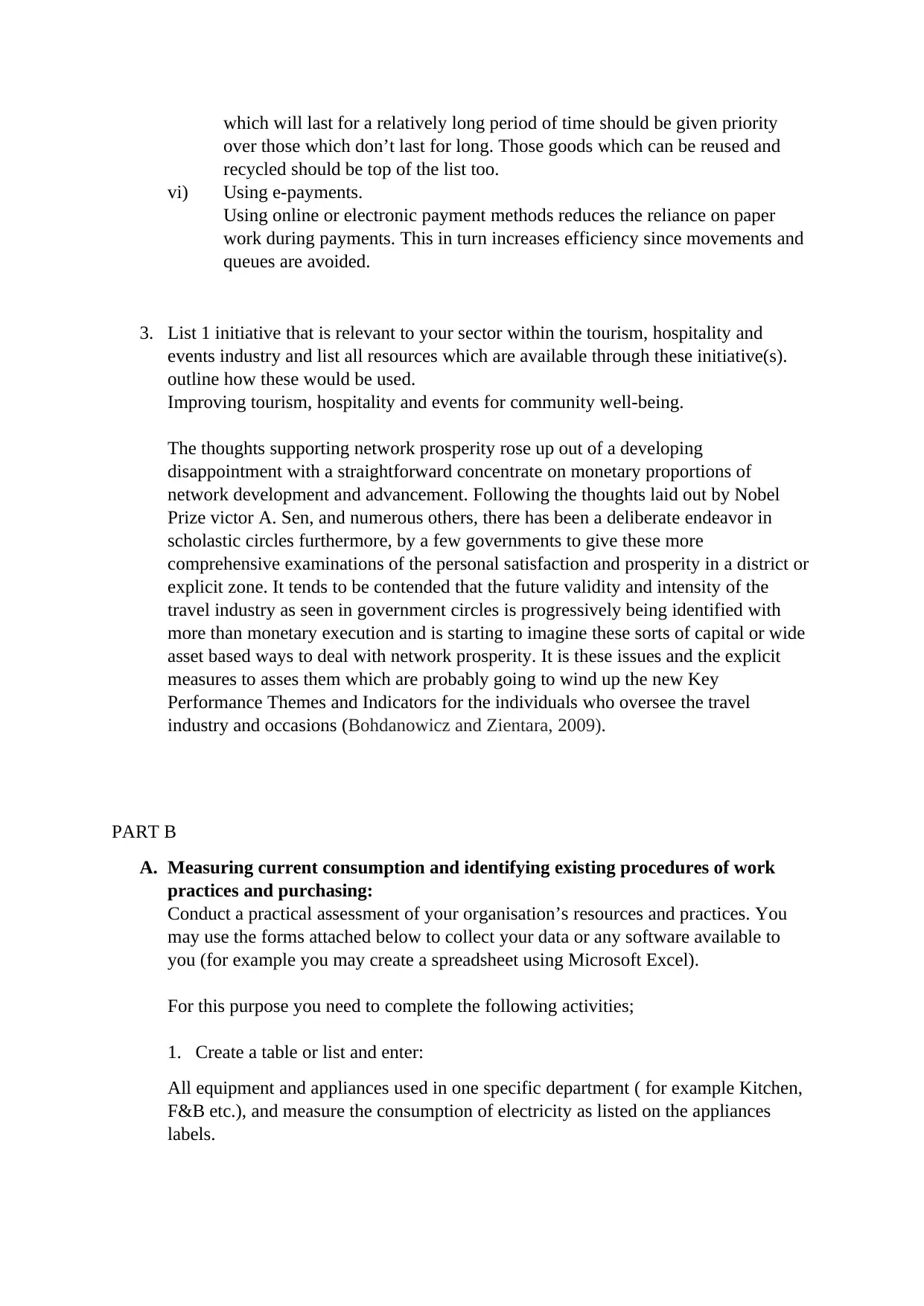
which will last for a relatively long period of time should be given priority
over those which don’t last for long. Those goods which can be reused and
recycled should be top of the list too.
vi) Using e-payments.
Using online or electronic payment methods reduces the reliance on paper
work during payments. This in turn increases efficiency since movements and
queues are avoided.
3. List 1 initiative that is relevant to your sector within the tourism, hospitality and
events industry and list all resources which are available through these initiative(s).
outline how these would be used.
Improving tourism, hospitality and events for community well-being.
The thoughts supporting network prosperity rose up out of a developing
disappointment with a straightforward concentrate on monetary proportions of
network development and advancement. Following the thoughts laid out by Nobel
Prize victor A. Sen, and numerous others, there has been a deliberate endeavor in
scholastic circles furthermore, by a few governments to give these more
comprehensive examinations of the personal satisfaction and prosperity in a district or
explicit zone. It tends to be contended that the future validity and intensity of the
travel industry as seen in government circles is progressively being identified with
more than monetary execution and is starting to imagine these sorts of capital or wide
asset based ways to deal with network prosperity. It is these issues and the explicit
measures to asses them which are probably going to wind up the new Key
Performance Themes and Indicators for the individuals who oversee the travel
industry and occasions (Bohdanowicz and Zientara, 2009).
PART B
A. Measuring current consumption and identifying existing procedures of work
practices and purchasing:
Conduct a practical assessment of your organisation’s resources and practices. You
may use the forms attached below to collect your data or any software available to
you (for example you may create a spreadsheet using Microsoft Excel).
For this purpose you need to complete the following activities;
1. Create a table or list and enter:
All equipment and appliances used in one specific department ( for example Kitchen,
F&B etc.), and measure the consumption of electricity as listed on the appliances
labels.
over those which don’t last for long. Those goods which can be reused and
recycled should be top of the list too.
vi) Using e-payments.
Using online or electronic payment methods reduces the reliance on paper
work during payments. This in turn increases efficiency since movements and
queues are avoided.
3. List 1 initiative that is relevant to your sector within the tourism, hospitality and
events industry and list all resources which are available through these initiative(s).
outline how these would be used.
Improving tourism, hospitality and events for community well-being.
The thoughts supporting network prosperity rose up out of a developing
disappointment with a straightforward concentrate on monetary proportions of
network development and advancement. Following the thoughts laid out by Nobel
Prize victor A. Sen, and numerous others, there has been a deliberate endeavor in
scholastic circles furthermore, by a few governments to give these more
comprehensive examinations of the personal satisfaction and prosperity in a district or
explicit zone. It tends to be contended that the future validity and intensity of the
travel industry as seen in government circles is progressively being identified with
more than monetary execution and is starting to imagine these sorts of capital or wide
asset based ways to deal with network prosperity. It is these issues and the explicit
measures to asses them which are probably going to wind up the new Key
Performance Themes and Indicators for the individuals who oversee the travel
industry and occasions (Bohdanowicz and Zientara, 2009).
PART B
A. Measuring current consumption and identifying existing procedures of work
practices and purchasing:
Conduct a practical assessment of your organisation’s resources and practices. You
may use the forms attached below to collect your data or any software available to
you (for example you may create a spreadsheet using Microsoft Excel).
For this purpose you need to complete the following activities;
1. Create a table or list and enter:
All equipment and appliances used in one specific department ( for example Kitchen,
F&B etc.), and measure the consumption of electricity as listed on the appliances
labels.
⊘ This is a preview!⊘
Do you want full access?
Subscribe today to unlock all pages.

Trusted by 1+ million students worldwide
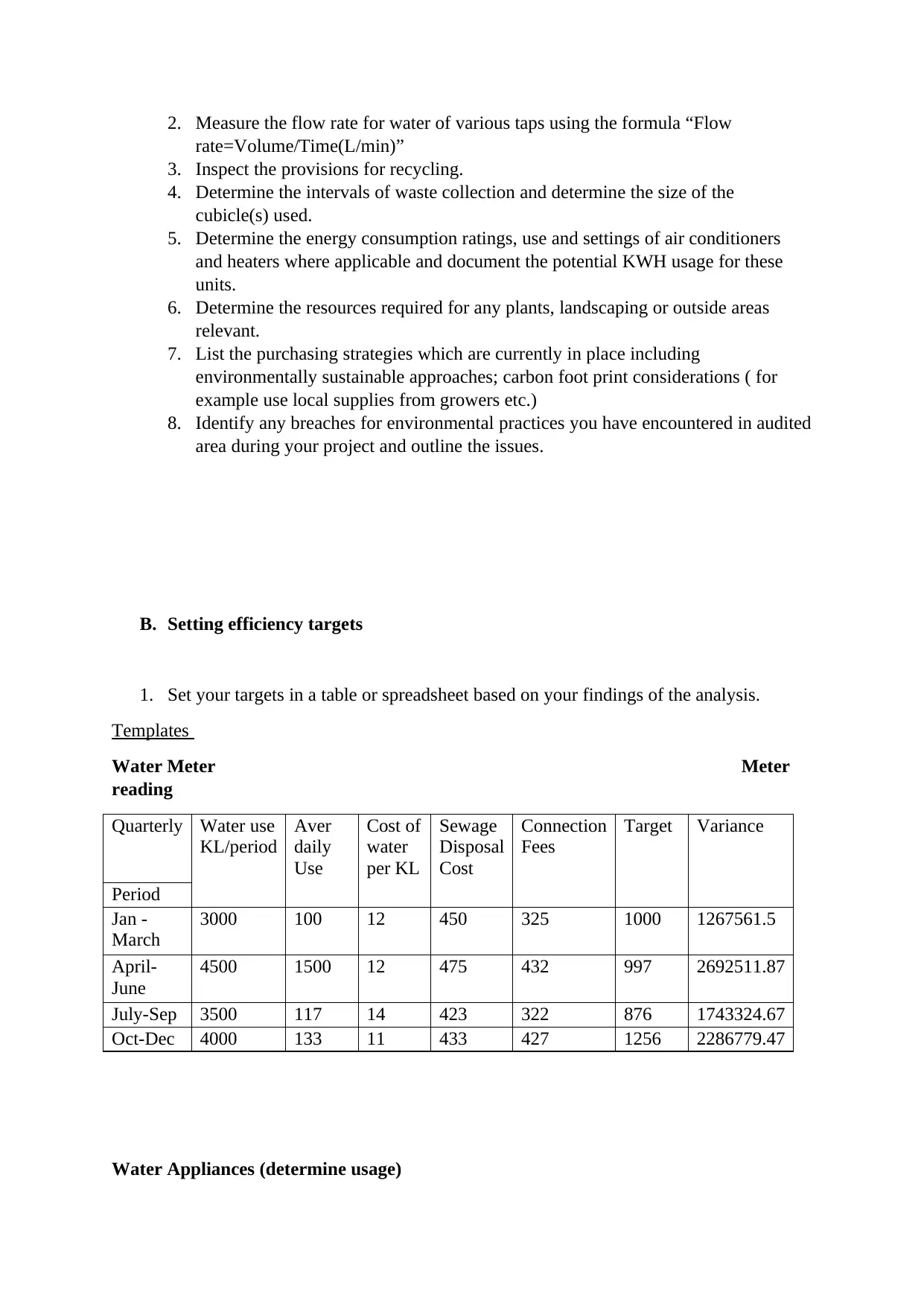
2. Measure the flow rate for water of various taps using the formula “Flow
rate=Volume/Time(L/min)”
3. Inspect the provisions for recycling.
4. Determine the intervals of waste collection and determine the size of the
cubicle(s) used.
5. Determine the energy consumption ratings, use and settings of air conditioners
and heaters where applicable and document the potential KWH usage for these
units.
6. Determine the resources required for any plants, landscaping or outside areas
relevant.
7. List the purchasing strategies which are currently in place including
environmentally sustainable approaches; carbon foot print considerations ( for
example use local supplies from growers etc.)
8. Identify any breaches for environmental practices you have encountered in audited
area during your project and outline the issues.
B. Setting efficiency targets
1. Set your targets in a table or spreadsheet based on your findings of the analysis.
Templates
Water Meter Meter
reading
Quarterly Water use
KL/period
Aver
daily
Use
Cost of
water
per KL
Sewage
Disposal
Cost
Connection
Fees
Target Variance
Period
Jan -
March
3000 100 12 450 325 1000 1267561.5
April-
June
4500 1500 12 475 432 997 2692511.87
July-Sep 3500 117 14 423 322 876 1743324.67
Oct-Dec 4000 133 11 433 427 1256 2286779.47
Water Appliances (determine usage)
rate=Volume/Time(L/min)”
3. Inspect the provisions for recycling.
4. Determine the intervals of waste collection and determine the size of the
cubicle(s) used.
5. Determine the energy consumption ratings, use and settings of air conditioners
and heaters where applicable and document the potential KWH usage for these
units.
6. Determine the resources required for any plants, landscaping or outside areas
relevant.
7. List the purchasing strategies which are currently in place including
environmentally sustainable approaches; carbon foot print considerations ( for
example use local supplies from growers etc.)
8. Identify any breaches for environmental practices you have encountered in audited
area during your project and outline the issues.
B. Setting efficiency targets
1. Set your targets in a table or spreadsheet based on your findings of the analysis.
Templates
Water Meter Meter
reading
Quarterly Water use
KL/period
Aver
daily
Use
Cost of
water
per KL
Sewage
Disposal
Cost
Connection
Fees
Target Variance
Period
Jan -
March
3000 100 12 450 325 1000 1267561.5
April-
June
4500 1500 12 475 432 997 2692511.87
July-Sep 3500 117 14 423 322 876 1743324.67
Oct-Dec 4000 133 11 433 427 1256 2286779.47
Water Appliances (determine usage)
Paraphrase This Document
Need a fresh take? Get an instant paraphrase of this document with our AI Paraphraser
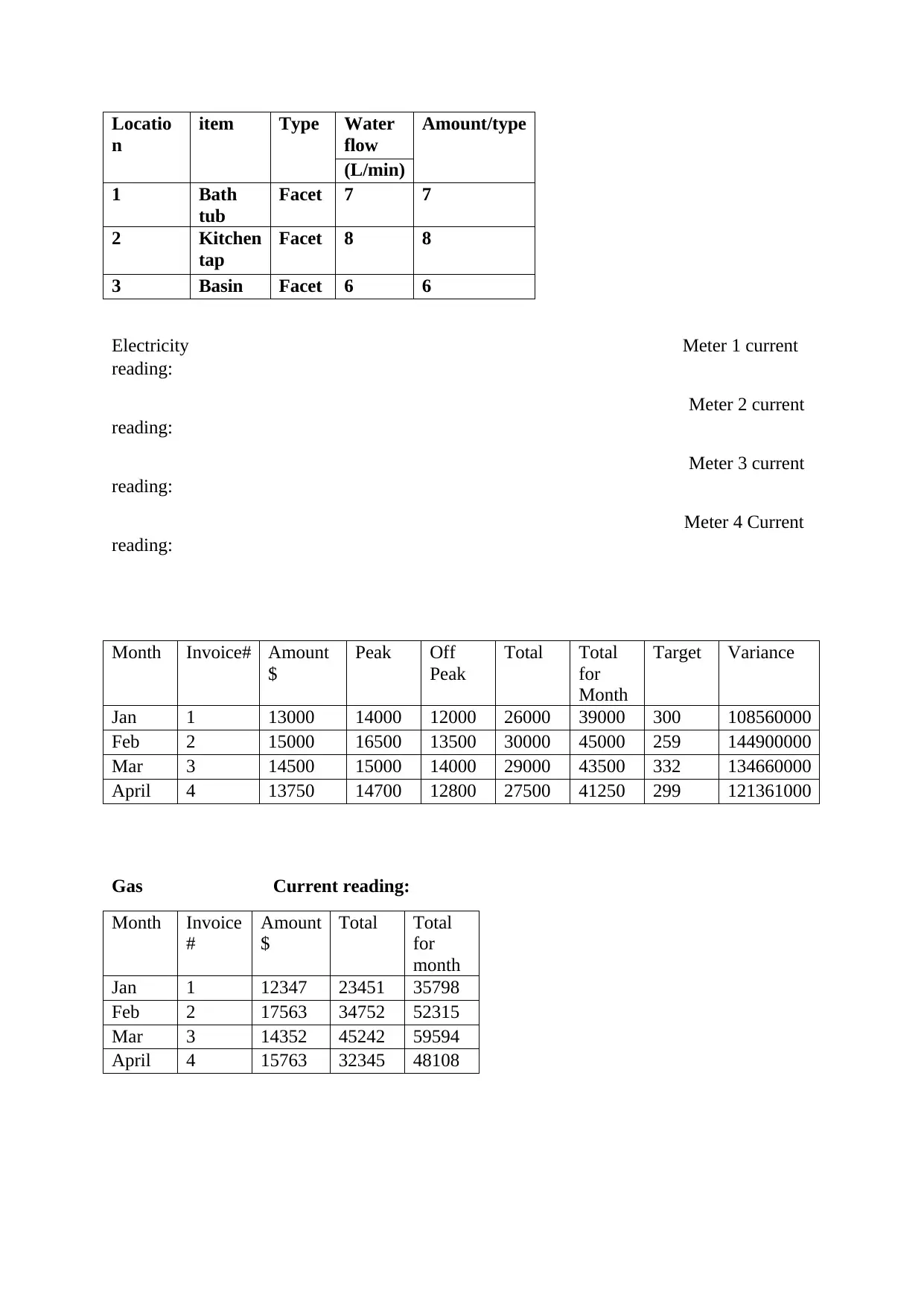
Locatio
n
item Type Water
flow
Amount/type
(L/min)
1 Bath
tub
Facet 7 7
2 Kitchen
tap
Facet 8 8
3 Basin Facet 6 6
Electricity Meter 1 current
reading:
Meter 2 current
reading:
Meter 3 current
reading:
Meter 4 Current
reading:
Month Invoice# Amount
$
Peak Off
Peak
Total Total
for
Month
Target Variance
Jan 1 13000 14000 12000 26000 39000 300 108560000
Feb 2 15000 16500 13500 30000 45000 259 144900000
Mar 3 14500 15000 14000 29000 43500 332 134660000
April 4 13750 14700 12800 27500 41250 299 121361000
Gas Current reading:
Month Invoice
#
Amount
$
Total Total
for
month
Jan 1 12347 23451 35798
Feb 2 17563 34752 52315
Mar 3 14352 45242 59594
April 4 15763 32345 48108
n
item Type Water
flow
Amount/type
(L/min)
1 Bath
tub
Facet 7 7
2 Kitchen
tap
Facet 8 8
3 Basin Facet 6 6
Electricity Meter 1 current
reading:
Meter 2 current
reading:
Meter 3 current
reading:
Meter 4 Current
reading:
Month Invoice# Amount
$
Peak Off
Peak
Total Total
for
Month
Target Variance
Jan 1 13000 14000 12000 26000 39000 300 108560000
Feb 2 15000 16500 13500 30000 45000 259 144900000
Mar 3 14500 15000 14000 29000 43500 332 134660000
April 4 13750 14700 12800 27500 41250 299 121361000
Gas Current reading:
Month Invoice
#
Amount
$
Total Total
for
month
Jan 1 12347 23451 35798
Feb 2 17563 34752 52315
Mar 3 14352 45242 59594
April 4 15763 32345 48108
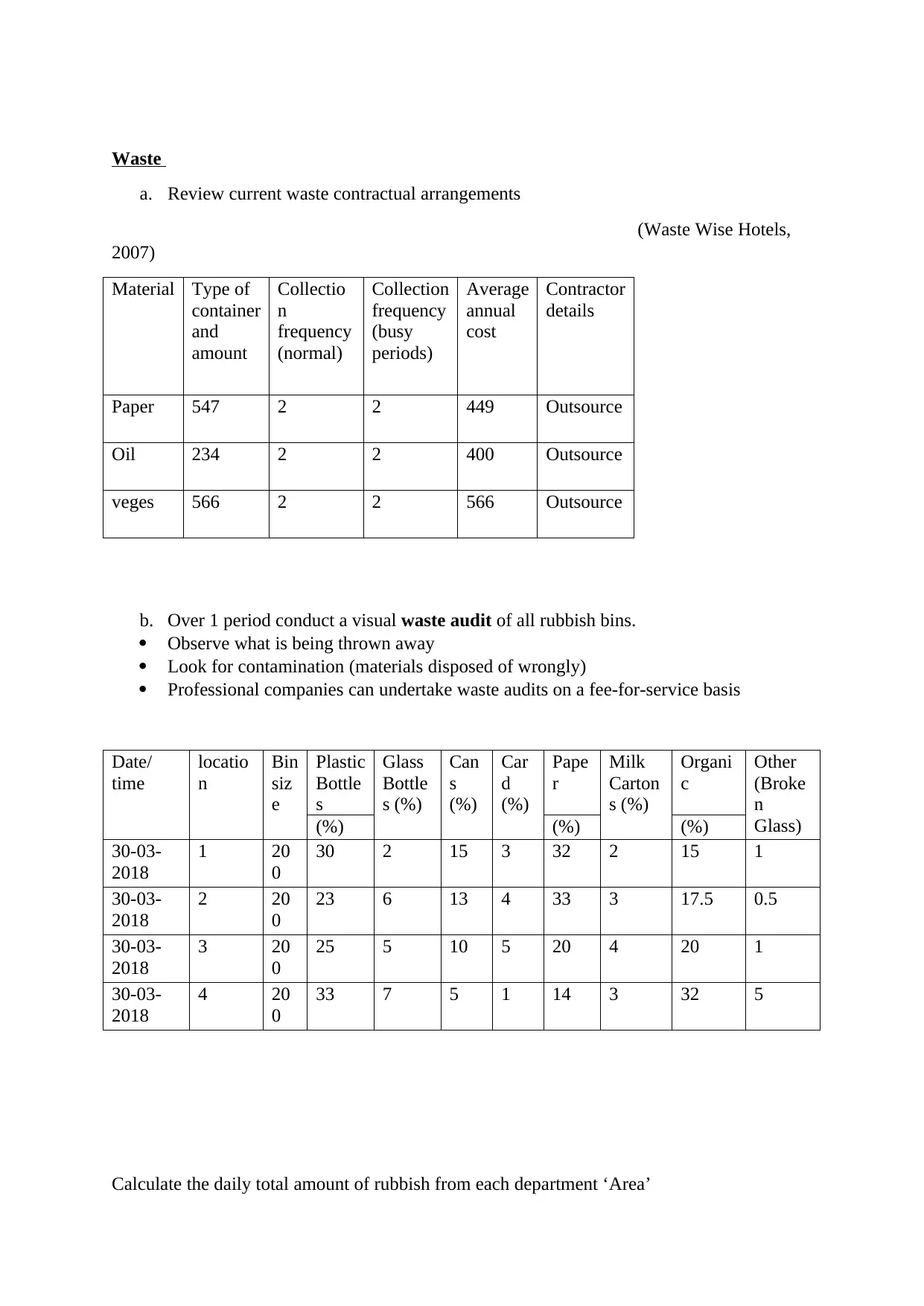
Waste
a. Review current waste contractual arrangements
(Waste Wise Hotels,
2007)
Material Type of
container
and
amount
Collectio
n
frequency
(normal)
Collection
frequency
(busy
periods)
Average
annual
cost
Contractor
details
Paper 547 2 2 449 Outsource
Oil 234 2 2 400 Outsource
veges 566 2 2 566 Outsource
b. Over 1 period conduct a visual waste audit of all rubbish bins.
Observe what is being thrown away
Look for contamination (materials disposed of wrongly)
Professional companies can undertake waste audits on a fee-for-service basis
Date/
time
locatio
n
Bin
siz
e
Plastic
Bottle
s
Glass
Bottle
s (%)
Can
s
(%)
Car
d
(%)
Pape
r
Milk
Carton
s (%)
Organi
c
Other
(Broke
n
Glass)(%) (%) (%)
30-03-
2018
1 20
0
30 2 15 3 32 2 15 1
30-03-
2018
2 20
0
23 6 13 4 33 3 17.5 0.5
30-03-
2018
3 20
0
25 5 10 5 20 4 20 1
30-03-
2018
4 20
0
33 7 5 1 14 3 32 5
Calculate the daily total amount of rubbish from each department ‘Area’
a. Review current waste contractual arrangements
(Waste Wise Hotels,
2007)
Material Type of
container
and
amount
Collectio
n
frequency
(normal)
Collection
frequency
(busy
periods)
Average
annual
cost
Contractor
details
Paper 547 2 2 449 Outsource
Oil 234 2 2 400 Outsource
veges 566 2 2 566 Outsource
b. Over 1 period conduct a visual waste audit of all rubbish bins.
Observe what is being thrown away
Look for contamination (materials disposed of wrongly)
Professional companies can undertake waste audits on a fee-for-service basis
Date/
time
locatio
n
Bin
siz
e
Plastic
Bottle
s
Glass
Bottle
s (%)
Can
s
(%)
Car
d
(%)
Pape
r
Milk
Carton
s (%)
Organi
c
Other
(Broke
n
Glass)(%) (%) (%)
30-03-
2018
1 20
0
30 2 15 3 32 2 15 1
30-03-
2018
2 20
0
23 6 13 4 33 3 17.5 0.5
30-03-
2018
3 20
0
25 5 10 5 20 4 20 1
30-03-
2018
4 20
0
33 7 5 1 14 3 32 5
Calculate the daily total amount of rubbish from each department ‘Area’
⊘ This is a preview!⊘
Do you want full access?
Subscribe today to unlock all pages.
Trusted by 1+ million students worldwide
Bin
size
Plastic
bottles(%)
Glass
bottles
(%)
Cans
(%)
Card
(%)
Paper
(%)
Milk
Cartons
(%)
Organic
(%)
Other
(%) –
broken
glass
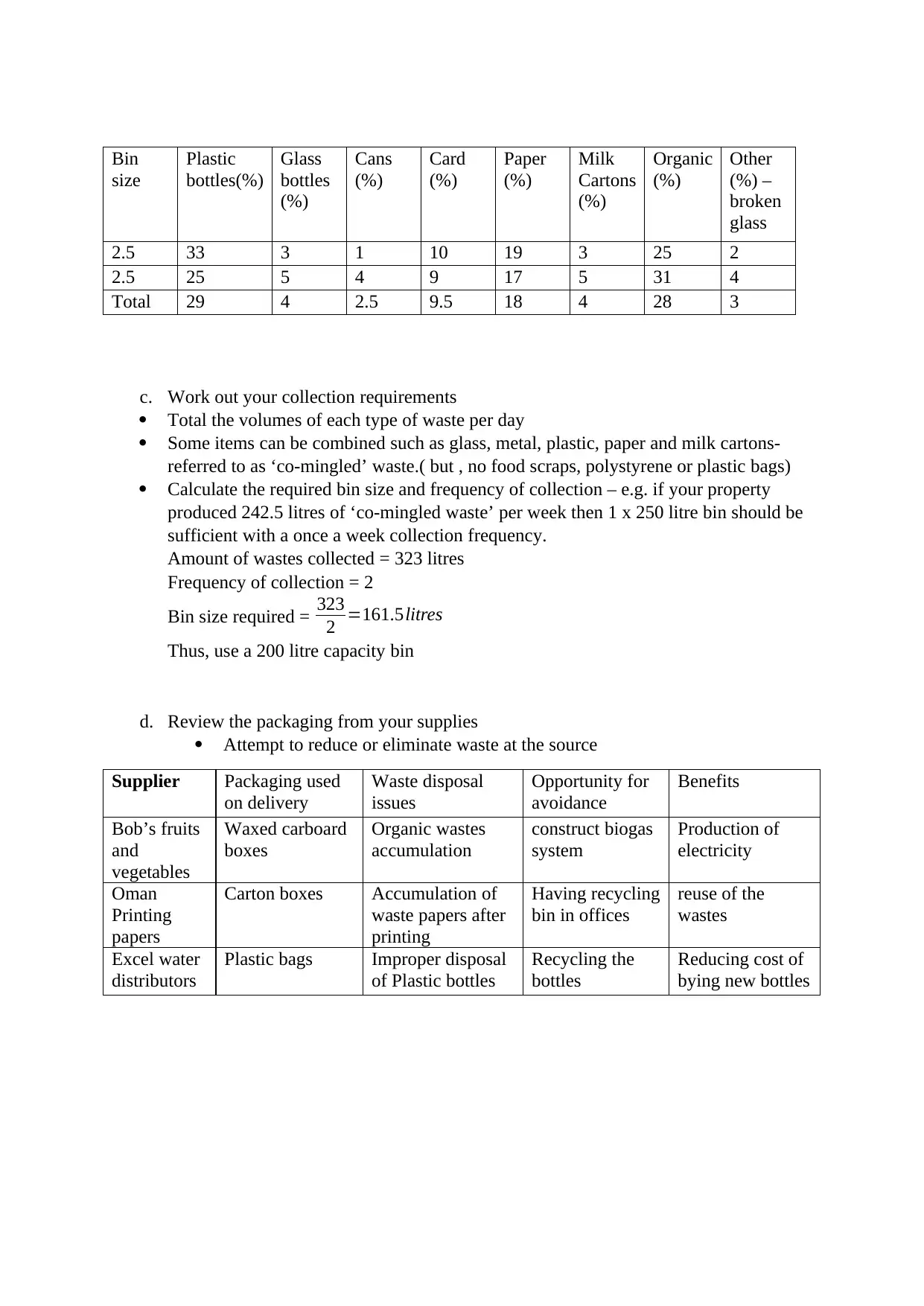
2.5 33 3 1 10 19 3 25 2
2.5 25 5 4 9 17 5 31 4
Total 29 4 2.5 9.5 18 4 28 3
c. Work out your collection requirements
Total the volumes of each type of waste per day
Some items can be combined such as glass, metal, plastic, paper and milk cartons-
referred to as ‘co-mingled’ waste.( but , no food scraps, polystyrene or plastic bags)
Calculate the required bin size and frequency of collection – e.g. if your property
produced 242.5 litres of ‘co-mingled waste’ per week then 1 x 250 litre bin should be
sufficient with a once a week collection frequency.
Amount of wastes collected = 323 litres
Frequency of collection = 2
Bin size required = 323
2 =161.5litres
Thus, use a 200 litre capacity bin
d. Review the packaging from your supplies
Attempt to reduce or eliminate waste at the source
Supplier Packaging used
on delivery
Waste disposal
issues
Opportunity for
avoidance
Benefits
Bob’s fruits
and
vegetables
Waxed carboard
boxes
Organic wastes
accumulation
construct biogas
system
Production of
electricity
Oman
Printing
papers
Carton boxes Accumulation of
waste papers after
printing
Having recycling
bin in offices
reuse of the
wastes
Excel water
distributors
Plastic bags Improper disposal
of Plastic bottles
Recycling the
bottles
Reducing cost of
bying new bottles
size
Plastic
bottles(%)
Glass
bottles
(%)
Cans
(%)
Card
(%)
Paper
(%)
Milk
Cartons
(%)
Organic
(%)
Other
(%) –
broken
glass
2.5 33 3 1 10 19 3 25 2
2.5 25 5 4 9 17 5 31 4
Total 29 4 2.5 9.5 18 4 28 3
c. Work out your collection requirements
Total the volumes of each type of waste per day
Some items can be combined such as glass, metal, plastic, paper and milk cartons-
referred to as ‘co-mingled’ waste.( but , no food scraps, polystyrene or plastic bags)
Calculate the required bin size and frequency of collection – e.g. if your property
produced 242.5 litres of ‘co-mingled waste’ per week then 1 x 250 litre bin should be
sufficient with a once a week collection frequency.
Amount of wastes collected = 323 litres
Frequency of collection = 2
Bin size required = 323
2 =161.5litres
Thus, use a 200 litre capacity bin
d. Review the packaging from your supplies
Attempt to reduce or eliminate waste at the source
Supplier Packaging used
on delivery
Waste disposal
issues
Opportunity for
avoidance
Benefits
Bob’s fruits
and
vegetables
Waxed carboard
boxes
Organic wastes
accumulation
construct biogas
system
Production of
electricity
Oman
Printing
papers
Carton boxes Accumulation of
waste papers after
printing
Having recycling
bin in offices
reuse of the
wastes
Excel water
distributors
Plastic bags Improper disposal
of Plastic bottles
Recycling the
bottles
Reducing cost of
bying new bottles
Paraphrase This Document
Need a fresh take? Get an instant paraphrase of this document with our AI Paraphraser
References
Bohdanowicz, P. and Zientara, P., 2009. Hotel companies' contribution to improving the
quality of life of local communities and the well-being of their employees. Tourism and
Hospitality Research, 9(2), pp.147-158.
Lee, K.H., 2009. Why and how to adopt green management into business organizations? The
case study of Korean SMEs in manufacturing industry. Management Decision, 47(7),
pp.1101-1121.
Schliephake, K., Stevens, G. and Clay, S., 2009. Making resources work more efficiently–the
importance of supply chain partnerships. Journal of Cleaner Production, 17(14), pp.1257-
1263.
Bohdanowicz, P. and Zientara, P., 2009. Hotel companies' contribution to improving the
quality of life of local communities and the well-being of their employees. Tourism and
Hospitality Research, 9(2), pp.147-158.
Lee, K.H., 2009. Why and how to adopt green management into business organizations? The
case study of Korean SMEs in manufacturing industry. Management Decision, 47(7),
pp.1101-1121.
Schliephake, K., Stevens, G. and Clay, S., 2009. Making resources work more efficiently–the
importance of supply chain partnerships. Journal of Cleaner Production, 17(14), pp.1257-
1263.

1 out of 8


Your All-in-One AI-Powered Toolkit for Academic Success.
+13062052269
info@desklib.com
Available 24*7 on WhatsApp / Email
![[object Object]](/_next/static/media/star-bottom.7253800d.svg)
Unlock your academic potential
Copyright © 2020–2026 A2Z Services. All Rights Reserved. Developed and managed by ZUCOL.