Analysing the Impact of Environmental Forces: A Business Report
VerifiedAdded on 2022/12/29
|9
|2794
|32
Report
AI Summary
This report provides a comprehensive analysis of the environmental forces that impact organizations, with a specific focus on the London School of Economics (LSE) as a case study. It explores both external factors, analyzed through the PESTLE framework (Political, Economic, Social, Technological, Legal, and Environmental), and internal factors, examined using the VRIO framework (Value, Rareness, Imitability, and Organization). The report discusses the significance of these forces at various levels, including the organization, market, and industry, highlighting how they affect planning, strategy implementation, and decision-making. The analysis covers the impact of globalization, technological advancements, and changing social dynamics on the educational sector, emphasizing the need for continuous adaptation and innovation within organizations to thrive in a competitive environment. The report concludes by demonstrating how LSE has successfully navigated these forces, mitigating negative impacts and capitalizing on opportunities for growth and development. The report also emphasizes on the importance of understanding the interplay between internal resources and external factors for organizational success.
Analysing the Impact
of Environmental
Forces
of Environmental
Forces

Paraphrase This Document
Need a fresh take? Get an instant paraphrase of this document with our AI Paraphraser
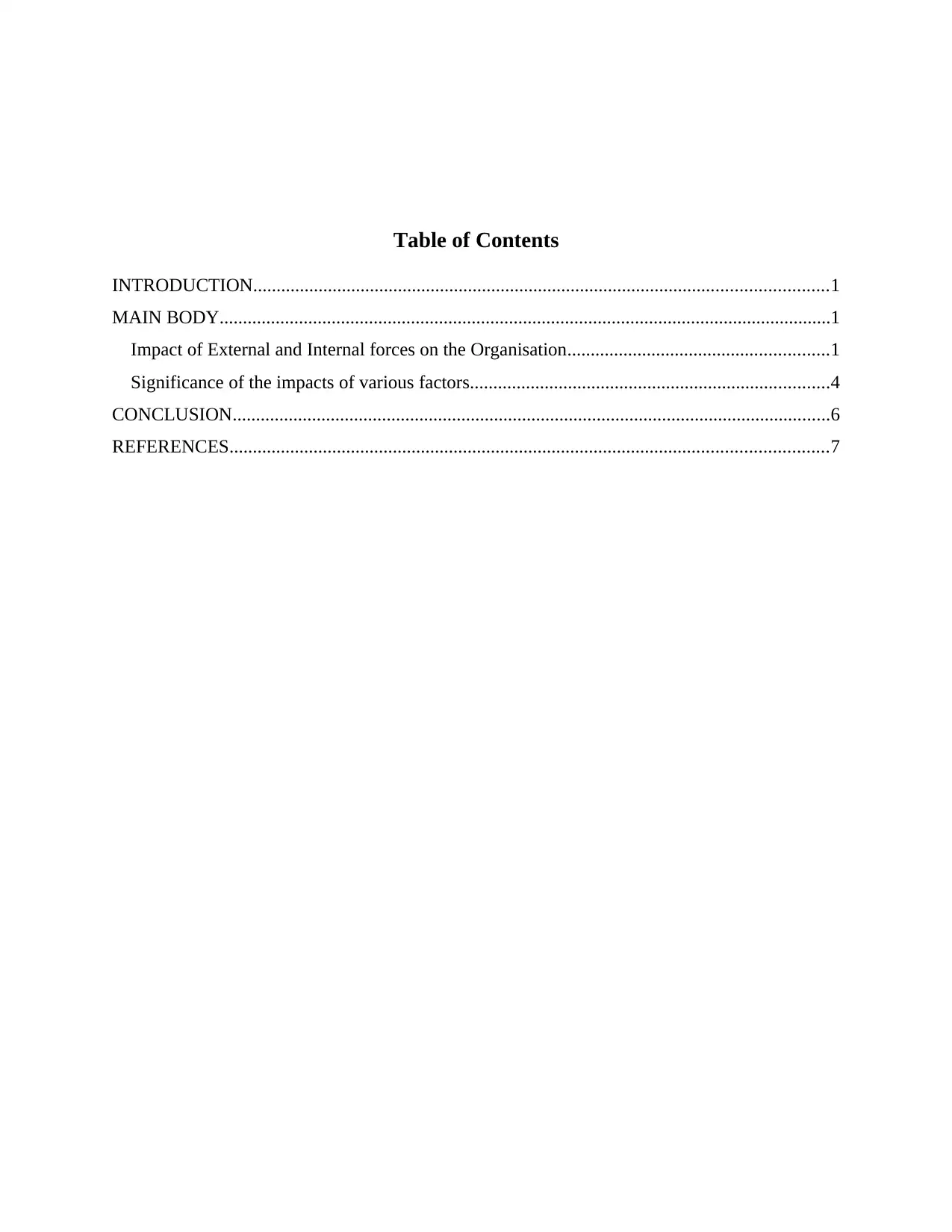
Table of Contents
INTRODUCTION...........................................................................................................................1
MAIN BODY...................................................................................................................................1
Impact of External and Internal forces on the Organisation........................................................1
Significance of the impacts of various factors.............................................................................4
CONCLUSION................................................................................................................................6
REFERENCES................................................................................................................................7
INTRODUCTION...........................................................................................................................1
MAIN BODY...................................................................................................................................1
Impact of External and Internal forces on the Organisation........................................................1
Significance of the impacts of various factors.............................................................................4
CONCLUSION................................................................................................................................6
REFERENCES................................................................................................................................7
INTRODUCTION
The report shall be focusing on the environmental forces that are impactful in an
organisation. Any organisation, be it relate to business, education, nursing and hospitality, hotel
and tourism, transport, agricultural and food commodities or any organisation operational in any
sector or industry, operates under the influences of a range of environmental forces. These forces
can exist within any organisation or outside. Understanding of theses forces becomes necessary
in the organisation because these affect forces effect planning, implementation of policies and
strategies and decision making (Catal, C. and Tekinerdogan, B., 2019). Any positive impact from
these forces can help organisation attaining efficiency and negative impact can spoil the planning
and obstruct achieving the desired results. Therefore, if the management and planners will be
fully aware of theses forces they can frame or reframe their plans and strategies accordingly and
turn threats posed by these forces into opportunity, deriving benefits to organisation as well as
various stakeholders.
MAIN BODY
For making comprehensive understanding of how several internal and external forces
affect an organisation, the report shall be taking example of a globally acknowledged educational
institution of United Kingdom, London School of Economics and Political science. The quality
of this institute in providing education, variety of courses offered, heterogeneity of students in
the organisation and wide popularity across the globe of this institution, will help achieving
purpose of discussion.
Impact of External and Internal forces on the Organisation
London School of Economics (LSE) was established in 1895. the age old institutes is
very popular among the students worldwide. LSE receives nearly 20000 applications very year
and admissible rate of these applicants is between 30% to 35%. The courses offered here varies
of economics, political science to anthropology, mathematics, philosophy, sociology etc. for
different degrees like bachelors, masters and Ph.D. The heterogeneity of students is evident from
the fact that the students here represents no less than 150 countries around the world. The
institute draw its finances several sources including donations and endowments, education fees,
funding council grants, research grants and investments. The expenditure of institute is also
1
The report shall be focusing on the environmental forces that are impactful in an
organisation. Any organisation, be it relate to business, education, nursing and hospitality, hotel
and tourism, transport, agricultural and food commodities or any organisation operational in any
sector or industry, operates under the influences of a range of environmental forces. These forces
can exist within any organisation or outside. Understanding of theses forces becomes necessary
in the organisation because these affect forces effect planning, implementation of policies and
strategies and decision making (Catal, C. and Tekinerdogan, B., 2019). Any positive impact from
these forces can help organisation attaining efficiency and negative impact can spoil the planning
and obstruct achieving the desired results. Therefore, if the management and planners will be
fully aware of theses forces they can frame or reframe their plans and strategies accordingly and
turn threats posed by these forces into opportunity, deriving benefits to organisation as well as
various stakeholders.
MAIN BODY
For making comprehensive understanding of how several internal and external forces
affect an organisation, the report shall be taking example of a globally acknowledged educational
institution of United Kingdom, London School of Economics and Political science. The quality
of this institute in providing education, variety of courses offered, heterogeneity of students in
the organisation and wide popularity across the globe of this institution, will help achieving
purpose of discussion.
Impact of External and Internal forces on the Organisation
London School of Economics (LSE) was established in 1895. the age old institutes is
very popular among the students worldwide. LSE receives nearly 20000 applications very year
and admissible rate of these applicants is between 30% to 35%. The courses offered here varies
of economics, political science to anthropology, mathematics, philosophy, sociology etc. for
different degrees like bachelors, masters and Ph.D. The heterogeneity of students is evident from
the fact that the students here represents no less than 150 countries around the world. The
institute draw its finances several sources including donations and endowments, education fees,
funding council grants, research grants and investments. The expenditure of institute is also
1
⊘ This is a preview!⊘
Do you want full access?
Subscribe today to unlock all pages.

Trusted by 1+ million students worldwide
significant. These facts marks the accountability of the institute have towards many stakeholders
globally, be it students, teachers and professors, investors, government and society.
This brings out the fact that the nature of environment this organisation operate in has a
very wide scope and consists the interests of global stakeholders.
Impact of External factors
In order to make good understanding of the external forces with a clear segmentation, the
PESTLE model of analysis is adopted in the report. PESTLE stands for the acronym of Political,
Economic, Social, Technological, Legal and Environmental forces (Cropley, A., 2020).
Political forces- Global acknowledgement of LSE make the institute vulnerable to this
force. Global politically sensitive issues, like issues related to community, ethnicity, language,
citizenship, migration etc. shall better be addressed in the institute or better it try its best to
detach itself from problems posed by them. Any sensitivity occurred due to this can damage
reputation and hamper sentiments of students, investors and society as a whole. Also, it may
attract the wrath and protests from any community of stakeholders.
Economic forces- As discussed above the institute draw its finances from various
sources. Some of these sources are within the control of organisation and some are not. LSE has
thus created a balance in them. For instance, if LSE faces any challenge in receipt of Grants from
Funding council, than that can be compensated by education fees, donations and endowments.
That helps institute to continue its expenditure for the noble cause its working for and retain the
faith of people, society, government and other global stakeholders.
Social forces- It is important for an educational institute to consider these factors at
priority. The social interests of people is needed to gain their trust and brings the institute as
authenticated. Heterogeneity of students and professors in the institute, investments and
donations received from across the globe, make it imperative for LSE to consider and respect
social sentiments of everybody (Durdyev and et.al., 2018). It should be kept in mind that no
humiliation and discrimination takes place in organisation based on language, ethnicity, race,
nationality or any other ground.
Technological forces- This is the most dynamic factor. LSE have to cope with
technological advancements in education industry. The teaching, imparting practical knowledge,
training, and usage of tools and equipments for any process shall not be traditional or obsolete.
2
globally, be it students, teachers and professors, investors, government and society.
This brings out the fact that the nature of environment this organisation operate in has a
very wide scope and consists the interests of global stakeholders.
Impact of External factors
In order to make good understanding of the external forces with a clear segmentation, the
PESTLE model of analysis is adopted in the report. PESTLE stands for the acronym of Political,
Economic, Social, Technological, Legal and Environmental forces (Cropley, A., 2020).
Political forces- Global acknowledgement of LSE make the institute vulnerable to this
force. Global politically sensitive issues, like issues related to community, ethnicity, language,
citizenship, migration etc. shall better be addressed in the institute or better it try its best to
detach itself from problems posed by them. Any sensitivity occurred due to this can damage
reputation and hamper sentiments of students, investors and society as a whole. Also, it may
attract the wrath and protests from any community of stakeholders.
Economic forces- As discussed above the institute draw its finances from various
sources. Some of these sources are within the control of organisation and some are not. LSE has
thus created a balance in them. For instance, if LSE faces any challenge in receipt of Grants from
Funding council, than that can be compensated by education fees, donations and endowments.
That helps institute to continue its expenditure for the noble cause its working for and retain the
faith of people, society, government and other global stakeholders.
Social forces- It is important for an educational institute to consider these factors at
priority. The social interests of people is needed to gain their trust and brings the institute as
authenticated. Heterogeneity of students and professors in the institute, investments and
donations received from across the globe, make it imperative for LSE to consider and respect
social sentiments of everybody (Durdyev and et.al., 2018). It should be kept in mind that no
humiliation and discrimination takes place in organisation based on language, ethnicity, race,
nationality or any other ground.
Technological forces- This is the most dynamic factor. LSE have to cope with
technological advancements in education industry. The teaching, imparting practical knowledge,
training, and usage of tools and equipments for any process shall not be traditional or obsolete.
2
Paraphrase This Document
Need a fresh take? Get an instant paraphrase of this document with our AI Paraphraser
This will bring the quality and competence in the students that graduate from the institute.
Because when these students expose themselves to outer world, they tends to represent LSE.
Legal forces- LSE is an institute incorporated under Companies Act, 1993 of UK as a
company. This bounds LSE to comply with the legal compliances under this act or any other act
and legalities of the land. This is necessary because if it comes out that LSE has not complied
with any norms and indulged in activities such as exploitation of stakeholders, malpractices in
conducting educational operations or misusing the funds and incomes, this will damage the brand
of LSE and faith that people have in LSE as one of the biggest educational institute.
Environmental forces- The environment in the Educational industry too have become
very competitive. There are wide range of colleges and universities that are offering Multiple
courses and degrees and competing with each other in quality of education, admissions, number
of courses, level of advancements etc. Also, in this industry many countries are adopting policies
that can bring their domestic universities at the levels of international universities like LSE. This
leaves no option rather than continuous growth and advancements in not only imparting
education, but also in recruitment policies, collaborations, practical and vocational training or
other areas.
Impact of Internal factors
Internal factors in an organisation comprises of various resources that it uses to conduct it
operations. In LSE these resources can be like finances and investors, students or other clients,
professors and other staff, technological equipments and other material resources, management
and its skills etc. How changes in these resources impacts the operations of LSE and how LSE
can mange them, can be analysed by using VRIO analysis model (Fauzi and et.al., 2020).
Value- Value of resources mean their feasibility, affordability and accessibility for the
organisation. For example, if any source of finance is proving costly or not easily accessible for
the organisation the LSE must try top rely on any other source. Therefore, any other resource is
good as long as it provide benefits in all terms.
Rareness- Rarity and limited availability is also another obstacle. For instance, faculty of
any course in not easily available in market. LSE can choose to outsource that faculty or train
their existing faculty in that course or can opt to drop that course for short time.
Imitability- Imitability means establishing effective communication with the resources.
Like those students and professors who are interested in working with LSE, shall have an
3
Because when these students expose themselves to outer world, they tends to represent LSE.
Legal forces- LSE is an institute incorporated under Companies Act, 1993 of UK as a
company. This bounds LSE to comply with the legal compliances under this act or any other act
and legalities of the land. This is necessary because if it comes out that LSE has not complied
with any norms and indulged in activities such as exploitation of stakeholders, malpractices in
conducting educational operations or misusing the funds and incomes, this will damage the brand
of LSE and faith that people have in LSE as one of the biggest educational institute.
Environmental forces- The environment in the Educational industry too have become
very competitive. There are wide range of colleges and universities that are offering Multiple
courses and degrees and competing with each other in quality of education, admissions, number
of courses, level of advancements etc. Also, in this industry many countries are adopting policies
that can bring their domestic universities at the levels of international universities like LSE. This
leaves no option rather than continuous growth and advancements in not only imparting
education, but also in recruitment policies, collaborations, practical and vocational training or
other areas.
Impact of Internal factors
Internal factors in an organisation comprises of various resources that it uses to conduct it
operations. In LSE these resources can be like finances and investors, students or other clients,
professors and other staff, technological equipments and other material resources, management
and its skills etc. How changes in these resources impacts the operations of LSE and how LSE
can mange them, can be analysed by using VRIO analysis model (Fauzi and et.al., 2020).
Value- Value of resources mean their feasibility, affordability and accessibility for the
organisation. For example, if any source of finance is proving costly or not easily accessible for
the organisation the LSE must try top rely on any other source. Therefore, any other resource is
good as long as it provide benefits in all terms.
Rareness- Rarity and limited availability is also another obstacle. For instance, faculty of
any course in not easily available in market. LSE can choose to outsource that faculty or train
their existing faculty in that course or can opt to drop that course for short time.
Imitability- Imitability means establishing effective communication with the resources.
Like those students and professors who are interested in working with LSE, shall have an
3
effective channel in communicating with LSE. Similarly investors must have access to timely
and efficient communication network. Establishing communication is a two way task.
Organisation- This indicates the manner in which organisation is using and coordinating
between its resources. Like the funds and incomes available in the institute shall be equitably
appropriated between necessary expanses (Jiang, H. and Verardo, M., 2018). If the funds are
being heavily utilised in making technological advancements and due salaries in the organisation
is unpaid, than the organisation will avail benefit from one resource but loose it from the other.
And, a proper balance will not be maintained.
Significance of the impacts of various factors
The environment in which any organisation operates is made up of various factors. These
factors can exists within the range of control of organisation or outside this. But, these factors are
indispensable from the organisation. When a change is bought by these factors, the impact can be
positive as well as negative. Therefore, any organisation must have a clear understanding to the
factors they are exposed to and what kind of impact they can levy over the business operations
and related stakeholders (Moşteanu and et.al., 2020). The impact of these factors can be seen at
different levels, be it an individual organisation, a market or at the industry level. The impacts
can also be at domestic, National or International level. In the educational industry, in which
LSE exists, the impact of these factors is clear from various instances. Like after the wave of
globalisation, the importance in manner of imparting education was changed. People were keen
in moving to advanced countries in search of good opportunities in work and well as study.
Therefore the importance of English language grew in the domestic studies as well as. Separate
English educational boards got created and traditional methods of education, religious schools
etc. became obsolete. English became common language for communication between people of
different origins.
This bought change in the perception of Governments and Administrations as well as and
they started supporting English schools in terms of grants and finances to increase competence of
people. Finances than started shifting to this new trend and many domestic and religious
institutes too had to change their educational models to remain in mainstream.
Similarly from the Digital revolution in the 21st century, the need to prioritize digital
channels of imparting education became important (Nyström, A. G. and Mustonen, M., 2017).
Online classes, use of laptops, practical learnings, importance of training, more focus on the
4
and efficient communication network. Establishing communication is a two way task.
Organisation- This indicates the manner in which organisation is using and coordinating
between its resources. Like the funds and incomes available in the institute shall be equitably
appropriated between necessary expanses (Jiang, H. and Verardo, M., 2018). If the funds are
being heavily utilised in making technological advancements and due salaries in the organisation
is unpaid, than the organisation will avail benefit from one resource but loose it from the other.
And, a proper balance will not be maintained.
Significance of the impacts of various factors
The environment in which any organisation operates is made up of various factors. These
factors can exists within the range of control of organisation or outside this. But, these factors are
indispensable from the organisation. When a change is bought by these factors, the impact can be
positive as well as negative. Therefore, any organisation must have a clear understanding to the
factors they are exposed to and what kind of impact they can levy over the business operations
and related stakeholders (Moşteanu and et.al., 2020). The impact of these factors can be seen at
different levels, be it an individual organisation, a market or at the industry level. The impacts
can also be at domestic, National or International level. In the educational industry, in which
LSE exists, the impact of these factors is clear from various instances. Like after the wave of
globalisation, the importance in manner of imparting education was changed. People were keen
in moving to advanced countries in search of good opportunities in work and well as study.
Therefore the importance of English language grew in the domestic studies as well as. Separate
English educational boards got created and traditional methods of education, religious schools
etc. became obsolete. English became common language for communication between people of
different origins.
This bought change in the perception of Governments and Administrations as well as and
they started supporting English schools in terms of grants and finances to increase competence of
people. Finances than started shifting to this new trend and many domestic and religious
institutes too had to change their educational models to remain in mainstream.
Similarly from the Digital revolution in the 21st century, the need to prioritize digital
channels of imparting education became important (Nyström, A. G. and Mustonen, M., 2017).
Online classes, use of laptops, practical learnings, importance of training, more focus on the
4
⊘ This is a preview!⊘
Do you want full access?
Subscribe today to unlock all pages.
Trusted by 1+ million students worldwide
courses of Engineering, Mathematics, Research and Development are some of the results of this
revolution. When the advancements in adopting these changes seen growing frequently in
countries like USA, UK, China, Japan etc. Many countries started using different policies to
promote these changes. This decision was supported through restrictions, collaborations,
outsourcing of study materials and faculties, introduction of awards and monetary benefits and
many more. This encouraged domestic institution to bring advancements and developments.
Investments were focused on digital techniques learnings and Research and development
activities. This is testimonial by the fact that many domestic educational institutes in various
countries are successful in providing these learning of new world and not much migrations of
students are taking place to other countries.
Requirements of complexities and new dynamics in the world have given rise to
introduction of new branches in education and research as well. Like, technological
developments in Medical studies, digital advancements in Marketing and Management have
integrated two and more than two subjects (Peng and et.al., 2017). Studies and researches in
these areas is also increasingly developing and heavily pursued by learners, needing institutes to
quickly adopt these changes.
LSE have successfully managed to survive these factors, whether they are internal or
external (Phelps, A. L. and Szabat, K. A., 2017). The organisation have achieved significantly
well in mitigating negative impacts of these factors and derived good outputs from the
opportunities came before the institute. For example, when LSE found it challenging in receipt of
insufficient funds from Funding council and donations, the organisation took steps for making its
own investments. The organisation was authorized to do so as it is registered as a company under
Companies Act. Similarly, realising that traditional methods of learning were not deriving
outputs, the organisation did no delay in adopting quicker and more efficient methods. Usage of
laptops, Digital projections, making use of online sources to study besides books, imparting
practical training, introduction of new courses, extension of limits of admissions and
diversification of permissible courses were some of the steps taken by LSE in meeting demands
of changing world (Zhang and et.al., 2020).
This is evident from the results that students here represents 153 countries of world. It has
second highest percentage of international students in the world. Alumni and staff in the institute
include 55 past or present heads of the Government as well as 18 Nobel laureates. As of 2017, 13
5
revolution. When the advancements in adopting these changes seen growing frequently in
countries like USA, UK, China, Japan etc. Many countries started using different policies to
promote these changes. This decision was supported through restrictions, collaborations,
outsourcing of study materials and faculties, introduction of awards and monetary benefits and
many more. This encouraged domestic institution to bring advancements and developments.
Investments were focused on digital techniques learnings and Research and development
activities. This is testimonial by the fact that many domestic educational institutes in various
countries are successful in providing these learning of new world and not much migrations of
students are taking place to other countries.
Requirements of complexities and new dynamics in the world have given rise to
introduction of new branches in education and research as well. Like, technological
developments in Medical studies, digital advancements in Marketing and Management have
integrated two and more than two subjects (Peng and et.al., 2017). Studies and researches in
these areas is also increasingly developing and heavily pursued by learners, needing institutes to
quickly adopt these changes.
LSE have successfully managed to survive these factors, whether they are internal or
external (Phelps, A. L. and Szabat, K. A., 2017). The organisation have achieved significantly
well in mitigating negative impacts of these factors and derived good outputs from the
opportunities came before the institute. For example, when LSE found it challenging in receipt of
insufficient funds from Funding council and donations, the organisation took steps for making its
own investments. The organisation was authorized to do so as it is registered as a company under
Companies Act. Similarly, realising that traditional methods of learning were not deriving
outputs, the organisation did no delay in adopting quicker and more efficient methods. Usage of
laptops, Digital projections, making use of online sources to study besides books, imparting
practical training, introduction of new courses, extension of limits of admissions and
diversification of permissible courses were some of the steps taken by LSE in meeting demands
of changing world (Zhang and et.al., 2020).
This is evident from the results that students here represents 153 countries of world. It has
second highest percentage of international students in the world. Alumni and staff in the institute
include 55 past or present heads of the Government as well as 18 Nobel laureates. As of 2017, 13
5
Paraphrase This Document
Need a fresh take? Get an instant paraphrase of this document with our AI Paraphraser
out of 49 Nobel Memorial Prizes in Economics were awarded to the staff and alumni of LSE.
According to a 2014 global census of US dollar billionaires, LSE has educated most of the
billionaires in the world.
CONCLUSION
Therefore, from the above discussion in the report, it can be concluded that, given the
complexities and dynamics of changing world, any organisation in any of the industry or sector
is exposed to various factors of internal as well as external nature. It is imperative for any
organisation to have a clear understanding about these forces so it can save itself up to the
maximum possible limits from any threats and challenges developed by these forces, and
sometimes turn these threats into opportunities by making changes in planning and policies.
Similarly, best understanding of these forces will help organisation derive maximum benefits.
But the exposure to these forces are significant and indispensable for an organisation and they
better be tackled to stay competent, competitive, achieve efficiency and growth.
6
According to a 2014 global census of US dollar billionaires, LSE has educated most of the
billionaires in the world.
CONCLUSION
Therefore, from the above discussion in the report, it can be concluded that, given the
complexities and dynamics of changing world, any organisation in any of the industry or sector
is exposed to various factors of internal as well as external nature. It is imperative for any
organisation to have a clear understanding about these forces so it can save itself up to the
maximum possible limits from any threats and challenges developed by these forces, and
sometimes turn these threats into opportunities by making changes in planning and policies.
Similarly, best understanding of these forces will help organisation derive maximum benefits.
But the exposure to these forces are significant and indispensable for an organisation and they
better be tackled to stay competent, competitive, achieve efficiency and growth.
6
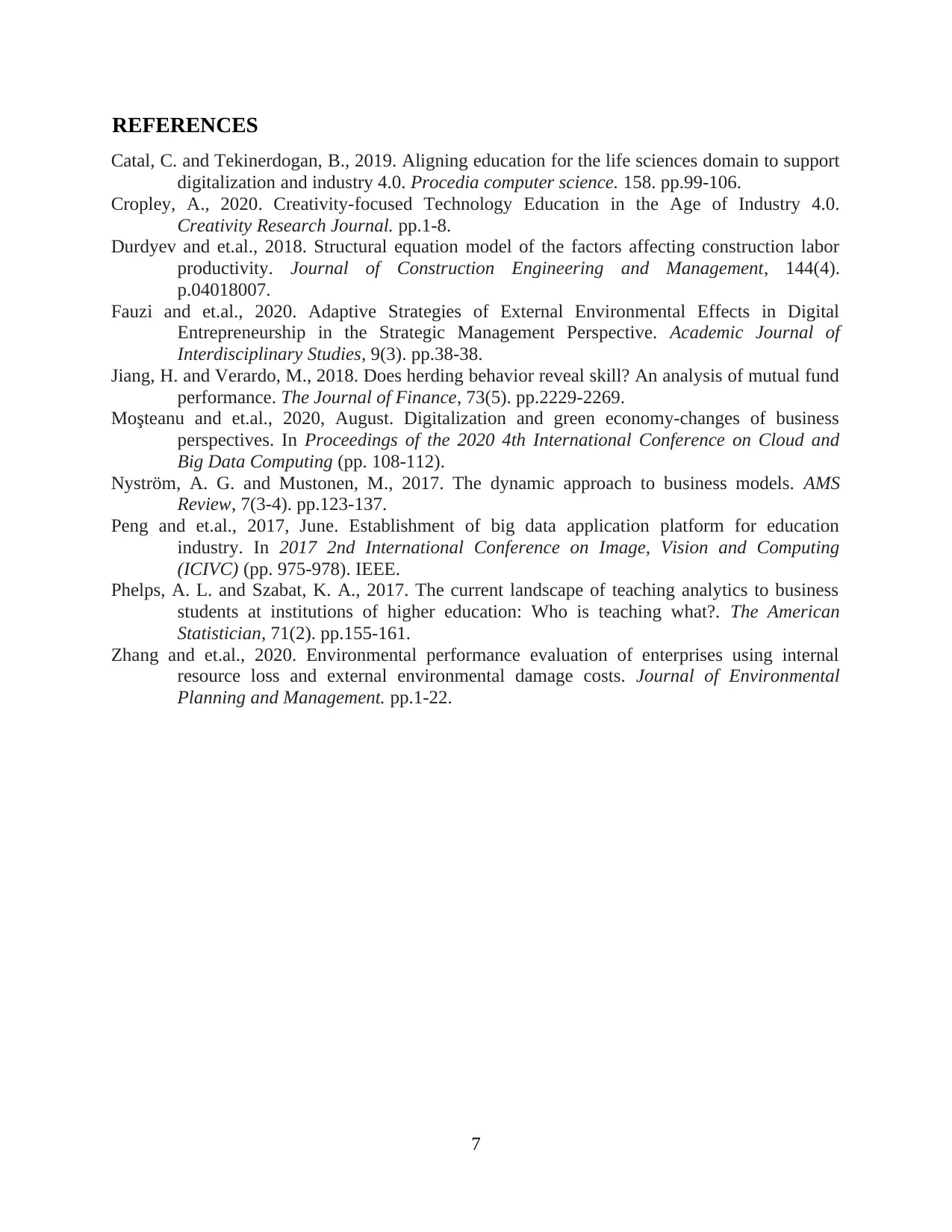
REFERENCES
Catal, C. and Tekinerdogan, B., 2019. Aligning education for the life sciences domain to support
digitalization and industry 4.0. Procedia computer science. 158. pp.99-106.
Cropley, A., 2020. Creativity-focused Technology Education in the Age of Industry 4.0.
Creativity Research Journal. pp.1-8.
Durdyev and et.al., 2018. Structural equation model of the factors affecting construction labor
productivity. Journal of Construction Engineering and Management, 144(4).
p.04018007.
Fauzi and et.al., 2020. Adaptive Strategies of External Environmental Effects in Digital
Entrepreneurship in the Strategic Management Perspective. Academic Journal of
Interdisciplinary Studies, 9(3). pp.38-38.
Jiang, H. and Verardo, M., 2018. Does herding behavior reveal skill? An analysis of mutual fund
performance. The Journal of Finance, 73(5). pp.2229-2269.
Moşteanu and et.al., 2020, August. Digitalization and green economy-changes of business
perspectives. In Proceedings of the 2020 4th International Conference on Cloud and
Big Data Computing (pp. 108-112).
Nyström, A. G. and Mustonen, M., 2017. The dynamic approach to business models. AMS
Review, 7(3-4). pp.123-137.
Peng and et.al., 2017, June. Establishment of big data application platform for education
industry. In 2017 2nd International Conference on Image, Vision and Computing
(ICIVC) (pp. 975-978). IEEE.
Phelps, A. L. and Szabat, K. A., 2017. The current landscape of teaching analytics to business
students at institutions of higher education: Who is teaching what?. The American
Statistician, 71(2). pp.155-161.
Zhang and et.al., 2020. Environmental performance evaluation of enterprises using internal
resource loss and external environmental damage costs. Journal of Environmental
Planning and Management. pp.1-22.
7
Catal, C. and Tekinerdogan, B., 2019. Aligning education for the life sciences domain to support
digitalization and industry 4.0. Procedia computer science. 158. pp.99-106.
Cropley, A., 2020. Creativity-focused Technology Education in the Age of Industry 4.0.
Creativity Research Journal. pp.1-8.
Durdyev and et.al., 2018. Structural equation model of the factors affecting construction labor
productivity. Journal of Construction Engineering and Management, 144(4).
p.04018007.
Fauzi and et.al., 2020. Adaptive Strategies of External Environmental Effects in Digital
Entrepreneurship in the Strategic Management Perspective. Academic Journal of
Interdisciplinary Studies, 9(3). pp.38-38.
Jiang, H. and Verardo, M., 2018. Does herding behavior reveal skill? An analysis of mutual fund
performance. The Journal of Finance, 73(5). pp.2229-2269.
Moşteanu and et.al., 2020, August. Digitalization and green economy-changes of business
perspectives. In Proceedings of the 2020 4th International Conference on Cloud and
Big Data Computing (pp. 108-112).
Nyström, A. G. and Mustonen, M., 2017. The dynamic approach to business models. AMS
Review, 7(3-4). pp.123-137.
Peng and et.al., 2017, June. Establishment of big data application platform for education
industry. In 2017 2nd International Conference on Image, Vision and Computing
(ICIVC) (pp. 975-978). IEEE.
Phelps, A. L. and Szabat, K. A., 2017. The current landscape of teaching analytics to business
students at institutions of higher education: Who is teaching what?. The American
Statistician, 71(2). pp.155-161.
Zhang and et.al., 2020. Environmental performance evaluation of enterprises using internal
resource loss and external environmental damage costs. Journal of Environmental
Planning and Management. pp.1-22.
7
⊘ This is a preview!⊘
Do you want full access?
Subscribe today to unlock all pages.
Trusted by 1+ million students worldwide

1 out of 9


Related Documents


Your All-in-One AI-Powered Toolkit for Academic Success.
+13062052269
info@desklib.com
Available 24*7 on WhatsApp / Email
![[object Object]](/_next/static/media/star-bottom.7253800d.svg)
Unlock your academic potential
Copyright © 2020–2026 A2Z Services. All Rights Reserved. Developed and managed by ZUCOL.