Environmental Impact Assessment: Samarco Mine and OK Tedi Mine
VerifiedAdded on 2023/06/01
|11
|3035
|475
Report
AI Summary
This report provides an environmental impact assessment (EIA) of the Samarco mine tailings dam failure in Brazil and the OK Tedi mine in Papua New Guinea. It examines the benefits and costs associated with these projects, including the creation of employment and economic growth versus environmental damage and social disruption. The report analyzes the stakeholder groups involved, such as mining companies, governments, and local communities, and their respective interests in the projects. It critically evaluates the EIA processes, highlighting flaws and proposing improvements, including the potential role of social impact assessments (SIA). The analysis underscores the importance of government regulations, identifies their positive and negative aspects, and suggests structures to mitigate negative consequences. The report emphasizes the need for comprehensive environmental and social considerations in project development to avoid disastrous outcomes and promote sustainable practices. It also stresses the significance of involving local people in the decision-making process to avoid issues and ensure sustainable operations.
Running head: ENVIRONMENTAL IMPACT ASSESSMENT 1
Environmental Impact Assessment
Name
Institution
Environmental Impact Assessment
Name
Institution

Paraphrase This Document
Need a fresh take? Get an instant paraphrase of this document with our AI Paraphraser
ENVIRONMENTAL IMPACT ASSESSMENT 2
Environmental Impact Assessment
In essence, environmental impact assessment (EIA) is the overall process or rather the
entire procedure that is required by project developers to follow with an aim of being granted
permission for a particular development. Apparently, EIA is considered an important planning
mechanism that is often used for preventing various environmental hazards as a result of a
particular action. Consequently, this body ensures that any potential problems are foreseen as
well as addressed at a rather early stage in the overall project planning and design. Following this
kind of procedure ensures that there are no costly mistakes in the implementation of various
projects, either due to environmental damage that is likely to occur during the implementation
stage of a project, or even because of modification that may be needed afterward (Epstein, 2018).
The purposes of this Environmental Impact Assessment paper is to assess principal
environmental concerns that are associated with the Samarco mine tailings dam failure and OK
Tedi mine in Papua New Guinea project.
One reason why it is important to involve the EIA is the overall disaster of the Samarco
mine tailings failure. Despite the company being alerted six months before regarding the danger
that the dam had, the mining company ignored them all. In fact, the company that was operating
the mines had initially predicted accurately the potential impact of such disaster in an assessment
that they had undertaken earlier (Glasson, Therivel, &Chadwick, 2005). According to a federal
prosecutor, a joint project that was between the Brazilian mining company vale and the
multinational the BHP Billiton had failed in taking any particular action that could have instead
prevented the disaster (Epstein & Yuthas, 2017). On the other hand, OK Tedi mine in Papua
New Guinea project was a designed copper mining operation that was located close to
headwaters of the OK Tedi River. The creation of the mining site was controversial and did not
Environmental Impact Assessment
In essence, environmental impact assessment (EIA) is the overall process or rather the
entire procedure that is required by project developers to follow with an aim of being granted
permission for a particular development. Apparently, EIA is considered an important planning
mechanism that is often used for preventing various environmental hazards as a result of a
particular action. Consequently, this body ensures that any potential problems are foreseen as
well as addressed at a rather early stage in the overall project planning and design. Following this
kind of procedure ensures that there are no costly mistakes in the implementation of various
projects, either due to environmental damage that is likely to occur during the implementation
stage of a project, or even because of modification that may be needed afterward (Epstein, 2018).
The purposes of this Environmental Impact Assessment paper is to assess principal
environmental concerns that are associated with the Samarco mine tailings dam failure and OK
Tedi mine in Papua New Guinea project.
One reason why it is important to involve the EIA is the overall disaster of the Samarco
mine tailings failure. Despite the company being alerted six months before regarding the danger
that the dam had, the mining company ignored them all. In fact, the company that was operating
the mines had initially predicted accurately the potential impact of such disaster in an assessment
that they had undertaken earlier (Glasson, Therivel, &Chadwick, 2005). According to a federal
prosecutor, a joint project that was between the Brazilian mining company vale and the
multinational the BHP Billiton had failed in taking any particular action that could have instead
prevented the disaster (Epstein & Yuthas, 2017). On the other hand, OK Tedi mine in Papua
New Guinea project was a designed copper mining operation that was located close to
headwaters of the OK Tedi River. The creation of the mining site was controversial and did not
ENVIRONMENTAL IMPACT ASSESSMENT 3
engage the local people of that place. Additionally, the project had proved a daunting effect
despite the fact that it was still implemented.
Benefits and Costs of Projects
Ideally, there are various benefits that particular development projects come with it
especially the creation of mining sites such as that of the Samarco mine tailings dam failure and
OK Tedi mine in Papua New Guinea project. In this light, a development project can no doubt
create a tangible importance of the overall local people or even the regional economies as well as
the real cost and revenue for the local governments (Joseph, Zeeg, Angus, Usborne, & Mutrie,
2017). One way of making people benefit from a development project or plan is set up a local
content. Local content is considered as a philosophy regarding a shared value considering
strategies a particular business organization can implement with an aim of increasing local
content thus maximizing the overall benefits to a particular local community and the involved
company alike. For instance, a particular firm can work closely with potential suppliers in a local
community in considering how their capacity can be built especially in meeting its procurement
needs while adjusting the set company’s requirements with an aim of including the local
businesses.
Primarily, the overall growth in local content particularly policies, as well as practices,
have led to the realization of various competing objectives in societal settings. In case there is a
creation of a particular development project in an area, there is a likelihood that the involved
company will involve the people from the local area in its daily activities. In this light, a
development project often creates employment for the local people in an area. Creation of
employment to the people has the tendency of improving the quality of life of people. For
instance, the development of the Samarco mining site created huge employment opportunities to
engage the local people of that place. Additionally, the project had proved a daunting effect
despite the fact that it was still implemented.
Benefits and Costs of Projects
Ideally, there are various benefits that particular development projects come with it
especially the creation of mining sites such as that of the Samarco mine tailings dam failure and
OK Tedi mine in Papua New Guinea project. In this light, a development project can no doubt
create a tangible importance of the overall local people or even the regional economies as well as
the real cost and revenue for the local governments (Joseph, Zeeg, Angus, Usborne, & Mutrie,
2017). One way of making people benefit from a development project or plan is set up a local
content. Local content is considered as a philosophy regarding a shared value considering
strategies a particular business organization can implement with an aim of increasing local
content thus maximizing the overall benefits to a particular local community and the involved
company alike. For instance, a particular firm can work closely with potential suppliers in a local
community in considering how their capacity can be built especially in meeting its procurement
needs while adjusting the set company’s requirements with an aim of including the local
businesses.
Primarily, the overall growth in local content particularly policies, as well as practices,
have led to the realization of various competing objectives in societal settings. In case there is a
creation of a particular development project in an area, there is a likelihood that the involved
company will involve the people from the local area in its daily activities. In this light, a
development project often creates employment for the local people in an area. Creation of
employment to the people has the tendency of improving the quality of life of people. For
instance, the development of the Samarco mining site created huge employment opportunities to
⊘ This is a preview!⊘
Do you want full access?
Subscribe today to unlock all pages.

Trusted by 1+ million students worldwide
ENVIRONMENTAL IMPACT ASSESSMENT 4
the people of Bento Rodrigues. Creation of employment opportunities means that local people
could get income which means that there would be an increase an increase in the circulation of
money in the local area. On the other hand, the implementation of a development plan can help
boost the economy of a region given the fact that an increase in money circulation of
employment may be caused by the output of that particular company in subsequent rounds or
even re-spending that often arises through the overall purchase from the local supplier industries.
Whether the Benefits Brought To the Country by Development Projects Outweigh the
Environmental and Social Costs
Even with various benefits that a country may realize due to the implementation of a
particular project, there is a need to critically asses its impact on the environment. Apparently,
most development projects are started with an aim of having benefits to the overall human well-
being in the long run. However, the impact that is associated with a certain development project
may lead to an unexpected negative impact on the health of people (Zamani, Sandin, Svanström,
& Peters, 2018). There are various benefits of a development project such as rapid development
in both local amenities and the creation of employment activities. Nonetheless, there are various
negative impacts of the development project that more often targets the ecosystem.
Creation of a mining site involves the location of a favorable location that is in most
cases located in a fertile land or even close to a waterway or river. As a result, there is a
likelihood of the disturbance of the ecosystem that normally happens because of deforestation.
For instance, the location of the OK Tedi mine in Papua New Guinea was located close to OK
Tedi River while the Samarco mining site was situated in a forest or rather a fertile land (Zamani,
Sandin, Svanström, & Peters, 2018). According to research, that various local people of these
areas agree that the major impact of these development projects is the act of disturbance of the
the people of Bento Rodrigues. Creation of employment opportunities means that local people
could get income which means that there would be an increase an increase in the circulation of
money in the local area. On the other hand, the implementation of a development plan can help
boost the economy of a region given the fact that an increase in money circulation of
employment may be caused by the output of that particular company in subsequent rounds or
even re-spending that often arises through the overall purchase from the local supplier industries.
Whether the Benefits Brought To the Country by Development Projects Outweigh the
Environmental and Social Costs
Even with various benefits that a country may realize due to the implementation of a
particular project, there is a need to critically asses its impact on the environment. Apparently,
most development projects are started with an aim of having benefits to the overall human well-
being in the long run. However, the impact that is associated with a certain development project
may lead to an unexpected negative impact on the health of people (Zamani, Sandin, Svanström,
& Peters, 2018). There are various benefits of a development project such as rapid development
in both local amenities and the creation of employment activities. Nonetheless, there are various
negative impacts of the development project that more often targets the ecosystem.
Creation of a mining site involves the location of a favorable location that is in most
cases located in a fertile land or even close to a waterway or river. As a result, there is a
likelihood of the disturbance of the ecosystem that normally happens because of deforestation.
For instance, the location of the OK Tedi mine in Papua New Guinea was located close to OK
Tedi River while the Samarco mining site was situated in a forest or rather a fertile land (Zamani,
Sandin, Svanström, & Peters, 2018). According to research, that various local people of these
areas agree that the major impact of these development projects is the act of disturbance of the
Paraphrase This Document
Need a fresh take? Get an instant paraphrase of this document with our AI Paraphraser
ENVIRONMENTAL IMPACT ASSESSMENT 5
ecosystem. Additionally, the extensive use of water by various mining companies and industrial
waste discharge especially into water sources is regarded as one of the leading causes of
poisoning the water, diseases, as well as the economic problems of the concerned country.
Environmental degradation as well as have imperative consequence particularly for the
concerned economy especially on the agriculture which is in most cases the main economic
activity of various individuals. For instance, the implementation of the mining project on the OK
Tedi river proved complicated and damaging especially to the people of Papua New Guinea
(Zamani, Sandin, Svanström, & Peters, 2018). The mining site interfered with the water system
as well as the fertility of soil due to the poisonous elements released in both water and air.
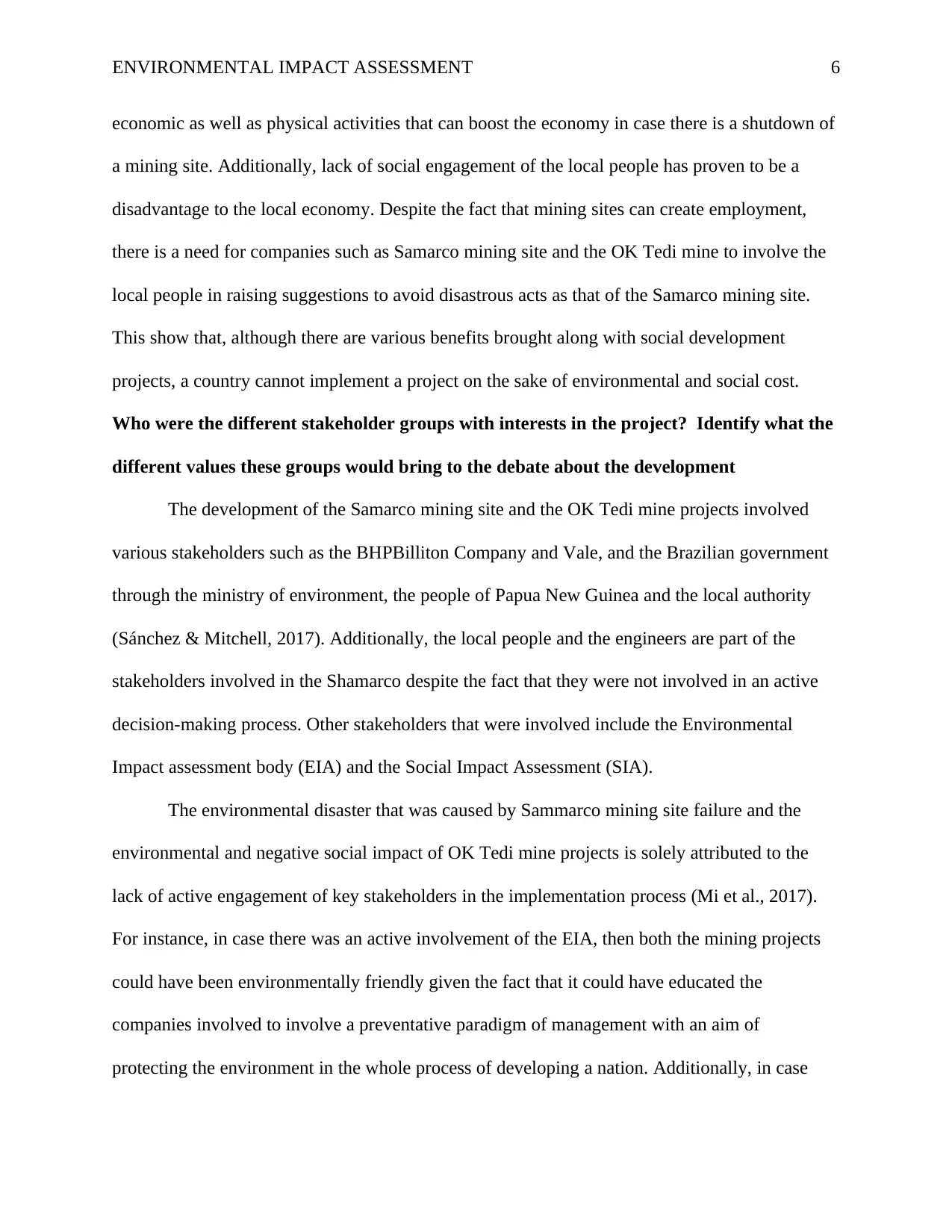
Additionally, the disaster of the Samarco mining site was one that left most of the ecosystem
destroyed. The muddy water that was released into the river was poisonous thus killing all kind
of animals including fish.
Furthermore, there are various social impacts that are likely to be caused by development
projects across various societal settings. For instance, people do not always benefit from the
income that a company generated by a mining company especially from mining projects
(Vanclay, Esteves, Aucamp, & Franks, 2015). The fact that minerals are considered to be non-
renewable resources, the overall revenue that is obtained from the mining activities has to be
invested back in other forms of a rather sustainable capital like particularly in human social,
ecosystem. Additionally, the extensive use of water by various mining companies and industrial
waste discharge especially into water sources is regarded as one of the leading causes of
poisoning the water, diseases, as well as the economic problems of the concerned country.
Environmental degradation as well as have imperative consequence particularly for the
concerned economy especially on the agriculture which is in most cases the main economic
activity of various individuals. For instance, the implementation of the mining project on the OK
Tedi river proved complicated and damaging especially to the people of Papua New Guinea
(Zamani, Sandin, Svanström, & Peters, 2018). The mining site interfered with the water system
as well as the fertility of soil due to the poisonous elements released in both water and air.
Additionally, the disaster of the Samarco mining site was one that left most of the ecosystem
destroyed. The muddy water that was released into the river was poisonous thus killing all kind
of animals including fish.
Furthermore, there are various social impacts that are likely to be caused by development
projects across various societal settings. For instance, people do not always benefit from the
income that a company generated by a mining company especially from mining projects
(Vanclay, Esteves, Aucamp, & Franks, 2015). The fact that minerals are considered to be non-
renewable resources, the overall revenue that is obtained from the mining activities has to be
invested back in other forms of a rather sustainable capital like particularly in human social,
ENVIRONMENTAL IMPACT ASSESSMENT 6
economic as well as physical activities that can boost the economy in case there is a shutdown of
a mining site. Additionally, lack of social engagement of the local people has proven to be a
disadvantage to the local economy. Despite the fact that mining sites can create employment,
there is a need for companies such as Samarco mining site and the OK Tedi mine to involve the
local people in raising suggestions to avoid disastrous acts as that of the Samarco mining site.
This show that, although there are various benefits brought along with social development
projects, a country cannot implement a project on the sake of environmental and social cost.
Who were the different stakeholder groups with interests in the project? Identify what the
different values these groups would bring to the debate about the development
The development of the Samarco mining site and the OK Tedi mine projects involved
various stakeholders such as the BHPBilliton Company and Vale, and the Brazilian government
through the ministry of environment, the people of Papua New Guinea and the local authority
(Sánchez & Mitchell, 2017). Additionally, the local people and the engineers are part of the
stakeholders involved in the Shamarco despite the fact that they were not involved in an active
decision-making process. Other stakeholders that were involved include the Environmental
Impact assessment body (EIA) and the Social Impact Assessment (SIA).
The environmental disaster that was caused by Sammarco mining site failure and the
environmental and negative social impact of OK Tedi mine projects is solely attributed to the
lack of active engagement of key stakeholders in the implementation process (Mi et al., 2017).
For instance, in case there was an active involvement of the EIA, then both the mining projects
could have been environmentally friendly given the fact that it could have educated the
companies involved to involve a preventative paradigm of management with an aim of
protecting the environment in the whole process of developing a nation. Additionally, in case
economic as well as physical activities that can boost the economy in case there is a shutdown of
a mining site. Additionally, lack of social engagement of the local people has proven to be a
disadvantage to the local economy. Despite the fact that mining sites can create employment,
there is a need for companies such as Samarco mining site and the OK Tedi mine to involve the
local people in raising suggestions to avoid disastrous acts as that of the Samarco mining site.
This show that, although there are various benefits brought along with social development
projects, a country cannot implement a project on the sake of environmental and social cost.
Who were the different stakeholder groups with interests in the project? Identify what the
different values these groups would bring to the debate about the development
The development of the Samarco mining site and the OK Tedi mine projects involved
various stakeholders such as the BHPBilliton Company and Vale, and the Brazilian government
through the ministry of environment, the people of Papua New Guinea and the local authority
(Sánchez & Mitchell, 2017). Additionally, the local people and the engineers are part of the
stakeholders involved in the Shamarco despite the fact that they were not involved in an active
decision-making process. Other stakeholders that were involved include the Environmental
Impact assessment body (EIA) and the Social Impact Assessment (SIA).
The environmental disaster that was caused by Sammarco mining site failure and the
environmental and negative social impact of OK Tedi mine projects is solely attributed to the
lack of active engagement of key stakeholders in the implementation process (Mi et al., 2017).
For instance, in case there was an active involvement of the EIA, then both the mining projects
could have been environmentally friendly given the fact that it could have educated the
companies involved to involve a preventative paradigm of management with an aim of
protecting the environment in the whole process of developing a nation. Additionally, in case
⊘ This is a preview!⊘
Do you want full access?
Subscribe today to unlock all pages.
Trusted by 1+ million students worldwide
ENVIRONMENTAL IMPACT ASSESSMENT 7
there was an active involvement of SIA, then the entire projects could have been sustainable and
all inclusive to accommodate the local people such as the Aboriginal.
The Critical Problems of The EIA Process
EIA is considered an important planning mechanism that is often used for preventing
various environmental hazards as a result of a particular action. In this light, the work of the EIA
is to foresee a problem in a particular project development and make sure that the problem has
been fixed to avoid disaster in the long run (Vohra et al., 2018). Nonetheless, there were various
constructions flaws that were involved during the construction of the Samarco mining site that
was actually was predicted by the EIA and was ignored by the BHP Billiton and the Vale
companies (Prokofieva, Lucas, Thorsen, & Carlsen, 2017). During the operation of the Samarco
mining site, there was a fast extension of the dam that held the wastewater from the mine against
the EIA principles of regulations. Despite the fact that the company was warned that the state of
the dam was not good, it ignored that call thus resulting in a tragic failure.
Whether a Social Impact Assessment Could Have Been Undertaken
The overall effectiveness of SIA hugely depends on various underlying assumptions
surrounding the purpose of SIA. The fact that SIA was created to put forward the various agenda
as well as interests of people is a good reason why there should have been an assessment of the
same to make sure that all the stakeholders were fairly engaged and involved in the two projects.
In this light, the involvement of SIA would have made sure that there was time to time
monitoring and management of the mining process as well as unintended social consequences in
the society (Petti, Serreli, & Di Cesare, 2018). Additionally, SIA could have been involved to
make sure that there were planned interventions or rather policies to safeguard the interest of the
local people especially that of Papua New Guinea.
there was an active involvement of SIA, then the entire projects could have been sustainable and
all inclusive to accommodate the local people such as the Aboriginal.
The Critical Problems of The EIA Process
EIA is considered an important planning mechanism that is often used for preventing
various environmental hazards as a result of a particular action. In this light, the work of the EIA
is to foresee a problem in a particular project development and make sure that the problem has
been fixed to avoid disaster in the long run (Vohra et al., 2018). Nonetheless, there were various
constructions flaws that were involved during the construction of the Samarco mining site that
was actually was predicted by the EIA and was ignored by the BHP Billiton and the Vale
companies (Prokofieva, Lucas, Thorsen, & Carlsen, 2017). During the operation of the Samarco
mining site, there was a fast extension of the dam that held the wastewater from the mine against
the EIA principles of regulations. Despite the fact that the company was warned that the state of
the dam was not good, it ignored that call thus resulting in a tragic failure.
Whether a Social Impact Assessment Could Have Been Undertaken
The overall effectiveness of SIA hugely depends on various underlying assumptions
surrounding the purpose of SIA. The fact that SIA was created to put forward the various agenda
as well as interests of people is a good reason why there should have been an assessment of the
same to make sure that all the stakeholders were fairly engaged and involved in the two projects.
In this light, the involvement of SIA would have made sure that there was time to time
monitoring and management of the mining process as well as unintended social consequences in
the society (Petti, Serreli, & Di Cesare, 2018). Additionally, SIA could have been involved to
make sure that there were planned interventions or rather policies to safeguard the interest of the
local people especially that of Papua New Guinea.
Paraphrase This Document
Need a fresh take? Get an instant paraphrase of this document with our AI Paraphraser
ENVIRONMENTAL IMPACT ASSESSMENT 8
Positive and negative aspects of government regulations in mining and structures or
processes that could be put in place to address the negative aspects
Government regulation is considered an important element in the implementation process
of any development process in a particular country. In this light, there are various benefits that
are associated with government regulations of mines. For instance, setting up mining regulation
is likely to reduce environmental pollution or rather degradation as well as minimizing health
risks people might go through in a mining site. On the other hand, government regulation has for
long been associated with high cost of production as attaining the certificate of operation is way
too much and takes a lot of time to be processed thus delaying development processes (Nunes,
Pereira, & Morais-Almeida, 2017). To minimize the high cost of mining process caused by
tiresome and expensive government approval process, there has to be a greater international body
such as SIA and EIA that foresee the approval and implementations of various development
projects. Notably, such companies will ensure that companies do not neglect environmental
friendly practice.
Implications of minimal consultation with local communities who may be potentially
affected by large-scale resource development projects
Every development projects require fair consultations of the overall community of
concern. However, lack or minimum consultations can lead to various implications in the long
run. In this light, a more informed as well as sophisticated societies require a transparent and
effective process that allows community involvement in the overall decision makings. In case
there is minimum community engagement, there is a chance that a particular development plan
would not meet the community expectations (Esteves, Franks, & Vanclay, 2012). For instance,
there was the minimum engagement of the Aboriginal in the implementation process of the OK
Tedi project thus resulting in poor management of land and thus continued conflict from the
Positive and negative aspects of government regulations in mining and structures or
processes that could be put in place to address the negative aspects
Government regulation is considered an important element in the implementation process
of any development process in a particular country. In this light, there are various benefits that
are associated with government regulations of mines. For instance, setting up mining regulation
is likely to reduce environmental pollution or rather degradation as well as minimizing health
risks people might go through in a mining site. On the other hand, government regulation has for
long been associated with high cost of production as attaining the certificate of operation is way
too much and takes a lot of time to be processed thus delaying development processes (Nunes,
Pereira, & Morais-Almeida, 2017). To minimize the high cost of mining process caused by
tiresome and expensive government approval process, there has to be a greater international body
such as SIA and EIA that foresee the approval and implementations of various development
projects. Notably, such companies will ensure that companies do not neglect environmental
friendly practice.
Implications of minimal consultation with local communities who may be potentially
affected by large-scale resource development projects
Every development projects require fair consultations of the overall community of
concern. However, lack or minimum consultations can lead to various implications in the long
run. In this light, a more informed as well as sophisticated societies require a transparent and
effective process that allows community involvement in the overall decision makings. In case
there is minimum community engagement, there is a chance that a particular development plan
would not meet the community expectations (Esteves, Franks, & Vanclay, 2012). For instance,
there was the minimum engagement of the Aboriginal in the implementation process of the OK
Tedi project thus resulting in poor management of land and thus continued conflict from the

ENVIRONMENTAL IMPACT ASSESSMENT 9
local communities. Additionally, minimum community engagement is likely to build
incredibility bank thus resulting to lack of dishonesty in the consultation process.
local communities. Additionally, minimum community engagement is likely to build
incredibility bank thus resulting to lack of dishonesty in the consultation process.
⊘ This is a preview!⊘
Do you want full access?
Subscribe today to unlock all pages.
Trusted by 1+ million students worldwide
ENVIRONMENTAL IMPACT ASSESSMENT 10
References
Epstein, M. J. (2018). Making sustainability work: Best practices in managing and measuring
corporate social, environmental and economic impacts. Routledge.
Epstein, M. J., & Yuthas, K. (2017). Measuring and Improving Social Impacts: a guide for
nonprofits, companies and Impact investors. Routledge.
Esteves, A. M., Franks, D., & Vanclay, F. (2012). Social impact assessment: the state of the art.
Impact Assessment and Project Appraisal, 30(1), 34-42.
Glasson, J., Therivel, R. &Chadwick, A. (2005), Introduction to Environmental Impact
Assessment, 3rd edition, UCL Press, London, pp16, 17.
Joseph, C., Zeeg, T., Angus, D., Usborne, A., & Mutrie, E. (2017). Use of significance
thresholds to integrate cumulative effects into project-level socio-economic impact
assessment in Canada. Environmental Impact Assessment Review, 67, 1-9.
Mi, Z., Wei, Y. M., Wang, B., Meng, J., Liu, Z., Shan, Y., ... & Guan, D. (2017). Socioeconomic
impact assessment of China's CO2 emissions peak prior to 2030. Journal of cleaner
production, 142, 2227-2236.
Nunes, C., Pereira, A. M., & Morais-Almeida, M. (2017). Asthma costs and social impact.
Asthma research and practice, 3(1), 1.
Petti, L., Serreli, M., & Di Cesare, S. (2018). Systematic literature review in social life cycle
assessment. The International Journal of Life Cycle Assessment, 23(3), 422-431.
Prokofieva, I., Lucas, B., Thorsen, B. J., & Carlsen, K. (2017). Tools for Sustainability Impact
Assessment Monetary values of environmental and social externalities for the purpose of
cost-benefit analysis in the EFORWOOD project. EFI technical reports, 50: 1-130.
References
Epstein, M. J. (2018). Making sustainability work: Best practices in managing and measuring
corporate social, environmental and economic impacts. Routledge.
Epstein, M. J., & Yuthas, K. (2017). Measuring and Improving Social Impacts: a guide for
nonprofits, companies and Impact investors. Routledge.
Esteves, A. M., Franks, D., & Vanclay, F. (2012). Social impact assessment: the state of the art.
Impact Assessment and Project Appraisal, 30(1), 34-42.
Glasson, J., Therivel, R. &Chadwick, A. (2005), Introduction to Environmental Impact
Assessment, 3rd edition, UCL Press, London, pp16, 17.
Joseph, C., Zeeg, T., Angus, D., Usborne, A., & Mutrie, E. (2017). Use of significance
thresholds to integrate cumulative effects into project-level socio-economic impact
assessment in Canada. Environmental Impact Assessment Review, 67, 1-9.
Mi, Z., Wei, Y. M., Wang, B., Meng, J., Liu, Z., Shan, Y., ... & Guan, D. (2017). Socioeconomic
impact assessment of China's CO2 emissions peak prior to 2030. Journal of cleaner
production, 142, 2227-2236.
Nunes, C., Pereira, A. M., & Morais-Almeida, M. (2017). Asthma costs and social impact.
Asthma research and practice, 3(1), 1.
Petti, L., Serreli, M., & Di Cesare, S. (2018). Systematic literature review in social life cycle
assessment. The International Journal of Life Cycle Assessment, 23(3), 422-431.
Prokofieva, I., Lucas, B., Thorsen, B. J., & Carlsen, K. (2017). Tools for Sustainability Impact
Assessment Monetary values of environmental and social externalities for the purpose of
cost-benefit analysis in the EFORWOOD project. EFI technical reports, 50: 1-130.
Paraphrase This Document
Need a fresh take? Get an instant paraphrase of this document with our AI Paraphraser
ENVIRONMENTAL IMPACT ASSESSMENT 11
Available vie EFI. http://www. EFI. int/files/attachments/publications/forward/efi_tr_50.
pdf. Accessed 2 Jan.
Sánchez, L. E., & Mitchell, R. (2017). Conceptualizing impact assessment as a learning process.
Environmental Impact Assessment Review, 62, 195-204.
Vanclay, F., Esteves, A. M., Aucamp, I., & Franks, D. M. (2015). Social Impact Assessment:
Guidance for assessing and managing the social impacts of projects.
Vohra, S., Orenstein, M., Viliani, F., Cave, B., Harris-Roxas, B., & Silva, F. (2018).
Environmental assessment and health impact assessment.
Zamani, B., Sandin, G., Svanström, M., & Peters, G. M. (2018). Hotspot identification in the
clothing industry using social life cycle assessment—opportunities and challenges of
input-output modeling. The International Journal of Life Cycle Assessment, 23(3), 536-
546.
Available vie EFI. http://www. EFI. int/files/attachments/publications/forward/efi_tr_50.
pdf. Accessed 2 Jan.
Sánchez, L. E., & Mitchell, R. (2017). Conceptualizing impact assessment as a learning process.
Environmental Impact Assessment Review, 62, 195-204.
Vanclay, F., Esteves, A. M., Aucamp, I., & Franks, D. M. (2015). Social Impact Assessment:
Guidance for assessing and managing the social impacts of projects.
Vohra, S., Orenstein, M., Viliani, F., Cave, B., Harris-Roxas, B., & Silva, F. (2018).
Environmental assessment and health impact assessment.
Zamani, B., Sandin, G., Svanström, M., & Peters, G. M. (2018). Hotspot identification in the
clothing industry using social life cycle assessment—opportunities and challenges of
input-output modeling. The International Journal of Life Cycle Assessment, 23(3), 536-
546.

1 out of 11


Your All-in-One AI-Powered Toolkit for Academic Success.
+13062052269
info@desklib.com
Available 24*7 on WhatsApp / Email
![[object Object]](/_next/static/media/star-bottom.7253800d.svg)
Unlock your academic potential
Copyright © 2020–2026 A2Z Services. All Rights Reserved. Developed and managed by ZUCOL.