Environmental Science Assignment: Love Canal Case Study Report

Verified

Added on  2022/08/25

|3
|414
|17
Report
AI Summary
This report analyzes the Love Canal case study, focusing on the environmental disaster caused by toxic waste. The assignment examines the actions of Lois Gibbs, the local and state government's responses, and the broader implications for environmental science. The student explores whether Gibbs overreacted and if the government handled the situation correctly, considering the challenges of hazardous waste disposal and the impact on the community. The report also discusses the importance of environmental justice, the need for public awareness, and the evolution of environmental regulations. It highlights the lessons learned from the Love Canal crisis and their relevance to contemporary environmental issues. The report references relevant sources to support its analysis.
Document Page
Running Head: ENVIRONMENTAL SCIENCE
0
Environmental Science
Student Name:
Student University:
tabler-icon-diamond-filled.svg

Paraphrase This Document

Need a fresh take? Get an instant paraphrase of this document with our AI Paraphraser
Document Page
ENVIRONMENTAL SCIENCE 1
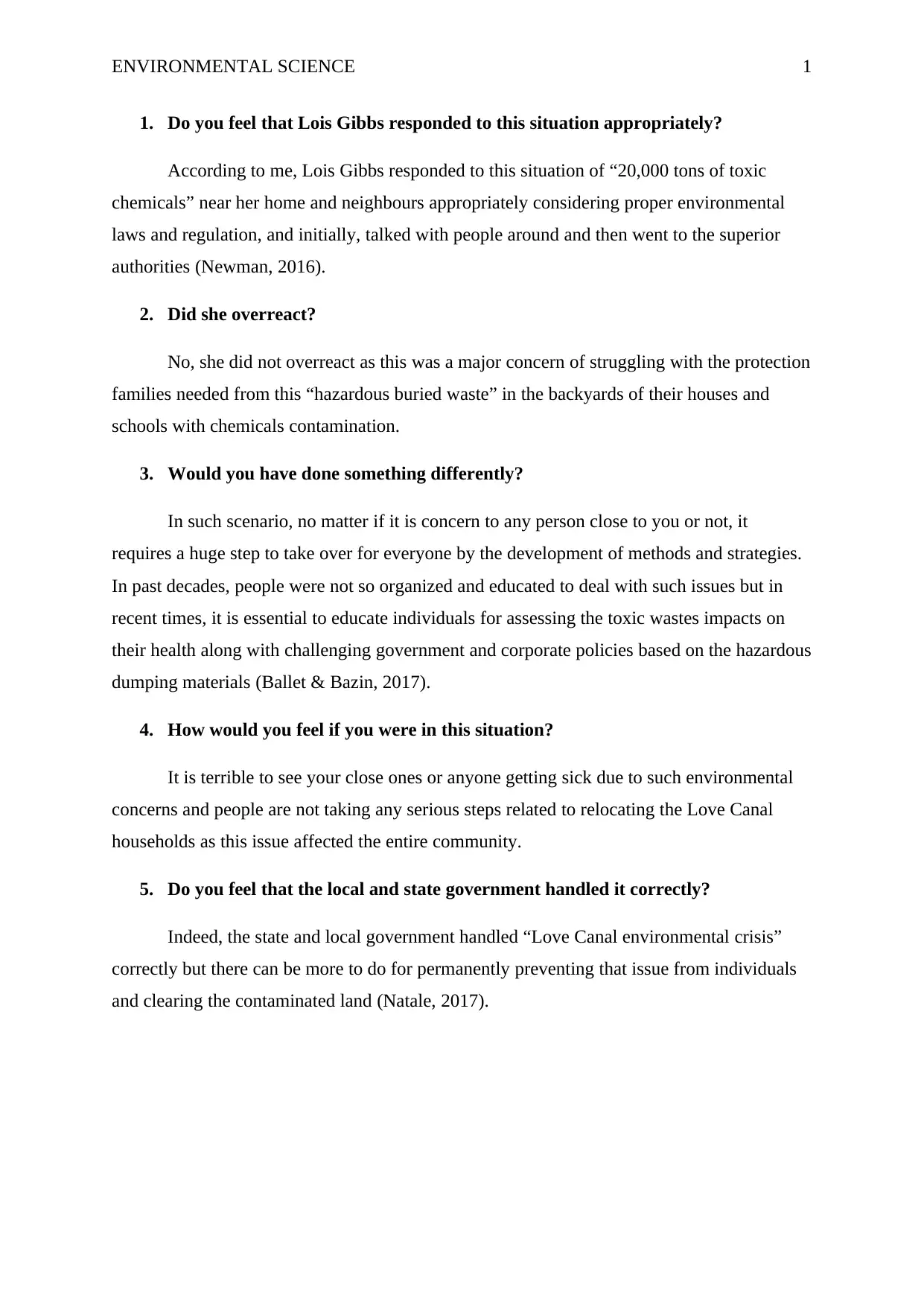
1. Do you feel that Lois Gibbs responded to this situation appropriately?
According to me, Lois Gibbs responded to this situation of “20,000 tons of toxic
chemicals” near her home and neighbours appropriately considering proper environmental
laws and regulation, and initially, talked with people around and then went to the superior
authorities (Newman, 2016).
2. Did she overreact?
No, she did not overreact as this was a major concern of struggling with the protection
families needed from this “hazardous buried waste” in the backyards of their houses and
schools with chemicals contamination.
3. Would you have done something differently?
In such scenario, no matter if it is concern to any person close to you or not, it
requires a huge step to take over for everyone by the development of methods and strategies.
In past decades, people were not so organized and educated to deal with such issues but in
recent times, it is essential to educate individuals for assessing the toxic wastes impacts on
their health along with challenging government and corporate policies based on the hazardous
dumping materials (Ballet & Bazin, 2017).
4. How would you feel if you were in this situation?
It is terrible to see your close ones or anyone getting sick due to such environmental
concerns and people are not taking any serious steps related to relocating the Love Canal
households as this issue affected the entire community.
5. Do you feel that the local and state government handled it correctly?
Indeed, the state and local government handled “Love Canal environmental crisis”
correctly but there can be more to do for permanently preventing that issue from individuals
and clearing the contaminated land (Natale, 2017).
Document Page
ENVIRONMENTAL SCIENCE 2
References
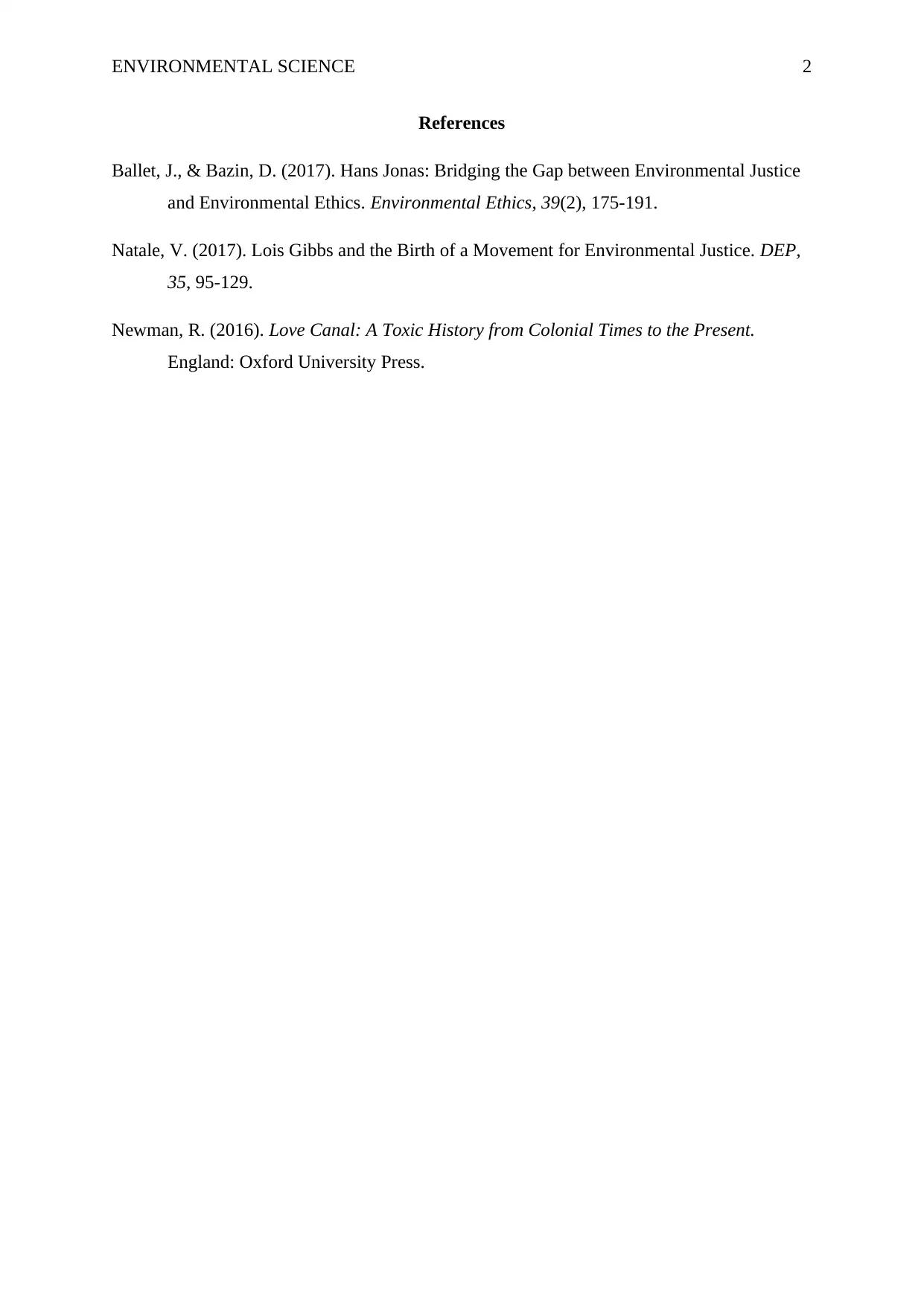
Ballet, J., & Bazin, D. (2017). Hans Jonas: Bridging the Gap between Environmental Justice
and Environmental Ethics. Environmental Ethics, 39(2), 175-191.
Natale, V. (2017). Lois Gibbs and the Birth of a Movement for Environmental Justice. DEP,
35, 95-129.
Newman, R. (2016). Love Canal: A Toxic History from Colonial Times to the Present.
England: Oxford University Press.
chevron_up_icon
1 out of 3
circle_padding
hide_on_mobile
zoom_out_icon
[object Object]