Analysis of Drinking Water Quality in Kuwait: Tap vs. Bottled Water

Verified

Added on  2023/04/24

|6
|1549
|238
Report
AI Summary
This report provides a comprehensive analysis of drinking water quality in Kuwait. It begins by outlining the procedure for drinking water production, highlighting the country's reliance on groundwater and the blending of distilled and brackish water. The report details the disinfection process using chlorine and the subsequent distribution of water to consumers. It identifies several issues during production, disinfection, storage, and distribution, such as corrosion and the blending ratio. The report then examines the quality of tap water, comparing it to bottled water through the analysis of TDS, electrical conductivity, and pH levels. Furthermore, it analyzes the composition of three different brands of bottled water, comparing their chemical contents. The study found no significant difference between tap and bottled water quality but stresses the need for improving pipeline distribution networks. The report concludes by emphasizing the need for authorities to address distribution issues and maintain water quality standards.
Document Page
Running head: WATER AND ENVIRONMENTAL DESIGN
WATER AND ENVIRONMENTAL DESIGN
Name of the Student
Name of the University
Author Note
tabler-icon-diamond-filled.svg

Paraphrase This Document

Need a fresh take? Get an instant paraphrase of this document with our AI Paraphraser
Document Page
1WATER AND ENVIRONMENTAL DESIGN
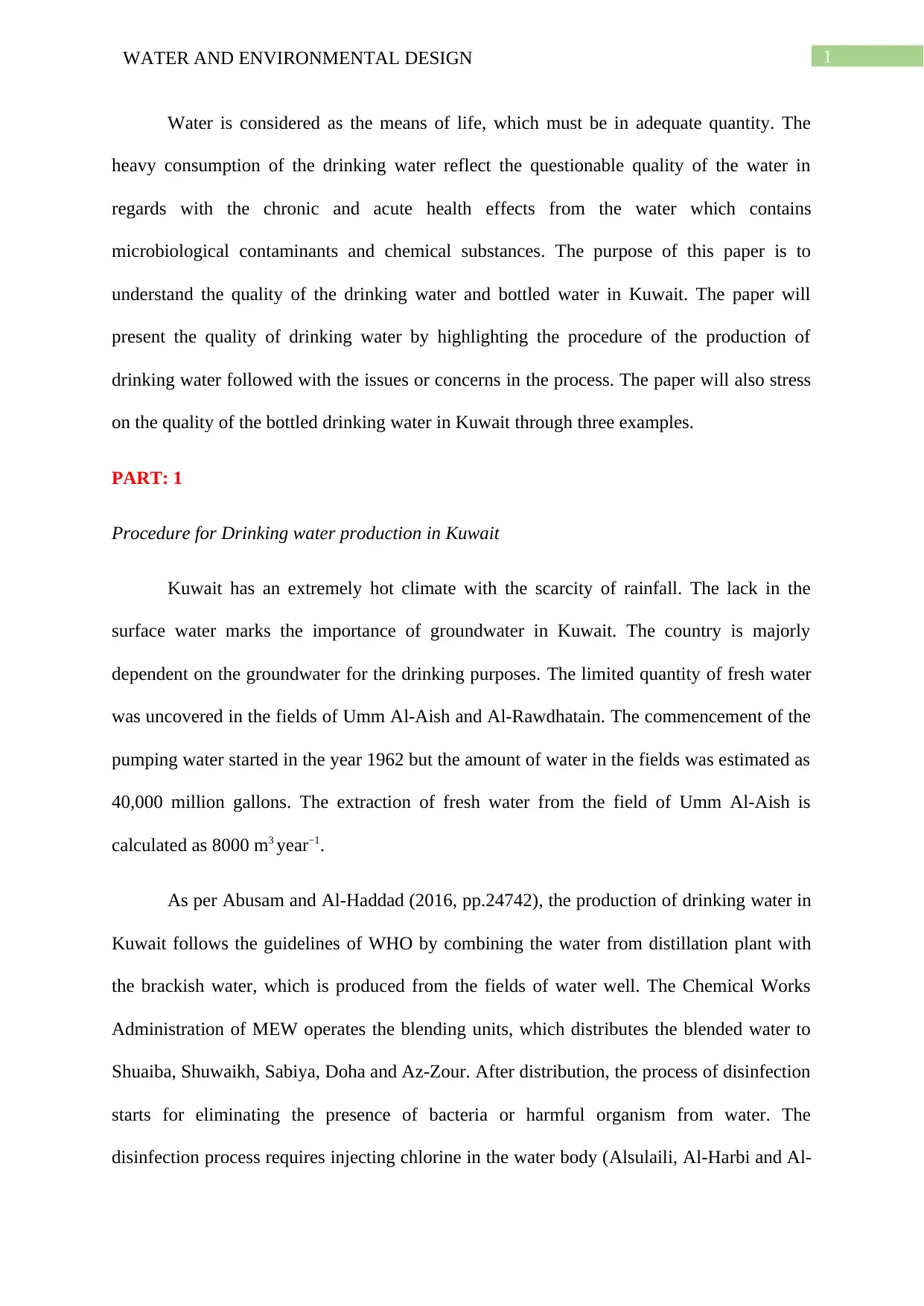
Water is considered as the means of life, which must be in adequate quantity. The
heavy consumption of the drinking water reflect the questionable quality of the water in
regards with the chronic and acute health effects from the water which contains
microbiological contaminants and chemical substances. The purpose of this paper is to
understand the quality of the drinking water and bottled water in Kuwait. The paper will
present the quality of drinking water by highlighting the procedure of the production of
drinking water followed with the issues or concerns in the process. The paper will also stress
on the quality of the bottled drinking water in Kuwait through three examples.
PART: 1
Procedure for Drinking water production in Kuwait
Kuwait has an extremely hot climate with the scarcity of rainfall. The lack in the
surface water marks the importance of groundwater in Kuwait. The country is majorly
dependent on the groundwater for the drinking purposes. The limited quantity of fresh water
was uncovered in the fields of Umm Al-Aish and Al-Rawdhatain. The commencement of the
pumping water started in the year 1962 but the amount of water in the fields was estimated as
40,000 million gallons. The extraction of fresh water from the field of Umm Al-Aish is
calculated as 8000 m3 year−1.
As per Abusam and Al-Haddad (2016, pp.24742), the production of drinking water in
Kuwait follows the guidelines of WHO by combining the water from distillation plant with
the brackish water, which is produced from the fields of water well. The Chemical Works
Administration of MEW operates the blending units, which distributes the blended water to
Shuaiba, Shuwaikh, Sabiya, Doha and Az-Zour. After distribution, the process of disinfection
starts for eliminating the presence of bacteria or harmful organism from water. The
disinfection process requires injecting chlorine in the water body (Alsulaili, Al-Harbi and Al-
Document Page
2WATER AND ENVIRONMENTAL DESIGN
Tawari 2015). The disinfection process is carried by the level of adding caustic soda for
maintaining the pH level up to a certified limit.
Blending of water in the plant followed by the distribution to various reservoirs where
the pumping process takes place. After the production of water through the process of
disinfecting, the water becomes available to the consumers through tankers, distribution line,
trunk lines and water towers (Alsulaili, Al-Harbi and Al-Tawari 2015).
Identification of issues during the production, disinfection, storage and distribution of water
is given as follows:
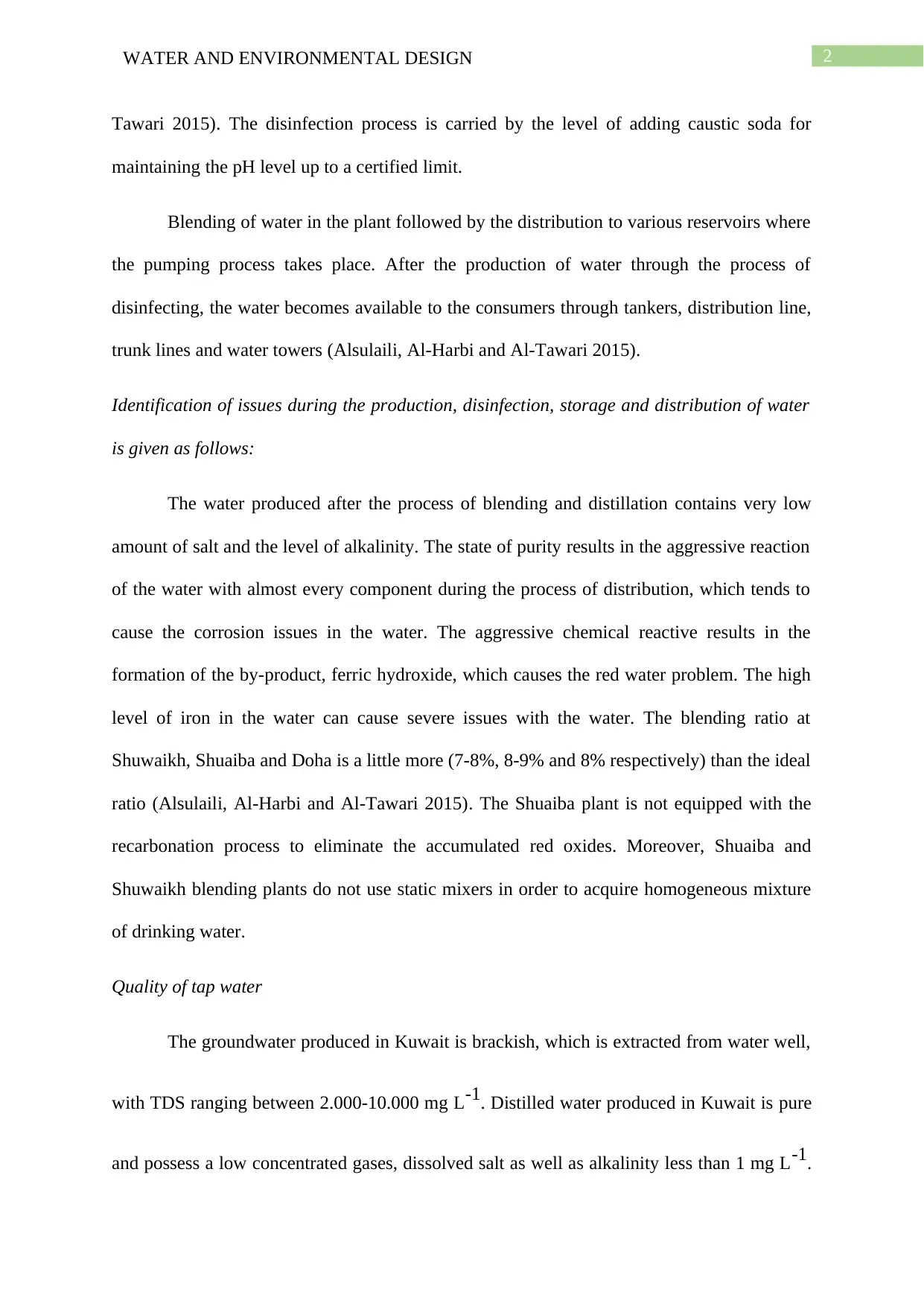
The water produced after the process of blending and distillation contains very low
amount of salt and the level of alkalinity. The state of purity results in the aggressive reaction
of the water with almost every component during the process of distribution, which tends to
cause the corrosion issues in the water. The aggressive chemical reactive results in the
formation of the by-product, ferric hydroxide, which causes the red water problem. The high
level of iron in the water can cause severe issues with the water. The blending ratio at
Shuwaikh, Shuaiba and Doha is a little more (7-8%, 8-9% and 8% respectively) than the ideal
ratio (Alsulaili, Al-Harbi and Al-Tawari 2015). The Shuaiba plant is not equipped with the
recarbonation process to eliminate the accumulated red oxides. Moreover, Shuaiba and
Shuwaikh blending plants do not use static mixers in order to acquire homogeneous mixture
of drinking water.
Quality of tap water
The groundwater produced in Kuwait is brackish, which is extracted from water well,
with TDS ranging between 2.000-10.000 mg L-1. Distilled water produced in Kuwait is pure
and possess a low concentrated gases, dissolved salt as well as alkalinity less than 1 mg L-1.
Document Page
3WATER AND ENVIRONMENTAL DESIGN
In Kuwait, the blend of distilled water and brackish water is used as fresh drinking water (Al-
Ruwaih, Alhumoud and Al-Mutairi 2010, pp.260).
A study was conducted by taking samples of water were taken from all around
Kuwait. In the study, the levels of TDS, electrical conductivity, (Na+) and pH were tested.
The level of pH, TDS, (Na+) and electrical conductivity were under the guidelines of
KUEPA, WHO and EPA (USA) (Al-Ruwaih, Alhumoud and Al-Mutairi 2010, pp.260).
However, the TDS values changes in distillation plants in the process of distribution through
pipelines, which should be treated as a concern for the authorities. The authorities should
come up with solutions to improve the pipeline distribution network to manage the lost
quality in the water. The level of electrical conductivity was highest in samples with high
TDS level (Aljamal, Speece and Bagnied 2016, pp.5065). The values of pH, electrical
conductivity and TDS were similar to that of six of the bottled drinking water, which
concludes that there is no significance difference in the quality of bottled drinking water in
Kuwait (Al-Ruwaih, Alhumoud and Al-Mutairi 2010, pp.260).
PART: 2
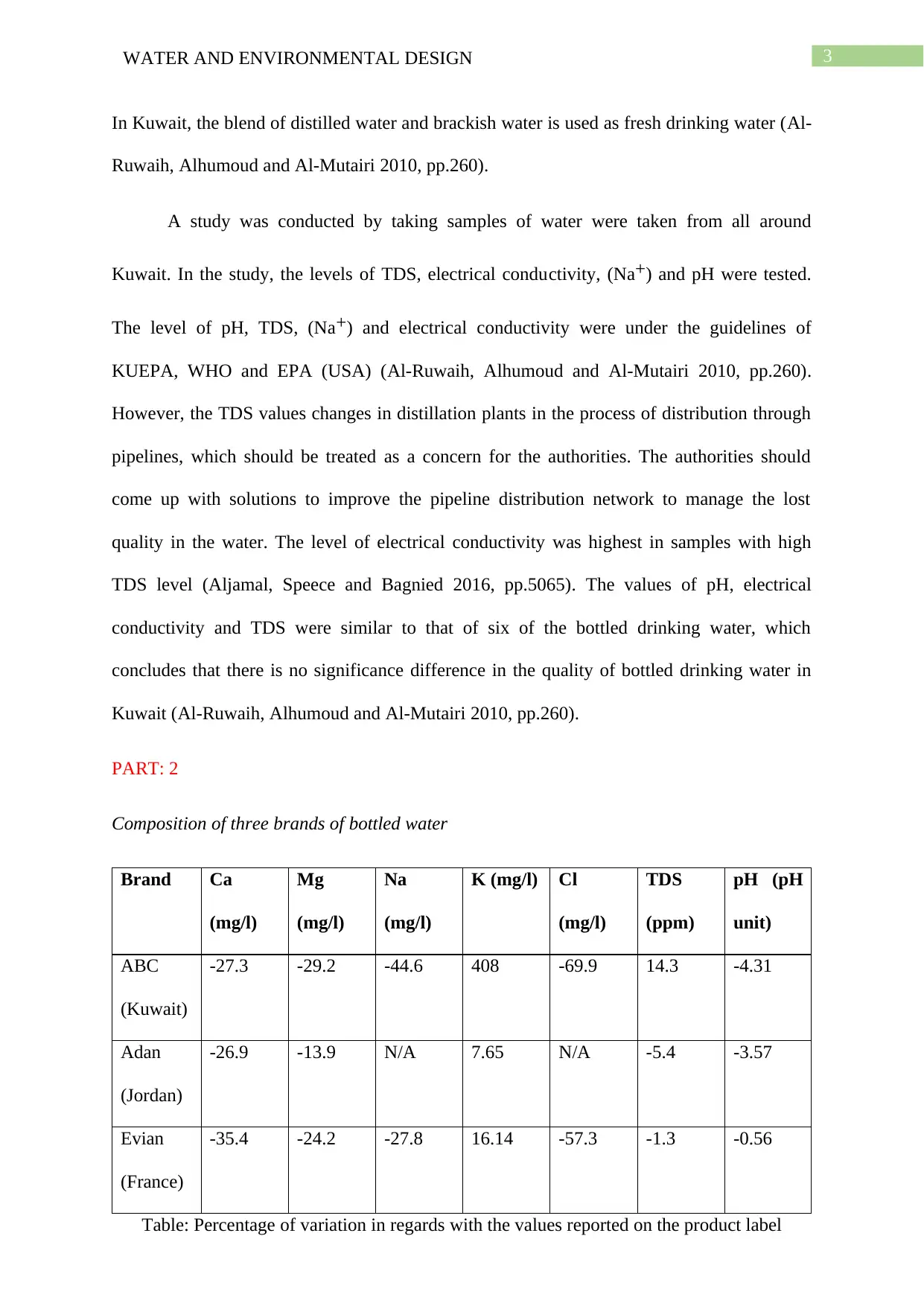
Composition of three brands of bottled water
Brand Ca
(mg/l)
Mg
(mg/l)
Na
(mg/l)
K (mg/l) Cl
(mg/l)
TDS
(ppm)
pH (pH
unit)
ABC
(Kuwait)
-27.3 -29.2 -44.6 408 -69.9 14.3 -4.31
Adan
(Jordan)
-26.9 -13.9 N/A 7.65 N/A -5.4 -3.57
Evian
(France)
-35.4 -24.2 -27.8 16.14 -57.3 -1.3 -0.56
Table: Percentage of variation in regards with the values reported on the product label
tabler-icon-diamond-filled.svg

Paraphrase This Document

Need a fresh take? Get an instant paraphrase of this document with our AI Paraphraser
Document Page
4WATER AND ENVIRONMENTAL DESIGN
(Source: Al-Mudhaf, Abu-Shady and Wichman 2007, pp.1019)
Analysis of bottled water
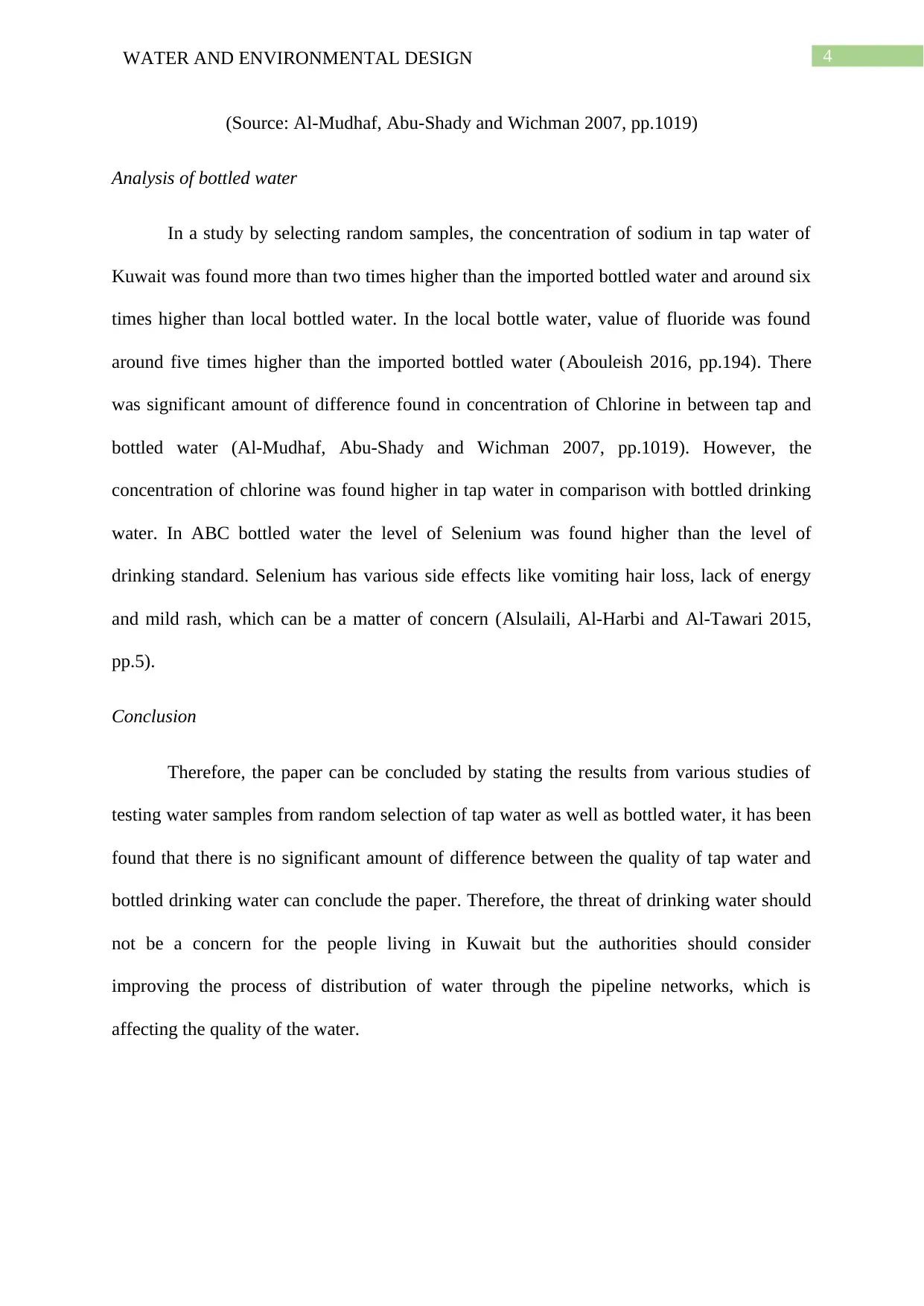
In a study by selecting random samples, the concentration of sodium in tap water of
Kuwait was found more than two times higher than the imported bottled water and around six
times higher than local bottled water. In the local bottle water, value of fluoride was found
around five times higher than the imported bottled water (Abouleish 2016, pp.194). There
was significant amount of difference found in concentration of Chlorine in between tap and
bottled water (Al-Mudhaf, Abu-Shady and Wichman 2007, pp.1019). However, the
concentration of chlorine was found higher in tap water in comparison with bottled drinking
water. In ABC bottled water the level of Selenium was found higher than the level of
drinking standard. Selenium has various side effects like vomiting hair loss, lack of energy
and mild rash, which can be a matter of concern (Alsulaili, Al-Harbi and Al-Tawari 2015,
pp.5).
Conclusion
Therefore, the paper can be concluded by stating the results from various studies of
testing water samples from random selection of tap water as well as bottled water, it has been
found that there is no significant amount of difference between the quality of tap water and
bottled drinking water can conclude the paper. Therefore, the threat of drinking water should
not be a concern for the people living in Kuwait but the authorities should consider
improving the process of distribution of water through the pipeline networks, which is
affecting the quality of the water.
Document Page
5WATER AND ENVIRONMENTAL DESIGN
References:
Abouleish, M.Y.Z., 2016. Evaluation of fluoride levels in bottled water and their contribution
to health and teeth problems in the United Arab Emirates. The Saudi dental journal, 28(4),
pp.194-202.
Abusam, A. and Al-Haddad, A., 2016. Long-term assessment of the product water of
sulaibiya wastewater treatment and reclamation plant, Kuwait. Desalination and Water
Treatment, 57(52), pp.24742-24749.
Al-Mudhaf, H.F., Abu-Shady, A.S.I. and Wichman, M.D., 2007. Overview of the chemical
content of household (tap) drinking water quality in the state of Kuwait. In Eleventh
International Water Technology Conference (pp. 1019-1035).
Al-Ruwaih, F.M., Alhumoud, J.M. and Al-Mutairi, S.M., 2010. Quality of potable water in
Kuwait. American Journal of Environmental Sciences, 6(3), pp.260-267.
Aljamal, A., Speece, M. and Bagnied, M.A., 2016. Kuwait water challenges: Building a
research agenda for policy impact and student experiential learning. Journal of Business
Research, 69(11), pp.5065-5070.
Alsulaili, A., Al-Harbi, M. and Al-Tawari, K., 2015. Physical and chemical characteristics of
drinking water quality in Kuwait: tap vs. bottled water. Journal of Engineering
Research, 1(3), pp.1-26.
chevron_up_icon
1 out of 6
circle_padding
hide_on_mobile
zoom_out_icon
[object Object]