EPE510 Project 1: Designing a Lesson Plan Focused on Prior Knowledge
VerifiedAdded on 2023/06/10
|11
|2698
|176
Project
AI Summary
This assignment is a solution for EPE510 Project 1, focusing on how learners demonstrate their acquired knowledge. It details a lesson design centered on assessing prior knowledge in language learning, specifically sentence formation and vocabulary development. The lesson plan includes engaging activities, clear learning intentions, and success criteria. It outlines a 30-minute lesson sequence with a hook, introduction, building activities, and conclusion. The project further includes a reflection section discussing the rationale for reflective practice, peer reflection, and the importance of teaching aids and collaborative efforts in creating a beneficial learning environment for children. The assignment emphasizes the use of various assessment methods and resources to enhance students' communication skills and overall language proficiency.
Project

Paraphrase This Document
Need a fresh take? Get an instant paraphrase of this document with our AI Paraphraser
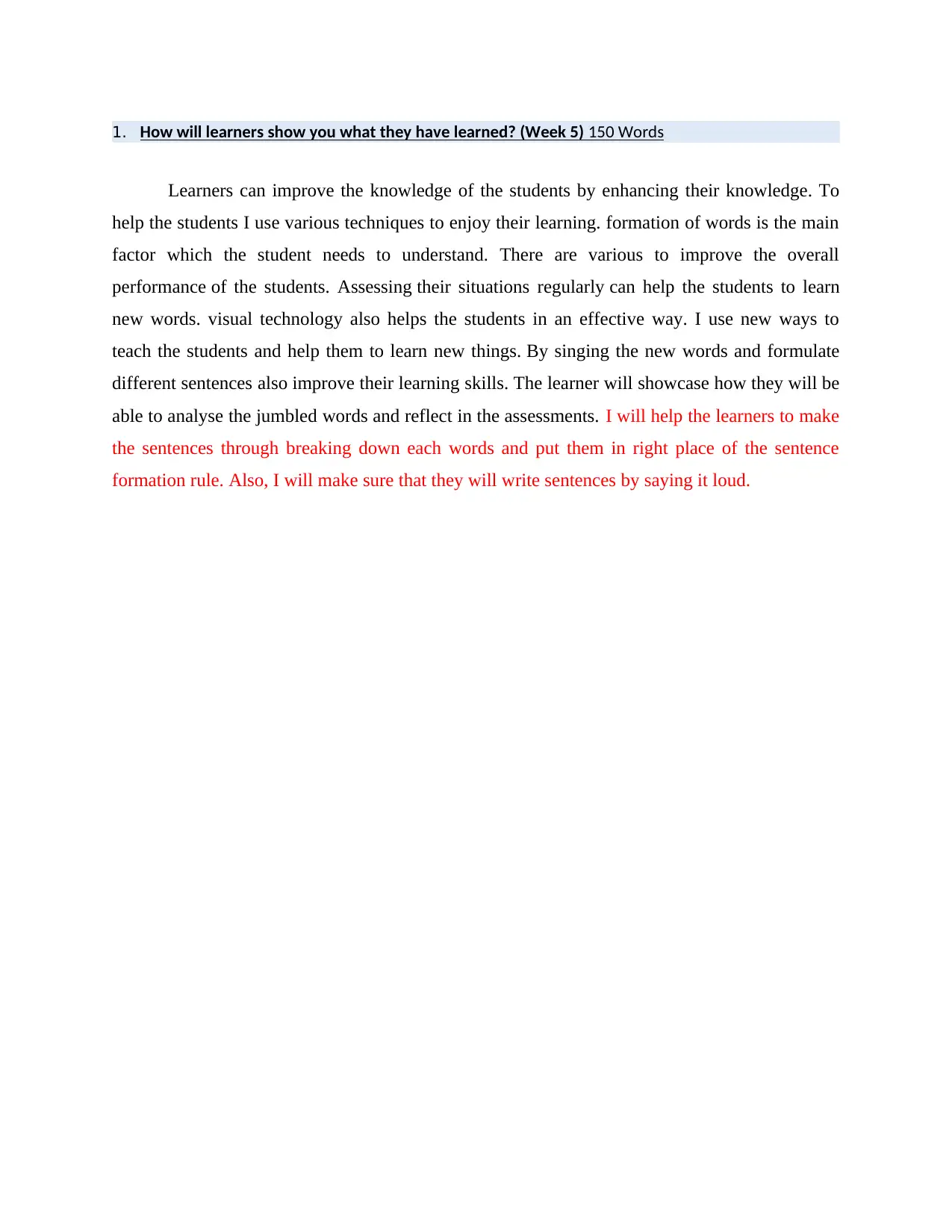
1. How will learners show you what they have learned? (Week 5) 150 Words
Learners can improve the knowledge of the students by enhancing their knowledge. To
help the students I use various techniques to enjoy their learning. formation of words is the main
factor which the student needs to understand. There are various to improve the overall
performance of the students. Assessing their situations regularly can help the students to learn
new words. visual technology also helps the students in an effective way. I use new ways to
teach the students and help them to learn new things. By singing the new words and formulate
different sentences also improve their learning skills. The learner will showcase how they will be
able to analyse the jumbled words and reflect in the assessments. I will help the learners to make
the sentences through breaking down each words and put them in right place of the sentence
formation rule. Also, I will make sure that they will write sentences by saying it loud.
Learners can improve the knowledge of the students by enhancing their knowledge. To
help the students I use various techniques to enjoy their learning. formation of words is the main
factor which the student needs to understand. There are various to improve the overall
performance of the students. Assessing their situations regularly can help the students to learn
new words. visual technology also helps the students in an effective way. I use new ways to
teach the students and help them to learn new things. By singing the new words and formulate
different sentences also improve their learning skills. The learner will showcase how they will be
able to analyse the jumbled words and reflect in the assessments. I will help the learners to make
the sentences through breaking down each words and put them in right place of the sentence
formation rule. Also, I will make sure that they will write sentences by saying it loud.
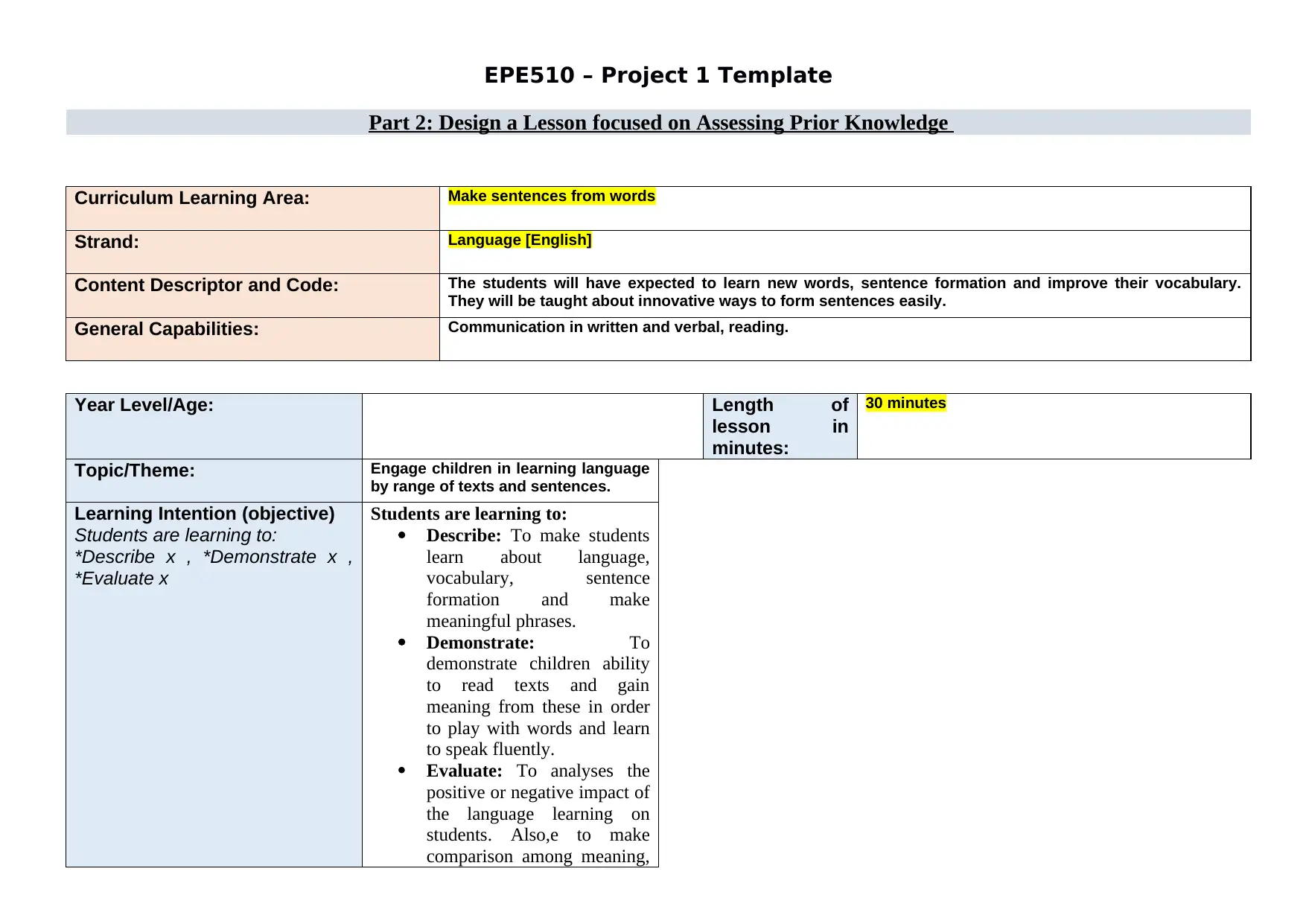
EPE510 – Project 1 Template
Part 2: Design a Lesson focused on Assessing Prior Knowledge
Curriculum Learning Area: Make sentences from words
Strand: Language [English]
Content Descriptor and Code: The students will have expected to learn new words, sentence formation and improve their vocabulary.
They will be taught about innovative ways to form sentences easily.
General Capabilities: Communication in written and verbal, reading.
Year Level/Age: Length of
lesson in
minutes:
30 minutes
Topic/Theme: Engage children in learning language
by range of texts and sentences.
Learning Intention (objective)
Students are learning to:
*Describe x , *Demonstrate x ,
*Evaluate x
Students are learning to:
Describe: To make students
learn about language,
vocabulary, sentence
formation and make
meaningful phrases.
Demonstrate: To
demonstrate children ability
to read texts and gain
meaning from these in order
to play with words and learn
to speak fluently.
Evaluate: To analyses the
positive or negative impact of
the language learning on
students. Also,e to make
comparison among meaning,
Part 2: Design a Lesson focused on Assessing Prior Knowledge
Curriculum Learning Area: Make sentences from words
Strand: Language [English]
Content Descriptor and Code: The students will have expected to learn new words, sentence formation and improve their vocabulary.
They will be taught about innovative ways to form sentences easily.
General Capabilities: Communication in written and verbal, reading.
Year Level/Age: Length of
lesson in
minutes:
30 minutes
Topic/Theme: Engage children in learning language
by range of texts and sentences.
Learning Intention (objective)
Students are learning to:
*Describe x , *Demonstrate x ,
*Evaluate x
Students are learning to:
Describe: To make students
learn about language,
vocabulary, sentence
formation and make
meaningful phrases.
Demonstrate: To
demonstrate children ability
to read texts and gain
meaning from these in order
to play with words and learn
to speak fluently.
Evaluate: To analyses the
positive or negative impact of
the language learning on
students. Also,e to make
comparison among meaning,
⊘ This is a preview!⊘
Do you want full access?
Subscribe today to unlock all pages.

Trusted by 1+ million students worldwide
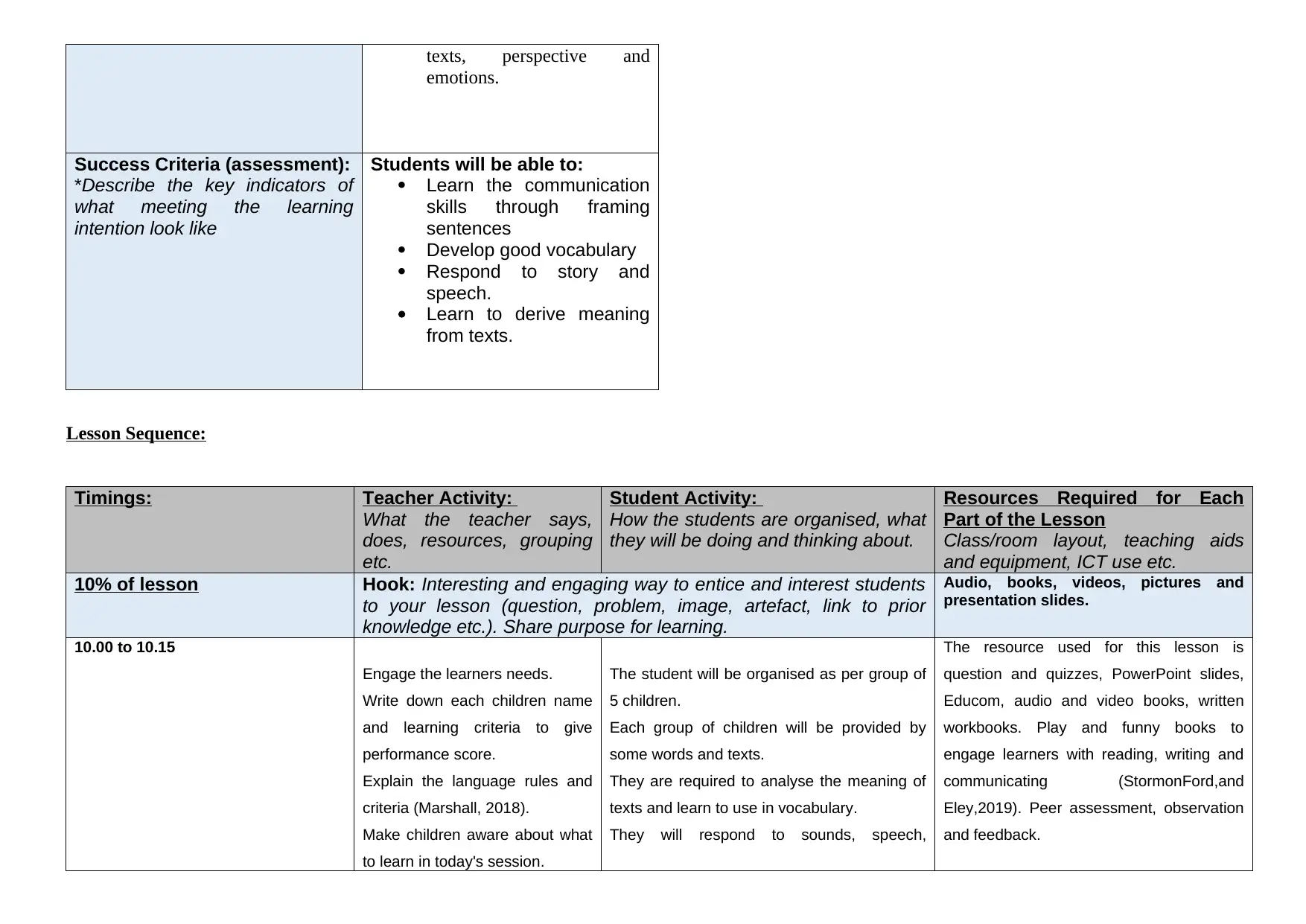
texts, perspective and
emotions.
Success Criteria (assessment):
*Describe the key indicators of
what meeting the learning
intention look like
Students will be able to:
Learn the communication
skills through framing
sentences
Develop good vocabulary
Respond to story and
speech.
Learn to derive meaning
from texts.
Lesson Sequence:
Timings: Teacher Activity:
What the teacher says,
does, resources, grouping
etc.
Student Activity:
How the students are organised, what
they will be doing and thinking about.
Resources Required for Each
Part of the Lesson
Class/room layout, teaching aids
and equipment, ICT use etc.
10% of lesson Hook: Interesting and engaging way to entice and interest students
to your lesson (question, problem, image, artefact, link to prior
knowledge etc.). Share purpose for learning.
Audio, books, videos, pictures and
presentation slides.
10.00 to 10.15
Engage the learners needs.
Write down each children name
and learning criteria to give
performance score.
Explain the language rules and
criteria (Marshall, 2018).
Make children aware about what
to learn in today's session.
The student will be organised as per group of
5 children.
Each group of children will be provided by
some words and texts.
They are required to analyse the meaning of
texts and learn to use in vocabulary.
They will respond to sounds, speech,
The resource used for this lesson is
question and quizzes, PowerPoint slides,
Educom, audio and video books, written
workbooks. Play and funny books to
engage learners with reading, writing and
communicating (StormonFord,and
Eley,2019). Peer assessment, observation
and feedback.
emotions.
Success Criteria (assessment):
*Describe the key indicators of
what meeting the learning
intention look like
Students will be able to:
Learn the communication
skills through framing
sentences
Develop good vocabulary
Respond to story and
speech.
Learn to derive meaning
from texts.
Lesson Sequence:
Timings: Teacher Activity:
What the teacher says,
does, resources, grouping
etc.
Student Activity:
How the students are organised, what
they will be doing and thinking about.
Resources Required for Each
Part of the Lesson
Class/room layout, teaching aids
and equipment, ICT use etc.
10% of lesson Hook: Interesting and engaging way to entice and interest students
to your lesson (question, problem, image, artefact, link to prior
knowledge etc.). Share purpose for learning.
Audio, books, videos, pictures and
presentation slides.
10.00 to 10.15
Engage the learners needs.
Write down each children name
and learning criteria to give
performance score.
Explain the language rules and
criteria (Marshall, 2018).
Make children aware about what
to learn in today's session.
The student will be organised as per group of
5 children.
Each group of children will be provided by
some words and texts.
They are required to analyse the meaning of
texts and learn to use in vocabulary.
They will respond to sounds, speech,
The resource used for this lesson is
question and quizzes, PowerPoint slides,
Educom, audio and video books, written
workbooks. Play and funny books to
engage learners with reading, writing and
communicating (StormonFord,and
Eley,2019). Peer assessment, observation
and feedback.
Paraphrase This Document
Need a fresh take? Get an instant paraphrase of this document with our AI Paraphraser

Revise the old words and
alphabets to move further for
analysing meaning through the
text.
Make group of 5 children and
collect resources to keep them
engaged with the lesson.
storytelling and rhymes.
The children sit in a group in which teacher
will demonstrate some words to pronounce.
First, they will revise all the alphabets and its
rhymes within the group.
The learners need to be highly attentive and
focused in learning language.
They must not miss any information related to
speech and sound.
The learners need to listened to teacher to
pronounce the word correctly.
Other resources are jingles, songs, texts,
literature role.
20% of lesson Introduction (Beginning): Present the learning intention to
students. Explain the purpose for learning. Demonstrate learning
task and elicit what learning will look like (student led success
criteria). You may wish to jointly construct task with class, before
moving onto the next stage.
10.30 to 11.00
Introduction about learning the
language, learn about phrases,
how words formed, use of verbs
in deriving meaning.
Learn about pronouns and
pronounce words by learning
words from dictionary.
There will be discussion about
how texts are identified in a
meaningful word.
The purpose of learning is make
their vocabulary and language
strong (West, and et.al., 2018).
The assignments will be given
The student needs to be aware about each
sessions and class to learn the words and
texts.
They need to think about the meaning of the
text in an appropriate manner.
The children will demonstrate their learned
meanings through framing a short sentence.
The children will frame sentence through
combining two words (Marangio, and Cooper,
2022).
The learners will be involving in play full
activities through games and a task will be
given to give instructions in English.
They need to think in creative ways and
The resources will have required to use for
the session is Moodle, dictionary, poems,
books and videos. `
alphabets to move further for
analysing meaning through the
text.
Make group of 5 children and
collect resources to keep them
engaged with the lesson.
storytelling and rhymes.
The children sit in a group in which teacher
will demonstrate some words to pronounce.
First, they will revise all the alphabets and its
rhymes within the group.
The learners need to be highly attentive and
focused in learning language.
They must not miss any information related to
speech and sound.
The learners need to listened to teacher to
pronounce the word correctly.
Other resources are jingles, songs, texts,
literature role.
20% of lesson Introduction (Beginning): Present the learning intention to
students. Explain the purpose for learning. Demonstrate learning
task and elicit what learning will look like (student led success
criteria). You may wish to jointly construct task with class, before
moving onto the next stage.
10.30 to 11.00
Introduction about learning the
language, learn about phrases,
how words formed, use of verbs
in deriving meaning.
Learn about pronouns and
pronounce words by learning
words from dictionary.
There will be discussion about
how texts are identified in a
meaningful word.
The purpose of learning is make
their vocabulary and language
strong (West, and et.al., 2018).
The assignments will be given
The student needs to be aware about each
sessions and class to learn the words and
texts.
They need to think about the meaning of the
text in an appropriate manner.
The children will demonstrate their learned
meanings through framing a short sentence.
The children will frame sentence through
combining two words (Marangio, and Cooper,
2022).
The learners will be involving in play full
activities through games and a task will be
given to give instructions in English.
They need to think in creative ways and
The resources will have required to use for
the session is Moodle, dictionary, poems,
books and videos. `
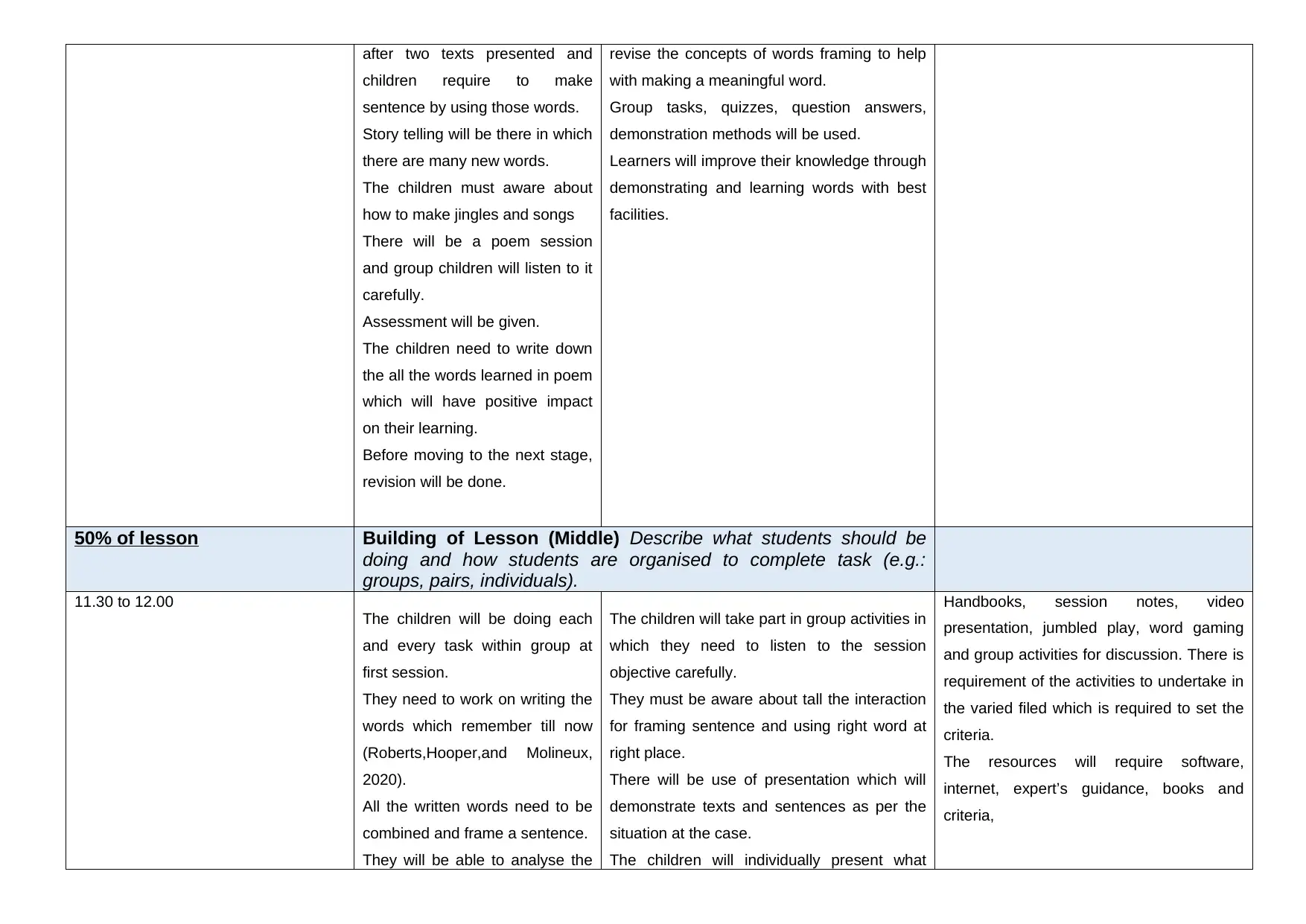
after two texts presented and
children require to make
sentence by using those words.
Story telling will be there in which
there are many new words.
The children must aware about
how to make jingles and songs
There will be a poem session
and group children will listen to it
carefully.
Assessment will be given.
The children need to write down
the all the words learned in poem
which will have positive impact
on their learning.
Before moving to the next stage,
revision will be done.
revise the concepts of words framing to help
with making a meaningful word.
Group tasks, quizzes, question answers,
demonstration methods will be used.
Learners will improve their knowledge through
demonstrating and learning words with best
facilities.
50% of lesson Building of Lesson (Middle) Describe what students should be
doing and how students are organised to complete task (e.g.:
groups, pairs, individuals).
11.30 to 12.00
The children will be doing each
and every task within group at
first session.
They need to work on writing the
words which remember till now
(Roberts,Hooper,and Molineux,
2020).
All the written words need to be
combined and frame a sentence.
They will be able to analyse the
The children will take part in group activities in
which they need to listen to the session
objective carefully.
They must be aware about tall the interaction
for framing sentence and using right word at
right place.
There will be use of presentation which will
demonstrate texts and sentences as per the
situation at the case.
The children will individually present what
Handbooks, session notes, video
presentation, jumbled play, word gaming
and group activities for discussion. There is
requirement of the activities to undertake in
the varied filed which is required to set the
criteria.
The resources will require software,
internet, expert’s guidance, books and
criteria,
children require to make
sentence by using those words.
Story telling will be there in which
there are many new words.
The children must aware about
how to make jingles and songs
There will be a poem session
and group children will listen to it
carefully.
Assessment will be given.
The children need to write down
the all the words learned in poem
which will have positive impact
on their learning.
Before moving to the next stage,
revision will be done.
revise the concepts of words framing to help
with making a meaningful word.
Group tasks, quizzes, question answers,
demonstration methods will be used.
Learners will improve their knowledge through
demonstrating and learning words with best
facilities.
50% of lesson Building of Lesson (Middle) Describe what students should be
doing and how students are organised to complete task (e.g.:
groups, pairs, individuals).
11.30 to 12.00
The children will be doing each
and every task within group at
first session.
They need to work on writing the
words which remember till now
(Roberts,Hooper,and Molineux,
2020).
All the written words need to be
combined and frame a sentence.
They will be able to analyse the
The children will take part in group activities in
which they need to listen to the session
objective carefully.
They must be aware about tall the interaction
for framing sentence and using right word at
right place.
There will be use of presentation which will
demonstrate texts and sentences as per the
situation at the case.
The children will individually present what
Handbooks, session notes, video
presentation, jumbled play, word gaming
and group activities for discussion. There is
requirement of the activities to undertake in
the varied filed which is required to set the
criteria.
The resources will require software,
internet, expert’s guidance, books and
criteria,
⊘ This is a preview!⊘
Do you want full access?
Subscribe today to unlock all pages.
Trusted by 1+ million students worldwide
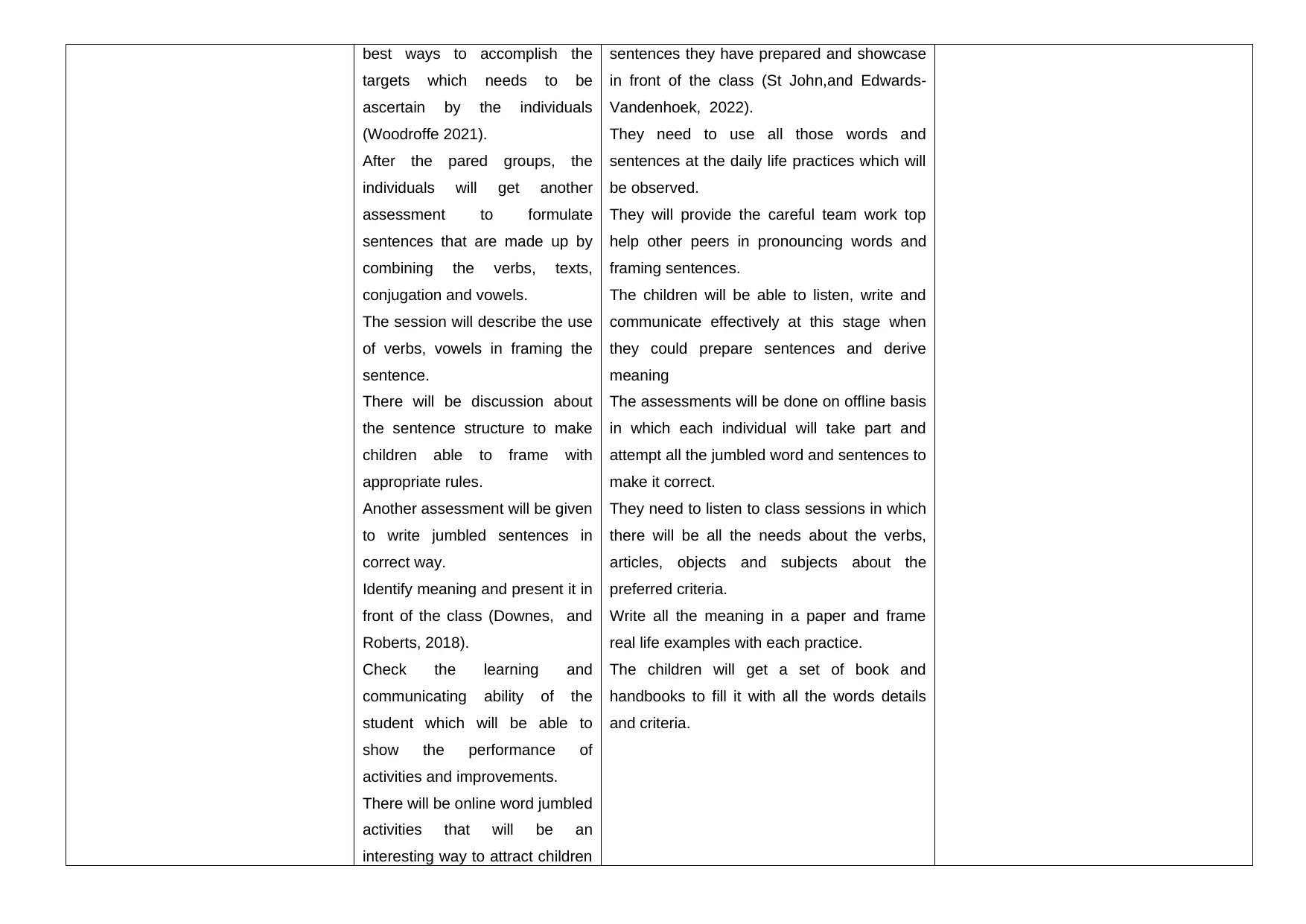
best ways to accomplish the
targets which needs to be
ascertain by the individuals
(Woodroffe 2021).
After the pared groups, the
individuals will get another
assessment to formulate
sentences that are made up by
combining the verbs, texts,
conjugation and vowels.
The session will describe the use
of verbs, vowels in framing the
sentence.
There will be discussion about
the sentence structure to make
children able to frame with
appropriate rules.
Another assessment will be given
to write jumbled sentences in
correct way.
Identify meaning and present it in
front of the class (Downes, and
Roberts, 2018).
Check the learning and
communicating ability of the
student which will be able to
show the performance of
activities and improvements.
There will be online word jumbled
activities that will be an
interesting way to attract children
sentences they have prepared and showcase
in front of the class (St John,and Edwards-
Vandenhoek, 2022).
They need to use all those words and
sentences at the daily life practices which will
be observed.
They will provide the careful team work top
help other peers in pronouncing words and
framing sentences.
The children will be able to listen, write and
communicate effectively at this stage when
they could prepare sentences and derive
meaning
The assessments will be done on offline basis
in which each individual will take part and
attempt all the jumbled word and sentences to
make it correct.
They need to listen to class sessions in which
there will be all the needs about the verbs,
articles, objects and subjects about the
preferred criteria.
Write all the meaning in a paper and frame
real life examples with each practice.
The children will get a set of book and
handbooks to fill it with all the words details
and criteria.
targets which needs to be
ascertain by the individuals
(Woodroffe 2021).
After the pared groups, the
individuals will get another
assessment to formulate
sentences that are made up by
combining the verbs, texts,
conjugation and vowels.
The session will describe the use
of verbs, vowels in framing the
sentence.
There will be discussion about
the sentence structure to make
children able to frame with
appropriate rules.
Another assessment will be given
to write jumbled sentences in
correct way.
Identify meaning and present it in
front of the class (Downes, and
Roberts, 2018).
Check the learning and
communicating ability of the
student which will be able to
show the performance of
activities and improvements.
There will be online word jumbled
activities that will be an
interesting way to attract children
sentences they have prepared and showcase
in front of the class (St John,and Edwards-
Vandenhoek, 2022).
They need to use all those words and
sentences at the daily life practices which will
be observed.
They will provide the careful team work top
help other peers in pronouncing words and
framing sentences.
The children will be able to listen, write and
communicate effectively at this stage when
they could prepare sentences and derive
meaning
The assessments will be done on offline basis
in which each individual will take part and
attempt all the jumbled word and sentences to
make it correct.
They need to listen to class sessions in which
there will be all the needs about the verbs,
articles, objects and subjects about the
preferred criteria.
Write all the meaning in a paper and frame
real life examples with each practice.
The children will get a set of book and
handbooks to fill it with all the words details
and criteria.
Paraphrase This Document
Need a fresh take? Get an instant paraphrase of this document with our AI Paraphraser
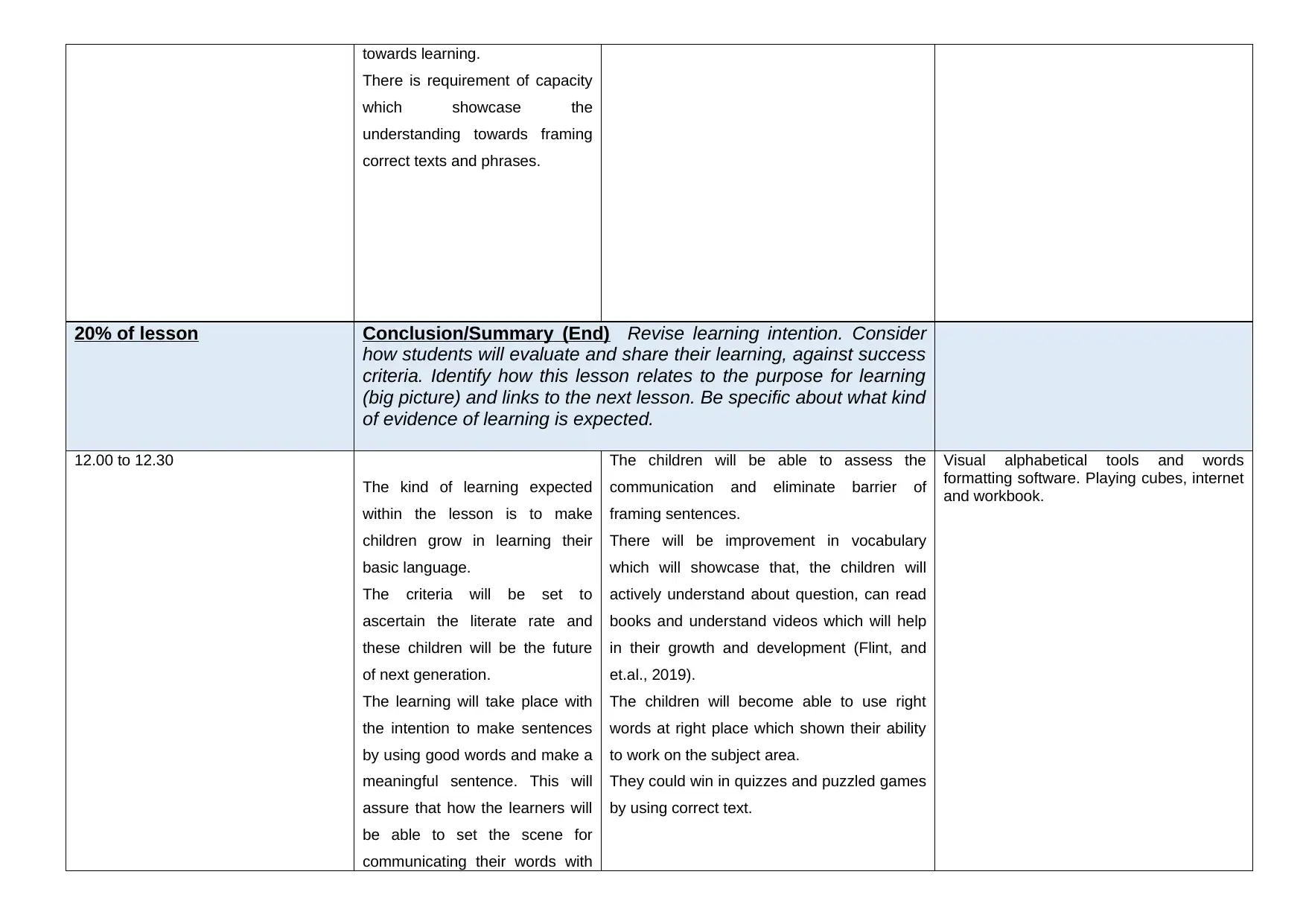
towards learning.
There is requirement of capacity
which showcase the
understanding towards framing
correct texts and phrases.
20% of lesson Conclusion/Summary (End) Revise learning intention. Consider
how students will evaluate and share their learning, against success
criteria. Identify how this lesson relates to the purpose for learning
(big picture) and links to the next lesson. Be specific about what kind
of evidence of learning is expected.
12.00 to 12.30
The kind of learning expected
within the lesson is to make
children grow in learning their
basic language.
The criteria will be set to
ascertain the literate rate and
these children will be the future
of next generation.
The learning will take place with
the intention to make sentences
by using good words and make a
meaningful sentence. This will
assure that how the learners will
be able to set the scene for
communicating their words with
The children will be able to assess the
communication and eliminate barrier of
framing sentences.
There will be improvement in vocabulary
which will showcase that, the children will
actively understand about question, can read
books and understand videos which will help
in their growth and development (Flint, and
et.al., 2019).
The children will become able to use right
words at right place which shown their ability
to work on the subject area.
They could win in quizzes and puzzled games
by using correct text.
Visual alphabetical tools and words
formatting software. Playing cubes, internet
and workbook.
There is requirement of capacity
which showcase the
understanding towards framing
correct texts and phrases.
20% of lesson Conclusion/Summary (End) Revise learning intention. Consider
how students will evaluate and share their learning, against success
criteria. Identify how this lesson relates to the purpose for learning
(big picture) and links to the next lesson. Be specific about what kind
of evidence of learning is expected.
12.00 to 12.30
The kind of learning expected
within the lesson is to make
children grow in learning their
basic language.
The criteria will be set to
ascertain the literate rate and
these children will be the future
of next generation.
The learning will take place with
the intention to make sentences
by using good words and make a
meaningful sentence. This will
assure that how the learners will
be able to set the scene for
communicating their words with
The children will be able to assess the
communication and eliminate barrier of
framing sentences.
There will be improvement in vocabulary
which will showcase that, the children will
actively understand about question, can read
books and understand videos which will help
in their growth and development (Flint, and
et.al., 2019).
The children will become able to use right
words at right place which shown their ability
to work on the subject area.
They could win in quizzes and puzzled games
by using correct text.
Visual alphabetical tools and words
formatting software. Playing cubes, internet
and workbook.

others.
Part 3: Reflection (500 words):
Rationale for Reflective practice from the literature
The reflective practice is a piece of work which shows how an individual gone through with some experience. It is required to analyse strength,
weakness of own self to work on the specific skills and knowledge. It gives an insight about how an individual will reflect on their performance and its works
like a self-check which helps in taking further decisions (Catherwood, 2021). From the overall project and literature, i have learned that teaching is an
important concept which helps in creating welfare of children to make them literate and learned about necessary knowledge and skills. I have learned to
analyse use of many teaching aids and resources which impact on planning and delivering lesson plan. It emphasises on building great plans for session that
will clear my mind during practical teaching. I will be able to connect better with children and understand their needs and specification from the lesson. This
shows that, during the work schedule, a lot of task and activities creates pressure, for that instance, designing learning plans. Scheme of work and sessions
plays vital role in working on the objectives carefully.
Peer Reflection
when I was working in the primary school, I have learned a lot of things about working with collaborative efforts, in teaching and learning there is
requirement of teamwork, referrals which helps in gaining individual potential about communication. I learned to prepare plans by managing behaviour with
others and take decisions for every session through conducting peer meetings. Also, in the review sessions, the peers have helped me in learning and
understanding about child capabilities and their attitudes. Also, I came across with varieties of their interest which Is focused in the lesson plan.
Part 3: Reflection (500 words):
Rationale for Reflective practice from the literature
The reflective practice is a piece of work which shows how an individual gone through with some experience. It is required to analyse strength,
weakness of own self to work on the specific skills and knowledge. It gives an insight about how an individual will reflect on their performance and its works
like a self-check which helps in taking further decisions (Catherwood, 2021). From the overall project and literature, i have learned that teaching is an
important concept which helps in creating welfare of children to make them literate and learned about necessary knowledge and skills. I have learned to
analyse use of many teaching aids and resources which impact on planning and delivering lesson plan. It emphasises on building great plans for session that
will clear my mind during practical teaching. I will be able to connect better with children and understand their needs and specification from the lesson. This
shows that, during the work schedule, a lot of task and activities creates pressure, for that instance, designing learning plans. Scheme of work and sessions
plays vital role in working on the objectives carefully.
Peer Reflection
when I was working in the primary school, I have learned a lot of things about working with collaborative efforts, in teaching and learning there is
requirement of teamwork, referrals which helps in gaining individual potential about communication. I learned to prepare plans by managing behaviour with
others and take decisions for every session through conducting peer meetings. Also, in the review sessions, the peers have helped me in learning and
understanding about child capabilities and their attitudes. Also, I came across with varieties of their interest which Is focused in the lesson plan.
⊘ This is a preview!⊘
Do you want full access?
Subscribe today to unlock all pages.
Trusted by 1+ million students worldwide

Paraphrase This Document
Need a fresh take? Get an instant paraphrase of this document with our AI Paraphraser
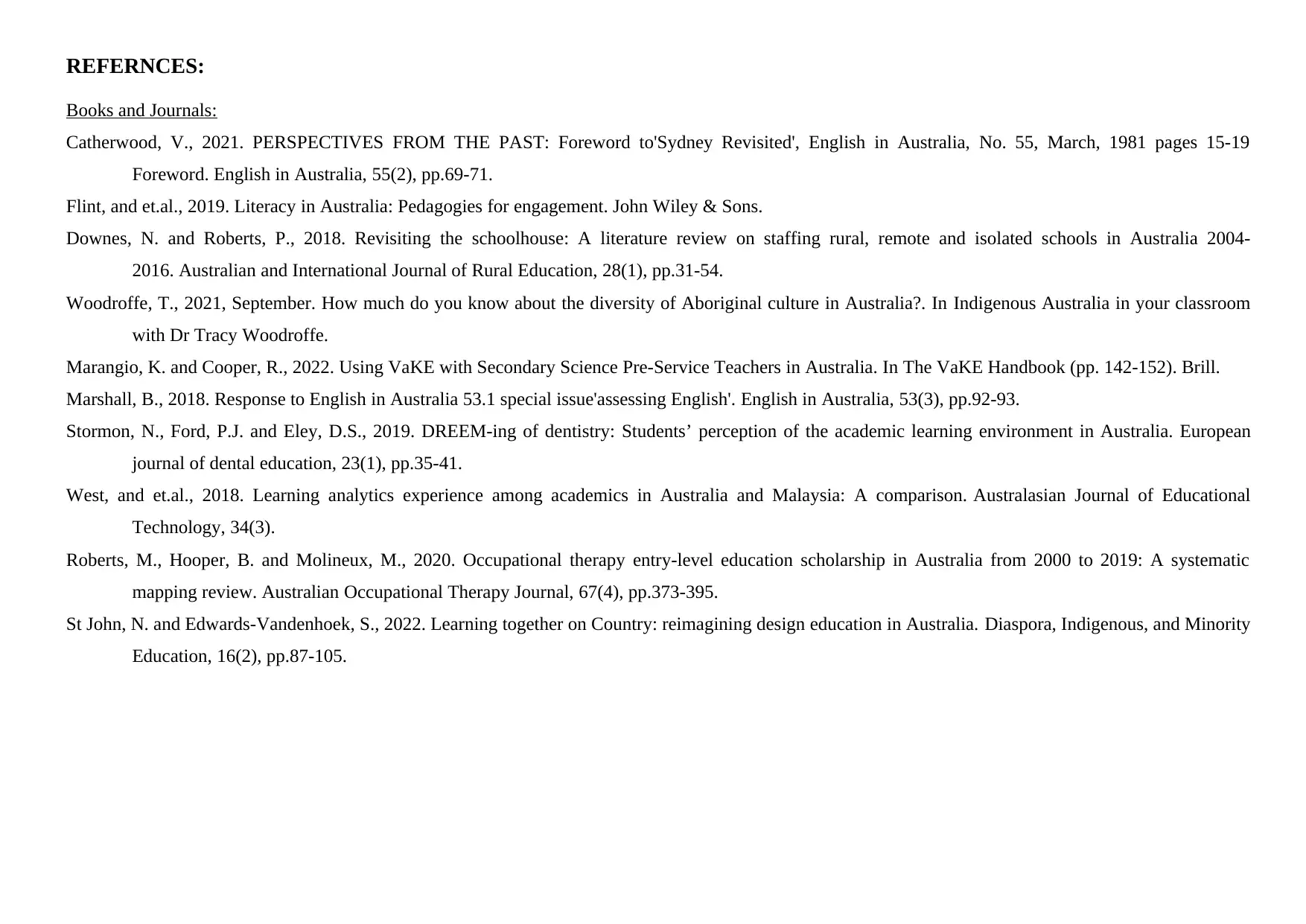
REFERNCES:
Books and Journals:
Catherwood, V., 2021. PERSPECTIVES FROM THE PAST: Foreword to'Sydney Revisited', English in Australia, No. 55, March, 1981 pages 15-19
Foreword. English in Australia, 55(2), pp.69-71.
Flint, and et.al., 2019. Literacy in Australia: Pedagogies for engagement. John Wiley & Sons.
Downes, N. and Roberts, P., 2018. Revisiting the schoolhouse: A literature review on staffing rural, remote and isolated schools in Australia 2004-
2016. Australian and International Journal of Rural Education, 28(1), pp.31-54.
Woodroffe, T., 2021, September. How much do you know about the diversity of Aboriginal culture in Australia?. In Indigenous Australia in your classroom
with Dr Tracy Woodroffe.
Marangio, K. and Cooper, R., 2022. Using VaKE with Secondary Science Pre-Service Teachers in Australia. In The VaKE Handbook (pp. 142-152). Brill.
Marshall, B., 2018. Response to English in Australia 53.1 special issue'assessing English'. English in Australia, 53(3), pp.92-93.
Stormon, N., Ford, P.J. and Eley, D.S., 2019. DREEM‐ing of dentistry: Students’ perception of the academic learning environment in Australia. European
journal of dental education, 23(1), pp.35-41.
West, and et.al., 2018. Learning analytics experience among academics in Australia and Malaysia: A comparison. Australasian Journal of Educational
Technology, 34(3).
Roberts, M., Hooper, B. and Molineux, M., 2020. Occupational therapy entry‐level education scholarship in Australia from 2000 to 2019: A systematic
mapping review. Australian Occupational Therapy Journal, 67(4), pp.373-395.
St John, N. and Edwards-Vandenhoek, S., 2022. Learning together on Country: reimagining design education in Australia. Diaspora, Indigenous, and Minority
Education, 16(2), pp.87-105.
Books and Journals:
Catherwood, V., 2021. PERSPECTIVES FROM THE PAST: Foreword to'Sydney Revisited', English in Australia, No. 55, March, 1981 pages 15-19
Foreword. English in Australia, 55(2), pp.69-71.
Flint, and et.al., 2019. Literacy in Australia: Pedagogies for engagement. John Wiley & Sons.
Downes, N. and Roberts, P., 2018. Revisiting the schoolhouse: A literature review on staffing rural, remote and isolated schools in Australia 2004-
2016. Australian and International Journal of Rural Education, 28(1), pp.31-54.
Woodroffe, T., 2021, September. How much do you know about the diversity of Aboriginal culture in Australia?. In Indigenous Australia in your classroom
with Dr Tracy Woodroffe.
Marangio, K. and Cooper, R., 2022. Using VaKE with Secondary Science Pre-Service Teachers in Australia. In The VaKE Handbook (pp. 142-152). Brill.
Marshall, B., 2018. Response to English in Australia 53.1 special issue'assessing English'. English in Australia, 53(3), pp.92-93.
Stormon, N., Ford, P.J. and Eley, D.S., 2019. DREEM‐ing of dentistry: Students’ perception of the academic learning environment in Australia. European
journal of dental education, 23(1), pp.35-41.
West, and et.al., 2018. Learning analytics experience among academics in Australia and Malaysia: A comparison. Australasian Journal of Educational
Technology, 34(3).
Roberts, M., Hooper, B. and Molineux, M., 2020. Occupational therapy entry‐level education scholarship in Australia from 2000 to 2019: A systematic
mapping review. Australian Occupational Therapy Journal, 67(4), pp.373-395.
St John, N. and Edwards-Vandenhoek, S., 2022. Learning together on Country: reimagining design education in Australia. Diaspora, Indigenous, and Minority
Education, 16(2), pp.87-105.

1 out of 11


Related Documents


Your All-in-One AI-Powered Toolkit for Academic Success.
+13062052269
info@desklib.com
Available 24*7 on WhatsApp / Email
![[object Object]](/_next/static/media/star-bottom.7253800d.svg)
Unlock your academic potential
Copyright © 2020–2026 A2Z Services. All Rights Reserved. Developed and managed by ZUCOL.