Analysis of The Epic of Gilgamesh: Foreshadowing and Themes

Verified

Added on  2023/06/04

|4
|760
|316
Essay
AI Summary
This essay provides an analysis of the Epic of Gilgamesh, focusing on the foreshadowing present in the prologue and throughout the narrative. It examines the significance of the city of Uruk as a representation of human accomplishment and contrasts it with the wilderness inhabited by Enkidu. The essay explores the implications of Gilgamesh's mixed divine and mortal parentage and the citizens' lament, leading to divine intervention and the creation of Enkidu. It delves into Enkidu's characteristics, the trapper's fear, and the consequences of Enkidu's encounter with the harlot. The analysis also covers Enkidu's interactions with shepherds and the mixed results of the campaign against Humbaba, highlighting the themes of friendship, sacrifice, and the inevitability of death. The essay emphasizes the recurrent motifs of dreams and the conflicting wills of the gods in shaping the plot, concluding that the Epic of Gilgamesh is a universal story about humanity's relationship with the natural world, consciousness, and the human condition.
Document Page
Running Head: THE EPIC OF GILGAMESH
The Epic Of Gilgamesh
Name of Student
Name of University
Author note
tabler-icon-diamond-filled.svg

Paraphrase This Document

Need a fresh take? Get an instant paraphrase of this document with our AI Paraphraser
Document Page
1
THE EPIC OF GILGAMESH
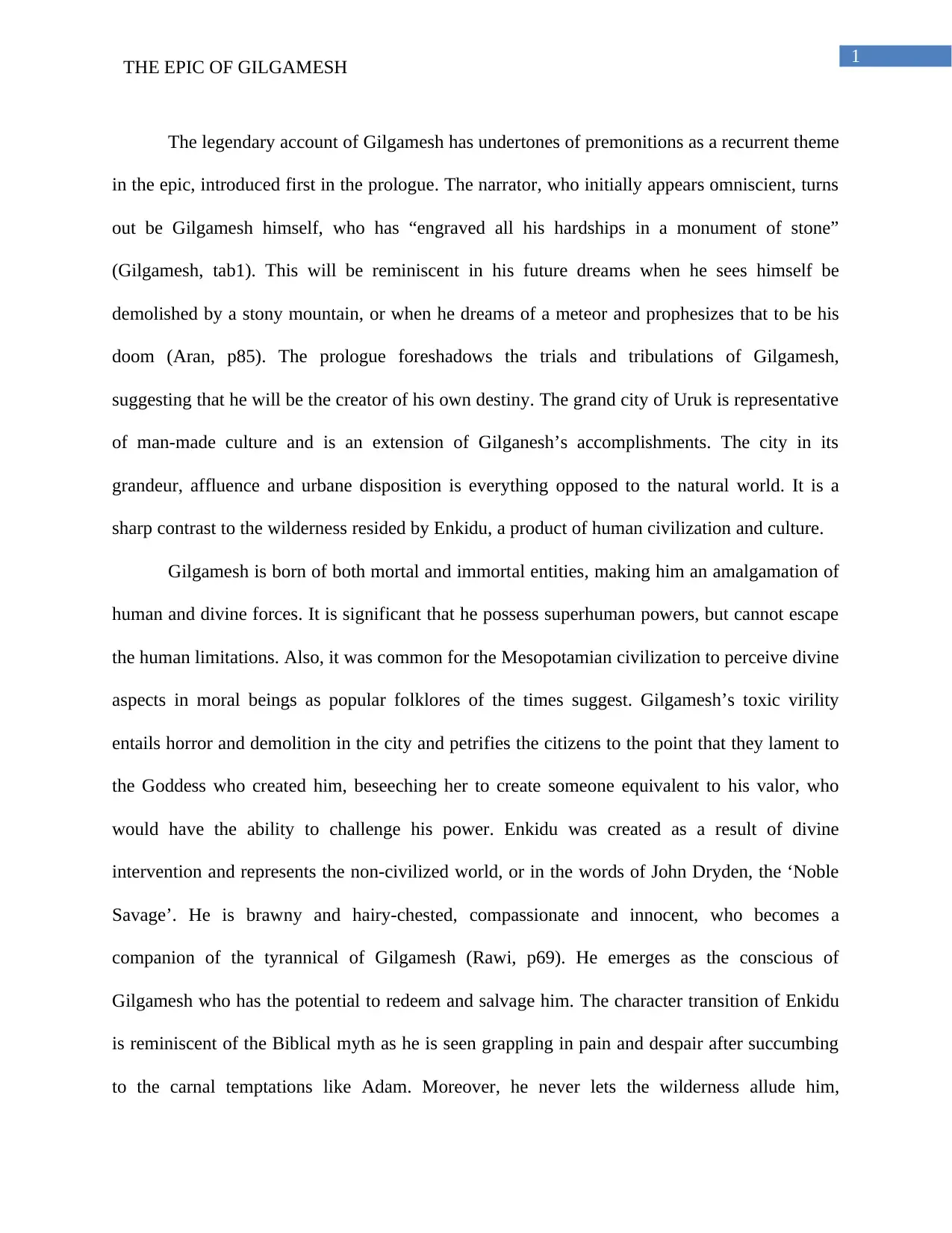
The legendary account of Gilgamesh has undertones of premonitions as a recurrent theme
in the epic, introduced first in the prologue. The narrator, who initially appears omniscient, turns
out be Gilgamesh himself, who has “engraved all his hardships in a monument of stone”
(Gilgamesh, tab1). This will be reminiscent in his future dreams when he sees himself be
demolished by a stony mountain, or when he dreams of a meteor and prophesizes that to be his
doom (Aran, p85). The prologue foreshadows the trials and tribulations of Gilgamesh,
suggesting that he will be the creator of his own destiny. The grand city of Uruk is representative
of man-made culture and is an extension of Gilganesh’s accomplishments. The city in its
grandeur, affluence and urbane disposition is everything opposed to the natural world. It is a
sharp contrast to the wilderness resided by Enkidu, a product of human civilization and culture.
Gilgamesh is born of both mortal and immortal entities, making him an amalgamation of
human and divine forces. It is significant that he possess superhuman powers, but cannot escape
the human limitations. Also, it was common for the Mesopotamian civilization to perceive divine
aspects in moral beings as popular folklores of the times suggest. Gilgamesh’s toxic virility
entails horror and demolition in the city and petrifies the citizens to the point that they lament to
the Goddess who created him, beseeching her to create someone equivalent to his valor, who
would have the ability to challenge his power. Enkidu was created as a result of divine
intervention and represents the non-civilized world, or in the words of John Dryden, the ‘Noble
Savage’. He is brawny and hairy-chested, compassionate and innocent, who becomes a
companion of the tyrannical of Gilgamesh (Rawi, p69). He emerges as the conscious of
Gilgamesh who has the potential to redeem and salvage him. The character transition of Enkidu
is reminiscent of the Biblical myth as he is seen grappling in pain and despair after succumbing
to the carnal temptations like Adam. Moreover, he never lets the wilderness allude him,
Document Page
2
THE EPIC OF GILGAMESH
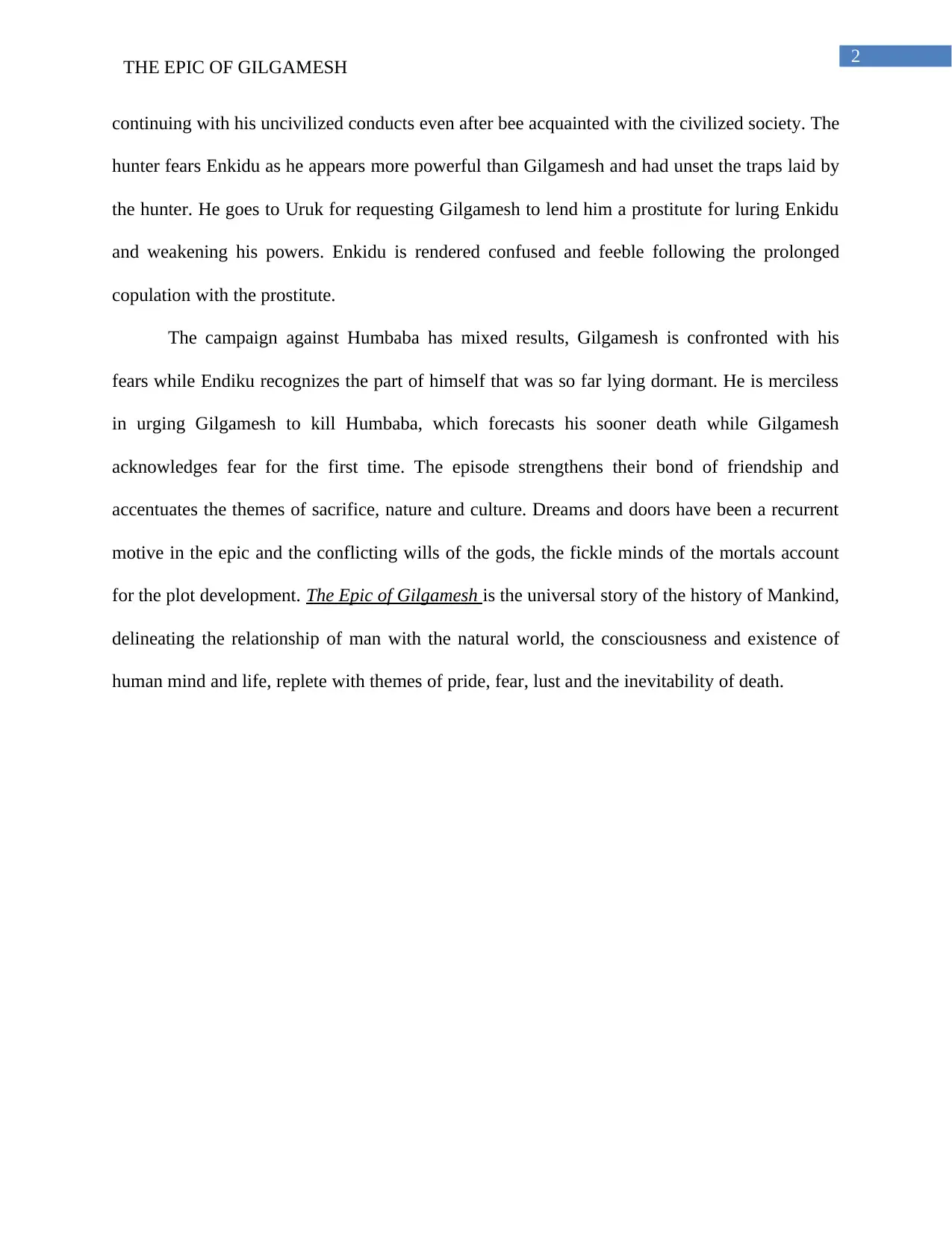
continuing with his uncivilized conducts even after bee acquainted with the civilized society. The
hunter fears Enkidu as he appears more powerful than Gilgamesh and had unset the traps laid by
the hunter. He goes to Uruk for requesting Gilgamesh to lend him a prostitute for luring Enkidu
and weakening his powers. Enkidu is rendered confused and feeble following the prolonged
copulation with the prostitute.
The campaign against Humbaba has mixed results, Gilgamesh is confronted with his
fears while Endiku recognizes the part of himself that was so far lying dormant. He is merciless
in urging Gilgamesh to kill Humbaba, which forecasts his sooner death while Gilgamesh
acknowledges fear for the first time. The episode strengthens their bond of friendship and
accentuates the themes of sacrifice, nature and culture. Dreams and doors have been a recurrent
motive in the epic and the conflicting wills of the gods, the fickle minds of the mortals account
for the plot development. The Epic of Gilgamesh is the universal story of the history of Mankind,
delineating the relationship of man with the natural world, the consciousness and existence of
human mind and life, replete with themes of pride, fear, lust and the inevitability of death.
Document Page
3
THE EPIC OF GILGAMESH
References:
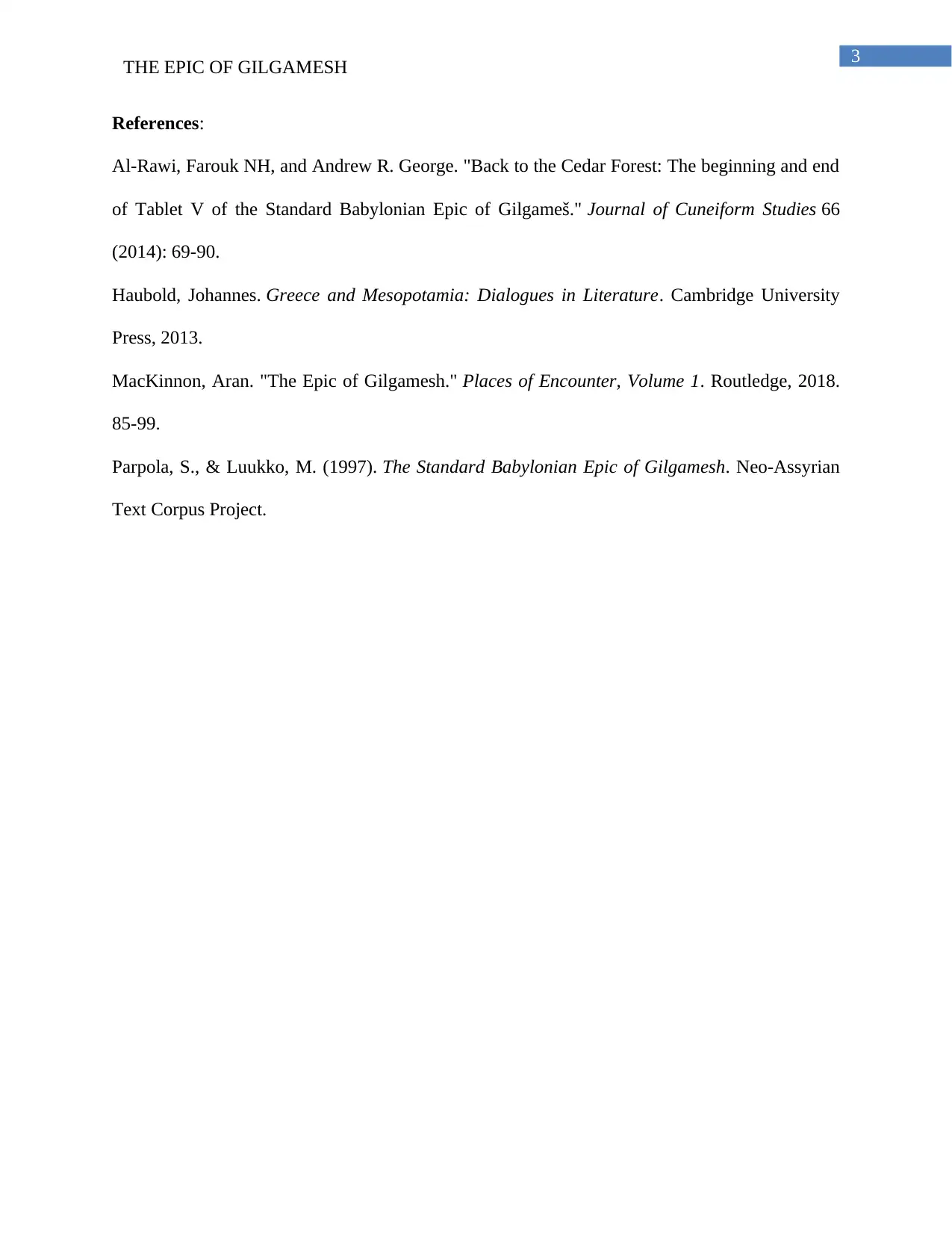
Al-Rawi, Farouk NH, and Andrew R. George. "Back to the Cedar Forest: The beginning and end
of Tablet V of the Standard Babylonian Epic of Gilgameš." Journal of Cuneiform Studies 66
(2014): 69-90.
Haubold, Johannes. Greece and Mesopotamia: Dialogues in Literature. Cambridge University
Press, 2013.
MacKinnon, Aran. "The Epic of Gilgamesh." Places of Encounter, Volume 1. Routledge, 2018.
85-99.
Parpola, S., & Luukko, M. (1997). The Standard Babylonian Epic of Gilgamesh. Neo-Assyrian
Text Corpus Project.
chevron_up_icon
1 out of 4
circle_padding
hide_on_mobile
zoom_out_icon
[object Object]