Essay on the Epic of Gilgamesh: Themes of Friendship and Legacy

Verified

Added on  2022/12/30

|4
|696
|46
Essay
AI Summary
This essay provides an analysis of the Epic of Gilgamesh, exploring the transformation of Gilgamesh from a tyrannical ruler to a figure who understands the true meaning of life through friendship and facing mortality. The essay delves into the themes of heroism, friendship, and death, highlighting how Gilgamesh's relationship with Enkidu and his eventual quest for immortality shape his understanding of his legacy and the importance of treating his subjects well. The essay concludes that true heroism lies in human connections, personal growth, and the impact one has on others, rather than in mere power or longevity. It examines the epic's interconnected themes, showing how Gilgamesh's experiences with friendship and loss lead him to a deeper understanding of life and his place in the world.
Document Page
Running Head: EPIC OF GILGAMESH
EPIC OF GILGAMESH
Name of Student
Name of University
Author Note
tabler-icon-diamond-filled.svg

Paraphrase This Document

Need a fresh take? Get an instant paraphrase of this document with our AI Paraphraser
Document Page
1EPIC OF GILGAMESH
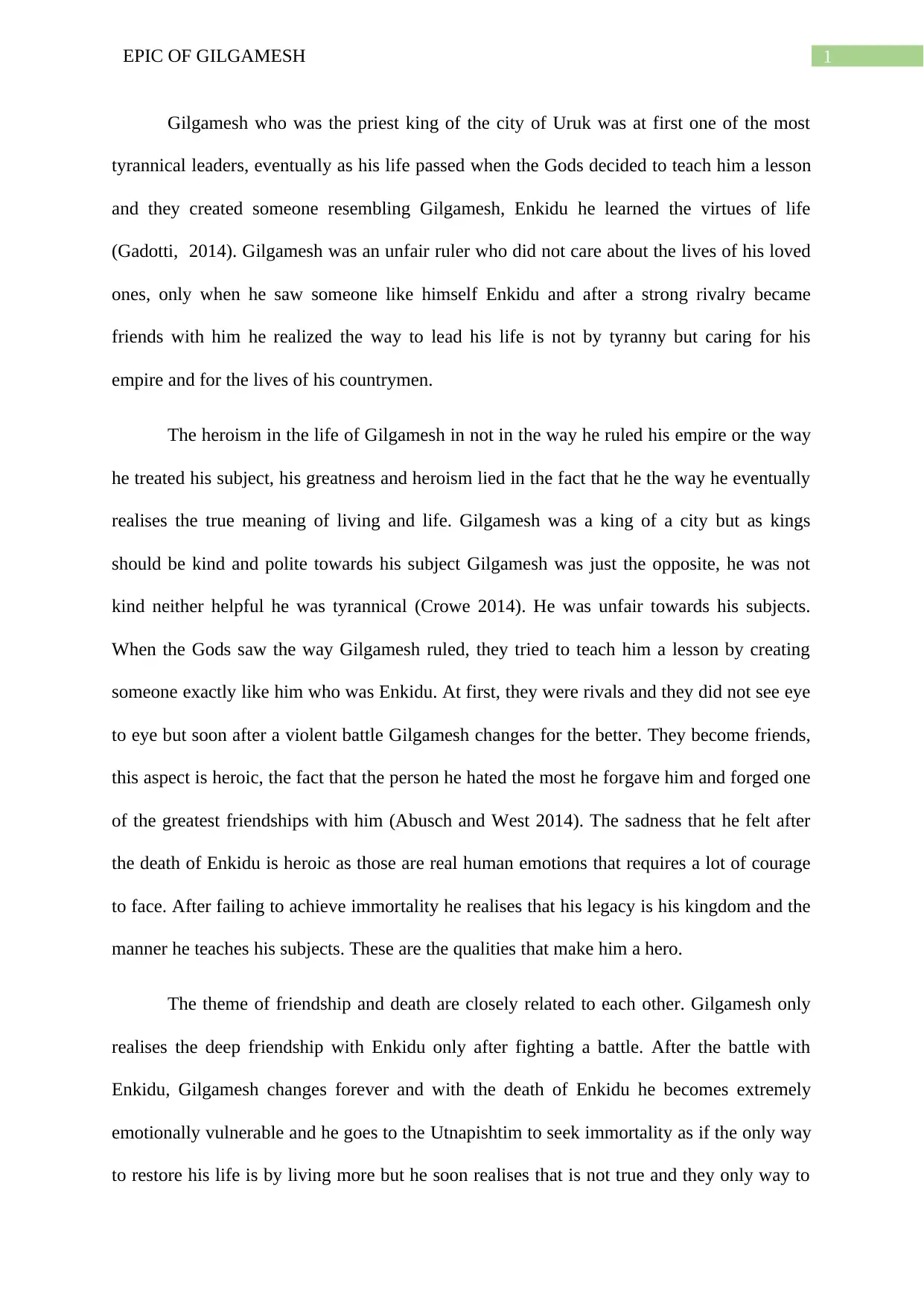
Gilgamesh who was the priest king of the city of Uruk was at first one of the most
tyrannical leaders, eventually as his life passed when the Gods decided to teach him a lesson
and they created someone resembling Gilgamesh, Enkidu he learned the virtues of life
(Gadotti, 2014). Gilgamesh was an unfair ruler who did not care about the lives of his loved
ones, only when he saw someone like himself Enkidu and after a strong rivalry became
friends with him he realized the way to lead his life is not by tyranny but caring for his
empire and for the lives of his countrymen.
The heroism in the life of Gilgamesh in not in the way he ruled his empire or the way
he treated his subject, his greatness and heroism lied in the fact that he the way he eventually
realises the true meaning of living and life. Gilgamesh was a king of a city but as kings
should be kind and polite towards his subject Gilgamesh was just the opposite, he was not
kind neither helpful he was tyrannical (Crowe 2014). He was unfair towards his subjects.
When the Gods saw the way Gilgamesh ruled, they tried to teach him a lesson by creating
someone exactly like him who was Enkidu. At first, they were rivals and they did not see eye
to eye but soon after a violent battle Gilgamesh changes for the better. They become friends,
this aspect is heroic, the fact that the person he hated the most he forgave him and forged one
of the greatest friendships with him (Abusch and West 2014). The sadness that he felt after
the death of Enkidu is heroic as those are real human emotions that requires a lot of courage
to face. After failing to achieve immortality he realises that his legacy is his kingdom and the
manner he teaches his subjects. These are the qualities that make him a hero.
The theme of friendship and death are closely related to each other. Gilgamesh only
realises the deep friendship with Enkidu only after fighting a battle. After the battle with
Enkidu, Gilgamesh changes forever and with the death of Enkidu he becomes extremely
emotionally vulnerable and he goes to the Utnapishtim to seek immortality as if the only way
to restore his life is by living more but he soon realises that is not true and they only way to
Document Page
2EPIC OF GILGAMESH
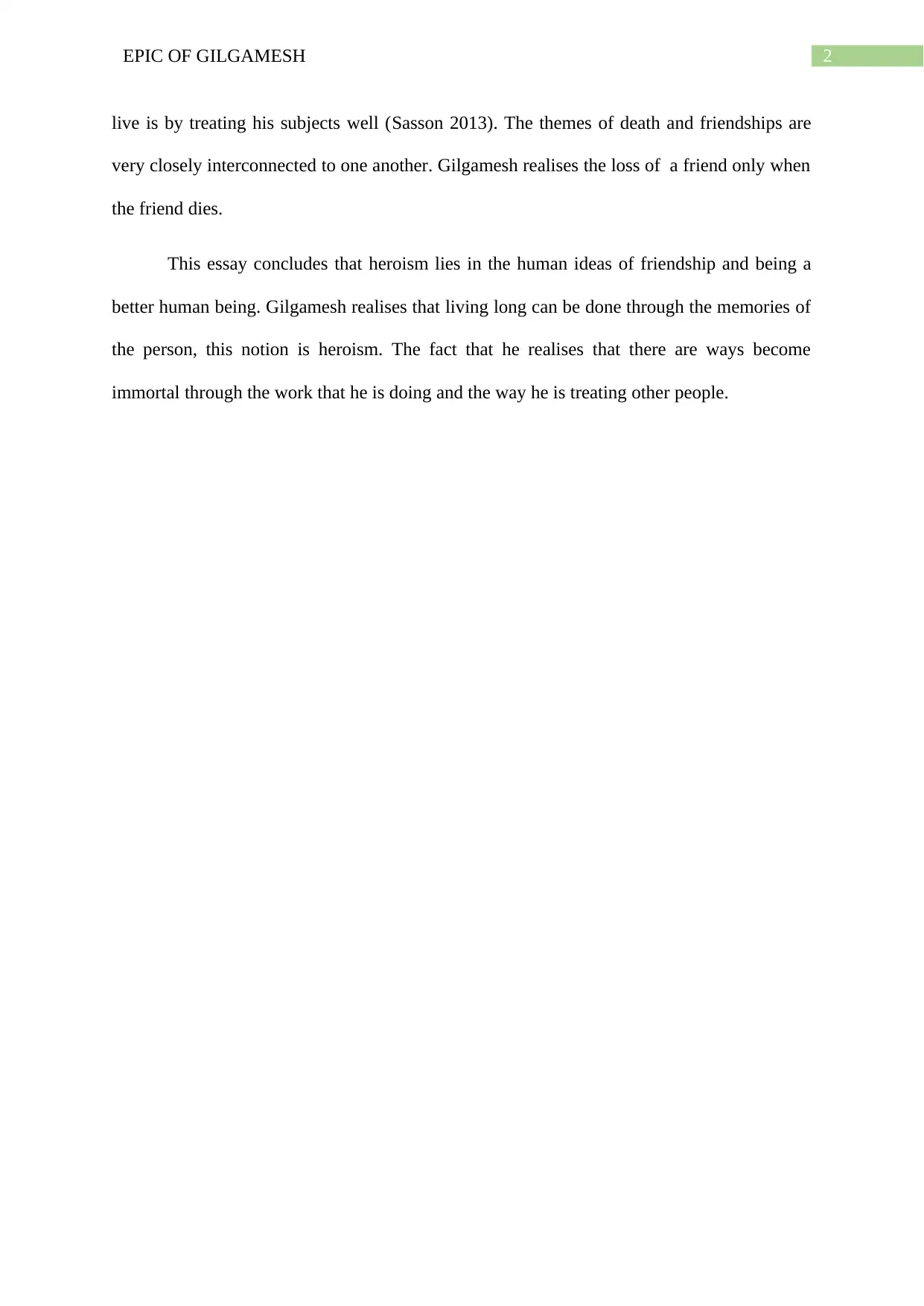
live is by treating his subjects well (Sasson 2013). The themes of death and friendships are
very closely interconnected to one another. Gilgamesh realises the loss of a friend only when
the friend dies.
This essay concludes that heroism lies in the human ideas of friendship and being a
better human being. Gilgamesh realises that living long can be done through the memories of
the person, this notion is heroism. The fact that he realises that there are ways become
immortal through the work that he is doing and the way he is treating other people.
Document Page
3EPIC OF GILGAMESH
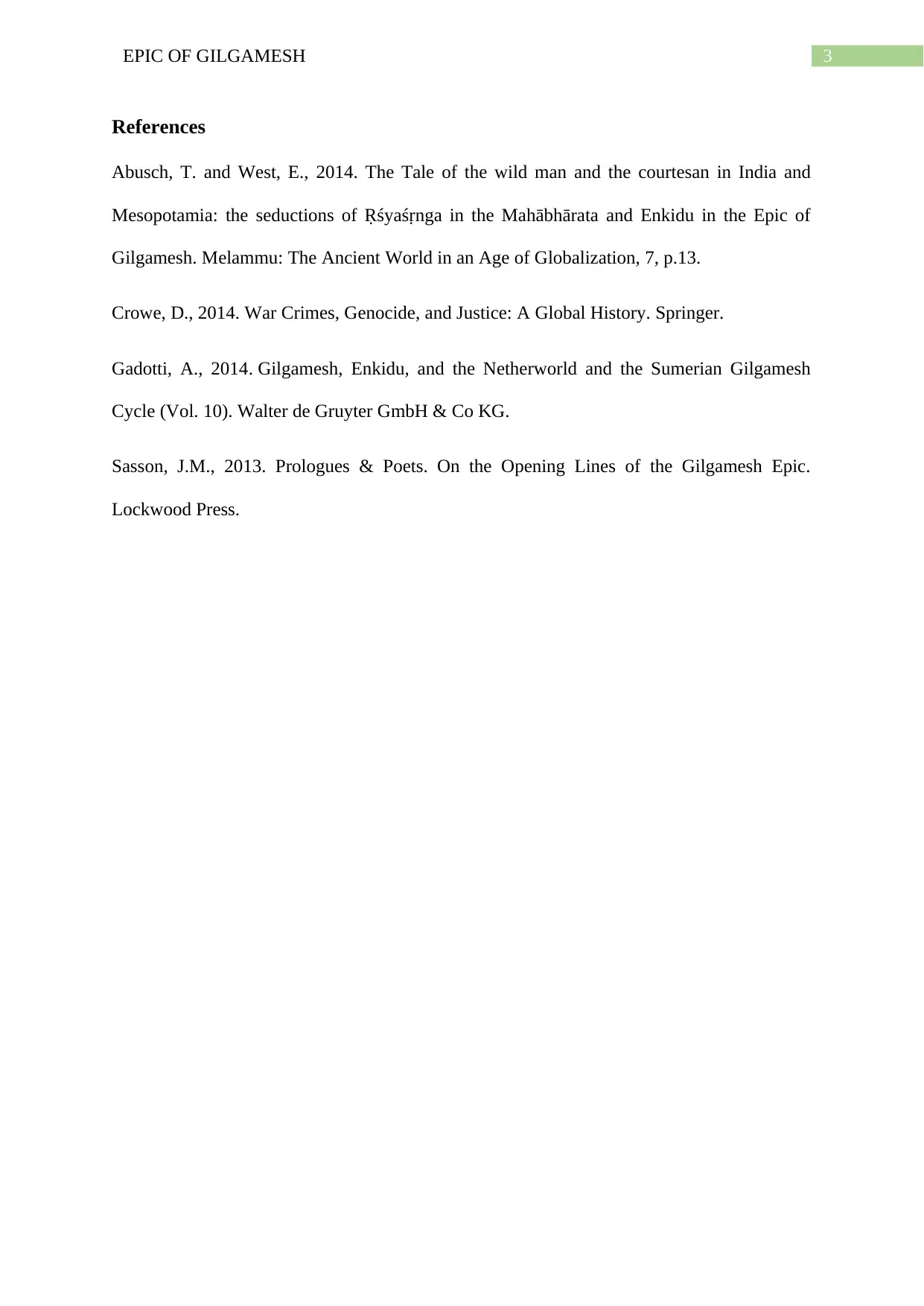
References
Abusch, T. and West, E., 2014. The Tale of the wild man and the courtesan in India and
Mesopotamia: the seductions of Ṛśyaśṛnga in the Mahābhārata and Enkidu in the Epic of
Gilgamesh. Melammu: The Ancient World in an Age of Globalization, 7, p.13.
Crowe, D., 2014. War Crimes, Genocide, and Justice: A Global History. Springer.
Gadotti, A., 2014. Gilgamesh, Enkidu, and the Netherworld and the Sumerian Gilgamesh
Cycle (Vol. 10). Walter de Gruyter GmbH & Co KG.
Sasson, J.M., 2013. Prologues & Poets. On the Opening Lines of the Gilgamesh Epic.
Lockwood Press.
chevron_up_icon
1 out of 4
circle_padding
hide_on_mobile
zoom_out_icon
[object Object]