Epidemiology Assignment: BVD Disease Analysis and Predictive Values

Verified

Added on  2020/04/21

|5
|835
|136
Homework Assignment
AI Summary
This assignment analyzes epidemiological concepts using a case study on Bovine Viral Diarrhea (BVD). It calculates and interprets sensitivity and specificity, demonstrating how these measures assess the accuracy of diagnostic tests. The assignment defines a gold standard test and discusses how altering its criteria impacts test accuracy. It further explores positive and negative predictive values, providing calculations and interpretations of these values to determine the probability of disease presence or absence within a population based on test results. The assignment uses provided statistical data to illustrate these concepts, reinforcing the application of epidemiological principles in disease assessment.
Document Page
Running head: EPIDEMIOLOGY
EPIDEMIOLOGY
[Author Name(s), First M. Last, Omit Titles and Degrees]
[Institutional Affiliation(s)]
tabler-icon-diamond-filled.svg

Paraphrase This Document

Need a fresh take? Get an instant paraphrase of this document with our AI Paraphraser
Document Page
2
EPIDEMIOLOGY
Question 1
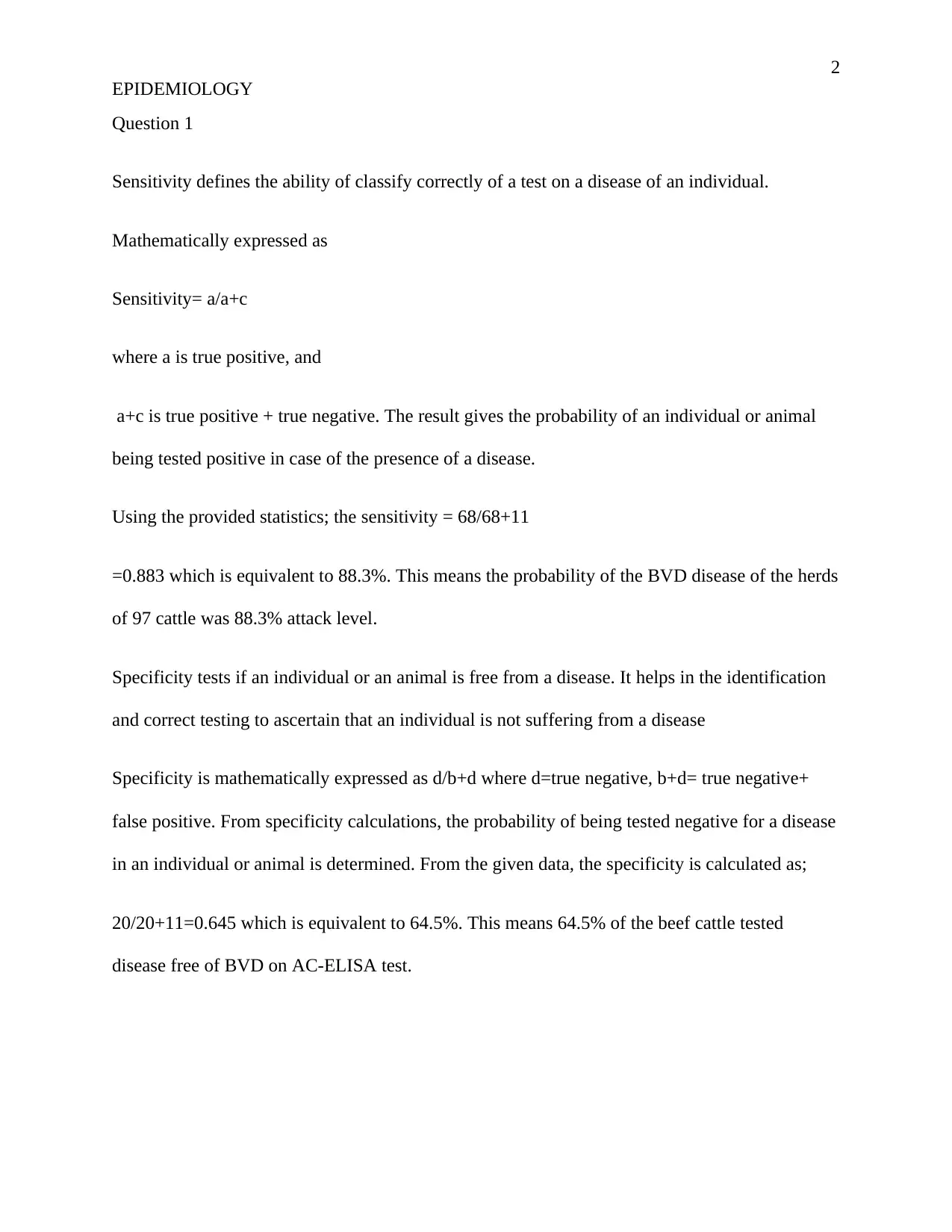
Sensitivity defines the ability of classify correctly of a test on a disease of an individual.
Mathematically expressed as
Sensitivity= a/a+c
where a is true positive, and
a+c is true positive + true negative. The result gives the probability of an individual or animal
being tested positive in case of the presence of a disease.
Using the provided statistics; the sensitivity = 68/68+11
=0.883 which is equivalent to 88.3%. This means the probability of the BVD disease of the herds
of 97 cattle was 88.3% attack level.
Specificity tests if an individual or an animal is free from a disease. It helps in the identification
and correct testing to ascertain that an individual is not suffering from a disease
Specificity is mathematically expressed as d/b+d where d=true negative, b+d= true negative+
false positive. From specificity calculations, the probability of being tested negative for a disease
in an individual or animal is determined. From the given data, the specificity is calculated as;
20/20+11=0.645 which is equivalent to 64.5%. This means 64.5% of the beef cattle tested
disease free of BVD on AC-ELISA test.
Document Page
3
EPIDEMIOLOGY
Question 2
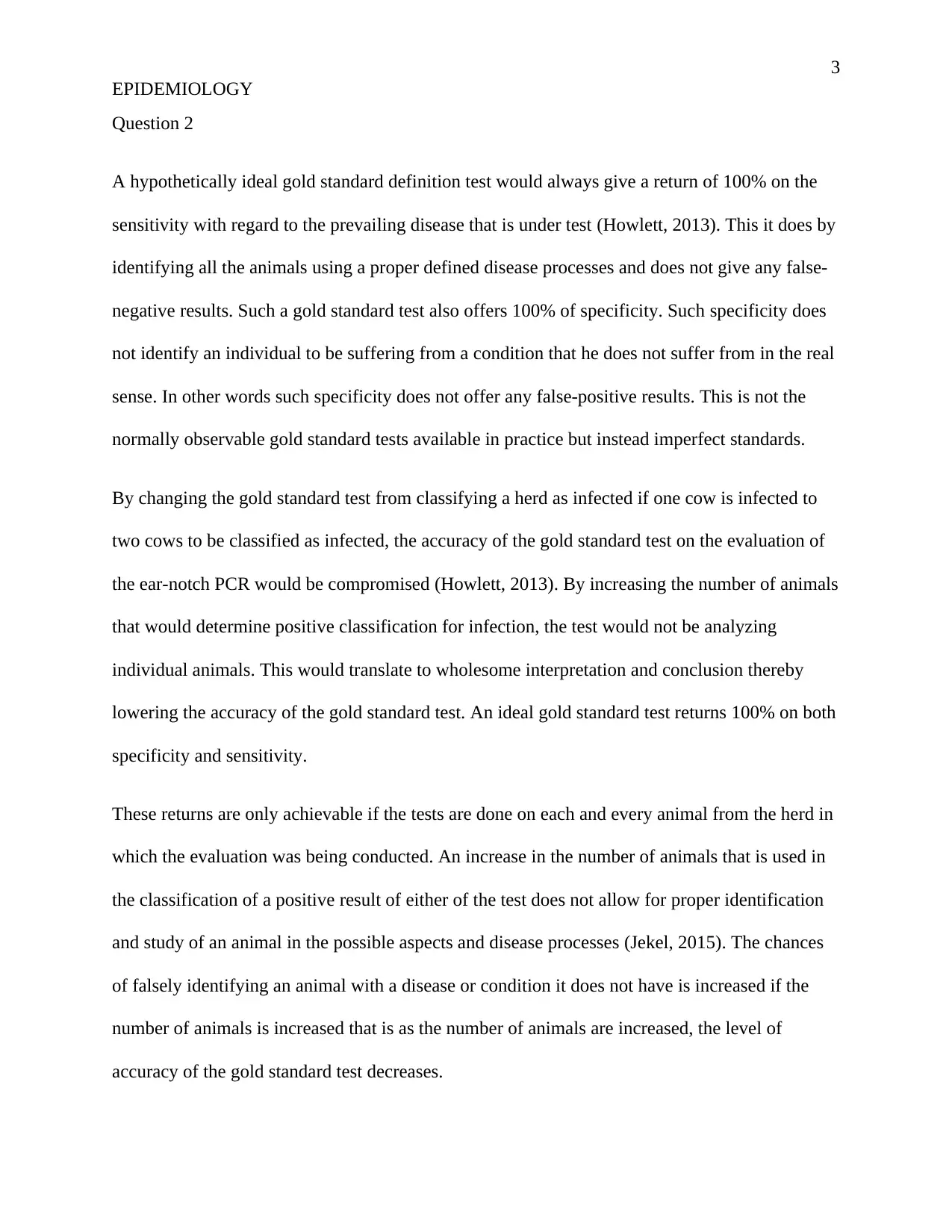
A hypothetically ideal gold standard definition test would always give a return of 100% on the
sensitivity with regard to the prevailing disease that is under test (Howlett, 2013). This it does by
identifying all the animals using a proper defined disease processes and does not give any false-
negative results. Such a gold standard test also offers 100% of specificity. Such specificity does
not identify an individual to be suffering from a condition that he does not suffer from in the real
sense. In other words such specificity does not offer any false-positive results. This is not the
normally observable gold standard tests available in practice but instead imperfect standards.
By changing the gold standard test from classifying a herd as infected if one cow is infected to
two cows to be classified as infected, the accuracy of the gold standard test on the evaluation of
the ear-notch PCR would be compromised (Howlett, 2013). By increasing the number of animals
that would determine positive classification for infection, the test would not be analyzing
individual animals. This would translate to wholesome interpretation and conclusion thereby
lowering the accuracy of the gold standard test. An ideal gold standard test returns 100% on both
specificity and sensitivity.
These returns are only achievable if the tests are done on each and every animal from the herd in
which the evaluation was being conducted. An increase in the number of animals that is used in
the classification of a positive result of either of the test does not allow for proper identification
and study of an animal in the possible aspects and disease processes (Jekel, 2015). The chances
of falsely identifying an animal with a disease or condition it does not have is increased if the
number of animals is increased that is as the number of animals are increased, the level of
accuracy of the gold standard test decreases.
Document Page
4
EPIDEMIOLOGY
Question 3
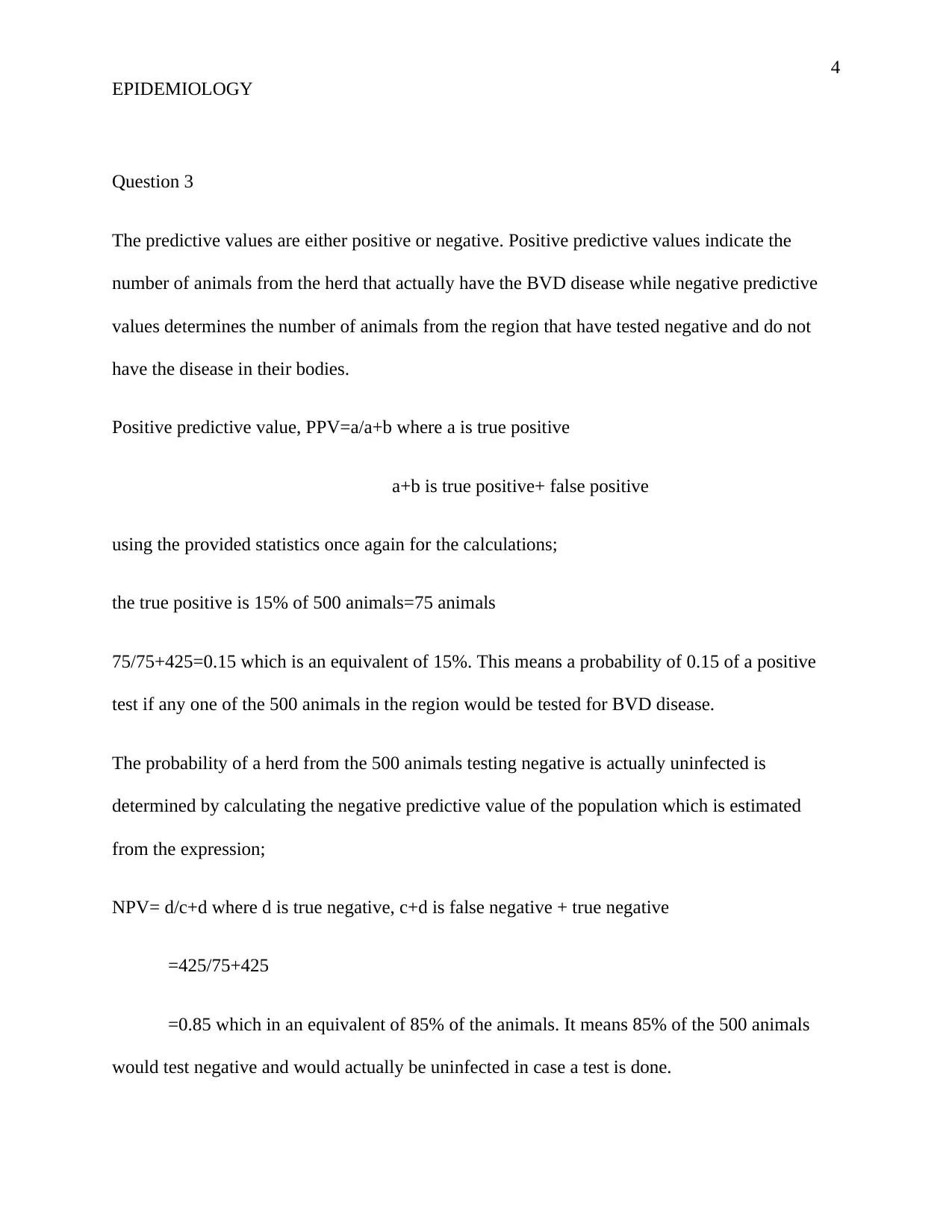
The predictive values are either positive or negative. Positive predictive values indicate the
number of animals from the herd that actually have the BVD disease while negative predictive
values determines the number of animals from the region that have tested negative and do not
have the disease in their bodies.
Positive predictive value, PPV=a/a+b where a is true positive
a+b is true positive+ false positive
using the provided statistics once again for the calculations;
the true positive is 15% of 500 animals=75 animals
75/75+425=0.15 which is an equivalent of 15%. This means a probability of 0.15 of a positive
test if any one of the 500 animals in the region would be tested for BVD disease.
The probability of a herd from the 500 animals testing negative is actually uninfected is
determined by calculating the negative predictive value of the population which is estimated
from the expression;
NPV= d/c+d where d is true negative, c+d is false negative + true negative
=425/75+425
=0.85 which in an equivalent of 85% of the animals. It means 85% of the 500 animals
would test negative and would actually be uninfected in case a test is done.
tabler-icon-diamond-filled.svg

Paraphrase This Document

Need a fresh take? Get an instant paraphrase of this document with our AI Paraphraser
Document Page
5
EPIDEMIOLOGY
References
Howlett, B. (2013). Evidence Based Practice for Health Professionals. New York: Jones &
Bartlett Publishers.
Jekel, J. F. (2015). Epidemiology, Biostatistics, and Preventive Medicine. New York: Elsevier
Health Sciences.
chevron_up_icon
1 out of 5
circle_padding
hide_on_mobile
zoom_out_icon
[object Object]