Epidemiology Protocol: Understanding Child Obesity in Australia
VerifiedAdded on 2023/06/10
|19
|4490
|235
Project
AI Summary
This epidemiology project protocol aims to investigate the causes behind the increasing cases of child obesity in urban areas of Australia. The protocol includes an introduction highlighting the statistical significance of the problem, the motivation for the study, and the objectives to formulate a solution plan. Ethical considerations are addressed, emphasizing respect for intellectual property, confidentiality, and social responsibility. The protocol incorporates journal reviews of existing literature on childhood obesity, focusing on identifying causes and dispelling myths. The study design involves observing children in their natural environments, such as homes and schools, and utilizing questionnaires for both children and their guardians to gather comprehensive data on lifestyle and feeding patterns. Materials and methods include observation and questionnaires, with data analysis planned to identify key factors contributing to child obesity in urban Australia. Desklib provides access to this and similar solved assignments to aid students in their studies.
Epidemiology 1
EPIDEMIOLOGY
By Students Name
Course Name
Professors Name
University
City and State
Dates
EPIDEMIOLOGY
By Students Name
Course Name
Professors Name
University
City and State
Dates

Paraphrase This Document
Need a fresh take? Get an instant paraphrase of this document with our AI Paraphraser
Epidemiology 2
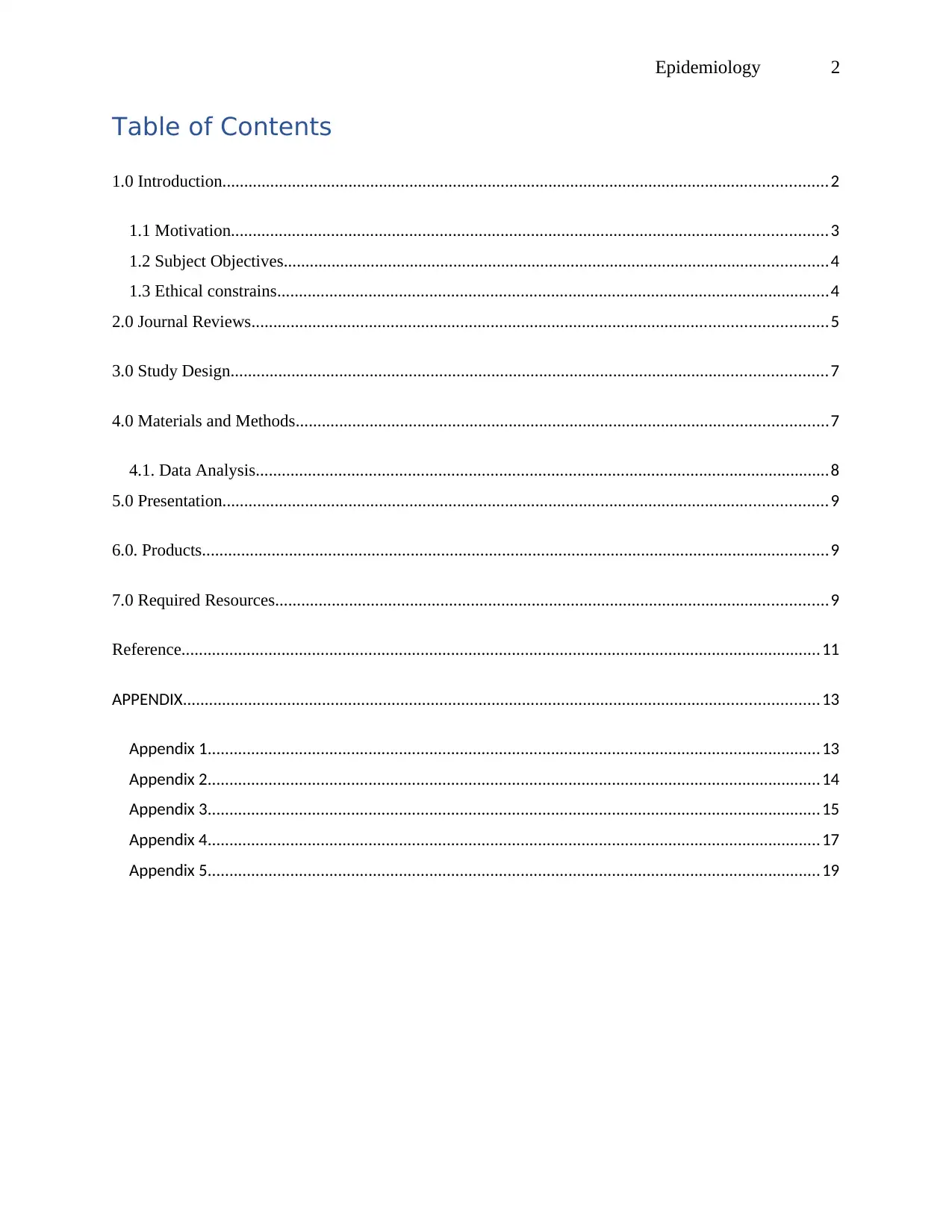
Table of Contents
1.0 Introduction...........................................................................................................................................2
1.1 Motivation.........................................................................................................................................3
1.2 Subject Objectives.............................................................................................................................4
1.3 Ethical constrains...............................................................................................................................4
2.0 Journal Reviews....................................................................................................................................5
3.0 Study Design.........................................................................................................................................7
4.0 Materials and Methods..........................................................................................................................7
4.1. Data Analysis....................................................................................................................................8
5.0 Presentation...........................................................................................................................................9
6.0. Products................................................................................................................................................9
7.0 Required Resources...............................................................................................................................9
Reference...................................................................................................................................................11
APPENDIX..................................................................................................................................................13
Appendix 1.............................................................................................................................................13
Appendix 2.............................................................................................................................................14
Appendix 3.............................................................................................................................................15
Appendix 4.............................................................................................................................................17
Appendix 5.............................................................................................................................................19
Table of Contents
1.0 Introduction...........................................................................................................................................2
1.1 Motivation.........................................................................................................................................3
1.2 Subject Objectives.............................................................................................................................4
1.3 Ethical constrains...............................................................................................................................4
2.0 Journal Reviews....................................................................................................................................5
3.0 Study Design.........................................................................................................................................7
4.0 Materials and Methods..........................................................................................................................7
4.1. Data Analysis....................................................................................................................................8
5.0 Presentation...........................................................................................................................................9
6.0. Products................................................................................................................................................9
7.0 Required Resources...............................................................................................................................9
Reference...................................................................................................................................................11
APPENDIX..................................................................................................................................................13
Appendix 1.............................................................................................................................................13
Appendix 2.............................................................................................................................................14
Appendix 3.............................................................................................................................................15
Appendix 4.............................................................................................................................................17
Appendix 5.............................................................................................................................................19
Epidemiology 3
Main Causes of High Cases of Child Obesity in Australia’s Urban Areas
1.0 Introduction
Obesity can be defined as a state of being overweight in relation to one’s body height.
According to the National institute of Health (NIH) when one’s body mass Index (BMI) is 30
and above then the person can be termed considered to be suffering from obesity. This has been a
common problem among children in different parts of the world but for this protocol, Australia’s
urban areas have had increase in the children obesity cases reported in different health centers
within the county. Statistically over the past few years the number of cases has been increasing at
an alarming rate. Research from (Cole, T.J., 2016) shows that one out of every four children in
Australia’s urban areas is suffering from obese and the same report also shows that the
representation of this data keeps changing with time and the rate at which these changes are
happening are alarming for the public health sector. Child obesity is becoming one of the most
health problem affecting the children. As seen from different research bodies, children obesity
cases in Australia have not been well documented hence this shows the need for the particular
study to be carried out (Gurnani, M., Birken, C. and Hamilton, J., 2015). WHO has also compile
a report on the comparison of obese cases between children in the rural areas and those brought
up in the urban areas of Australia. The report shows that urban children report at least 4 children
out of 10 suffer from obese while for the rural areas only one out of ten children suffers from
obese. There have been other health bodies that have conducted this similar research and the
findings have been the same in all the cases (Hayes, A., et al., 2016). Study by the Australian
Bureau of statistics – Australian health survey shows that the child brought up in an urban setup
is 70 percent more likely to be come obese that a child who is brought up in the rural setup.
Main Causes of High Cases of Child Obesity in Australia’s Urban Areas
1.0 Introduction
Obesity can be defined as a state of being overweight in relation to one’s body height.
According to the National institute of Health (NIH) when one’s body mass Index (BMI) is 30
and above then the person can be termed considered to be suffering from obesity. This has been a
common problem among children in different parts of the world but for this protocol, Australia’s
urban areas have had increase in the children obesity cases reported in different health centers
within the county. Statistically over the past few years the number of cases has been increasing at
an alarming rate. Research from (Cole, T.J., 2016) shows that one out of every four children in
Australia’s urban areas is suffering from obese and the same report also shows that the
representation of this data keeps changing with time and the rate at which these changes are
happening are alarming for the public health sector. Child obesity is becoming one of the most
health problem affecting the children. As seen from different research bodies, children obesity
cases in Australia have not been well documented hence this shows the need for the particular
study to be carried out (Gurnani, M., Birken, C. and Hamilton, J., 2015). WHO has also compile
a report on the comparison of obese cases between children in the rural areas and those brought
up in the urban areas of Australia. The report shows that urban children report at least 4 children
out of 10 suffer from obese while for the rural areas only one out of ten children suffers from
obese. There have been other health bodies that have conducted this similar research and the
findings have been the same in all the cases (Hayes, A., et al., 2016). Study by the Australian
Bureau of statistics – Australian health survey shows that the child brought up in an urban setup
is 70 percent more likely to be come obese that a child who is brought up in the rural setup.
⊘ This is a preview!⊘
Do you want full access?
Subscribe today to unlock all pages.

Trusted by 1+ million students worldwide
Epidemiology 4
1.1 Motivation
After going through all this statistical data gathered from reliable sources in Australia in
relation to child obesity and the different areas in the country, I was motivated to dig deeper and
find out the main cause behind the pattern of the health problem. Obesity also being a global
health issue made me realize the need to learn more of the causes of the high spread of the
problem. Through this one would generate a well-researched solution to try and curb the problem
especially in the affected areas in the country and in this case, the urban areas within the country.
The gathered health records from different health care centers clearly shows that the urban areas
are he most affected by the problem. With this established, finding out the main cause behind it
became my goal hence the need for the project.
1.2 Subject Objectives
The main aim of this study is to find out the main causes behind the increase in cases of
child obesity in Australian urban areas, this will help in the formulation of a solution plan of the
problem. With the causes behind the rise of child obesity cases it will be possible to curb the
problem since the problems root cause is already established. Hence eliminating the problem
cannot posse a huge challenge. It is important to mention that the study objective will generate a
comprehensive report on the causes of child obesity in the Australian urban areas which can be
used in different health avenues for the better understanding of the public health facing the
country.
1.3 Ethical constrains
This comes in when interacting with other people through out the study. It is evident that
the study will involve interacting with individuals both physically or via the interacting with
other individual private work. The application of ethical principals of research will be necessary
1.1 Motivation
After going through all this statistical data gathered from reliable sources in Australia in
relation to child obesity and the different areas in the country, I was motivated to dig deeper and
find out the main cause behind the pattern of the health problem. Obesity also being a global
health issue made me realize the need to learn more of the causes of the high spread of the
problem. Through this one would generate a well-researched solution to try and curb the problem
especially in the affected areas in the country and in this case, the urban areas within the country.
The gathered health records from different health care centers clearly shows that the urban areas
are he most affected by the problem. With this established, finding out the main cause behind it
became my goal hence the need for the project.
1.2 Subject Objectives
The main aim of this study is to find out the main causes behind the increase in cases of
child obesity in Australian urban areas, this will help in the formulation of a solution plan of the
problem. With the causes behind the rise of child obesity cases it will be possible to curb the
problem since the problems root cause is already established. Hence eliminating the problem
cannot posse a huge challenge. It is important to mention that the study objective will generate a
comprehensive report on the causes of child obesity in the Australian urban areas which can be
used in different health avenues for the better understanding of the public health facing the
country.
1.3 Ethical constrains
This comes in when interacting with other people through out the study. It is evident that
the study will involve interacting with individuals both physically or via the interacting with
other individual private work. The application of ethical principals of research will be necessary
Paraphrase This Document
Need a fresh take? Get an instant paraphrase of this document with our AI Paraphraser
Epidemiology 5
so as to ensure the study does not violate any ethical implications of conducting researches. One
of the most important ethical research principal is the utilization of other peoples work. The
respect for intellectual property is on of the basic ethic principal to observe. The study is to honor
patents, copyrights as well as other forms of intellectual properties. Throughout the study,
confidentiality is another principle that is going to be honored. This involves the different
communications that are to take place during the study and the involved participants
confidentiality is to be honored as per their request. The research is also expected to uphold
social responsibility and strive to promote social good by preventing or mitigating any social
harm which may arise through the research process. Also, the legality bit of the research will be
upheld through the understanding of the relevant laws to adhere to in relation to institutions
involved in the study as well as the governmental policies hat may be involved during the study.
In respect to the above ethical obligations the research is good to start and constant check up to
ensure no ethical principal is violated is to be carried out.
2.0 Journal Reviews
Sahoo, K. et al., (2015) has conducted and extensive study on childhood obesity and
covered different relevant points in the research that has greatly impacted the known and shared
knowledge in relation to the area of study. The study by Sahoo, K. et al., (2015) embraces the
fact that childhood obesity has grown into an epidemic level in developed countries has started
also affecting the developing countries. Assessing the journal, it is evident that some of the
essential parts of the research have been critically analyzed, for instant Sahoo, K. et al., (2015)
have answered the who analysis of the research by addressing the children as the unique
population as well as where which has clearly been identified as the developed countries but a
slight challenge comes in since the research does not specifically narrowed down on where. The
so as to ensure the study does not violate any ethical implications of conducting researches. One
of the most important ethical research principal is the utilization of other peoples work. The
respect for intellectual property is on of the basic ethic principal to observe. The study is to honor
patents, copyrights as well as other forms of intellectual properties. Throughout the study,
confidentiality is another principle that is going to be honored. This involves the different
communications that are to take place during the study and the involved participants
confidentiality is to be honored as per their request. The research is also expected to uphold
social responsibility and strive to promote social good by preventing or mitigating any social
harm which may arise through the research process. Also, the legality bit of the research will be
upheld through the understanding of the relevant laws to adhere to in relation to institutions
involved in the study as well as the governmental policies hat may be involved during the study.
In respect to the above ethical obligations the research is good to start and constant check up to
ensure no ethical principal is violated is to be carried out.
2.0 Journal Reviews
Sahoo, K. et al., (2015) has conducted and extensive study on childhood obesity and
covered different relevant points in the research that has greatly impacted the known and shared
knowledge in relation to the area of study. The study by Sahoo, K. et al., (2015) embraces the
fact that childhood obesity has grown into an epidemic level in developed countries has started
also affecting the developing countries. Assessing the journal, it is evident that some of the
essential parts of the research have been critically analyzed, for instant Sahoo, K. et al., (2015)
have answered the who analysis of the research by addressing the children as the unique
population as well as where which has clearly been identified as the developed countries but a
slight challenge comes in since the research does not specifically narrowed down on where. The
Epidemiology 6
why and how of the research has also explicitly been covered. We get to understand the main
causes of the childhood obesity epidemic as well as the consequences of the epidemic. The work
by Sahoo, K. et al., (2015) is of great use in this study since it helps identify the main causes of
childhood obesity. The causes are unique despite the area of study since the epidemic affects the
children in a similar manner.
Sabin, M.A., et al., (2015) have also conducted a research on childhood obesity but taken
a different approach on the matter as compared to the previous work by Sahoo, K., et al., (2015).
Sabin, M.A. and the other researchers took a step back and analyzed the changes and the increase
in the cases of childhood obesity and to address this came up with the identification of the
misleading myths among other irrelevant information the entire paper has effectively addressed
the research question that guide the study. They have clearly identified the who as the child as
well and the other such as what being obesity and when being the timeline of the changes in the
spread of the childhood obesity. The research has slightly failed to clearly capture the where
which specifically narrows down the area for the study being conducted. The research is very
important for the study being curried out since it helps in singling out the irrelevant information
that has been crowding the areas of study also helps point out the outcomes associated with
childhood obesity which is very important and lastly the work by Sabin, M.A., et al., (2015)
helps in the understanding of the environmental factors, individual genetics among other reasons
behind the growth of childhood obesity epidemic.
Vallgårda, S., 2018 caries out a very important research and tries to establish the clear
definition of childhood obesity as well as the different proposed policies in the fight against the
global epidemic. The research tries to establish whether the fight against the epidemic has a hand
in the continuous growth of the epidemic. It is such a consistent research that opens up the eyes
why and how of the research has also explicitly been covered. We get to understand the main
causes of the childhood obesity epidemic as well as the consequences of the epidemic. The work
by Sahoo, K. et al., (2015) is of great use in this study since it helps identify the main causes of
childhood obesity. The causes are unique despite the area of study since the epidemic affects the
children in a similar manner.
Sabin, M.A., et al., (2015) have also conducted a research on childhood obesity but taken
a different approach on the matter as compared to the previous work by Sahoo, K., et al., (2015).
Sabin, M.A. and the other researchers took a step back and analyzed the changes and the increase
in the cases of childhood obesity and to address this came up with the identification of the
misleading myths among other irrelevant information the entire paper has effectively addressed
the research question that guide the study. They have clearly identified the who as the child as
well and the other such as what being obesity and when being the timeline of the changes in the
spread of the childhood obesity. The research has slightly failed to clearly capture the where
which specifically narrows down the area for the study being conducted. The research is very
important for the study being curried out since it helps in singling out the irrelevant information
that has been crowding the areas of study also helps point out the outcomes associated with
childhood obesity which is very important and lastly the work by Sabin, M.A., et al., (2015)
helps in the understanding of the environmental factors, individual genetics among other reasons
behind the growth of childhood obesity epidemic.
Vallgårda, S., 2018 caries out a very important research and tries to establish the clear
definition of childhood obesity as well as the different proposed policies in the fight against the
global epidemic. The research tries to establish whether the fight against the epidemic has a hand
in the continuous growth of the epidemic. It is such a consistent research that opens up the eyes
⊘ This is a preview!⊘
Do you want full access?
Subscribe today to unlock all pages.
Trusted by 1+ million students worldwide
Epidemiology 7
of the reader in a different view of the problem. Not only does Vallgårda, S., 2018 concentrate
on the causes of childhood obesity but looks at the whole problem in a different light. Maybe we
the policy makers are making weak moves in fighting the problem hence leading to its
uncontrolled state at the moment. The research clearly covers all the research questions not
leaving out any important aspect of the study. It clearly paints out the who being the policy
makers fighting childhood obesity, what being the continued growth in spread of childhood
obesity, where being specified in some of the developed countries, among other research
questions. Clearly the study is very important for my project since it gives one a different insight
of the whole reason behind the growth of the epidemic.
3.0 Study Design
This will help us in understanding how the entire study will be conducted. The children being the
population under study, conducting some of the study strategies will be slightly impossible hence
the involvement of the parents and the guardians will be important. The study will be carried out
in different environments that the children normally interact with a lot. These incudes their
homes and the schools. For the urban settings most children school near there homes so as to
easily access their hommes after school. This makes it possible for the study to be conducted.
The study will entail a number of participant who will be the children and their mothers. The
selectin of the study subject will involve sampling and which will be based on a few steps. Since
the study is understanding the children’s life style and relating to the probable causes of obesity
participants will need to meet specific requirement so as to help get effective responses for the
project. For the child to perfectly fit for the study;
The parents or guardians needs to be present or available for the study.
The children for the study should be attending a learning institution that is accessible.
of the reader in a different view of the problem. Not only does Vallgårda, S., 2018 concentrate
on the causes of childhood obesity but looks at the whole problem in a different light. Maybe we
the policy makers are making weak moves in fighting the problem hence leading to its
uncontrolled state at the moment. The research clearly covers all the research questions not
leaving out any important aspect of the study. It clearly paints out the who being the policy
makers fighting childhood obesity, what being the continued growth in spread of childhood
obesity, where being specified in some of the developed countries, among other research
questions. Clearly the study is very important for my project since it gives one a different insight
of the whole reason behind the growth of the epidemic.
3.0 Study Design
This will help us in understanding how the entire study will be conducted. The children being the
population under study, conducting some of the study strategies will be slightly impossible hence
the involvement of the parents and the guardians will be important. The study will be carried out
in different environments that the children normally interact with a lot. These incudes their
homes and the schools. For the urban settings most children school near there homes so as to
easily access their hommes after school. This makes it possible for the study to be conducted.
The study will entail a number of participant who will be the children and their mothers. The
selectin of the study subject will involve sampling and which will be based on a few steps. Since
the study is understanding the children’s life style and relating to the probable causes of obesity
participants will need to meet specific requirement so as to help get effective responses for the
project. For the child to perfectly fit for the study;
The parents or guardians needs to be present or available for the study.
The children for the study should be attending a learning institution that is accessible.
Paraphrase This Document
Need a fresh take? Get an instant paraphrase of this document with our AI Paraphraser
Epidemiology 8
The child feeding patterns should be normal and not interfered with due to the research
being conducted
The normal activities of the child should be independent free of any interference by the
parents.
The parents or the guardians should have a normal Urban setup life inclusive of a job or
other activities portraying normal family setup
4.0 Materials and Methods
There are two instruments that will be used for this study, namely observation and questionnaire.
Observation will involve the observation of the study subjects in their natural environment and
the recording of all the relevant data in relation the participants health. All these are to be
reordered and taken in as data for the study. Some of the things to observe include the activities
the children are involved in, he feeding patterns they are used to, the relationships they form with
the other children, the environment they associate with or the environment they interact with,
their parents and their lifestyle among other observations (Ott, R.L. and Longnecker, M.T.,
2015).
The questionnaire is the other most important tool for gathering the needed in formation. There
will be several types of questionnaires that will be used for the project which will be
differentiated depending on who will respond to it. There will be a questionnaire based on the
environment the child interacts with and it will be directed to the adult in charge of the
environment. There will be a school-based questionnaire for the teachers (Ek, A., et al., 2016.).
The questionnaire will be based on the child’s school life style. There will be another
questionnaire for the parents or the guardians. This is for the home environment that the child
interacts with and the parent or the guardian is in charge.
The child feeding patterns should be normal and not interfered with due to the research
being conducted
The normal activities of the child should be independent free of any interference by the
parents.
The parents or the guardians should have a normal Urban setup life inclusive of a job or
other activities portraying normal family setup
4.0 Materials and Methods
There are two instruments that will be used for this study, namely observation and questionnaire.
Observation will involve the observation of the study subjects in their natural environment and
the recording of all the relevant data in relation the participants health. All these are to be
reordered and taken in as data for the study. Some of the things to observe include the activities
the children are involved in, he feeding patterns they are used to, the relationships they form with
the other children, the environment they associate with or the environment they interact with,
their parents and their lifestyle among other observations (Ott, R.L. and Longnecker, M.T.,
2015).
The questionnaire is the other most important tool for gathering the needed in formation. There
will be several types of questionnaires that will be used for the project which will be
differentiated depending on who will respond to it. There will be a questionnaire based on the
environment the child interacts with and it will be directed to the adult in charge of the
environment. There will be a school-based questionnaire for the teachers (Ek, A., et al., 2016.).
The questionnaire will be based on the child’s school life style. There will be another
questionnaire for the parents or the guardians. This is for the home environment that the child
interacts with and the parent or the guardian is in charge.
Epidemiology 9
Questionnaire A. Parent or guardian
Appendix 4
Questionnaire for the school responsible party
Appendix 5
4.1. Data Analysis
All the gathered data has to be analyzed so as to get important information from the collected
information. The analysis of this data will need a well thought of approach so as to ensure all the
gathered information is in-line with the projects requirements (Wildemuth, B.M. ed., 2016). For
this particular project the best analytical data process will be the use which will involve the
identification of similarities in the gathered data so as to figure at a common pattern present in
the information. With these patterns it becomes easy for one to match the study area with the
patters so as to help one identify the possible causes of the increased cases of childhood obesity.
5.0 Presentation
The best presentation of this data will be in tables and graphs, charts carrying the analyzed
information will be used so as to ensure effective communication of the covered information.
6.0. Products
The project will lead to the production of a well-researched health journal for the presentation to
the health care board within the government so as to show them the magnitude of the childhood
obesity in Australian urban areas (Sun, Yet al., 2017). Also, the presentation of this is to be done
on every public health campaign in relation to public health issues affecting our country.
Questionnaire A. Parent or guardian
Appendix 4
Questionnaire for the school responsible party
Appendix 5
4.1. Data Analysis
All the gathered data has to be analyzed so as to get important information from the collected
information. The analysis of this data will need a well thought of approach so as to ensure all the
gathered information is in-line with the projects requirements (Wildemuth, B.M. ed., 2016). For
this particular project the best analytical data process will be the use which will involve the
identification of similarities in the gathered data so as to figure at a common pattern present in
the information. With these patterns it becomes easy for one to match the study area with the
patters so as to help one identify the possible causes of the increased cases of childhood obesity.
5.0 Presentation
The best presentation of this data will be in tables and graphs, charts carrying the analyzed
information will be used so as to ensure effective communication of the covered information.
6.0. Products
The project will lead to the production of a well-researched health journal for the presentation to
the health care board within the government so as to show them the magnitude of the childhood
obesity in Australian urban areas (Sun, Yet al., 2017). Also, the presentation of this is to be done
on every public health campaign in relation to public health issues affecting our country.
⊘ This is a preview!⊘
Do you want full access?
Subscribe today to unlock all pages.
Trusted by 1+ million students worldwide
Epidemiology 10
7.0 Required Resources
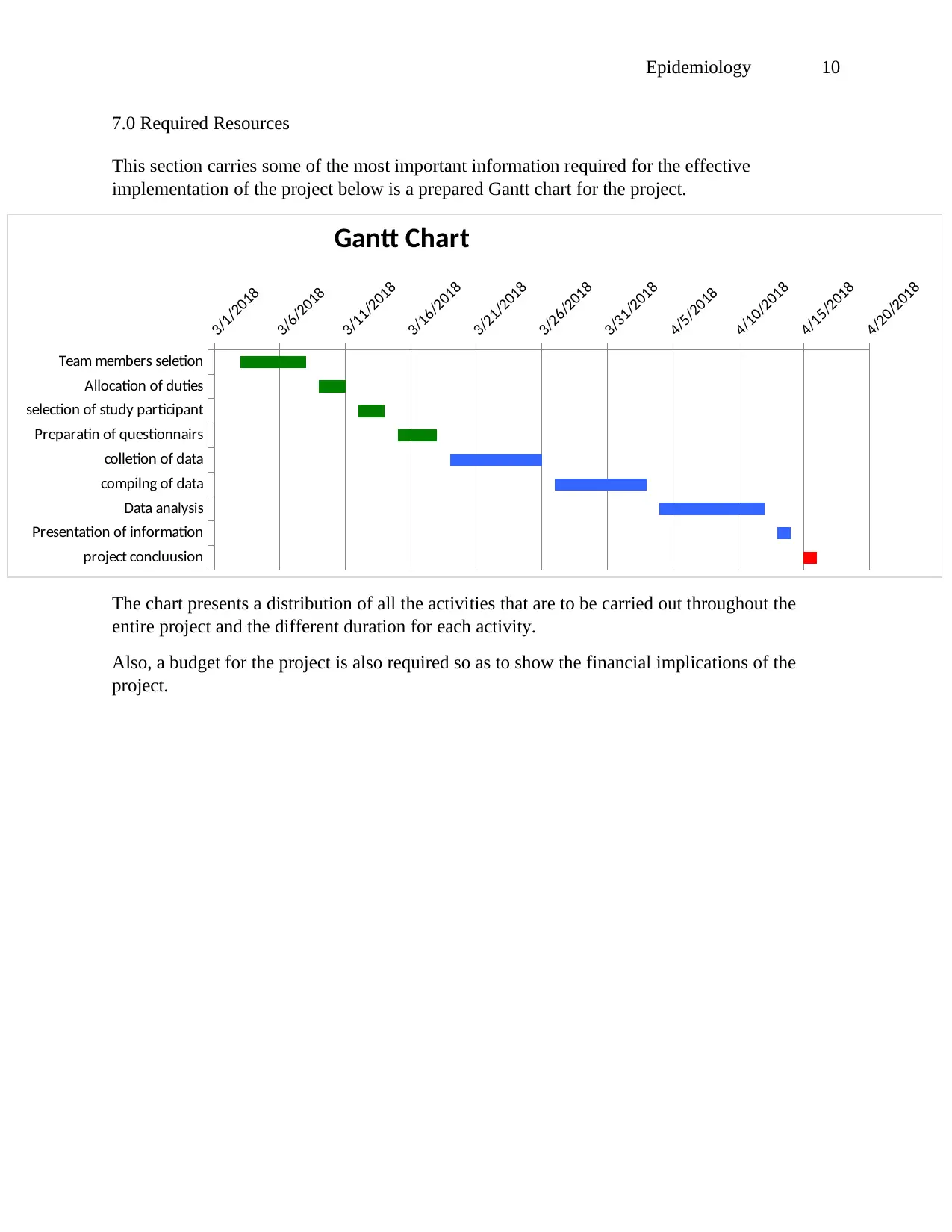
This section carries some of the most important information required for the effective
implementation of the project below is a prepared Gantt chart for the project.
Team members seletion
Allocation of duties
selection of study participant
Preparatin of questionnairs
colletion of data
compilng of data
Data analysis
Presentation of information
project concluusion
3/1/2018
3/6/2018
3/11/2018
3/16/2018
3/21/2018
3/26/2018
3/31/2018
4/5/2018
4/10/2018
4/15/2018
4/20/2018
Gantt Chart
The chart presents a distribution of all the activities that are to be carried out throughout the
entire project and the different duration for each activity.
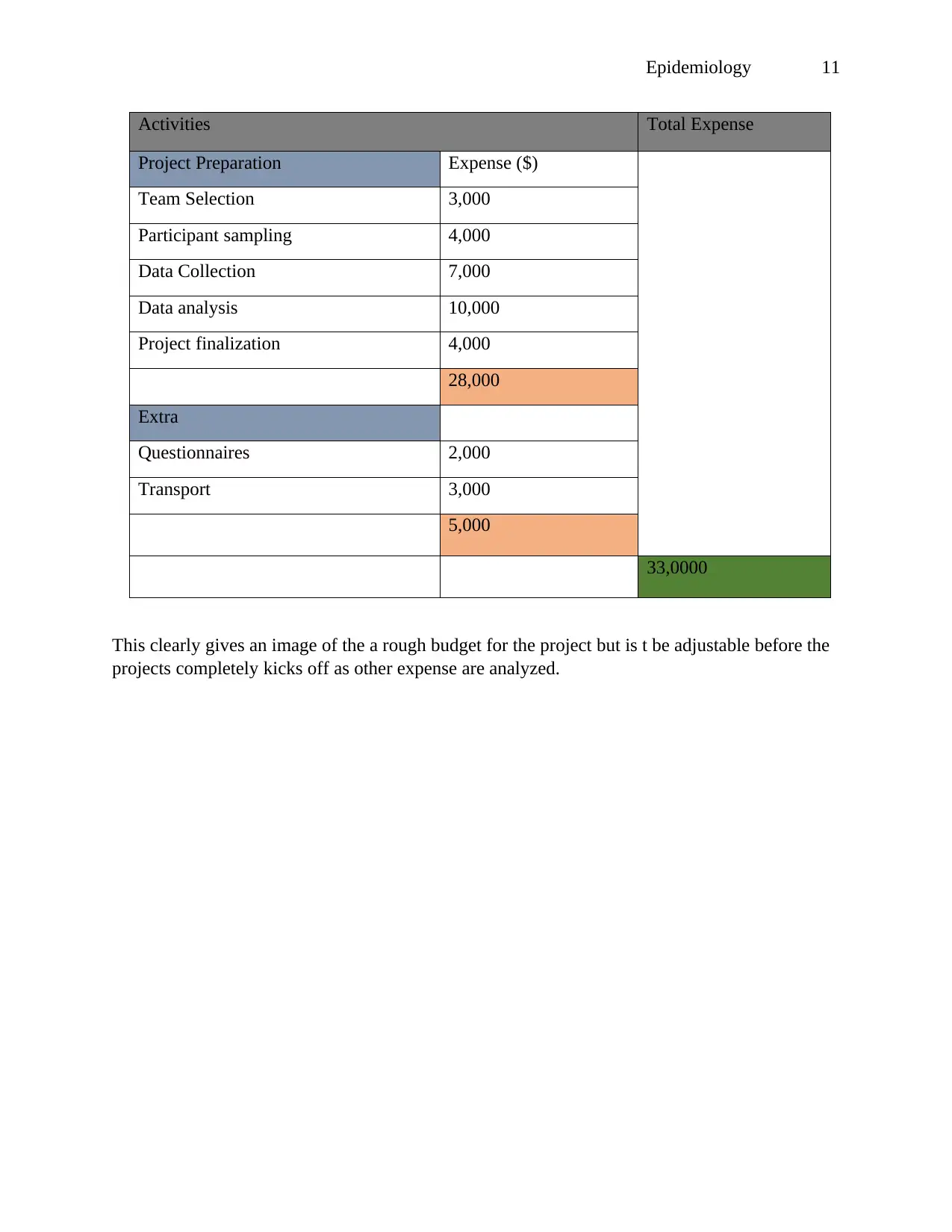
Also, a budget for the project is also required so as to show the financial implications of the
project.
7.0 Required Resources
This section carries some of the most important information required for the effective
implementation of the project below is a prepared Gantt chart for the project.
Team members seletion
Allocation of duties
selection of study participant
Preparatin of questionnairs
colletion of data
compilng of data
Data analysis
Presentation of information
project concluusion
3/1/2018
3/6/2018
3/11/2018
3/16/2018
3/21/2018
3/26/2018
3/31/2018
4/5/2018
4/10/2018
4/15/2018
4/20/2018
Gantt Chart
The chart presents a distribution of all the activities that are to be carried out throughout the
entire project and the different duration for each activity.
Also, a budget for the project is also required so as to show the financial implications of the
project.
Paraphrase This Document
Need a fresh take? Get an instant paraphrase of this document with our AI Paraphraser
Epidemiology 11
Activities Total Expense
Project Preparation Expense ($)
Team Selection 3,000
Participant sampling 4,000
Data Collection 7,000
Data analysis 10,000
Project finalization 4,000
28,000
Extra
Questionnaires 2,000
Transport 3,000
5,000
33,0000
This clearly gives an image of the a rough budget for the project but is t be adjustable before the
projects completely kicks off as other expense are analyzed.
Activities Total Expense
Project Preparation Expense ($)
Team Selection 3,000
Participant sampling 4,000
Data Collection 7,000
Data analysis 10,000
Project finalization 4,000
28,000
Extra
Questionnaires 2,000
Transport 3,000
5,000
33,0000
This clearly gives an image of the a rough budget for the project but is t be adjustable before the
projects completely kicks off as other expense are analyzed.
Epidemiology 12
Reference
Cole, T.J., 2016. Early Causes of Childhood Obesity and Implications for Prevention. Retrieved
December 2015.
Ek, A., Sorjonen, K., Eli, K., Lindberg, L., Nyman, J., Marcus, C. and Nowicka, P., 2016.
Associations between parental concerns about preschoolers’ weight and eating and
parental feeding practices: results from analyses of the child eating behavior
questionnaire, the Child Feeding Questionnaire, and the lifestyle behavior checklist. PloS
one, 11(1), p.e0147257.
Gurnani, M., Birken, C. and Hamilton, J., 2015. Childhood obesity: causes, consequences, and
management. Pediatric Clinics, 62(4), pp.821-840.
Hayes, A., Chevalier, A., D'Souza, M., Baur, L., Wen, L.M. and Simpson, J., 2016. Early
childhood obesity: Association with healthcare expenditure in Australia. Obesity, 24(8),
pp.1752-1758.
Lobstein, T., Jackson-Leach, R., Moodie, M.L., Hall, K.D., Gortmaker, S.L., Swinburn, B.A.,
James, W.P.T., Wang, Y. and McPherson, K., 2015. Child and adolescent obesity: part of
a bigger picture. The Lancet, 385(9986), pp.2510-2520.
Ott, R.L. and Longnecker, M.T., 2015. An introduction to statistical methods and data analysis.
Nelson Education.
Sabin, M.A., Kao, K.T., Juonala, M., Baur, L.A. and Wake, M., 2015. Viewpoint article:
Childhood obesity–looking back over 50 years to begin to look forward. Journal of
paediatrics and child health, 51(1), pp.82-86.
Reference
Cole, T.J., 2016. Early Causes of Childhood Obesity and Implications for Prevention. Retrieved
December 2015.
Ek, A., Sorjonen, K., Eli, K., Lindberg, L., Nyman, J., Marcus, C. and Nowicka, P., 2016.
Associations between parental concerns about preschoolers’ weight and eating and
parental feeding practices: results from analyses of the child eating behavior
questionnaire, the Child Feeding Questionnaire, and the lifestyle behavior checklist. PloS
one, 11(1), p.e0147257.
Gurnani, M., Birken, C. and Hamilton, J., 2015. Childhood obesity: causes, consequences, and
management. Pediatric Clinics, 62(4), pp.821-840.
Hayes, A., Chevalier, A., D'Souza, M., Baur, L., Wen, L.M. and Simpson, J., 2016. Early
childhood obesity: Association with healthcare expenditure in Australia. Obesity, 24(8),
pp.1752-1758.
Lobstein, T., Jackson-Leach, R., Moodie, M.L., Hall, K.D., Gortmaker, S.L., Swinburn, B.A.,
James, W.P.T., Wang, Y. and McPherson, K., 2015. Child and adolescent obesity: part of
a bigger picture. The Lancet, 385(9986), pp.2510-2520.
Ott, R.L. and Longnecker, M.T., 2015. An introduction to statistical methods and data analysis.
Nelson Education.
Sabin, M.A., Kao, K.T., Juonala, M., Baur, L.A. and Wake, M., 2015. Viewpoint article:
Childhood obesity–looking back over 50 years to begin to look forward. Journal of
paediatrics and child health, 51(1), pp.82-86.
⊘ This is a preview!⊘
Do you want full access?
Subscribe today to unlock all pages.
Trusted by 1+ million students worldwide

1 out of 19


Related Documents


Your All-in-One AI-Powered Toolkit for Academic Success.
+13062052269
info@desklib.com
Available 24*7 on WhatsApp / Email
![[object Object]](/_next/static/media/star-bottom.7253800d.svg)
Unlock your academic potential
Copyright © 2020–2026 A2Z Services. All Rights Reserved. Developed and managed by ZUCOL.