PHE3EPI Assignment 1: Study Designs and Measures in Epidemiology
VerifiedAdded on 2022/09/06
|9
|1458
|20
Homework Assignment
AI Summary
This assignment, prepared for the PHE3EPI course, delves into key concepts of epidemiology through a series of analytical questions. The student addresses topics such as calculating prevalence and cumulative incidence of stomach cancer among vegetarians, analyzing the suitability of case-control versus cohort studies, and determining the odds ratio. The assignment further explores measures of disease frequency and association in various scenarios, including bladder cancer and environmental factors affecting preschool children. The student also examines different study designs like cross-sectional, prospective cohort, and ecological studies. The document provides calculations, interpretations, and an overview of the advantages and disadvantages of each study design, along with relevant formulas and references. The assignment covers a range of epidemiological methods, including the assessment of risk factors and the application of appropriate measures of association, such as relative risk and attributable risk, to evaluate public health concerns and interventions.
Running Head: A STUDY ON TH CONCEPTS OF EPIDEMIOLOGY
A STUDY ON TH CONCEPTS OF EPIDEMIOLOGY
Name of the Student:
Name of the University:
Author Note:
A STUDY ON TH CONCEPTS OF EPIDEMIOLOGY
Name of the Student:
Name of the University:
Author Note:
Paraphrase This Document
Need a fresh take? Get an instant paraphrase of this document with our AI Paraphraser

1A STUDY ON TH CONCEPTS OF EPIDEMIOLOGY
Answer 1
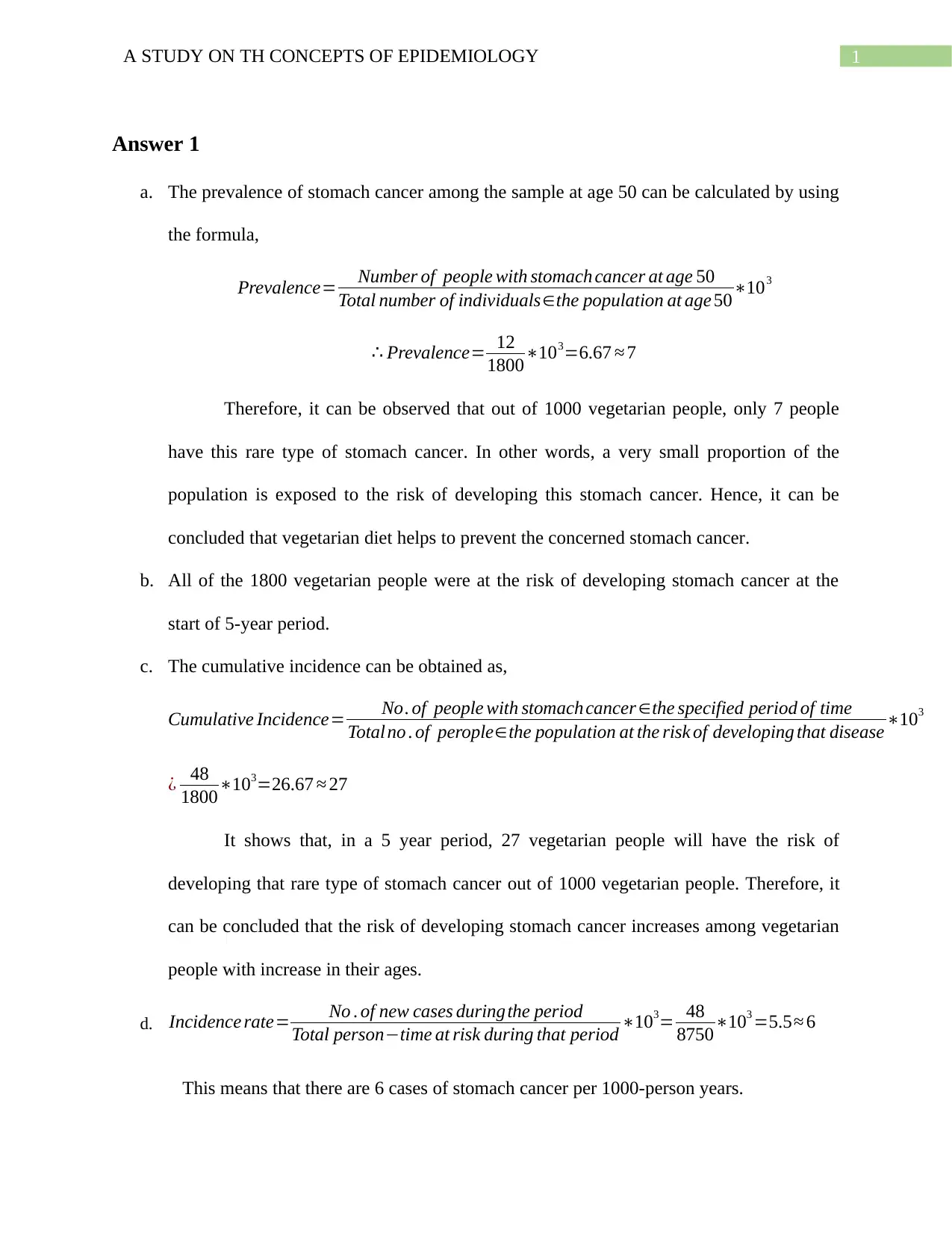
a. The prevalence of stomach cancer among the sample at age 50 can be calculated by using
the formula,
Prevalence= Number of people with stomach cancer at age 50
Total number of individuals∈the population at age 50∗103
∴ Prevalence= 12
1800∗103=6.67 ≈ 7
Therefore, it can be observed that out of 1000 vegetarian people, only 7 people
have this rare type of stomach cancer. In other words, a very small proportion of the
population is exposed to the risk of developing this stomach cancer. Hence, it can be
concluded that vegetarian diet helps to prevent the concerned stomach cancer.
b. All of the 1800 vegetarian people were at the risk of developing stomach cancer at the
start of 5-year period.
c. The cumulative incidence can be obtained as,
Cumulative Incidence= No. of people with stomach cancer ∈the specified period of time
Total no . of perople∈the population at the risk of developing that disease ∗103
¿ 48
1800∗103=26.67 ≈ 27
It shows that, in a 5 year period, 27 vegetarian people will have the risk of
developing that rare type of stomach cancer out of 1000 vegetarian people. Therefore, it
can be concluded that the risk of developing stomach cancer increases among vegetarian
people with increase in their ages.
d. Incidence rate= No . of new cases duringthe period
Total person−time at risk during that period ∗103= 48
8750∗103 =5.5≈ 6
This means that there are 6 cases of stomach cancer per 1000-person years.
Answer 1
a. The prevalence of stomach cancer among the sample at age 50 can be calculated by using
the formula,
Prevalence= Number of people with stomach cancer at age 50
Total number of individuals∈the population at age 50∗103
∴ Prevalence= 12
1800∗103=6.67 ≈ 7
Therefore, it can be observed that out of 1000 vegetarian people, only 7 people
have this rare type of stomach cancer. In other words, a very small proportion of the
population is exposed to the risk of developing this stomach cancer. Hence, it can be
concluded that vegetarian diet helps to prevent the concerned stomach cancer.
b. All of the 1800 vegetarian people were at the risk of developing stomach cancer at the
start of 5-year period.
c. The cumulative incidence can be obtained as,
Cumulative Incidence= No. of people with stomach cancer ∈the specified period of time
Total no . of perople∈the population at the risk of developing that disease ∗103
¿ 48
1800∗103=26.67 ≈ 27
It shows that, in a 5 year period, 27 vegetarian people will have the risk of
developing that rare type of stomach cancer out of 1000 vegetarian people. Therefore, it
can be concluded that the risk of developing stomach cancer increases among vegetarian
people with increase in their ages.
d. Incidence rate= No . of new cases duringthe period
Total person−time at risk during that period ∗103= 48
8750∗103 =5.5≈ 6
This means that there are 6 cases of stomach cancer per 1000-person years.

2A STUDY ON TH CONCEPTS OF EPIDEMIOLOGY
e. Cumulative incidence does not take into account the fact that some participants were lost
to follow-up and some died whereas incidence rate considers this (Merrill, 2016). Hence,
incidence rate would be better measurement for this study design.
Answer 2
a. From the theory of study design, it can be noted that prospective cohort study is used to
determine the risk factors of the disease and to establish a cause and effect relationship.
However, case-control study is used to study the association between risk factors and a
disease which is very rare (Rothman, Greenland & Lash, 2014). It can be observed form
question 1 that the development of this particular stomach cancer is very rare among
vegetarian people. Hence, case-control study is more appropriate than the prospective
cohort study in this case.
b. The Odds Ratio would be perfect to measure the association between the vegetarian diet
and risk of stomach cancer since it compares the odds of exposure to a disease among
cases with that of controls.
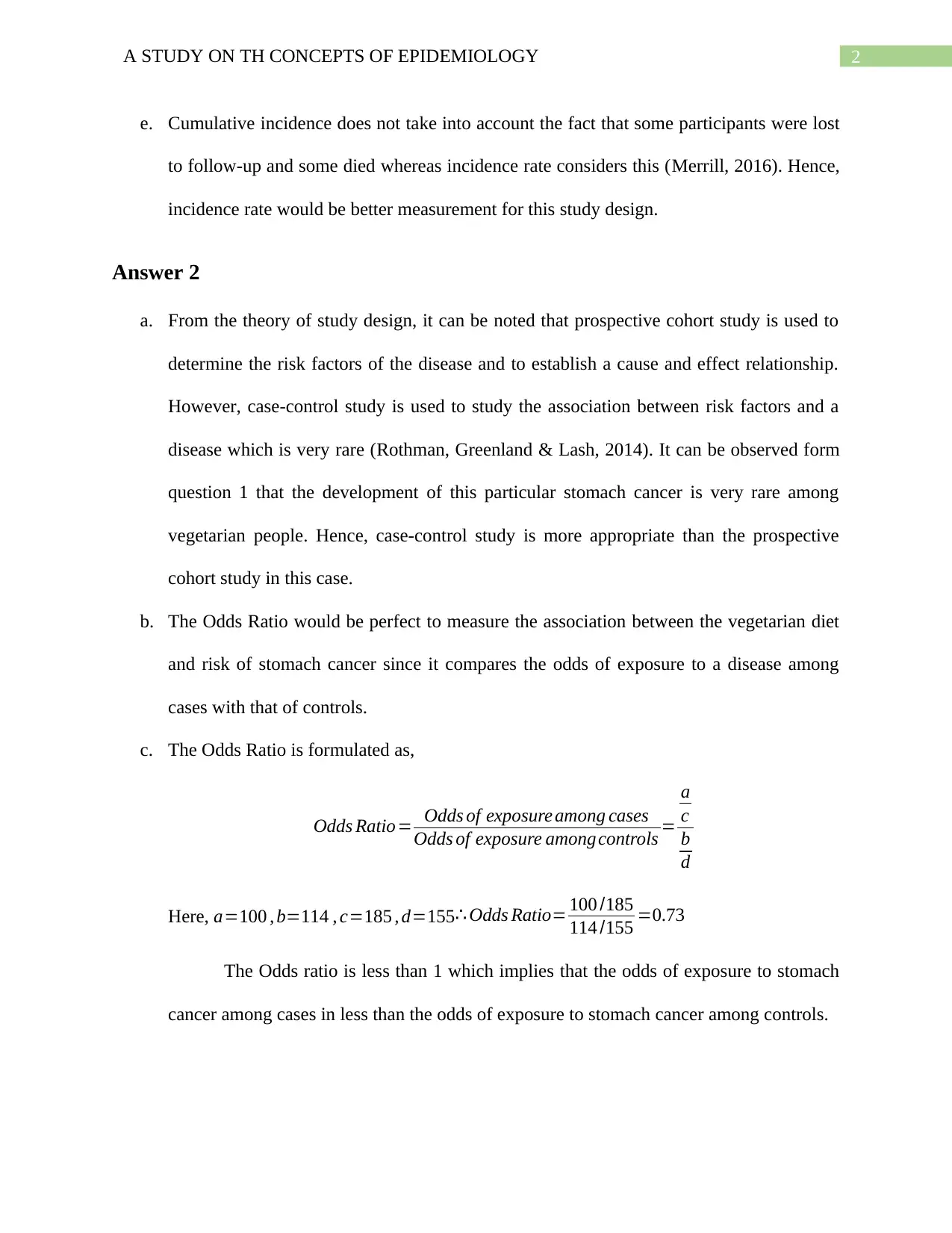
c. The Odds Ratio is formulated as,
Odds Ratio= Odds of exposure among cases
Odds of exposure amongcontrols =
a
c
b
d
Here, a=100 , b=114 , c=185 , d=155∴ Odds Ratio= 100 /185
114 /155 =0.73
The Odds ratio is less than 1 which implies that the odds of exposure to stomach
cancer among cases in less than the odds of exposure to stomach cancer among controls.
e. Cumulative incidence does not take into account the fact that some participants were lost
to follow-up and some died whereas incidence rate considers this (Merrill, 2016). Hence,
incidence rate would be better measurement for this study design.
Answer 2
a. From the theory of study design, it can be noted that prospective cohort study is used to
determine the risk factors of the disease and to establish a cause and effect relationship.
However, case-control study is used to study the association between risk factors and a
disease which is very rare (Rothman, Greenland & Lash, 2014). It can be observed form
question 1 that the development of this particular stomach cancer is very rare among
vegetarian people. Hence, case-control study is more appropriate than the prospective
cohort study in this case.
b. The Odds Ratio would be perfect to measure the association between the vegetarian diet
and risk of stomach cancer since it compares the odds of exposure to a disease among
cases with that of controls.
c. The Odds Ratio is formulated as,
Odds Ratio= Odds of exposure among cases
Odds of exposure amongcontrols =
a
c
b
d
Here, a=100 , b=114 , c=185 , d=155∴ Odds Ratio= 100 /185
114 /155 =0.73
The Odds ratio is less than 1 which implies that the odds of exposure to stomach
cancer among cases in less than the odds of exposure to stomach cancer among controls.
⊘ This is a preview!⊘
Do you want full access?
Subscribe today to unlock all pages.

Trusted by 1+ million students worldwide

3A STUDY ON TH CONCEPTS OF EPIDEMIOLOGY
d. The Odds ratio is found to be 0.73<1. This means that odds of vegetarian diet among
people with stomach cancer is less than the odds of vegetarian diet among individuals not
having stomach cancer.
e. The association measure shows that odds of the veg diet for cancer patients is less than
that for non-cancer patients. This means that vegetarian diet helps to prevent this rare
form of stomach cancer. Hence, it is suggested to encourage people for having vegetarian
diet.
Answer 3
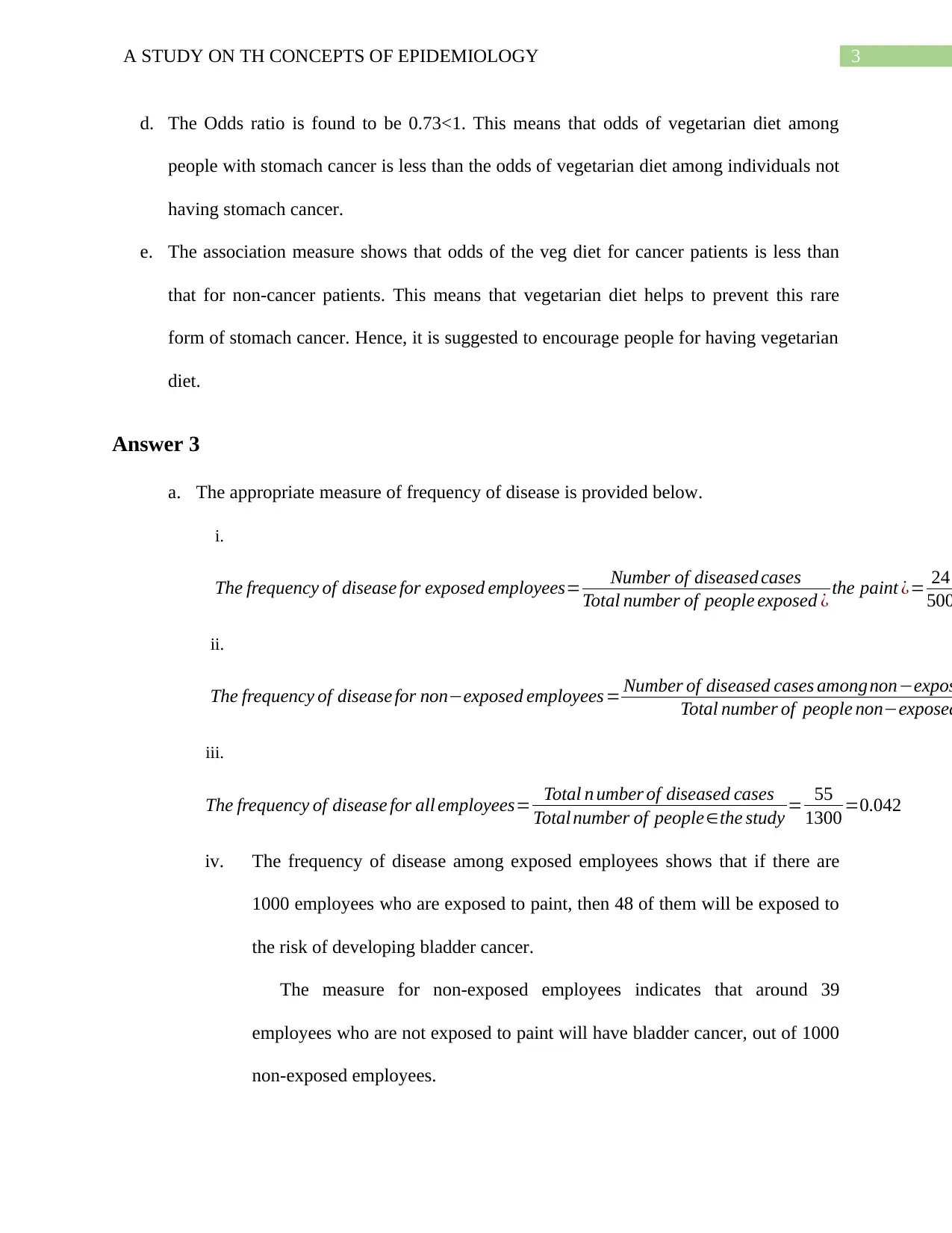
a. The appropriate measure of frequency of disease is provided below.
i.
The frequency of disease for exposed employees= Number of diseased cases
Total number of people exposed ¿ the paint ¿= 24
500
ii.
The frequency of disease for non−exposed employees = Number of diseased cases amongnon−expos
Total number of people non−exposed
iii.
The frequency of disease for all employees= Total n umber of diseased cases
Total number of people∈the study = 55
1300 =0.042
iv. The frequency of disease among exposed employees shows that if there are
1000 employees who are exposed to paint, then 48 of them will be exposed to
the risk of developing bladder cancer.
The measure for non-exposed employees indicates that around 39
employees who are not exposed to paint will have bladder cancer, out of 1000
non-exposed employees.
d. The Odds ratio is found to be 0.73<1. This means that odds of vegetarian diet among
people with stomach cancer is less than the odds of vegetarian diet among individuals not
having stomach cancer.
e. The association measure shows that odds of the veg diet for cancer patients is less than
that for non-cancer patients. This means that vegetarian diet helps to prevent this rare
form of stomach cancer. Hence, it is suggested to encourage people for having vegetarian
diet.
Answer 3
a. The appropriate measure of frequency of disease is provided below.
i.
The frequency of disease for exposed employees= Number of diseased cases
Total number of people exposed ¿ the paint ¿= 24
500
ii.
The frequency of disease for non−exposed employees = Number of diseased cases amongnon−expos
Total number of people non−exposed
iii.
The frequency of disease for all employees= Total n umber of diseased cases
Total number of people∈the study = 55
1300 =0.042
iv. The frequency of disease among exposed employees shows that if there are
1000 employees who are exposed to paint, then 48 of them will be exposed to
the risk of developing bladder cancer.
The measure for non-exposed employees indicates that around 39
employees who are not exposed to paint will have bladder cancer, out of 1000
non-exposed employees.
Paraphrase This Document
Need a fresh take? Get an instant paraphrase of this document with our AI Paraphraser

4A STUDY ON TH CONCEPTS OF EPIDEMIOLOGY
From the third part, it can be observed that the proportion of diseased
cases among all employees is 0.042. This implies that in a sample of 1000
employees, only 42 of them will be exposed to the risk of having bladder
cancer.
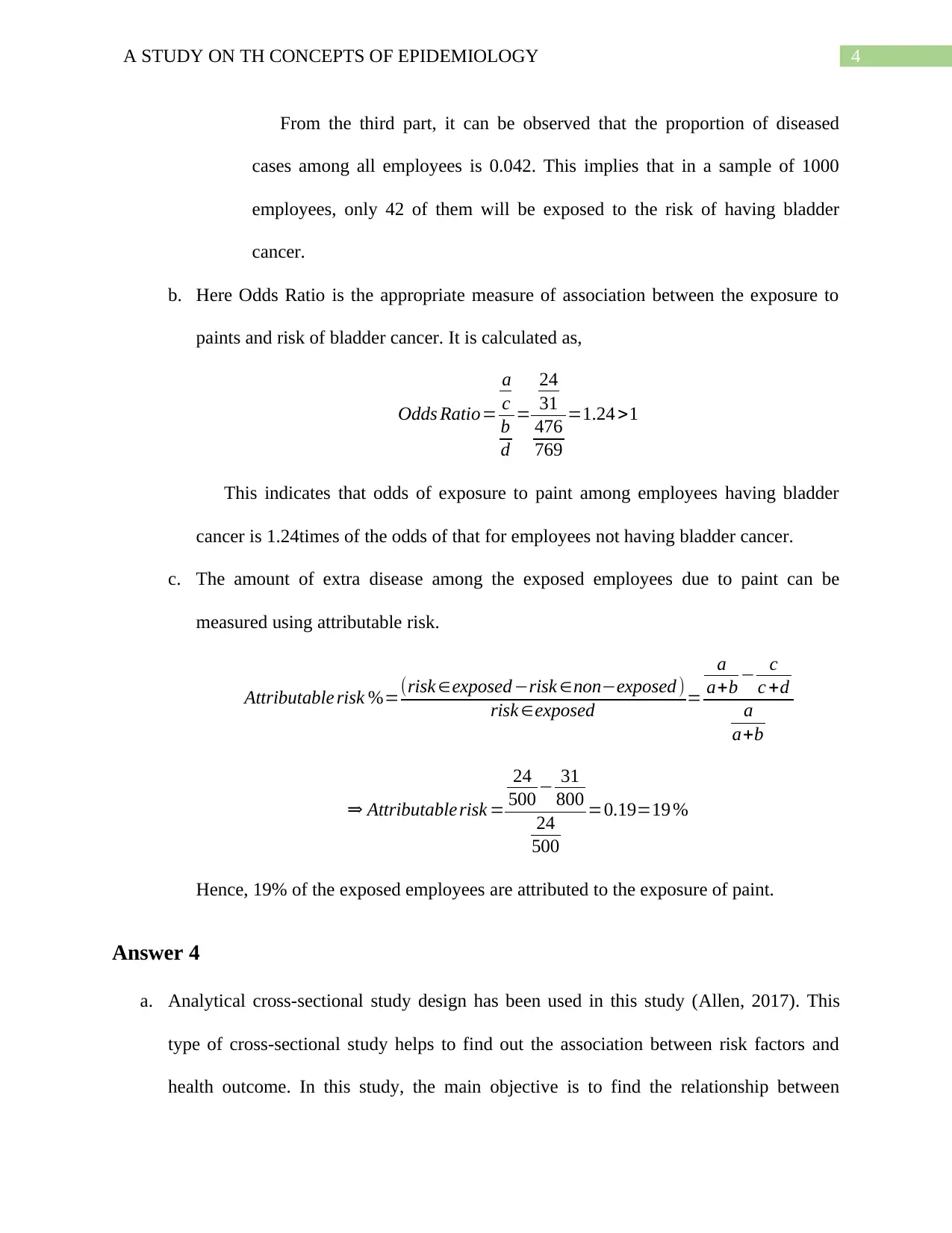
b. Here Odds Ratio is the appropriate measure of association between the exposure to
paints and risk of bladder cancer. It is calculated as,
Odds Ratio=
a
c
b
d
=
24
31
476
769
=1.24 >1
This indicates that odds of exposure to paint among employees having bladder
cancer is 1.24times of the odds of that for employees not having bladder cancer.
c. The amount of extra disease among the exposed employees due to paint can be
measured using attributable risk.
Attributable risk %=(risk ∈exposed−risk ∈non−exposed )
risk ∈exposed =
a
a+b − c
c +d
a
a+b
⇒ Attributable risk =
24
500 − 31
800
24
500
=0.19=19 %
Hence, 19% of the exposed employees are attributed to the exposure of paint.
Answer 4
a. Analytical cross-sectional study design has been used in this study (Allen, 2017). This
type of cross-sectional study helps to find out the association between risk factors and
health outcome. In this study, the main objective is to find the relationship between
From the third part, it can be observed that the proportion of diseased
cases among all employees is 0.042. This implies that in a sample of 1000
employees, only 42 of them will be exposed to the risk of having bladder
cancer.
b. Here Odds Ratio is the appropriate measure of association between the exposure to
paints and risk of bladder cancer. It is calculated as,
Odds Ratio=
a
c
b
d
=
24
31
476
769
=1.24 >1
This indicates that odds of exposure to paint among employees having bladder
cancer is 1.24times of the odds of that for employees not having bladder cancer.
c. The amount of extra disease among the exposed employees due to paint can be
measured using attributable risk.
Attributable risk %=(risk ∈exposed−risk ∈non−exposed )
risk ∈exposed =
a
a+b − c
c +d
a
a+b
⇒ Attributable risk =
24
500 − 31
800
24
500
=0.19=19 %
Hence, 19% of the exposed employees are attributed to the exposure of paint.
Answer 4
a. Analytical cross-sectional study design has been used in this study (Allen, 2017). This
type of cross-sectional study helps to find out the association between risk factors and
health outcome. In this study, the main objective is to find the relationship between

5A STUDY ON TH CONCEPTS OF EPIDEMIOLOGY
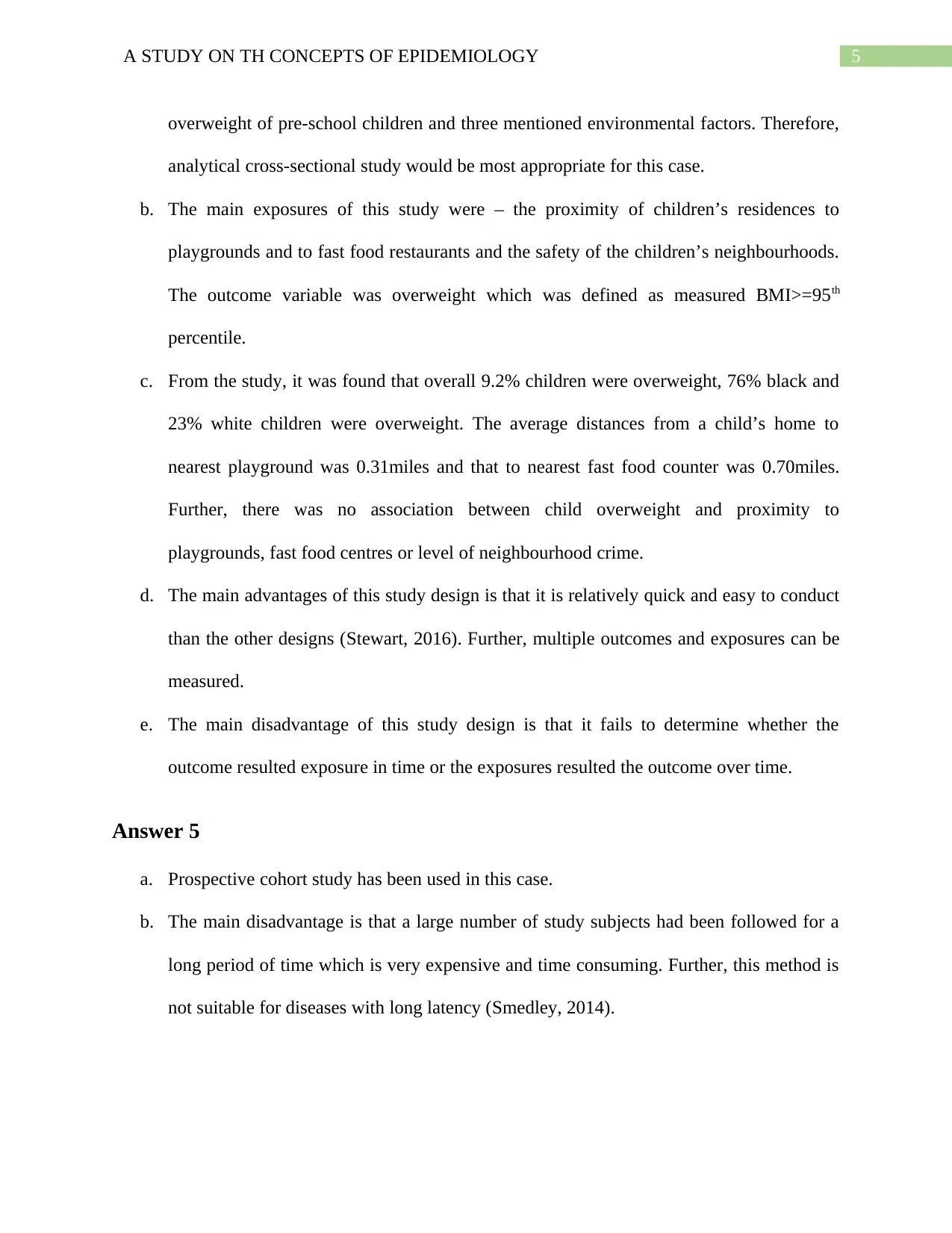
overweight of pre-school children and three mentioned environmental factors. Therefore,
analytical cross-sectional study would be most appropriate for this case.
b. The main exposures of this study were – the proximity of children’s residences to
playgrounds and to fast food restaurants and the safety of the children’s neighbourhoods.
The outcome variable was overweight which was defined as measured BMI>=95th
percentile.
c. From the study, it was found that overall 9.2% children were overweight, 76% black and
23% white children were overweight. The average distances from a child’s home to
nearest playground was 0.31miles and that to nearest fast food counter was 0.70miles.
Further, there was no association between child overweight and proximity to
playgrounds, fast food centres or level of neighbourhood crime.
d. The main advantages of this study design is that it is relatively quick and easy to conduct
than the other designs (Stewart, 2016). Further, multiple outcomes and exposures can be
measured.
e. The main disadvantage of this study design is that it fails to determine whether the
outcome resulted exposure in time or the exposures resulted the outcome over time.
Answer 5
a. Prospective cohort study has been used in this case.
b. The main disadvantage is that a large number of study subjects had been followed for a
long period of time which is very expensive and time consuming. Further, this method is
not suitable for diseases with long latency (Smedley, 2014).
overweight of pre-school children and three mentioned environmental factors. Therefore,
analytical cross-sectional study would be most appropriate for this case.
b. The main exposures of this study were – the proximity of children’s residences to
playgrounds and to fast food restaurants and the safety of the children’s neighbourhoods.
The outcome variable was overweight which was defined as measured BMI>=95th
percentile.
c. From the study, it was found that overall 9.2% children were overweight, 76% black and
23% white children were overweight. The average distances from a child’s home to
nearest playground was 0.31miles and that to nearest fast food counter was 0.70miles.
Further, there was no association between child overweight and proximity to
playgrounds, fast food centres or level of neighbourhood crime.
d. The main advantages of this study design is that it is relatively quick and easy to conduct
than the other designs (Stewart, 2016). Further, multiple outcomes and exposures can be
measured.
e. The main disadvantage of this study design is that it fails to determine whether the
outcome resulted exposure in time or the exposures resulted the outcome over time.
Answer 5
a. Prospective cohort study has been used in this case.
b. The main disadvantage is that a large number of study subjects had been followed for a
long period of time which is very expensive and time consuming. Further, this method is
not suitable for diseases with long latency (Smedley, 2014).
⊘ This is a preview!⊘
Do you want full access?
Subscribe today to unlock all pages.

Trusted by 1+ million students worldwide

6A STUDY ON TH CONCEPTS OF EPIDEMIOLOGY
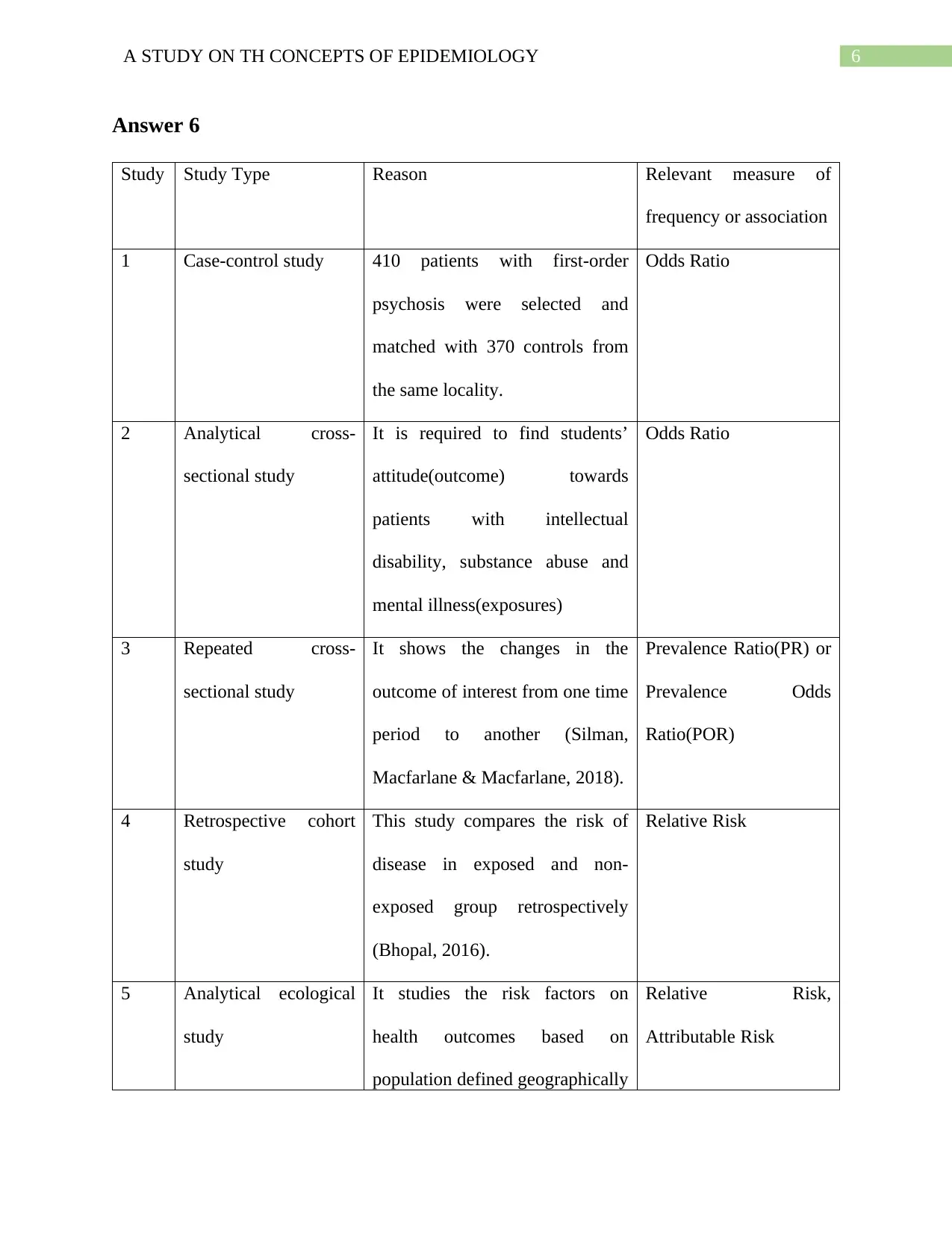
Answer 6
Study Study Type Reason Relevant measure of
frequency or association
1 Case-control study 410 patients with first-order
psychosis were selected and
matched with 370 controls from
the same locality.
Odds Ratio
2 Analytical cross-
sectional study
It is required to find students’
attitude(outcome) towards
patients with intellectual
disability, substance abuse and
mental illness(exposures)
Odds Ratio
3 Repeated cross-
sectional study
It shows the changes in the
outcome of interest from one time
period to another (Silman,
Macfarlane & Macfarlane, 2018).
Prevalence Ratio(PR) or
Prevalence Odds
Ratio(POR)
4 Retrospective cohort
study
This study compares the risk of
disease in exposed and non-
exposed group retrospectively
(Bhopal, 2016).
Relative Risk
5 Analytical ecological
study
It studies the risk factors on
health outcomes based on
population defined geographically
Relative Risk,
Attributable Risk
Answer 6
Study Study Type Reason Relevant measure of
frequency or association
1 Case-control study 410 patients with first-order
psychosis were selected and
matched with 370 controls from
the same locality.
Odds Ratio
2 Analytical cross-
sectional study
It is required to find students’
attitude(outcome) towards
patients with intellectual
disability, substance abuse and
mental illness(exposures)
Odds Ratio
3 Repeated cross-
sectional study
It shows the changes in the
outcome of interest from one time
period to another (Silman,
Macfarlane & Macfarlane, 2018).
Prevalence Ratio(PR) or
Prevalence Odds
Ratio(POR)
4 Retrospective cohort
study
This study compares the risk of
disease in exposed and non-
exposed group retrospectively
(Bhopal, 2016).
Relative Risk
5 Analytical ecological
study
It studies the risk factors on
health outcomes based on
population defined geographically
Relative Risk,
Attributable Risk
Paraphrase This Document
Need a fresh take? Get an instant paraphrase of this document with our AI Paraphraser

7A STUDY ON TH CONCEPTS OF EPIDEMIOLOGY
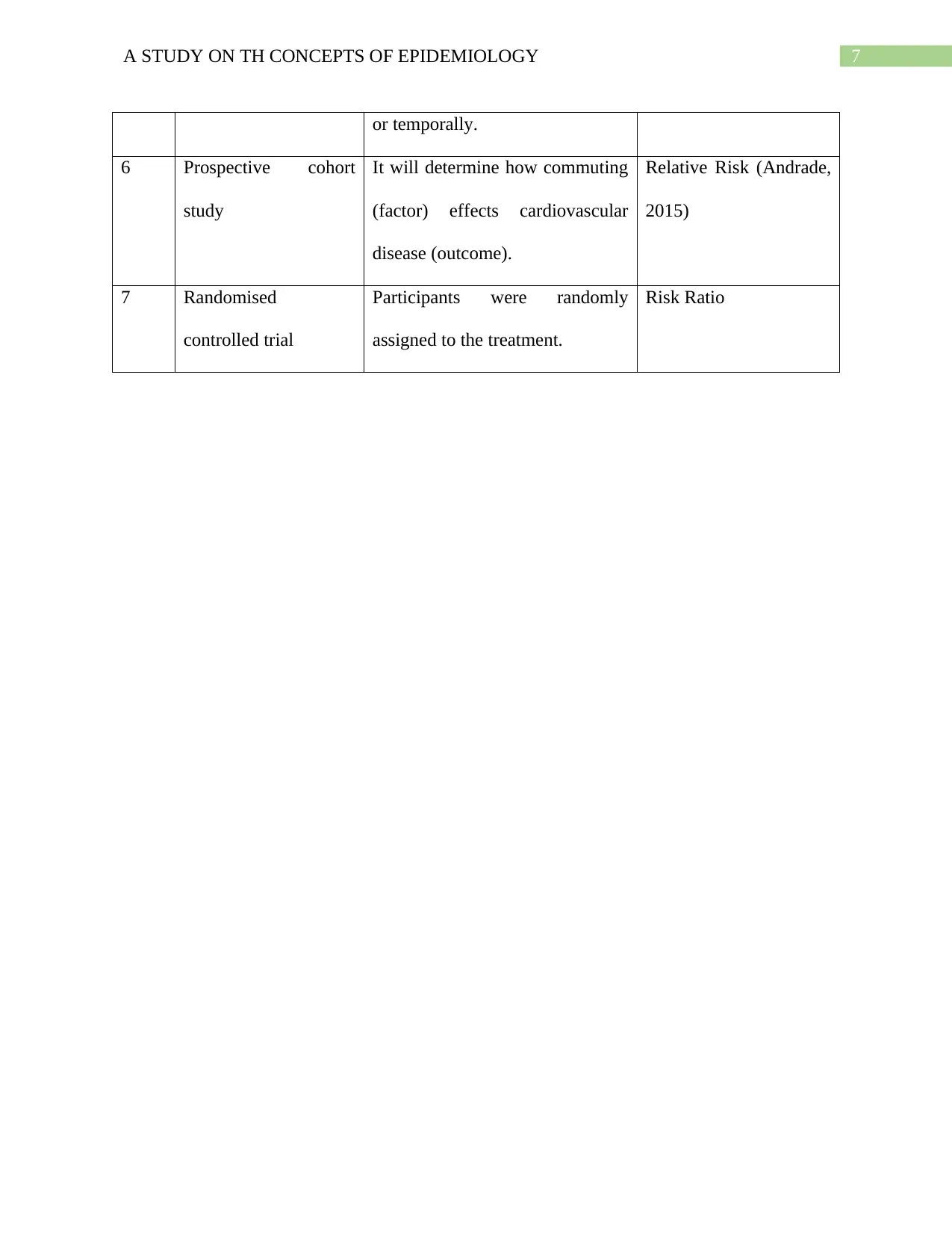
or temporally.
6 Prospective cohort
study
It will determine how commuting
(factor) effects cardiovascular
disease (outcome).
Relative Risk (Andrade,
2015)
7 Randomised
controlled trial
Participants were randomly
assigned to the treatment.
Risk Ratio
or temporally.
6 Prospective cohort
study
It will determine how commuting
(factor) effects cardiovascular
disease (outcome).
Relative Risk (Andrade,
2015)
7 Randomised
controlled trial
Participants were randomly
assigned to the treatment.
Risk Ratio

8A STUDY ON TH CONCEPTS OF EPIDEMIOLOGY
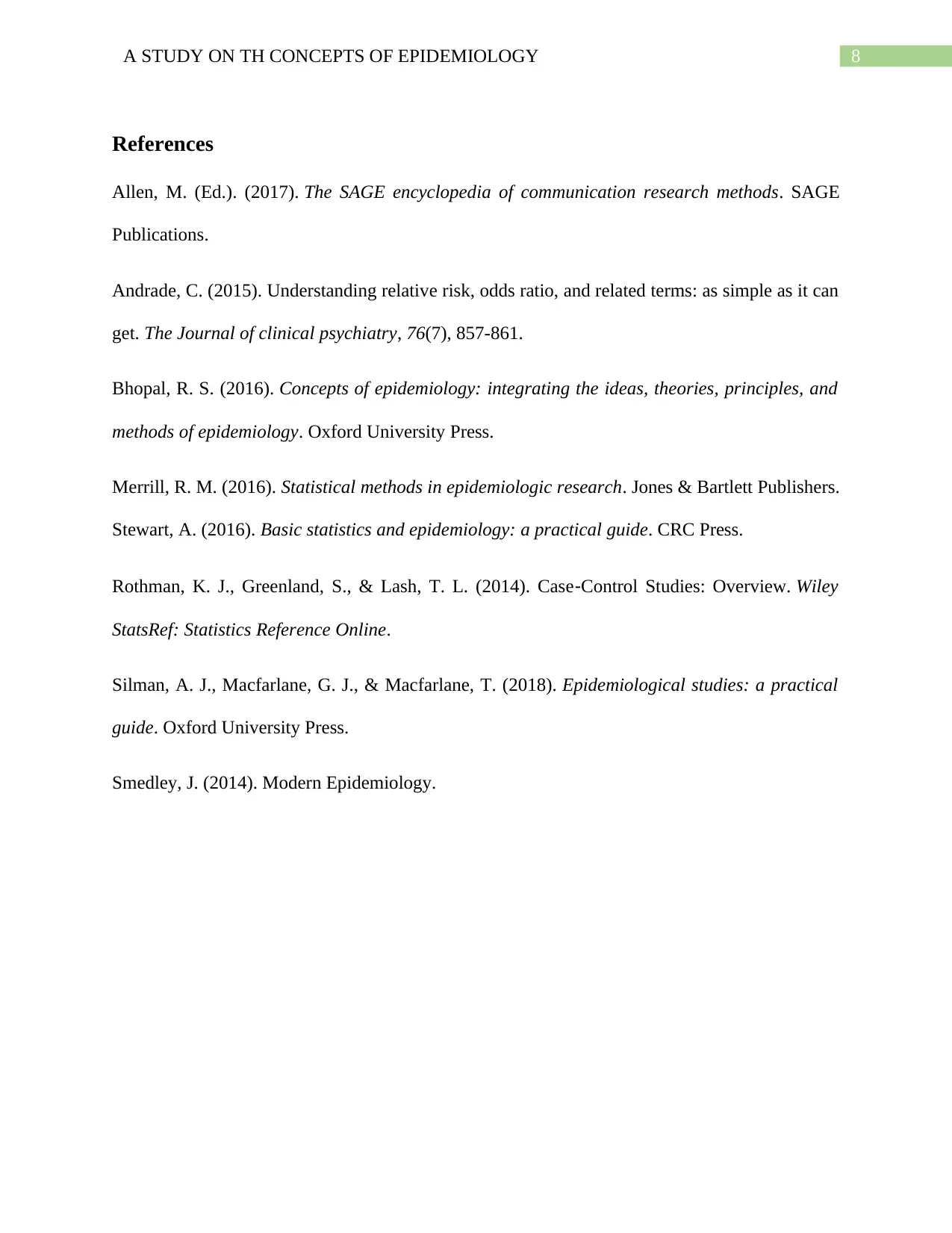
References
Allen, M. (Ed.). (2017). The SAGE encyclopedia of communication research methods. SAGE
Publications.
Andrade, C. (2015). Understanding relative risk, odds ratio, and related terms: as simple as it can
get. The Journal of clinical psychiatry, 76(7), 857-861.
Bhopal, R. S. (2016). Concepts of epidemiology: integrating the ideas, theories, principles, and
methods of epidemiology. Oxford University Press.
Merrill, R. M. (2016). Statistical methods in epidemiologic research. Jones & Bartlett Publishers.
Stewart, A. (2016). Basic statistics and epidemiology: a practical guide. CRC Press.
Rothman, K. J., Greenland, S., & Lash, T. L. (2014). Case‐Control Studies: Overview. Wiley
StatsRef: Statistics Reference Online.
Silman, A. J., Macfarlane, G. J., & Macfarlane, T. (2018). Epidemiological studies: a practical
guide. Oxford University Press.
Smedley, J. (2014). Modern Epidemiology.
References
Allen, M. (Ed.). (2017). The SAGE encyclopedia of communication research methods. SAGE
Publications.
Andrade, C. (2015). Understanding relative risk, odds ratio, and related terms: as simple as it can
get. The Journal of clinical psychiatry, 76(7), 857-861.
Bhopal, R. S. (2016). Concepts of epidemiology: integrating the ideas, theories, principles, and
methods of epidemiology. Oxford University Press.
Merrill, R. M. (2016). Statistical methods in epidemiologic research. Jones & Bartlett Publishers.
Stewart, A. (2016). Basic statistics and epidemiology: a practical guide. CRC Press.
Rothman, K. J., Greenland, S., & Lash, T. L. (2014). Case‐Control Studies: Overview. Wiley
StatsRef: Statistics Reference Online.
Silman, A. J., Macfarlane, G. J., & Macfarlane, T. (2018). Epidemiological studies: a practical
guide. Oxford University Press.
Smedley, J. (2014). Modern Epidemiology.
⊘ This is a preview!⊘
Do you want full access?
Subscribe today to unlock all pages.

Trusted by 1+ million students worldwide
1 out of 9
Related Documents
Your All-in-One AI-Powered Toolkit for Academic Success.
+13062052269
info@desklib.com
Available 24*7 on WhatsApp / Email
Unlock your academic potential
Copyright © 2020–2025 A2Z Services. All Rights Reserved. Developed and managed by ZUCOL.