Analysis of EpiPen Shortage and Supply Chain Management Issues

Verified

Added on  2021/04/17

|5
|1205
|34
Report
AI Summary
This report critically analyzes an article discussing the EpiPen shortage in Canberra, Australia, highlighting failures in supply chain management by the Therapeutic Goods Administration (TGA) and the supplier Alpha-Pharm. The analysis identifies weaknesses such as poor supply chain infrastructure, lack of inventory control, and restrictions on other pharmaceutical companies. The report emphasizes the need for effective supply chain management to address the shortage, including outsourcing activities, improving delivery systems, maintaining sufficient inventories, and allowing competition. The conclusion underscores the article's shortcomings in offering solutions and stresses the importance of proactive supply chain strategies to prevent future shortages and ensure timely access to life-saving medications. The report suggests that effective supply chain management is crucial for overcoming the EpiPen shortage.
Document Page
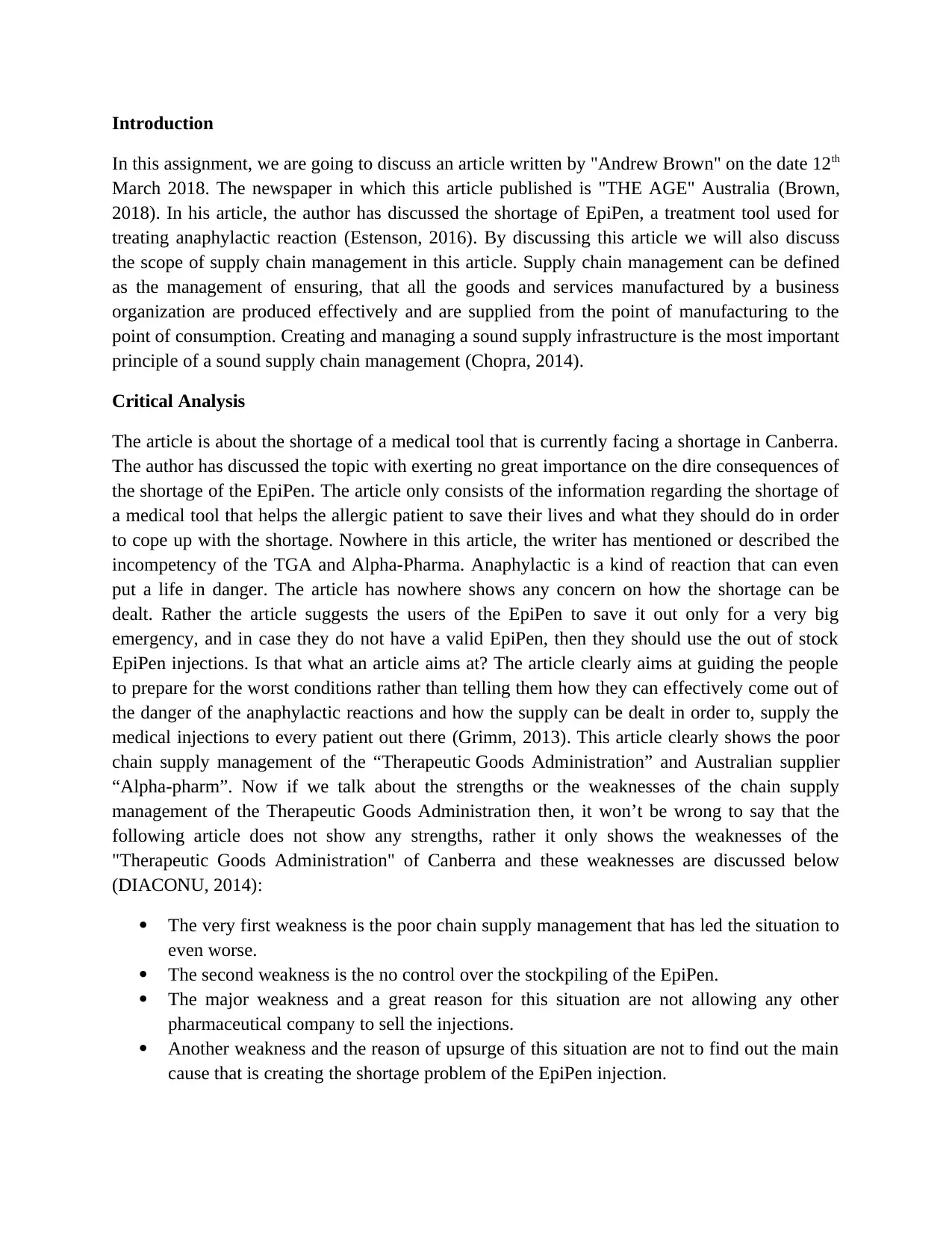
Introduction
In this assignment, we are going to discuss an article written by "Andrew Brown" on the date 12th
March 2018. The newspaper in which this article published is "THE AGE" Australia (Brown,
2018). In his article, the author has discussed the shortage of EpiPen, a treatment tool used for
treating anaphylactic reaction (Estenson, 2016). By discussing this article we will also discuss
the scope of supply chain management in this article. Supply chain management can be defined
as the management of ensuring, that all the goods and services manufactured by a business
organization are produced effectively and are supplied from the point of manufacturing to the
point of consumption. Creating and managing a sound supply infrastructure is the most important
principle of a sound supply chain management (Chopra, 2014).
Critical Analysis
The article is about the shortage of a medical tool that is currently facing a shortage in Canberra.
The author has discussed the topic with exerting no great importance on the dire consequences of
the shortage of the EpiPen. The article only consists of the information regarding the shortage of
a medical tool that helps the allergic patient to save their lives and what they should do in order
to cope up with the shortage. Nowhere in this article, the writer has mentioned or described the
incompetency of the TGA and Alpha-Pharma. Anaphylactic is a kind of reaction that can even
put a life in danger. The article has nowhere shows any concern on how the shortage can be
dealt. Rather the article suggests the users of the EpiPen to save it out only for a very big
emergency, and in case they do not have a valid EpiPen, then they should use the out of stock
EpiPen injections. Is that what an article aims at? The article clearly aims at guiding the people
to prepare for the worst conditions rather than telling them how they can effectively come out of
the danger of the anaphylactic reactions and how the supply can be dealt in order to, supply the
medical injections to every patient out there (Grimm, 2013). This article clearly shows the poor
chain supply management of the “Therapeutic Goods Administration” and Australian supplier
“Alpha-pharm”. Now if we talk about the strengths or the weaknesses of the chain supply
management of the Therapeutic Goods Administration then, it won’t be wrong to say that the
following article does not show any strengths, rather it only shows the weaknesses of the
"Therapeutic Goods Administration" of Canberra and these weaknesses are discussed below
(DIACONU, 2014):
The very first weakness is the poor chain supply management that has led the situation to
even worse.
The second weakness is the no control over the stockpiling of the EpiPen.
The major weakness and a great reason for this situation are not allowing any other
pharmaceutical company to sell the injections.
Another weakness and the reason of upsurge of this situation are not to find out the main
cause that is creating the shortage problem of the EpiPen injection.
tabler-icon-diamond-filled.svg

Paraphrase This Document

Need a fresh take? Get an instant paraphrase of this document with our AI Paraphraser
Document Page
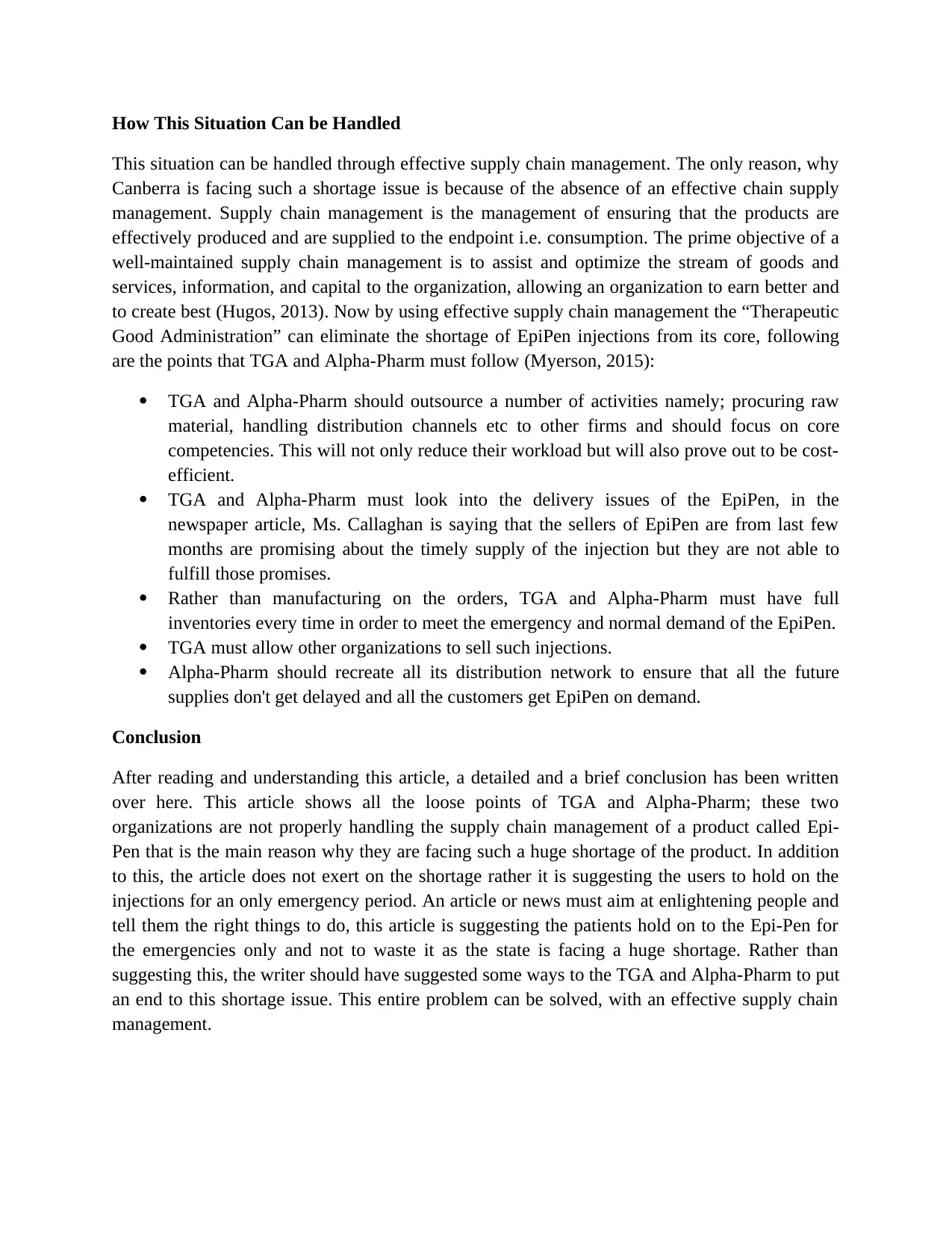
How This Situation Can be Handled
This situation can be handled through effective supply chain management. The only reason, why
Canberra is facing such a shortage issue is because of the absence of an effective chain supply
management. Supply chain management is the management of ensuring that the products are
effectively produced and are supplied to the endpoint i.e. consumption. The prime objective of a
well-maintained supply chain management is to assist and optimize the stream of goods and
services, information, and capital to the organization, allowing an organization to earn better and
to create best (Hugos, 2013). Now by using effective supply chain management the “Therapeutic
Good Administration” can eliminate the shortage of EpiPen injections from its core, following
are the points that TGA and Alpha-Pharm must follow (Myerson, 2015):
TGA and Alpha-Pharm should outsource a number of activities namely; procuring raw
material, handling distribution channels etc to other firms and should focus on core
competencies. This will not only reduce their workload but will also prove out to be cost-
efficient.
TGA and Alpha-Pharm must look into the delivery issues of the EpiPen, in the
newspaper article, Ms. Callaghan is saying that the sellers of EpiPen are from last few
months are promising about the timely supply of the injection but they are not able to
fulfill those promises.
Rather than manufacturing on the orders, TGA and Alpha-Pharm must have full
inventories every time in order to meet the emergency and normal demand of the EpiPen.
TGA must allow other organizations to sell such injections.
Alpha-Pharm should recreate all its distribution network to ensure that all the future
supplies don't get delayed and all the customers get EpiPen on demand.
Conclusion
After reading and understanding this article, a detailed and a brief conclusion has been written
over here. This article shows all the loose points of TGA and Alpha-Pharm; these two
organizations are not properly handling the supply chain management of a product called Epi-
Pen that is the main reason why they are facing such a huge shortage of the product. In addition
to this, the article does not exert on the shortage rather it is suggesting the users to hold on the
injections for an only emergency period. An article or news must aim at enlightening people and
tell them the right things to do, this article is suggesting the patients hold on to the Epi-Pen for
the emergencies only and not to waste it as the state is facing a huge shortage. Rather than
suggesting this, the writer should have suggested some ways to the TGA and Alpha-Pharm to put
an end to this shortage issue. This entire problem can be solved, with an effective supply chain
management.
Document Page
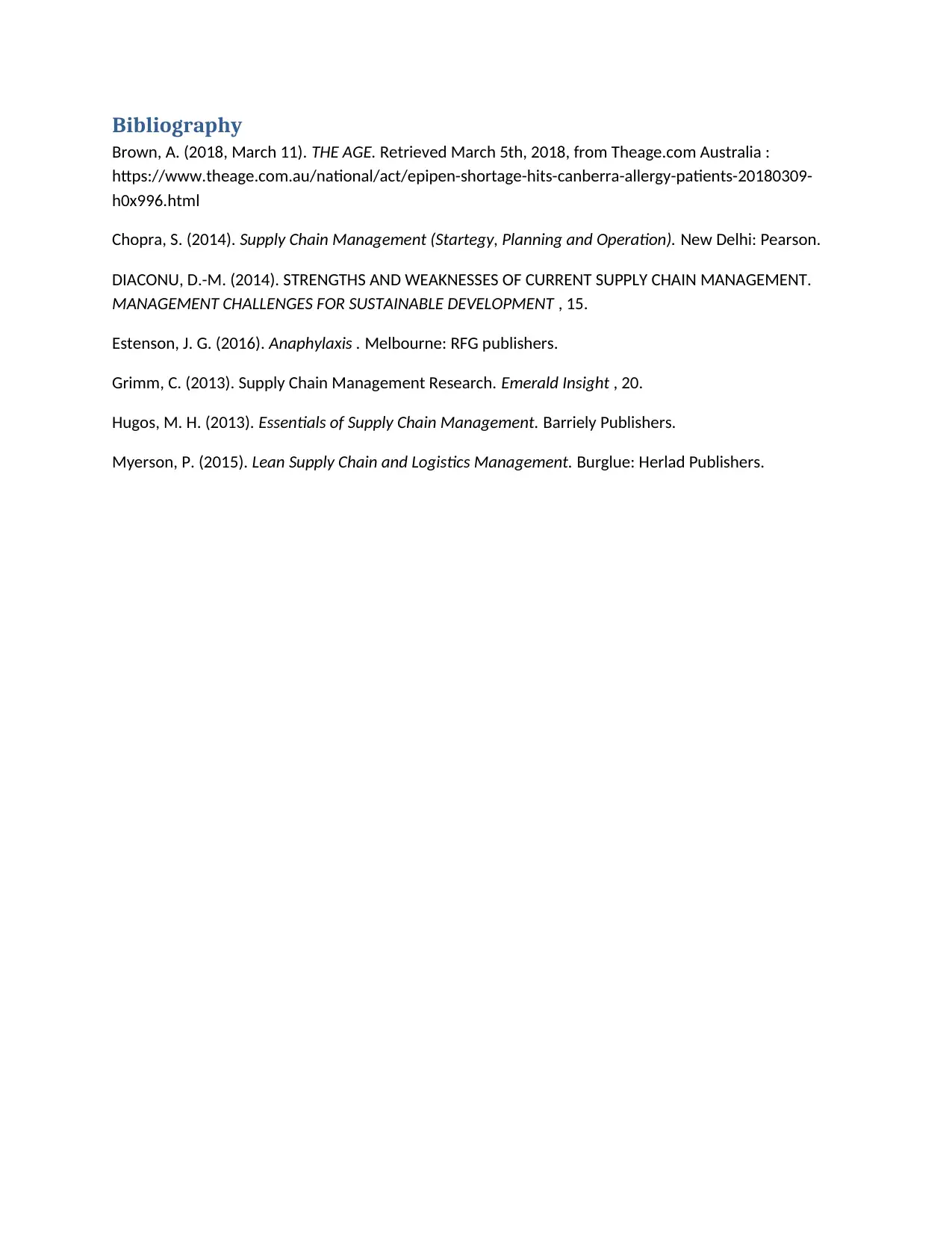
Bibliography
Brown, A. (2018, March 11). THE AGE. Retrieved March 5th, 2018, from Theage.com Australia :
https://www.theage.com.au/national/act/epipen-shortage-hits-canberra-allergy-patients-20180309-
h0x996.html
Chopra, S. (2014). Supply Chain Management (Startegy, Planning and Operation). New Delhi: Pearson.
DIACONU, D.-M. (2014). STRENGTHS AND WEAKNESSES OF CURRENT SUPPLY CHAIN MANAGEMENT.
MANAGEMENT CHALLENGES FOR SUSTAINABLE DEVELOPMENT , 15.
Estenson, J. G. (2016). Anaphylaxis . Melbourne: RFG publishers.
Grimm, C. (2013). Supply Chain Management Research. Emerald Insight , 20.
Hugos, M. H. (2013). Essentials of Supply Chain Management. Barriely Publishers.
Myerson, P. (2015). Lean Supply Chain and Logistics Management. Burglue: Herlad Publishers.
Document Page
Appendix:
https://www.theage.com.au/national/act/epipen-shortage-hits-canberra-allergy-patients-
20180309-h0x996.html
tabler-icon-diamond-filled.svg

Paraphrase This Document

Need a fresh take? Get an instant paraphrase of this document with our AI Paraphraser
Document Page
chevron_up_icon
1 out of 5
circle_padding
hide_on_mobile
zoom_out_icon
[object Object]