E-Portfolio: Integrating Digital Technologies in Education Practices
VerifiedAdded on 2023/06/04
|17
|4188
|436
Portfolio
AI Summary
This e-portfolio explores the integration of digital technologies in education through weekly tasks and critical evaluations. It covers various models and frameworks like SAMR and Bloom's Digital Taxonomy, examining how technology enhances learning. The portfolio evaluates digital tools such as Google Classroom and Canva, focusing on their usability and impact on teaching and learning. It also addresses digital ethics, lesson planning incorporating technology, and assessment strategies. The ethical and legal issues, including cyberbullying and student privacy, are discussed, alongside emerging technologies like Augmented Reality (AR) and their potential to transform education. The work emphasizes the importance of digital ethics in research and teaching, aiming to equip students with the skills and knowledge to navigate the digital landscape responsibly. Desklib offers similar resources for students seeking academic support.

Readings and E Portfolio

Paraphrase This Document
Need a fresh take? Get an instant paraphrase of this document with our AI Paraphraser
Table of Contents
PART A – Weekly E-Portfolio Tasks.............................................................................................3
Week 5: Models and Frameworks of Digital Technologies........................................................3
Week 6: Digital Technologies in the Classroom.........................................................................7
Week 9: Lesson Planning and Digital Technologies...................................................................8
Week 10: Assessment and Digital Technologies.......................................................................10
Week 11: Ethical and Legal Issues............................................................................................11
Week 12: New and Emerging Digital Technologies.................................................................11
Critical Evaluation.....................................................................................................................12
PART B - Response to Readings...................................................................................................12
REFERENCES................................................................................................................................1
PART A – Weekly E-Portfolio Tasks.............................................................................................3
Week 5: Models and Frameworks of Digital Technologies........................................................3
Week 6: Digital Technologies in the Classroom.........................................................................7
Week 9: Lesson Planning and Digital Technologies...................................................................8
Week 10: Assessment and Digital Technologies.......................................................................10
Week 11: Ethical and Legal Issues............................................................................................11
Week 12: New and Emerging Digital Technologies.................................................................11
Critical Evaluation.....................................................................................................................12
PART B - Response to Readings...................................................................................................12
REFERENCES................................................................................................................................1
PART A – Weekly E-Portfolio Tasks
Week 5: Models and Frameworks of Digital Technologies
SAMR
Week 5: Models and Frameworks of Digital Technologies
SAMR
⊘ This is a preview!⊘
Do you want full access?
Subscribe today to unlock all pages.

Trusted by 1+ million students worldwide
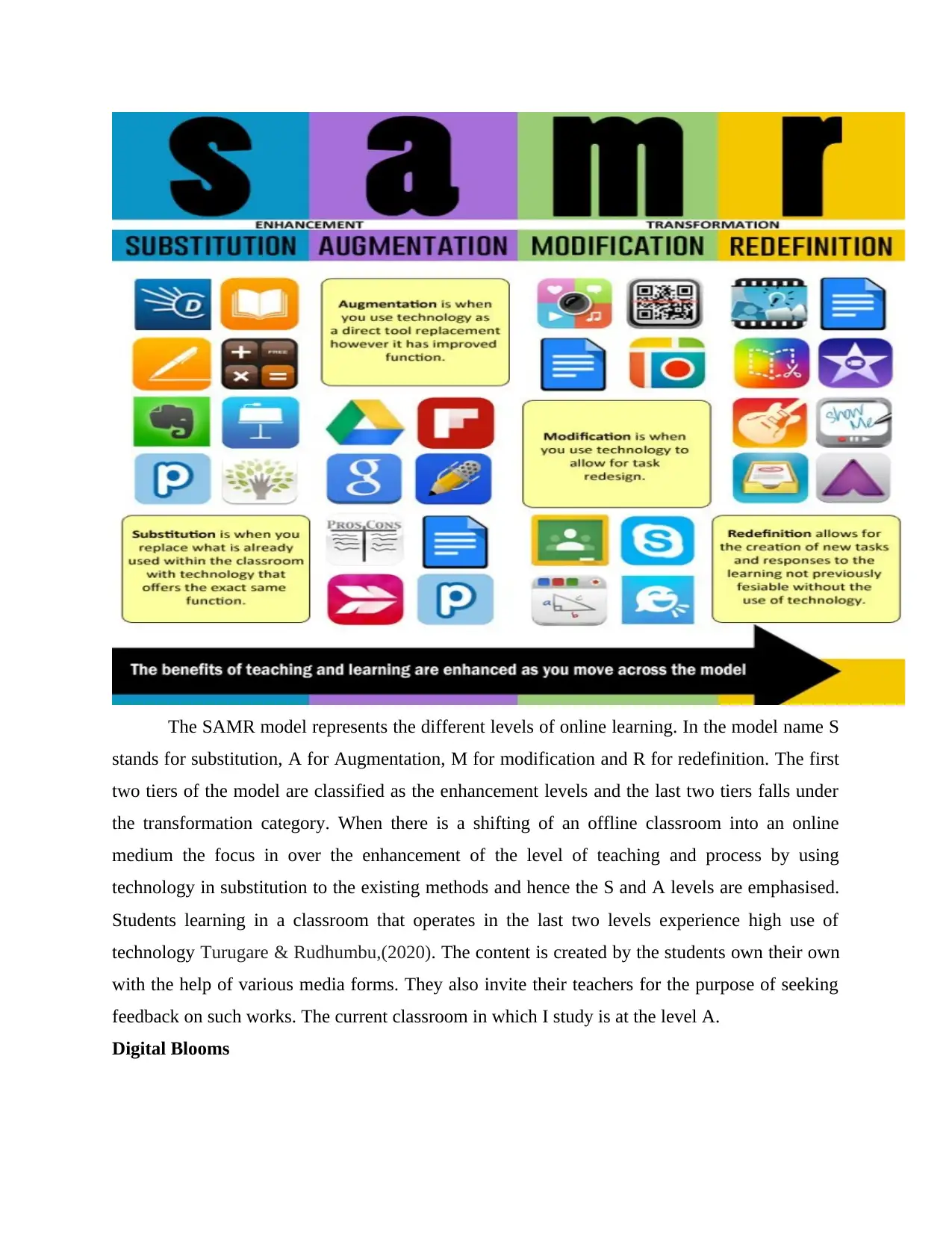
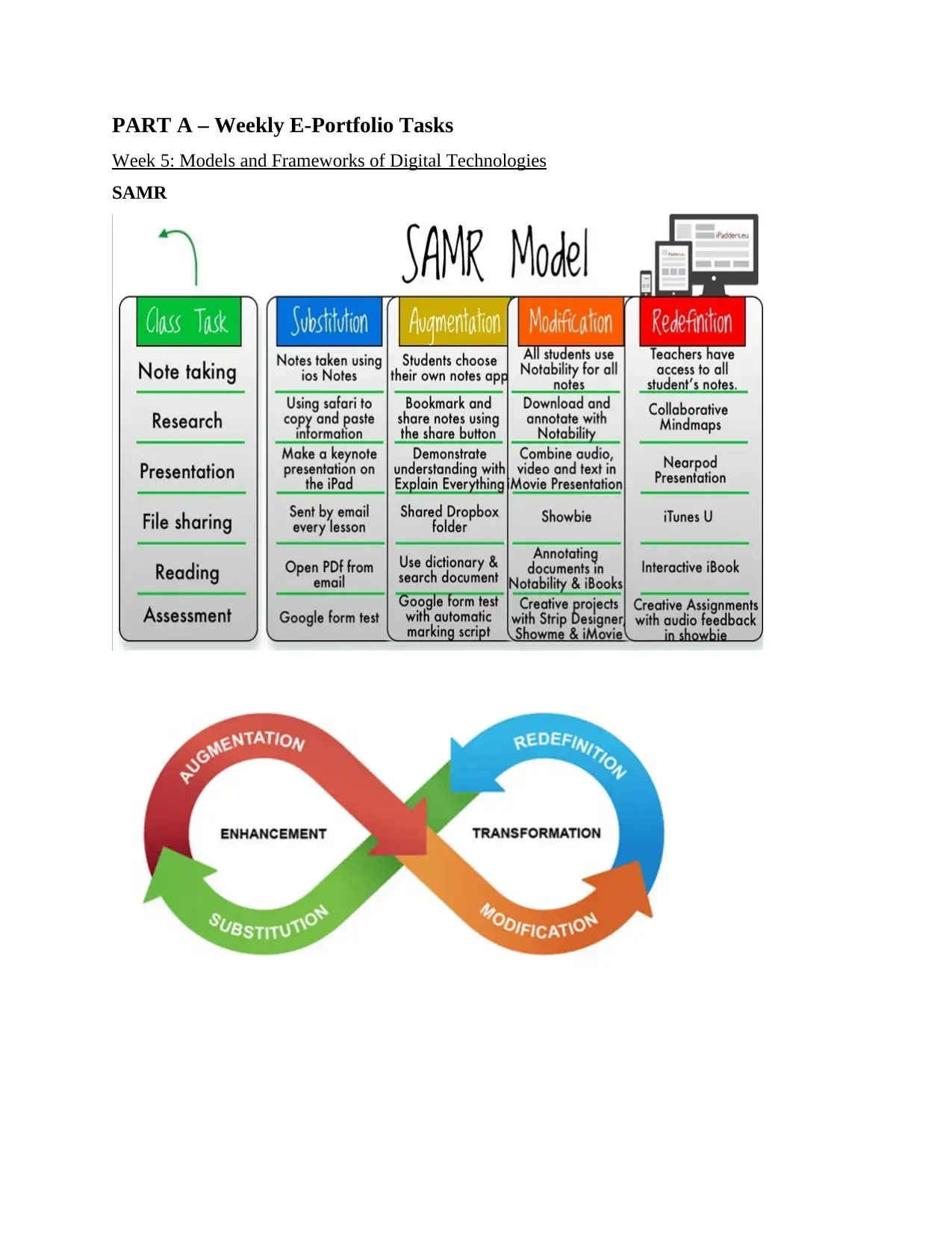
The SAMR model represents the different levels of online learning. In the model name S
stands for substitution, A for Augmentation, M for modification and R for redefinition. The first
two tiers of the model are classified as the enhancement levels and the last two tiers falls under
the transformation category. When there is a shifting of an offline classroom into an online
medium the focus in over the enhancement of the level of teaching and process by using
technology in substitution to the existing methods and hence the S and A levels are emphasised.
Students learning in a classroom that operates in the last two levels experience high use of
technology Turugare & Rudhumbu,(2020). The content is created by the students own their own
with the help of various media forms. They also invite their teachers for the purpose of seeking
feedback on such works. The current classroom in which I study is at the level A.
Digital Blooms
stands for substitution, A for Augmentation, M for modification and R for redefinition. The first
two tiers of the model are classified as the enhancement levels and the last two tiers falls under
the transformation category. When there is a shifting of an offline classroom into an online
medium the focus in over the enhancement of the level of teaching and process by using
technology in substitution to the existing methods and hence the S and A levels are emphasised.
Students learning in a classroom that operates in the last two levels experience high use of
technology Turugare & Rudhumbu,(2020). The content is created by the students own their own
with the help of various media forms. They also invite their teachers for the purpose of seeking
feedback on such works. The current classroom in which I study is at the level A.
Digital Blooms
Paraphrase This Document
Need a fresh take? Get an instant paraphrase of this document with our AI Paraphraser
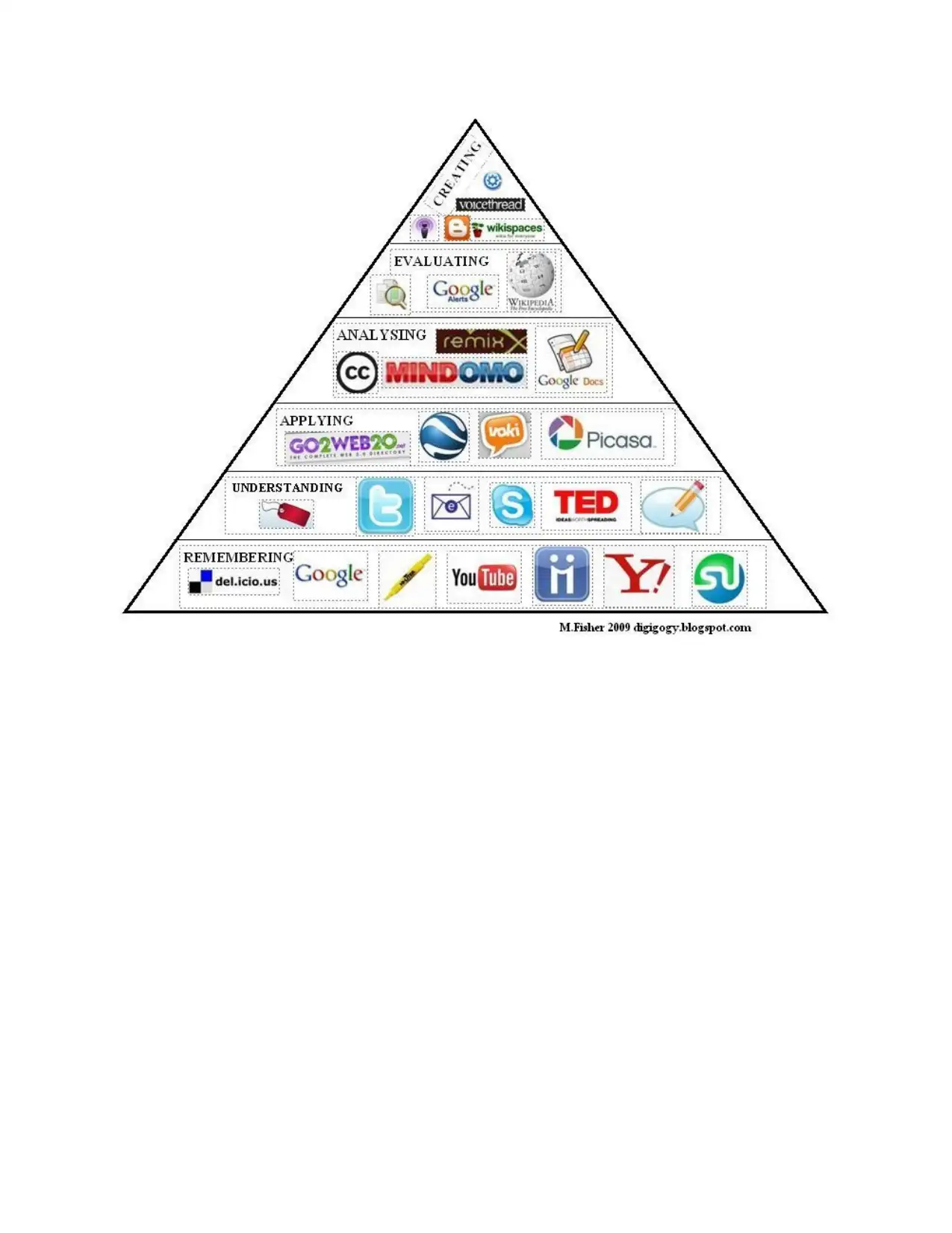
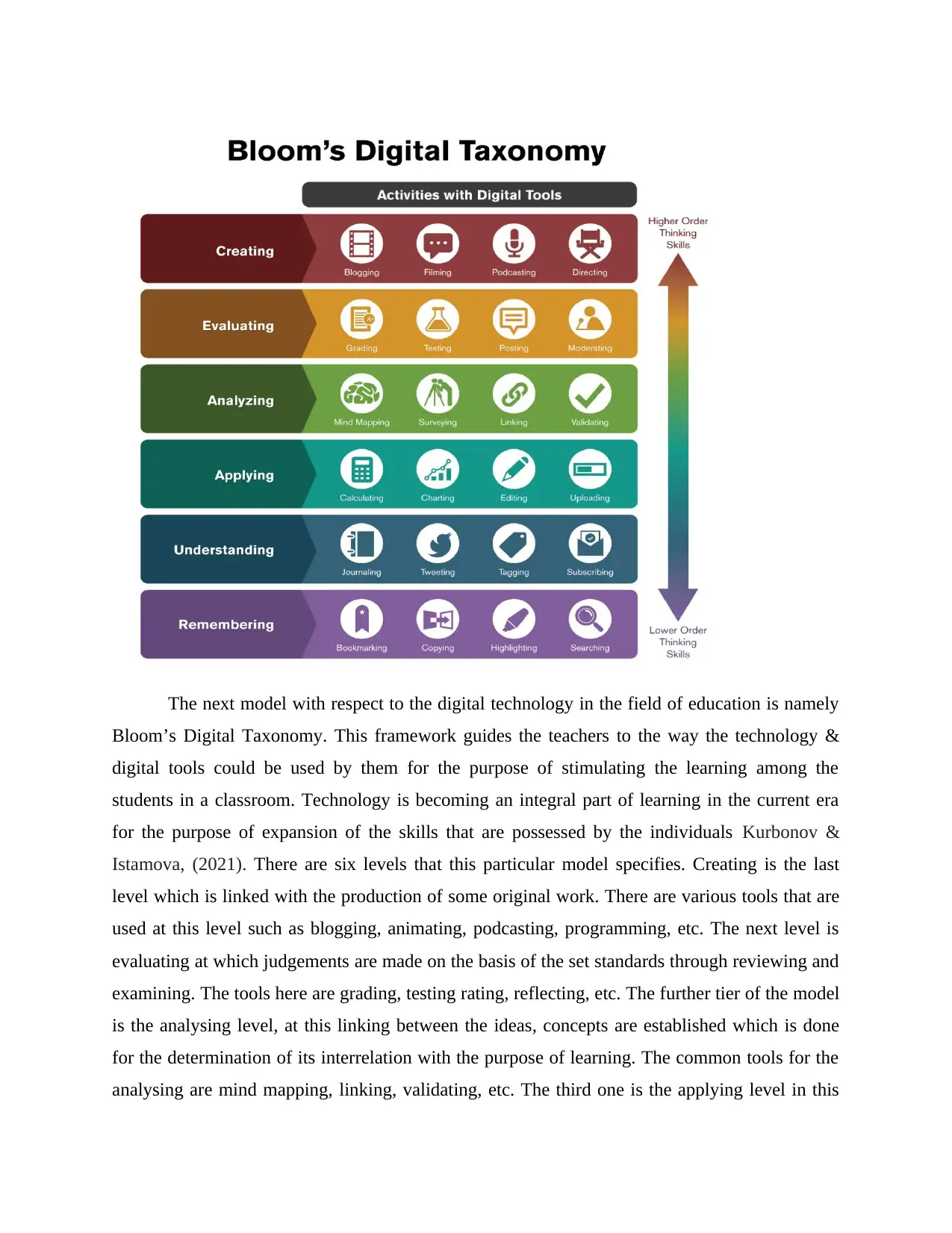
The next model with respect to the digital technology in the field of education is namely
Bloom’s Digital Taxonomy. This framework guides the teachers to the way the technology &
digital tools could be used by them for the purpose of stimulating the learning among the
students in a classroom. Technology is becoming an integral part of learning in the current era
for the purpose of expansion of the skills that are possessed by the individuals Kurbonov &
Istamova, (2021). There are six levels that this particular model specifies. Creating is the last
level which is linked with the production of some original work. There are various tools that are
used at this level such as blogging, animating, podcasting, programming, etc. The next level is
evaluating at which judgements are made on the basis of the set standards through reviewing and
examining. The tools here are grading, testing rating, reflecting, etc. The further tier of the model
is the analysing level, at this linking between the ideas, concepts are established which is done
for the determination of its interrelation with the purpose of learning. The common tools for the
analysing are mind mapping, linking, validating, etc. The third one is the applying level in this
Bloom’s Digital Taxonomy. This framework guides the teachers to the way the technology &
digital tools could be used by them for the purpose of stimulating the learning among the
students in a classroom. Technology is becoming an integral part of learning in the current era
for the purpose of expansion of the skills that are possessed by the individuals Kurbonov &
Istamova, (2021). There are six levels that this particular model specifies. Creating is the last
level which is linked with the production of some original work. There are various tools that are
used at this level such as blogging, animating, podcasting, programming, etc. The next level is
evaluating at which judgements are made on the basis of the set standards through reviewing and
examining. The tools here are grading, testing rating, reflecting, etc. The further tier of the model
is the analysing level, at this linking between the ideas, concepts are established which is done
for the determination of its interrelation with the purpose of learning. The common tools for the
analysing are mind mapping, linking, validating, etc. The third one is the applying level in this
⊘ This is a preview!⊘
Do you want full access?
Subscribe today to unlock all pages.
Trusted by 1+ million students worldwide
the information possessed is used in various situations that can be in the form of presentations,
model or diagrams. The tools to this are charting presenting, calculating, etc Erbas, Çipuri &
Joni, (2021). The second level is namely the understanding level which is concerned with the
explaining of concepts, terms, ideas or the determination of the meaning from graphics or written
texts. Tools for understanding level are annotating, advanced searching, commenting, etc. First is
the remembering level, this involves recalling the facts, concepts or material retrieving. The tools
related to this are bookmarking, googling, searching, group networking, etc.
Week 6: Digital Technologies in the Classroom
Evaluation
The materials that are used for teaching by the teachers in teaching and learning process
are evaluated by them. The evaluation of digital technology chosen that is google classroom will
be included in this section. This technology is easy to use and users can use it from any of their
devices. For the creation of assignments google documents is used which makes the work easier.
The platform serves as a medium of effective communication and information sharing, this is
one of the major advantage that is associated with using of google classroom technology into the
classroom. The feedback process turns effective and the process of assignment also enhances and
fasten up. It eliminates the requirement of using paper and also provides an interface that is user
friendly as well as clean Roy (2019). It can be used by teachers, learners and everyone, the
commenting system is improvised as the URLs can be used for the online discussion. Some
problems are faced in organization of materials and organization of deadlines of assignment as
the integration of operations is limited. The users who are new to google features might get
confuse with it as the platform uses all the apps and features created by google. The feed of the
app needs to be refreshed every time to view the recent updates as they do not get updated
automatically. Further only the teachers can share their content over the online session no such
option is available to the learners. The quizzes and tests on google classroom are not automated
making it a major reason of being incapable to replace the existing learning environment Ugli, &
Ugli (2022). Further it is not integrated with google hangouts so online integration between the
leaners and teachers is lacking.
Concept Map Designing Using Canva
model or diagrams. The tools to this are charting presenting, calculating, etc Erbas, Çipuri &
Joni, (2021). The second level is namely the understanding level which is concerned with the
explaining of concepts, terms, ideas or the determination of the meaning from graphics or written
texts. Tools for understanding level are annotating, advanced searching, commenting, etc. First is
the remembering level, this involves recalling the facts, concepts or material retrieving. The tools
related to this are bookmarking, googling, searching, group networking, etc.
Week 6: Digital Technologies in the Classroom
Evaluation
The materials that are used for teaching by the teachers in teaching and learning process
are evaluated by them. The evaluation of digital technology chosen that is google classroom will
be included in this section. This technology is easy to use and users can use it from any of their
devices. For the creation of assignments google documents is used which makes the work easier.
The platform serves as a medium of effective communication and information sharing, this is
one of the major advantage that is associated with using of google classroom technology into the
classroom. The feedback process turns effective and the process of assignment also enhances and
fasten up. It eliminates the requirement of using paper and also provides an interface that is user
friendly as well as clean Roy (2019). It can be used by teachers, learners and everyone, the
commenting system is improvised as the URLs can be used for the online discussion. Some
problems are faced in organization of materials and organization of deadlines of assignment as
the integration of operations is limited. The users who are new to google features might get
confuse with it as the platform uses all the apps and features created by google. The feed of the
app needs to be refreshed every time to view the recent updates as they do not get updated
automatically. Further only the teachers can share their content over the online session no such
option is available to the learners. The quizzes and tests on google classroom are not automated
making it a major reason of being incapable to replace the existing learning environment Ugli, &
Ugli (2022). Further it is not integrated with google hangouts so online integration between the
leaners and teachers is lacking.
Concept Map Designing Using Canva
Paraphrase This Document
Need a fresh take? Get an instant paraphrase of this document with our AI Paraphraser
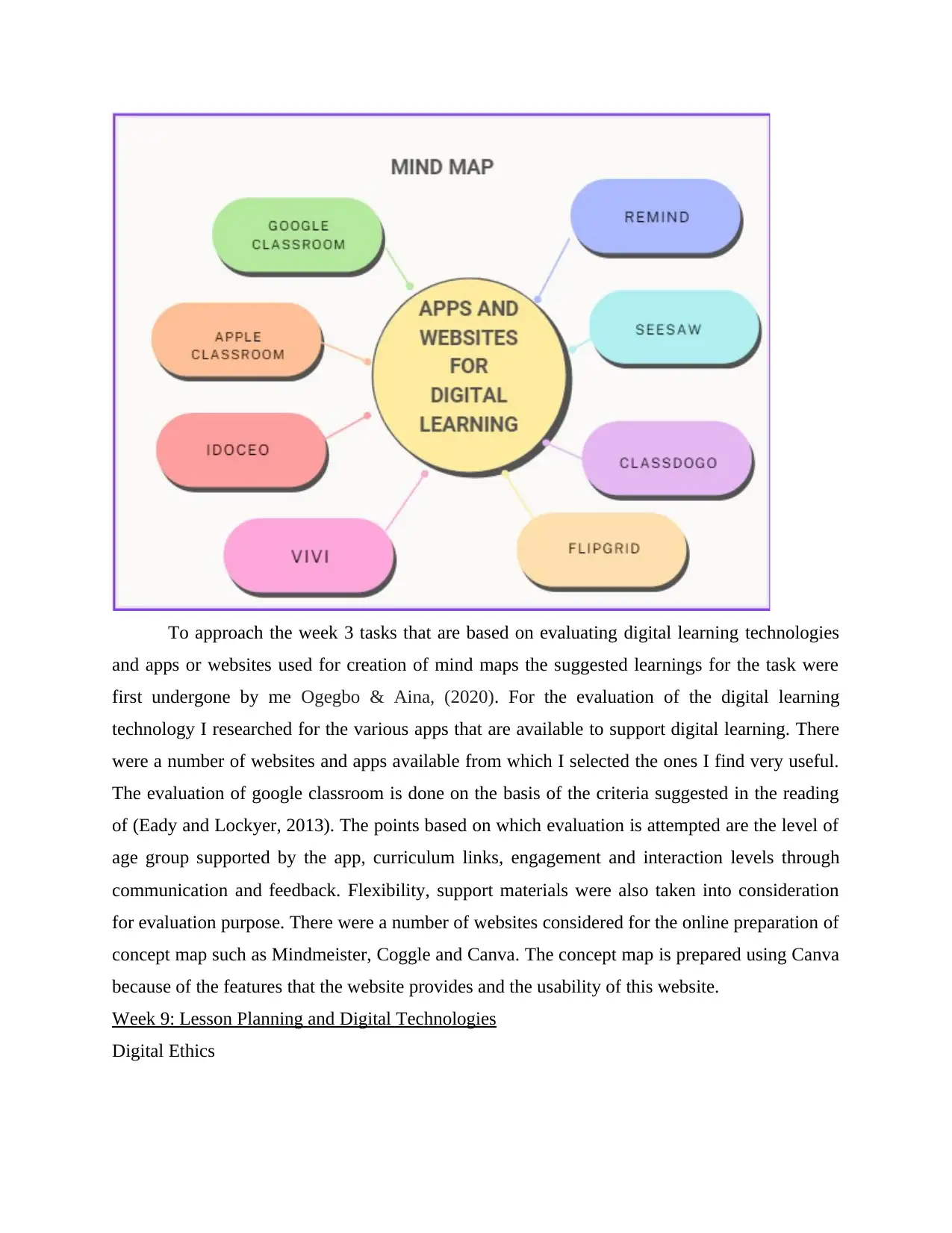
To approach the week 3 tasks that are based on evaluating digital learning technologies
and apps or websites used for creation of mind maps the suggested learnings for the task were
first undergone by me Ogegbo & Aina, (2020). For the evaluation of the digital learning
technology I researched for the various apps that are available to support digital learning. There
were a number of websites and apps available from which I selected the ones I find very useful.
The evaluation of google classroom is done on the basis of the criteria suggested in the reading
of (Eady and Lockyer, 2013). The points based on which evaluation is attempted are the level of
age group supported by the app, curriculum links, engagement and interaction levels through
communication and feedback. Flexibility, support materials were also taken into consideration
for evaluation purpose. There were a number of websites considered for the online preparation of
concept map such as Mindmeister, Coggle and Canva. The concept map is prepared using Canva
because of the features that the website provides and the usability of this website.
Week 9: Lesson Planning and Digital Technologies
Digital Ethics
and apps or websites used for creation of mind maps the suggested learnings for the task were
first undergone by me Ogegbo & Aina, (2020). For the evaluation of the digital learning
technology I researched for the various apps that are available to support digital learning. There
were a number of websites and apps available from which I selected the ones I find very useful.
The evaluation of google classroom is done on the basis of the criteria suggested in the reading
of (Eady and Lockyer, 2013). The points based on which evaluation is attempted are the level of
age group supported by the app, curriculum links, engagement and interaction levels through
communication and feedback. Flexibility, support materials were also taken into consideration
for evaluation purpose. There were a number of websites considered for the online preparation of
concept map such as Mindmeister, Coggle and Canva. The concept map is prepared using Canva
because of the features that the website provides and the usability of this website.
Week 9: Lesson Planning and Digital Technologies
Digital Ethics
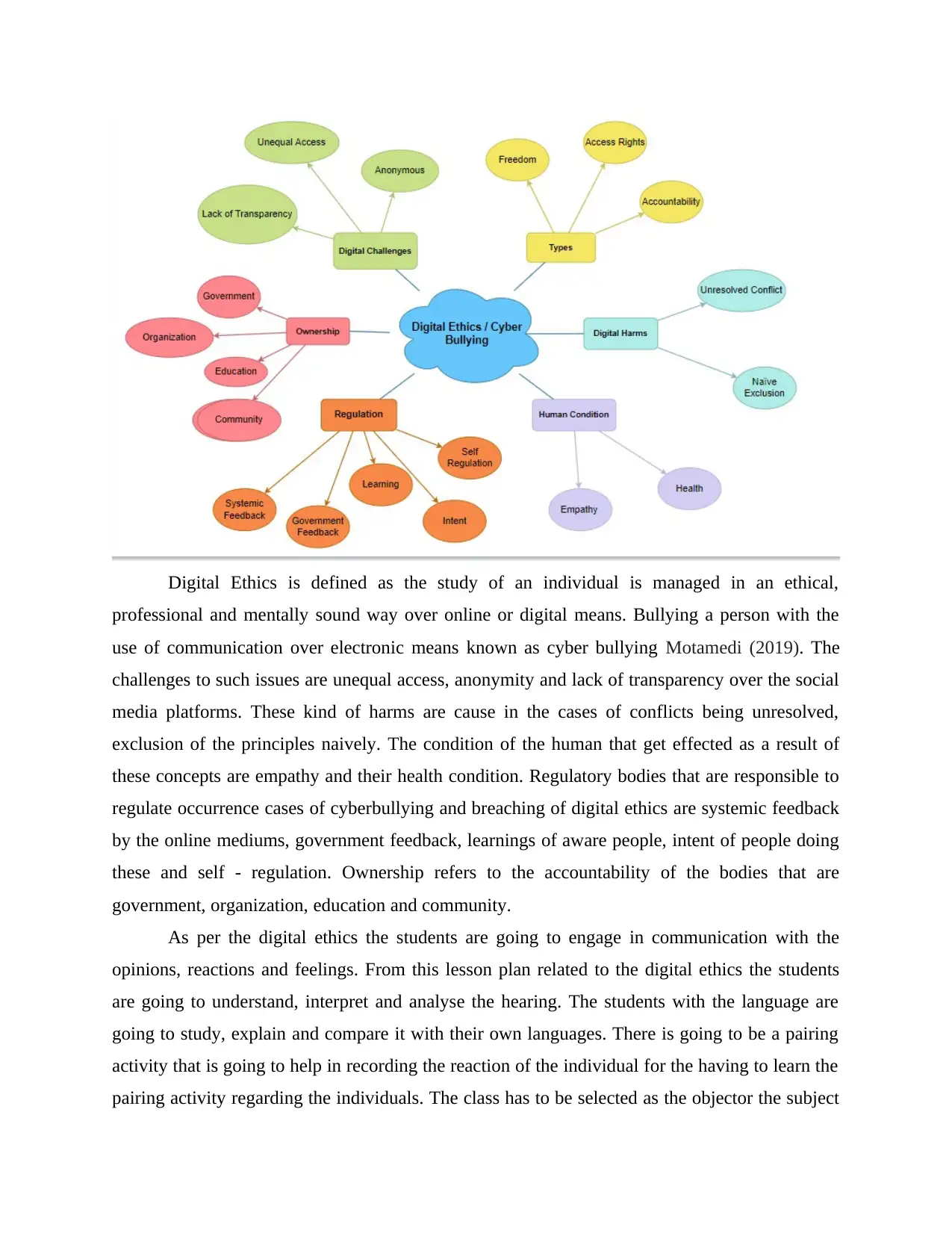
Digital Ethics is defined as the study of an individual is managed in an ethical,
professional and mentally sound way over online or digital means. Bullying a person with the
use of communication over electronic means known as cyber bullying Motamedi (2019). The
challenges to such issues are unequal access, anonymity and lack of transparency over the social
media platforms. These kind of harms are cause in the cases of conflicts being unresolved,
exclusion of the principles naively. The condition of the human that get effected as a result of
these concepts are empathy and their health condition. Regulatory bodies that are responsible to
regulate occurrence cases of cyberbullying and breaching of digital ethics are systemic feedback
by the online mediums, government feedback, learnings of aware people, intent of people doing
these and self - regulation. Ownership refers to the accountability of the bodies that are
government, organization, education and community.
As per the digital ethics the students are going to engage in communication with the
opinions, reactions and feelings. From this lesson plan related to the digital ethics the students
are going to understand, interpret and analyse the hearing. The students with the language are
going to study, explain and compare it with their own languages. There is going to be a pairing
activity that is going to help in recording the reaction of the individual for the having to learn the
pairing activity regarding the individuals. The class has to be selected as the objector the subject
professional and mentally sound way over online or digital means. Bullying a person with the
use of communication over electronic means known as cyber bullying Motamedi (2019). The
challenges to such issues are unequal access, anonymity and lack of transparency over the social
media platforms. These kind of harms are cause in the cases of conflicts being unresolved,
exclusion of the principles naively. The condition of the human that get effected as a result of
these concepts are empathy and their health condition. Regulatory bodies that are responsible to
regulate occurrence cases of cyberbullying and breaching of digital ethics are systemic feedback
by the online mediums, government feedback, learnings of aware people, intent of people doing
these and self - regulation. Ownership refers to the accountability of the bodies that are
government, organization, education and community.
As per the digital ethics the students are going to engage in communication with the
opinions, reactions and feelings. From this lesson plan related to the digital ethics the students
are going to understand, interpret and analyse the hearing. The students with the language are
going to study, explain and compare it with their own languages. There is going to be a pairing
activity that is going to help in recording the reaction of the individual for the having to learn the
pairing activity regarding the individuals. The class has to be selected as the objector the subject
⊘ This is a preview!⊘
Do you want full access?
Subscribe today to unlock all pages.
Trusted by 1+ million students worldwide
that is said to be the having unfair issues regarding the understanding the Arabic instructions
however, the digital use is going to help in interpreting their learnings.
Development of digital ethics in the use of technology has made the students more
sustainable towards their work. it has been the reason for having the class as the use of
technology that is essential for the learning and development. This is going to be the contributing
factor that would bring the learners with the ability to generate the learning success that is
required. This understanding between the teacher and the students regarding the ways in which
they can develop their operational success. Is considered to be the factor that has gained the
success that is required.
Management of the learning plan through this model is going to bring the confidence in the
learners regarding the use of the digital ethics.
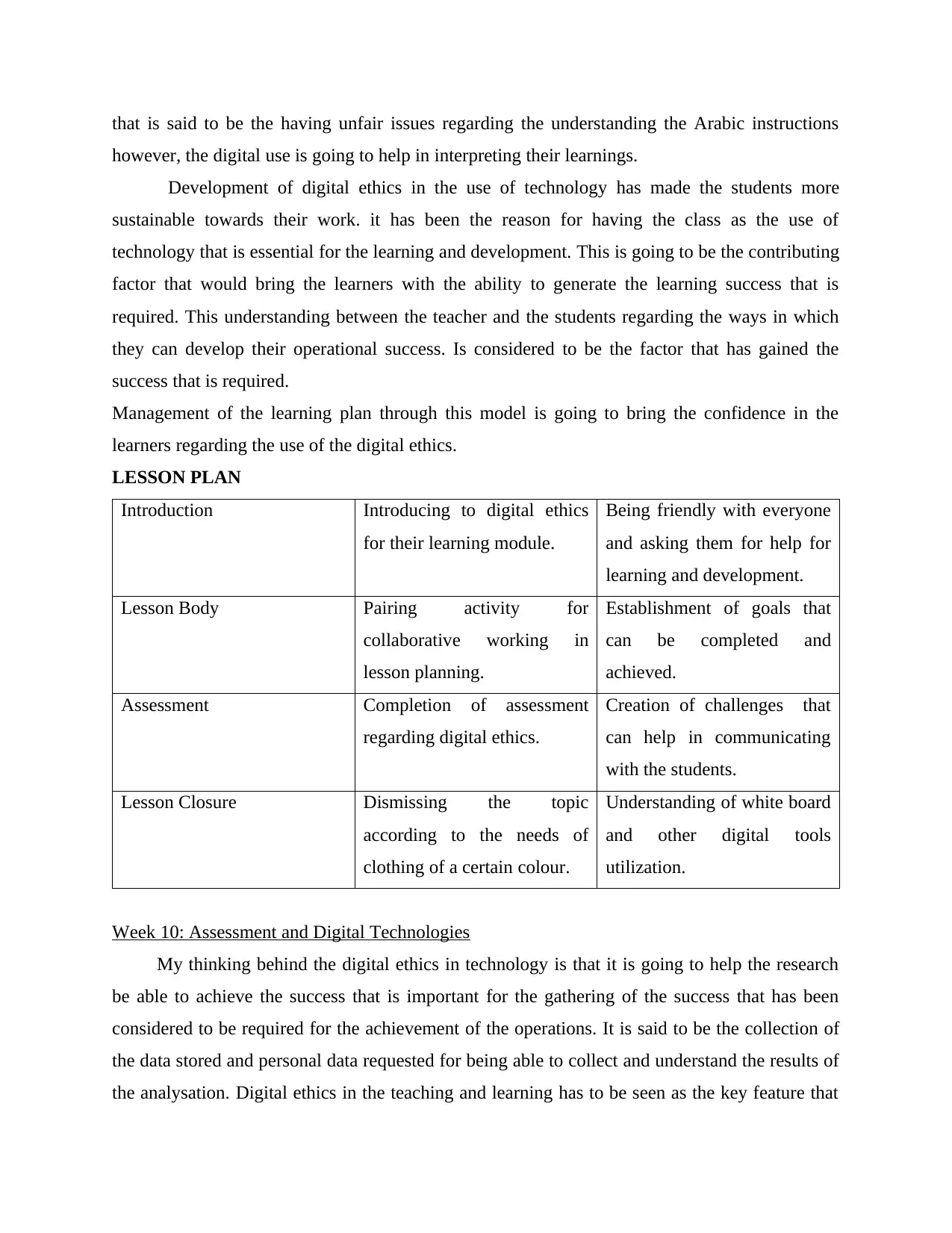
LESSON PLAN
Introduction Introducing to digital ethics
for their learning module.
Being friendly with everyone
and asking them for help for
learning and development.
Lesson Body Pairing activity for
collaborative working in
lesson planning.
Establishment of goals that
can be completed and
achieved.
Assessment Completion of assessment
regarding digital ethics.
Creation of challenges that
can help in communicating
with the students.
Lesson Closure Dismissing the topic
according to the needs of
clothing of a certain colour.
Understanding of white board
and other digital tools
utilization.
Week 10: Assessment and Digital Technologies
My thinking behind the digital ethics in technology is that it is going to help the research
be able to achieve the success that is important for the gathering of the success that has been
considered to be required for the achievement of the operations. It is said to be the collection of
the data stored and personal data requested for being able to collect and understand the results of
the analysation. Digital ethics in the teaching and learning has to be seen as the key feature that
however, the digital use is going to help in interpreting their learnings.
Development of digital ethics in the use of technology has made the students more
sustainable towards their work. it has been the reason for having the class as the use of
technology that is essential for the learning and development. This is going to be the contributing
factor that would bring the learners with the ability to generate the learning success that is
required. This understanding between the teacher and the students regarding the ways in which
they can develop their operational success. Is considered to be the factor that has gained the
success that is required.
Management of the learning plan through this model is going to bring the confidence in the
learners regarding the use of the digital ethics.
LESSON PLAN
Introduction Introducing to digital ethics
for their learning module.
Being friendly with everyone
and asking them for help for
learning and development.
Lesson Body Pairing activity for
collaborative working in
lesson planning.
Establishment of goals that
can be completed and
achieved.
Assessment Completion of assessment
regarding digital ethics.
Creation of challenges that
can help in communicating
with the students.
Lesson Closure Dismissing the topic
according to the needs of
clothing of a certain colour.
Understanding of white board
and other digital tools
utilization.
Week 10: Assessment and Digital Technologies
My thinking behind the digital ethics in technology is that it is going to help the research
be able to achieve the success that is important for the gathering of the success that has been
considered to be required for the achievement of the operations. It is said to be the collection of
the data stored and personal data requested for being able to collect and understand the results of
the analysation. Digital ethics in the teaching and learning has to be seen as the key feature that
Paraphrase This Document
Need a fresh take? Get an instant paraphrase of this document with our AI Paraphraser
influences the teaching and also acts as the key determination of the technology. The plan is
going to help the students better grasp the digital practices into their operation and create better
development regarding the resources required and analysed.
Week 11: Ethical and Legal Issues
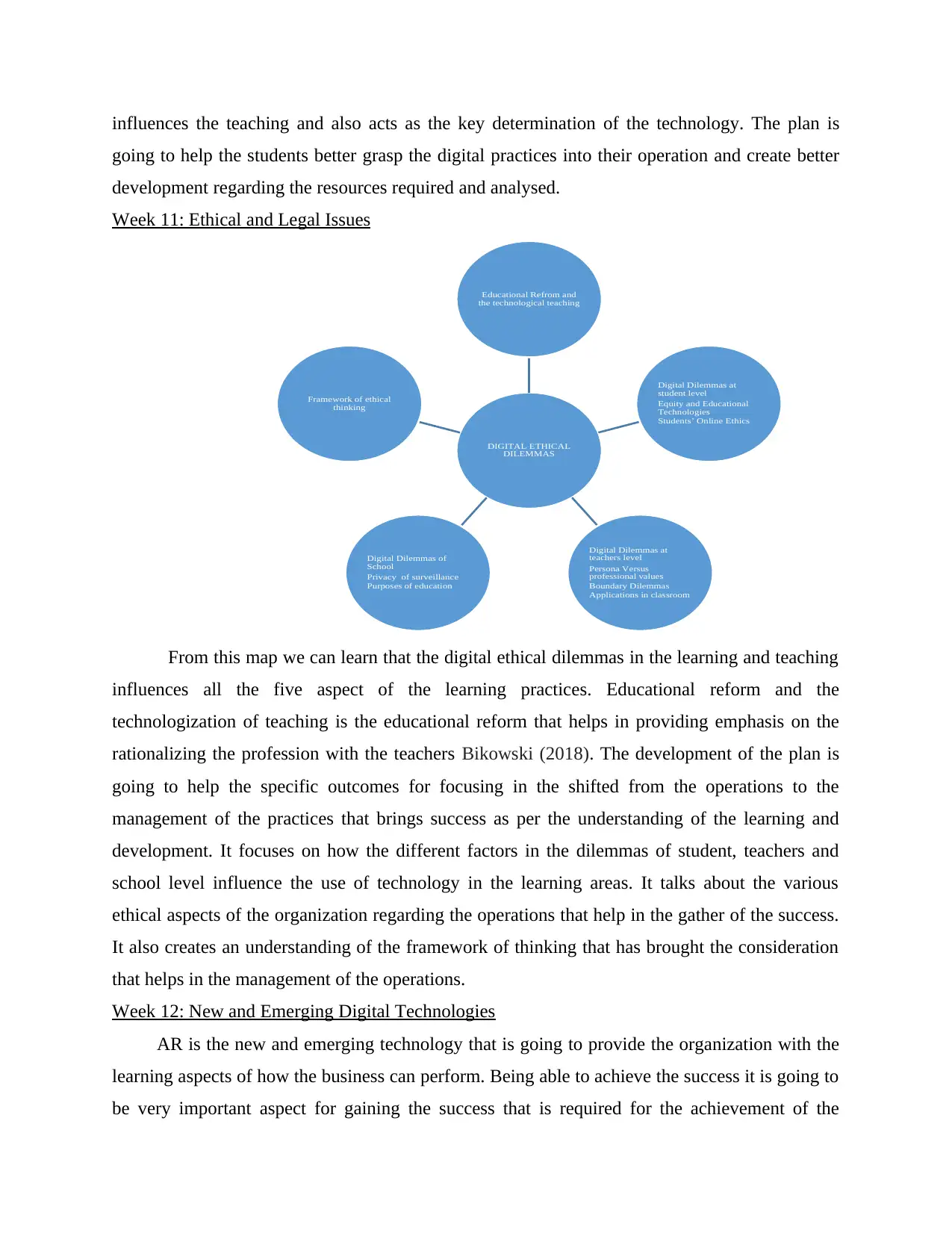
From this map we can learn that the digital ethical dilemmas in the learning and teaching
influences all the five aspect of the learning practices. Educational reform and the
technologization of teaching is the educational reform that helps in providing emphasis on the
rationalizing the profession with the teachers Bikowski (2018). The development of the plan is
going to help the specific outcomes for focusing in the shifted from the operations to the
management of the practices that brings success as per the understanding of the learning and
development. It focuses on how the different factors in the dilemmas of student, teachers and
school level influence the use of technology in the learning areas. It talks about the various
ethical aspects of the organization regarding the operations that help in the gather of the success.
It also creates an understanding of the framework of thinking that has brought the consideration
that helps in the management of the operations.
Week 12: New and Emerging Digital Technologies
AR is the new and emerging technology that is going to provide the organization with the
learning aspects of how the business can perform. Being able to achieve the success it is going to
be very important aspect for gaining the success that is required for the achievement of the
DIGITAL ETHICAL
DILEMMAS
Educational Refrom and
the technological teaching
Digital Dilemmas at
student level
Equity and Educational
Technologies
Students’ Online Ethics
Digital Dilemmas at
teachers level
Persona Versus
professional values
Boundary Dilemmas
Applications in classroom
Digital Dilemmas of
School
Privacy of surveillance
Purposes of education
Framework of ethical
thinking
going to help the students better grasp the digital practices into their operation and create better
development regarding the resources required and analysed.
Week 11: Ethical and Legal Issues
From this map we can learn that the digital ethical dilemmas in the learning and teaching
influences all the five aspect of the learning practices. Educational reform and the
technologization of teaching is the educational reform that helps in providing emphasis on the
rationalizing the profession with the teachers Bikowski (2018). The development of the plan is
going to help the specific outcomes for focusing in the shifted from the operations to the
management of the practices that brings success as per the understanding of the learning and
development. It focuses on how the different factors in the dilemmas of student, teachers and
school level influence the use of technology in the learning areas. It talks about the various
ethical aspects of the organization regarding the operations that help in the gather of the success.
It also creates an understanding of the framework of thinking that has brought the consideration
that helps in the management of the operations.
Week 12: New and Emerging Digital Technologies
AR is the new and emerging technology that is going to provide the organization with the
learning aspects of how the business can perform. Being able to achieve the success it is going to
be very important aspect for gaining the success that is required for the achievement of the
DIGITAL ETHICAL
DILEMMAS
Educational Refrom and
the technological teaching
Digital Dilemmas at
student level
Equity and Educational
Technologies
Students’ Online Ethics
Digital Dilemmas at
teachers level
Persona Versus
professional values
Boundary Dilemmas
Applications in classroom
Digital Dilemmas of
School
Privacy of surveillance
Purposes of education
Framework of ethical
thinking
results. Use of AR is going help in being an education feature that is going to enhance the
learning abilities like problem solving collaboration and creation of better prepare students for
the future. Being so traditionally pedagogy is going to help focus on the technical knowledge and
proficiencies.
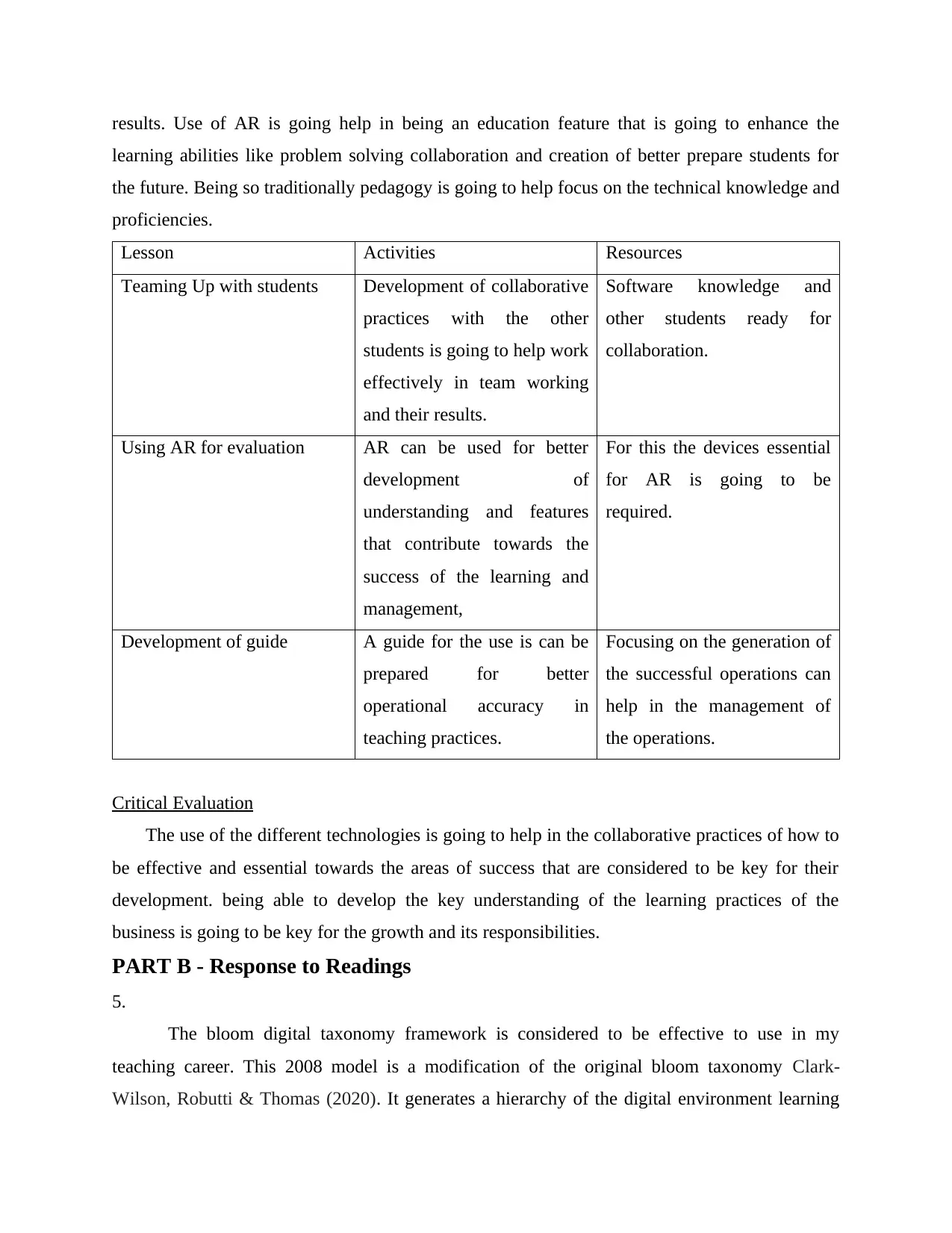
Lesson Activities Resources
Teaming Up with students Development of collaborative
practices with the other
students is going to help work
effectively in team working
and their results.
Software knowledge and
other students ready for
collaboration.
Using AR for evaluation AR can be used for better
development of
understanding and features
that contribute towards the
success of the learning and
management,
For this the devices essential
for AR is going to be
required.
Development of guide A guide for the use is can be
prepared for better
operational accuracy in
teaching practices.
Focusing on the generation of
the successful operations can
help in the management of
the operations.
Critical Evaluation
The use of the different technologies is going to help in the collaborative practices of how to
be effective and essential towards the areas of success that are considered to be key for their
development. being able to develop the key understanding of the learning practices of the
business is going to be key for the growth and its responsibilities.
PART B - Response to Readings
5.
The bloom digital taxonomy framework is considered to be effective to use in my
teaching career. This 2008 model is a modification of the original bloom taxonomy Clark-
Wilson, Robutti & Thomas (2020). It generates a hierarchy of the digital environment learning
learning abilities like problem solving collaboration and creation of better prepare students for
the future. Being so traditionally pedagogy is going to help focus on the technical knowledge and
proficiencies.
Lesson Activities Resources
Teaming Up with students Development of collaborative
practices with the other
students is going to help work
effectively in team working
and their results.
Software knowledge and
other students ready for
collaboration.
Using AR for evaluation AR can be used for better
development of
understanding and features
that contribute towards the
success of the learning and
management,
For this the devices essential
for AR is going to be
required.
Development of guide A guide for the use is can be
prepared for better
operational accuracy in
teaching practices.
Focusing on the generation of
the successful operations can
help in the management of
the operations.
Critical Evaluation
The use of the different technologies is going to help in the collaborative practices of how to
be effective and essential towards the areas of success that are considered to be key for their
development. being able to develop the key understanding of the learning practices of the
business is going to be key for the growth and its responsibilities.
PART B - Response to Readings
5.
The bloom digital taxonomy framework is considered to be effective to use in my
teaching career. This 2008 model is a modification of the original bloom taxonomy Clark-
Wilson, Robutti & Thomas (2020). It generates a hierarchy of the digital environment learning
⊘ This is a preview!⊘
Do you want full access?
Subscribe today to unlock all pages.
Trusted by 1+ million students worldwide

1 out of 17


Your All-in-One AI-Powered Toolkit for Academic Success.
+13062052269
info@desklib.com
Available 24*7 on WhatsApp / Email
![[object Object]](/_next/static/media/star-bottom.7253800d.svg)
Unlock your academic potential
Copyright © 2020–2026 A2Z Services. All Rights Reserved. Developed and managed by ZUCOL.