An Analysis of Equality and Diversity in the Workplace at Platt & Hill
VerifiedAdded on 2023/01/17
|23
|4959
|24
Report
AI Summary
This report provides a comprehensive analysis of equality and diversity in the workplace, focusing on the company Platt & Hill. It begins with an introduction that outlines the research's overview, background of the organization, rationale, aim, objectives, and research questions. A literature review explores the concepts and strategies of equality and diversity, emphasizing their effectiveness and benefits. The methodology section details the qualitative and quantitative research approaches, research philosophy, time horizon, and research strategy, including data collection methods like questionnaires. The report analyzes data findings, discusses the importance of developing and maintaining cultural diversity, and concludes with reflections and recommendations for Platt & Hill. The report highlights the importance of diversity in the workplace and provides strategies for improvement.
Equality
And
Diversity In The
Workplace
1
And
Diversity In The
Workplace
1

Paraphrase This Document
Need a fresh take? Get an instant paraphrase of this document with our AI Paraphraser
Table of Contents
Theme: Equality and diversity at the workplace..............................................................................3
INTRODUCTION ..........................................................................................................................3
Overview of research..............................................................................................................3
Background of organization...................................................................................................3
Rationale of research..............................................................................................................4
Research Aim.........................................................................................................................4
Research Objective.................................................................................................................4
Research Questions................................................................................................................4
Significance of research.........................................................................................................4
Literature review..............................................................................................................................4
Research methodology.....................................................................................................................6
Research approach..................................................................................................................6
Research philosophy...............................................................................................................7
Time Horizon..........................................................................................................................7
Research strategy....................................................................................................................9
Data collection........................................................................................................................9
Sampling...............................................................................................................................10
Research ethics.....................................................................................................................11
Questionnaire........................................................................................................................11
Data finding, Analysis and Discussion..........................................................................................11
Conclusion.....................................................................................................................................19
Reflection.......................................................................................................................................19
Recommendation ..........................................................................................................................20
2
Theme: Equality and diversity at the workplace..............................................................................3
INTRODUCTION ..........................................................................................................................3
Overview of research..............................................................................................................3
Background of organization...................................................................................................3
Rationale of research..............................................................................................................4
Research Aim.........................................................................................................................4
Research Objective.................................................................................................................4
Research Questions................................................................................................................4
Significance of research.........................................................................................................4
Literature review..............................................................................................................................4
Research methodology.....................................................................................................................6
Research approach..................................................................................................................6
Research philosophy...............................................................................................................7
Time Horizon..........................................................................................................................7
Research strategy....................................................................................................................9
Data collection........................................................................................................................9
Sampling...............................................................................................................................10
Research ethics.....................................................................................................................11
Questionnaire........................................................................................................................11
Data finding, Analysis and Discussion..........................................................................................11
Conclusion.....................................................................................................................................19
Reflection.......................................................................................................................................19
Recommendation ..........................................................................................................................20
2
Theme: Equality and diversity at the workplace.
INTRODUCTION
Overview of research
In current time for all company it is essential to develop activities for adopting equality
and diversity in its workplace. Equality is considered as term that ensure that individual or
groups of people are not facing any issues related to discriminations, differently or less
favourable situation (Ahonen and et. al., 2014). This is so because discrimination can be take
place on several aspects such as age, gender, colour, religion, belief, race, culture, sexual
orientation, culture, language and many more. On the other hand, diversity is defines as a term
according to which each individual is consider unique as well as different. These can be based on
ethnicity, gender, religious beliefs, age, physical abilities, political belief, socio economic and
many more. Organisation selected for report is Platt & Hill which is located in Oldham, United
kingdom. It is founded by John Platt and John Hill in year 1889.
Background of organization
Platt & Hill is founded by John Platt and John Hill in 1889 and it is located at Oldham,
United Kingdom. They are operating their business in foam and fibre fillings. Respective
company is proactive as well as modern company which move and adapt according to
requirement of customers and industry (Bendl and et. al., 2015). They develop wide range of
filling products specially development of polyester fibres as well as polyurethane foams. They
are hiring workforce at diverse level so this is necessary for them to develop and maintain
equality as well as diversity in its work station. Through this they also able to gain numbers of
benefits such as employees feel motivated, less conflict, increase staff loyalty and so on.
Rationale of research
Topic which is selected for conducting this research is to develop knowledgable and
understanding of equality as well as diversity in the work station (Davis, Frolova and Callahan,
2016). So that Platt & Hill can develop effective plans or strategies for adopting equality and
diversity at their work station which help them in minimising issues, conflict situation and many
other issues. Along with this aim of creating respective project is to develop understanding of
equality and diversity at workplace, strategies that use to maintain these effective as well as
research is also developed in order to understand its effectiveness.
3
INTRODUCTION
Overview of research
In current time for all company it is essential to develop activities for adopting equality
and diversity in its workplace. Equality is considered as term that ensure that individual or
groups of people are not facing any issues related to discriminations, differently or less
favourable situation (Ahonen and et. al., 2014). This is so because discrimination can be take
place on several aspects such as age, gender, colour, religion, belief, race, culture, sexual
orientation, culture, language and many more. On the other hand, diversity is defines as a term
according to which each individual is consider unique as well as different. These can be based on
ethnicity, gender, religious beliefs, age, physical abilities, political belief, socio economic and
many more. Organisation selected for report is Platt & Hill which is located in Oldham, United
kingdom. It is founded by John Platt and John Hill in year 1889.
Background of organization
Platt & Hill is founded by John Platt and John Hill in 1889 and it is located at Oldham,
United Kingdom. They are operating their business in foam and fibre fillings. Respective
company is proactive as well as modern company which move and adapt according to
requirement of customers and industry (Bendl and et. al., 2015). They develop wide range of
filling products specially development of polyester fibres as well as polyurethane foams. They
are hiring workforce at diverse level so this is necessary for them to develop and maintain
equality as well as diversity in its work station. Through this they also able to gain numbers of
benefits such as employees feel motivated, less conflict, increase staff loyalty and so on.
Rationale of research
Topic which is selected for conducting this research is to develop knowledgable and
understanding of equality as well as diversity in the work station (Davis, Frolova and Callahan,
2016). So that Platt & Hill can develop effective plans or strategies for adopting equality and
diversity at their work station which help them in minimising issues, conflict situation and many
other issues. Along with this aim of creating respective project is to develop understanding of
equality and diversity at workplace, strategies that use to maintain these effective as well as
research is also developed in order to understand its effectiveness.
3
⊘ This is a preview!⊘
Do you want full access?
Subscribe today to unlock all pages.

Trusted by 1+ million students worldwide
Research Aim
“To identify the importance of developing and maintaining cultural diversity at
workplace.” A study on Platt & Hill .
Research Objective
To analyse the concept of equality and diversity at workplace.
To ascertain the strategies that can be used to maintaining cultural diversity at workplace.
To identify the effectiveness of developing and maintaining cultural diversity at
workplace.
Research Questions
What is the concept and strategies of equality and diversity within the Platt and Hill, and
how effective is it?
Significance of research
Significance or scope of developing respective project is to create understanding of
equality as well as diversity at the workplace as it will lead to accomplishment of work in
effective manner for attaining desire goal as well as target (Fine-Davis and Faas, 2014). Through
this project manager also able to understand effectiveness of adopting as well as maintaining
equality and diversity in work station for those company which is operating at the international
level with numbers of stores.
Literature review What is the concept and strategies of equality and diversity within the Platt and Hill,
and how effective is it?
According to the perspective of Dr. Kelly S. Meier, 2019, for every firm to implement
practices or activities related to equality as well as diversity because through that they can
accomplish their work properly and it will also help them in achieving their desire objective as
well as goal properly. According to author equality and diversity is defined as activities which is
used to promoting equality of several opportunities for all staffs by diversity, according to which
every individual should given the chance to attain their potential i.e. free or away from prejudice
as well as discrimination (Equality & Diversity in the Workplace, 2020). For developing this
company need to hire their employees from different location so that they able to provide
opportunities at the diverse level as well as they also need to develop proper strategies for
4
“To identify the importance of developing and maintaining cultural diversity at
workplace.” A study on Platt & Hill .
Research Objective
To analyse the concept of equality and diversity at workplace.
To ascertain the strategies that can be used to maintaining cultural diversity at workplace.
To identify the effectiveness of developing and maintaining cultural diversity at
workplace.
Research Questions
What is the concept and strategies of equality and diversity within the Platt and Hill, and
how effective is it?
Significance of research
Significance or scope of developing respective project is to create understanding of
equality as well as diversity at the workplace as it will lead to accomplishment of work in
effective manner for attaining desire goal as well as target (Fine-Davis and Faas, 2014). Through
this project manager also able to understand effectiveness of adopting as well as maintaining
equality and diversity in work station for those company which is operating at the international
level with numbers of stores.
Literature review What is the concept and strategies of equality and diversity within the Platt and Hill,
and how effective is it?
According to the perspective of Dr. Kelly S. Meier, 2019, for every firm to implement
practices or activities related to equality as well as diversity because through that they can
accomplish their work properly and it will also help them in achieving their desire objective as
well as goal properly. According to author equality and diversity is defined as activities which is
used to promoting equality of several opportunities for all staffs by diversity, according to which
every individual should given the chance to attain their potential i.e. free or away from prejudice
as well as discrimination (Equality & Diversity in the Workplace, 2020). For developing this
company need to hire their employees from different location so that they able to provide
opportunities at the diverse level as well as they also need to develop proper strategies for
4
Paraphrase This Document
Need a fresh take? Get an instant paraphrase of this document with our AI Paraphraser
avoiding issues which take place due to inequality. Among with this, company may develop
proper rules, regulations and policies based on implementing equality as well as diversity in the
place of work as well as they also develop strict actions who will not follow it properly.
According to the view point of Dr. Richard T. Alpert, 2020, for an organization it is
essential to develop effective culture which result in development of effective understanding,
communication and interaction among the peoples who belongs from different culture. There are
numbers of strategies which a company management may adopt in order to develop and keep
effective culture related to equality as well as diversity in the place of work. Such as they may
maintain proper communication among the employees so that each and every staff know each
other and understand their culture (Managing Cultural Diversity in the Workplace, 2020).
Through this strategy they also able to minimise the situation related to conflict that arise due to
miscommunication, language or cultural barriers and many more. In addition to this, an
organisation can also adopt team building strategy in order to develop cultural diversity at their
workplace. According to this practices they must promote team work for conducting each and
every work because through it members able to know each other as well as it will also help in
understanding their culture, religion, language and so on (Guillaume and et. al., 2017). Company
may also plan informal event or meeting on regular basis at which every person get opportunity
to interact with each other, through this they able to promote cultural diversity at their workplace
in successful manner.
As per the article given on 6Q Blog, 2020, by adopting cultural diversity at workplace a
company management able to gain numbers of benefits such as it enhance employees moral
which directly lead to increase in productivity (8 Amazing Benefits of Cultural Diversity in the
Workplace, 2020). This is so because when staff feel motivated as well as satisfied with their
work then they accomplish their work in most proper way so that they will accomplish their
work properly for attaining desire or predetermine goal. Another benefit that gain by an
organisation through cultural diversity is decrease in ratio of employees turnover because when
employees feel motivated and valuable at their workplace then they become loyal staff which
encourage them to retain for long time. In addition to these are also several other effectiveness
that are attain by an organisation by implementing cultural diversity at their place of work such
as they able to enhance employees engagement because when there is diversify culture then all
employees feel valuable and important which satisfy them and encourage to engaged with
5
proper rules, regulations and policies based on implementing equality as well as diversity in the
place of work as well as they also develop strict actions who will not follow it properly.
According to the view point of Dr. Richard T. Alpert, 2020, for an organization it is
essential to develop effective culture which result in development of effective understanding,
communication and interaction among the peoples who belongs from different culture. There are
numbers of strategies which a company management may adopt in order to develop and keep
effective culture related to equality as well as diversity in the place of work. Such as they may
maintain proper communication among the employees so that each and every staff know each
other and understand their culture (Managing Cultural Diversity in the Workplace, 2020).
Through this strategy they also able to minimise the situation related to conflict that arise due to
miscommunication, language or cultural barriers and many more. In addition to this, an
organisation can also adopt team building strategy in order to develop cultural diversity at their
workplace. According to this practices they must promote team work for conducting each and
every work because through it members able to know each other as well as it will also help in
understanding their culture, religion, language and so on (Guillaume and et. al., 2017). Company
may also plan informal event or meeting on regular basis at which every person get opportunity
to interact with each other, through this they able to promote cultural diversity at their workplace
in successful manner.
As per the article given on 6Q Blog, 2020, by adopting cultural diversity at workplace a
company management able to gain numbers of benefits such as it enhance employees moral
which directly lead to increase in productivity (8 Amazing Benefits of Cultural Diversity in the
Workplace, 2020). This is so because when staff feel motivated as well as satisfied with their
work then they accomplish their work in most proper way so that they will accomplish their
work properly for attaining desire or predetermine goal. Another benefit that gain by an
organisation through cultural diversity is decrease in ratio of employees turnover because when
employees feel motivated and valuable at their workplace then they become loyal staff which
encourage them to retain for long time. In addition to these are also several other effectiveness
that are attain by an organisation by implementing cultural diversity at their place of work such
as they able to enhance employees engagement because when there is diversify culture then all
employees feel valuable and important which satisfy them and encourage to engaged with
5
particular firm for long time duration (Haq, 2014). Along with this it will also lead to enhancing
company reputation at the potential marketplace due to which they get opportunities to hire wide
range of skills because all applicants want to work at company who value their staffs. Moreover,
it will also help an organisation in maximising their profitability, creativity and cultural insights
at potential as well as targeted marketplace.
Research methodology
Research approach
Qualitative research approach
This research approach is defined as a model having scientific factors of observation that
generally implement in order to gather data which are non numerical. Respective kind of
research method will mention to determining means, concept, characteristics, explanation, figure
of speech, symbols as well as description of things (Hideg and Ferris, 2016). This will not
include counts or measurement related to numerical data. There are numbers of methods which
are include in respective approaches such as case study analysis, observation procedure, face to
face interview or individual interview, keeping record and many more.
Quantitative research approach
Quantitative research method which emphasize goal or objective that is related to
measurements as well as statistical, mathematical, numerical and so on. For this also numbers of
methods can be adopted such as data gather through polls, questionnaire, survey, manipulating
statistical data and many more (Holgate and et. al., 2012). Respective method generally focus on
collecting numerical data and informations. It also help in providing more reliable as well as
accurate information or data related to the topic.
In respect of respective report, project manager is using both qualitative research
approach as well as quantitative research approach. In order to adopt qualitative method
researcher will conduct analysis through literature review at which researcher analyse
informations gather by different authors. On the other hand, for adopting quantitative method
project manager will develop questionnaire.
Research philosophy
Research philosophy is defined as over arching activity that is related to the creation of
knowledge as well as nature of knowledge. This is also defined as a phenomenon which is
6
company reputation at the potential marketplace due to which they get opportunities to hire wide
range of skills because all applicants want to work at company who value their staffs. Moreover,
it will also help an organisation in maximising their profitability, creativity and cultural insights
at potential as well as targeted marketplace.
Research methodology
Research approach
Qualitative research approach
This research approach is defined as a model having scientific factors of observation that
generally implement in order to gather data which are non numerical. Respective kind of
research method will mention to determining means, concept, characteristics, explanation, figure
of speech, symbols as well as description of things (Hideg and Ferris, 2016). This will not
include counts or measurement related to numerical data. There are numbers of methods which
are include in respective approaches such as case study analysis, observation procedure, face to
face interview or individual interview, keeping record and many more.
Quantitative research approach
Quantitative research method which emphasize goal or objective that is related to
measurements as well as statistical, mathematical, numerical and so on. For this also numbers of
methods can be adopted such as data gather through polls, questionnaire, survey, manipulating
statistical data and many more (Holgate and et. al., 2012). Respective method generally focus on
collecting numerical data and informations. It also help in providing more reliable as well as
accurate information or data related to the topic.
In respect of respective report, project manager is using both qualitative research
approach as well as quantitative research approach. In order to adopt qualitative method
researcher will conduct analysis through literature review at which researcher analyse
informations gather by different authors. On the other hand, for adopting quantitative method
project manager will develop questionnaire.
Research philosophy
Research philosophy is defined as over arching activity that is related to the creation of
knowledge as well as nature of knowledge. This is also defined as a phenomenon which is
6
⊘ This is a preview!⊘
Do you want full access?
Subscribe today to unlock all pages.
Trusted by 1+ million students worldwide
adopted in order to gather, analyse and use informations by a project manager in order to conduct
research in appropriate way (Kirton and Greene, 2015). Along with this it is also defined as a
summary of research experiences and research interest with future, present and past activities of
researcher. In context of respective research, researcher is using pragmatism research philosophy
which is generally adopted when project manager implement mixed researcher approach
(Quantitative research and Qualitative research).
Time Horizon
Work breakdown structure
It is consider as systematic engineering project through which project manager break
whole task or project into small section and then accordingly they conduct work. Through this
they able to attain goal as well as objective in effective manner because they conduct work
systematically (Klarsfeld and et. al., 2016). Through this method project manager also ensure
that all the works are conducted in proper as well as correct manner.
Gantt Chart
Gantt Chart is developed by Henry Gantt in around 1910 – 1915. It is consider as type of
bar chart which illustrates project schedule as well as it will also show dependency relationship
among the activities as well as current schedule status (Kumra, Manfredi and Vickers, 2012). By
developing this project manager as well as their team able to conduct work in effective manner
7
research in appropriate way (Kirton and Greene, 2015). Along with this it is also defined as a
summary of research experiences and research interest with future, present and past activities of
researcher. In context of respective research, researcher is using pragmatism research philosophy
which is generally adopted when project manager implement mixed researcher approach
(Quantitative research and Qualitative research).
Time Horizon
Work breakdown structure
It is consider as systematic engineering project through which project manager break
whole task or project into small section and then accordingly they conduct work. Through this
they able to attain goal as well as objective in effective manner because they conduct work
systematically (Klarsfeld and et. al., 2016). Through this method project manager also ensure
that all the works are conducted in proper as well as correct manner.
Gantt Chart
Gantt Chart is developed by Henry Gantt in around 1910 – 1915. It is consider as type of
bar chart which illustrates project schedule as well as it will also show dependency relationship
among the activities as well as current schedule status (Kumra, Manfredi and Vickers, 2012). By
developing this project manager as well as their team able to conduct work in effective manner
7
Paraphrase This Document
Need a fresh take? Get an instant paraphrase of this document with our AI Paraphraser
for attaining goal as well as objective. This is so because it will they get proper schedule or
guideline for conducting work which they help in conducting work properly.
8
guideline for conducting work which they help in conducting work properly.
8
Research strategy
Research strategy is defined as step by step procedure or action plan which gives
direction to person's efforts or thoughts. It will also help in conducting research in systematic as
well as scheduled form in order to produce quality outcome of research. In this there are numbers
of research strategy are included for example questionnaire, survey, observation, case study
analysis and many more (Oswick and Noon, 2014). There are several factors are consider for
developing good research strategy like that must be articulate to topic, locate background
information, conduct proper searches, consider scope of topic and many more.
Data collection
Primary Method
It is consider as data or information which is collected by a project manager from first
hand source (Ozturk and Tatli, 2016). Data gathered by respective method are more accurate as
well as reliable. For this numbers of method can be used such as survey, experiment, interview,
observation, schedules, questionnaire and many more.
Secondary Method
It is considered as second hand data which are gather by project manner from already
existed informations or data (Ragins and et. al., 2012). These data or informations are already
collected as well as analysed by some other person in past. Several sources which can be adopted
for gathering secondary data or informations are government publications, earlier research, client
histories, service records, personal record and many more.
Project manager of respective research will adopt both primary as well as secondary
informations or data. For primary data collection method they adopt questionnaire method as
well as in respect of secondary data they are gathering informations through literature review.
Research strategies Research Onion: It is consider as combination of different stages that are involved in
development of effective research work. In this research strategies there are different
layers like onion which provide more detailed description of stages of research
procedure. By adopting this research strategy researcher of respective research able to
gather data or information which help them in gaining desire outcome successfully.
8 Steps plan of research: According to this research strategy there are mainly eight steps
involved in planning of research. In respect of this research at first stage project manager
9
Research strategy is defined as step by step procedure or action plan which gives
direction to person's efforts or thoughts. It will also help in conducting research in systematic as
well as scheduled form in order to produce quality outcome of research. In this there are numbers
of research strategy are included for example questionnaire, survey, observation, case study
analysis and many more (Oswick and Noon, 2014). There are several factors are consider for
developing good research strategy like that must be articulate to topic, locate background
information, conduct proper searches, consider scope of topic and many more.
Data collection
Primary Method
It is consider as data or information which is collected by a project manager from first
hand source (Ozturk and Tatli, 2016). Data gathered by respective method are more accurate as
well as reliable. For this numbers of method can be used such as survey, experiment, interview,
observation, schedules, questionnaire and many more.
Secondary Method
It is considered as second hand data which are gather by project manner from already
existed informations or data (Ragins and et. al., 2012). These data or informations are already
collected as well as analysed by some other person in past. Several sources which can be adopted
for gathering secondary data or informations are government publications, earlier research, client
histories, service records, personal record and many more.
Project manager of respective research will adopt both primary as well as secondary
informations or data. For primary data collection method they adopt questionnaire method as
well as in respect of secondary data they are gathering informations through literature review.
Research strategies Research Onion: It is consider as combination of different stages that are involved in
development of effective research work. In this research strategies there are different
layers like onion which provide more detailed description of stages of research
procedure. By adopting this research strategy researcher of respective research able to
gather data or information which help them in gaining desire outcome successfully.
8 Steps plan of research: According to this research strategy there are mainly eight steps
involved in planning of research. In respect of this research at first stage project manager
9
⊘ This is a preview!⊘
Do you want full access?
Subscribe today to unlock all pages.
Trusted by 1+ million students worldwide
will identify problem, at next they will review the literature for gathering information
after that they will clarify the problems. Then at fourth stage they will clearly define
terms and concepts so that decision can develop accordingly after that identification of
population will be done. Then at sixth phase researcher will develop instrumentation plan
so that they can gather effective data or information at next stage and after that at last
stage analysis of data will be done.
Sampling
It is consider as a procedure used in statistical evaluation in which predetermined
numbers are consider for the observations activities. There are different types of sampling that
can be adopted by a project manner in order to select their respondents such as random sampling,
stratified sampling, multistage sampling, cluster sampling, systematic random sampling and
many more (Kirton and Greene, 2015). In respect of respective research, researcher will adopt
random sampling method because through it they able to provide equal opportunity to all
population. The selected numbers of respondents by this research project manager is 40.
Research ethics
There are numbers of ethical factors that are necessary to be consider by project manager
during gathering information or data related to the topic such as it is essential for researcher to
keep all record or personal information confidentiality that are related to team members,
respondents or data gathered (Klarsfeld and et. al., 2016). This is so because through it they able
to avoid illegal activities which may arise through person informations or data gathered by
researcher. In addition to this, project manager also need to consider all rules, regulations and
policies which are developed by legal authorise for conducting research.
Questionnaire
Questionnaire is developed by Statistical Society of London, United kingdom in year
1838 (Özbilgin and et. al., 2015). It is considered as research tool or instrument which is consists
of set of questions in order to gather informations from the respondents.
Data finding, Analysis and Discussion
Q1. Do you have knowledge about role of equality and diversity in
enhancing organisational performance?
Frequency
10
after that they will clarify the problems. Then at fourth stage they will clearly define
terms and concepts so that decision can develop accordingly after that identification of
population will be done. Then at sixth phase researcher will develop instrumentation plan
so that they can gather effective data or information at next stage and after that at last
stage analysis of data will be done.
Sampling
It is consider as a procedure used in statistical evaluation in which predetermined
numbers are consider for the observations activities. There are different types of sampling that
can be adopted by a project manner in order to select their respondents such as random sampling,
stratified sampling, multistage sampling, cluster sampling, systematic random sampling and
many more (Kirton and Greene, 2015). In respect of respective research, researcher will adopt
random sampling method because through it they able to provide equal opportunity to all
population. The selected numbers of respondents by this research project manager is 40.
Research ethics
There are numbers of ethical factors that are necessary to be consider by project manager
during gathering information or data related to the topic such as it is essential for researcher to
keep all record or personal information confidentiality that are related to team members,
respondents or data gathered (Klarsfeld and et. al., 2016). This is so because through it they able
to avoid illegal activities which may arise through person informations or data gathered by
researcher. In addition to this, project manager also need to consider all rules, regulations and
policies which are developed by legal authorise for conducting research.
Questionnaire
Questionnaire is developed by Statistical Society of London, United kingdom in year
1838 (Özbilgin and et. al., 2015). It is considered as research tool or instrument which is consists
of set of questions in order to gather informations from the respondents.
Data finding, Analysis and Discussion
Q1. Do you have knowledge about role of equality and diversity in
enhancing organisational performance?
Frequency
10
Paraphrase This Document
Need a fresh take? Get an instant paraphrase of this document with our AI Paraphraser
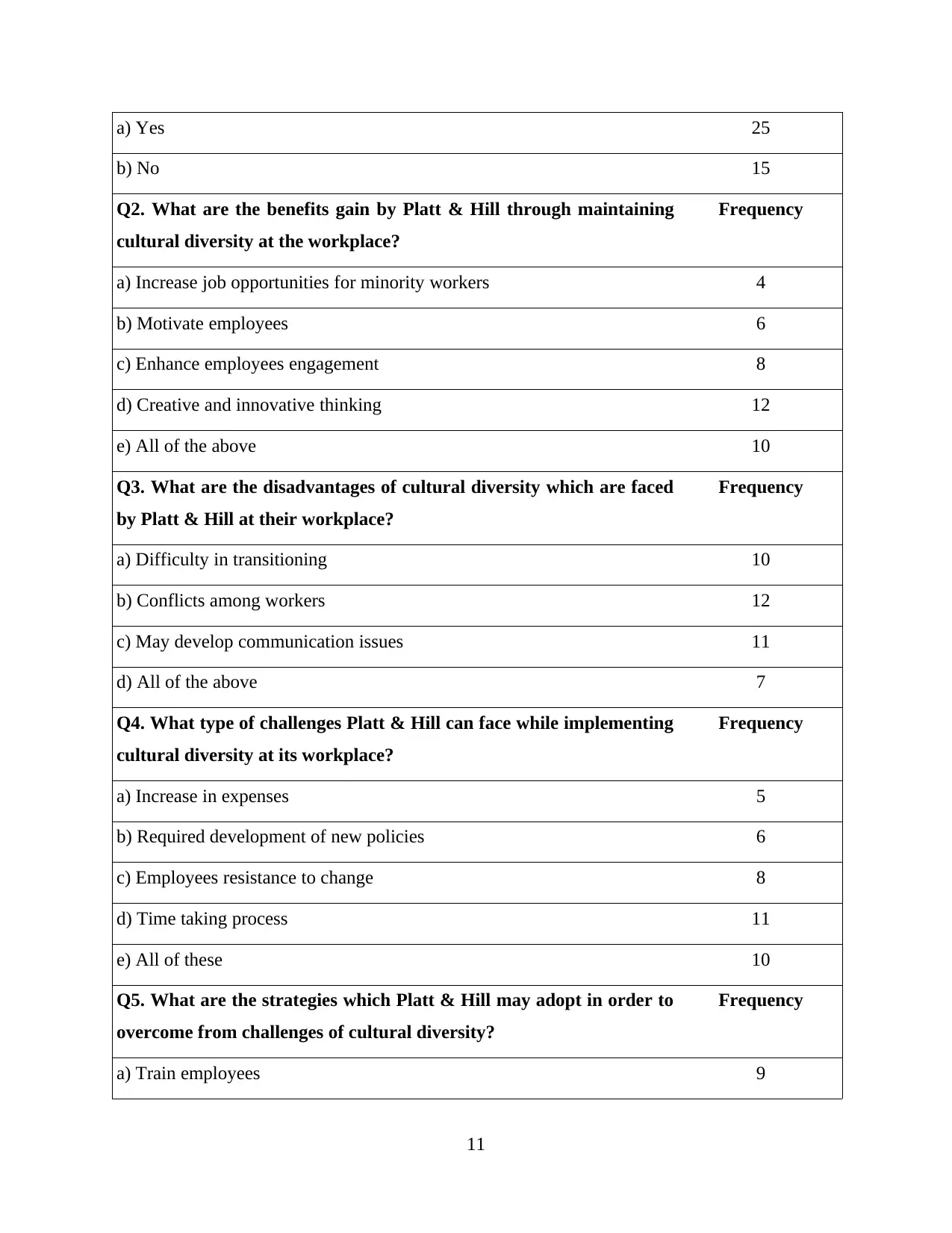
a) Yes 25
b) No 15
Q2. What are the benefits gain by Platt & Hill through maintaining
cultural diversity at the workplace?
Frequency
a) Increase job opportunities for minority workers 4
b) Motivate employees 6
c) Enhance employees engagement 8
d) Creative and innovative thinking 12
e) All of the above 10
Q3. What are the disadvantages of cultural diversity which are faced
by Platt & Hill at their workplace?
Frequency
a) Difficulty in transitioning 10
b) Conflicts among workers 12
c) May develop communication issues 11
d) All of the above 7
Q4. What type of challenges Platt & Hill can face while implementing
cultural diversity at its workplace?
Frequency
a) Increase in expenses 5
b) Required development of new policies 6
c) Employees resistance to change 8
d) Time taking process 11
e) All of these 10
Q5. What are the strategies which Platt & Hill may adopt in order to
overcome from challenges of cultural diversity?
Frequency
a) Train employees 9
11
b) No 15
Q2. What are the benefits gain by Platt & Hill through maintaining
cultural diversity at the workplace?
Frequency
a) Increase job opportunities for minority workers 4
b) Motivate employees 6
c) Enhance employees engagement 8
d) Creative and innovative thinking 12
e) All of the above 10
Q3. What are the disadvantages of cultural diversity which are faced
by Platt & Hill at their workplace?
Frequency
a) Difficulty in transitioning 10
b) Conflicts among workers 12
c) May develop communication issues 11
d) All of the above 7
Q4. What type of challenges Platt & Hill can face while implementing
cultural diversity at its workplace?
Frequency
a) Increase in expenses 5
b) Required development of new policies 6
c) Employees resistance to change 8
d) Time taking process 11
e) All of these 10
Q5. What are the strategies which Platt & Hill may adopt in order to
overcome from challenges of cultural diversity?
Frequency
a) Train employees 9
11
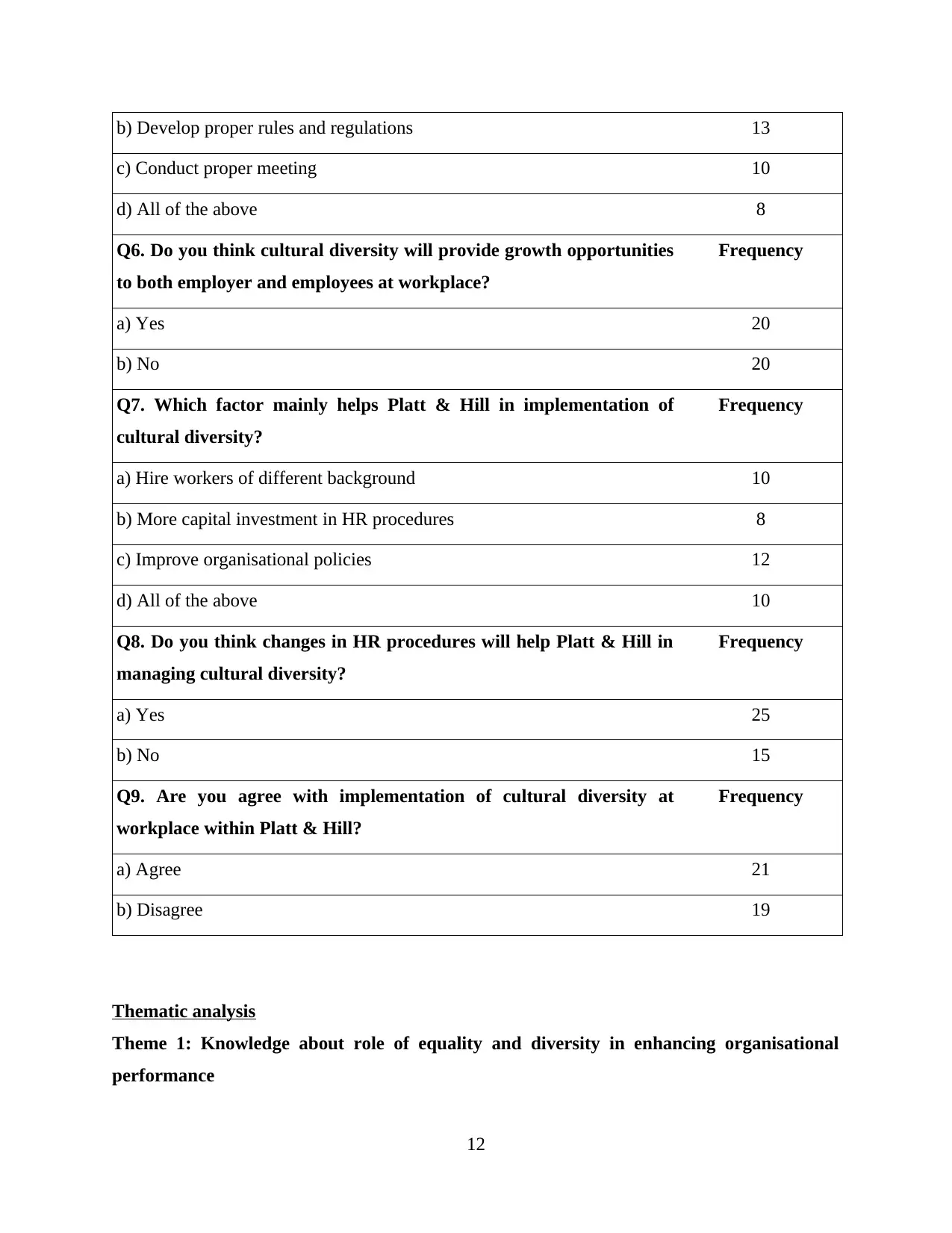
b) Develop proper rules and regulations 13
c) Conduct proper meeting 10
d) All of the above 8
Q6. Do you think cultural diversity will provide growth opportunities
to both employer and employees at workplace?
Frequency
a) Yes 20
b) No 20
Q7. Which factor mainly helps Platt & Hill in implementation of
cultural diversity?
Frequency
a) Hire workers of different background 10
b) More capital investment in HR procedures 8
c) Improve organisational policies 12
d) All of the above 10
Q8. Do you think changes in HR procedures will help Platt & Hill in
managing cultural diversity?
Frequency
a) Yes 25
b) No 15
Q9. Are you agree with implementation of cultural diversity at
workplace within Platt & Hill?
Frequency
a) Agree 21
b) Disagree 19
Thematic analysis
Theme 1: Knowledge about role of equality and diversity in enhancing organisational
performance
12
c) Conduct proper meeting 10
d) All of the above 8
Q6. Do you think cultural diversity will provide growth opportunities
to both employer and employees at workplace?
Frequency
a) Yes 20
b) No 20
Q7. Which factor mainly helps Platt & Hill in implementation of
cultural diversity?
Frequency
a) Hire workers of different background 10
b) More capital investment in HR procedures 8
c) Improve organisational policies 12
d) All of the above 10
Q8. Do you think changes in HR procedures will help Platt & Hill in
managing cultural diversity?
Frequency
a) Yes 25
b) No 15
Q9. Are you agree with implementation of cultural diversity at
workplace within Platt & Hill?
Frequency
a) Agree 21
b) Disagree 19
Thematic analysis
Theme 1: Knowledge about role of equality and diversity in enhancing organisational
performance
12
⊘ This is a preview!⊘
Do you want full access?
Subscribe today to unlock all pages.
Trusted by 1+ million students worldwide

1 out of 23


Related Documents


Your All-in-One AI-Powered Toolkit for Academic Success.
+13062052269
info@desklib.com
Available 24*7 on WhatsApp / Email
![[object Object]](/_next/static/media/star-bottom.7253800d.svg)
Unlock your academic potential
Copyright © 2020–2026 A2Z Services. All Rights Reserved. Developed and managed by ZUCOL.