Analyzing Equality, Diversity, and Fear Treatment in Public Services

Verified

Added on  2021/02/20

|6
|990
|77
Report
AI Summary
This report delves into the concepts of equality, diversity, and fear, providing a comprehensive overview of prejudice, stereotyping, and discrimination within society and public services. It explores the origins and types of prejudice, examining its impact on individuals and institutions. The report discusses direct and indirect discrimination, the Lawrence inquiry and institutional racism, and Allport's Scale of Discrimination. It concludes by highlighting the implications of discrimination for public services and emphasizes the importance of addressing these issues to ensure fairness and social justice. The report includes a list of references for further reading.
Document Page
Equality , Diversity and Fear
treatment
tabler-icon-diamond-filled.svg

Paraphrase This Document

Need a fresh take? Get an instant paraphrase of this document with our AI Paraphraser
Document Page
Table of Contents
INTRODUCTION...........................................................................................................................1
Prejudice......................................................................................................................................1
Origins of Prejudice....................................................................................................................1
Types of Prejudice.......................................................................................................................1
Stereotyping and its effects on public services...........................................................................1
Discrimination.............................................................................................................................1
Direct and Indirect Discrimination..............................................................................................2
Lawrence inquiry and institutional racism..................................................................................2
Allport’s Scale of Discrimination...............................................................................................2
Implication of Discrimination for public services......................................................................2
CONCLUSION................................................................................................................................3
REFERENCES................................................................................................................................4
Document Page
INTRODUCTION
Equality is defined as same responsibilities, rights and status for each member of family,
group or society. Diversity refers to an extent of differences which prevails between individuals
who are part of well-defined and purposefully group. These deviations can be due to behaviour,
personality, creed, caste, genetic attributes, sexual orientation, intelligence, socio economic
background, gender, age, religion, etc.
Prejudice
Prejudice refers to irrational or preconceived opinions that subsequently leads to
provision of preferential treatment along with some unfavourable biasness for other individuals.
It is an affective feeling towards group members or person which are often based on behaviour of
individual within a group membership.
Origins of Prejudice
Prejudice can be said to be universal human experience which have certain number of
origins, basically evolutionary, cultural, psychological and social. Prejudice implies
prejudgement. An individual is prejudiced when an attitude has been formed with respect to any
particular social group before enough information is gathered to have an knowledgeable thought.
It denotes a elementary part of complex of individuals thought process.
Types of Prejudice
There are various types of prejudice which are normally observed within present era
depending upon different aspects like socio-economic status, sexual orientation, age, gender,
religion, nationality and race of an individual.
Stereotyping and its effects on public services
One of the most commonly known types of prejudice are stereotypes which are defined
as belief or ideology with respect to peculiar set of individuals. They have certain number of
implications for furnishing public services. The government within present era intends to initiate
various measures and steps which are required for aiming at eliminating this social evil.
Discrimination
This denotes a practice which is referred to formulation of differentiation between group
on the basis of certain factors like sexual orientation, gender, age, race, etc. Generally, they
1
Document Page
denote actions or behaviour of individual which is usually antagonistic towards either a single
person or group of people with respect to certain aspects. It is a unfair treatment of people
because they belongs to diverse and dominant groups within the society.
Direct and Indirect Discrimination
Direct discrimination occurs in between when people are treated in worse manner than
any other individual who have pursuing things:
The individual possess protected characteristic.
An individual is connected with person who have some protected characteristic.
Somebody possess an opinion that individual have certain protected characteristic.
Basically individuals who are treated unfairly by anyone just due to the one who they are.
It is against Equality Act 2010, which states it as unlawful.
Indirect discrimination occurs when policies are applied on everyone in an identical
manner but specifically have some disadvantages with peculiar section of people who possess
protected characteristic and an individual has unprivileged for being apart of that specific group.
Lawrence inquiry and institutional racism
The enquiry has been carried out into a murder of guy who is of age 18 years, named
Lawrence . Institutional racism has a form of racism which is verbalised within practice of social
and political institutions. This is illustrated in terms of disparities with respect to education,
wealth, criminal justice, healthcare, political power, housing, employment, income, etc.
Allport’s Scale of Discrimination
This scale is defined as measurement of signs associated with prejudice witnessed within
the society. It is also referred to Allport's Scale of Discrimination and Prejudice which have been
coined by Gordon Allport. It is measure of manifestation within a society for prejudice. It ranges
from antilocution, avoidance, discrimination, physical attack and extermination.
Implication of Discrimination for public services
Discrimination creates strong impact on public services and government has purely
reserved organisations or groups, individuals for engaging within practice of discrimination. The
political system have been devised anti discrimination laws for prevention of this social evil.
Owing to this, when entities have indulged within such kind of social evil and they have to
adhere to assorted impacts for the same.
2
tabler-icon-diamond-filled.svg

Paraphrase This Document

Need a fresh take? Get an instant paraphrase of this document with our AI Paraphraser
Document Page
CONCLUSION
With respect to above given discussion, it has been concluded that prejudice as well as
discrimination are two probable aspects which can be neglected by organisation for making sure
welfare of all the employees. Along with this, it has been observed that prejudice and
discrimination leads to relevant influence on operations of business related with public service
entities as they are the ones who will be responsible for devising certain laws.
3
Document Page
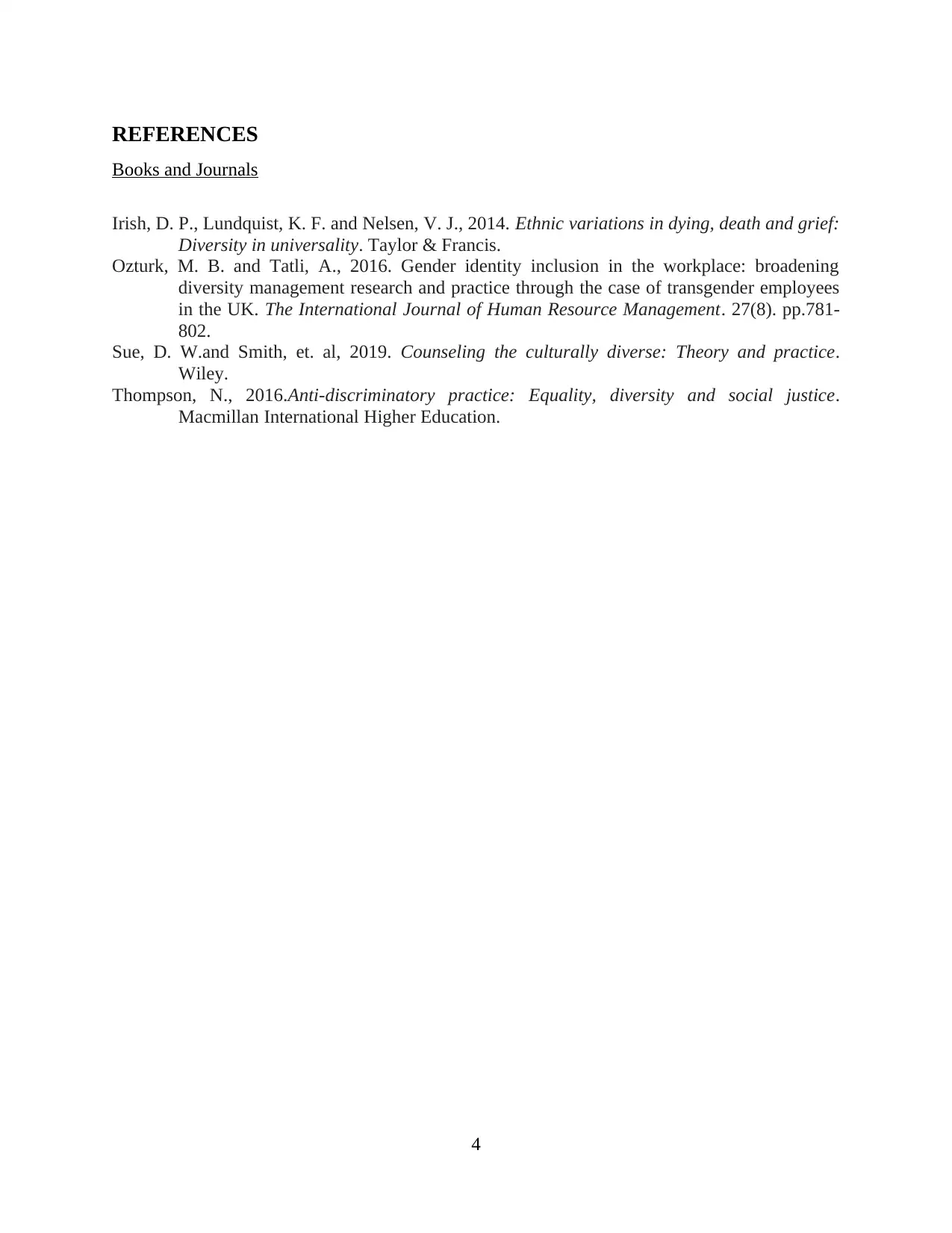
REFERENCES
Books and Journals
Irish, D. P., Lundquist, K. F. and Nelsen, V. J., 2014. Ethnic variations in dying, death and grief:
Diversity in universality. Taylor & Francis.
Ozturk, M. B. and Tatli, A., 2016. Gender identity inclusion in the workplace: broadening
diversity management research and practice through the case of transgender employees
in the UK. The International Journal of Human Resource Management. 27(8). pp.781-
802.
Sue, D. W.and Smith, et. al, 2019. Counseling the culturally diverse: Theory and practice.
Wiley.
Thompson, N., 2016.Anti-discriminatory practice: Equality, diversity and social justice.
Macmillan International Higher Education.
4
chevron_up_icon
1 out of 6
circle_padding
hide_on_mobile
zoom_out_icon
[object Object]