Sainsbury's Research: Behaviors Supporting Equality and Diversity
VerifiedAdded on 2023/01/16
|23
|5066
|88
Report
AI Summary
This research project investigates behaviors that support equality and diversity in the workplace, specifically within Sainsbury's. The report explores the concepts of equity and equality, examining their importance in a business context. It aims to identify strategies and behaviors that Sainsbury's can adopt to foster a diverse and inclusive environment. The literature review covers equity vs. equality, strategies for promoting diversity, and the importance of these concepts in the workplace. The methodology includes a positivist research philosophy, an inductive approach, and qualitative research methods, utilizing both primary and secondary data sources. The project's activities and timelines are outlined, and a Gantt chart is used for project management.

Research Project

Paraphrase This Document
Need a fresh take? Get an instant paraphrase of this document with our AI Paraphraser
TITLE: “To have a better understanding about behaviour that support equality and
diversity in the workplace”. A research project on Sainsbury
Chapter 1: Introduction
1(i) Research project description
This investigation project is supported to Sainsbury plc which is second largest
supermarket of UK and is headquartered in London, UK. A wide range of products are offered
by this organisation from a variety of brands and includes meat, frozen food, fresh and bakery
products, health and beauty products, cleaning products, baby products together with clothing,
electronics and entertainment products (Boehm and Dwertmann, 2015). Sainsbury is having
more than 605 supermarkets and a large workforce thus, to maintain their efficiency and to
provide a healthy and positive workforce the concept of equity and equality becomes crucial and
important for this organisation. Beside this, to maintain its competitive strength and superiority
in the business market effective administration of sameness and diverseness in working
enviroenment is also necessary for Sainsbury. Therefore, following research project is
conducted to have better understanding about behaviour that support equality and diversity in the
workplace of Sainsbury.
1(ii) Research aim and objectives
The purpose of conducting this investigation report on Sainsbury is, “to evaluate the
behaviour that support equality and diversity in the workplace together with having a better
understanding about concept of Equality and Equity in context of a business organization”.
The main objectives and targets of this research project conducted on Sainsbury are as follows:
To study the concept of equity and equality in context of a business organisation.
To evaluate the various strategies and behaviour that can be adopted by Sainsbury to
support and have equality and diversity in its business organisation(Borkowski, 2016). To develop a better understanding about the importance of leading equity, equality and
diversity at workplace of an organisation.
Question Tag
What do you understand by the concept of equity and equality in context of a business
organisation?
1
diversity in the workplace”. A research project on Sainsbury
Chapter 1: Introduction
1(i) Research project description
This investigation project is supported to Sainsbury plc which is second largest
supermarket of UK and is headquartered in London, UK. A wide range of products are offered
by this organisation from a variety of brands and includes meat, frozen food, fresh and bakery
products, health and beauty products, cleaning products, baby products together with clothing,
electronics and entertainment products (Boehm and Dwertmann, 2015). Sainsbury is having
more than 605 supermarkets and a large workforce thus, to maintain their efficiency and to
provide a healthy and positive workforce the concept of equity and equality becomes crucial and
important for this organisation. Beside this, to maintain its competitive strength and superiority
in the business market effective administration of sameness and diverseness in working
enviroenment is also necessary for Sainsbury. Therefore, following research project is
conducted to have better understanding about behaviour that support equality and diversity in the
workplace of Sainsbury.
1(ii) Research aim and objectives
The purpose of conducting this investigation report on Sainsbury is, “to evaluate the
behaviour that support equality and diversity in the workplace together with having a better
understanding about concept of Equality and Equity in context of a business organization”.
The main objectives and targets of this research project conducted on Sainsbury are as follows:
To study the concept of equity and equality in context of a business organisation.
To evaluate the various strategies and behaviour that can be adopted by Sainsbury to
support and have equality and diversity in its business organisation(Borkowski, 2016). To develop a better understanding about the importance of leading equity, equality and
diversity at workplace of an organisation.
Question Tag
What do you understand by the concept of equity and equality in context of a business
organisation?
1
⊘ This is a preview!⊘
Do you want full access?
Subscribe today to unlock all pages.

Trusted by 1+ million students worldwide
What are the possible strategies and behaviour that can be adopted by Sainsbury to
support and have equality and diversity in its business organisation?
What importance is lead by equity, equality and diversity at workplace of an
organisation?
1(iii) Reasons for choosing this research project
The major motive behind selecting this topic of investigation task is to get a better
understanding and develop a perspective about the concept of equity and equality together with
analysing the importance facilitated by creation of sameness and diverseness in working
environment. Proper management of equity and equality together with maintenance of
significant level of diversity is necessary for an organisation as it lead to a better workplace
culture and also yield motivation in employees through providing fair opportunity that enhance
the productivity of workforce (Bratton, 2015). Further, this research topic is also helpful and
needed by the researcher to meet and fulfil its educational criteria and also associated with its
academic background that will lead to better research and interpersonal skills.
1(iv) Activities and timescales
The various activities included in this project along with their time duration are provided
below:
Activities Time duration
Setting of Aims and objective 4 days
Research methodology 12 days
Literature review 4 days
Data collection 12 days
Data analysis 5 days
Conclusion and recommendations 21 days
Final submission 25 days
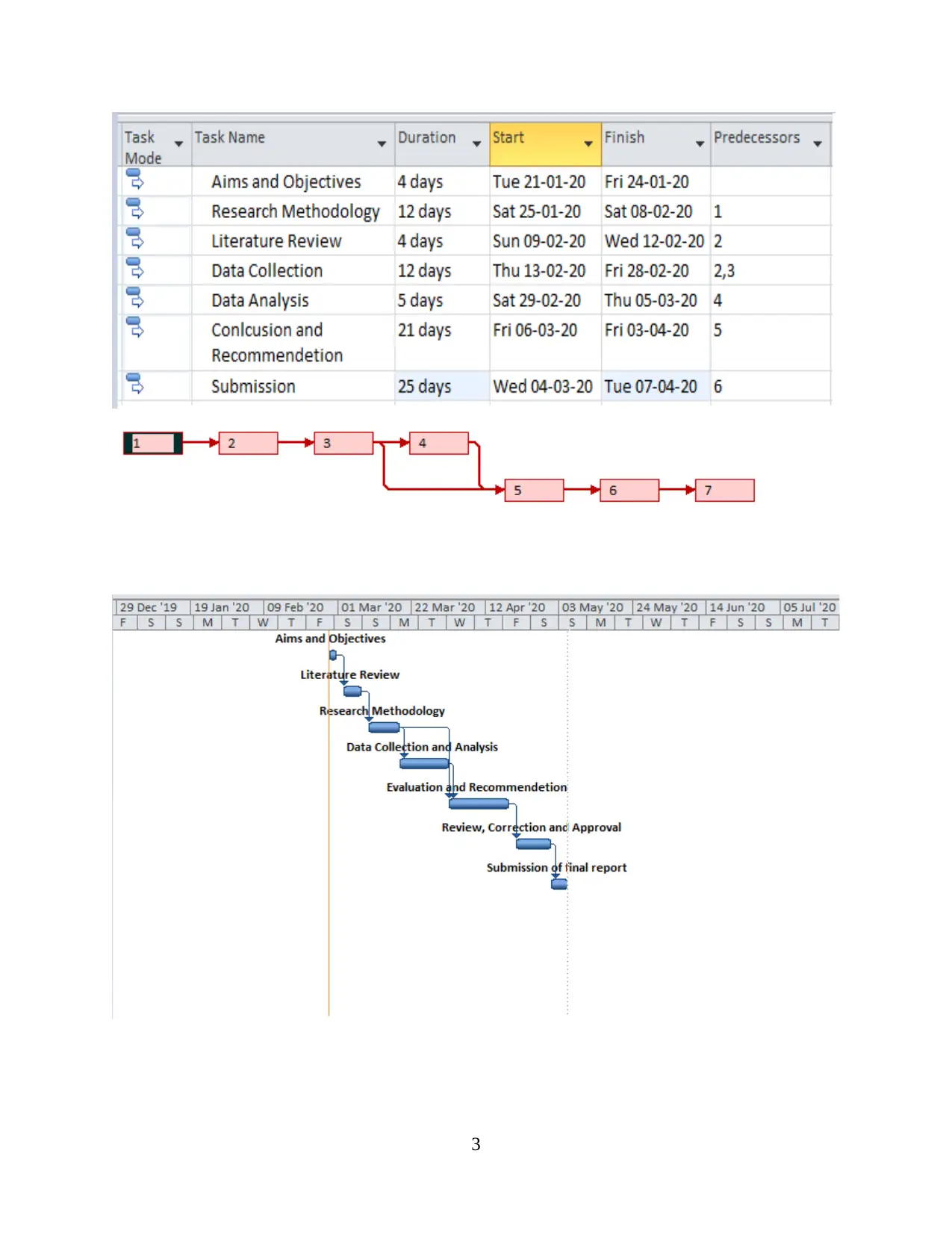
Beside this to ensure completion of research project on time and to meet the timelines of
each activity use of Gantt chart is made which is an essential project management tool (D'Cruz,
and et. al., 2016). Gantt chart is one of most widely used research and important management
tool that lead to a transparent and more clearer presentation of various activities of a research
through properly stating the start and end time of each activity.
2
support and have equality and diversity in its business organisation?
What importance is lead by equity, equality and diversity at workplace of an
organisation?
1(iii) Reasons for choosing this research project
The major motive behind selecting this topic of investigation task is to get a better
understanding and develop a perspective about the concept of equity and equality together with
analysing the importance facilitated by creation of sameness and diverseness in working
environment. Proper management of equity and equality together with maintenance of
significant level of diversity is necessary for an organisation as it lead to a better workplace
culture and also yield motivation in employees through providing fair opportunity that enhance
the productivity of workforce (Bratton, 2015). Further, this research topic is also helpful and
needed by the researcher to meet and fulfil its educational criteria and also associated with its
academic background that will lead to better research and interpersonal skills.
1(iv) Activities and timescales
The various activities included in this project along with their time duration are provided
below:
Activities Time duration
Setting of Aims and objective 4 days
Research methodology 12 days
Literature review 4 days
Data collection 12 days
Data analysis 5 days
Conclusion and recommendations 21 days
Final submission 25 days
Beside this to ensure completion of research project on time and to meet the timelines of
each activity use of Gantt chart is made which is an essential project management tool (D'Cruz,
and et. al., 2016). Gantt chart is one of most widely used research and important management
tool that lead to a transparent and more clearer presentation of various activities of a research
through properly stating the start and end time of each activity.
2
Paraphrase This Document
Need a fresh take? Get an instant paraphrase of this document with our AI Paraphraser
3
Chapter 2: Literature review
2.1) Introduction
Literature review is basically associated with the survey of various scholarly sources like
books, articles and other online sources and website to get better understanding about the
specific topic and research questions in order to situate and support findings of research with the
help of existing knowledge (DelCampo, Haggerty and Knippel, 2017). The following literature
review is done on the topic related with the concept of equity, sameness and diverseness in
working environment with the assistance of analyzing and evaluating view points of various
authors through help of online sources.
2.2) Literature review
To study the concept of equity and equality in context of a business organization
As per the view point of Donna Stringer and Nagarajan Ramamoorthy, (2017), Equity
and equality are two different concept where equity is relate with providing and understanding
the needs of people that yield them full enjoyment and healthy lives. In contrast, equality aims at
ensuring that everyone gets the same things. It can also be evaluated that the ultimate aim of both
equity and equality is to promote fairness and justice in the organization to provide a motivated
and healthy workplace to employees. Apart from this, as per the opinion of Surbhi S,(2017),
Equity is related with the clear and fair allocation of origins to all the workforce, which present
equivalence where as sameness refers the provisions of providing similar origins to all
individual i.e. it is associated with state of being similar irrespective of ones personal needs and
desires. Thus, it can be evaluated that Equality and equity are two vital concept and strategies
that are used necessary for all organization to facilitate fairness and also ensure a healthy and
well motivated atmosphere for employees. Equality is mainly related with sameness i.e. treating
every individual as same where equity is associated with fairness i.e. providing what actually
needed by an individual to become successful and more productive (Farndale, and et.al., 2015).
Therefore, both equality and equity are important from point of view of organization to have
transparency and impartiality in its operations which is beneficial for both employer and
employee as it lead to enhancement in moral of employees and also tempt them to improve their
efficiency.
4
2.1) Introduction
Literature review is basically associated with the survey of various scholarly sources like
books, articles and other online sources and website to get better understanding about the
specific topic and research questions in order to situate and support findings of research with the
help of existing knowledge (DelCampo, Haggerty and Knippel, 2017). The following literature
review is done on the topic related with the concept of equity, sameness and diverseness in
working environment with the assistance of analyzing and evaluating view points of various
authors through help of online sources.
2.2) Literature review
To study the concept of equity and equality in context of a business organization
As per the view point of Donna Stringer and Nagarajan Ramamoorthy, (2017), Equity
and equality are two different concept where equity is relate with providing and understanding
the needs of people that yield them full enjoyment and healthy lives. In contrast, equality aims at
ensuring that everyone gets the same things. It can also be evaluated that the ultimate aim of both
equity and equality is to promote fairness and justice in the organization to provide a motivated
and healthy workplace to employees. Apart from this, as per the opinion of Surbhi S,(2017),
Equity is related with the clear and fair allocation of origins to all the workforce, which present
equivalence where as sameness refers the provisions of providing similar origins to all
individual i.e. it is associated with state of being similar irrespective of ones personal needs and
desires. Thus, it can be evaluated that Equality and equity are two vital concept and strategies
that are used necessary for all organization to facilitate fairness and also ensure a healthy and
well motivated atmosphere for employees. Equality is mainly related with sameness i.e. treating
every individual as same where equity is associated with fairness i.e. providing what actually
needed by an individual to become successful and more productive (Farndale, and et.al., 2015).
Therefore, both equality and equity are important from point of view of organization to have
transparency and impartiality in its operations which is beneficial for both employer and
employee as it lead to enhancement in moral of employees and also tempt them to improve their
efficiency.
4
⊘ This is a preview!⊘
Do you want full access?
Subscribe today to unlock all pages.
Trusted by 1+ million students worldwide
To evaluate the various strategies and behaviour that can be adopted by Sainsbury to support
and have equality and diversity in its business organisation
According to the view point of Angel Sharma, (2016), diverseness and sameness has
become an intrinsic part of administration of every organisation to promote an effective
workplace culture. The various behaviours and strategies that can be adopted by Sainsbury to
have equality and diversity at its workplace includes various performance appraisal approach to
manage diversity and equality together with fair management and leadership that facilitates an
unbiased atmosphere at workplace. Further, it can be analysed that the utmost strategies and
behavior that can lead to encourage diverseness and sameness in working environment of
Sainsbury includes support from top management along with an effective communication about
the diversity and equality with employees to raise awareness about these concepts. Along with
this, as per the view point of Kimberlee Leonard, (2019), the term diversity is associated with
complex issues and consists people coming from different backgrounds and include a variety of
interest thus, proper management and strategies and needed to coordinate them. Sainsbury can
have a more effective and unbiased leadership and management style in order to create a
behavior and culture that support equality and diversity. Highlighting individual uniqueness,
improving plans and rules adhering to organisation's aims and objectives, communicating
diverseness argumentation and continuous evolvement and engagement of employees are some
effective ways and strategies that can be adopted by Sainsbury to support and have sameness and
diverseness in its business concern establishment.
To develop a better understanding about the importance of leading equity, equality and
diversity at workplace of an organization
As per the to the view point of Louise Petty, (2016), the equity, equality and diversity are
important for all organisation as it ensure that everyone who are working in an organisation have
access to same opportunity and should receive a fair treatment from employer and organisation.
The concept of equity and equality are important for an organisation as it lead to enhancement in
moral and efficiency of employees through providing a better workplace culture where as
diversity yield better competitive strength and future expansion opportunity through providing a
mix of employees coming form different culture and backgrounds that enhance overall
competencies and viability of a company. On the other hand, As per the opinion of Sophie
Johnson, (2020), equity, equality and diversity are crucial for a company as equity yield a fair
5
and have equality and diversity in its business organisation
According to the view point of Angel Sharma, (2016), diverseness and sameness has
become an intrinsic part of administration of every organisation to promote an effective
workplace culture. The various behaviours and strategies that can be adopted by Sainsbury to
have equality and diversity at its workplace includes various performance appraisal approach to
manage diversity and equality together with fair management and leadership that facilitates an
unbiased atmosphere at workplace. Further, it can be analysed that the utmost strategies and
behavior that can lead to encourage diverseness and sameness in working environment of
Sainsbury includes support from top management along with an effective communication about
the diversity and equality with employees to raise awareness about these concepts. Along with
this, as per the view point of Kimberlee Leonard, (2019), the term diversity is associated with
complex issues and consists people coming from different backgrounds and include a variety of
interest thus, proper management and strategies and needed to coordinate them. Sainsbury can
have a more effective and unbiased leadership and management style in order to create a
behavior and culture that support equality and diversity. Highlighting individual uniqueness,
improving plans and rules adhering to organisation's aims and objectives, communicating
diverseness argumentation and continuous evolvement and engagement of employees are some
effective ways and strategies that can be adopted by Sainsbury to support and have sameness and
diverseness in its business concern establishment.
To develop a better understanding about the importance of leading equity, equality and
diversity at workplace of an organization
As per the to the view point of Louise Petty, (2016), the equity, equality and diversity are
important for all organisation as it ensure that everyone who are working in an organisation have
access to same opportunity and should receive a fair treatment from employer and organisation.
The concept of equity and equality are important for an organisation as it lead to enhancement in
moral and efficiency of employees through providing a better workplace culture where as
diversity yield better competitive strength and future expansion opportunity through providing a
mix of employees coming form different culture and backgrounds that enhance overall
competencies and viability of a company. On the other hand, As per the opinion of Sophie
Johnson, (2020), equity, equality and diversity are crucial for a company as equity yield a fair
5
Paraphrase This Document
Need a fresh take? Get an instant paraphrase of this document with our AI Paraphraser
treatment in organisation and equality lead to equal job opportunities which provide a well
motivated and efficient workforce in an organisation. Further, diversity lead to a better
combination and also ensure a effective balance of talented and creative in the workforce which
are coming form different background through eliminating conflicts among them (Grissom, Kern
and Rodriguez, 2015). Thus, it can be evaluated that all these three concepts plays an important
role in Sainsbury through retaining most talented employees and also encourages them to have
better performance and efficiency with the help of providing a fair treatment and equal
opportunity through eliminating and reducing all kind of discrimination from the workplace.
Chapter 3: Methodology
3.1) Research approach
RESEARCH PHILOSOPHY
It is a phenomena of collecting, analysing and using of data. It deals with concept,
sources, nature and development of knowledge and formulation of beliefs and assumption based
on true facts. Its two main research are-
Positivism- It is natural scientist based on observable social entity work. It majorly focused with
predicting and observing research outcomes on the basis of collection of data and hypothesis
development (Guillaume, and et. al., 2017).
Interpretivism- It emphasises on difference between research among people views other than
things. It required small sample size to research.
In these research, positivism philosophy is selected to analysis research as it importance
is predicting and getting outcomes.
RESEARCH APPROACH
It is defined as plan and procedure of collection, analysis, interpreting of assumed data.
The overall decision of researcher involve philosophy assumption and approaches to study a
research. It is of two type are :-
Deduction- Its mainly focus on test theory. It used collection and analysis of data which is
related to hypothesis of existing theory.
Inductive- Its involve pattern for development and observation of research explanation were no
hypothesis and theories are applied (Hunt, Layton and Prince, 2015).
6
motivated and efficient workforce in an organisation. Further, diversity lead to a better
combination and also ensure a effective balance of talented and creative in the workforce which
are coming form different background through eliminating conflicts among them (Grissom, Kern
and Rodriguez, 2015). Thus, it can be evaluated that all these three concepts plays an important
role in Sainsbury through retaining most talented employees and also encourages them to have
better performance and efficiency with the help of providing a fair treatment and equal
opportunity through eliminating and reducing all kind of discrimination from the workplace.
Chapter 3: Methodology
3.1) Research approach
RESEARCH PHILOSOPHY
It is a phenomena of collecting, analysing and using of data. It deals with concept,
sources, nature and development of knowledge and formulation of beliefs and assumption based
on true facts. Its two main research are-
Positivism- It is natural scientist based on observable social entity work. It majorly focused with
predicting and observing research outcomes on the basis of collection of data and hypothesis
development (Guillaume, and et. al., 2017).
Interpretivism- It emphasises on difference between research among people views other than
things. It required small sample size to research.
In these research, positivism philosophy is selected to analysis research as it importance
is predicting and getting outcomes.
RESEARCH APPROACH
It is defined as plan and procedure of collection, analysis, interpreting of assumed data.
The overall decision of researcher involve philosophy assumption and approaches to study a
research. It is of two type are :-
Deduction- Its mainly focus on test theory. It used collection and analysis of data which is
related to hypothesis of existing theory.
Inductive- Its involve pattern for development and observation of research explanation were no
hypothesis and theories are applied (Hunt, Layton and Prince, 2015).
6
In these research, inductive approach is selected to analysis research as it made specific
conclusion and outsourcing functions.
RESEARCH METHOD
It is the strategies, process and techniques of collection of data or analysing information
and create better understanding of research question more effectively. This method is used to
implement the plan in research. It is of two types are-
Qualitative- It is scientific method of collection of data which is observation of gathering
information in non-numerical data. It is also used for in-depth and detailed knowledge about
respondent.
Quantitative- Its research is done in systematic manner with the techniques of mathematical,
statistical, graphs and tables. The method of data collection is in form of numbers or athematic
reflects brief perspectives of people (Marchington, and et. al., 2016).
In these research, qualitative research method is selected to analysis research as it provide
detailed knowledge and helpful in making proper decision and justify research objective.
SOURCES OF DATA COLLECTION
It is collection of data of sampling size which determine understanding, planning,
gathering of actual data, facts and figure. It is mainly of two types are-
Primary- It provide first hand data which is reliable and authentic, collected by researcher
itself. The sources are interviews, survey, questionnaire, group discussion.
Secondary- It is method of collection data which is already existence and done research with
past research or work done (Nichols, Horner and Fyfe, 2015)(Nicolson, 2015)(Özbilgin and et.
al., 2015). The sources are books, journals, literature,online website.
In these research, the investigator will use both source of data collection like primary and
secondary because these sources should be preferred as to maintain the reliability and research is
done on particular data in time to time.
3.2) Methodologies
i) Sampling
Sampling is basically an activity that is used at the time of statistical analysis and is
associated with selection of predetermined and specific number of units and observations from a
larger population to accomplish a research in more effective way (Ravazzani, 2016). For this
research project use of random sampling is made in which all observations has an equal chance
7
conclusion and outsourcing functions.
RESEARCH METHOD
It is the strategies, process and techniques of collection of data or analysing information
and create better understanding of research question more effectively. This method is used to
implement the plan in research. It is of two types are-
Qualitative- It is scientific method of collection of data which is observation of gathering
information in non-numerical data. It is also used for in-depth and detailed knowledge about
respondent.
Quantitative- Its research is done in systematic manner with the techniques of mathematical,
statistical, graphs and tables. The method of data collection is in form of numbers or athematic
reflects brief perspectives of people (Marchington, and et. al., 2016).
In these research, qualitative research method is selected to analysis research as it provide
detailed knowledge and helpful in making proper decision and justify research objective.
SOURCES OF DATA COLLECTION
It is collection of data of sampling size which determine understanding, planning,
gathering of actual data, facts and figure. It is mainly of two types are-
Primary- It provide first hand data which is reliable and authentic, collected by researcher
itself. The sources are interviews, survey, questionnaire, group discussion.
Secondary- It is method of collection data which is already existence and done research with
past research or work done (Nichols, Horner and Fyfe, 2015)(Nicolson, 2015)(Özbilgin and et.
al., 2015). The sources are books, journals, literature,online website.
In these research, the investigator will use both source of data collection like primary and
secondary because these sources should be preferred as to maintain the reliability and research is
done on particular data in time to time.
3.2) Methodologies
i) Sampling
Sampling is basically an activity that is used at the time of statistical analysis and is
associated with selection of predetermined and specific number of units and observations from a
larger population to accomplish a research in more effective way (Ravazzani, 2016). For this
research project use of random sampling is made in which all observations has an equal chance
7
⊘ This is a preview!⊘
Do you want full access?
Subscribe today to unlock all pages.
Trusted by 1+ million students worldwide
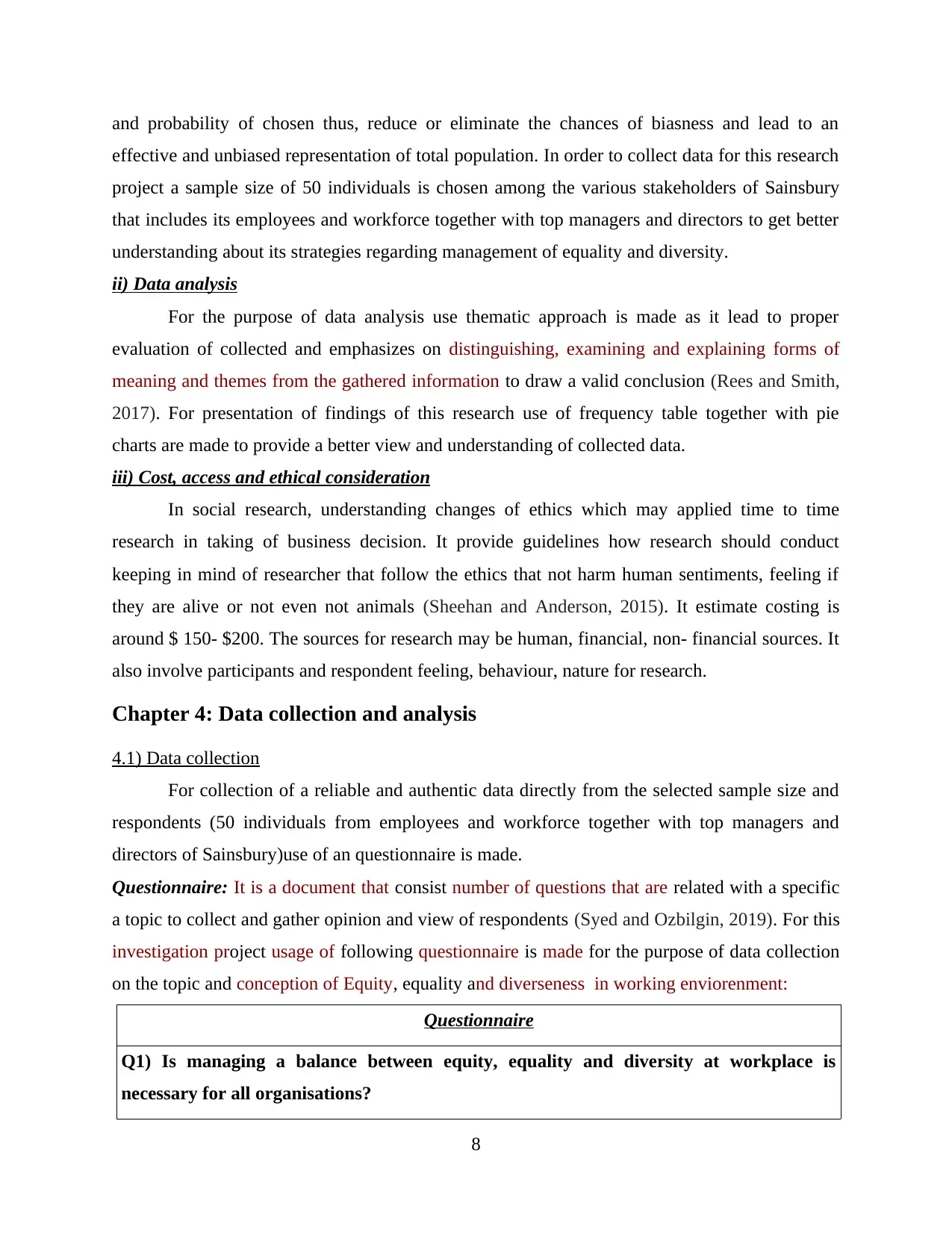
and probability of chosen thus, reduce or eliminate the chances of biasness and lead to an
effective and unbiased representation of total population. In order to collect data for this research
project a sample size of 50 individuals is chosen among the various stakeholders of Sainsbury
that includes its employees and workforce together with top managers and directors to get better
understanding about its strategies regarding management of equality and diversity.
ii) Data analysis
For the purpose of data analysis use thematic approach is made as it lead to proper
evaluation of collected and emphasizes on distinguishing, examining and explaining forms of
meaning and themes from the gathered information to draw a valid conclusion (Rees and Smith,
2017). For presentation of findings of this research use of frequency table together with pie
charts are made to provide a better view and understanding of collected data.
iii) Cost, access and ethical consideration
In social research, understanding changes of ethics which may applied time to time
research in taking of business decision. It provide guidelines how research should conduct
keeping in mind of researcher that follow the ethics that not harm human sentiments, feeling if
they are alive or not even not animals (Sheehan and Anderson, 2015). It estimate costing is
around $ 150- $200. The sources for research may be human, financial, non- financial sources. It
also involve participants and respondent feeling, behaviour, nature for research.
Chapter 4: Data collection and analysis
4.1) Data collection
For collection of a reliable and authentic data directly from the selected sample size and
respondents (50 individuals from employees and workforce together with top managers and
directors of Sainsbury)use of an questionnaire is made.
Questionnaire: It is a document that consist number of questions that are related with a specific
a topic to collect and gather opinion and view of respondents (Syed and Ozbilgin, 2019). For this
investigation project usage of following questionnaire is made for the purpose of data collection
on the topic and conception of Equity, equality and diverseness in working enviorenment:
Questionnaire
Q1) Is managing a balance between equity, equality and diversity at workplace is
necessary for all organisations?
8
effective and unbiased representation of total population. In order to collect data for this research
project a sample size of 50 individuals is chosen among the various stakeholders of Sainsbury
that includes its employees and workforce together with top managers and directors to get better
understanding about its strategies regarding management of equality and diversity.
ii) Data analysis
For the purpose of data analysis use thematic approach is made as it lead to proper
evaluation of collected and emphasizes on distinguishing, examining and explaining forms of
meaning and themes from the gathered information to draw a valid conclusion (Rees and Smith,
2017). For presentation of findings of this research use of frequency table together with pie
charts are made to provide a better view and understanding of collected data.
iii) Cost, access and ethical consideration
In social research, understanding changes of ethics which may applied time to time
research in taking of business decision. It provide guidelines how research should conduct
keeping in mind of researcher that follow the ethics that not harm human sentiments, feeling if
they are alive or not even not animals (Sheehan and Anderson, 2015). It estimate costing is
around $ 150- $200. The sources for research may be human, financial, non- financial sources. It
also involve participants and respondent feeling, behaviour, nature for research.
Chapter 4: Data collection and analysis
4.1) Data collection
For collection of a reliable and authentic data directly from the selected sample size and
respondents (50 individuals from employees and workforce together with top managers and
directors of Sainsbury)use of an questionnaire is made.
Questionnaire: It is a document that consist number of questions that are related with a specific
a topic to collect and gather opinion and view of respondents (Syed and Ozbilgin, 2019). For this
investigation project usage of following questionnaire is made for the purpose of data collection
on the topic and conception of Equity, equality and diverseness in working enviorenment:
Questionnaire
Q1) Is managing a balance between equity, equality and diversity at workplace is
necessary for all organisations?
8
Paraphrase This Document
Need a fresh take? Get an instant paraphrase of this document with our AI Paraphraser
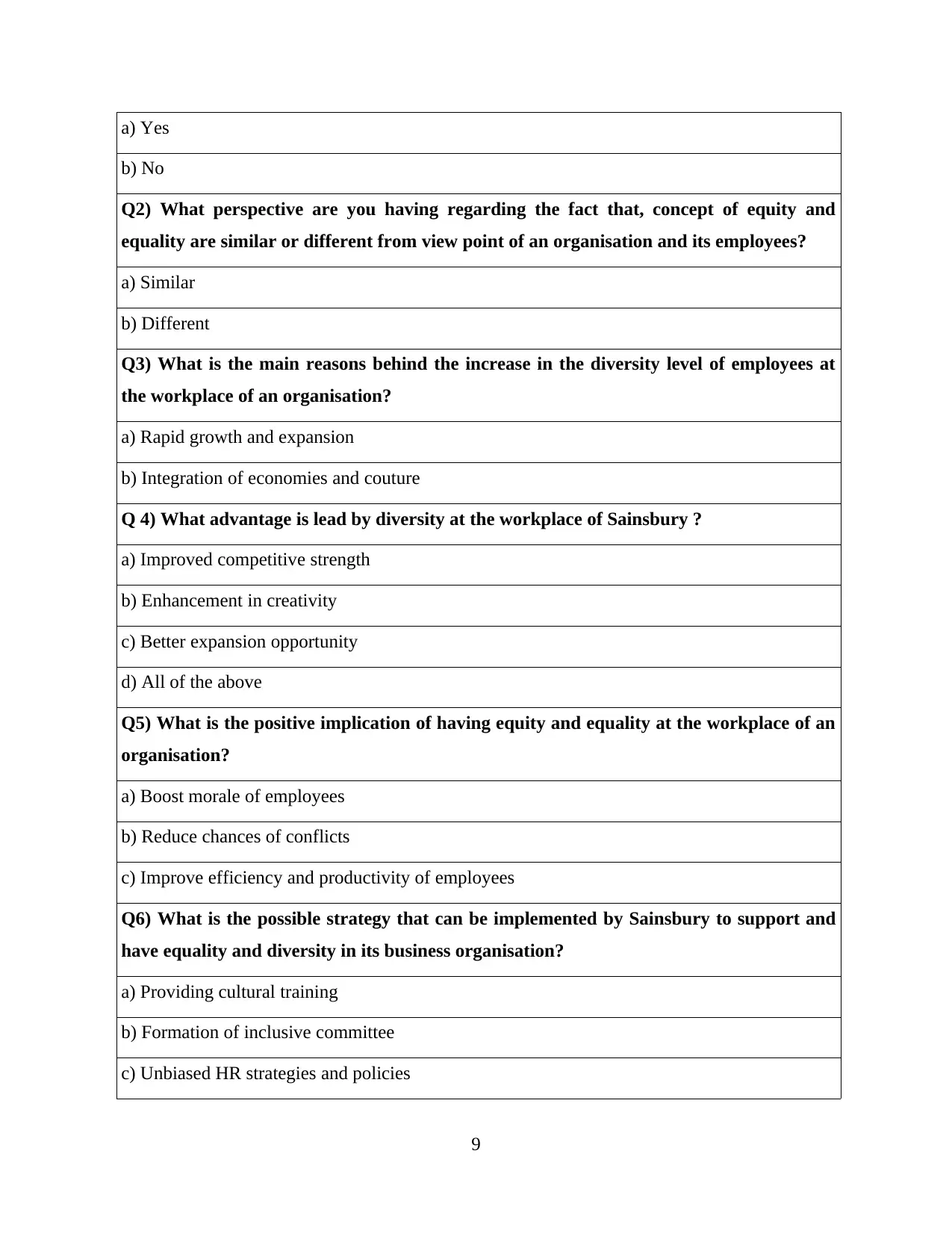
a) Yes
b) No
Q2) What perspective are you having regarding the fact that, concept of equity and
equality are similar or different from view point of an organisation and its employees?
a) Similar
b) Different
Q3) What is the main reasons behind the increase in the diversity level of employees at
the workplace of an organisation?
a) Rapid growth and expansion
b) Integration of economies and couture
Q 4) What advantage is lead by diversity at the workplace of Sainsbury ?
a) Improved competitive strength
b) Enhancement in creativity
c) Better expansion opportunity
d) All of the above
Q5) What is the positive implication of having equity and equality at the workplace of an
organisation?
a) Boost morale of employees
b) Reduce chances of conflicts
c) Improve efficiency and productivity of employees
Q6) What is the possible strategy that can be implemented by Sainsbury to support and
have equality and diversity in its business organisation?
a) Providing cultural training
b) Formation of inclusive committee
c) Unbiased HR strategies and policies
9
b) No
Q2) What perspective are you having regarding the fact that, concept of equity and
equality are similar or different from view point of an organisation and its employees?
a) Similar
b) Different
Q3) What is the main reasons behind the increase in the diversity level of employees at
the workplace of an organisation?
a) Rapid growth and expansion
b) Integration of economies and couture
Q 4) What advantage is lead by diversity at the workplace of Sainsbury ?
a) Improved competitive strength
b) Enhancement in creativity
c) Better expansion opportunity
d) All of the above
Q5) What is the positive implication of having equity and equality at the workplace of an
organisation?
a) Boost morale of employees
b) Reduce chances of conflicts
c) Improve efficiency and productivity of employees
Q6) What is the possible strategy that can be implemented by Sainsbury to support and
have equality and diversity in its business organisation?
a) Providing cultural training
b) Formation of inclusive committee
c) Unbiased HR strategies and policies
9
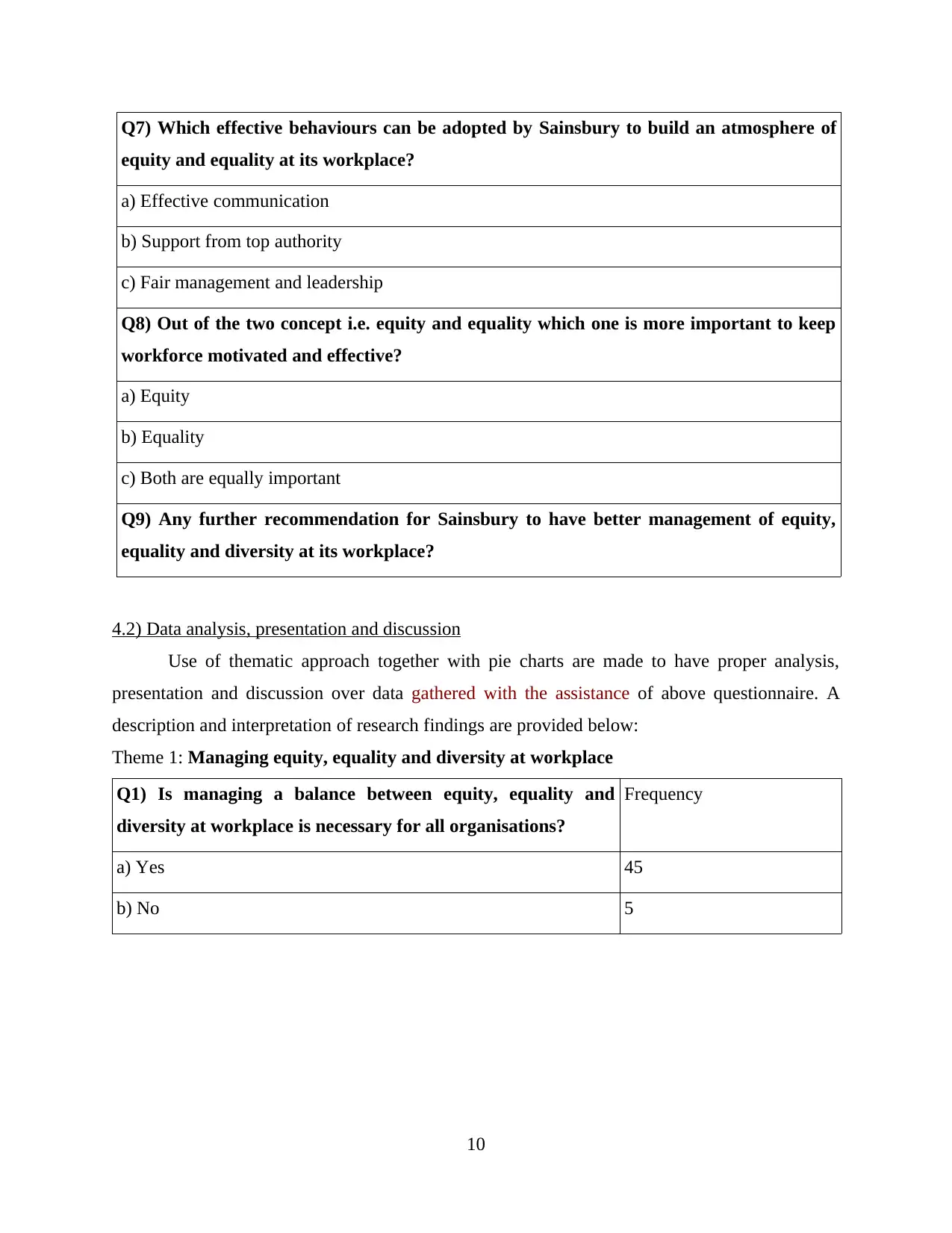
Q7) Which effective behaviours can be adopted by Sainsbury to build an atmosphere of
equity and equality at its workplace?
a) Effective communication
b) Support from top authority
c) Fair management and leadership
Q8) Out of the two concept i.e. equity and equality which one is more important to keep
workforce motivated and effective?
a) Equity
b) Equality
c) Both are equally important
Q9) Any further recommendation for Sainsbury to have better management of equity,
equality and diversity at its workplace?
4.2) Data analysis, presentation and discussion
Use of thematic approach together with pie charts are made to have proper analysis,
presentation and discussion over data gathered with the assistance of above questionnaire. A
description and interpretation of research findings are provided below:
Theme 1: Managing equity, equality and diversity at workplace
Q1) Is managing a balance between equity, equality and
diversity at workplace is necessary for all organisations?
Frequency
a) Yes 45
b) No 5
10
equity and equality at its workplace?
a) Effective communication
b) Support from top authority
c) Fair management and leadership
Q8) Out of the two concept i.e. equity and equality which one is more important to keep
workforce motivated and effective?
a) Equity
b) Equality
c) Both are equally important
Q9) Any further recommendation for Sainsbury to have better management of equity,
equality and diversity at its workplace?
4.2) Data analysis, presentation and discussion
Use of thematic approach together with pie charts are made to have proper analysis,
presentation and discussion over data gathered with the assistance of above questionnaire. A
description and interpretation of research findings are provided below:
Theme 1: Managing equity, equality and diversity at workplace
Q1) Is managing a balance between equity, equality and
diversity at workplace is necessary for all organisations?
Frequency
a) Yes 45
b) No 5
10
⊘ This is a preview!⊘
Do you want full access?
Subscribe today to unlock all pages.
Trusted by 1+ million students worldwide

1 out of 23


Related Documents


Your All-in-One AI-Powered Toolkit for Academic Success.
+13062052269
info@desklib.com
Available 24*7 on WhatsApp / Email
![[object Object]](/_next/static/media/star-bottom.7253800d.svg)
Unlock your academic potential
Copyright © 2020–2026 A2Z Services. All Rights Reserved. Developed and managed by ZUCOL.