Equipment Engineering 7947: Vibration Analysis & Prevention
VerifiedAdded on 2023/06/15
|8
|1824
|101
Report
AI Summary
This report investigates the excessive vibration in a centrifugal fan used for drying malt, identifying potential causes such as mechanical looseness, unbalanced rotor mass, shaft misalignment, cracks in the shaft and rotor, and resonance. The report details the symptoms associated with each cause and provides recommendations, including proper design of interference fits, precise shaft alignment using laser systems, critical speed mapping during fan design, and regular vibration measurements. The importance of using quality components and avoiding mismatched parts from different manufacturers is emphasized. The report also includes a vibration frequency curve obtained from accelerometer readings and suggests further steps for accurate fault diagnosis and prevention of recurrence.
Running Head: MECHANICAL VIBRATION 0
Paper Title Capitalized and Centered
Name of Student
Institution Affiliation
Paper Title Capitalized and Centered
Name of Student
Institution Affiliation

Paraphrase This Document
Need a fresh take? Get an instant paraphrase of this document with our AI Paraphraser
MECHANICAL VIBRATION 2
Introduction.
Centrifugal fans have always been linked to vibration connected challenges from their time
of inception till now. The various problems related to these type of fans are further subdivided
into two categories, that is, simple problems that comprises of unbalance conditions initiated by
mass variations on the rotor of the fan and much more intricate issues which comprises of
alignment of the shaft, resonance, mechanically loose connections and cracked shaft and/or
rotors (Bachmann, 2010).
From maintenance and production point of view, these vibration problems are costly to the
owner. Therefore, the threshold for acceptable vibration ranges has to be set for corresponding
speeds of operation. The following, are brief discussions of the most probable causes of vibration
in this centrifugal fan. Discussed along, are their corresponding signs and symptoms.
Mechanical loose connections.
It is possible that the looseness in the mechanical parts of the fan could cause the excessive
vibrations and increase the level of unbalance that exists in the fan. According to this diagram, it
is evident that the connection between the bearing pedestals, foundation, and the bearing
pedestals could be loose. Usually, loose connections cause harmonic levels of vibration and
subharmonic levels of vibration (Neisse, 2006)
Secondly, the excessive vibration may have occurred due to the mechanical loose connection
between the fan shaft and fan rotor. It's difficult to determine this type of vibration, but easy to
correct when found. This is because in several instances it induces an exceedingly high
unbalance type of level vibration (CzmoChowski, 2014).
Introduction.
Centrifugal fans have always been linked to vibration connected challenges from their time
of inception till now. The various problems related to these type of fans are further subdivided
into two categories, that is, simple problems that comprises of unbalance conditions initiated by
mass variations on the rotor of the fan and much more intricate issues which comprises of
alignment of the shaft, resonance, mechanically loose connections and cracked shaft and/or
rotors (Bachmann, 2010).
From maintenance and production point of view, these vibration problems are costly to the
owner. Therefore, the threshold for acceptable vibration ranges has to be set for corresponding
speeds of operation. The following, are brief discussions of the most probable causes of vibration
in this centrifugal fan. Discussed along, are their corresponding signs and symptoms.
Mechanical loose connections.
It is possible that the looseness in the mechanical parts of the fan could cause the excessive
vibrations and increase the level of unbalance that exists in the fan. According to this diagram, it
is evident that the connection between the bearing pedestals, foundation, and the bearing
pedestals could be loose. Usually, loose connections cause harmonic levels of vibration and
subharmonic levels of vibration (Neisse, 2006)
Secondly, the excessive vibration may have occurred due to the mechanical loose connection
between the fan shaft and fan rotor. It's difficult to determine this type of vibration, but easy to
correct when found. This is because in several instances it induces an exceedingly high
unbalance type of level vibration (CzmoChowski, 2014).
MECHANICAL VIBRATION 3
Unbalanced rotor mass.
Unbalanced rotor mass is always known to be the common cause of excessive vibration in
centrifugal fans. Due to this, it’s relevant to say that there could be a mass imbalance in this fan.
Its symptom is a high 1x level of vibration. This mass imbalance could have been caused by
exposure to the heated air which is forced over the drying malt. Secondly, this issue of rotor
mass imbalance could have been caused by wear of the rotor fan due to collisions of particles at
high speed. Similarly, uneven rotor mass distribution could be caused by disparities in
manufacturing (Guo, 2005).
Misalignment of shafts.
When installing a new fan or replacing its assembly accurate fan shaft and drive motor
alignment should be addressed properly. Second harmonics in the frequency spectrum is
common occurrence whenever there is a misalignment of fan shaft and the rotor shaft. In most
cases, misalignment of the shaft would also cause excessive axial vibration. However, since this
fan has no axial vibration probe, it's difficult to detect unless there is an existence of second
harmonics vibration component. The misalignment of the shaft could have been caused by bent
shafts, wrongly placed bearings or it can be attributed to carelessness during its installation
(Eisinger, 2002).
Cracks in the shaft and rotor.
Cracks development in the rotor shaft or in the fan shaft could have led to the excessive
vibration levels in spite of careful impeller balancing. This is not only to this centrifugal fan but
to any type of rotating machine. If the cracks are not detected in time a catastrophic failure would
occur to the fan. Similarly, cracks could further lead to the development of 2x vibration
Unbalanced rotor mass.
Unbalanced rotor mass is always known to be the common cause of excessive vibration in
centrifugal fans. Due to this, it’s relevant to say that there could be a mass imbalance in this fan.
Its symptom is a high 1x level of vibration. This mass imbalance could have been caused by
exposure to the heated air which is forced over the drying malt. Secondly, this issue of rotor
mass imbalance could have been caused by wear of the rotor fan due to collisions of particles at
high speed. Similarly, uneven rotor mass distribution could be caused by disparities in
manufacturing (Guo, 2005).
Misalignment of shafts.
When installing a new fan or replacing its assembly accurate fan shaft and drive motor
alignment should be addressed properly. Second harmonics in the frequency spectrum is
common occurrence whenever there is a misalignment of fan shaft and the rotor shaft. In most
cases, misalignment of the shaft would also cause excessive axial vibration. However, since this
fan has no axial vibration probe, it's difficult to detect unless there is an existence of second
harmonics vibration component. The misalignment of the shaft could have been caused by bent
shafts, wrongly placed bearings or it can be attributed to carelessness during its installation
(Eisinger, 2002).
Cracks in the shaft and rotor.
Cracks development in the rotor shaft or in the fan shaft could have led to the excessive
vibration levels in spite of careful impeller balancing. This is not only to this centrifugal fan but
to any type of rotating machine. If the cracks are not detected in time a catastrophic failure would
occur to the fan. Similarly, cracks could further lead to the development of 2x vibration
⊘ This is a preview!⊘
Do you want full access?
Subscribe today to unlock all pages.

Trusted by 1+ million students worldwide
MECHANICAL VIBRATION 4
component together with a change in amplitude and phase of the 1x component of vibration (Wu,
2001).
Resonance.
Resonance refers to a phenomenon whereby the vibrating system of the rotor drives the
shaft system causing it to pulsate with amplitudes of greater value at specific frequencies. The
pulsations, on the closure of inlet valves, could be attributed to this resonance. Two factors are
often considered in resonance problems that are, critical speeds and structural resonance.
Usually, fans are designed to function with speeds less than their corresponding critical speeds
and the centrifugal fan in question is not an exception. The damaged surfaces where bearings
were attached could also be as a result of the resonance. This is because excessive vibration
while passing through a critical speed causes severe damage to seals, bearings and other parts of
the fan.
Structural resonance, on the other hand, is much more challenging to tell, since all
structure has natural frequency of resonation. Failure of the fan components could result due to a
fan operating at a structural resonance which is incorrect (Jeon, 2003).
Recommendation.
To obtain accurate data that would aid in the fault diagnosis and consequently be
preventing recurrence, vibration measurement must be carried out along with other techniques of
fault detection to probe the causes of the excessive vibration in the fan. To obtain accurate and
repeated measurement of vibration, one needs to choose the best type of vibration
component together with a change in amplitude and phase of the 1x component of vibration (Wu,
2001).
Resonance.
Resonance refers to a phenomenon whereby the vibrating system of the rotor drives the
shaft system causing it to pulsate with amplitudes of greater value at specific frequencies. The
pulsations, on the closure of inlet valves, could be attributed to this resonance. Two factors are
often considered in resonance problems that are, critical speeds and structural resonance.
Usually, fans are designed to function with speeds less than their corresponding critical speeds
and the centrifugal fan in question is not an exception. The damaged surfaces where bearings
were attached could also be as a result of the resonance. This is because excessive vibration
while passing through a critical speed causes severe damage to seals, bearings and other parts of
the fan.
Structural resonance, on the other hand, is much more challenging to tell, since all
structure has natural frequency of resonation. Failure of the fan components could result due to a
fan operating at a structural resonance which is incorrect (Jeon, 2003).
Recommendation.
To obtain accurate data that would aid in the fault diagnosis and consequently be
preventing recurrence, vibration measurement must be carried out along with other techniques of
fault detection to probe the causes of the excessive vibration in the fan. To obtain accurate and
repeated measurement of vibration, one needs to choose the best type of vibration
Paraphrase This Document
Need a fresh take? Get an instant paraphrase of this document with our AI Paraphraser
MECHANICAL VIBRATION 5
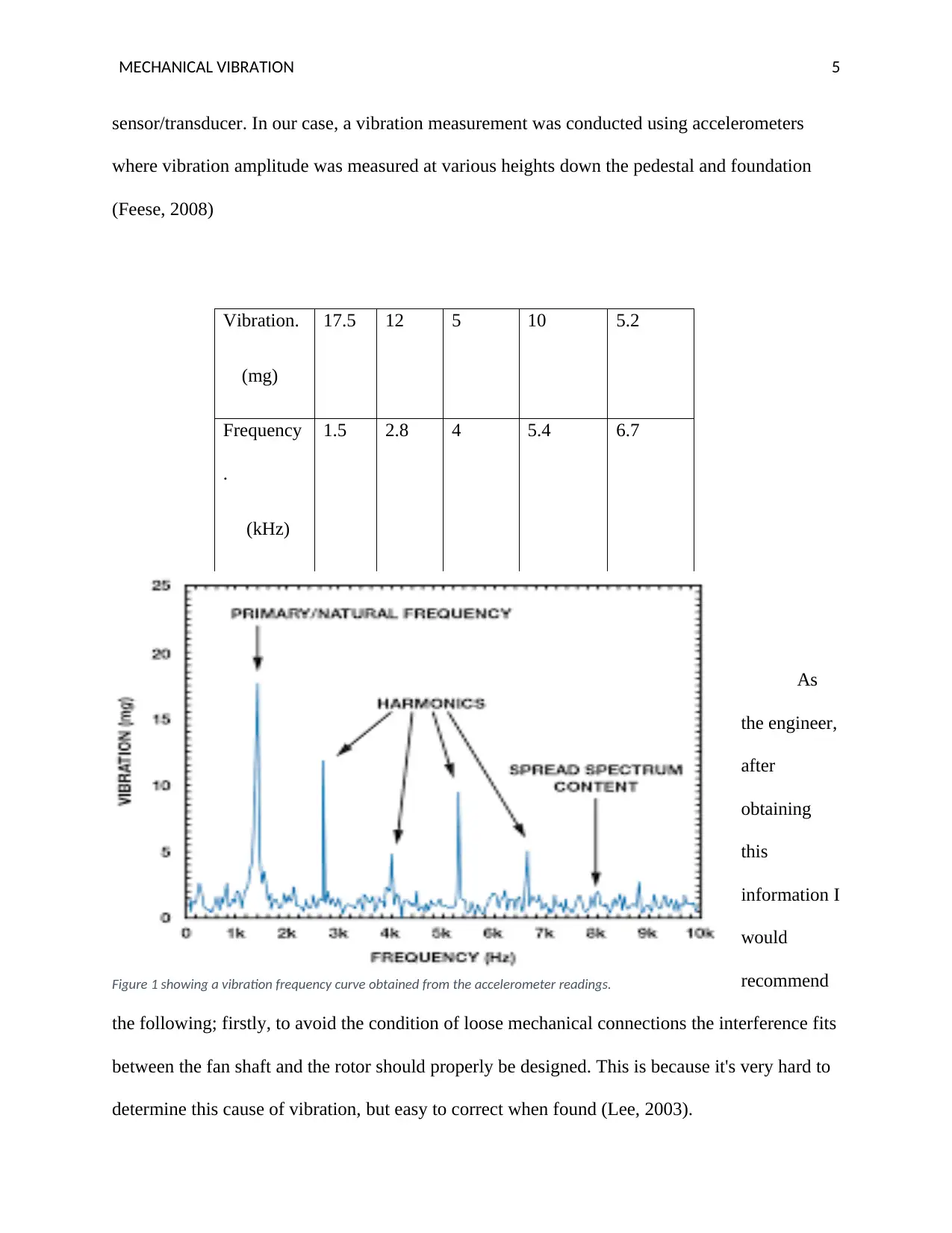
sensor/transducer. In our case, a vibration measurement was conducted using accelerometers
where vibration amplitude was measured at various heights down the pedestal and foundation
(Feese, 2008)
Vibration.
(mg)
17.5 12 5 10 5.2
Frequency
.
(kHz)
1.5 2.8 4 5.4 6.7
As
the engineer,
after
obtaining
this
information I
would
recommend
the following; firstly, to avoid the condition of loose mechanical connections the interference fits
between the fan shaft and the rotor should properly be designed. This is because it's very hard to
determine this cause of vibration, but easy to correct when found (Lee, 2003).
Figure 1 showing a vibration frequency curve obtained from the accelerometer readings.
sensor/transducer. In our case, a vibration measurement was conducted using accelerometers
where vibration amplitude was measured at various heights down the pedestal and foundation
(Feese, 2008)
Vibration.
(mg)
17.5 12 5 10 5.2
Frequency
.
(kHz)
1.5 2.8 4 5.4 6.7
As
the engineer,
after
obtaining
this
information I
would
recommend
the following; firstly, to avoid the condition of loose mechanical connections the interference fits
between the fan shaft and the rotor should properly be designed. This is because it's very hard to
determine this cause of vibration, but easy to correct when found (Lee, 2003).
Figure 1 showing a vibration frequency curve obtained from the accelerometer readings.
MECHANICAL VIBRATION 6
To curb shaft misalignment in future several factors are to be considered. Firstly, when
installing a new fan or replacing an existing shaft/rotor assembly, I will ensure that there is an
appropriate alignment of the drive shaft motor and fan shaft. Secondly, I will install axial
vibration probes to detect all types of vibration components. Similarly, using a laser or dial
alignment system good alignment between the fan shaft and the rotor shaft can be verified
properly when installing a new fan or replacing the fan/shaft assembly (Smith, 2008).
Moreover, to curb resonance related issues, it’s important to understand the types of
resonance. There exist only two types of resonance that are, critical speed and structural
resonance. During new fan design, critical speed mapping is addressed by designing the fan to
operate below the critical speed. On the other hand, every existing structure must have a natural
frequency with which it resonates. Usually, the structural resonance varies with operating speed,
but can easily be detected by performing a vibration measurement (Osborne, 2006).
Additionally, the problem of unbalanced rotor mass is the major cause of excessive
vibration and could be one of the causes of the vibration problems associated with this
centrifugal fan, therefore it has to be properly dealt with by lagging the rotor so as to prevent
heat from the hot air from causing it to expand and creating imbalance. Also, I will ensure that
my client does not buy fan components from different manufacturers as this would cause uneven
distribution of mass in the fan rotor and other components (Finley, 2009).
References.
To curb shaft misalignment in future several factors are to be considered. Firstly, when
installing a new fan or replacing an existing shaft/rotor assembly, I will ensure that there is an
appropriate alignment of the drive shaft motor and fan shaft. Secondly, I will install axial
vibration probes to detect all types of vibration components. Similarly, using a laser or dial
alignment system good alignment between the fan shaft and the rotor shaft can be verified
properly when installing a new fan or replacing the fan/shaft assembly (Smith, 2008).
Moreover, to curb resonance related issues, it’s important to understand the types of
resonance. There exist only two types of resonance that are, critical speed and structural
resonance. During new fan design, critical speed mapping is addressed by designing the fan to
operate below the critical speed. On the other hand, every existing structure must have a natural
frequency with which it resonates. Usually, the structural resonance varies with operating speed,
but can easily be detected by performing a vibration measurement (Osborne, 2006).
Additionally, the problem of unbalanced rotor mass is the major cause of excessive
vibration and could be one of the causes of the vibration problems associated with this
centrifugal fan, therefore it has to be properly dealt with by lagging the rotor so as to prevent
heat from the hot air from causing it to expand and creating imbalance. Also, I will ensure that
my client does not buy fan components from different manufacturers as this would cause uneven
distribution of mass in the fan rotor and other components (Finley, 2009).
References.
⊘ This is a preview!⊘
Do you want full access?
Subscribe today to unlock all pages.
Trusted by 1+ million students worldwide
MECHANICAL VIBRATION 7
Bachmann, H., Ammann, W. J., Deischl, F., Eisenmann, J., Floegl, I., Hirsch, G. H., &
Nussbaumer, H. (2012). Vibration problems in structures: practical guidelines. Birkhäuser.
CzmoChowski, J., Moczko, P., Odyjas, P., & Pietrusiak, D. (2014). Tests of rotary machines
vibrations in steady and unsteady states on the basis of large diameter centrifugal fans.
Eksploatacja Niezawodność, 16(2).
Eisinger, F. L. (2002). Acoustic fatigue of impellers of rotating machinery. TRANSACTIONS-
AMERICAN SOCIETY OF MECHANICAL ENGINEERS JOURNAL OF PRESSURE VESSEL
TECHNOLOGY, 124(2), 154-160.
Feese, T., & Maxfield, R. (2008). Torsional vibration problem with motor/ID fan system due to
PWM variable frequency drive. In Proceedings of the 37th Turbo machinery Symposium. Texas
A&M University. Turbo machinery Laboratories.
Finley, W. R., Hodowanec, M. M., & Holter, W. G. (1999). An analytical approach to solving
motor vibration problems. In Petroleum and Chemical Industry Conference, 1999. Industry
Applications Society 46th Annual (pp. 217-232). IEEE.
Guo, S., & Maruta, Y. (2005). Experimental investigations on pressure fluctuations and vibration
of the impeller in a centrifugal pump with vanned diffusers. JSME International Journal Series
B Fluids and Thermal Engineering, 48(1), 136-143.
Jeon, W. H., & Lee, D. J. (1999). An analysis of the flow and aerodynamic acoustic sources of a
centrifugal impeller. Journal of Sound and Vibration, 222(3), 505-511.
Jeon, W. H., & Lee, D. J. (2003). A numerical study on the flow and sound fields of centrifugal
impeller located near a wedge. Journal of sound and vibration, 266(4), 785-804.
Neise, W. (2008). Review of noise reduction methods for centrifugal fans. Journal of
Engineering for Industry, 104(2), 151-161.
Bachmann, H., Ammann, W. J., Deischl, F., Eisenmann, J., Floegl, I., Hirsch, G. H., &
Nussbaumer, H. (2012). Vibration problems in structures: practical guidelines. Birkhäuser.
CzmoChowski, J., Moczko, P., Odyjas, P., & Pietrusiak, D. (2014). Tests of rotary machines
vibrations in steady and unsteady states on the basis of large diameter centrifugal fans.
Eksploatacja Niezawodność, 16(2).
Eisinger, F. L. (2002). Acoustic fatigue of impellers of rotating machinery. TRANSACTIONS-
AMERICAN SOCIETY OF MECHANICAL ENGINEERS JOURNAL OF PRESSURE VESSEL
TECHNOLOGY, 124(2), 154-160.
Feese, T., & Maxfield, R. (2008). Torsional vibration problem with motor/ID fan system due to
PWM variable frequency drive. In Proceedings of the 37th Turbo machinery Symposium. Texas
A&M University. Turbo machinery Laboratories.
Finley, W. R., Hodowanec, M. M., & Holter, W. G. (1999). An analytical approach to solving
motor vibration problems. In Petroleum and Chemical Industry Conference, 1999. Industry
Applications Society 46th Annual (pp. 217-232). IEEE.
Guo, S., & Maruta, Y. (2005). Experimental investigations on pressure fluctuations and vibration
of the impeller in a centrifugal pump with vanned diffusers. JSME International Journal Series
B Fluids and Thermal Engineering, 48(1), 136-143.
Jeon, W. H., & Lee, D. J. (1999). An analysis of the flow and aerodynamic acoustic sources of a
centrifugal impeller. Journal of Sound and Vibration, 222(3), 505-511.
Jeon, W. H., & Lee, D. J. (2003). A numerical study on the flow and sound fields of centrifugal
impeller located near a wedge. Journal of sound and vibration, 266(4), 785-804.
Neise, W. (2008). Review of noise reduction methods for centrifugal fans. Journal of
Engineering for Industry, 104(2), 151-161.
Paraphrase This Document
Need a fresh take? Get an instant paraphrase of this document with our AI Paraphraser
MECHANICAL VIBRATION 8
Osborne, W. C. (1966). Fans (Vol. 1). Oxford: Pergamon Press.
Smith, D. R., & Simmons, H. R. (1980, December). Unique fan vibration problems: their causes
and solutions. In Proceedings of the 9th Turbo machinery Symposium Gas Turbine Laboratories.
Wu, J. D., & Bali, M. R. (2001). Application of feed forward adaptive active-noise control for
reducing blade passing noise in centrifugal fans. Journal of sound and vibration, 239(5), 1051-
1062.
Osborne, W. C. (1966). Fans (Vol. 1). Oxford: Pergamon Press.
Smith, D. R., & Simmons, H. R. (1980, December). Unique fan vibration problems: their causes
and solutions. In Proceedings of the 9th Turbo machinery Symposium Gas Turbine Laboratories.
Wu, J. D., & Bali, M. R. (2001). Application of feed forward adaptive active-noise control for
reducing blade passing noise in centrifugal fans. Journal of sound and vibration, 239(5), 1051-
1062.

1 out of 8


Your All-in-One AI-Powered Toolkit for Academic Success.
+13062052269
info@desklib.com
Available 24*7 on WhatsApp / Email
![[object Object]](/_next/static/media/star-bottom.7253800d.svg)
Unlock your academic potential
Copyright © 2020–2026 A2Z Services. All Rights Reserved. Developed and managed by ZUCOL.