Equity Law: Evolution Around the Defendant's Conscience Moral Center

Verified

Added on  2023/03/31

|5
|1253
|483
Essay
AI Summary
This essay examines the significance of the defendant's conscience within the framework of equity law in England and Wales. It delves into the concept of conscience, highlighting its objective constitution and its role in guiding the application of laws in various situations. The essay explores how modern courts apply conscience through doctrines like unconscionability, constructive trusts, and proprietary estoppel, emphasizing the importance of considering the defendant's awareness, intentions, and suspicions. It analyzes how the conscience of the defendant affects the imposition of constructive trusts and the establishment of proprietary estoppel, referencing key cases such as Cobbe v Yeoman’s Row Management Ltd and Westdeutsche Landesbank Girozentrale v Islington LBC, ultimately concluding that the principle of conscience is vital in the progression of equity laws. Desklib offers a wide range of resources, including past papers and solved assignments, to support students in their academic endeavors.
Document Page
EQUITY 1
The conscience of the defendant is the moral center around which all equitable doctrines evolve
Student’s Name
Institution
Course
Tutor
Date
tabler-icon-diamond-filled.svg

Paraphrase This Document

Need a fresh take? Get an instant paraphrase of this document with our AI Paraphraser
Document Page
EQUITY 2
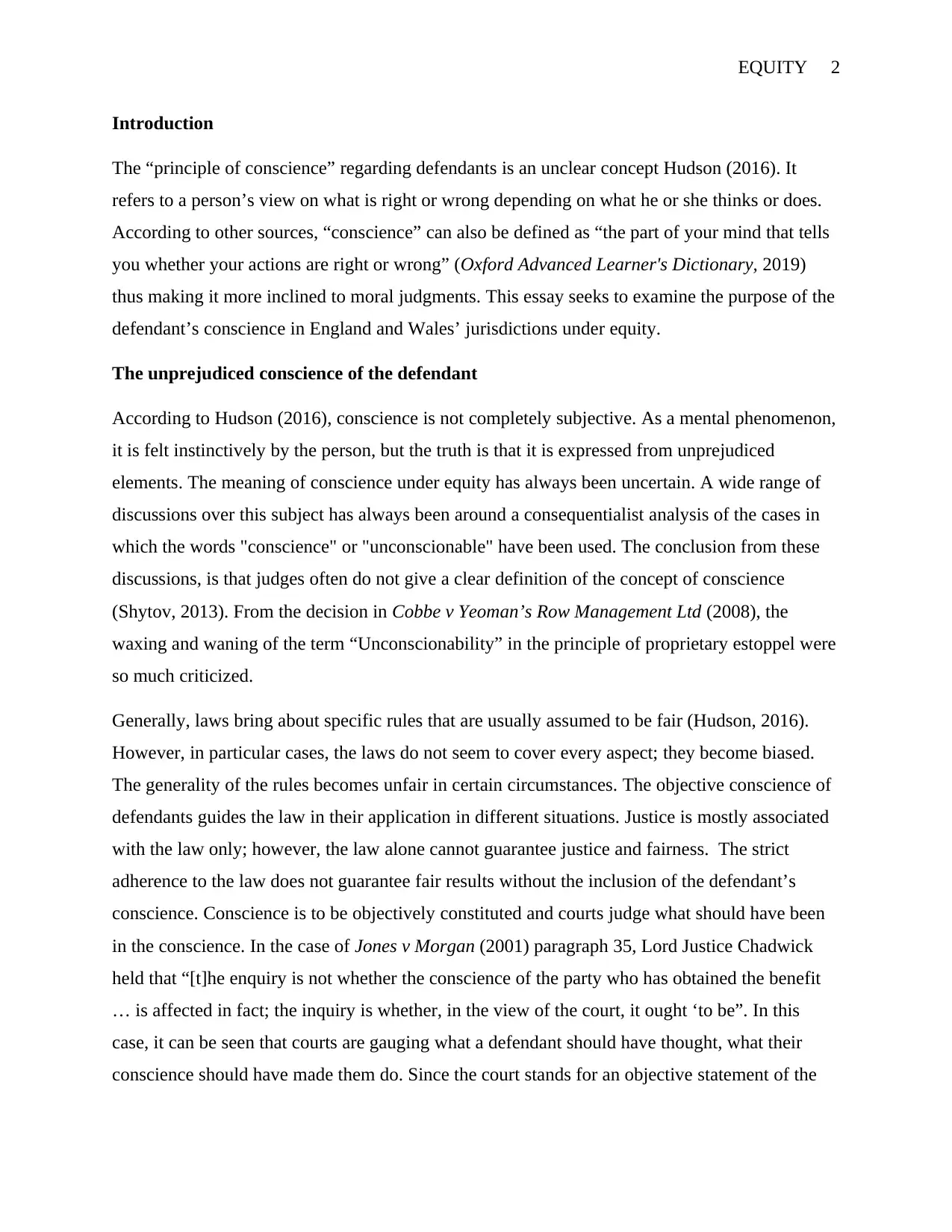
Introduction
The “principle of conscience” regarding defendants is an unclear concept Hudson (2016). It
refers to a person’s view on what is right or wrong depending on what he or she thinks or does.
According to other sources, “conscience” can also be defined as “the part of your mind that tells
you whether your actions are right or wrong” (Oxford Advanced Learner's Dictionary, 2019)
thus making it more inclined to moral judgments. This essay seeks to examine the purpose of the
defendant’s conscience in England and Wales’ jurisdictions under equity.
The unprejudiced conscience of the defendant
According to Hudson (2016), conscience is not completely subjective. As a mental phenomenon,
it is felt instinctively by the person, but the truth is that it is expressed from unprejudiced
elements. The meaning of conscience under equity has always been uncertain. A wide range of
discussions over this subject has always been around a consequentialist analysis of the cases in
which the words "conscience" or "unconscionable" have been used. The conclusion from these
discussions, is that judges often do not give a clear definition of the concept of conscience
(Shytov, 2013). From the decision in Cobbe v Yeoman’s Row Management Ltd (2008), the
waxing and waning of the term “Unconscionability” in the principle of proprietary estoppel were
so much criticized.
Generally, laws bring about specific rules that are usually assumed to be fair (Hudson, 2016).
However, in particular cases, the laws do not seem to cover every aspect; they become biased.
The generality of the rules becomes unfair in certain circumstances. The objective conscience of
defendants guides the law in their application in different situations. Justice is mostly associated
with the law only; however, the law alone cannot guarantee justice and fairness. The strict
adherence to the law does not guarantee fair results without the inclusion of the defendant’s
conscience. Conscience is to be objectively constituted and courts judge what should have been
in the conscience. In the case of Jones v Morgan (2001) paragraph 35, Lord Justice Chadwick
held that “[t]he enquiry is not whether the conscience of the party who has obtained the benefit
… is affected in fact; the inquiry is whether, in the view of the court, it ought ‘to be”. In this
case, it can be seen that courts are gauging what a defendant should have thought, what their
conscience should have made them do. Since the court stands for an objective statement of the
Document Page
EQUITY 3
values which ought to have been put to the conscience of the person, it is able to do that
successfully.
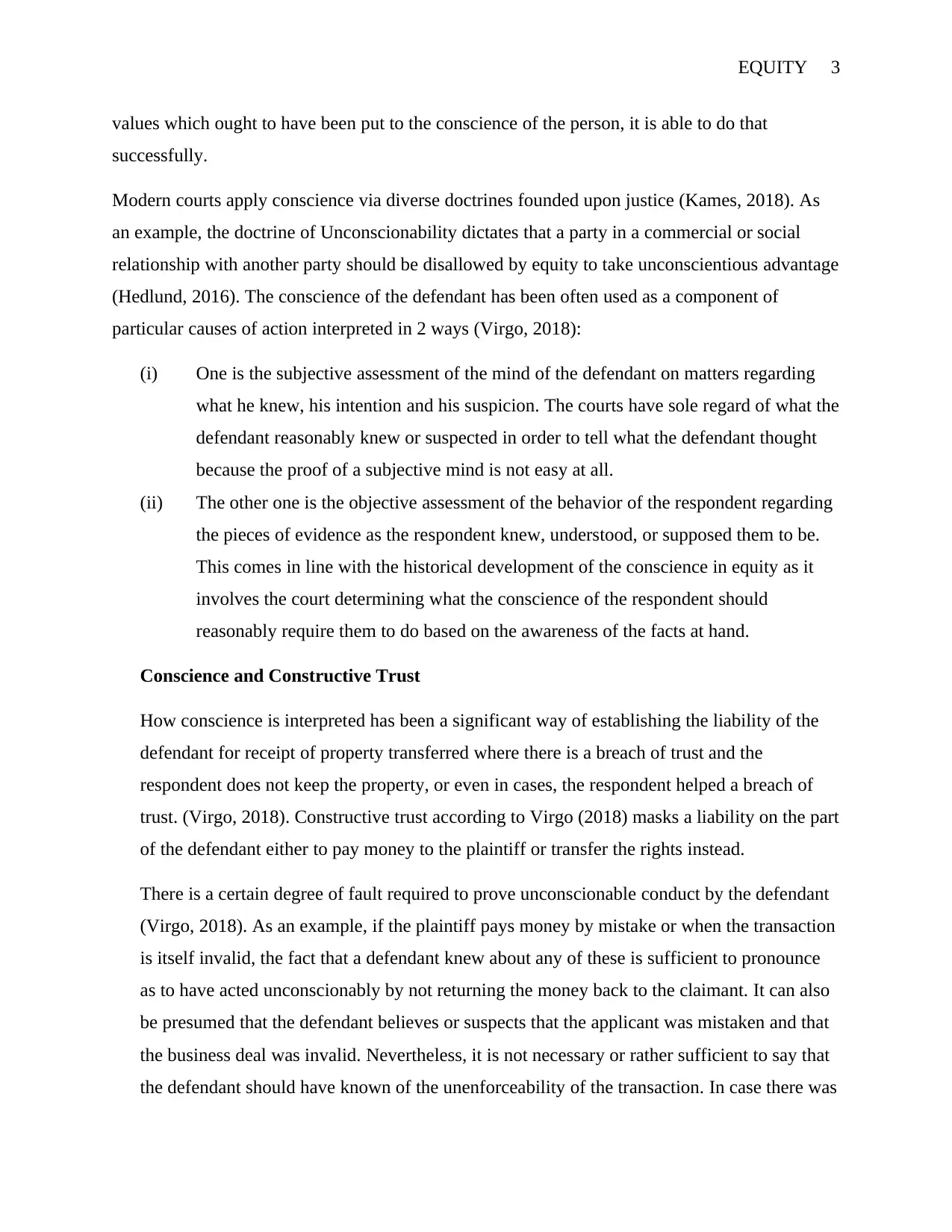
Modern courts apply conscience via diverse doctrines founded upon justice (Kames, 2018). As
an example, the doctrine of Unconscionability dictates that a party in a commercial or social
relationship with another party should be disallowed by equity to take unconscientious advantage
(Hedlund, 2016). The conscience of the defendant has been often used as a component of
particular causes of action interpreted in 2 ways (Virgo, 2018):
(i) One is the subjective assessment of the mind of the defendant on matters regarding
what he knew, his intention and his suspicion. The courts have sole regard of what the
defendant reasonably knew or suspected in order to tell what the defendant thought
because the proof of a subjective mind is not easy at all.
(ii) The other one is the objective assessment of the behavior of the respondent regarding
the pieces of evidence as the respondent knew, understood, or supposed them to be.
This comes in line with the historical development of the conscience in equity as it
involves the court determining what the conscience of the respondent should
reasonably require them to do based on the awareness of the facts at hand.
Conscience and Constructive Trust
How conscience is interpreted has been a significant way of establishing the liability of the
defendant for receipt of property transferred where there is a breach of trust and the
respondent does not keep the property, or even in cases, the respondent helped a breach of
trust. (Virgo, 2018). Constructive trust according to Virgo (2018) masks a liability on the part
of the defendant either to pay money to the plaintiff or transfer the rights instead.
There is a certain degree of fault required to prove unconscionable conduct by the defendant
(Virgo, 2018). As an example, if the plaintiff pays money by mistake or when the transaction
is itself invalid, the fact that a defendant knew about any of these is sufficient to pronounce
as to have acted unconscionably by not returning the money back to the claimant. It can also
be presumed that the defendant believes or suspects that the applicant was mistaken and that
the business deal was invalid. Nevertheless, it is not necessary or rather sufficient to say that
the defendant should have known of the unenforceability of the transaction. In case there was
Document Page
EQUITY 4
a need to set up a test of what the defendant should have known, there would be a widening
of the circumstances to recognize constructive trust.
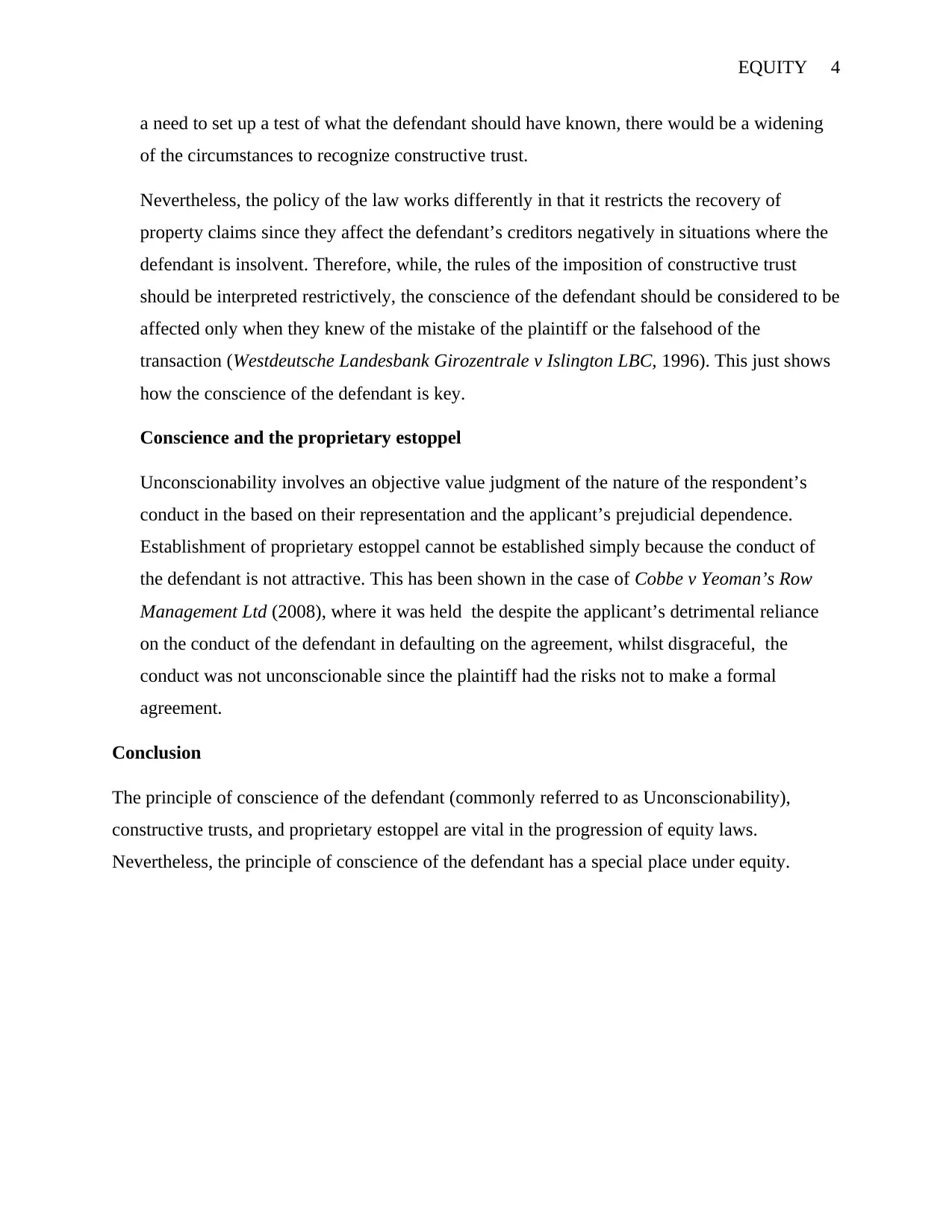
Nevertheless, the policy of the law works differently in that it restricts the recovery of
property claims since they affect the defendant’s creditors negatively in situations where the
defendant is insolvent. Therefore, while, the rules of the imposition of constructive trust
should be interpreted restrictively, the conscience of the defendant should be considered to be
affected only when they knew of the mistake of the plaintiff or the falsehood of the
transaction (Westdeutsche Landesbank Girozentrale v Islington LBC, 1996). This just shows
how the conscience of the defendant is key.
Conscience and the proprietary estoppel
Unconscionability involves an objective value judgment of the nature of the respondent’s
conduct in the based on their representation and the applicant’s prejudicial dependence.
Establishment of proprietary estoppel cannot be established simply because the conduct of
the defendant is not attractive. This has been shown in the case of Cobbe v Yeoman’s Row
Management Ltd (2008), where it was held the despite the applicant’s detrimental reliance
on the conduct of the defendant in defaulting on the agreement, whilst disgraceful, the
conduct was not unconscionable since the plaintiff had the risks not to make a formal
agreement.
Conclusion
The principle of conscience of the defendant (commonly referred to as Unconscionability),
constructive trusts, and proprietary estoppel are vital in the progression of equity laws.
Nevertheless, the principle of conscience of the defendant has a special place under equity.
tabler-icon-diamond-filled.svg

Paraphrase This Document

Need a fresh take? Get an instant paraphrase of this document with our AI Paraphraser
Document Page
EQUITY 5
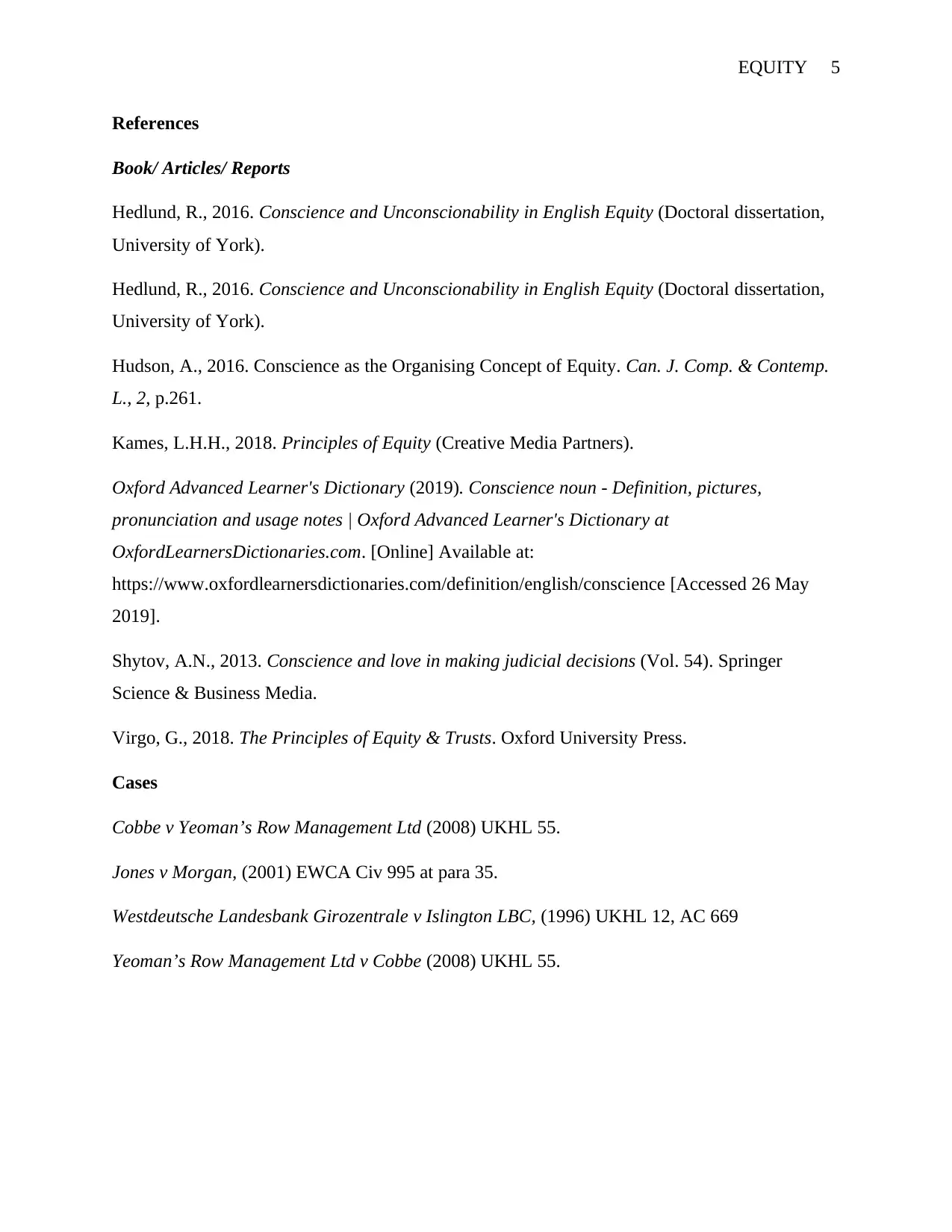
References
Book/ Articles/ Reports
Hedlund, R., 2016. Conscience and Unconscionability in English Equity (Doctoral dissertation,
University of York).
Hedlund, R., 2016. Conscience and Unconscionability in English Equity (Doctoral dissertation,
University of York).
Hudson, A., 2016. Conscience as the Organising Concept of Equity. Can. J. Comp. & Contemp.
L., 2, p.261.
Kames, L.H.H., 2018. Principles of Equity (Creative Media Partners).
Oxford Advanced Learner's Dictionary (2019). Conscience noun - Definition, pictures,
pronunciation and usage notes | Oxford Advanced Learner's Dictionary at
OxfordLearnersDictionaries.com. [Online] Available at:
https://www.oxfordlearnersdictionaries.com/definition/english/conscience [Accessed 26 May
2019].
Shytov, A.N., 2013. Conscience and love in making judicial decisions (Vol. 54). Springer
Science & Business Media.
Virgo, G., 2018. The Principles of Equity & Trusts. Oxford University Press.
Cases
Cobbe v Yeoman’s Row Management Ltd (2008) UKHL 55.
Jones v Morgan, (2001) EWCA Civ 995 at para 35.
Westdeutsche Landesbank Girozentrale v Islington LBC, (1996) UKHL 12, AC 669
Yeoman’s Row Management Ltd v Cobbe (2008) UKHL 55.
chevron_up_icon
1 out of 5
circle_padding
hide_on_mobile
zoom_out_icon
[object Object]