Equity and Trust: Analysis of Trust Capacities and Legal Frameworks

Verified

Added on  2020/10/04

|4
|442
|265
Report
AI Summary
This report examines the capacities of a trust, focusing on its legal implications and the roles of trustees and beneficiaries. The document discusses the legal nature of a trust, including the ownership of assets and the ability to enter into contracts and agreements. Furthermore, the report highlights the ability of a trust to be a party in legal proceedings and the responsibilities of the trustee. The report references various sources, including books and journals, to support its analysis of how trusts function within legal and financial contexts. This assignment provides an overview of the key elements of trust law and the practical considerations of establishing and managing a trust.

Document Page
Equity and trust
tabler-icon-diamond-filled.svg

Paraphrase This Document

Need a fresh take? Get an instant paraphrase of this document with our AI Paraphraser
Document Page
Table of Contents
(a) What are the capacities of trust..................................................................................................3
REFERENCES................................................................................................................................4
Document Page
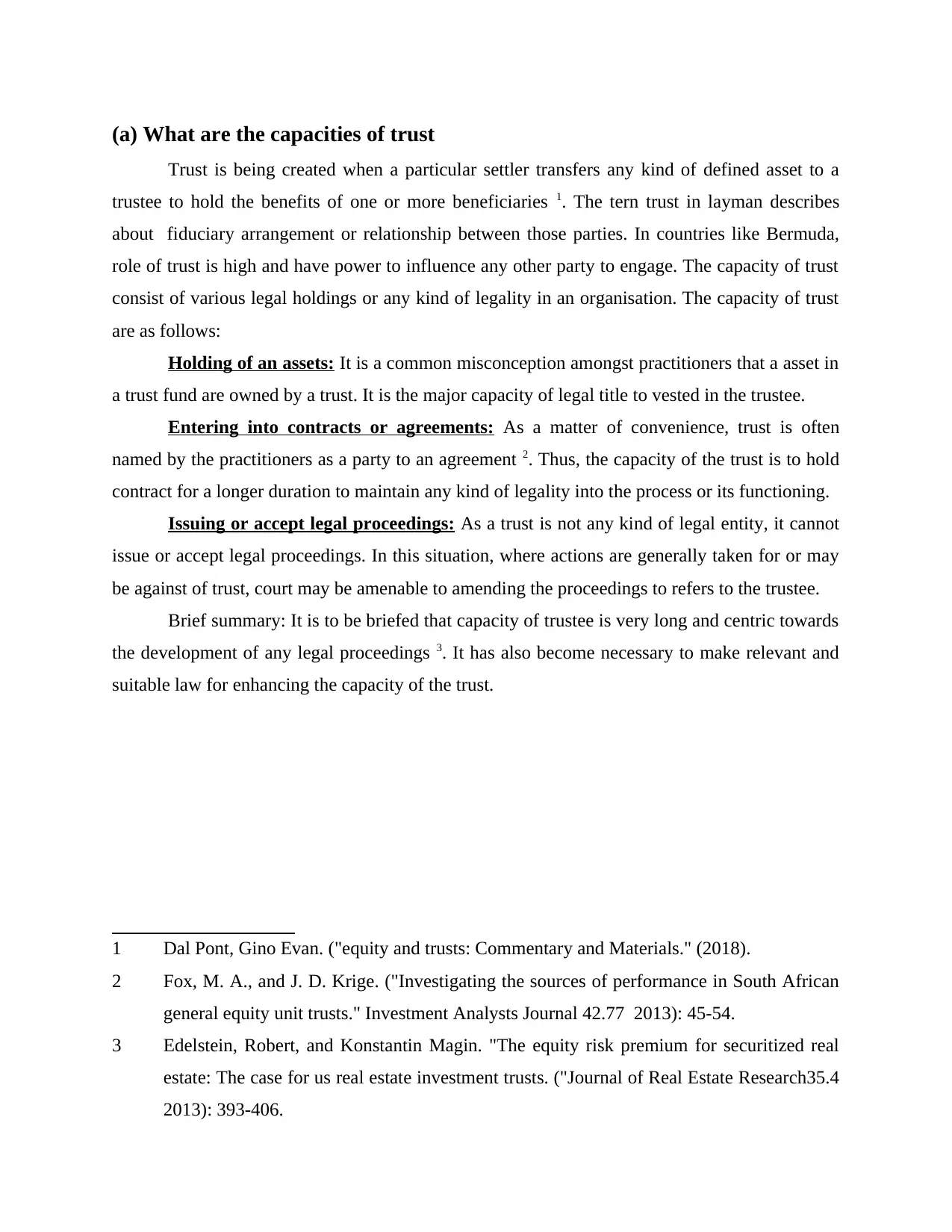
(a) What are the capacities of trust
Trust is being created when a particular settler transfers any kind of defined asset to a
trustee to hold the benefits of one or more beneficiaries 1. The tern trust in layman describes
about fiduciary arrangement or relationship between those parties. In countries like Bermuda,
role of trust is high and have power to influence any other party to engage. The capacity of trust
consist of various legal holdings or any kind of legality in an organisation. The capacity of trust
are as follows:
Holding of an assets: It is a common misconception amongst practitioners that a asset in
a trust fund are owned by a trust. It is the major capacity of legal title to vested in the trustee.
Entering into contracts or agreements: As a matter of convenience, trust is often
named by the practitioners as a party to an agreement 2. Thus, the capacity of the trust is to hold
contract for a longer duration to maintain any kind of legality into the process or its functioning.
Issuing or accept legal proceedings: As a trust is not any kind of legal entity, it cannot
issue or accept legal proceedings. In this situation, where actions are generally taken for or may
be against of trust, court may be amenable to amending the proceedings to refers to the trustee.
Brief summary: It is to be briefed that capacity of trustee is very long and centric towards
the development of any legal proceedings 3. It has also become necessary to make relevant and
suitable law for enhancing the capacity of the trust.
1 Dal Pont, Gino Evan. ("equity and trusts: Commentary and Materials." (2018).
2 Fox, M. A., and J. D. Krige. ("Investigating the sources of performance in South African
general equity unit trusts." Investment Analysts Journal 42.77 2013): 45-54.
3 Edelstein, Robert, and Konstantin Magin. "The equity risk premium for securitized real
estate: The case for us real estate investment trusts. ("Journal of Real Estate Research35.4
2013): 393-406.
Document Page
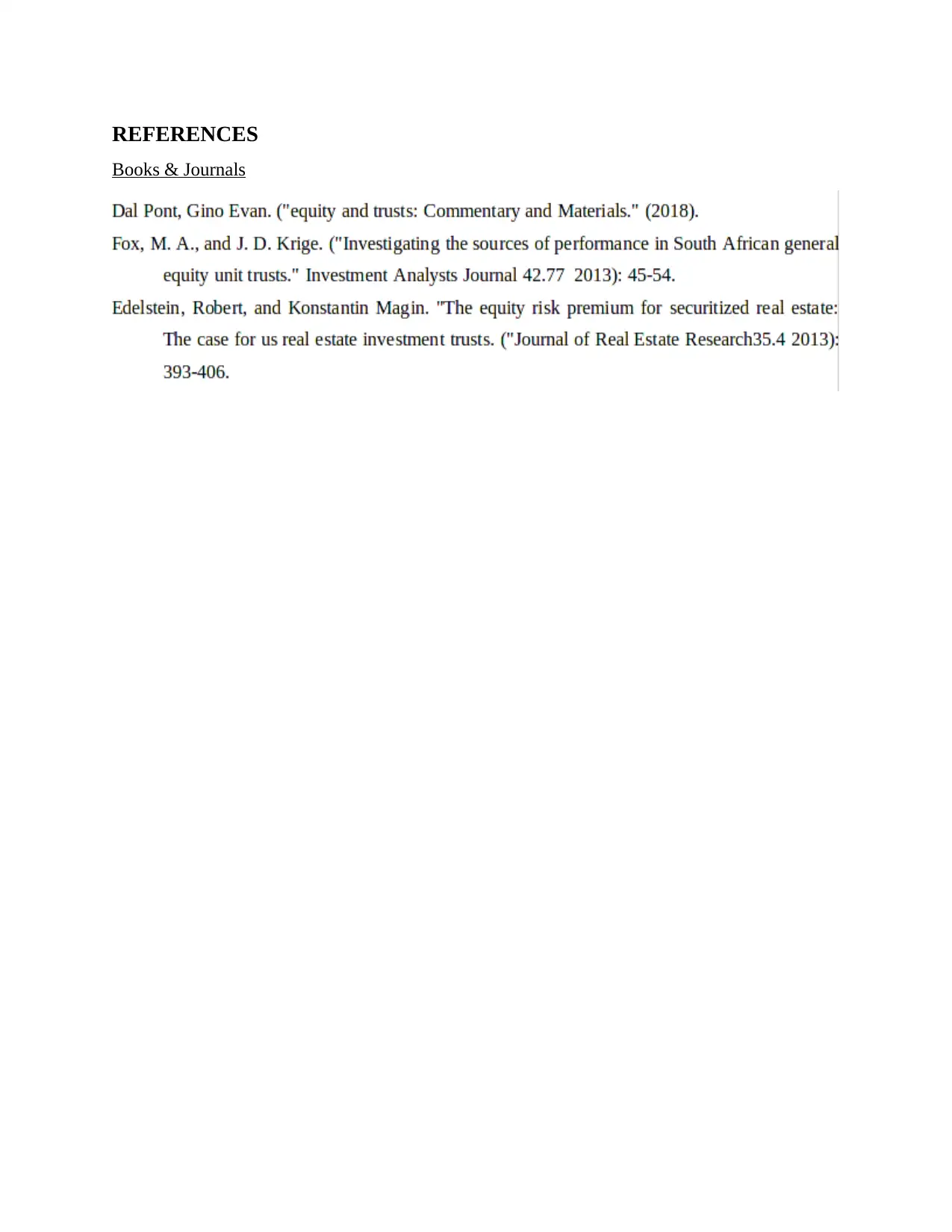
REFERENCES
Books & Journals
chevron_up_icon
1 out of 4
circle_padding
hide_on_mobile
zoom_out_icon
[object Object]