University of Law - GDL Equity and Trusts June 2022 Exam Answers
VerifiedAdded on 2023/06/10
|21
|9771
|126
Homework Assignment
AI Summary
This document presents a comprehensive solution to an Equity and Trusts exam, likely from the University of Law's GDL program in June 2022. The assignment addresses two main scenarios. The first scenario focuses on a director, Talish, seeking advice regarding the actions of another director, Unita, who has been made bankrupt and has made unauthorized withdrawals from the company. The solution analyzes potential remedies available to the company, TrayStack Ltd, against Unita and a third party, Vijay, who received some of the misappropriated funds. The second scenario involves Issam, who seeks advice on the validity of provisions in his will. The analysis covers the validity of specific bequests, including those related to a hockey club and its mascot, and provides guidance on how to best achieve Issam's wishes. It further explores the implications of a completed share transfer and whether Issam can still include the shares in his will. The solution provides legal analysis of the scenarios, offering advice on breach of trust, remedies and the validity of testamentary dispositions.
Candidate Number: Click here to enter text.
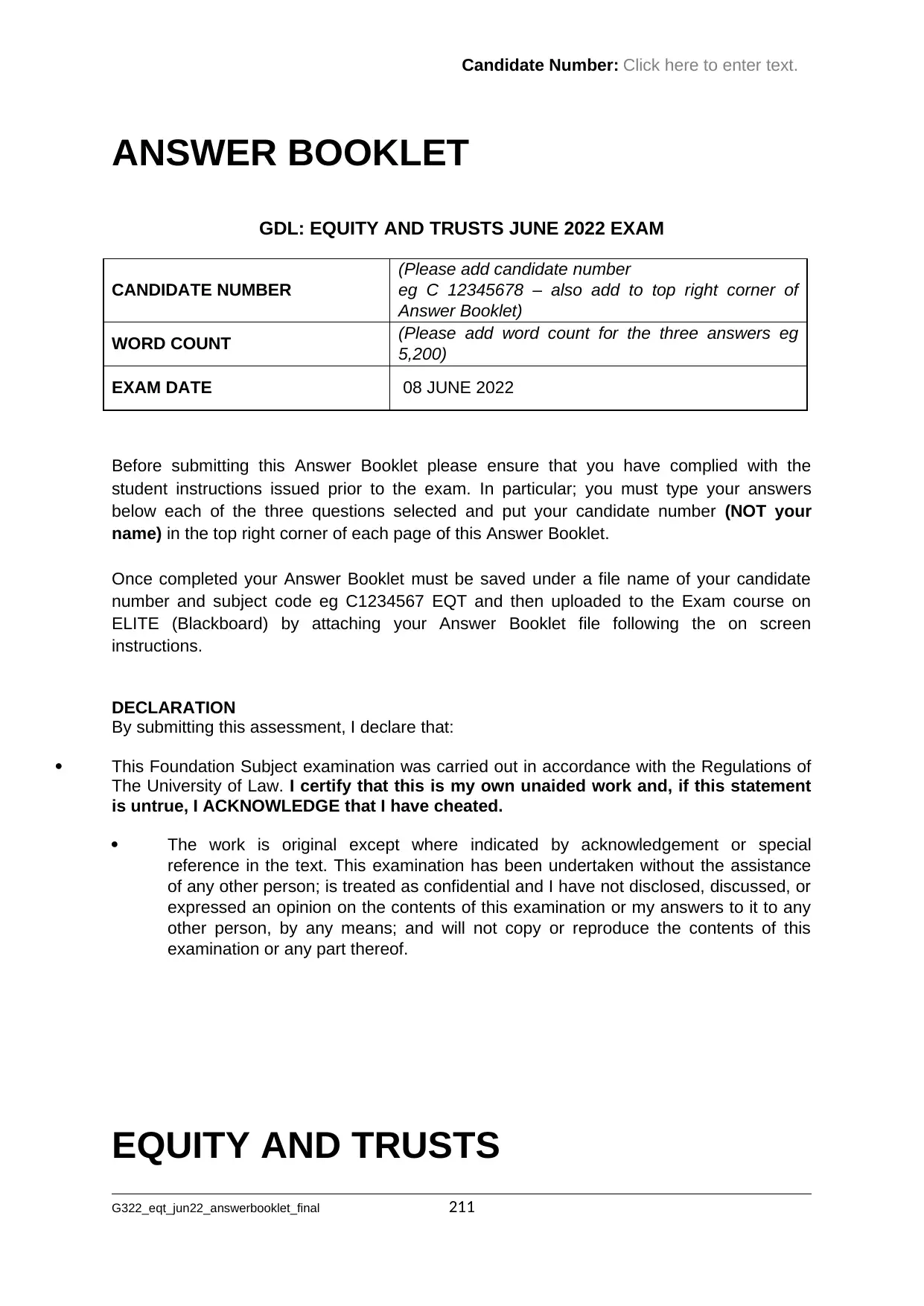
ANSWER BOOKLET
GDL: EQUITY AND TRUSTS JUNE 2022 EXAM
CANDIDATE NUMBER
(Please add candidate number
eg C 12345678 – also add to top right corner of
Answer Booklet)
WORD COUNT (Please add word count for the three answers eg
5,200)
EXAM DATE 08 JUNE 2022
Before submitting this Answer Booklet please ensure that you have complied with the
student instructions issued prior to the exam. In particular; you must type your answers
below each of the three questions selected and put your candidate number (NOT your
name) in the top right corner of each page of this Answer Booklet.
Once completed your Answer Booklet must be saved under a file name of your candidate
number and subject code eg C1234567 EQT and then uploaded to the Exam course on
ELITE (Blackboard) by attaching your Answer Booklet file following the on screen
instructions.
DECLARATION
By submitting this assessment, I declare that:
This Foundation Subject examination was carried out in accordance with the Regulations of
The University of Law. I certify that this is my own unaided work and, if this statement
is untrue, I ACKNOWLEDGE that I have cheated.
The work is original except where indicated by acknowledgement or special
reference in the text. This examination has been undertaken without the assistance
of any other person; is treated as confidential and I have not disclosed, discussed, or
expressed an opinion on the contents of this examination or my answers to it to any
other person, by any means; and will not copy or reproduce the contents of this
examination or any part thereof.
EQUITY AND TRUSTS
G322_eqt_jun22_answerbooklet_final 211
ANSWER BOOKLET
GDL: EQUITY AND TRUSTS JUNE 2022 EXAM
CANDIDATE NUMBER
(Please add candidate number
eg C 12345678 – also add to top right corner of
Answer Booklet)
WORD COUNT (Please add word count for the three answers eg
5,200)
EXAM DATE 08 JUNE 2022
Before submitting this Answer Booklet please ensure that you have complied with the
student instructions issued prior to the exam. In particular; you must type your answers
below each of the three questions selected and put your candidate number (NOT your
name) in the top right corner of each page of this Answer Booklet.
Once completed your Answer Booklet must be saved under a file name of your candidate
number and subject code eg C1234567 EQT and then uploaded to the Exam course on
ELITE (Blackboard) by attaching your Answer Booklet file following the on screen
instructions.
DECLARATION
By submitting this assessment, I declare that:
This Foundation Subject examination was carried out in accordance with the Regulations of
The University of Law. I certify that this is my own unaided work and, if this statement
is untrue, I ACKNOWLEDGE that I have cheated.
The work is original except where indicated by acknowledgement or special
reference in the text. This examination has been undertaken without the assistance
of any other person; is treated as confidential and I have not disclosed, discussed, or
expressed an opinion on the contents of this examination or my answers to it to any
other person, by any means; and will not copy or reproduce the contents of this
examination or any part thereof.
EQUITY AND TRUSTS
G322_eqt_jun22_answerbooklet_final 211

Paraphrase This Document
Need a fresh take? Get an instant paraphrase of this document with our AI Paraphraser
Candidate Number: Click here to enter text.
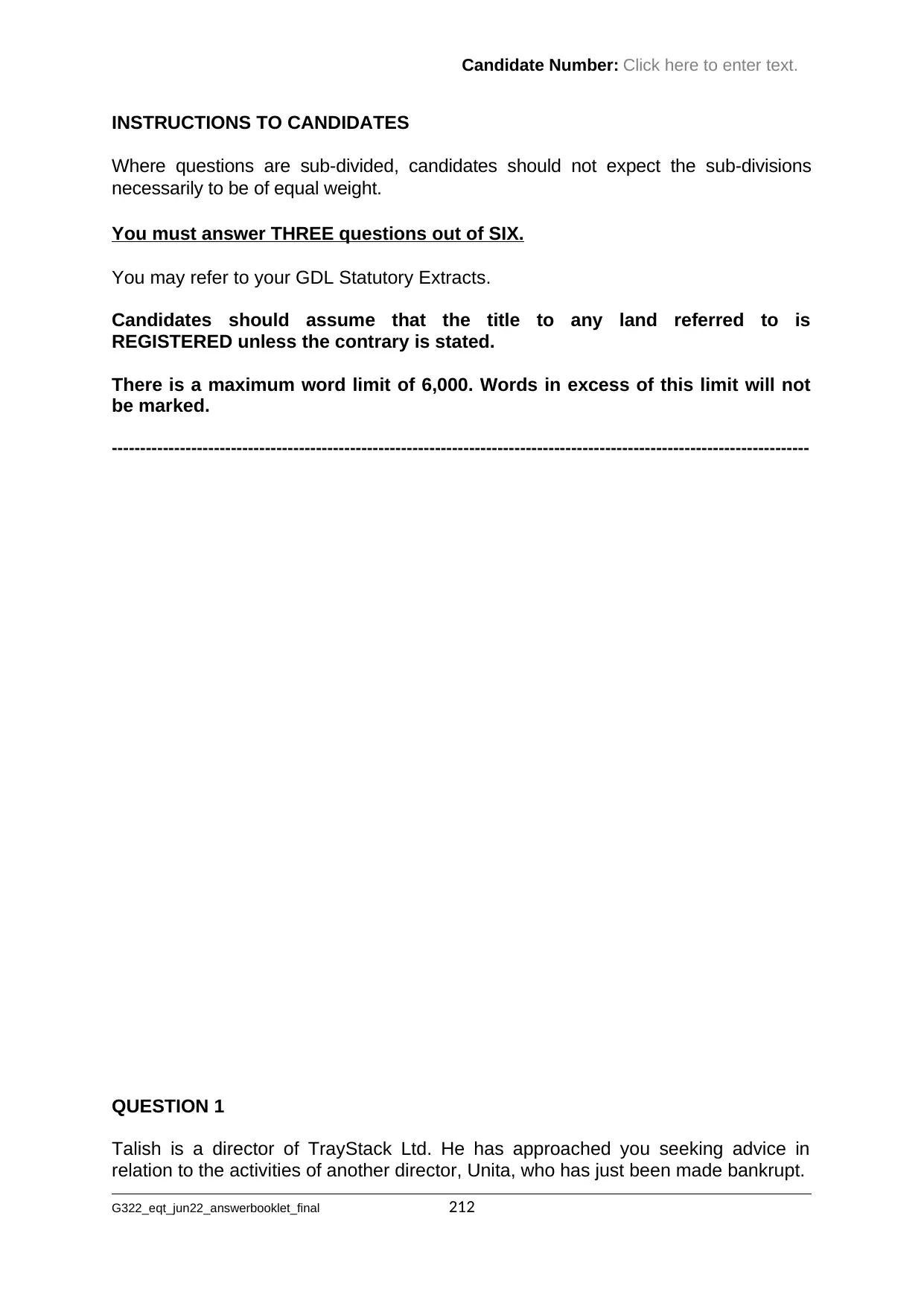
INSTRUCTIONS TO CANDIDATES
Where questions are sub-divided, candidates should not expect the sub-divisions
necessarily to be of equal weight.
You must answer THREE questions out of SIX.
You may refer to your GDL Statutory Extracts.
Candidates should assume that the title to any land referred to is
REGISTERED unless the contrary is stated.
There is a maximum word limit of 6,000. Words in excess of this limit will not
be marked.
---------------------------------------------------------------------------------------------------------------------------
QUESTION 1
Talish is a director of TrayStack Ltd. He has approached you seeking advice in
relation to the activities of another director, Unita, who has just been made bankrupt.
G322_eqt_jun22_answerbooklet_final 212
INSTRUCTIONS TO CANDIDATES
Where questions are sub-divided, candidates should not expect the sub-divisions
necessarily to be of equal weight.
You must answer THREE questions out of SIX.
You may refer to your GDL Statutory Extracts.
Candidates should assume that the title to any land referred to is
REGISTERED unless the contrary is stated.
There is a maximum word limit of 6,000. Words in excess of this limit will not
be marked.
---------------------------------------------------------------------------------------------------------------------------
QUESTION 1
Talish is a director of TrayStack Ltd. He has approached you seeking advice in
relation to the activities of another director, Unita, who has just been made bankrupt.
G322_eqt_jun22_answerbooklet_final 212
Candidate Number: Click here to enter text.
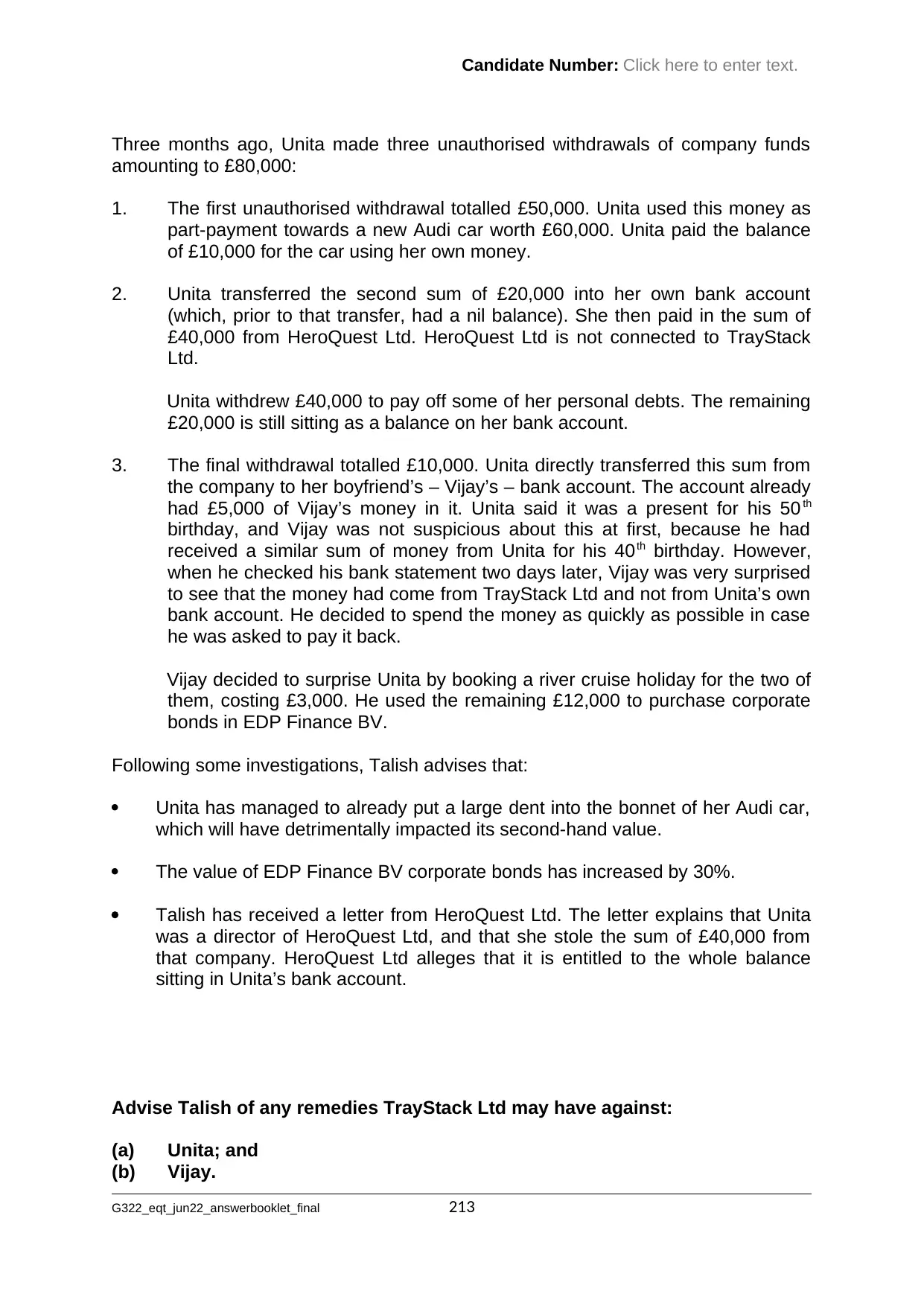
Three months ago, Unita made three unauthorised withdrawals of company funds
amounting to £80,000:
1. The first unauthorised withdrawal totalled £50,000. Unita used this money as
part-payment towards a new Audi car worth £60,000. Unita paid the balance
of £10,000 for the car using her own money.
2. Unita transferred the second sum of £20,000 into her own bank account
(which, prior to that transfer, had a nil balance). She then paid in the sum of
£40,000 from HeroQuest Ltd. HeroQuest Ltd is not connected to TrayStack
Ltd.
Unita withdrew £40,000 to pay off some of her personal debts. The remaining
£20,000 is still sitting as a balance on her bank account.
3. The final withdrawal totalled £10,000. Unita directly transferred this sum from
the company to her boyfriend’s – Vijay’s – bank account. The account already
had £5,000 of Vijay’s money in it. Unita said it was a present for his 50 th
birthday, and Vijay was not suspicious about this at first, because he had
received a similar sum of money from Unita for his 40th birthday. However,
when he checked his bank statement two days later, Vijay was very surprised
to see that the money had come from TrayStack Ltd and not from Unita’s own
bank account. He decided to spend the money as quickly as possible in case
he was asked to pay it back.
Vijay decided to surprise Unita by booking a river cruise holiday for the two of
them, costing £3,000. He used the remaining £12,000 to purchase corporate
bonds in EDP Finance BV.
Following some investigations, Talish advises that:
Unita has managed to already put a large dent into the bonnet of her Audi car,
which will have detrimentally impacted its second-hand value.
The value of EDP Finance BV corporate bonds has increased by 30%.
Talish has received a letter from HeroQuest Ltd. The letter explains that Unita
was a director of HeroQuest Ltd, and that she stole the sum of £40,000 from
that company. HeroQuest Ltd alleges that it is entitled to the whole balance
sitting in Unita’s bank account.
Advise Talish of any remedies TrayStack Ltd may have against:
(a) Unita; and
(b) Vijay.
G322_eqt_jun22_answerbooklet_final 213
Three months ago, Unita made three unauthorised withdrawals of company funds
amounting to £80,000:
1. The first unauthorised withdrawal totalled £50,000. Unita used this money as
part-payment towards a new Audi car worth £60,000. Unita paid the balance
of £10,000 for the car using her own money.
2. Unita transferred the second sum of £20,000 into her own bank account
(which, prior to that transfer, had a nil balance). She then paid in the sum of
£40,000 from HeroQuest Ltd. HeroQuest Ltd is not connected to TrayStack
Ltd.
Unita withdrew £40,000 to pay off some of her personal debts. The remaining
£20,000 is still sitting as a balance on her bank account.
3. The final withdrawal totalled £10,000. Unita directly transferred this sum from
the company to her boyfriend’s – Vijay’s – bank account. The account already
had £5,000 of Vijay’s money in it. Unita said it was a present for his 50 th
birthday, and Vijay was not suspicious about this at first, because he had
received a similar sum of money from Unita for his 40th birthday. However,
when he checked his bank statement two days later, Vijay was very surprised
to see that the money had come from TrayStack Ltd and not from Unita’s own
bank account. He decided to spend the money as quickly as possible in case
he was asked to pay it back.
Vijay decided to surprise Unita by booking a river cruise holiday for the two of
them, costing £3,000. He used the remaining £12,000 to purchase corporate
bonds in EDP Finance BV.
Following some investigations, Talish advises that:
Unita has managed to already put a large dent into the bonnet of her Audi car,
which will have detrimentally impacted its second-hand value.
The value of EDP Finance BV corporate bonds has increased by 30%.
Talish has received a letter from HeroQuest Ltd. The letter explains that Unita
was a director of HeroQuest Ltd, and that she stole the sum of £40,000 from
that company. HeroQuest Ltd alleges that it is entitled to the whole balance
sitting in Unita’s bank account.
Advise Talish of any remedies TrayStack Ltd may have against:
(a) Unita; and
(b) Vijay.
G322_eqt_jun22_answerbooklet_final 213
⊘ This is a preview!⊘
Do you want full access?
Subscribe today to unlock all pages.

Trusted by 1+ million students worldwide

Candidate Number: Click here to enter text.
>>>>>>>>>>>>>>>>>>>>>>>>>>>>>>>>>>>>>>>>>>>>>>>>>>>>>>>>>>>>>>>>
TYPE YOUR ANSWER HERE
G322_eqt_jun22_answerbooklet_final 214
>>>>>>>>>>>>>>>>>>>>>>>>>>>>>>>>>>>>>>>>>>>>>>>>>>>>>>>>>>>>>>>>
TYPE YOUR ANSWER HERE
G322_eqt_jun22_answerbooklet_final 214
Paraphrase This Document
Need a fresh take? Get an instant paraphrase of this document with our AI Paraphraser
Candidate Number: Click here to enter text.
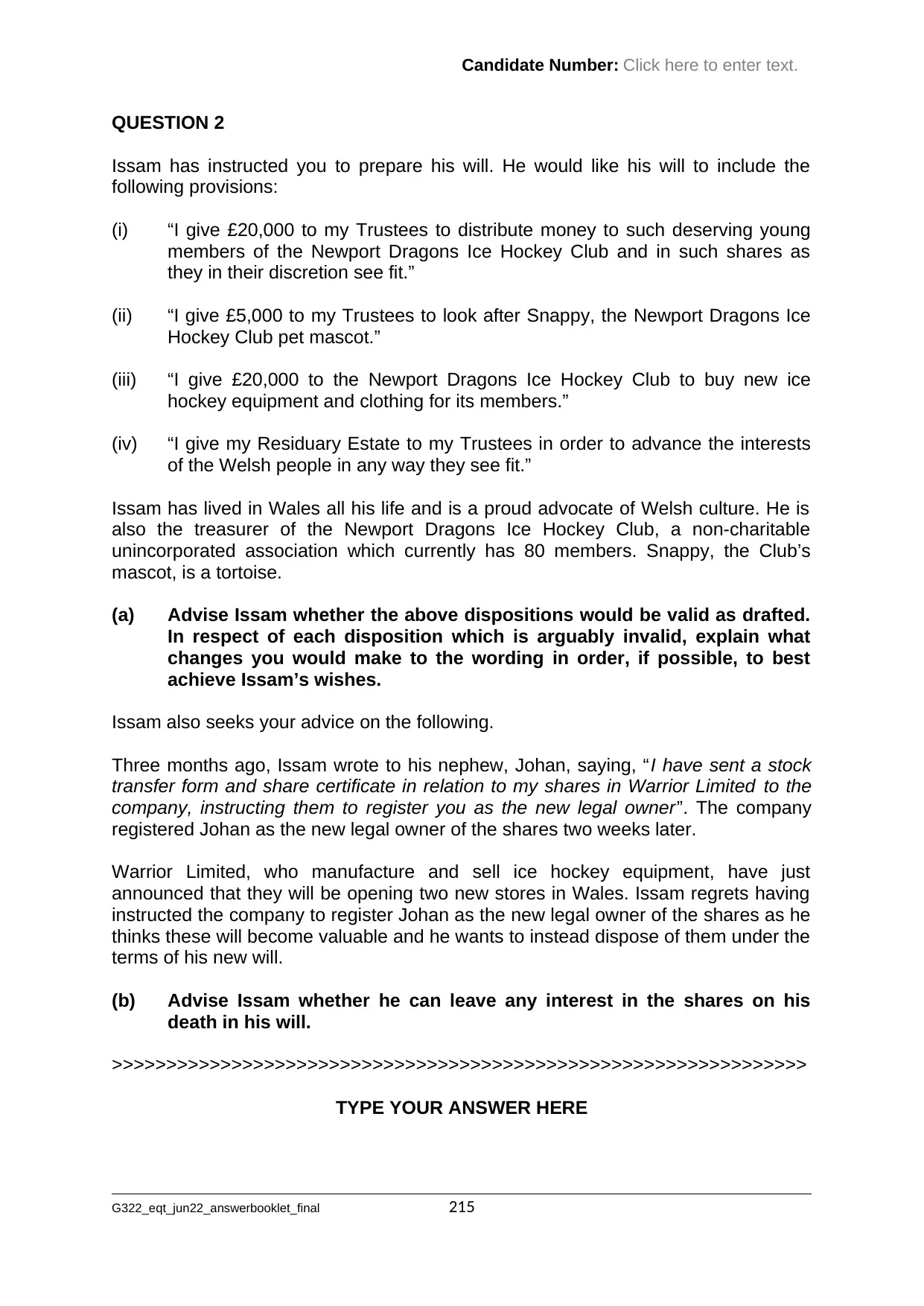
QUESTION 2
Issam has instructed you to prepare his will. He would like his will to include the
following provisions:
(i) “I give £20,000 to my Trustees to distribute money to such deserving young
members of the Newport Dragons Ice Hockey Club and in such shares as
they in their discretion see fit.”
(ii) “I give £5,000 to my Trustees to look after Snappy, the Newport Dragons Ice
Hockey Club pet mascot.”
(iii) “I give £20,000 to the Newport Dragons Ice Hockey Club to buy new ice
hockey equipment and clothing for its members.”
(iv) “I give my Residuary Estate to my Trustees in order to advance the interests
of the Welsh people in any way they see fit.”
Issam has lived in Wales all his life and is a proud advocate of Welsh culture. He is
also the treasurer of the Newport Dragons Ice Hockey Club, a non-charitable
unincorporated association which currently has 80 members. Snappy, the Club’s
mascot, is a tortoise.
(a) Advise Issam whether the above dispositions would be valid as drafted.
In respect of each disposition which is arguably invalid, explain what
changes you would make to the wording in order, if possible, to best
achieve Issam’s wishes.
Issam also seeks your advice on the following.
Three months ago, Issam wrote to his nephew, Johan, saying, “I have sent a stock
transfer form and share certificate in relation to my shares in Warrior Limited to the
company, instructing them to register you as the new legal owner”. The company
registered Johan as the new legal owner of the shares two weeks later.
Warrior Limited, who manufacture and sell ice hockey equipment, have just
announced that they will be opening two new stores in Wales. Issam regrets having
instructed the company to register Johan as the new legal owner of the shares as he
thinks these will become valuable and he wants to instead dispose of them under the
terms of his new will.
(b) Advise Issam whether he can leave any interest in the shares on his
death in his will.
>>>>>>>>>>>>>>>>>>>>>>>>>>>>>>>>>>>>>>>>>>>>>>>>>>>>>>>>>>>>>>>>
TYPE YOUR ANSWER HERE
G322_eqt_jun22_answerbooklet_final 215
QUESTION 2
Issam has instructed you to prepare his will. He would like his will to include the
following provisions:
(i) “I give £20,000 to my Trustees to distribute money to such deserving young
members of the Newport Dragons Ice Hockey Club and in such shares as
they in their discretion see fit.”
(ii) “I give £5,000 to my Trustees to look after Snappy, the Newport Dragons Ice
Hockey Club pet mascot.”
(iii) “I give £20,000 to the Newport Dragons Ice Hockey Club to buy new ice
hockey equipment and clothing for its members.”
(iv) “I give my Residuary Estate to my Trustees in order to advance the interests
of the Welsh people in any way they see fit.”
Issam has lived in Wales all his life and is a proud advocate of Welsh culture. He is
also the treasurer of the Newport Dragons Ice Hockey Club, a non-charitable
unincorporated association which currently has 80 members. Snappy, the Club’s
mascot, is a tortoise.
(a) Advise Issam whether the above dispositions would be valid as drafted.
In respect of each disposition which is arguably invalid, explain what
changes you would make to the wording in order, if possible, to best
achieve Issam’s wishes.
Issam also seeks your advice on the following.
Three months ago, Issam wrote to his nephew, Johan, saying, “I have sent a stock
transfer form and share certificate in relation to my shares in Warrior Limited to the
company, instructing them to register you as the new legal owner”. The company
registered Johan as the new legal owner of the shares two weeks later.
Warrior Limited, who manufacture and sell ice hockey equipment, have just
announced that they will be opening two new stores in Wales. Issam regrets having
instructed the company to register Johan as the new legal owner of the shares as he
thinks these will become valuable and he wants to instead dispose of them under the
terms of his new will.
(b) Advise Issam whether he can leave any interest in the shares on his
death in his will.
>>>>>>>>>>>>>>>>>>>>>>>>>>>>>>>>>>>>>>>>>>>>>>>>>>>>>>>>>>>>>>>>
TYPE YOUR ANSWER HERE
G322_eqt_jun22_answerbooklet_final 215
Candidate Number: Click here to enter text.
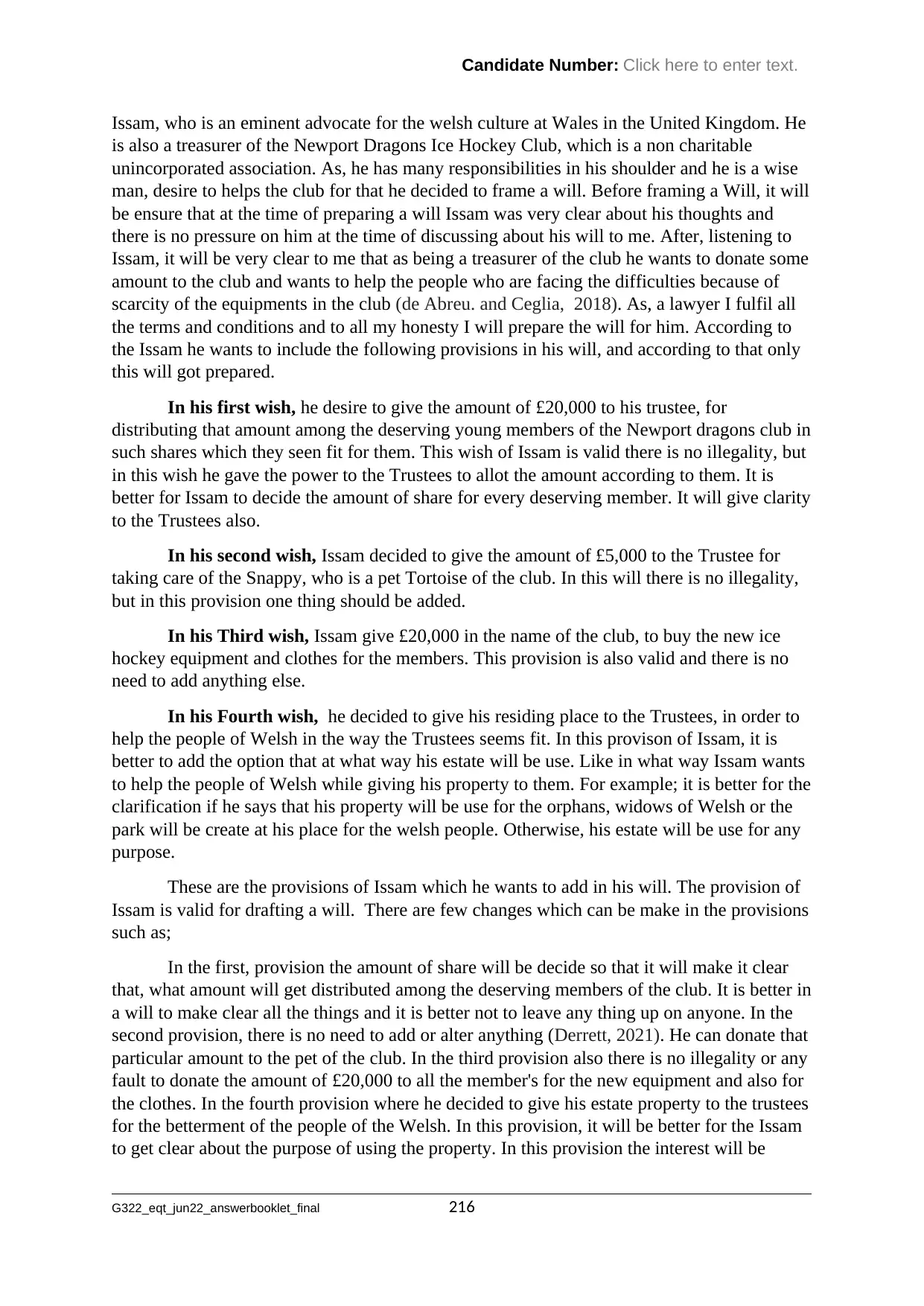
Issam, who is an eminent advocate for the welsh culture at Wales in the United Kingdom. He
is also a treasurer of the Newport Dragons Ice Hockey Club, which is a non charitable
unincorporated association. As, he has many responsibilities in his shoulder and he is a wise
man, desire to helps the club for that he decided to frame a will. Before framing a Will, it will
be ensure that at the time of preparing a will Issam was very clear about his thoughts and
there is no pressure on him at the time of discussing about his will to me. After, listening to
Issam, it will be very clear to me that as being a treasurer of the club he wants to donate some
amount to the club and wants to help the people who are facing the difficulties because of
scarcity of the equipments in the club (de Abreu. and Ceglia, 2018). As, a lawyer I fulfil all
the terms and conditions and to all my honesty I will prepare the will for him. According to
the Issam he wants to include the following provisions in his will, and according to that only
this will got prepared.
In his first wish, he desire to give the amount of £20,000 to his trustee, for
distributing that amount among the deserving young members of the Newport dragons club in
such shares which they seen fit for them. This wish of Issam is valid there is no illegality, but
in this wish he gave the power to the Trustees to allot the amount according to them. It is
better for Issam to decide the amount of share for every deserving member. It will give clarity
to the Trustees also.
In his second wish, Issam decided to give the amount of £5,000 to the Trustee for
taking care of the Snappy, who is a pet Tortoise of the club. In this will there is no illegality,
but in this provision one thing should be added.
In his Third wish, Issam give £20,000 in the name of the club, to buy the new ice
hockey equipment and clothes for the members. This provision is also valid and there is no
need to add anything else.
In his Fourth wish, he decided to give his residing place to the Trustees, in order to
help the people of Welsh in the way the Trustees seems fit. In this provison of Issam, it is
better to add the option that at what way his estate will be use. Like in what way Issam wants
to help the people of Welsh while giving his property to them. For example; it is better for the
clarification if he says that his property will be use for the orphans, widows of Welsh or the
park will be create at his place for the welsh people. Otherwise, his estate will be use for any
purpose.
These are the provisions of Issam which he wants to add in his will. The provision of
Issam is valid for drafting a will. There are few changes which can be make in the provisions
such as;
In the first, provision the amount of share will be decide so that it will make it clear
that, what amount will get distributed among the deserving members of the club. It is better in
a will to make clear all the things and it is better not to leave any thing up on anyone. In the
second provision, there is no need to add or alter anything (Derrett, 2021). He can donate that
particular amount to the pet of the club. In the third provision also there is no illegality or any
fault to donate the amount of £20,000 to all the member's for the new equipment and also for
the clothes. In the fourth provision where he decided to give his estate property to the trustees
for the betterment of the people of the Welsh. In this provision, it will be better for the Issam
to get clear about the purpose of using the property. In this provision the interest will be
G322_eqt_jun22_answerbooklet_final 216
Issam, who is an eminent advocate for the welsh culture at Wales in the United Kingdom. He
is also a treasurer of the Newport Dragons Ice Hockey Club, which is a non charitable
unincorporated association. As, he has many responsibilities in his shoulder and he is a wise
man, desire to helps the club for that he decided to frame a will. Before framing a Will, it will
be ensure that at the time of preparing a will Issam was very clear about his thoughts and
there is no pressure on him at the time of discussing about his will to me. After, listening to
Issam, it will be very clear to me that as being a treasurer of the club he wants to donate some
amount to the club and wants to help the people who are facing the difficulties because of
scarcity of the equipments in the club (de Abreu. and Ceglia, 2018). As, a lawyer I fulfil all
the terms and conditions and to all my honesty I will prepare the will for him. According to
the Issam he wants to include the following provisions in his will, and according to that only
this will got prepared.
In his first wish, he desire to give the amount of £20,000 to his trustee, for
distributing that amount among the deserving young members of the Newport dragons club in
such shares which they seen fit for them. This wish of Issam is valid there is no illegality, but
in this wish he gave the power to the Trustees to allot the amount according to them. It is
better for Issam to decide the amount of share for every deserving member. It will give clarity
to the Trustees also.
In his second wish, Issam decided to give the amount of £5,000 to the Trustee for
taking care of the Snappy, who is a pet Tortoise of the club. In this will there is no illegality,
but in this provision one thing should be added.
In his Third wish, Issam give £20,000 in the name of the club, to buy the new ice
hockey equipment and clothes for the members. This provision is also valid and there is no
need to add anything else.
In his Fourth wish, he decided to give his residing place to the Trustees, in order to
help the people of Welsh in the way the Trustees seems fit. In this provison of Issam, it is
better to add the option that at what way his estate will be use. Like in what way Issam wants
to help the people of Welsh while giving his property to them. For example; it is better for the
clarification if he says that his property will be use for the orphans, widows of Welsh or the
park will be create at his place for the welsh people. Otherwise, his estate will be use for any
purpose.
These are the provisions of Issam which he wants to add in his will. The provision of
Issam is valid for drafting a will. There are few changes which can be make in the provisions
such as;
In the first, provision the amount of share will be decide so that it will make it clear
that, what amount will get distributed among the deserving members of the club. It is better in
a will to make clear all the things and it is better not to leave any thing up on anyone. In the
second provision, there is no need to add or alter anything (Derrett, 2021). He can donate that
particular amount to the pet of the club. In the third provision also there is no illegality or any
fault to donate the amount of £20,000 to all the member's for the new equipment and also for
the clothes. In the fourth provision where he decided to give his estate property to the trustees
for the betterment of the people of the Welsh. In this provision, it will be better for the Issam
to get clear about the purpose of using the property. In this provision the interest will be
G322_eqt_jun22_answerbooklet_final 216
⊘ This is a preview!⊘
Do you want full access?
Subscribe today to unlock all pages.
Trusted by 1+ million students worldwide
Candidate Number: Click here to enter text.
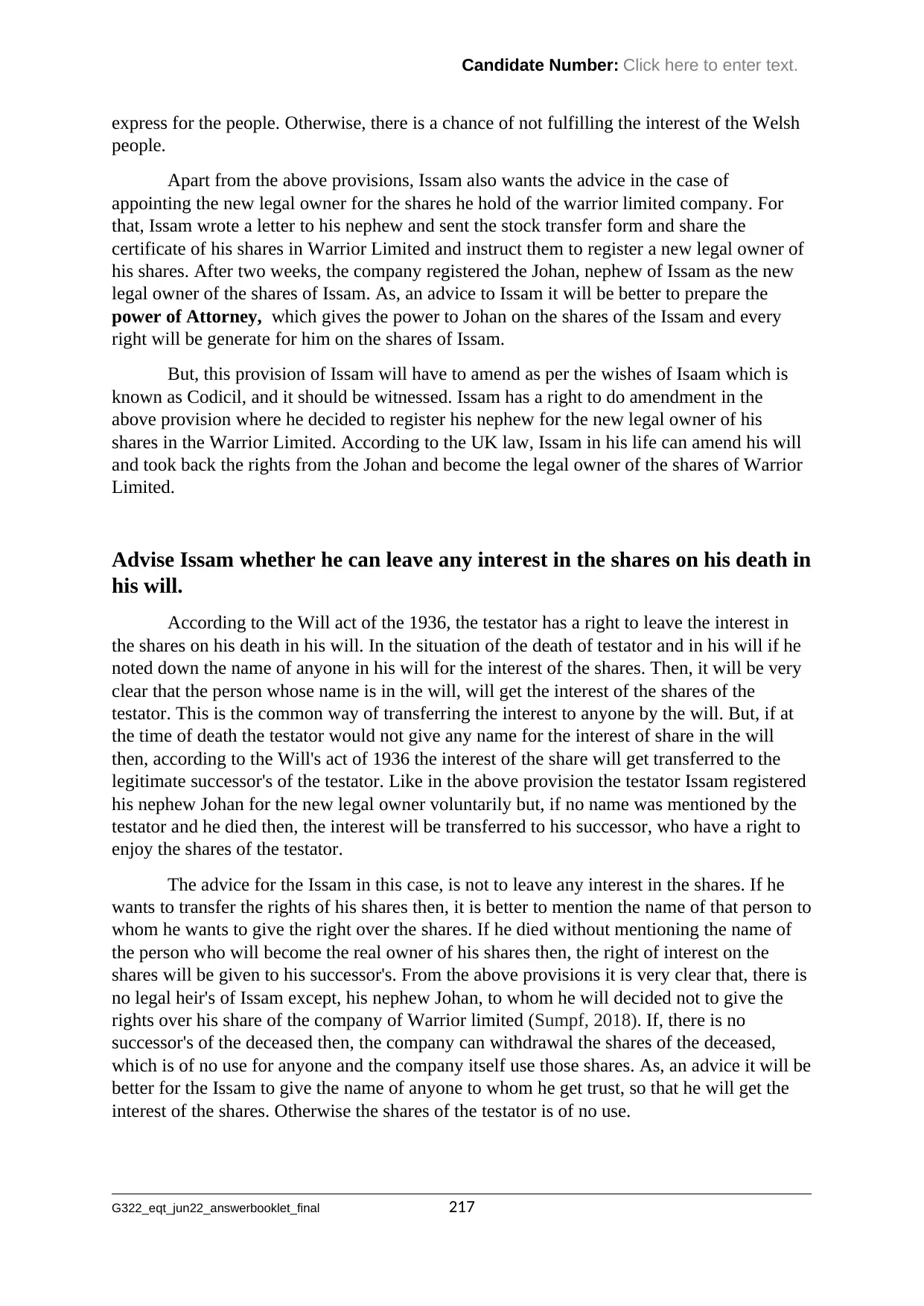
express for the people. Otherwise, there is a chance of not fulfilling the interest of the Welsh
people.
Apart from the above provisions, Issam also wants the advice in the case of
appointing the new legal owner for the shares he hold of the warrior limited company. For
that, Issam wrote a letter to his nephew and sent the stock transfer form and share the
certificate of his shares in Warrior Limited and instruct them to register a new legal owner of
his shares. After two weeks, the company registered the Johan, nephew of Issam as the new
legal owner of the shares of Issam. As, an advice to Issam it will be better to prepare the
power of Attorney, which gives the power to Johan on the shares of the Issam and every
right will be generate for him on the shares of Issam.
But, this provision of Issam will have to amend as per the wishes of Isaam which is
known as Codicil, and it should be witnessed. Issam has a right to do amendment in the
above provision where he decided to register his nephew for the new legal owner of his
shares in the Warrior Limited. According to the UK law, Issam in his life can amend his will
and took back the rights from the Johan and become the legal owner of the shares of Warrior
Limited.
Advise Issam whether he can leave any interest in the shares on his death in
his will.
According to the Will act of the 1936, the testator has a right to leave the interest in
the shares on his death in his will. In the situation of the death of testator and in his will if he
noted down the name of anyone in his will for the interest of the shares. Then, it will be very
clear that the person whose name is in the will, will get the interest of the shares of the
testator. This is the common way of transferring the interest to anyone by the will. But, if at
the time of death the testator would not give any name for the interest of share in the will
then, according to the Will's act of 1936 the interest of the share will get transferred to the
legitimate successor's of the testator. Like in the above provision the testator Issam registered
his nephew Johan for the new legal owner voluntarily but, if no name was mentioned by the
testator and he died then, the interest will be transferred to his successor, who have a right to
enjoy the shares of the testator.
The advice for the Issam in this case, is not to leave any interest in the shares. If he
wants to transfer the rights of his shares then, it is better to mention the name of that person to
whom he wants to give the right over the shares. If he died without mentioning the name of
the person who will become the real owner of his shares then, the right of interest on the
shares will be given to his successor's. From the above provisions it is very clear that, there is
no legal heir's of Issam except, his nephew Johan, to whom he will decided not to give the
rights over his share of the company of Warrior limited (Sumpf, 2018). If, there is no
successor's of the deceased then, the company can withdrawal the shares of the deceased,
which is of no use for anyone and the company itself use those shares. As, an advice it will be
better for the Issam to give the name of anyone to whom he get trust, so that he will get the
interest of the shares. Otherwise the shares of the testator is of no use.
G322_eqt_jun22_answerbooklet_final 217
express for the people. Otherwise, there is a chance of not fulfilling the interest of the Welsh
people.
Apart from the above provisions, Issam also wants the advice in the case of
appointing the new legal owner for the shares he hold of the warrior limited company. For
that, Issam wrote a letter to his nephew and sent the stock transfer form and share the
certificate of his shares in Warrior Limited and instruct them to register a new legal owner of
his shares. After two weeks, the company registered the Johan, nephew of Issam as the new
legal owner of the shares of Issam. As, an advice to Issam it will be better to prepare the
power of Attorney, which gives the power to Johan on the shares of the Issam and every
right will be generate for him on the shares of Issam.
But, this provision of Issam will have to amend as per the wishes of Isaam which is
known as Codicil, and it should be witnessed. Issam has a right to do amendment in the
above provision where he decided to register his nephew for the new legal owner of his
shares in the Warrior Limited. According to the UK law, Issam in his life can amend his will
and took back the rights from the Johan and become the legal owner of the shares of Warrior
Limited.
Advise Issam whether he can leave any interest in the shares on his death in
his will.
According to the Will act of the 1936, the testator has a right to leave the interest in
the shares on his death in his will. In the situation of the death of testator and in his will if he
noted down the name of anyone in his will for the interest of the shares. Then, it will be very
clear that the person whose name is in the will, will get the interest of the shares of the
testator. This is the common way of transferring the interest to anyone by the will. But, if at
the time of death the testator would not give any name for the interest of share in the will
then, according to the Will's act of 1936 the interest of the share will get transferred to the
legitimate successor's of the testator. Like in the above provision the testator Issam registered
his nephew Johan for the new legal owner voluntarily but, if no name was mentioned by the
testator and he died then, the interest will be transferred to his successor, who have a right to
enjoy the shares of the testator.
The advice for the Issam in this case, is not to leave any interest in the shares. If he
wants to transfer the rights of his shares then, it is better to mention the name of that person to
whom he wants to give the right over the shares. If he died without mentioning the name of
the person who will become the real owner of his shares then, the right of interest on the
shares will be given to his successor's. From the above provisions it is very clear that, there is
no legal heir's of Issam except, his nephew Johan, to whom he will decided not to give the
rights over his share of the company of Warrior limited (Sumpf, 2018). If, there is no
successor's of the deceased then, the company can withdrawal the shares of the deceased,
which is of no use for anyone and the company itself use those shares. As, an advice it will be
better for the Issam to give the name of anyone to whom he get trust, so that he will get the
interest of the shares. Otherwise the shares of the testator is of no use.
G322_eqt_jun22_answerbooklet_final 217
Paraphrase This Document
Need a fresh take? Get an instant paraphrase of this document with our AI Paraphraser
Candidate Number: Click here to enter text.
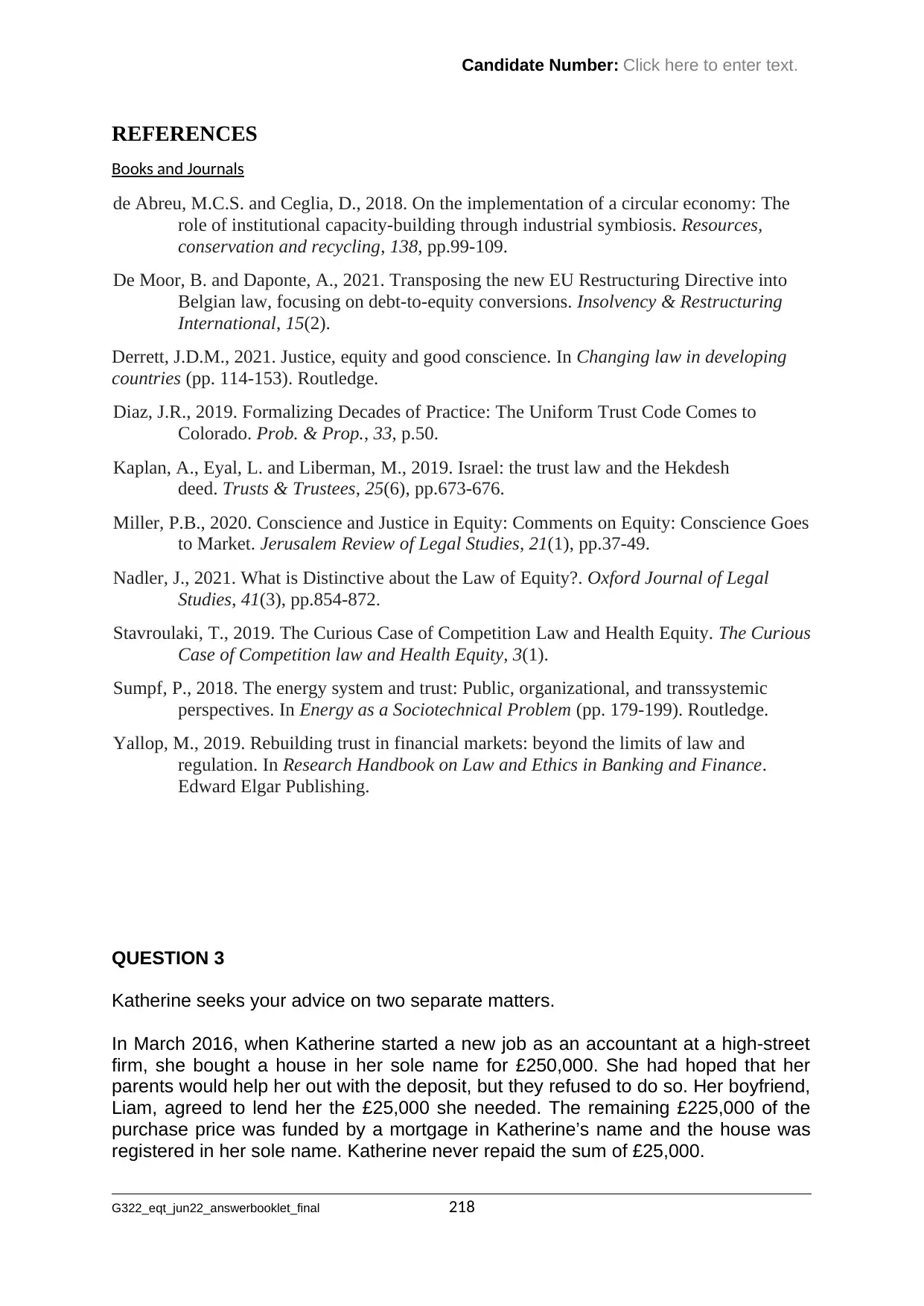
REFERENCES
Books and Journals
de Abreu, M.C.S. and Ceglia, D., 2018. On the implementation of a circular economy: The
role of institutional capacity-building through industrial symbiosis. Resources,
conservation and recycling, 138, pp.99-109.
De Moor, B. and Daponte, A., 2021. Transposing the new EU Restructuring Directive into
Belgian law, focusing on debt-to-equity conversions. Insolvency & Restructuring
International, 15(2).
Derrett, J.D.M., 2021. Justice, equity and good conscience. In Changing law in developing
countries (pp. 114-153). Routledge.
Diaz, J.R., 2019. Formalizing Decades of Practice: The Uniform Trust Code Comes to
Colorado. Prob. & Prop., 33, p.50.
Kaplan, A., Eyal, L. and Liberman, M., 2019. Israel: the trust law and the Hekdesh
deed. Trusts & Trustees, 25(6), pp.673-676.
Miller, P.B., 2020. Conscience and Justice in Equity: Comments on Equity: Conscience Goes
to Market. Jerusalem Review of Legal Studies, 21(1), pp.37-49.
Nadler, J., 2021. What is Distinctive about the Law of Equity?. Oxford Journal of Legal
Studies, 41(3), pp.854-872.
Stavroulaki, T., 2019. The Curious Case of Competition Law and Health Equity. The Curious
Case of Competition law and Health Equity, 3(1).
Sumpf, P., 2018. The energy system and trust: Public, organizational, and transsystemic
perspectives. In Energy as a Sociotechnical Problem (pp. 179-199). Routledge.
Yallop, M., 2019. Rebuilding trust in financial markets: beyond the limits of law and
regulation. In Research Handbook on Law and Ethics in Banking and Finance.
Edward Elgar Publishing.
QUESTION 3
Katherine seeks your advice on two separate matters.
In March 2016, when Katherine started a new job as an accountant at a high-street
firm, she bought a house in her sole name for £250,000. She had hoped that her
parents would help her out with the deposit, but they refused to do so. Her boyfriend,
Liam, agreed to lend her the £25,000 she needed. The remaining £225,000 of the
purchase price was funded by a mortgage in Katherine’s name and the house was
registered in her sole name. Katherine never repaid the sum of £25,000.
G322_eqt_jun22_answerbooklet_final 218
REFERENCES
Books and Journals
de Abreu, M.C.S. and Ceglia, D., 2018. On the implementation of a circular economy: The
role of institutional capacity-building through industrial symbiosis. Resources,
conservation and recycling, 138, pp.99-109.
De Moor, B. and Daponte, A., 2021. Transposing the new EU Restructuring Directive into
Belgian law, focusing on debt-to-equity conversions. Insolvency & Restructuring
International, 15(2).
Derrett, J.D.M., 2021. Justice, equity and good conscience. In Changing law in developing
countries (pp. 114-153). Routledge.
Diaz, J.R., 2019. Formalizing Decades of Practice: The Uniform Trust Code Comes to
Colorado. Prob. & Prop., 33, p.50.
Kaplan, A., Eyal, L. and Liberman, M., 2019. Israel: the trust law and the Hekdesh
deed. Trusts & Trustees, 25(6), pp.673-676.
Miller, P.B., 2020. Conscience and Justice in Equity: Comments on Equity: Conscience Goes
to Market. Jerusalem Review of Legal Studies, 21(1), pp.37-49.
Nadler, J., 2021. What is Distinctive about the Law of Equity?. Oxford Journal of Legal
Studies, 41(3), pp.854-872.
Stavroulaki, T., 2019. The Curious Case of Competition Law and Health Equity. The Curious
Case of Competition law and Health Equity, 3(1).
Sumpf, P., 2018. The energy system and trust: Public, organizational, and transsystemic
perspectives. In Energy as a Sociotechnical Problem (pp. 179-199). Routledge.
Yallop, M., 2019. Rebuilding trust in financial markets: beyond the limits of law and
regulation. In Research Handbook on Law and Ethics in Banking and Finance.
Edward Elgar Publishing.
QUESTION 3
Katherine seeks your advice on two separate matters.
In March 2016, when Katherine started a new job as an accountant at a high-street
firm, she bought a house in her sole name for £250,000. She had hoped that her
parents would help her out with the deposit, but they refused to do so. Her boyfriend,
Liam, agreed to lend her the £25,000 she needed. The remaining £225,000 of the
purchase price was funded by a mortgage in Katherine’s name and the house was
registered in her sole name. Katherine never repaid the sum of £25,000.
G322_eqt_jun22_answerbooklet_final 218
Candidate Number: Click here to enter text.
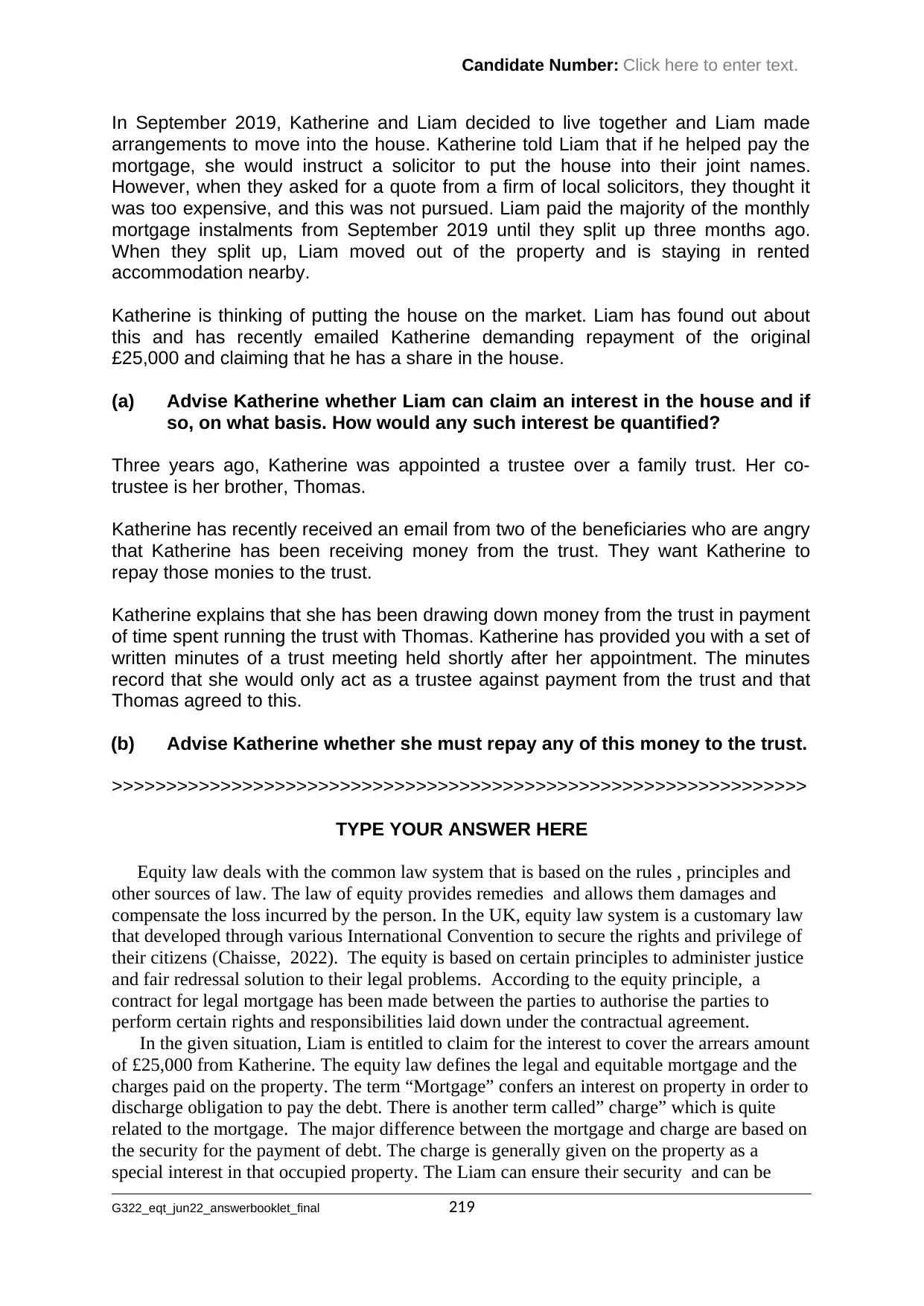
In September 2019, Katherine and Liam decided to live together and Liam made
arrangements to move into the house. Katherine told Liam that if he helped pay the
mortgage, she would instruct a solicitor to put the house into their joint names.
However, when they asked for a quote from a firm of local solicitors, they thought it
was too expensive, and this was not pursued. Liam paid the majority of the monthly
mortgage instalments from September 2019 until they split up three months ago.
When they split up, Liam moved out of the property and is staying in rented
accommodation nearby.
Katherine is thinking of putting the house on the market. Liam has found out about
this and has recently emailed Katherine demanding repayment of the original
£25,000 and claiming that he has a share in the house.
(a) Advise Katherine whether Liam can claim an interest in the house and if
so, on what basis. How would any such interest be quantified?
Three years ago, Katherine was appointed a trustee over a family trust. Her co-
trustee is her brother, Thomas.
Katherine has recently received an email from two of the beneficiaries who are angry
that Katherine has been receiving money from the trust. They want Katherine to
repay those monies to the trust.
Katherine explains that she has been drawing down money from the trust in payment
of time spent running the trust with Thomas. Katherine has provided you with a set of
written minutes of a trust meeting held shortly after her appointment. The minutes
record that she would only act as a trustee against payment from the trust and that
Thomas agreed to this.
(b) Advise Katherine whether she must repay any of this money to the trust.
>>>>>>>>>>>>>>>>>>>>>>>>>>>>>>>>>>>>>>>>>>>>>>>>>>>>>>>>>>>>>>>>
TYPE YOUR ANSWER HERE
Equity law deals with the common law system that is based on the rules , principles and
other sources of law. The law of equity provides remedies and allows them damages and
compensate the loss incurred by the person. In the UK, equity law system is a customary law
that developed through various International Convention to secure the rights and privilege of
their citizens (Chaisse, 2022). The equity is based on certain principles to administer justice
and fair redressal solution to their legal problems. According to the equity principle, a
contract for legal mortgage has been made between the parties to authorise the parties to
perform certain rights and responsibilities laid down under the contractual agreement.
In the given situation, Liam is entitled to claim for the interest to cover the arrears amount
of £25,000 from Katherine. The equity law defines the legal and equitable mortgage and the
charges paid on the property. The term “Mortgage” confers an interest on property in order to
discharge obligation to pay the debt. There is another term called” charge” which is quite
related to the mortgage. The major difference between the mortgage and charge are based on
the security for the payment of debt. The charge is generally given on the property as a
special interest in that occupied property. The Liam can ensure their security and can be
G322_eqt_jun22_answerbooklet_final 219
In September 2019, Katherine and Liam decided to live together and Liam made
arrangements to move into the house. Katherine told Liam that if he helped pay the
mortgage, she would instruct a solicitor to put the house into their joint names.
However, when they asked for a quote from a firm of local solicitors, they thought it
was too expensive, and this was not pursued. Liam paid the majority of the monthly
mortgage instalments from September 2019 until they split up three months ago.
When they split up, Liam moved out of the property and is staying in rented
accommodation nearby.
Katherine is thinking of putting the house on the market. Liam has found out about
this and has recently emailed Katherine demanding repayment of the original
£25,000 and claiming that he has a share in the house.
(a) Advise Katherine whether Liam can claim an interest in the house and if
so, on what basis. How would any such interest be quantified?
Three years ago, Katherine was appointed a trustee over a family trust. Her co-
trustee is her brother, Thomas.
Katherine has recently received an email from two of the beneficiaries who are angry
that Katherine has been receiving money from the trust. They want Katherine to
repay those monies to the trust.
Katherine explains that she has been drawing down money from the trust in payment
of time spent running the trust with Thomas. Katherine has provided you with a set of
written minutes of a trust meeting held shortly after her appointment. The minutes
record that she would only act as a trustee against payment from the trust and that
Thomas agreed to this.
(b) Advise Katherine whether she must repay any of this money to the trust.
>>>>>>>>>>>>>>>>>>>>>>>>>>>>>>>>>>>>>>>>>>>>>>>>>>>>>>>>>>>>>>>>
TYPE YOUR ANSWER HERE
Equity law deals with the common law system that is based on the rules , principles and
other sources of law. The law of equity provides remedies and allows them damages and
compensate the loss incurred by the person. In the UK, equity law system is a customary law
that developed through various International Convention to secure the rights and privilege of
their citizens (Chaisse, 2022). The equity is based on certain principles to administer justice
and fair redressal solution to their legal problems. According to the equity principle, a
contract for legal mortgage has been made between the parties to authorise the parties to
perform certain rights and responsibilities laid down under the contractual agreement.
In the given situation, Liam is entitled to claim for the interest to cover the arrears amount
of £25,000 from Katherine. The equity law defines the legal and equitable mortgage and the
charges paid on the property. The term “Mortgage” confers an interest on property in order to
discharge obligation to pay the debt. There is another term called” charge” which is quite
related to the mortgage. The major difference between the mortgage and charge are based on
the security for the payment of debt. The charge is generally given on the property as a
special interest in that occupied property. The Liam can ensure their security and can be
G322_eqt_jun22_answerbooklet_final 219
⊘ This is a preview!⊘
Do you want full access?
Subscribe today to unlock all pages.
Trusted by 1+ million students worldwide
Candidate Number: Click here to enter text.
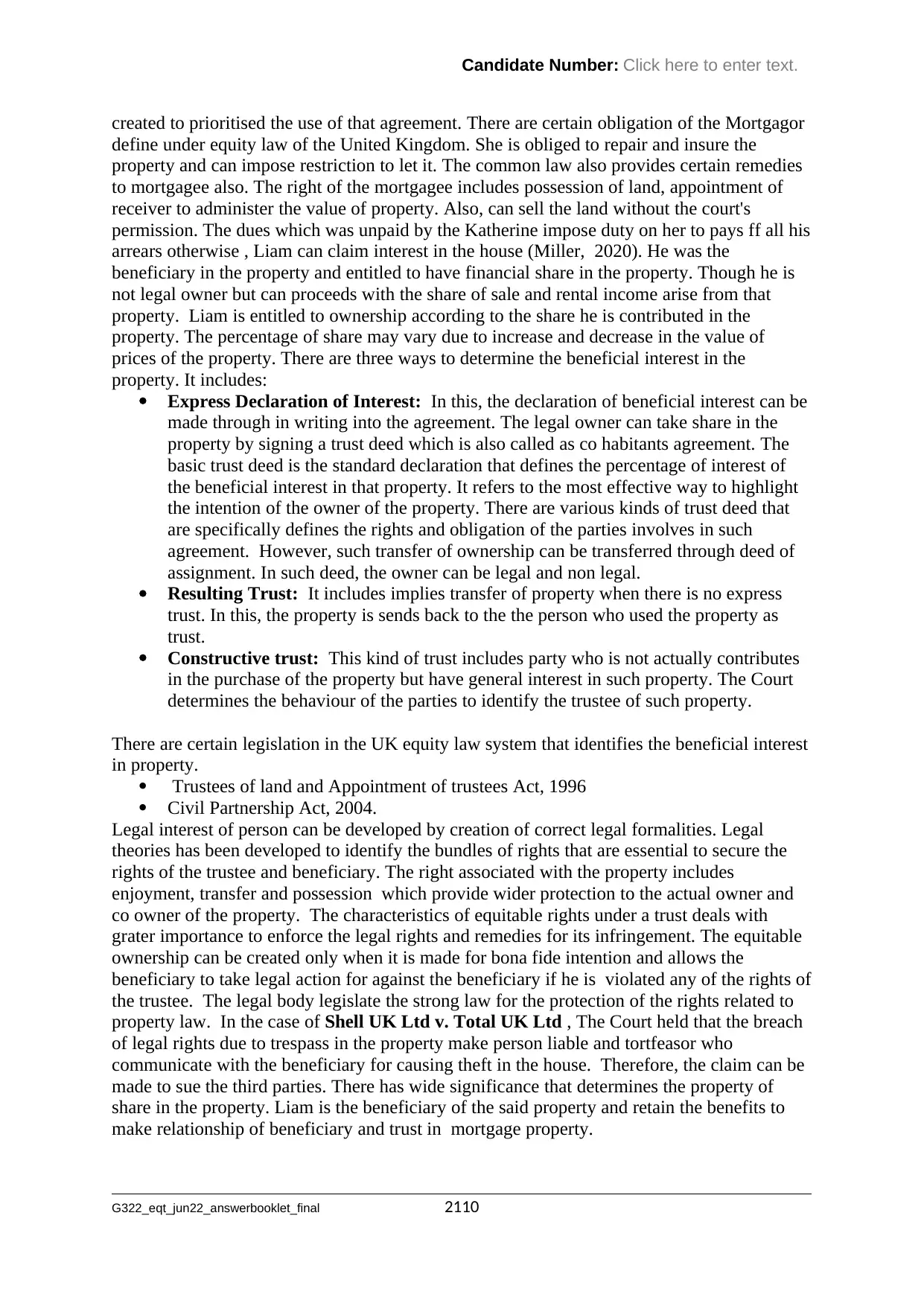
created to prioritised the use of that agreement. There are certain obligation of the Mortgagor
define under equity law of the United Kingdom. She is obliged to repair and insure the
property and can impose restriction to let it. The common law also provides certain remedies
to mortgagee also. The right of the mortgagee includes possession of land, appointment of
receiver to administer the value of property. Also, can sell the land without the court's
permission. The dues which was unpaid by the Katherine impose duty on her to pays ff all his
arrears otherwise , Liam can claim interest in the house (Miller, 2020). He was the
beneficiary in the property and entitled to have financial share in the property. Though he is
not legal owner but can proceeds with the share of sale and rental income arise from that
property. Liam is entitled to ownership according to the share he is contributed in the
property. The percentage of share may vary due to increase and decrease in the value of
prices of the property. There are three ways to determine the beneficial interest in the
property. It includes:
Express Declaration of Interest: In this, the declaration of beneficial interest can be
made through in writing into the agreement. The legal owner can take share in the
property by signing a trust deed which is also called as co habitants agreement. The
basic trust deed is the standard declaration that defines the percentage of interest of
the beneficial interest in that property. It refers to the most effective way to highlight
the intention of the owner of the property. There are various kinds of trust deed that
are specifically defines the rights and obligation of the parties involves in such
agreement. However, such transfer of ownership can be transferred through deed of
assignment. In such deed, the owner can be legal and non legal.
Resulting Trust: It includes implies transfer of property when there is no express
trust. In this, the property is sends back to the the person who used the property as
trust.
Constructive trust: This kind of trust includes party who is not actually contributes
in the purchase of the property but have general interest in such property. The Court
determines the behaviour of the parties to identify the trustee of such property.
There are certain legislation in the UK equity law system that identifies the beneficial interest
in property.
Trustees of land and Appointment of trustees Act, 1996
Civil Partnership Act, 2004.
Legal interest of person can be developed by creation of correct legal formalities. Legal
theories has been developed to identify the bundles of rights that are essential to secure the
rights of the trustee and beneficiary. The right associated with the property includes
enjoyment, transfer and possession which provide wider protection to the actual owner and
co owner of the property. The characteristics of equitable rights under a trust deals with
grater importance to enforce the legal rights and remedies for its infringement. The equitable
ownership can be created only when it is made for bona fide intention and allows the
beneficiary to take legal action for against the beneficiary if he is violated any of the rights of
the trustee. The legal body legislate the strong law for the protection of the rights related to
property law. In the case of Shell UK Ltd v. Total UK Ltd , The Court held that the breach
of legal rights due to trespass in the property make person liable and tortfeasor who
communicate with the beneficiary for causing theft in the house. Therefore, the claim can be
made to sue the third parties. There has wide significance that determines the property of
share in the property. Liam is the beneficiary of the said property and retain the benefits to
make relationship of beneficiary and trust in mortgage property.
G322_eqt_jun22_answerbooklet_final 2110
created to prioritised the use of that agreement. There are certain obligation of the Mortgagor
define under equity law of the United Kingdom. She is obliged to repair and insure the
property and can impose restriction to let it. The common law also provides certain remedies
to mortgagee also. The right of the mortgagee includes possession of land, appointment of
receiver to administer the value of property. Also, can sell the land without the court's
permission. The dues which was unpaid by the Katherine impose duty on her to pays ff all his
arrears otherwise , Liam can claim interest in the house (Miller, 2020). He was the
beneficiary in the property and entitled to have financial share in the property. Though he is
not legal owner but can proceeds with the share of sale and rental income arise from that
property. Liam is entitled to ownership according to the share he is contributed in the
property. The percentage of share may vary due to increase and decrease in the value of
prices of the property. There are three ways to determine the beneficial interest in the
property. It includes:
Express Declaration of Interest: In this, the declaration of beneficial interest can be
made through in writing into the agreement. The legal owner can take share in the
property by signing a trust deed which is also called as co habitants agreement. The
basic trust deed is the standard declaration that defines the percentage of interest of
the beneficial interest in that property. It refers to the most effective way to highlight
the intention of the owner of the property. There are various kinds of trust deed that
are specifically defines the rights and obligation of the parties involves in such
agreement. However, such transfer of ownership can be transferred through deed of
assignment. In such deed, the owner can be legal and non legal.
Resulting Trust: It includes implies transfer of property when there is no express
trust. In this, the property is sends back to the the person who used the property as
trust.
Constructive trust: This kind of trust includes party who is not actually contributes
in the purchase of the property but have general interest in such property. The Court
determines the behaviour of the parties to identify the trustee of such property.
There are certain legislation in the UK equity law system that identifies the beneficial interest
in property.
Trustees of land and Appointment of trustees Act, 1996
Civil Partnership Act, 2004.
Legal interest of person can be developed by creation of correct legal formalities. Legal
theories has been developed to identify the bundles of rights that are essential to secure the
rights of the trustee and beneficiary. The right associated with the property includes
enjoyment, transfer and possession which provide wider protection to the actual owner and
co owner of the property. The characteristics of equitable rights under a trust deals with
grater importance to enforce the legal rights and remedies for its infringement. The equitable
ownership can be created only when it is made for bona fide intention and allows the
beneficiary to take legal action for against the beneficiary if he is violated any of the rights of
the trustee. The legal body legislate the strong law for the protection of the rights related to
property law. In the case of Shell UK Ltd v. Total UK Ltd , The Court held that the breach
of legal rights due to trespass in the property make person liable and tortfeasor who
communicate with the beneficiary for causing theft in the house. Therefore, the claim can be
made to sue the third parties. There has wide significance that determines the property of
share in the property. Liam is the beneficiary of the said property and retain the benefits to
make relationship of beneficiary and trust in mortgage property.
G322_eqt_jun22_answerbooklet_final 2110
Paraphrase This Document
Need a fresh take? Get an instant paraphrase of this document with our AI Paraphraser
Candidate Number: Click here to enter text.
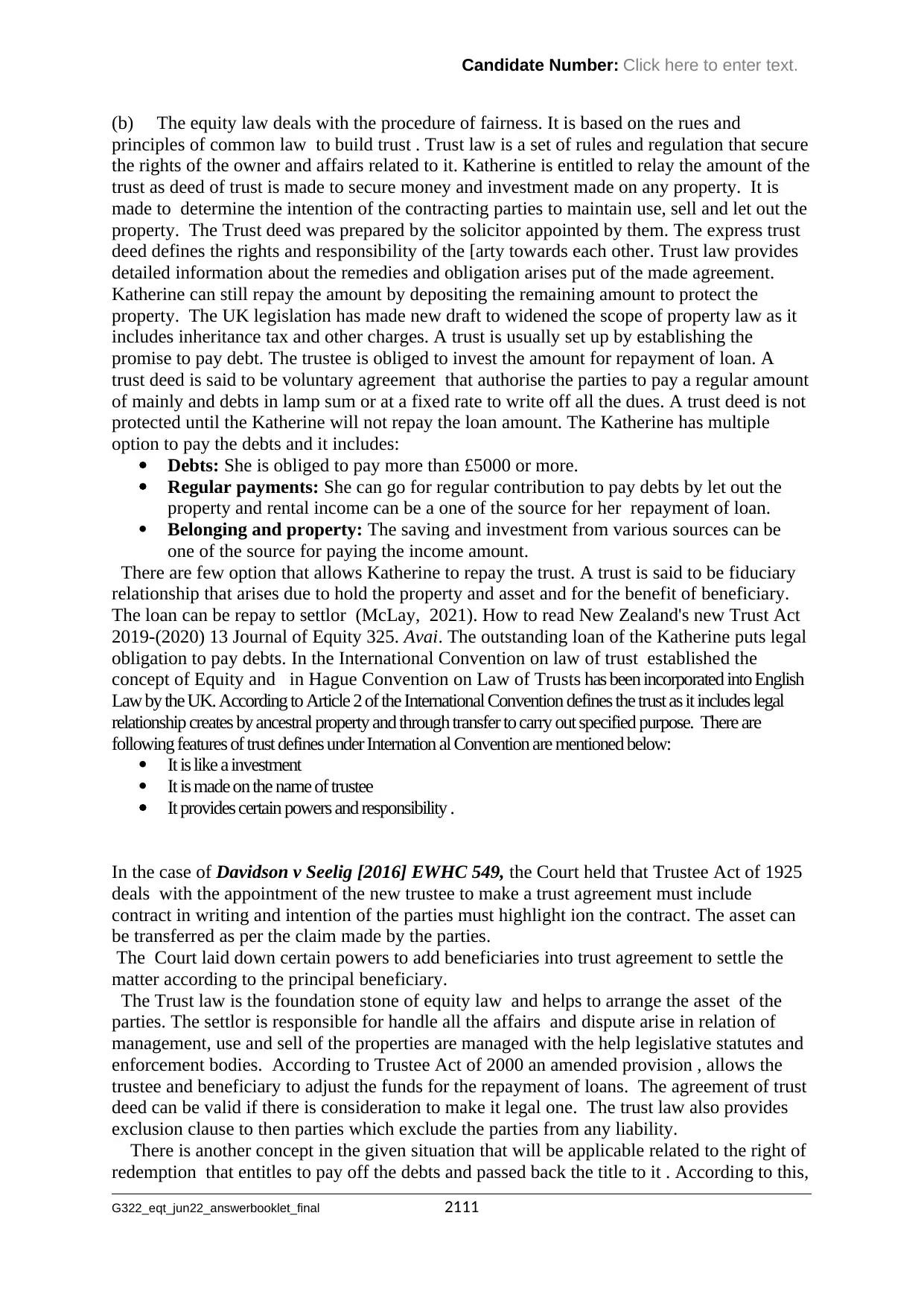
(b) The equity law deals with the procedure of fairness. It is based on the rues and
principles of common law to build trust . Trust law is a set of rules and regulation that secure
the rights of the owner and affairs related to it. Katherine is entitled to relay the amount of the
trust as deed of trust is made to secure money and investment made on any property. It is
made to determine the intention of the contracting parties to maintain use, sell and let out the
property. The Trust deed was prepared by the solicitor appointed by them. The express trust
deed defines the rights and responsibility of the [arty towards each other. Trust law provides
detailed information about the remedies and obligation arises put of the made agreement.
Katherine can still repay the amount by depositing the remaining amount to protect the
property. The UK legislation has made new draft to widened the scope of property law as it
includes inheritance tax and other charges. A trust is usually set up by establishing the
promise to pay debt. The trustee is obliged to invest the amount for repayment of loan. A
trust deed is said to be voluntary agreement that authorise the parties to pay a regular amount
of mainly and debts in lamp sum or at a fixed rate to write off all the dues. A trust deed is not
protected until the Katherine will not repay the loan amount. The Katherine has multiple
option to pay the debts and it includes:
Debts: She is obliged to pay more than £5000 or more.
Regular payments: She can go for regular contribution to pay debts by let out the
property and rental income can be a one of the source for her repayment of loan.
Belonging and property: The saving and investment from various sources can be
one of the source for paying the income amount.
There are few option that allows Katherine to repay the trust. A trust is said to be fiduciary
relationship that arises due to hold the property and asset and for the benefit of beneficiary.
The loan can be repay to settlor (McLay, 2021). How to read New Zealand's new Trust Act
2019-(2020) 13 Journal of Equity 325. Avai. The outstanding loan of the Katherine puts legal
obligation to pay debts. In the International Convention on law of trust established the
concept of Equity and in Hague Convention on Law of Trusts has been incorporated into English
Law by the UK. According to Article 2 of the International Convention defines the trust as it includes legal
relationship creates by ancestral property and through transfer to carry out specified purpose. There are
following features of trust defines under Internation al Convention are mentioned below:
It is like a investment
It is made on the name of trustee
It provides certain powers and responsibility .
In the case of Davidson v Seelig [2016] EWHC 549, the Court held that Trustee Act of 1925
deals with the appointment of the new trustee to make a trust agreement must include
contract in writing and intention of the parties must highlight ion the contract. The asset can
be transferred as per the claim made by the parties.
The Court laid down certain powers to add beneficiaries into trust agreement to settle the
matter according to the principal beneficiary.
The Trust law is the foundation stone of equity law and helps to arrange the asset of the
parties. The settlor is responsible for handle all the affairs and dispute arise in relation of
management, use and sell of the properties are managed with the help legislative statutes and
enforcement bodies. According to Trustee Act of 2000 an amended provision , allows the
trustee and beneficiary to adjust the funds for the repayment of loans. The agreement of trust
deed can be valid if there is consideration to make it legal one. The trust law also provides
exclusion clause to then parties which exclude the parties from any liability.
There is another concept in the given situation that will be applicable related to the right of
redemption that entitles to pay off the debts and passed back the title to it . According to this,
G322_eqt_jun22_answerbooklet_final 2111
(b) The equity law deals with the procedure of fairness. It is based on the rues and
principles of common law to build trust . Trust law is a set of rules and regulation that secure
the rights of the owner and affairs related to it. Katherine is entitled to relay the amount of the
trust as deed of trust is made to secure money and investment made on any property. It is
made to determine the intention of the contracting parties to maintain use, sell and let out the
property. The Trust deed was prepared by the solicitor appointed by them. The express trust
deed defines the rights and responsibility of the [arty towards each other. Trust law provides
detailed information about the remedies and obligation arises put of the made agreement.
Katherine can still repay the amount by depositing the remaining amount to protect the
property. The UK legislation has made new draft to widened the scope of property law as it
includes inheritance tax and other charges. A trust is usually set up by establishing the
promise to pay debt. The trustee is obliged to invest the amount for repayment of loan. A
trust deed is said to be voluntary agreement that authorise the parties to pay a regular amount
of mainly and debts in lamp sum or at a fixed rate to write off all the dues. A trust deed is not
protected until the Katherine will not repay the loan amount. The Katherine has multiple
option to pay the debts and it includes:
Debts: She is obliged to pay more than £5000 or more.
Regular payments: She can go for regular contribution to pay debts by let out the
property and rental income can be a one of the source for her repayment of loan.
Belonging and property: The saving and investment from various sources can be
one of the source for paying the income amount.
There are few option that allows Katherine to repay the trust. A trust is said to be fiduciary
relationship that arises due to hold the property and asset and for the benefit of beneficiary.
The loan can be repay to settlor (McLay, 2021). How to read New Zealand's new Trust Act
2019-(2020) 13 Journal of Equity 325. Avai. The outstanding loan of the Katherine puts legal
obligation to pay debts. In the International Convention on law of trust established the
concept of Equity and in Hague Convention on Law of Trusts has been incorporated into English
Law by the UK. According to Article 2 of the International Convention defines the trust as it includes legal
relationship creates by ancestral property and through transfer to carry out specified purpose. There are
following features of trust defines under Internation al Convention are mentioned below:
It is like a investment
It is made on the name of trustee
It provides certain powers and responsibility .
In the case of Davidson v Seelig [2016] EWHC 549, the Court held that Trustee Act of 1925
deals with the appointment of the new trustee to make a trust agreement must include
contract in writing and intention of the parties must highlight ion the contract. The asset can
be transferred as per the claim made by the parties.
The Court laid down certain powers to add beneficiaries into trust agreement to settle the
matter according to the principal beneficiary.
The Trust law is the foundation stone of equity law and helps to arrange the asset of the
parties. The settlor is responsible for handle all the affairs and dispute arise in relation of
management, use and sell of the properties are managed with the help legislative statutes and
enforcement bodies. According to Trustee Act of 2000 an amended provision , allows the
trustee and beneficiary to adjust the funds for the repayment of loans. The agreement of trust
deed can be valid if there is consideration to make it legal one. The trust law also provides
exclusion clause to then parties which exclude the parties from any liability.
There is another concept in the given situation that will be applicable related to the right of
redemption that entitles to pay off the debts and passed back the title to it . According to this,
G322_eqt_jun22_answerbooklet_final 2111
Candidate Number: Click here to enter text.
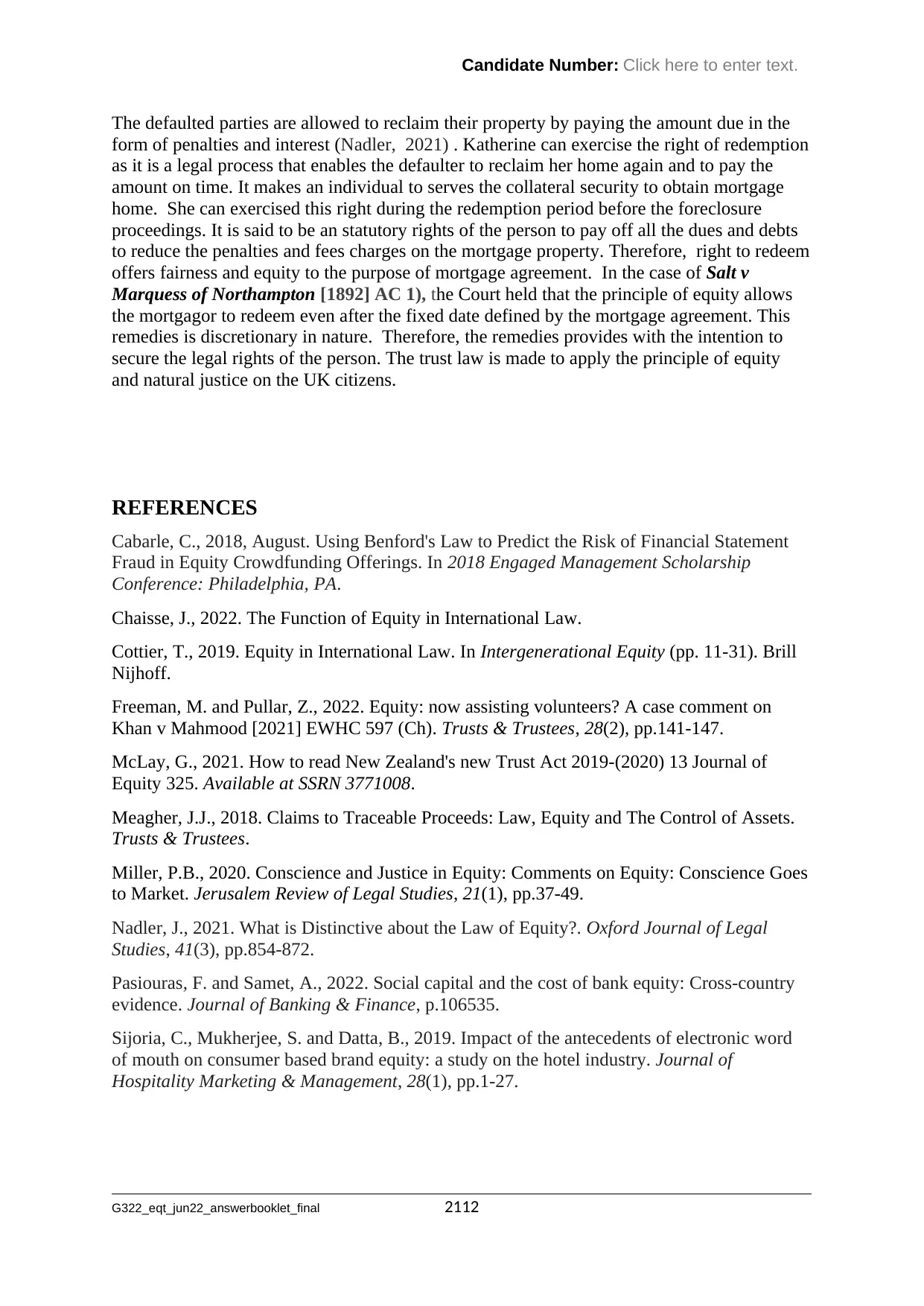
The defaulted parties are allowed to reclaim their property by paying the amount due in the
form of penalties and interest (Nadler, 2021) . Katherine can exercise the right of redemption
as it is a legal process that enables the defaulter to reclaim her home again and to pay the
amount on time. It makes an individual to serves the collateral security to obtain mortgage
home. She can exercised this right during the redemption period before the foreclosure
proceedings. It is said to be an statutory rights of the person to pay off all the dues and debts
to reduce the penalties and fees charges on the mortgage property. Therefore, right to redeem
offers fairness and equity to the purpose of mortgage agreement. In the case of Salt v
Marquess of Northampton [1892] AC 1), the Court held that the principle of equity allows
the mortgagor to redeem even after the fixed date defined by the mortgage agreement. This
remedies is discretionary in nature. Therefore, the remedies provides with the intention to
secure the legal rights of the person. The trust law is made to apply the principle of equity
and natural justice on the UK citizens.
REFERENCES
Cabarle, C., 2018, August. Using Benford's Law to Predict the Risk of Financial Statement
Fraud in Equity Crowdfunding Offerings. In 2018 Engaged Management Scholarship
Conference: Philadelphia, PA.
Chaisse, J., 2022. The Function of Equity in International Law.
Cottier, T., 2019. Equity in International Law. In Intergenerational Equity (pp. 11-31). Brill
Nijhoff.
Freeman, M. and Pullar, Z., 2022. Equity: now assisting volunteers? A case comment on
Khan v Mahmood [2021] EWHC 597 (Ch). Trusts & Trustees, 28(2), pp.141-147.
McLay, G., 2021. How to read New Zealand's new Trust Act 2019-(2020) 13 Journal of
Equity 325. Available at SSRN 3771008.
Meagher, J.J., 2018. Claims to Traceable Proceeds: Law, Equity and The Control of Assets.
Trusts & Trustees.
Miller, P.B., 2020. Conscience and Justice in Equity: Comments on Equity: Conscience Goes
to Market. Jerusalem Review of Legal Studies, 21(1), pp.37-49.
Nadler, J., 2021. What is Distinctive about the Law of Equity?. Oxford Journal of Legal
Studies, 41(3), pp.854-872.
Pasiouras, F. and Samet, A., 2022. Social capital and the cost of bank equity: Cross-country
evidence. Journal of Banking & Finance, p.106535.
Sijoria, C., Mukherjee, S. and Datta, B., 2019. Impact of the antecedents of electronic word
of mouth on consumer based brand equity: a study on the hotel industry. Journal of
Hospitality Marketing & Management, 28(1), pp.1-27.
G322_eqt_jun22_answerbooklet_final 2112
The defaulted parties are allowed to reclaim their property by paying the amount due in the
form of penalties and interest (Nadler, 2021) . Katherine can exercise the right of redemption
as it is a legal process that enables the defaulter to reclaim her home again and to pay the
amount on time. It makes an individual to serves the collateral security to obtain mortgage
home. She can exercised this right during the redemption period before the foreclosure
proceedings. It is said to be an statutory rights of the person to pay off all the dues and debts
to reduce the penalties and fees charges on the mortgage property. Therefore, right to redeem
offers fairness and equity to the purpose of mortgage agreement. In the case of Salt v
Marquess of Northampton [1892] AC 1), the Court held that the principle of equity allows
the mortgagor to redeem even after the fixed date defined by the mortgage agreement. This
remedies is discretionary in nature. Therefore, the remedies provides with the intention to
secure the legal rights of the person. The trust law is made to apply the principle of equity
and natural justice on the UK citizens.
REFERENCES
Cabarle, C., 2018, August. Using Benford's Law to Predict the Risk of Financial Statement
Fraud in Equity Crowdfunding Offerings. In 2018 Engaged Management Scholarship
Conference: Philadelphia, PA.
Chaisse, J., 2022. The Function of Equity in International Law.
Cottier, T., 2019. Equity in International Law. In Intergenerational Equity (pp. 11-31). Brill
Nijhoff.
Freeman, M. and Pullar, Z., 2022. Equity: now assisting volunteers? A case comment on
Khan v Mahmood [2021] EWHC 597 (Ch). Trusts & Trustees, 28(2), pp.141-147.
McLay, G., 2021. How to read New Zealand's new Trust Act 2019-(2020) 13 Journal of
Equity 325. Available at SSRN 3771008.
Meagher, J.J., 2018. Claims to Traceable Proceeds: Law, Equity and The Control of Assets.
Trusts & Trustees.
Miller, P.B., 2020. Conscience and Justice in Equity: Comments on Equity: Conscience Goes
to Market. Jerusalem Review of Legal Studies, 21(1), pp.37-49.
Nadler, J., 2021. What is Distinctive about the Law of Equity?. Oxford Journal of Legal
Studies, 41(3), pp.854-872.
Pasiouras, F. and Samet, A., 2022. Social capital and the cost of bank equity: Cross-country
evidence. Journal of Banking & Finance, p.106535.
Sijoria, C., Mukherjee, S. and Datta, B., 2019. Impact of the antecedents of electronic word
of mouth on consumer based brand equity: a study on the hotel industry. Journal of
Hospitality Marketing & Management, 28(1), pp.1-27.
G322_eqt_jun22_answerbooklet_final 2112
⊘ This is a preview!⊘
Do you want full access?
Subscribe today to unlock all pages.
Trusted by 1+ million students worldwide

1 out of 21


Related Documents


Your All-in-One AI-Powered Toolkit for Academic Success.
+13062052269
info@desklib.com
Available 24*7 on WhatsApp / Email
![[object Object]](/_next/static/media/star-bottom.7253800d.svg)
Unlock your academic potential
Copyright © 2020–2026 A2Z Services. All Rights Reserved. Developed and managed by ZUCOL.