Era Dance Theatre: Issues in Malay Dance Scene Management in Singapore
VerifiedAdded on 2023/01/23
|42
|14047
|75
Case Study
AI Summary
This case study investigates the management challenges faced by the Malay dance scene in Singapore, with a specific focus on Era Dance Theatre Ltd. The study explores the historical context of dance in Singapore, the struggles between traditional and contemporary forms, and the economic viability of Malay dance troupes. It examines the company's background, including its artistic collaborations, and the issues of declining audience interest and financial losses. The research questions address the effectiveness of marketing strategies and audience understanding of contemporary Malay dance. The methodology includes a case study approach, interpretive philosophy, and both qualitative and quantitative data collection. The study reviews literature on arts marketing, education, and the specifics of Malay dance, and analyzes findings from surveys and data tables. The conclusion suggests that Era Dance Theatre needs to review its marketing and education practices, while reducing its dependence on student ticket sales, to achieve continuous growth and success. The study highlights the importance of addressing the challenges within the Malay dance scene to ensure its future viability and cultural significance.
Probing issues within the management of Malay Dance scene in
Singapore: Case study of Era Dance Theatre Ltd
1
Singapore: Case study of Era Dance Theatre Ltd
1

Paraphrase This Document
Need a fresh take? Get an instant paraphrase of this document with our AI Paraphraser
Abstract
Dance in Singapore is comprised with traditional along with contemporary forms. It has a
short history of artistic and professional dance form. This type of dance firm faces a constant
struggle in between rejection and acceptance of the western dance that has re-emphasized the
ethnic cultures from time to time. The future of Malay dance scene is witnessed as not
emerging as per the recent study; people are not finding it economically beneficiary for any
organization that is based on this type of dance Troup. These dance troops are busy when
there is any occasion or at any event, rather most of the time, they find it hard to earn money
In the recent past ETD has started with an incredible impression with the artists in Malaysia
for starting and collaborating with dance, Visual performing arts. This helps in allowing the
harmony of Art talk. This results in ability to create artistic profiles and upbrininging the
livelihood of many Malayan dance performers. This industry is talking backseat as new
generation re not much into this dance business and the audience are not that much interested
in understanding the contemporary dance by the Malay dance troop. As a result the business
is affected, people are not interested and the company is running in loss.
This study aims to provide ideas that will increase the sales of the organisation and the
company is able to boost its growth. The researcher has selected interpretive theme of
philosophy and primary data collection method for the conduction of the research.
The survey result concluded that the majority of audiences are coming in the dance shows for
supporting their families and friends. The few numbers of the audience are coming to
improve their personal knowledge about the dance forms. The audience wants entertainment
but the Malay contemporary dance is a different type of dance which expresses the thoughts
and ideas or concepts about the shape of dance. The majority audiences do not understand the
content of the contemporary dance forms.
2
Dance in Singapore is comprised with traditional along with contemporary forms. It has a
short history of artistic and professional dance form. This type of dance firm faces a constant
struggle in between rejection and acceptance of the western dance that has re-emphasized the
ethnic cultures from time to time. The future of Malay dance scene is witnessed as not
emerging as per the recent study; people are not finding it economically beneficiary for any
organization that is based on this type of dance Troup. These dance troops are busy when
there is any occasion or at any event, rather most of the time, they find it hard to earn money
In the recent past ETD has started with an incredible impression with the artists in Malaysia
for starting and collaborating with dance, Visual performing arts. This helps in allowing the
harmony of Art talk. This results in ability to create artistic profiles and upbrininging the
livelihood of many Malayan dance performers. This industry is talking backseat as new
generation re not much into this dance business and the audience are not that much interested
in understanding the contemporary dance by the Malay dance troop. As a result the business
is affected, people are not interested and the company is running in loss.
This study aims to provide ideas that will increase the sales of the organisation and the
company is able to boost its growth. The researcher has selected interpretive theme of
philosophy and primary data collection method for the conduction of the research.
The survey result concluded that the majority of audiences are coming in the dance shows for
supporting their families and friends. The few numbers of the audience are coming to
improve their personal knowledge about the dance forms. The audience wants entertainment
but the Malay contemporary dance is a different type of dance which expresses the thoughts
and ideas or concepts about the shape of dance. The majority audiences do not understand the
content of the contemporary dance forms.
2

Acknowledgement
I would like to express the deepest appreciation to my committee chair Professor _________,
who has the attitude and the substance of a genius: he continually and convincingly conveyed
a spirit of adventure in regard to research and scholarship, and an excitement in regard to
teaching. Without his guidance and persistent help this dissertation would not have been
possible.
3
I would like to express the deepest appreciation to my committee chair Professor _________,
who has the attitude and the substance of a genius: he continually and convincingly conveyed
a spirit of adventure in regard to research and scholarship, and an excitement in regard to
teaching. Without his guidance and persistent help this dissertation would not have been
possible.
3
⊘ This is a preview!⊘
Do you want full access?
Subscribe today to unlock all pages.

Trusted by 1+ million students worldwide
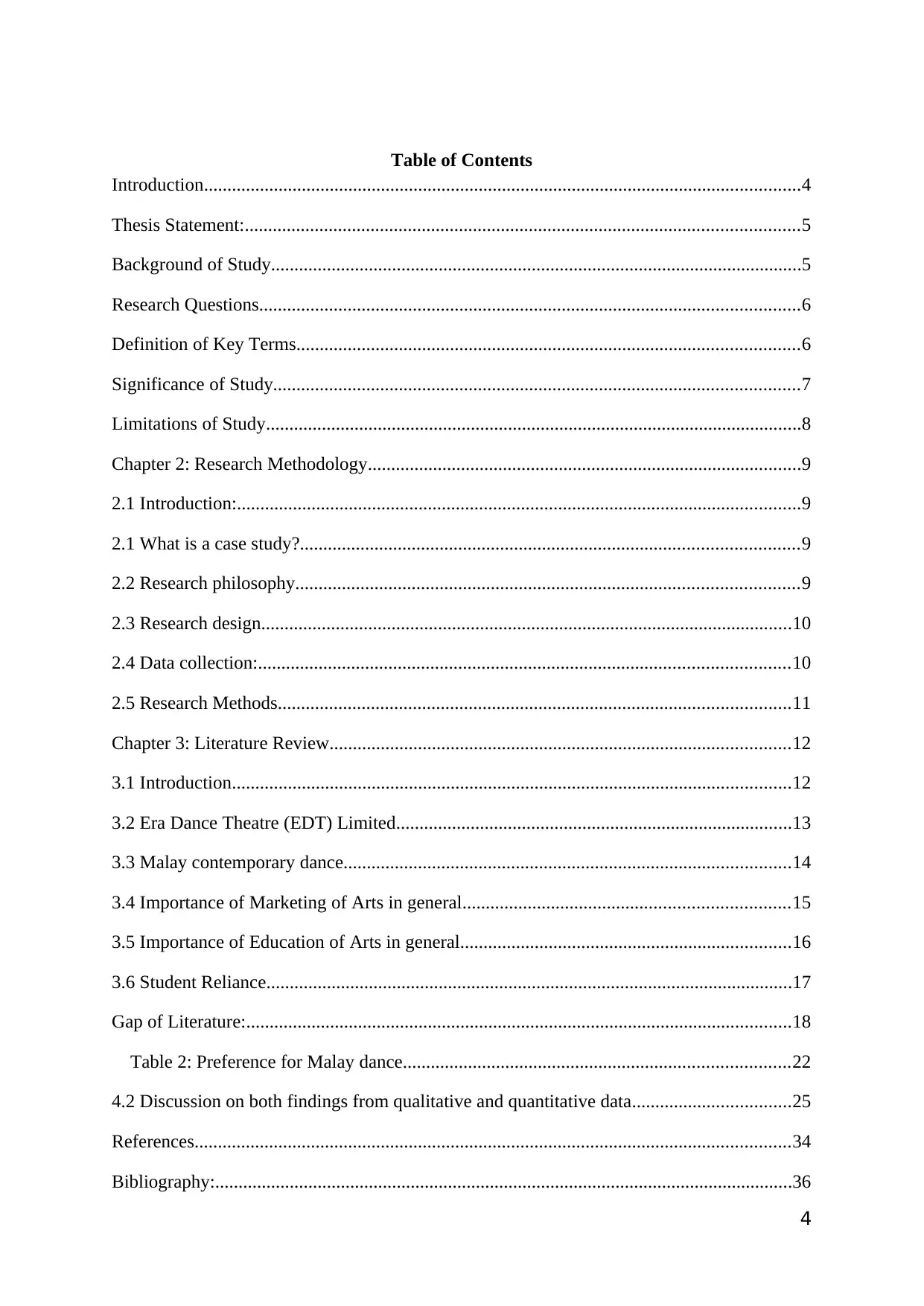
Table of Contents
Introduction................................................................................................................................4
Thesis Statement:.......................................................................................................................5
Background of Study..................................................................................................................5
Research Questions....................................................................................................................6
Definition of Key Terms............................................................................................................6
Significance of Study.................................................................................................................7
Limitations of Study...................................................................................................................8
Chapter 2: Research Methodology.............................................................................................9
2.1 Introduction:.........................................................................................................................9
2.1 What is a case study?...........................................................................................................9
2.2 Research philosophy............................................................................................................9
2.3 Research design..................................................................................................................10
2.4 Data collection:..................................................................................................................10
2.5 Research Methods..............................................................................................................11
Chapter 3: Literature Review...................................................................................................12
3.1 Introduction........................................................................................................................12
3.2 Era Dance Theatre (EDT) Limited.....................................................................................13
3.3 Malay contemporary dance................................................................................................14
3.4 Importance of Marketing of Arts in general......................................................................15
3.5 Importance of Education of Arts in general.......................................................................16
3.6 Student Reliance.................................................................................................................17
Gap of Literature:.....................................................................................................................18
Table 2: Preference for Malay dance...................................................................................22
4.2 Discussion on both findings from qualitative and quantitative data..................................25
References................................................................................................................................34
Bibliography:............................................................................................................................36
4
Introduction................................................................................................................................4
Thesis Statement:.......................................................................................................................5
Background of Study..................................................................................................................5
Research Questions....................................................................................................................6
Definition of Key Terms............................................................................................................6
Significance of Study.................................................................................................................7
Limitations of Study...................................................................................................................8
Chapter 2: Research Methodology.............................................................................................9
2.1 Introduction:.........................................................................................................................9
2.1 What is a case study?...........................................................................................................9
2.2 Research philosophy............................................................................................................9
2.3 Research design..................................................................................................................10
2.4 Data collection:..................................................................................................................10
2.5 Research Methods..............................................................................................................11
Chapter 3: Literature Review...................................................................................................12
3.1 Introduction........................................................................................................................12
3.2 Era Dance Theatre (EDT) Limited.....................................................................................13
3.3 Malay contemporary dance................................................................................................14
3.4 Importance of Marketing of Arts in general......................................................................15
3.5 Importance of Education of Arts in general.......................................................................16
3.6 Student Reliance.................................................................................................................17
Gap of Literature:.....................................................................................................................18
Table 2: Preference for Malay dance...................................................................................22
4.2 Discussion on both findings from qualitative and quantitative data..................................25
References................................................................................................................................34
Bibliography:............................................................................................................................36
4
Paraphrase This Document
Need a fresh take? Get an instant paraphrase of this document with our AI Paraphraser

Appendix..................................................................................................................................39
5
5

List of tables
Table 1: choice of shows..........................................................................................................23
Table 2: Preference for Malay dance.......................................................................................24
Table 3: Age group...................................................................................................................25
Table 4: Purpose of watching...................................................................................................26
Table 5: Understanding the content.........................................................................................27
6
Table 1: choice of shows..........................................................................................................23
Table 2: Preference for Malay dance.......................................................................................24
Table 3: Age group...................................................................................................................25
Table 4: Purpose of watching...................................................................................................26
Table 5: Understanding the content.........................................................................................27
6
⊘ This is a preview!⊘
Do you want full access?
Subscribe today to unlock all pages.
Trusted by 1+ million students worldwide
Chapter 1: Introduction
Introduction
Singapore has separated from Malaysia just 17 years ago; but the differences in the Malay-
language literature of the two neighbors had already become apparent due to the different
trajectories of their social and economic development. Dance in Singapore is comprised with
traditional along with contemporary forms. It has a short history of artistic and professional
dance form. This type of Malay dance form faces a constant struggle in between rejection and
acceptance of the western dance that has re-emphasized the ethnic cultures from time to time.
The Singapore identity through this dance is quite challenging, it often comprises to an
outward looking perception rather than acceptance along with recognition of indigenous
creativity.
The future of Malay dance scene is witnessed as not emerging as per the recent study; people
are not finding it economically beneficiary for any organization that is based on this type of
dance Troup. These dance troops are busy when there is any occasion or at any event, rather
most of the time, they find it hard to earn money. Troupe books an average of 60
performances over the two-week festive period every year. They can earn anywhere from
S$688 (US$500) to S$2,888 for each show, depending on factors such as the number of
performers and the difficulty of the stunts involved (Sterling, 256). However, this income in
not fixed it varies with the no of shows or event organized in a year.
This paper will study the management of the Malay Dance scene in Singapore today and
investigate the problems faced within the organization. A case study of Era Dance Theatre
Ltd will be discussed in order to get the understanding of the current scenario.
Thesis Statement:
For Era Dance Theatre Ltd to attain continuous growth and success, it needs to review its
marketing and education practices, meanwhile curbing its overreliance on students to push
for ticket sales.
Background of Study
Many Asian countries have been concerned about the outflow of human capital in to more
developed countries. However, in Malaysia, it is needed the address the problems and it has
assumed urgency in the final decade as it focuses on its long –established goal of becoming a
developed country by 2020. The traditional performance and revenues earned from it plays a
7
Introduction
Singapore has separated from Malaysia just 17 years ago; but the differences in the Malay-
language literature of the two neighbors had already become apparent due to the different
trajectories of their social and economic development. Dance in Singapore is comprised with
traditional along with contemporary forms. It has a short history of artistic and professional
dance form. This type of Malay dance form faces a constant struggle in between rejection and
acceptance of the western dance that has re-emphasized the ethnic cultures from time to time.
The Singapore identity through this dance is quite challenging, it often comprises to an
outward looking perception rather than acceptance along with recognition of indigenous
creativity.
The future of Malay dance scene is witnessed as not emerging as per the recent study; people
are not finding it economically beneficiary for any organization that is based on this type of
dance Troup. These dance troops are busy when there is any occasion or at any event, rather
most of the time, they find it hard to earn money. Troupe books an average of 60
performances over the two-week festive period every year. They can earn anywhere from
S$688 (US$500) to S$2,888 for each show, depending on factors such as the number of
performers and the difficulty of the stunts involved (Sterling, 256). However, this income in
not fixed it varies with the no of shows or event organized in a year.
This paper will study the management of the Malay Dance scene in Singapore today and
investigate the problems faced within the organization. A case study of Era Dance Theatre
Ltd will be discussed in order to get the understanding of the current scenario.
Thesis Statement:
For Era Dance Theatre Ltd to attain continuous growth and success, it needs to review its
marketing and education practices, meanwhile curbing its overreliance on students to push
for ticket sales.
Background of Study
Many Asian countries have been concerned about the outflow of human capital in to more
developed countries. However, in Malaysia, it is needed the address the problems and it has
assumed urgency in the final decade as it focuses on its long –established goal of becoming a
developed country by 2020. The traditional performance and revenues earned from it plays a
7
Paraphrase This Document
Need a fresh take? Get an instant paraphrase of this document with our AI Paraphraser
significant role in developing the economy of any country or organisation. Era dance theatre
is considered as recipient of National arts Council Major Grant for the period of 1 April to
march 2019. was consolidated on thirteenth May 2009 as an organization restricted by
assurance and not having an offer capital. The organization was initiated by two chiefs,
Artistic Director Osman Abdul Hamid and Executive Director Azrin Abdul Rahim.
Period Dance Theater (EDT) was some time ago a Malay Dance bunch framed by Osman
Abdul Hamid in 1992. For a long time, EDT extended the limits of the Malay move scene in
Singapore, bringing a one of a kind nature of Malay move under the innovative course of
Osman Abdul Hamid.
The organization's collection incorporates conventional, contemporary and new inventive
Malay move. Its yearly features are Kacip Mas Dulang Permata, a stage given to
choreographers to grandstand their works, the Muara Festival, a territorial Malay move and
music celebration that advances the trading of execution collection between gatherings and
the Multi-Genre/Tri-Master Production where the combination of various classes are meshed
into one comprehensive creation. These occasions serve to celebrate, raise and support the
extravagance of the Malay culture and convention.
EDT has made considerable progress since the joining of the organization as it sets out on
new difficulties and openings. In the course of the most recent couple of years, the
organization has arranged numerous preparations and joint coordinated efforts with nearby
and outside gatherings entomb and intra-social classes. EDT would like to investigate new
limits, for example, giving remedial courses through move and music. Past amusement and
rejuvenating the Malay expressions in Singapore, EDT would like to use workmanship as a
remedial device to improve one's physical and enthusiastic prosperity. The official executive,
Mr. Azrin, is a certified psychotherapist and a psychological aptitudes mentor gaining
practical experience in family treatment just as treatment for youngsters and youths. He
likewise leads psycho-training workshops, helping members manage learning issue, misuse
and injury.
The organisations facing issues with its growth as the future generation is not much interested
in this type of dance form and do not want to take this as their profession. This lacks in
engagement of new talent and people are also not interested to watch the traditional dances,
8
is considered as recipient of National arts Council Major Grant for the period of 1 April to
march 2019. was consolidated on thirteenth May 2009 as an organization restricted by
assurance and not having an offer capital. The organization was initiated by two chiefs,
Artistic Director Osman Abdul Hamid and Executive Director Azrin Abdul Rahim.
Period Dance Theater (EDT) was some time ago a Malay Dance bunch framed by Osman
Abdul Hamid in 1992. For a long time, EDT extended the limits of the Malay move scene in
Singapore, bringing a one of a kind nature of Malay move under the innovative course of
Osman Abdul Hamid.
The organization's collection incorporates conventional, contemporary and new inventive
Malay move. Its yearly features are Kacip Mas Dulang Permata, a stage given to
choreographers to grandstand their works, the Muara Festival, a territorial Malay move and
music celebration that advances the trading of execution collection between gatherings and
the Multi-Genre/Tri-Master Production where the combination of various classes are meshed
into one comprehensive creation. These occasions serve to celebrate, raise and support the
extravagance of the Malay culture and convention.
EDT has made considerable progress since the joining of the organization as it sets out on
new difficulties and openings. In the course of the most recent couple of years, the
organization has arranged numerous preparations and joint coordinated efforts with nearby
and outside gatherings entomb and intra-social classes. EDT would like to investigate new
limits, for example, giving remedial courses through move and music. Past amusement and
rejuvenating the Malay expressions in Singapore, EDT would like to use workmanship as a
remedial device to improve one's physical and enthusiastic prosperity. The official executive,
Mr. Azrin, is a certified psychotherapist and a psychological aptitudes mentor gaining
practical experience in family treatment just as treatment for youngsters and youths. He
likewise leads psycho-training workshops, helping members manage learning issue, misuse
and injury.
The organisations facing issues with its growth as the future generation is not much interested
in this type of dance form and do not want to take this as their profession. This lacks in
engagement of new talent and people are also not interested to watch the traditional dances,
8
thus the company is facing losses. This paper aims to identify areas that will help the
company to flourish and grow in future with suggestive recommendation.
Research Questions
1.2.1 Are the marketing strategies in effective in attaining audiences?
1.2.2 Is Malay contemporary dance well-understood by the audience? How has it
affected the audience size?
1.3 Research Objectives
1.3.1 To document the past productions and study the trends of audience
1.3.2 To find out the marketing efforts and strategies implemented by EDT and
access its effectiveness
1.3.3 To find out audiences’ perspectives on Malay contemporary dance
Definition of Key Terms
1.3.4 Arts Marketing:
Arts marketing are considered as a systematized process through which process of
creating awareness and interest of an artist can be done. It is a artwork that leads
desire for engaging the artist to its own products.
1.3.5 Arts Education:
Arts in education are considered as expanding field of educational research and
practice that is informed by several investigations into learning through the
experience of Arts.
1.3.6 Malay Dance
Malay Dance portrays the customs or adapts resam and culture of the Malays. It helps in
depicting the true nature of the Malay people along with their way of life. It is divided into
two categories, traditional malay dance and adopted malay dance. It has been influenced by
foreign cultures as per historical and political events.
1.5.3.1 Traditional Malay Dance
The traditional dance forms of Malay communities in Singapore are wide and it is diverse,
these dance groups include varieties of dance form such as Zaplin, joget etc.
9
company to flourish and grow in future with suggestive recommendation.
Research Questions
1.2.1 Are the marketing strategies in effective in attaining audiences?
1.2.2 Is Malay contemporary dance well-understood by the audience? How has it
affected the audience size?
1.3 Research Objectives
1.3.1 To document the past productions and study the trends of audience
1.3.2 To find out the marketing efforts and strategies implemented by EDT and
access its effectiveness
1.3.3 To find out audiences’ perspectives on Malay contemporary dance
Definition of Key Terms
1.3.4 Arts Marketing:
Arts marketing are considered as a systematized process through which process of
creating awareness and interest of an artist can be done. It is a artwork that leads
desire for engaging the artist to its own products.
1.3.5 Arts Education:
Arts in education are considered as expanding field of educational research and
practice that is informed by several investigations into learning through the
experience of Arts.
1.3.6 Malay Dance
Malay Dance portrays the customs or adapts resam and culture of the Malays. It helps in
depicting the true nature of the Malay people along with their way of life. It is divided into
two categories, traditional malay dance and adopted malay dance. It has been influenced by
foreign cultures as per historical and political events.
1.5.3.1 Traditional Malay Dance
The traditional dance forms of Malay communities in Singapore are wide and it is diverse,
these dance groups include varieties of dance form such as Zaplin, joget etc.
9
⊘ This is a preview!⊘
Do you want full access?
Subscribe today to unlock all pages.
Trusted by 1+ million students worldwide
1.5.3.2 Malay Contemporary Dance
When the traditional Malay dance is compatible with modern dance form, then is it
considered as Malay Contemporary dance form. Malay folk dance has been served this dance
form as an inspiration from 2013.
1.5.4 Dance Education
Dance education is considered as transferring of Dance education into knowledge of dance
students through skills and knowledge of training, or acc this type of knowledge through use
of dance research.
Significance of Study
In the recent past ETD has started with an incredible impression with the artists in
Malaysia for starting and collaborating with dance, Visual performing arts. This helps
in allowing the harmony of Art talk. This results in ability to create artistic profiles
and upbrininging the livelihood of many Malayan dance performers. This industry is
talking backseat as new generation re not much into this dance business and the
audience are not that much interested in understanding the contemporary dance by the
Malay dance troop. As a result the business is affected, people are not interested and
the company is running in loss. This study aims to provide ideas that will increase the
sales of the organisation and the company is able to boost its growth.
Limitations of Study
Lack of data and time restriction is the main limitation of the Study. It’s hard to find the
economic impact of such dance troops in Malaysia and hard to gather data related to this field
only.
10
When the traditional Malay dance is compatible with modern dance form, then is it
considered as Malay Contemporary dance form. Malay folk dance has been served this dance
form as an inspiration from 2013.
1.5.4 Dance Education
Dance education is considered as transferring of Dance education into knowledge of dance
students through skills and knowledge of training, or acc this type of knowledge through use
of dance research.
Significance of Study
In the recent past ETD has started with an incredible impression with the artists in
Malaysia for starting and collaborating with dance, Visual performing arts. This helps
in allowing the harmony of Art talk. This results in ability to create artistic profiles
and upbrininging the livelihood of many Malayan dance performers. This industry is
talking backseat as new generation re not much into this dance business and the
audience are not that much interested in understanding the contemporary dance by the
Malay dance troop. As a result the business is affected, people are not interested and
the company is running in loss. This study aims to provide ideas that will increase the
sales of the organisation and the company is able to boost its growth.
Limitations of Study
Lack of data and time restriction is the main limitation of the Study. It’s hard to find the
economic impact of such dance troops in Malaysia and hard to gather data related to this field
only.
10
Paraphrase This Document
Need a fresh take? Get an instant paraphrase of this document with our AI Paraphraser
Chapter 2: Research Methodology
2.1 Introduction:
The research part of any theory much depends on the methodological section of the research.
The main concepts of the research are methods, design, philosophy etc. the methodology
basically describes the methodical process of a reassert how it gets it shape, for these the
design of the research philosophical aspects are helping a lot.
2.1 What is a case study?
Case study analysis helps in understanding the business through a business problem. It helps
in examining the alternative solutions and purpose the effective solution through the use of
supportive evidence.
Purpose of case study:
Why Era Dance Theatre Ltd?
In this research Era Dance Theatre has been chosen as because it is among one of the few
Dance Organisation in Singapore that incorporated into a Company within a Short time
period. This organisation is highly involved with the contemporary Malay Dance Group and
has a position in Singapore arts culture so this organisation has been chosen in order to
complete the research.
2.2 Research philosophy
The reach philosophy mainly depends on the various sources, information, and data, and
nature, enhancement of the knowledge that helps to create more correct and prominent data.
According to (Langley, 2016), Research philosophy revolves around three different types of
theory, like positivism, realism, and interpretive. All these three theories help to create a solid
knowledge base for the methodical section of the research. Philosophical aspects of the
theme shape the whole research project in a realistic way. Philosophical aspect means how
one topic is getting evaluated by time and time and how that can be explained
philosophically. The philosophy and religion of Spiritualism show that nothing happens
without a purpose, there is a definite reason for every human life. The theories related to
management of that identified dance form Malay and ETD Company and its presence in
make can be seen as an interpretive theme of philosophy that further helps to solidify the
methodical parts of the research.
11
2.1 Introduction:
The research part of any theory much depends on the methodological section of the research.
The main concepts of the research are methods, design, philosophy etc. the methodology
basically describes the methodical process of a reassert how it gets it shape, for these the
design of the research philosophical aspects are helping a lot.
2.1 What is a case study?
Case study analysis helps in understanding the business through a business problem. It helps
in examining the alternative solutions and purpose the effective solution through the use of
supportive evidence.
Purpose of case study:
Why Era Dance Theatre Ltd?
In this research Era Dance Theatre has been chosen as because it is among one of the few
Dance Organisation in Singapore that incorporated into a Company within a Short time
period. This organisation is highly involved with the contemporary Malay Dance Group and
has a position in Singapore arts culture so this organisation has been chosen in order to
complete the research.
2.2 Research philosophy
The reach philosophy mainly depends on the various sources, information, and data, and
nature, enhancement of the knowledge that helps to create more correct and prominent data.
According to (Langley, 2016), Research philosophy revolves around three different types of
theory, like positivism, realism, and interpretive. All these three theories help to create a solid
knowledge base for the methodical section of the research. Philosophical aspects of the
theme shape the whole research project in a realistic way. Philosophical aspect means how
one topic is getting evaluated by time and time and how that can be explained
philosophically. The philosophy and religion of Spiritualism show that nothing happens
without a purpose, there is a definite reason for every human life. The theories related to
management of that identified dance form Malay and ETD Company and its presence in
make can be seen as an interpretive theme of philosophy that further helps to solidify the
methodical parts of the research.
11
2.3 Research design
The research design mainly describes the process of the actual method of the topic. The
design means step by step information that helps to structure the research. It describes the
descriptive manner of any method which helps to fulfill the requirement. And identify the
exact reach value of the topic (Melton & Hartline, 15). One’s research problem determines
the type of design they are using for their topic.The research design explains the overall
strategy that is a composed of the study in `1 logical way, thereby, ensuring research
problem; it creates the serial data collection, measurement, and analysis of data.
2.4 Data collection:
The researcher needs the secondary section of the data followed by sources like books,
articles, internet sources, journals. Data collection is mainly a procedure of collecting all of
these data in a serial way. It discusses various types of information and selected all the
variable possibilities of how to develop the issue (Östlund et al., 2015). This eventually helps
the researcher to get a solid outcome, and answers related to the work. Data collection is an
import part of the data analysis part. Collecting the exact data and preserve it which helps in
the future discussion of the research. Data collection has various methods of collecting the
data. There is mainly two type’s method of collection of data like primary data and secondary
data.
Figure 1: Data collection process
12
The research design mainly describes the process of the actual method of the topic. The
design means step by step information that helps to structure the research. It describes the
descriptive manner of any method which helps to fulfill the requirement. And identify the
exact reach value of the topic (Melton & Hartline, 15). One’s research problem determines
the type of design they are using for their topic.The research design explains the overall
strategy that is a composed of the study in `1 logical way, thereby, ensuring research
problem; it creates the serial data collection, measurement, and analysis of data.
2.4 Data collection:
The researcher needs the secondary section of the data followed by sources like books,
articles, internet sources, journals. Data collection is mainly a procedure of collecting all of
these data in a serial way. It discusses various types of information and selected all the
variable possibilities of how to develop the issue (Östlund et al., 2015). This eventually helps
the researcher to get a solid outcome, and answers related to the work. Data collection is an
import part of the data analysis part. Collecting the exact data and preserve it which helps in
the future discussion of the research. Data collection has various methods of collecting the
data. There is mainly two type’s method of collection of data like primary data and secondary
data.
Figure 1: Data collection process
12
⊘ This is a preview!⊘
Do you want full access?
Subscribe today to unlock all pages.
Trusted by 1+ million students worldwide

1 out of 42


Your All-in-One AI-Powered Toolkit for Academic Success.
+13062052269
info@desklib.com
Available 24*7 on WhatsApp / Email
![[object Object]](/_next/static/media/star-bottom.7253800d.svg)
Unlock your academic potential
Copyright © 2020–2026 A2Z Services. All Rights Reserved. Developed and managed by ZUCOL.