Application of Ergonomic Analysis in Construction Management: A Report
VerifiedAdded on 2022/05/18
|7
|3462
|23
Report
AI Summary
This report examines the application of ergonomic principles within the construction industry, focusing on identifying and mitigating workplace hazards to enhance worker safety and efficiency. The study delves into various risk factors, including forceful exertion, repetitive tasks, awkward postures, vibrations, and adverse environmental conditions, such as extreme temperatures and noise. The methodology involves analyzing these factors and proposing solutions through control measures and the use of pragmatic approaches. The report highlights the importance of proper tool handling, working schedules, and the reduction of stress levels to prevent injuries and improve overall worker comfort. The findings underscore the significance of ergonomic principles in creating a safer and more productive construction environment by addressing issues like forceful straining, static postures, and the impact of climatic conditions on worker performance and well-being. The research emphasizes the need for continuous improvement and proactive measures to protect workers from potential hazards.
Running Head: ERGONOMIC PRINCIPLES 1
Title
Author’s name
Institutional affiliation
Title
Author’s name
Institutional affiliation

Paraphrase This Document
Need a fresh take? Get an instant paraphrase of this document with our AI Paraphraser
ERGONOMIC PRINCIPLES 2
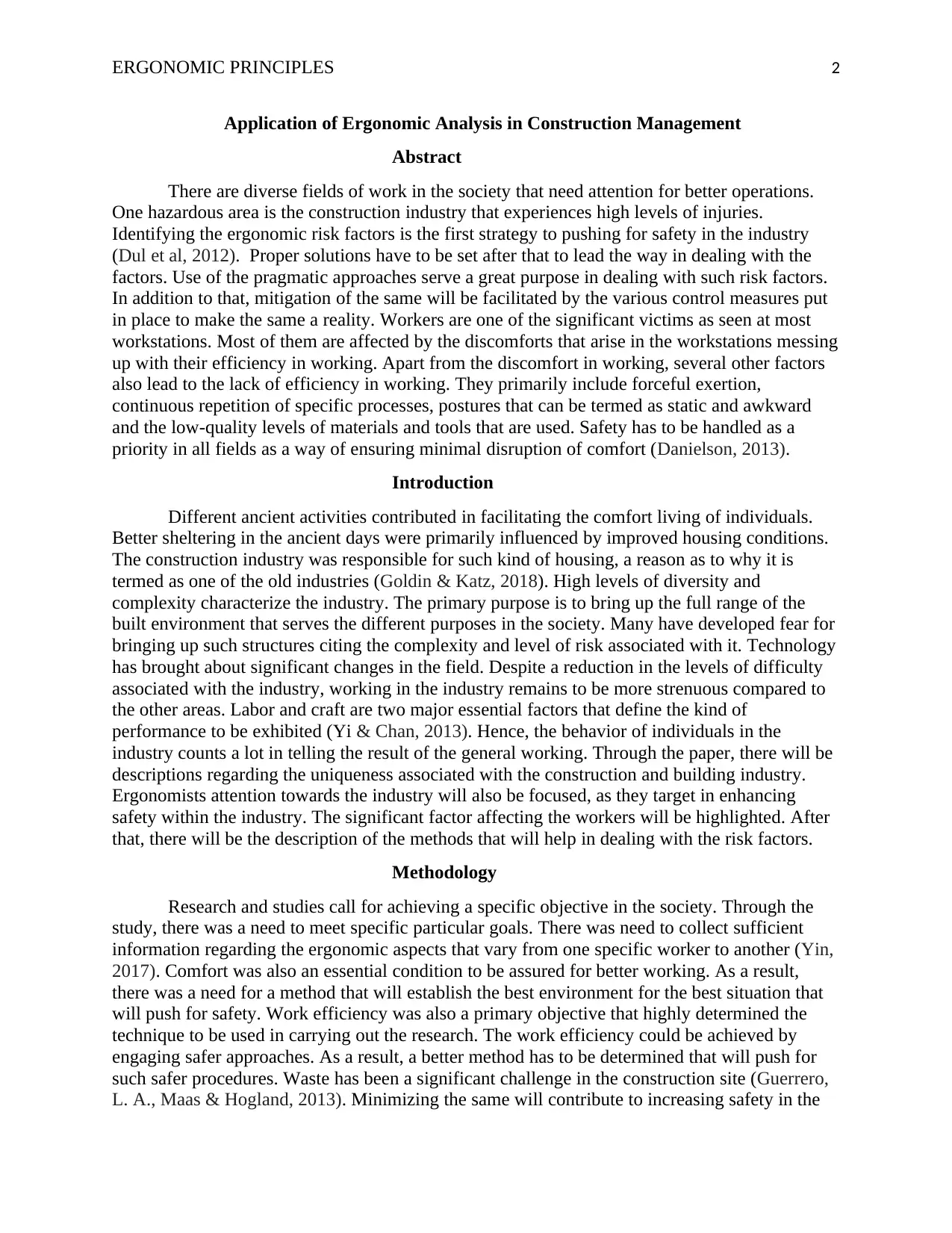
Application of Ergonomic Analysis in Construction Management
Abstract
There are diverse fields of work in the society that need attention for better operations.
One hazardous area is the construction industry that experiences high levels of injuries.
Identifying the ergonomic risk factors is the first strategy to pushing for safety in the industry
(Dul et al, 2012). Proper solutions have to be set after that to lead the way in dealing with the
factors. Use of the pragmatic approaches serve a great purpose in dealing with such risk factors.
In addition to that, mitigation of the same will be facilitated by the various control measures put
in place to make the same a reality. Workers are one of the significant victims as seen at most
workstations. Most of them are affected by the discomforts that arise in the workstations messing
up with their efficiency in working. Apart from the discomfort in working, several other factors
also lead to the lack of efficiency in working. They primarily include forceful exertion,
continuous repetition of specific processes, postures that can be termed as static and awkward
and the low-quality levels of materials and tools that are used. Safety has to be handled as a
priority in all fields as a way of ensuring minimal disruption of comfort (Danielson, 2013).
Introduction
Different ancient activities contributed in facilitating the comfort living of individuals.
Better sheltering in the ancient days were primarily influenced by improved housing conditions.
The construction industry was responsible for such kind of housing, a reason as to why it is
termed as one of the old industries (Goldin & Katz, 2018). High levels of diversity and
complexity characterize the industry. The primary purpose is to bring up the full range of the
built environment that serves the different purposes in the society. Many have developed fear for
bringing up such structures citing the complexity and level of risk associated with it. Technology
has brought about significant changes in the field. Despite a reduction in the levels of difficulty
associated with the industry, working in the industry remains to be more strenuous compared to
the other areas. Labor and craft are two major essential factors that define the kind of
performance to be exhibited (Yi & Chan, 2013). Hence, the behavior of individuals in the
industry counts a lot in telling the result of the general working. Through the paper, there will be
descriptions regarding the uniqueness associated with the construction and building industry.
Ergonomists attention towards the industry will also be focused, as they target in enhancing
safety within the industry. The significant factor affecting the workers will be highlighted. After
that, there will be the description of the methods that will help in dealing with the risk factors.
Methodology
Research and studies call for achieving a specific objective in the society. Through the
study, there was a need to meet specific particular goals. There was need to collect sufficient
information regarding the ergonomic aspects that vary from one specific worker to another (Yin,
2017). Comfort was also an essential condition to be assured for better working. As a result,
there was a need for a method that will establish the best environment for the best situation that
will push for safety. Work efficiency was also a primary objective that highly determined the
technique to be used in carrying out the research. The work efficiency could be achieved by
engaging safer approaches. As a result, a better method has to be determined that will push for
such safer procedures. Waste has been a significant challenge in the construction site (Guerrero,
L. A., Maas & Hogland, 2013). Minimizing the same will contribute to increasing safety in the
Application of Ergonomic Analysis in Construction Management
Abstract
There are diverse fields of work in the society that need attention for better operations.
One hazardous area is the construction industry that experiences high levels of injuries.
Identifying the ergonomic risk factors is the first strategy to pushing for safety in the industry
(Dul et al, 2012). Proper solutions have to be set after that to lead the way in dealing with the
factors. Use of the pragmatic approaches serve a great purpose in dealing with such risk factors.
In addition to that, mitigation of the same will be facilitated by the various control measures put
in place to make the same a reality. Workers are one of the significant victims as seen at most
workstations. Most of them are affected by the discomforts that arise in the workstations messing
up with their efficiency in working. Apart from the discomfort in working, several other factors
also lead to the lack of efficiency in working. They primarily include forceful exertion,
continuous repetition of specific processes, postures that can be termed as static and awkward
and the low-quality levels of materials and tools that are used. Safety has to be handled as a
priority in all fields as a way of ensuring minimal disruption of comfort (Danielson, 2013).
Introduction
Different ancient activities contributed in facilitating the comfort living of individuals.
Better sheltering in the ancient days were primarily influenced by improved housing conditions.
The construction industry was responsible for such kind of housing, a reason as to why it is
termed as one of the old industries (Goldin & Katz, 2018). High levels of diversity and
complexity characterize the industry. The primary purpose is to bring up the full range of the
built environment that serves the different purposes in the society. Many have developed fear for
bringing up such structures citing the complexity and level of risk associated with it. Technology
has brought about significant changes in the field. Despite a reduction in the levels of difficulty
associated with the industry, working in the industry remains to be more strenuous compared to
the other areas. Labor and craft are two major essential factors that define the kind of
performance to be exhibited (Yi & Chan, 2013). Hence, the behavior of individuals in the
industry counts a lot in telling the result of the general working. Through the paper, there will be
descriptions regarding the uniqueness associated with the construction and building industry.
Ergonomists attention towards the industry will also be focused, as they target in enhancing
safety within the industry. The significant factor affecting the workers will be highlighted. After
that, there will be the description of the methods that will help in dealing with the risk factors.
Methodology
Research and studies call for achieving a specific objective in the society. Through the
study, there was a need to meet specific particular goals. There was need to collect sufficient
information regarding the ergonomic aspects that vary from one specific worker to another (Yin,
2017). Comfort was also an essential condition to be assured for better working. As a result,
there was a need for a method that will establish the best environment for the best situation that
will push for safety. Work efficiency was also a primary objective that highly determined the
technique to be used in carrying out the research. The work efficiency could be achieved by
engaging safer approaches. As a result, a better method has to be determined that will push for
such safer procedures. Waste has been a significant challenge in the construction site (Guerrero,
L. A., Maas & Hogland, 2013). Minimizing the same will contribute to increasing safety in the
ERGONOMIC PRINCIPLES 3
construction sites. Different study methods can push for reducing such waste in the society. The
plans were highly embraced through the research. Questionnaires were prepared that proper
facilitated surveying through the various firms in the nation. SPSS played a significant role in the
appropriate analysis of the collected data. The result was a better conclusion that assured the
bettering of the construction industry.
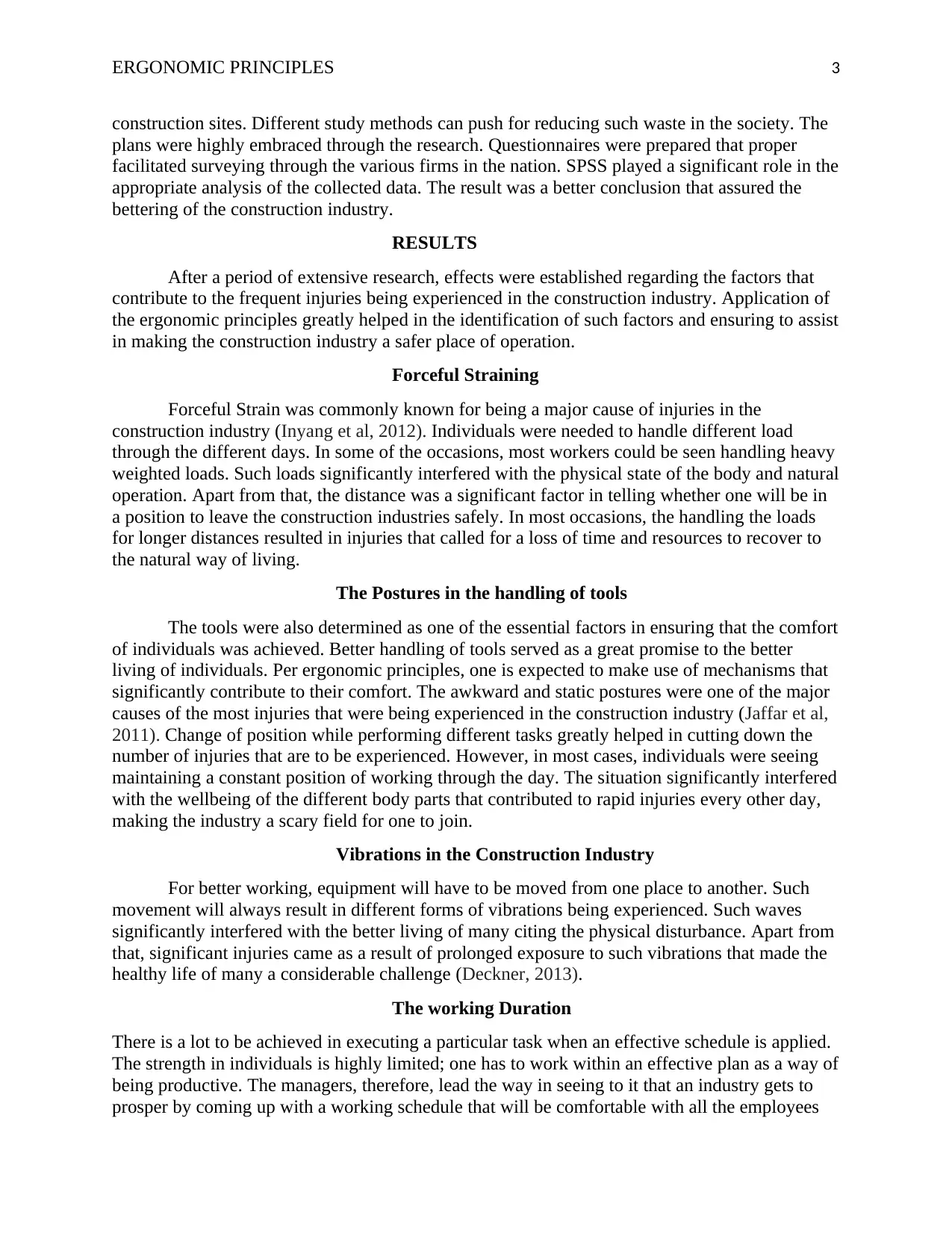
RESULTS
After a period of extensive research, effects were established regarding the factors that
contribute to the frequent injuries being experienced in the construction industry. Application of
the ergonomic principles greatly helped in the identification of such factors and ensuring to assist
in making the construction industry a safer place of operation.
Forceful Straining
Forceful Strain was commonly known for being a major cause of injuries in the
construction industry (Inyang et al, 2012). Individuals were needed to handle different load
through the different days. In some of the occasions, most workers could be seen handling heavy
weighted loads. Such loads significantly interfered with the physical state of the body and natural
operation. Apart from that, the distance was a significant factor in telling whether one will be in
a position to leave the construction industries safely. In most occasions, the handling the loads
for longer distances resulted in injuries that called for a loss of time and resources to recover to
the natural way of living.
The Postures in the handling of tools
The tools were also determined as one of the essential factors in ensuring that the comfort
of individuals was achieved. Better handling of tools served as a great promise to the better
living of individuals. Per ergonomic principles, one is expected to make use of mechanisms that
significantly contribute to their comfort. The awkward and static postures were one of the major
causes of the most injuries that were being experienced in the construction industry (Jaffar et al,
2011). Change of position while performing different tasks greatly helped in cutting down the
number of injuries that are to be experienced. However, in most cases, individuals were seeing
maintaining a constant position of working through the day. The situation significantly interfered
with the wellbeing of the different body parts that contributed to rapid injuries every other day,
making the industry a scary field for one to join.
Vibrations in the Construction Industry
For better working, equipment will have to be moved from one place to another. Such
movement will always result in different forms of vibrations being experienced. Such waves
significantly interfered with the better living of many citing the physical disturbance. Apart from
that, significant injuries came as a result of prolonged exposure to such vibrations that made the
healthy life of many a considerable challenge (Deckner, 2013).
The working Duration
There is a lot to be achieved in executing a particular task when an effective schedule is applied.
The strength in individuals is highly limited; one has to work within an effective plan as a way of
being productive. The managers, therefore, lead the way in seeing to it that an industry gets to
prosper by coming up with a working schedule that will be comfortable with all the employees
construction sites. Different study methods can push for reducing such waste in the society. The
plans were highly embraced through the research. Questionnaires were prepared that proper
facilitated surveying through the various firms in the nation. SPSS played a significant role in the
appropriate analysis of the collected data. The result was a better conclusion that assured the
bettering of the construction industry.
RESULTS
After a period of extensive research, effects were established regarding the factors that
contribute to the frequent injuries being experienced in the construction industry. Application of
the ergonomic principles greatly helped in the identification of such factors and ensuring to assist
in making the construction industry a safer place of operation.
Forceful Straining
Forceful Strain was commonly known for being a major cause of injuries in the
construction industry (Inyang et al, 2012). Individuals were needed to handle different load
through the different days. In some of the occasions, most workers could be seen handling heavy
weighted loads. Such loads significantly interfered with the physical state of the body and natural
operation. Apart from that, the distance was a significant factor in telling whether one will be in
a position to leave the construction industries safely. In most occasions, the handling the loads
for longer distances resulted in injuries that called for a loss of time and resources to recover to
the natural way of living.
The Postures in the handling of tools
The tools were also determined as one of the essential factors in ensuring that the comfort
of individuals was achieved. Better handling of tools served as a great promise to the better
living of individuals. Per ergonomic principles, one is expected to make use of mechanisms that
significantly contribute to their comfort. The awkward and static postures were one of the major
causes of the most injuries that were being experienced in the construction industry (Jaffar et al,
2011). Change of position while performing different tasks greatly helped in cutting down the
number of injuries that are to be experienced. However, in most cases, individuals were seeing
maintaining a constant position of working through the day. The situation significantly interfered
with the wellbeing of the different body parts that contributed to rapid injuries every other day,
making the industry a scary field for one to join.
Vibrations in the Construction Industry
For better working, equipment will have to be moved from one place to another. Such
movement will always result in different forms of vibrations being experienced. Such waves
significantly interfered with the better living of many citing the physical disturbance. Apart from
that, significant injuries came as a result of prolonged exposure to such vibrations that made the
healthy life of many a considerable challenge (Deckner, 2013).
The working Duration
There is a lot to be achieved in executing a particular task when an effective schedule is applied.
The strength in individuals is highly limited; one has to work within an effective plan as a way of
being productive. The managers, therefore, lead the way in seeing to it that an industry gets to
prosper by coming up with a working schedule that will be comfortable with all the employees
⊘ This is a preview!⊘
Do you want full access?
Subscribe today to unlock all pages.

Trusted by 1+ million students worldwide
ERGONOMIC PRINCIPLES 4
within the particular workstation. Despite the availability of such information, there have been
cases where overworking has been seeing as a way of pushing for higher incomes. The workers
are forced to work when they are to be on their holidays. The case greatly interferes with their
mental well-being. The allowances that could allow for the body to pick up and to regain its
usual way of working is cut. The result is that within a short period, their concentration drops
drastically leading to increased cases of carelessness stimulating several injuries being
experienced in the industry. Boredom has to be highly avoided while in the industry. The moods
of the different workers have to be active through the handling of the entire project. Such a form
of working will ensure each person gets to pay keen consultation on the more exceptional steps
pushing for high levels of activity through the operation (Song & Liang, 2011).
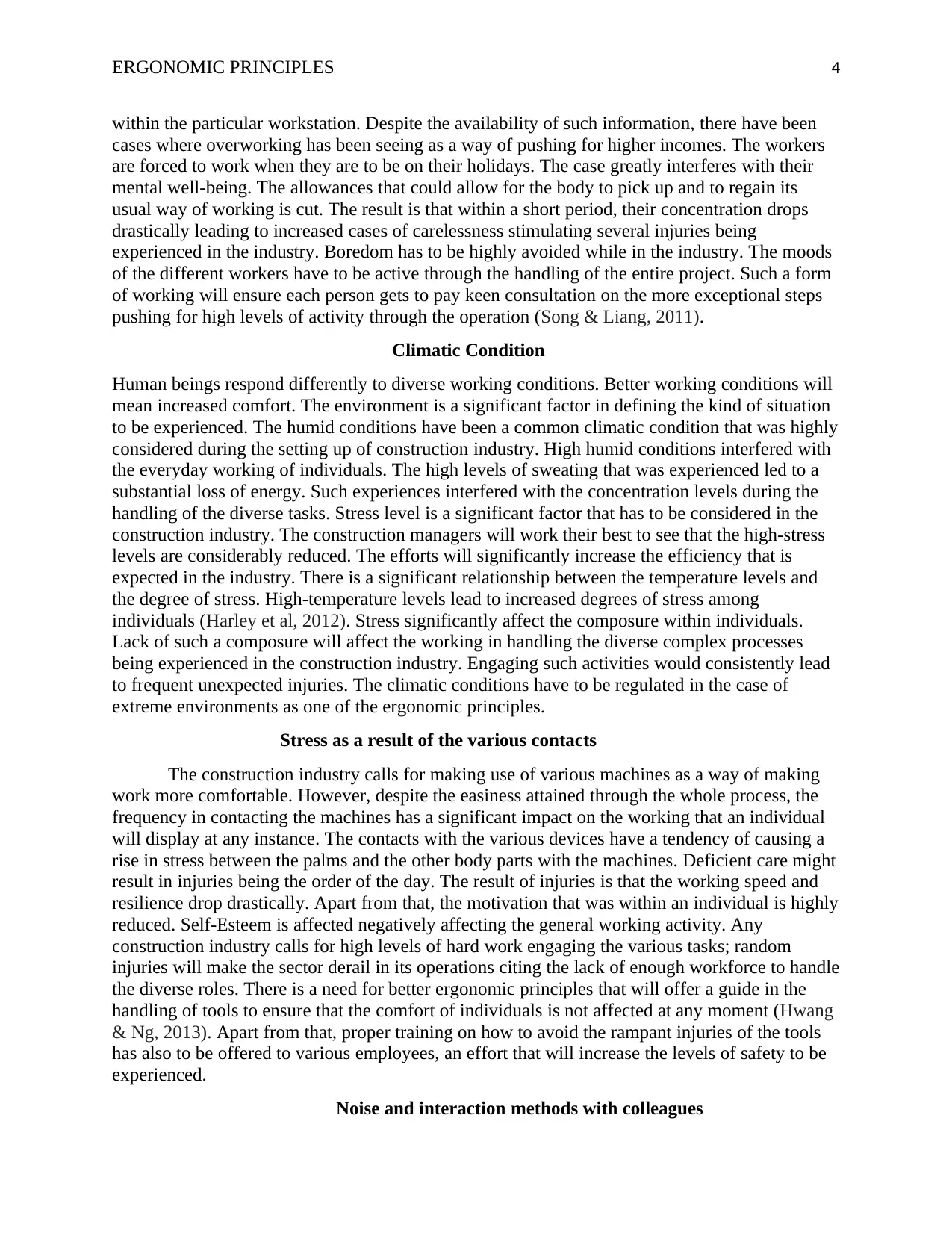
Climatic Condition
Human beings respond differently to diverse working conditions. Better working conditions will
mean increased comfort. The environment is a significant factor in defining the kind of situation
to be experienced. The humid conditions have been a common climatic condition that was highly
considered during the setting up of construction industry. High humid conditions interfered with
the everyday working of individuals. The high levels of sweating that was experienced led to a
substantial loss of energy. Such experiences interfered with the concentration levels during the
handling of the diverse tasks. Stress level is a significant factor that has to be considered in the
construction industry. The construction managers will work their best to see that the high-stress
levels are considerably reduced. The efforts will significantly increase the efficiency that is
expected in the industry. There is a significant relationship between the temperature levels and
the degree of stress. High-temperature levels lead to increased degrees of stress among
individuals (Harley et al, 2012). Stress significantly affect the composure within individuals.
Lack of such a composure will affect the working in handling the diverse complex processes
being experienced in the construction industry. Engaging such activities would consistently lead
to frequent unexpected injuries. The climatic conditions have to be regulated in the case of
extreme environments as one of the ergonomic principles.
Stress as a result of the various contacts
The construction industry calls for making use of various machines as a way of making
work more comfortable. However, despite the easiness attained through the whole process, the
frequency in contacting the machines has a significant impact on the working that an individual
will display at any instance. The contacts with the various devices have a tendency of causing a
rise in stress between the palms and the other body parts with the machines. Deficient care might
result in injuries being the order of the day. The result of injuries is that the working speed and
resilience drop drastically. Apart from that, the motivation that was within an individual is highly
reduced. Self-Esteem is affected negatively affecting the general working activity. Any
construction industry calls for high levels of hard work engaging the various tasks; random
injuries will make the sector derail in its operations citing the lack of enough workforce to handle
the diverse roles. There is a need for better ergonomic principles that will offer a guide in the
handling of tools to ensure that the comfort of individuals is not affected at any moment (Hwang
& Ng, 2013). Apart from that, proper training on how to avoid the rampant injuries of the tools
has also to be offered to various employees, an effort that will increase the levels of safety to be
experienced.
Noise and interaction methods with colleagues
within the particular workstation. Despite the availability of such information, there have been
cases where overworking has been seeing as a way of pushing for higher incomes. The workers
are forced to work when they are to be on their holidays. The case greatly interferes with their
mental well-being. The allowances that could allow for the body to pick up and to regain its
usual way of working is cut. The result is that within a short period, their concentration drops
drastically leading to increased cases of carelessness stimulating several injuries being
experienced in the industry. Boredom has to be highly avoided while in the industry. The moods
of the different workers have to be active through the handling of the entire project. Such a form
of working will ensure each person gets to pay keen consultation on the more exceptional steps
pushing for high levels of activity through the operation (Song & Liang, 2011).
Climatic Condition
Human beings respond differently to diverse working conditions. Better working conditions will
mean increased comfort. The environment is a significant factor in defining the kind of situation
to be experienced. The humid conditions have been a common climatic condition that was highly
considered during the setting up of construction industry. High humid conditions interfered with
the everyday working of individuals. The high levels of sweating that was experienced led to a
substantial loss of energy. Such experiences interfered with the concentration levels during the
handling of the diverse tasks. Stress level is a significant factor that has to be considered in the
construction industry. The construction managers will work their best to see that the high-stress
levels are considerably reduced. The efforts will significantly increase the efficiency that is
expected in the industry. There is a significant relationship between the temperature levels and
the degree of stress. High-temperature levels lead to increased degrees of stress among
individuals (Harley et al, 2012). Stress significantly affect the composure within individuals.
Lack of such a composure will affect the working in handling the diverse complex processes
being experienced in the construction industry. Engaging such activities would consistently lead
to frequent unexpected injuries. The climatic conditions have to be regulated in the case of
extreme environments as one of the ergonomic principles.
Stress as a result of the various contacts
The construction industry calls for making use of various machines as a way of making
work more comfortable. However, despite the easiness attained through the whole process, the
frequency in contacting the machines has a significant impact on the working that an individual
will display at any instance. The contacts with the various devices have a tendency of causing a
rise in stress between the palms and the other body parts with the machines. Deficient care might
result in injuries being the order of the day. The result of injuries is that the working speed and
resilience drop drastically. Apart from that, the motivation that was within an individual is highly
reduced. Self-Esteem is affected negatively affecting the general working activity. Any
construction industry calls for high levels of hard work engaging the various tasks; random
injuries will make the sector derail in its operations citing the lack of enough workforce to handle
the diverse roles. There is a need for better ergonomic principles that will offer a guide in the
handling of tools to ensure that the comfort of individuals is not affected at any moment (Hwang
& Ng, 2013). Apart from that, proper training on how to avoid the rampant injuries of the tools
has also to be offered to various employees, an effort that will increase the levels of safety to be
experienced.
Noise and interaction methods with colleagues
Paraphrase This Document
Need a fresh take? Get an instant paraphrase of this document with our AI Paraphraser
ERGONOMIC PRINCIPLES 5
The machines do not only cause physical injuries on the arms and the physical body
parts. The devices are also known for lots of noise especially when the servicing of the same was
poorly done. The construction industry makes use of machines almost at all levels of
construction. Therefore, there is a high possibility that with lots of noise from them, there will be
lots of discomfort through the whole process of handling the construction activities. Ergonomic
principles dictate that all machines have to be properly serviced before being put to use. Constant
checking of the machine after and before the next application will serve a significant purpose in
ensuring that the maintenance cost remains to be low and affordable through the construction
activity. Such kind of working method will be a great encouragement to any individual working
with the construction industry. Silencers are also of much importance in ensuring that the
unnecessary noises are eliminated and one is in a position to work with the first peace within
them. The workers of the construction sites have to be offered with the appropriate dressing that
will ensure no unnecessary noise gets into the ears of an individual. The peaceful and calm
environment will play a significant role in raising the level of concentration (Kang et al, 2016).
Apart from that, creativity will be at the highest peak the products of the general working being
at a peak every other day. A construction industry calls for several workers to work together to
achieve a particular purpose. The interaction between the different colleagues has a significant
influence on the kind of productivity that will be experienced. Peaceful coexistence will mean
that there will be lot of consultation. Apart from that, all challenges will be easily communicated
among individuals, and the creation of an almost perfect working environment will be much
easy.
Limitations
Regardless of the ease involved in handling the question surveys, most customers dislike
completing the review offered to them. As a result, they may end up ignoring some of the
questions provided to them. Such was primarily experienced that led to limited information being
collected regarding ergonomic principles in the construction industry. Frequent surveys were of
much importance in facilitating up to date information. However, there was a challenge in
carrying out numerous such surveys from individuals (Hunter, 2012). In most occasions, most of
them were irritated and completely ignored some of the studies.
Future Research
Several ergonomic techniques were recommended for better working. However, their
efficiency could not hit a hundred percent. There is a need for such data to be used by future
research personnel and establish better ergonomic techniques. Proper ranking of such factors will
contribute to the excellence that is to be experienced. The relative important index will be of
much of importance in facilitating the classification that is needed.
Conclusion
One of the primary industries in the society is the construction industry. The changes
experienced in society as a result of the efforts from the construction industry contributed to
making it a significant industry in addition to being relevant to the lives of many. The goals of
the society are majorly achieved by having better construction industries being guided by
excellence. The sector has several departments that offer guidance to its working. All
departments embracing perfection will mean that the world will be rising to perfection regarding
the shelter and the social infrastructure such as roads. There is a need for ensuring that the set
The machines do not only cause physical injuries on the arms and the physical body
parts. The devices are also known for lots of noise especially when the servicing of the same was
poorly done. The construction industry makes use of machines almost at all levels of
construction. Therefore, there is a high possibility that with lots of noise from them, there will be
lots of discomfort through the whole process of handling the construction activities. Ergonomic
principles dictate that all machines have to be properly serviced before being put to use. Constant
checking of the machine after and before the next application will serve a significant purpose in
ensuring that the maintenance cost remains to be low and affordable through the construction
activity. Such kind of working method will be a great encouragement to any individual working
with the construction industry. Silencers are also of much importance in ensuring that the
unnecessary noises are eliminated and one is in a position to work with the first peace within
them. The workers of the construction sites have to be offered with the appropriate dressing that
will ensure no unnecessary noise gets into the ears of an individual. The peaceful and calm
environment will play a significant role in raising the level of concentration (Kang et al, 2016).
Apart from that, creativity will be at the highest peak the products of the general working being
at a peak every other day. A construction industry calls for several workers to work together to
achieve a particular purpose. The interaction between the different colleagues has a significant
influence on the kind of productivity that will be experienced. Peaceful coexistence will mean
that there will be lot of consultation. Apart from that, all challenges will be easily communicated
among individuals, and the creation of an almost perfect working environment will be much
easy.
Limitations
Regardless of the ease involved in handling the question surveys, most customers dislike
completing the review offered to them. As a result, they may end up ignoring some of the
questions provided to them. Such was primarily experienced that led to limited information being
collected regarding ergonomic principles in the construction industry. Frequent surveys were of
much importance in facilitating up to date information. However, there was a challenge in
carrying out numerous such surveys from individuals (Hunter, 2012). In most occasions, most of
them were irritated and completely ignored some of the studies.
Future Research
Several ergonomic techniques were recommended for better working. However, their
efficiency could not hit a hundred percent. There is a need for such data to be used by future
research personnel and establish better ergonomic techniques. Proper ranking of such factors will
contribute to the excellence that is to be experienced. The relative important index will be of
much of importance in facilitating the classification that is needed.
Conclusion
One of the primary industries in the society is the construction industry. The changes
experienced in society as a result of the efforts from the construction industry contributed to
making it a significant industry in addition to being relevant to the lives of many. The goals of
the society are majorly achieved by having better construction industries being guided by
excellence. The sector has several departments that offer guidance to its working. All
departments embracing perfection will mean that the world will be rising to perfection regarding
the shelter and the social infrastructure such as roads. There is a need for ensuring that the set
ERGONOMIC PRINCIPLES 6
policies in the current society get to contribute in making the journey of perfection much easy
and enjoyable for those who will persevere through the whole process. Workers are the core bit
of the construction industry, and their effectivity significantly contributes to the superiority of the
entire nation. The mental, physical and economic state of the workers in the construction
industry will clearly define whether the sector is to experience a revolution soon. Constant
evaluation of the same will serve as the first step in ensuring that the self-esteem of the workers
in the construction industry remain active and up to the task regardless of the weight associated
with the industry and the nature of the risk being experienced. Failure to do so will serve as the
primary cause of a drop in their productivity hence being responsible for the losses to be made
by the governing agencies. Their wellbeing, therefore, counts much in telling the position of a
nation through its operation. Better ergonomic principles will motivate healthy living of the
workers. The process of coming up with such principles must, therefore, be handled with
ultimate professionalism to see to it that the implemented principles have a positive contribution
in the society. The step will serve as an encouragement to many yet to embrace such principles
through their working. Better principles will also mean that the precautionary measures to be
introduced in various schools to serve such a purpose will be way much better. Hence, the
injuries in the industry will be cut down through several generations. The functioning of the
nation will be at a different level. However, the writing does not mean an end in research. The
collected data will serve a significant purpose in seeing to it that new principles are developed
that will serve as an improvement to the current beliefs in existence.
policies in the current society get to contribute in making the journey of perfection much easy
and enjoyable for those who will persevere through the whole process. Workers are the core bit
of the construction industry, and their effectivity significantly contributes to the superiority of the
entire nation. The mental, physical and economic state of the workers in the construction
industry will clearly define whether the sector is to experience a revolution soon. Constant
evaluation of the same will serve as the first step in ensuring that the self-esteem of the workers
in the construction industry remain active and up to the task regardless of the weight associated
with the industry and the nature of the risk being experienced. Failure to do so will serve as the
primary cause of a drop in their productivity hence being responsible for the losses to be made
by the governing agencies. Their wellbeing, therefore, counts much in telling the position of a
nation through its operation. Better ergonomic principles will motivate healthy living of the
workers. The process of coming up with such principles must, therefore, be handled with
ultimate professionalism to see to it that the implemented principles have a positive contribution
in the society. The step will serve as an encouragement to many yet to embrace such principles
through their working. Better principles will also mean that the precautionary measures to be
introduced in various schools to serve such a purpose will be way much better. Hence, the
injuries in the industry will be cut down through several generations. The functioning of the
nation will be at a different level. However, the writing does not mean an end in research. The
collected data will serve a significant purpose in seeing to it that new principles are developed
that will serve as an improvement to the current beliefs in existence.
⊘ This is a preview!⊘
Do you want full access?
Subscribe today to unlock all pages.
Trusted by 1+ million students worldwide
ERGONOMIC PRINCIPLES 7
References
Danielson, C. (2013). The Framework for Teaching Evaluation Instrument, 2013 Instructionally
Focused Edition. Retrieved January, 17, 2017.
Deckner, F. (2013). Ground vibrations due to pile and sheet pile driving: influencing factors,
predictions and measurements(Doctoral dissertation, KTH Royal Institute of Technology).
Dul, J., Bruder, R., Buckle, P., Carayon, P., Falzon, P., Marras, W. S., ... & van der Doelen, B.
(2012). A strategy for human factors/ergonomics: developing the discipline and
profession. Ergonomics, 55(4), 377-395.
Goldin, C., & Katz, L. F. (2018). The race between education and technology. In Inequality in
the 21st Century (pp. 49-54). Routledge.
Guerrero, L. A., Maas, G., & Hogland, W. (2013). Solid waste management challenges for cities
in developing countries. Waste management, 33(1), 220-232.
Harley, C. D., Anderson, K. M., Demes, K. W., Jorve, J. P., Kordas, R. L., Coyle, T. A., &
Graham, M. H. (2012). Effects of climate change on global seaweed communities. Journal of
Phycology, 48(5), 1064-1078.
Hwang, B. G., & Ng, W. J. (2013). Project management knowledge and skills for green
construction: Overcoming challenges. International Journal of Project Management, 31(2), 272-
284.
Hunter, L. (2012). Challenging the reported disadvantages of e-questionnaires and addressing
methodological issues of online data collection. Nurse researcher, 20(1), 11.
Inyang, N., Al-Hussein, M., El-Rich, M., & Al-Jibouri, S. (2012). Ergonomic analysis and the
need for its integration for planning and assessing construction tasks. Journal of Construction
Engineering and Management, 138(12), 1370-1376.
Jaffar, N., Abdul-Tharim, A. H., Mohd-Kamar, I. F., & Lop, N. S. (2011). A literature review of
ergonomics risk factors in construction industry. Procedia Engineering, 20, 89-97.
Kang, J., Aletta, F., Gjestland, T. T., Brown, L. A., Botteldooren, D., Schulte-Fortkamp, B., ... &
Coelho, J. L. B. (2016). Ten questions on the soundscapes of the built environment. Building
and Environment, 108, 284-294.
Song, L., & Liang, D. (2011). Lean construction implementation and its implication on
sustainability: a contractor’s case study. Canadian Journal of Civil Engineering, 38(3), 350-359.
Yi, W., & Chan, A. P. (2013). Critical review of labor productivity research in construction
journals. Journal of management in engineering, 30(2), 214-225.
Yin, R. K. (2017). Case study research and applications: Design and methods. Sage
publications.
References
Danielson, C. (2013). The Framework for Teaching Evaluation Instrument, 2013 Instructionally
Focused Edition. Retrieved January, 17, 2017.
Deckner, F. (2013). Ground vibrations due to pile and sheet pile driving: influencing factors,
predictions and measurements(Doctoral dissertation, KTH Royal Institute of Technology).
Dul, J., Bruder, R., Buckle, P., Carayon, P., Falzon, P., Marras, W. S., ... & van der Doelen, B.
(2012). A strategy for human factors/ergonomics: developing the discipline and
profession. Ergonomics, 55(4), 377-395.
Goldin, C., & Katz, L. F. (2018). The race between education and technology. In Inequality in
the 21st Century (pp. 49-54). Routledge.
Guerrero, L. A., Maas, G., & Hogland, W. (2013). Solid waste management challenges for cities
in developing countries. Waste management, 33(1), 220-232.
Harley, C. D., Anderson, K. M., Demes, K. W., Jorve, J. P., Kordas, R. L., Coyle, T. A., &
Graham, M. H. (2012). Effects of climate change on global seaweed communities. Journal of
Phycology, 48(5), 1064-1078.
Hwang, B. G., & Ng, W. J. (2013). Project management knowledge and skills for green
construction: Overcoming challenges. International Journal of Project Management, 31(2), 272-
284.
Hunter, L. (2012). Challenging the reported disadvantages of e-questionnaires and addressing
methodological issues of online data collection. Nurse researcher, 20(1), 11.
Inyang, N., Al-Hussein, M., El-Rich, M., & Al-Jibouri, S. (2012). Ergonomic analysis and the
need for its integration for planning and assessing construction tasks. Journal of Construction
Engineering and Management, 138(12), 1370-1376.
Jaffar, N., Abdul-Tharim, A. H., Mohd-Kamar, I. F., & Lop, N. S. (2011). A literature review of
ergonomics risk factors in construction industry. Procedia Engineering, 20, 89-97.
Kang, J., Aletta, F., Gjestland, T. T., Brown, L. A., Botteldooren, D., Schulte-Fortkamp, B., ... &
Coelho, J. L. B. (2016). Ten questions on the soundscapes of the built environment. Building
and Environment, 108, 284-294.
Song, L., & Liang, D. (2011). Lean construction implementation and its implication on
sustainability: a contractor’s case study. Canadian Journal of Civil Engineering, 38(3), 350-359.
Yi, W., & Chan, A. P. (2013). Critical review of labor productivity research in construction
journals. Journal of management in engineering, 30(2), 214-225.
Yin, R. K. (2017). Case study research and applications: Design and methods. Sage
publications.

1 out of 7


Related Documents


Your All-in-One AI-Powered Toolkit for Academic Success.
+13062052269
info@desklib.com
Available 24*7 on WhatsApp / Email
![[object Object]](/_next/static/media/star-bottom.7253800d.svg)
Unlock your academic potential
Copyright © 2020–2026 A2Z Services. All Rights Reserved. Developed and managed by ZUCOL.