Investigating Glyphosate Resistance in Erigeron bonariensis: A Study
VerifiedAdded on 2020/02/24
|23
|6943
|76
Report
AI Summary
This report investigates the mechanisms of glyphosate resistance in Erigeron bonariensis, a close relative of Erigeron canadensis, aiming to determine if EPSPS and ABC transporter genes (M10 and M11) are responsible for resistance. The study involves RNA extraction from glyphosate-treated and untreated individuals collected from various sites. Quantitative PCR and RNA-Seq analysis are used to examine gene expression. Total RNA is used for cDNA library synthesis, sequenced via Illumina HiSeq, assembled using Trinity, and analyzed for differential expression and functional annotation. The introduction provides a comprehensive background on herbicide resistance, including its history, the impact of glyphosate, and the two main resistance mechanisms: target-site and non-target site resistance. It discusses the evolution of glyphosate resistance in various weed species, the role of EPSPS, and the importance of translocation in herbicide efficacy. The report also reviews previous studies on glyphosate resistance in other plant species, highlighting different mechanisms and the significance of ABC transporters. The research seeks to determine if the resistance observed in E. bonariensis involves similar mechanisms or if other genes are responsible.
ABSTRACT
Herbicide resistance is the heritable ability of weeds to survive and reproduce in the presence of
herbicide doses that are lethal to the wild type of the species. One mechanism of such resistance
is non-target site reduced translocation of the herbicide, in which vacuolar sequestration prevents
the chemical from spreading around the plant. Resistance of Erigeron canadensis to glyphosate
is thought to involve this mechanism and it is believed that EPSPS and the ABC transporter
genes M10 and M11 may be responsible for this resistance. This study therefore aims at
determining through quantitative PCR and RNA-Seq if these genes provide the mechanism for
glyphosate resistance in Erigeron bonariensis, a close relative of Erigeron canadensis, or if there
are other genes responsible for the resistance observed in this species. RNA will be extracted
from the leaves of glyphosate treated and untreated individuals, collected from 10 sites in the
Central Valley and two control populations of Erigeron bonariensis, for quantitative real time
PCR and RNA-Seq analysis. Total RNA for RNA-Seq analysis will be used in cDNA library
synthesis and sequenced via Illumina HiSeq. Sequenced reads will be assembled de novo using
the software Trinity, assigned to respective genes with the pipeline HTSeq, tested for differential
expression by DESeq and functionally annotated using the NCBI nonredundant protein (Nr)
database.
1
Herbicide resistance is the heritable ability of weeds to survive and reproduce in the presence of
herbicide doses that are lethal to the wild type of the species. One mechanism of such resistance
is non-target site reduced translocation of the herbicide, in which vacuolar sequestration prevents
the chemical from spreading around the plant. Resistance of Erigeron canadensis to glyphosate
is thought to involve this mechanism and it is believed that EPSPS and the ABC transporter
genes M10 and M11 may be responsible for this resistance. This study therefore aims at
determining through quantitative PCR and RNA-Seq if these genes provide the mechanism for
glyphosate resistance in Erigeron bonariensis, a close relative of Erigeron canadensis, or if there
are other genes responsible for the resistance observed in this species. RNA will be extracted
from the leaves of glyphosate treated and untreated individuals, collected from 10 sites in the
Central Valley and two control populations of Erigeron bonariensis, for quantitative real time
PCR and RNA-Seq analysis. Total RNA for RNA-Seq analysis will be used in cDNA library
synthesis and sequenced via Illumina HiSeq. Sequenced reads will be assembled de novo using
the software Trinity, assigned to respective genes with the pipeline HTSeq, tested for differential
expression by DESeq and functionally annotated using the NCBI nonredundant protein (Nr)
database.
1

Paraphrase This Document
Need a fresh take? Get an instant paraphrase of this document with our AI Paraphraser
INTRODUCTION
Moss (2002) defines herbicide resistance as the heritable ability of weeds to survive and
reproduce in the presence of herbicide doses that are lethal to the wild type of the species.
Herbicide resistance was first observed by an ornamental nursery owner in 1968 (Jasieniuk at al.
1996). The first of resistance to herbicide was recorded in Senecio vulgaris; at which seeds from
the resistant biotypes were found to resist the chemicals simazine and atrazine (Pieterse 2010). In
1974, resistance to glyphosate herbicide became a problem for corn growers (Gressel et al.
1982). Since then, more than 187 species of weeds throughout the globe have developed
resistance against various herbicides which have targeted a broad range of biochemical processes
(Pieterse 2010). The first case of herbicide resistance was reported in 1981 at UC Riverside,
California (Holt at al. 1981) and recently, more species which are have also evolved resistance to
various other herbicide chemicals employed by farmers in California (Malone 2014).
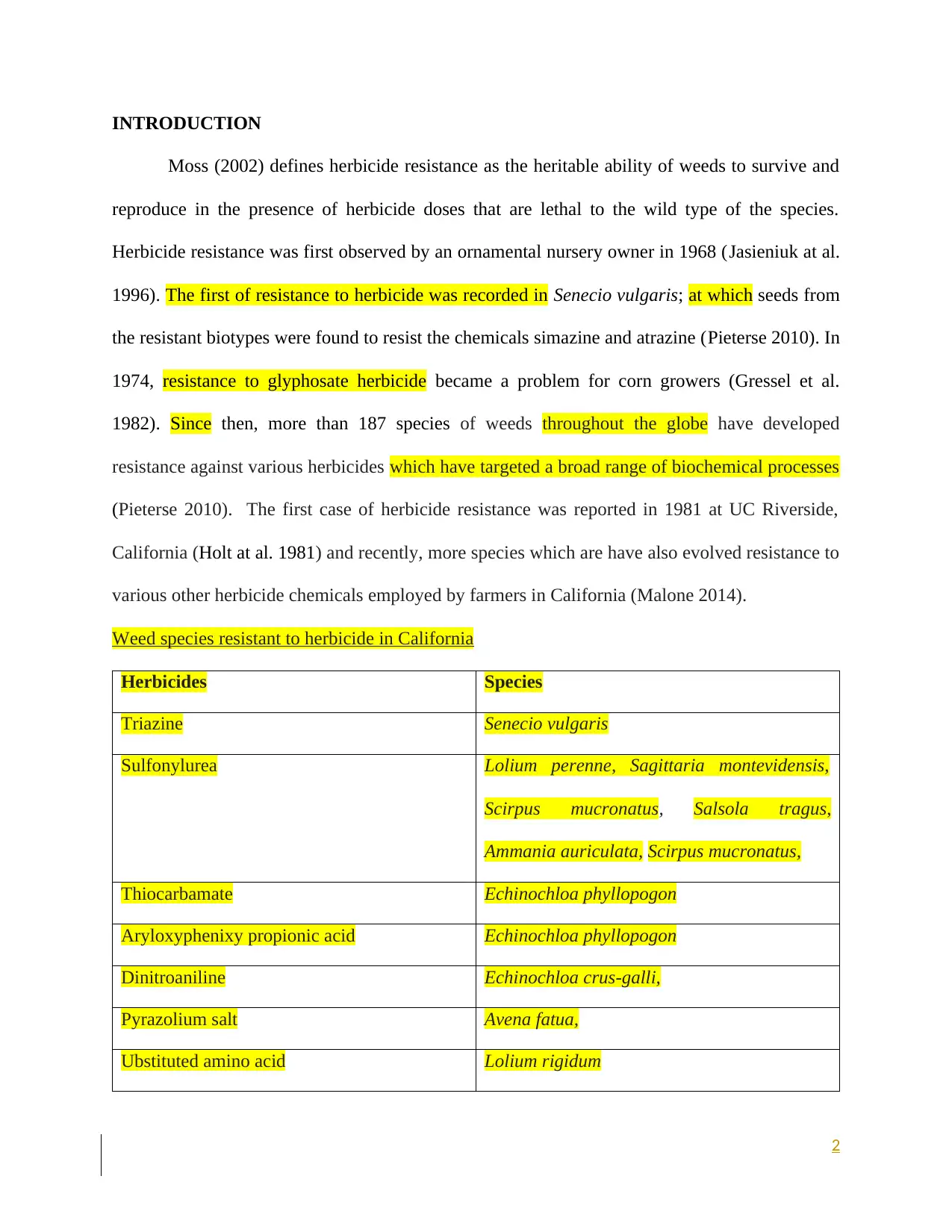
Weed species resistant to herbicide in California
Herbicides Species
Triazine Senecio vulgaris
Sulfonylurea Lolium perenne, Sagittaria montevidensis,
Scirpus mucronatus, Salsola tragus,
Ammania auriculata, Scirpus mucronatus,
Thiocarbamate Echinochloa phyllopogon
Aryloxyphenixy propionic acid Echinochloa phyllopogon
Dinitroaniline Echinochloa crus-galli,
Pyrazolium salt Avena fatua,
Ubstituted amino acid Lolium rigidum
2
Moss (2002) defines herbicide resistance as the heritable ability of weeds to survive and
reproduce in the presence of herbicide doses that are lethal to the wild type of the species.
Herbicide resistance was first observed by an ornamental nursery owner in 1968 (Jasieniuk at al.
1996). The first of resistance to herbicide was recorded in Senecio vulgaris; at which seeds from
the resistant biotypes were found to resist the chemicals simazine and atrazine (Pieterse 2010). In
1974, resistance to glyphosate herbicide became a problem for corn growers (Gressel et al.
1982). Since then, more than 187 species of weeds throughout the globe have developed
resistance against various herbicides which have targeted a broad range of biochemical processes
(Pieterse 2010). The first case of herbicide resistance was reported in 1981 at UC Riverside,
California (Holt at al. 1981) and recently, more species which are have also evolved resistance to
various other herbicide chemicals employed by farmers in California (Malone 2014).
Weed species resistant to herbicide in California
Herbicides Species
Triazine Senecio vulgaris
Sulfonylurea Lolium perenne, Sagittaria montevidensis,
Scirpus mucronatus, Salsola tragus,
Ammania auriculata, Scirpus mucronatus,
Thiocarbamate Echinochloa phyllopogon
Aryloxyphenixy propionic acid Echinochloa phyllopogon
Dinitroaniline Echinochloa crus-galli,
Pyrazolium salt Avena fatua,
Ubstituted amino acid Lolium rigidum
2
Glyphosate herbicide (marketed by Monsanto as RoundUp®) contains N-
phosphonomethyl glycine that acts against plants by hindering aromatic amino acid synthesis
(Bridges 2003). Upon application on leaves, the plant takes in glyphosate through pores and is
transported through the phloem alongside with other products of photosynthesis to all parts of the
plant. In susceptible plants, glyphosate hinders the role of the plastidine enzyme 5-
enolpiruvilshikimate-3-phosphate synthase (EPSPS) important in the prechorismate step of the
shikimate pathway. In the absence of glyphosate, this enzyme works by condensing shikimate-3-
phosphate and phosphoenolpyruvate into 5-enolpiruvilshikimate-3-phosphate (EPSP) with
inorganic phosphate, initiating the anabolism of aromatic amino acids (Ferreira 2008).
Disruption of the synthesis of aromatic amino acids (phenylalanine, tryptophan, and tyrosine)
eventually kills the plant (Herman and Weaver 1999).
Glyphosate has become the world’s most commonly used herbicide since its market
introduction in 1974 (Baylis 2000). Its use around the globe is contributed by several factors to
make it the most utilized herbicide. The ideal characteristics that it has include the potency
against an extensive variety of species (monocots and dicots), less harmful activity against
animals than other herbicides (the enzyme EPSPS which is not found in animals), rapid
microbial degeneration and low cost (Duke and Powles 2008). Also, it has been commonly used
in recent years as a part of reduced tillage frameworks with a dependence on herbicides to
control weeds that have numerous environmental benefits and economic importance (Owen
2008; Powles 2008; Shaner 2000). With the adoption of genetically modified crops with
glyphosate resistance in 1996, the already high levels of glyphosate application increased
(Powles & Preston 2006). The combined effects of glyphosate ignorant over-usage in glyphosate
resistant hairy fleabane and completely reduced tillage has created an agricultural environment
3
phosphonomethyl glycine that acts against plants by hindering aromatic amino acid synthesis
(Bridges 2003). Upon application on leaves, the plant takes in glyphosate through pores and is
transported through the phloem alongside with other products of photosynthesis to all parts of the
plant. In susceptible plants, glyphosate hinders the role of the plastidine enzyme 5-
enolpiruvilshikimate-3-phosphate synthase (EPSPS) important in the prechorismate step of the
shikimate pathway. In the absence of glyphosate, this enzyme works by condensing shikimate-3-
phosphate and phosphoenolpyruvate into 5-enolpiruvilshikimate-3-phosphate (EPSP) with
inorganic phosphate, initiating the anabolism of aromatic amino acids (Ferreira 2008).
Disruption of the synthesis of aromatic amino acids (phenylalanine, tryptophan, and tyrosine)
eventually kills the plant (Herman and Weaver 1999).
Glyphosate has become the world’s most commonly used herbicide since its market
introduction in 1974 (Baylis 2000). Its use around the globe is contributed by several factors to
make it the most utilized herbicide. The ideal characteristics that it has include the potency
against an extensive variety of species (monocots and dicots), less harmful activity against
animals than other herbicides (the enzyme EPSPS which is not found in animals), rapid
microbial degeneration and low cost (Duke and Powles 2008). Also, it has been commonly used
in recent years as a part of reduced tillage frameworks with a dependence on herbicides to
control weeds that have numerous environmental benefits and economic importance (Owen
2008; Powles 2008; Shaner 2000). With the adoption of genetically modified crops with
glyphosate resistance in 1996, the already high levels of glyphosate application increased
(Powles & Preston 2006). The combined effects of glyphosate ignorant over-usage in glyphosate
resistant hairy fleabane and completely reduced tillage has created an agricultural environment
3
⊘ This is a preview!⊘
Do you want full access?
Subscribe today to unlock all pages.

Trusted by 1+ million students worldwide
that has an increased risk of evolution of glyphosate resistance (Neve at al. 2003). Herbicide
resistance is stimulated by the re-current use of herbicides with the same active chemical
ingredients (LeBaron 1991), and so inevitably, glyphosate resistance has evolved in many weeds
(Powles et al. 1998). Because of its ability to control numerous weed species adaptability to low
tillage systems, and low animal toxicity result in increased glyphosate remaining to be a key
factor in modern systems because growers are unwilling to return to the greater tillage systems or
older, more toxic herbicides (Beckie 2012).
Two mechanisms that confer resistance have contributed to glyphosate resistance in
weeds are target-site and non-target site resistance (REF). Target site-based resistance is a
condition where resistance evolves due to a gene mutation resulting in a structural or chemical
change to a target site enzyme so that the herbicide fails to effectively inhibit the normal enzyme
function (Powles and Preston 2006). The missense mutation may involve a specific nucleotide
substitution in the coding region producing a different amino acid that results in structural,
hydrophobicity or charge change in site of the enzyme that the herbicide targets, making it less
sensitive to inhibition by the herbicide. A few weeds such as goosegrass (Eleusine indica (L.)
Gaertn.), have evolved weak target site mutagenesis (Lee and Ngim, 2000; Dinelli et al. 2006) of
the enzyme EPSPS, via a substitution mutation that replaced the amino acid proline with serine
at position 106 (Pro106-Ser). Ng et al. (2004 & 2005) demonstrated that substitution of proline
by threonine (Pro106-Thr) confers resistance glyphosate resistance to goosegrass The mutated
EPSPS enzyme has a low affinity for glyphosate but almost normal affinity for phosphoenol
pyruvate (the enzyme’s usual substrate); permitting the shikimate pathway can proceed normally
even in the presence of glyphosate (Gaines et al. 2010).
4
resistance is stimulated by the re-current use of herbicides with the same active chemical
ingredients (LeBaron 1991), and so inevitably, glyphosate resistance has evolved in many weeds
(Powles et al. 1998). Because of its ability to control numerous weed species adaptability to low
tillage systems, and low animal toxicity result in increased glyphosate remaining to be a key
factor in modern systems because growers are unwilling to return to the greater tillage systems or
older, more toxic herbicides (Beckie 2012).
Two mechanisms that confer resistance have contributed to glyphosate resistance in
weeds are target-site and non-target site resistance (REF). Target site-based resistance is a
condition where resistance evolves due to a gene mutation resulting in a structural or chemical
change to a target site enzyme so that the herbicide fails to effectively inhibit the normal enzyme
function (Powles and Preston 2006). The missense mutation may involve a specific nucleotide
substitution in the coding region producing a different amino acid that results in structural,
hydrophobicity or charge change in site of the enzyme that the herbicide targets, making it less
sensitive to inhibition by the herbicide. A few weeds such as goosegrass (Eleusine indica (L.)
Gaertn.), have evolved weak target site mutagenesis (Lee and Ngim, 2000; Dinelli et al. 2006) of
the enzyme EPSPS, via a substitution mutation that replaced the amino acid proline with serine
at position 106 (Pro106-Ser). Ng et al. (2004 & 2005) demonstrated that substitution of proline
by threonine (Pro106-Thr) confers resistance glyphosate resistance to goosegrass The mutated
EPSPS enzyme has a low affinity for glyphosate but almost normal affinity for phosphoenol
pyruvate (the enzyme’s usual substrate); permitting the shikimate pathway can proceed normally
even in the presence of glyphosate (Gaines et al. 2010).
4
Paraphrase This Document
Need a fresh take? Get an instant paraphrase of this document with our AI Paraphraser
Non-target site mutations including sequestration and detoxification in addition to
translocation function by limiting the translocation of glyphosate (Wakelin et al. 2004) to target
sites. According to Claus and Brehrens’ (1976) study-rapid and widespread glyphosate
translocation is necessary to achieve high herbicide efficacy. There is therefore a possibility that
changes in its translocation may confer resistance. The study that unraveled this phenomenon
was carried out in rigid ryegrass (Lolium rigidum Gaud.; Lorraine-Colwill et al. 2002), and
indicated that resistance in at least one biotype was not due to EPSPS enzyme target mutagenesis
or degradation. In the same study, it was shown that there was no significant difference between
glyphosate resistance and susceptible species in EPSPS sensitivity or expression level or in
glyphosate absorption. However, the patters of glyphosate translocation differed. The
researchers observed accumulation of glyphosate at lower parts of the plant through diffusion
and to some extend in the roots in susceptible plants whereas in resistant plants, it accumulated
in the tip of the leaves through transpiration with a negligible amount transported to the roots
(Lorraine-Colwill et al. 2002). (Welkelin et al. 2004) found the same pattern of reduced
glyphosate translocation when working with only four glyphosate resistant ryegrass populations
in Australia.
Researchers investigating mechanisms of glyphosate resistance in all Lolium rigidum
species have not found large differences in glyphosate translocation. Perez et al. (2004) found no
significant difference in glyphosate absorption and translocation between susceptible and
resistant Chilean Lolium plants. In an investigation in glyphosate resistance in Californian
Lolium, Simarmata et al. (2003) found significantly higher glyphosate concentration in treated
leaves of glyphosate resistant plants 2-3 days after treatment. Interestingly, these authors
observed no other significant differences in glyphosate absorption or translocation between
5
translocation function by limiting the translocation of glyphosate (Wakelin et al. 2004) to target
sites. According to Claus and Brehrens’ (1976) study-rapid and widespread glyphosate
translocation is necessary to achieve high herbicide efficacy. There is therefore a possibility that
changes in its translocation may confer resistance. The study that unraveled this phenomenon
was carried out in rigid ryegrass (Lolium rigidum Gaud.; Lorraine-Colwill et al. 2002), and
indicated that resistance in at least one biotype was not due to EPSPS enzyme target mutagenesis
or degradation. In the same study, it was shown that there was no significant difference between
glyphosate resistance and susceptible species in EPSPS sensitivity or expression level or in
glyphosate absorption. However, the patters of glyphosate translocation differed. The
researchers observed accumulation of glyphosate at lower parts of the plant through diffusion
and to some extend in the roots in susceptible plants whereas in resistant plants, it accumulated
in the tip of the leaves through transpiration with a negligible amount transported to the roots
(Lorraine-Colwill et al. 2002). (Welkelin et al. 2004) found the same pattern of reduced
glyphosate translocation when working with only four glyphosate resistant ryegrass populations
in Australia.
Researchers investigating mechanisms of glyphosate resistance in all Lolium rigidum
species have not found large differences in glyphosate translocation. Perez et al. (2004) found no
significant difference in glyphosate absorption and translocation between susceptible and
resistant Chilean Lolium plants. In an investigation in glyphosate resistance in Californian
Lolium, Simarmata et al. (2003) found significantly higher glyphosate concentration in treated
leaves of glyphosate resistant plants 2-3 days after treatment. Interestingly, these authors
observed no other significant differences in glyphosate absorption or translocation between
5
resistant and susceptible plants (Lorraine-Colwill et al. 2002). These varying results suggest
potentially different non-target resistance mechanisms to glyphosate in different Lolium
populations. In general, most studies observed no differences in glyphosate absorption, but with
phloem translocation reduced greatly (Feng et al. 2004; Koger and Reddy 2005) in resistant
species. Failure of glyphosate translocation from leaves to the roots seems to be important
mechanisms that lead to resistance in certain Lolium biotypes (Preston 2002).
Erigeron species are annual or short-lived perennial plants native to the Americas that
have in the recent past become cosmopolitan and invasive weeds of many crops and arable lands
(Prieur-Richard et al. 2000). The genus is in the sunflower family (Asteraceae) and the weed
species were formerly placed in the genus Conyza before taxonomic revision ( Baldwin, 2012).
Erigeron spp. are prolific seed producers: a single plant is capable of producing thousands of
viable wind dispersed seeds (Weaver 2001; Shields et al. 2006).
Erigeron spp. have become very common and problematic weedy plants in agronomic
crops around the world (Weaver 2001). This is probably because they are capable of adapting to
plain soils where they establish in the absence of tillage (Buhler 1992). The opportunistic nature
of Erigeron in undisturbed areas makes them well- suited for becoming established in
agricultural fields and surrounding areas; particularly in no-tillage or where tillage is minimal
(Bruce and Kells 1990). Considering the fact that over the last two decades the amount of crop
hectares in conservation tillage has increased in is=n CA (Young 2006), weeds such as Erigeron
spp. are becoming a great concern.
The two main species of Erigeron in California are hairy fleabane (Erigeron bonariensis
L.) and horseweed (Erigeron canadensis L.), both summer annuals. Unlike horseweed, which is
weedy across the U.S., fleabane is an agricultural problem specific to California (Shrestha 2008).
6
potentially different non-target resistance mechanisms to glyphosate in different Lolium
populations. In general, most studies observed no differences in glyphosate absorption, but with
phloem translocation reduced greatly (Feng et al. 2004; Koger and Reddy 2005) in resistant
species. Failure of glyphosate translocation from leaves to the roots seems to be important
mechanisms that lead to resistance in certain Lolium biotypes (Preston 2002).
Erigeron species are annual or short-lived perennial plants native to the Americas that
have in the recent past become cosmopolitan and invasive weeds of many crops and arable lands
(Prieur-Richard et al. 2000). The genus is in the sunflower family (Asteraceae) and the weed
species were formerly placed in the genus Conyza before taxonomic revision ( Baldwin, 2012).
Erigeron spp. are prolific seed producers: a single plant is capable of producing thousands of
viable wind dispersed seeds (Weaver 2001; Shields et al. 2006).
Erigeron spp. have become very common and problematic weedy plants in agronomic
crops around the world (Weaver 2001). This is probably because they are capable of adapting to
plain soils where they establish in the absence of tillage (Buhler 1992). The opportunistic nature
of Erigeron in undisturbed areas makes them well- suited for becoming established in
agricultural fields and surrounding areas; particularly in no-tillage or where tillage is minimal
(Bruce and Kells 1990). Considering the fact that over the last two decades the amount of crop
hectares in conservation tillage has increased in is=n CA (Young 2006), weeds such as Erigeron
spp. are becoming a great concern.
The two main species of Erigeron in California are hairy fleabane (Erigeron bonariensis
L.) and horseweed (Erigeron canadensis L.), both summer annuals. Unlike horseweed, which is
weedy across the U.S., fleabane is an agricultural problem specific to California (Shrestha 2008).
6
⊘ This is a preview!⊘
Do you want full access?
Subscribe today to unlock all pages.
Trusted by 1+ million students worldwide
The optimal temperature for germination of hairy fleabane ranges between 2.03 and 2.34 degrees
centigrade and the seeds usually germinate under moderate water availability conditions
(Karlsson and Milberg, 2007). Based on these characteristics, conditions are ideal for fleabane
germination in the cooler seasons of California’s Central Valley, October-March. Hairy fleabane
has adapted to a wide range of conditions ranging from irrigated vineyard and orchard systems
dry non-crop areas (Shrestha et al. 2014). Information is available concerning the economic
impact of hairy fleabane (Pandolfo et al. 2016).
Erigeron bonariensis have been shown to exhibit high concentration of glyphosate in the
southern Central Valley of California (Okada et al. 2013), but the actual resistance mechanism is
still obscure, especially the dynamics that occur at the genetic level that bring about the plant
obscuring glyphosate resistance. A number of studies have been performed on fleabane’s close
relative, E. canadensis, in an attempt to establish the presence or absence of target site mutations
at codon 106 of the EPSPS gene, as well the synchronization mechanism of EPSPS enzyme
overexpression levels (Tani et al. 2015). However, the presence and number of these genes and
their specific roles in glyphosate resistance in fleabane have not been established. The ABC
transporter genes’ expression relationship with glyphosate transport in the resistant biotypes
needs to be examined in Hairy fleabane (Tani et al. 2015), and the fact that reduced translocation
is the suspected mechanism of glyphosate resistance in fleabane from other parts of the world
(Ferreira et al. 2008). It is also imperative to examine target mutations in the EPSPS gene
(Gaines et al. 2010), are involved in fleabane glyphosate resistance. In addition to identifying the
known target site mutation in EPSPS (Pro106 in Lolium rigidum), it is important to determine if
there are other mutations that confer target site resistance via changes in the EPSPS enzyme
itself.
7
centigrade and the seeds usually germinate under moderate water availability conditions
(Karlsson and Milberg, 2007). Based on these characteristics, conditions are ideal for fleabane
germination in the cooler seasons of California’s Central Valley, October-March. Hairy fleabane
has adapted to a wide range of conditions ranging from irrigated vineyard and orchard systems
dry non-crop areas (Shrestha et al. 2014). Information is available concerning the economic
impact of hairy fleabane (Pandolfo et al. 2016).
Erigeron bonariensis have been shown to exhibit high concentration of glyphosate in the
southern Central Valley of California (Okada et al. 2013), but the actual resistance mechanism is
still obscure, especially the dynamics that occur at the genetic level that bring about the plant
obscuring glyphosate resistance. A number of studies have been performed on fleabane’s close
relative, E. canadensis, in an attempt to establish the presence or absence of target site mutations
at codon 106 of the EPSPS gene, as well the synchronization mechanism of EPSPS enzyme
overexpression levels (Tani et al. 2015). However, the presence and number of these genes and
their specific roles in glyphosate resistance in fleabane have not been established. The ABC
transporter genes’ expression relationship with glyphosate transport in the resistant biotypes
needs to be examined in Hairy fleabane (Tani et al. 2015), and the fact that reduced translocation
is the suspected mechanism of glyphosate resistance in fleabane from other parts of the world
(Ferreira et al. 2008). It is also imperative to examine target mutations in the EPSPS gene
(Gaines et al. 2010), are involved in fleabane glyphosate resistance. In addition to identifying the
known target site mutation in EPSPS (Pro106 in Lolium rigidum), it is important to determine if
there are other mutations that confer target site resistance via changes in the EPSPS enzyme
itself.
7
Paraphrase This Document
Need a fresh take? Get an instant paraphrase of this document with our AI Paraphraser
Candidate ABC transporter genes for our study were selected based on previous research
on horseweed where it was demonstrated that application of glyphosate to either resistant or
susceptible biotypes did not influence EPSPS gene extension, but ABC transporter genes M10
and M11 were tremendously upregulated in the resistant plants but not in the non-resistant
biotypes (Nol et al. 2012). This suggests a possible role of M11 and M10 ABC transporter genes
in resistance to glyphosate in Erigeron Canadensis (horseweed). These ABC transporters may
function to sequester glyphosate into the vacuole resulting in a non-target site mechanism of
glyphosate resistance in horseweed (Peng et al. 2010).
P450 genes have been demonstrated to play an important role in mediating non-target
herbicide resistance. An affirmation of the relationship between p450 enzyme activity and
herbicide resistance in weeds by Yuan et al. (2007), suggested that this class of genes also
contributes to the difficulty with which the weeds are eliminated. P450 genes code for several
enzymes that can participate in herbicide detoxification in phase 1 metabolic processes. Their
expression products bring about reactions such as hydroxylation, decarboxylation, and
deamination, among other processes that all aim at neutralizing the toxin in the plant body
(Morant et al. 2003). The p450 enzymes have been shown synchronized with phase 2 detoxifying
enzymes to ensure that herbicide effects are neutralized in the plant body (Menendez et al. 1996).
Even though no specific p450 genes have yet been identified from herbicide resistant weeds,
p450 genes are candidates for study via RNA-Seg in glyphosate-resistant hairy fleabane to
determine whether they are unregulated in resistant plants before or after glyphosate treatment,
and if so, whether they work in conjunction with other relevant detoxification genes.
Weeds are very competitive for resources, both above and below ground, and therefore
contribute to reduction in crop yield. As herbicides are the most commonly used weed control
8
on horseweed where it was demonstrated that application of glyphosate to either resistant or
susceptible biotypes did not influence EPSPS gene extension, but ABC transporter genes M10
and M11 were tremendously upregulated in the resistant plants but not in the non-resistant
biotypes (Nol et al. 2012). This suggests a possible role of M11 and M10 ABC transporter genes
in resistance to glyphosate in Erigeron Canadensis (horseweed). These ABC transporters may
function to sequester glyphosate into the vacuole resulting in a non-target site mechanism of
glyphosate resistance in horseweed (Peng et al. 2010).
P450 genes have been demonstrated to play an important role in mediating non-target
herbicide resistance. An affirmation of the relationship between p450 enzyme activity and
herbicide resistance in weeds by Yuan et al. (2007), suggested that this class of genes also
contributes to the difficulty with which the weeds are eliminated. P450 genes code for several
enzymes that can participate in herbicide detoxification in phase 1 metabolic processes. Their
expression products bring about reactions such as hydroxylation, decarboxylation, and
deamination, among other processes that all aim at neutralizing the toxin in the plant body
(Morant et al. 2003). The p450 enzymes have been shown synchronized with phase 2 detoxifying
enzymes to ensure that herbicide effects are neutralized in the plant body (Menendez et al. 1996).
Even though no specific p450 genes have yet been identified from herbicide resistant weeds,
p450 genes are candidates for study via RNA-Seg in glyphosate-resistant hairy fleabane to
determine whether they are unregulated in resistant plants before or after glyphosate treatment,
and if so, whether they work in conjunction with other relevant detoxification genes.
Weeds are very competitive for resources, both above and below ground, and therefore
contribute to reduction in crop yield. As herbicides are the most commonly used weed control
8
method, weed populations are subject to significant evolutionary pressure for the mechanisms to
survive herbicide exposure. This herbicide selection pressure has been present for decades in
weed population- resulting in herbicide efficacy and rising crop losses (Green et al. 2008).
Information about the genetic basis of herbicide resistance is key in effective weed management
and has the potential to bolster agricultural productivity. Elucidating the role of both target site
and non-target mutations in resistance to various chemicals is important in the genetic
engineering of crop plant resistance, especially by plant transformation techniques. Modern
molecular biology techniques permit the determination of the genes that are upregulated in
response to herbicide exposure in particular weed species, to begin to decipher the mechanisms
behind non-target-site-based resistance (NTSR). The aim of this study is to elaborate on the
specific role of the p450 genes in herbicide resistance in fleabane and identify, any additional
target and non-target mutations that may yet be undiscovered,. This study will reaffirm the
presence of glyphosate-resistant genes in hairy fleabane in the Central Valley; and will identify
whether it has evolved once or multiple times,. This information is critical to the cultivators to
ensure that effective and sustainable weed management and control strategies are put in place.
SPECIFIC AIMS
Broad Objective: To identify the presence of genetic basis of glyphosate (RoundUp®)
resistance in Central Valley population of the agricultural weed fleabane (Erigeron bonariensis
L.).
9
survive herbicide exposure. This herbicide selection pressure has been present for decades in
weed population- resulting in herbicide efficacy and rising crop losses (Green et al. 2008).
Information about the genetic basis of herbicide resistance is key in effective weed management
and has the potential to bolster agricultural productivity. Elucidating the role of both target site
and non-target mutations in resistance to various chemicals is important in the genetic
engineering of crop plant resistance, especially by plant transformation techniques. Modern
molecular biology techniques permit the determination of the genes that are upregulated in
response to herbicide exposure in particular weed species, to begin to decipher the mechanisms
behind non-target-site-based resistance (NTSR). The aim of this study is to elaborate on the
specific role of the p450 genes in herbicide resistance in fleabane and identify, any additional
target and non-target mutations that may yet be undiscovered,. This study will reaffirm the
presence of glyphosate-resistant genes in hairy fleabane in the Central Valley; and will identify
whether it has evolved once or multiple times,. This information is critical to the cultivators to
ensure that effective and sustainable weed management and control strategies are put in place.
SPECIFIC AIMS
Broad Objective: To identify the presence of genetic basis of glyphosate (RoundUp®)
resistance in Central Valley population of the agricultural weed fleabane (Erigeron bonariensis
L.).
9
⊘ This is a preview!⊘
Do you want full access?
Subscribe today to unlock all pages.
Trusted by 1+ million students worldwide
Specific Objectives:
1. To determine differential gene expression in known populations of glyphosate-resistant
vs. sensitive fleabane before and after different glyphosate application rates.
2. To establish if the candidate genes EPSPS and ABC transporter genes M10 and M11, as
well as to-be-determined candidate genes from RNA-Seq, are significant in glyphosate
herbicide resistance in fleabane populations.
3. To determine whether different glyphosate-resistant populations of fleabane from the
Central Valley have different genetic bases for resistance.
Hypothesis: Glyphosate resistance in fleabane is due to non-target site resistance, facilitated by
transcriptional upregulation of ABC transporter genes.
Specific Hypotheses:
1. Glyphosate application will show significant result in upregulation of ABC transporter
genes in glyphosate –resistant hairy fleabane but not the glyphosate-sensitive population.
2. Target site resistance in the EPSPS gene is not significant in glyphosate resistance but
M10 and M11 (and possibly other ABC transporter genes) participate in non-target site
herbicide resistance in fleabane.
3. Different glyphosate-resistant Central Valley fleabane populations have different
expression levels for M10 and M11 (and possibly other ABC transporter genes), due to
different origins of resistance.
10
1. To determine differential gene expression in known populations of glyphosate-resistant
vs. sensitive fleabane before and after different glyphosate application rates.
2. To establish if the candidate genes EPSPS and ABC transporter genes M10 and M11, as
well as to-be-determined candidate genes from RNA-Seq, are significant in glyphosate
herbicide resistance in fleabane populations.
3. To determine whether different glyphosate-resistant populations of fleabane from the
Central Valley have different genetic bases for resistance.
Hypothesis: Glyphosate resistance in fleabane is due to non-target site resistance, facilitated by
transcriptional upregulation of ABC transporter genes.
Specific Hypotheses:
1. Glyphosate application will show significant result in upregulation of ABC transporter
genes in glyphosate –resistant hairy fleabane but not the glyphosate-sensitive population.
2. Target site resistance in the EPSPS gene is not significant in glyphosate resistance but
M10 and M11 (and possibly other ABC transporter genes) participate in non-target site
herbicide resistance in fleabane.
3. Different glyphosate-resistant Central Valley fleabane populations have different
expression levels for M10 and M11 (and possibly other ABC transporter genes), due to
different origins of resistance.
10
Paraphrase This Document
Need a fresh take? Get an instant paraphrase of this document with our AI Paraphraser
EXPERIMENTAL DESIGN
Sample preparation
Ten different populations of Erigeron bonariensis (each population containing 18 plants) will be
selected for germination from the central valley 2016 (in Waselkov lab). HFS, HFR and one
hybrid fleabane/ horseweed population for DNA analysis (from Dr. Shrestha) will be used. HFS
and HFR will be used as control plants as HFS are susceptible and the HFR are glyphosate in
nature. Some seeds will be bulked from our 20 plants per population for the 10 Valley
populations. Collected seeds from each plant in their own envelope will be mixed from these
envelopes to make a "bulk population" sample for this experiment. 4 Petri dishes will be labelled
for each population, each with its own filter paper. 25 seeds for each Petri plate will be
counted, except for the GR population, which has very low germination success--- 8 Petri plates
will be used for this population. After adding the seeds, add 10 ml of distilled water plates will
be sealed with Para film. Growth chamber will be used to germinate seeds, set at 20/15 C
day/night temperature and 13-hr day length. There is no control over humidity in these chambers
(Nandula et al. 2006's). Each day, the number of seedlings will be counted on each plate by keep
careful track in an Excel spreadsheet. After two weeks in the growth chamber, germination
percentage on each plate and average for each population will be counted. Germination is
defined as the stage when the root or the stem has extended >1 mm beyond the seed coat.
Experiment will be run for 4 weeks. For the 10 Valley populations and GS and GR controls: At
the 2-3 true leaf stage, 18 plants/population into 5 cm^2 or 4-inch pots will be transplanted. This
is for the glyphosate spraying experiment (modeled on Okada et al. 2014)—we will spray 2
replicates of 6 plants each per population, with 6 plants of the GR and GS populations as a
control each time. The third replicate of 6 plants will be an unsprayed control—we will grow
11
Sample preparation
Ten different populations of Erigeron bonariensis (each population containing 18 plants) will be
selected for germination from the central valley 2016 (in Waselkov lab). HFS, HFR and one
hybrid fleabane/ horseweed population for DNA analysis (from Dr. Shrestha) will be used. HFS
and HFR will be used as control plants as HFS are susceptible and the HFR are glyphosate in
nature. Some seeds will be bulked from our 20 plants per population for the 10 Valley
populations. Collected seeds from each plant in their own envelope will be mixed from these
envelopes to make a "bulk population" sample for this experiment. 4 Petri dishes will be labelled
for each population, each with its own filter paper. 25 seeds for each Petri plate will be
counted, except for the GR population, which has very low germination success--- 8 Petri plates
will be used for this population. After adding the seeds, add 10 ml of distilled water plates will
be sealed with Para film. Growth chamber will be used to germinate seeds, set at 20/15 C
day/night temperature and 13-hr day length. There is no control over humidity in these chambers
(Nandula et al. 2006's). Each day, the number of seedlings will be counted on each plate by keep
careful track in an Excel spreadsheet. After two weeks in the growth chamber, germination
percentage on each plate and average for each population will be counted. Germination is
defined as the stage when the root or the stem has extended >1 mm beyond the seed coat.
Experiment will be run for 4 weeks. For the 10 Valley populations and GS and GR controls: At
the 2-3 true leaf stage, 18 plants/population into 5 cm^2 or 4-inch pots will be transplanted. This
is for the glyphosate spraying experiment (modeled on Okada et al. 2014)—we will spray 2
replicates of 6 plants each per population, with 6 plants of the GR and GS populations as a
control each time. The third replicate of 6 plants will be an unsprayed control—we will grow
11
these GR and GS plants up for multiplication of seeds for future studies (like replicating drought
experiment). After transplanting into small pots, plants will be grown to the 5-8 leaf stage, as per
Okada et al. 2014. 2 replicates of the plants with glyphosate at this stage (1X and 2X) will be
sprayed, and one replicate will be unsprayed. Randomized plants will be randomized among
treatment before spraying, and a complete randomized block design will be done after spraying,
to minimize spatial effects in the greenhouse. The setting up of the greenhouse for the rearing of
the samples began with the minimal headspace (few if any of the plants would grow into a
hanging plant) and utmost lighting in great consideration. Square footage was also to be minimal
as the samples requires not as much clearance. The freestanding design will be favored due to the
maximum lighting provided by the design unlike the attached design which would limit the
lighting to only the sides. Research design, growth conditions and exposure to glyphosate will
be as described in Okada et al. (2013; 2014). Prior to exposure to glyphosate, several leaves will
be collected from all the populations and stored in a -800C freezer for RNA extraction. Twenty-
four hours after exposure to glyphosate, leaves will be collected from all the individuals and
stored in the -800C freezer for RNA analysis. The leaves are to be selected randomly ensuring
inclusiveness of all strata (pots/trays) picking equal number of sample subjects per stratum
randomly.
RNA extraction
Leaves will be harvested, stored at -80°C, and ground in liquid nitrogen. Total RNA will be
isolated from the leaves using the Qiagen Plant RNeasy Mini Kit, using the protocol included
with the kit, and stored at -20°C C until downstream gene-expression analysis. Potential genomic
DNA will be removed using DNase (FisherSci) and RNA will be measured using Qubit® dsDNA
HS Assay Kits. Denaturing gel electrophoresis will be done to assess RNA quality.
12
experiment). After transplanting into small pots, plants will be grown to the 5-8 leaf stage, as per
Okada et al. 2014. 2 replicates of the plants with glyphosate at this stage (1X and 2X) will be
sprayed, and one replicate will be unsprayed. Randomized plants will be randomized among
treatment before spraying, and a complete randomized block design will be done after spraying,
to minimize spatial effects in the greenhouse. The setting up of the greenhouse for the rearing of
the samples began with the minimal headspace (few if any of the plants would grow into a
hanging plant) and utmost lighting in great consideration. Square footage was also to be minimal
as the samples requires not as much clearance. The freestanding design will be favored due to the
maximum lighting provided by the design unlike the attached design which would limit the
lighting to only the sides. Research design, growth conditions and exposure to glyphosate will
be as described in Okada et al. (2013; 2014). Prior to exposure to glyphosate, several leaves will
be collected from all the populations and stored in a -800C freezer for RNA extraction. Twenty-
four hours after exposure to glyphosate, leaves will be collected from all the individuals and
stored in the -800C freezer for RNA analysis. The leaves are to be selected randomly ensuring
inclusiveness of all strata (pots/trays) picking equal number of sample subjects per stratum
randomly.
RNA extraction
Leaves will be harvested, stored at -80°C, and ground in liquid nitrogen. Total RNA will be
isolated from the leaves using the Qiagen Plant RNeasy Mini Kit, using the protocol included
with the kit, and stored at -20°C C until downstream gene-expression analysis. Potential genomic
DNA will be removed using DNase (FisherSci) and RNA will be measured using Qubit® dsDNA
HS Assay Kits. Denaturing gel electrophoresis will be done to assess RNA quality.
12
⊘ This is a preview!⊘
Do you want full access?
Subscribe today to unlock all pages.
Trusted by 1+ million students worldwide

1 out of 23


Related Documents


Your All-in-One AI-Powered Toolkit for Academic Success.
+13062052269
info@desklib.com
Available 24*7 on WhatsApp / Email
![[object Object]](/_next/static/media/star-bottom.7253800d.svg)
Unlock your academic potential
Copyright © 2020–2026 A2Z Services. All Rights Reserved. Developed and managed by ZUCOL.