Unit 11 Research Project: Impact of ERP on Business at Tesco
VerifiedAdded on  2024/05/23
|8
|2069
|84
Project
AI Summary
This research project investigates the impact of Enterprise Resource Planning (ERP) systems on business performance, focusing on a case study of Tesco. The project identifies the mismanagement of human resources as a critical issue and explores how digital technology, particularly ERP, can address these challenges. The research objectives include identifying the impact of ERP on business enhancement and decision-making, analyzing the benefits and issues of ERP implementation, identifying challenges faced by human resource management, and recommending strategies to promote the adoption of digital technology. The research employs a post-positivism philosophy, a descriptive research design, and a deductive research approach. Data collection involves both primary (online surveys and face-to-face interviews) and secondary sources. The study aims to provide insights into how ERP systems can improve organizational performance and productivity, address human resource management issues, and overcome challenges in ERP implementation, ultimately promoting the usage and acceptance of digital technology within organizations.

RESEARCH PROPOSAL
1
1
Paraphrase This Document
Need a fresh take? Get an instant paraphrase of this document with our AI Paraphraser

Section One: Title, objective, responsibilities
Title: The impact of ERP on effective business performance - a case study of Tesco
Problem statement:
There are several innovative inventions that have triggered the growth and efficiency of the
business operations with organisation. The most important issue that has been identified these
days is the mismanagement of the human resources within an organisation. This project
revolves around identifying the impact of digital technology over eradicating the issues that
are faced by the human resource management while in the process of managing the most
important assets that are a human resource within an organisation. ERP plays an important
role in collecting a large data reflecting the performance of employees and helps the human
resource department to implement better decisions for enhancing employees’ and
organisational performance.
Research objectives:
ï‚· To effectively identify the impact of ERP on business enhancement and decision
making in Tesco.
ï‚· To analyse the benefits and issues involved in the implementation of digital
technology in the form of ERP system for Tesco.
ï‚· To identify the various challenges that are faced by the human resource management
while handling human resources
ï‚· To effectively recommend strategies so that the usage and acceptance of digital
technology such as ERP can be promoted
Research questions:
ï‚· What are the impact of ERP system on organisation performance and productivity?
ï‚· In what manner the digital technology helps in the process of eradicating various
issues faced by human resource management?
ï‚· What are the different challenges that are faced by the organisation in the effective
implementation of ERP software?
ï‚· What recommendation can be effectively recommended so that the usage and
acceptance of digital technology can be promoted and speeded?
Section Two: Reasons for choosing this research project
As influenced by the idea of Westerman et al. (2014), it can be said that the era of digital
technology has effectively revolutionised the trend of manual handling and work. It has been
2
Title: The impact of ERP on effective business performance - a case study of Tesco
Problem statement:
There are several innovative inventions that have triggered the growth and efficiency of the
business operations with organisation. The most important issue that has been identified these
days is the mismanagement of the human resources within an organisation. This project
revolves around identifying the impact of digital technology over eradicating the issues that
are faced by the human resource management while in the process of managing the most
important assets that are a human resource within an organisation. ERP plays an important
role in collecting a large data reflecting the performance of employees and helps the human
resource department to implement better decisions for enhancing employees’ and
organisational performance.
Research objectives:
ï‚· To effectively identify the impact of ERP on business enhancement and decision
making in Tesco.
ï‚· To analyse the benefits and issues involved in the implementation of digital
technology in the form of ERP system for Tesco.
ï‚· To identify the various challenges that are faced by the human resource management
while handling human resources
ï‚· To effectively recommend strategies so that the usage and acceptance of digital
technology such as ERP can be promoted
Research questions:
ï‚· What are the impact of ERP system on organisation performance and productivity?
ï‚· In what manner the digital technology helps in the process of eradicating various
issues faced by human resource management?
ï‚· What are the different challenges that are faced by the organisation in the effective
implementation of ERP software?
ï‚· What recommendation can be effectively recommended so that the usage and
acceptance of digital technology can be promoted and speeded?
Section Two: Reasons for choosing this research project
As influenced by the idea of Westerman et al. (2014), it can be said that the era of digital
technology has effectively revolutionised the trend of manual handling and work. It has been
2

observed that there is an emerging need for implementing more and more technological
gadgets within various organisations so as to lessen the work pressure and its disadvantages.
In consideration of such type of issues, it can be said that the title of the proposed research is
apt. In addition, it can also be said that technology has always been an interesting subject.
The knowledge of digital technology and understanding of the different ways through the
means of which it can be implemented will prove to be very beneficial. Moreover, in
addition, it can be said that technology these days is in great demand and hence, this research
topic has been selected (Laudon and Laudon, 2015).
Section Three: Literature sources searched
Literary sources prove to be of great importance while in the process of analysing the issues
and the complete research. The proposed research will effectively utilise different types of
models and theories in order to critique the usage of digital technology and its importance.
This section will effectively bring out different types of issues and importance that drive the
acceptance of digital technology throughout operations in different types of organisations.
Technology acceptance model is one such model that analyse different types of factors that
effectively initiates the acceptance of the digital technology. As influenced by the idea of
Westerman and Bonnet (2015), it can be said that the acceptance of digital technology
effectively depends upon various factors. In linking with technology acceptance model, it can
be analysed that acceptance of technology effectively depends upon the benefits that are
derived from the different that specific technology. It can be analysed that there is one more
factor that is the ease of use of that specific technology, which makes it more useful and
utilised within an organisation. This is the reason that this model can be effectively linked to
the present research topic (Iansiti and Lakhani, 2014).
This section will also focus on analysing the different issues that are faced by the human
resource management while in the process of handling the human resources within an
organisation. Researcher in this section will effectively highlight the major need for digital
technology. According to Ernkvist (2015), it can be analysed that within large multinational
organisations there is an effective need for effective handling of large employee base.
Performance management also plays a very important role in this case. It has been identified
that there are many organisations wherein the performance of the employees are not
effectively monitored and reviewed in a proper manner because of lack of effective
technology. This results in lack of motivation among employees due to the scarcity of the
benefits that are being provided to them.
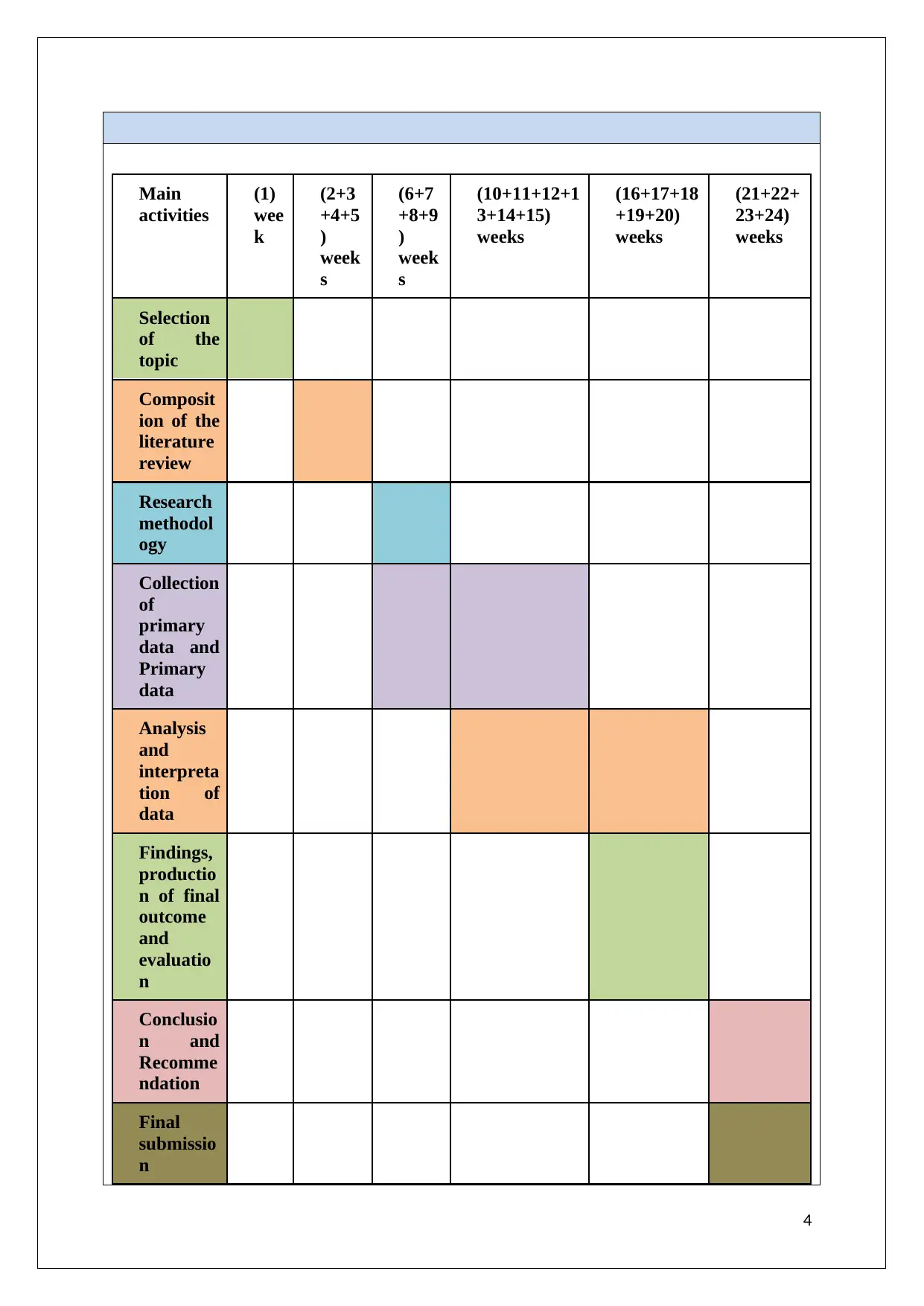
Section Four: Activities and timescales
3
gadgets within various organisations so as to lessen the work pressure and its disadvantages.
In consideration of such type of issues, it can be said that the title of the proposed research is
apt. In addition, it can also be said that technology has always been an interesting subject.
The knowledge of digital technology and understanding of the different ways through the
means of which it can be implemented will prove to be very beneficial. Moreover, in
addition, it can be said that technology these days is in great demand and hence, this research
topic has been selected (Laudon and Laudon, 2015).
Section Three: Literature sources searched
Literary sources prove to be of great importance while in the process of analysing the issues
and the complete research. The proposed research will effectively utilise different types of
models and theories in order to critique the usage of digital technology and its importance.
This section will effectively bring out different types of issues and importance that drive the
acceptance of digital technology throughout operations in different types of organisations.
Technology acceptance model is one such model that analyse different types of factors that
effectively initiates the acceptance of the digital technology. As influenced by the idea of
Westerman and Bonnet (2015), it can be said that the acceptance of digital technology
effectively depends upon various factors. In linking with technology acceptance model, it can
be analysed that acceptance of technology effectively depends upon the benefits that are
derived from the different that specific technology. It can be analysed that there is one more
factor that is the ease of use of that specific technology, which makes it more useful and
utilised within an organisation. This is the reason that this model can be effectively linked to
the present research topic (Iansiti and Lakhani, 2014).
This section will also focus on analysing the different issues that are faced by the human
resource management while in the process of handling the human resources within an
organisation. Researcher in this section will effectively highlight the major need for digital
technology. According to Ernkvist (2015), it can be analysed that within large multinational
organisations there is an effective need for effective handling of large employee base.
Performance management also plays a very important role in this case. It has been identified
that there are many organisations wherein the performance of the employees are not
effectively monitored and reviewed in a proper manner because of lack of effective
technology. This results in lack of motivation among employees due to the scarcity of the
benefits that are being provided to them.
Section Four: Activities and timescales
3
⊘ This is a preview!⊘
Do you want full access?
Subscribe today to unlock all pages.

Trusted by 1+ million students worldwide

Main
activities
(1)
wee
k
(2+3
+4+5
)
week
s
(6+7
+8+9
)
week
s
(10+11+12+1
3+14+15)
weeks
(16+17+18
+19+20)
weeks
(21+22+
23+24)
weeks
Selection
of the
topic
Composit
ion of the
literature
review
Research
methodol
ogy
Collection
of
primary
data and
Primary
data
Analysis
and
interpreta
tion of
data
Findings,
productio
n of final
outcome
and
evaluatio
n
Conclusio
n and
Recomme
ndation
Final
submissio
n
4
activities
(1)
wee
k
(2+3
+4+5
)
week
s
(6+7
+8+9
)
week
s
(10+11+12+1
3+14+15)
weeks
(16+17+18
+19+20)
weeks
(21+22+
23+24)
weeks
Selection
of the
topic
Composit
ion of the
literature
review
Research
methodol
ogy
Collection
of
primary
data and
Primary
data
Analysis
and
interpreta
tion of
data
Findings,
productio
n of final
outcome
and
evaluatio
n
Conclusio
n and
Recomme
ndation
Final
submissio
n
4
Paraphrase This Document
Need a fresh take? Get an instant paraphrase of this document with our AI Paraphraser

And
writing of
the report
Section Five: Research approach and methodologies
Research philosophy:
There are four different types of research philosophies that are effectively considered by a
researcher while in the process of conducting a researcher. These are positivism,
interpretivism, realism, and post-positivism. This proposed research will effectively use post-
positivism philosophy due to its nature of providing logical arguments along with focusing on
the social factors. This will help in analysing the impacts of digital technology and the
various issues that are faced due to lack of it (Taylor et al. 2015).
Research design:
There are three different types of research designs namely exploratory, explanatory and
descriptive. As influenced by the idea of Bryman and Bell (2015), descriptive research design
focuses on bringing out the answers to the research questions in a very detailed manner. This
is the reason that this research design will be effectively utilised by the researcher in the
proposed research. It will help in the process of analysing the various influences and the
challenges faced in a detailed manner.
Research approach:
In the viewpoint of Bernard (2017), it can be said that there are 2 different types of research
approach namely deductive and inductive. Deductive research focuses on analysis of the
concepts and ideas and linking it with the research topic from the theories and models that are
already existent. This is not the case with the inductive research approach, which focuses on
the development of new theories and models. In the proposed research, the researcher will
effectively focus on utilising the deductive approach as it will help in the process of
development of the answers deduced from the existing theories and models such as
technology acceptance model and so on.
Data collection method:
There are two types of data collection methods namely primary and secondary. As influenced
by the idea of LoBiondo-Wood and Haber (2017), it can be said that the primary data
collection method focuses on collection of data from the different sources directly that are
5
writing of
the report
Section Five: Research approach and methodologies
Research philosophy:
There are four different types of research philosophies that are effectively considered by a
researcher while in the process of conducting a researcher. These are positivism,
interpretivism, realism, and post-positivism. This proposed research will effectively use post-
positivism philosophy due to its nature of providing logical arguments along with focusing on
the social factors. This will help in analysing the impacts of digital technology and the
various issues that are faced due to lack of it (Taylor et al. 2015).
Research design:
There are three different types of research designs namely exploratory, explanatory and
descriptive. As influenced by the idea of Bryman and Bell (2015), descriptive research design
focuses on bringing out the answers to the research questions in a very detailed manner. This
is the reason that this research design will be effectively utilised by the researcher in the
proposed research. It will help in the process of analysing the various influences and the
challenges faced in a detailed manner.
Research approach:
In the viewpoint of Bernard (2017), it can be said that there are 2 different types of research
approach namely deductive and inductive. Deductive research focuses on analysis of the
concepts and ideas and linking it with the research topic from the theories and models that are
already existent. This is not the case with the inductive research approach, which focuses on
the development of new theories and models. In the proposed research, the researcher will
effectively focus on utilising the deductive approach as it will help in the process of
development of the answers deduced from the existing theories and models such as
technology acceptance model and so on.
Data collection method:
There are two types of data collection methods namely primary and secondary. As influenced
by the idea of LoBiondo-Wood and Haber (2017), it can be said that the primary data
collection method focuses on collection of data from the different sources directly that are
5

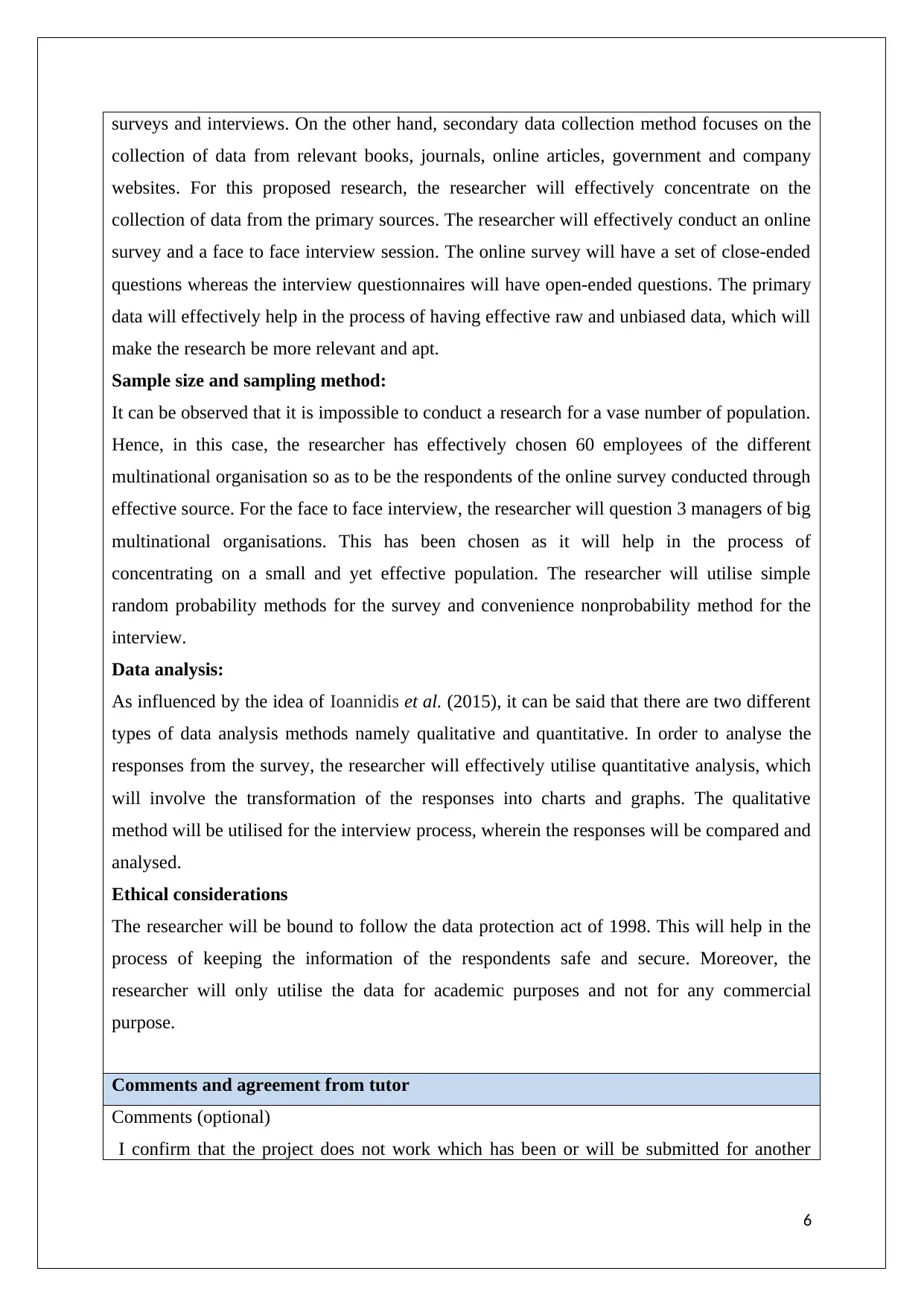
surveys and interviews. On the other hand, secondary data collection method focuses on the
collection of data from relevant books, journals, online articles, government and company
websites. For this proposed research, the researcher will effectively concentrate on the
collection of data from the primary sources. The researcher will effectively conduct an online
survey and a face to face interview session. The online survey will have a set of close-ended
questions whereas the interview questionnaires will have open-ended questions. The primary
data will effectively help in the process of having effective raw and unbiased data, which will
make the research be more relevant and apt.
Sample size and sampling method:
It can be observed that it is impossible to conduct a research for a vase number of population.
Hence, in this case, the researcher has effectively chosen 60 employees of the different
multinational organisation so as to be the respondents of the online survey conducted through
effective source. For the face to face interview, the researcher will question 3 managers of big
multinational organisations. This has been chosen as it will help in the process of
concentrating on a small and yet effective population. The researcher will utilise simple
random probability methods for the survey and convenience nonprobability method for the
interview.
Data analysis:
As influenced by the idea of Ioannidis et al. (2015), it can be said that there are two different
types of data analysis methods namely qualitative and quantitative. In order to analyse the
responses from the survey, the researcher will effectively utilise quantitative analysis, which
will involve the transformation of the responses into charts and graphs. The qualitative
method will be utilised for the interview process, wherein the responses will be compared and
analysed.
Ethical considerations
The researcher will be bound to follow the data protection act of 1998. This will help in the
process of keeping the information of the respondents safe and secure. Moreover, the
researcher will only utilise the data for academic purposes and not for any commercial
purpose.
Comments and agreement from tutor
Comments (optional)
I confirm that the project does not work which has been or will be submitted for another
6
collection of data from relevant books, journals, online articles, government and company
websites. For this proposed research, the researcher will effectively concentrate on the
collection of data from the primary sources. The researcher will effectively conduct an online
survey and a face to face interview session. The online survey will have a set of close-ended
questions whereas the interview questionnaires will have open-ended questions. The primary
data will effectively help in the process of having effective raw and unbiased data, which will
make the research be more relevant and apt.
Sample size and sampling method:
It can be observed that it is impossible to conduct a research for a vase number of population.
Hence, in this case, the researcher has effectively chosen 60 employees of the different
multinational organisation so as to be the respondents of the online survey conducted through
effective source. For the face to face interview, the researcher will question 3 managers of big
multinational organisations. This has been chosen as it will help in the process of
concentrating on a small and yet effective population. The researcher will utilise simple
random probability methods for the survey and convenience nonprobability method for the
interview.
Data analysis:
As influenced by the idea of Ioannidis et al. (2015), it can be said that there are two different
types of data analysis methods namely qualitative and quantitative. In order to analyse the
responses from the survey, the researcher will effectively utilise quantitative analysis, which
will involve the transformation of the responses into charts and graphs. The qualitative
method will be utilised for the interview process, wherein the responses will be compared and
analysed.
Ethical considerations
The researcher will be bound to follow the data protection act of 1998. This will help in the
process of keeping the information of the respondents safe and secure. Moreover, the
researcher will only utilise the data for academic purposes and not for any commercial
purpose.
Comments and agreement from tutor
Comments (optional)
I confirm that the project does not work which has been or will be submitted for another
6
⊘ This is a preview!⊘
Do you want full access?
Subscribe today to unlock all pages.

Trusted by 1+ million students worldwide

qualification and is appropriate
Agreed Name: Date:
Comments and agreement from project checker (if applicable)
Comments (optional)
I confirm that the project does not work which has been or will be submitted for another
qualification and is appropriate
Agreed Name: Date:
7
Agreed Name: Date:
Comments and agreement from project checker (if applicable)
Comments (optional)
I confirm that the project does not work which has been or will be submitted for another
qualification and is appropriate
Agreed Name: Date:
7
Paraphrase This Document
Need a fresh take? Get an instant paraphrase of this document with our AI Paraphraser

Reference:
Bernard, H.R., (2017). Research methods in anthropology: Qualitative and quantitative
approaches. Rowman & Littlefield.
Bryman, A. and Bell, E., (2015). Business research methods. Oxford University Press, USA.
Ernkvist, M., (2015). The double knot of technology and business-model innovation in the
era of ferment of digital exchanges: The case of OM, a pioneer in electronic options
exchanges. Technological Forecasting and Social Change, 99, pp.285-299.
Iansiti, M. and Lakhani, K.R., (2014). Digital ubiquity:: How connections, sensors, and data
are revolutionizing business. Harvard Business Review, 92(11), p.19.
Ioannidis, J.P., Fanelli, D., Dunne, D.D. and Goodman, S.N., (2015). Meta-research:
evaluation and improvement of research methods and practices. PLoS biology, 13(10),
p.e1002264.
Laudon, K.C. and Laudon, J.P., (2015). Management Information Systems: Managing the
Digital Firm Plus MyMISLab with Pearson eText--Access Card Package. Prentice Hall Press.
LoBiondo-Wood, G. and Haber, J., (2017). Nursing Research-E-Book: Methods and Critical
Appraisal for Evidence-Based Practice. Elsevier Health Sciences.
Taylor, S.J., Bogdan, R. and DeVault, M., (2015). Introduction to qualitative research
methods: A guidebook and resource. John Wiley & Sons.
Westerman, G. and Bonnet, D., (2015). Revamping your business through digital
transformation. MIT Sloan Management Review, 56(3), p.10.
Westerman, G., Bonnet, D. and McAfee, A., (2014). Leading digital: Turning technology
into business transformation. Harvard Business Press.
8
Bernard, H.R., (2017). Research methods in anthropology: Qualitative and quantitative
approaches. Rowman & Littlefield.
Bryman, A. and Bell, E., (2015). Business research methods. Oxford University Press, USA.
Ernkvist, M., (2015). The double knot of technology and business-model innovation in the
era of ferment of digital exchanges: The case of OM, a pioneer in electronic options
exchanges. Technological Forecasting and Social Change, 99, pp.285-299.
Iansiti, M. and Lakhani, K.R., (2014). Digital ubiquity:: How connections, sensors, and data
are revolutionizing business. Harvard Business Review, 92(11), p.19.
Ioannidis, J.P., Fanelli, D., Dunne, D.D. and Goodman, S.N., (2015). Meta-research:
evaluation and improvement of research methods and practices. PLoS biology, 13(10),
p.e1002264.
Laudon, K.C. and Laudon, J.P., (2015). Management Information Systems: Managing the
Digital Firm Plus MyMISLab with Pearson eText--Access Card Package. Prentice Hall Press.
LoBiondo-Wood, G. and Haber, J., (2017). Nursing Research-E-Book: Methods and Critical
Appraisal for Evidence-Based Practice. Elsevier Health Sciences.
Taylor, S.J., Bogdan, R. and DeVault, M., (2015). Introduction to qualitative research
methods: A guidebook and resource. John Wiley & Sons.
Westerman, G. and Bonnet, D., (2015). Revamping your business through digital
transformation. MIT Sloan Management Review, 56(3), p.10.
Westerman, G., Bonnet, D. and McAfee, A., (2014). Leading digital: Turning technology
into business transformation. Harvard Business Press.
8
1 out of 8
Related Documents
Your All-in-One AI-Powered Toolkit for Academic Success.
 +13062052269
info@desklib.com
Available 24*7 on WhatsApp / Email
Unlock your academic potential
Copyright © 2020–2025 A2Z Services. All Rights Reserved. Developed and managed by ZUCOL.