Employee Productivity and ERP Implementation: A Literature Review
VerifiedAdded on 2019/09/30
|13
|3336
|186
Literature Review
AI Summary
This literature review investigates the multifaceted impact of Enterprise Resource Planning (ERP) implementation on employee productivity, change management, and overall business value. The review explores the effects of ERP on employee productivity, highlighting the importance of leadership, communication, and change management. It examines the necessary approaches for successful ERP implementation, emphasizing the significance of feedback systems and employee engagement. Furthermore, it delves into the business value of ERP systems, including cost optimization, increased revenue, and improved profitability. The review also considers statistical evidence regarding employee efficiency and explores how sales employees in the Australian telecommunication industry can leverage ERP software to enhance sales performance. Finally, the review outlines the input-process-output model for ERP implementation and its potential future impacts. This document, available on Desklib, offers a comprehensive analysis of these critical aspects, providing insights for organizations considering or undergoing ERP implementation.

LITERATURE REVIEW
LITERATURE REVIEW
STUDENT NAME
NAME OF THE INSTITUTE
LITERATURE REVIEW
STUDENT NAME
NAME OF THE INSTITUTE

Paraphrase This Document
Need a fresh take? Get an instant paraphrase of this document with our AI Paraphraser
LITERATURE REVIEW
Research Question 1: What is the impact of enterprise resource planning implementation on
employees’ productivity?
Literature Review:
Chen, Law & Yang (2009) argued that the impact of enterprise resource planning could
be different for different organizations and the impact could be different in short term and long
term. One of the objectives of ERP implementation is to increase the employee’s’ productivity in
long term. The fresh implementation of ERP system can pose some problems relating to the
ability of organizations to collaborate with stakeholders in horizontal relationships. As Daft
(2015) points out, leaders who are unable to create collaborative, trusting relationships with
others often fail and essentially the productivity of employees could depend on this
collaboration. The interaction with organizations in the external environment, may introduce
cultures and business strategies that function in opposition to the organizations historical view.
Knutsen and Brock (2014) extrapolate that an organization cannot be independent of its
environment, but interacts through influencing and being influenced. It is true that the use of
ERP systems has become the norm in today’s business environment. It is expected that the
leaders would be able to manage the change arising from the implementation of ERP systems
and this would ultimately have a positive impact on employees’ productivity.
It is important to mention that the implementation of ERP could be a big change in the
organization and the employees’ productivity could also depend on the way organizational
managers and leaders manage the change (Tran, 2013). Lack of leadership in ERP
implementation causes so much stress and confusion for organizations. When a leader shows
lack of interest in leading a project or contributing to implementation of changes, it creates lack
2
Research Question 1: What is the impact of enterprise resource planning implementation on
employees’ productivity?
Literature Review:
Chen, Law & Yang (2009) argued that the impact of enterprise resource planning could
be different for different organizations and the impact could be different in short term and long
term. One of the objectives of ERP implementation is to increase the employee’s’ productivity in
long term. The fresh implementation of ERP system can pose some problems relating to the
ability of organizations to collaborate with stakeholders in horizontal relationships. As Daft
(2015) points out, leaders who are unable to create collaborative, trusting relationships with
others often fail and essentially the productivity of employees could depend on this
collaboration. The interaction with organizations in the external environment, may introduce
cultures and business strategies that function in opposition to the organizations historical view.
Knutsen and Brock (2014) extrapolate that an organization cannot be independent of its
environment, but interacts through influencing and being influenced. It is true that the use of
ERP systems has become the norm in today’s business environment. It is expected that the
leaders would be able to manage the change arising from the implementation of ERP systems
and this would ultimately have a positive impact on employees’ productivity.
It is important to mention that the implementation of ERP could be a big change in the
organization and the employees’ productivity could also depend on the way organizational
managers and leaders manage the change (Tran, 2013). Lack of leadership in ERP
implementation causes so much stress and confusion for organizations. When a leader shows
lack of interest in leading a project or contributing to implementation of changes, it creates lack
2
LITERATURE REVIEW
of interest of the employees. Leaders must be able to help guide his team to the successful
implementation of the changes. They must be willing to step in and refocus the team when there
are roadblocks. Having lack of leadership will eventually cause a project or implementation to
fail. Stakeholders will then be affected from the lack of accomplishment. This can lead in loss of
future interest in motivating a team to participate in technology changes like ERP
implementation.
The communication in the organization during the course of ERP implementation is also
a key driver of employees’ productivity. Communication is key in any organization productivity
and ERP implementation. A break down in communication is often caused by upper
management due to the lack of leadership training and also leadership.
Research Question 2:What is the necessary approach of ERP in increasing the employee’s
productivity in an organization?
Literature Review:
The necessary approach to the implementation of ERP in increasing the employees’s
productivity in an organization should focus on two key aspects. These are change management
and transformation. According Dibrell & Davis (2008) the implementation of ERP creates a
transformation between the organization and the environment where the environment becomes
an essential part of the organization instead of a perceived external variable (Dibrell & Davis
2008). The researchers described the symbiotic relationship between environment and
organization creates a depth of adaptiveness where the organization continually adjusts
according to changes in the environment (Dibrell & Davis, 2008). The researchers recognized
the challenges of transformation in a participatory organization that operates with an open
3
of interest of the employees. Leaders must be able to help guide his team to the successful
implementation of the changes. They must be willing to step in and refocus the team when there
are roadblocks. Having lack of leadership will eventually cause a project or implementation to
fail. Stakeholders will then be affected from the lack of accomplishment. This can lead in loss of
future interest in motivating a team to participate in technology changes like ERP
implementation.
The communication in the organization during the course of ERP implementation is also
a key driver of employees’ productivity. Communication is key in any organization productivity
and ERP implementation. A break down in communication is often caused by upper
management due to the lack of leadership training and also leadership.
Research Question 2:What is the necessary approach of ERP in increasing the employee’s
productivity in an organization?
Literature Review:
The necessary approach to the implementation of ERP in increasing the employees’s
productivity in an organization should focus on two key aspects. These are change management
and transformation. According Dibrell & Davis (2008) the implementation of ERP creates a
transformation between the organization and the environment where the environment becomes
an essential part of the organization instead of a perceived external variable (Dibrell & Davis
2008). The researchers described the symbiotic relationship between environment and
organization creates a depth of adaptiveness where the organization continually adjusts
according to changes in the environment (Dibrell & Davis, 2008). The researchers recognized
the challenges of transformation in a participatory organization that operates with an open
3
⊘ This is a preview!⊘
Do you want full access?
Subscribe today to unlock all pages.

Trusted by 1+ million students worldwide
LITERATURE REVIEW
systems approach. According to Dibrell & Davis (2008) the challenges included “inertia,
managerial ‘bounded rationality’, political constraints and institutional ‘embeddedness’, and
weak organizational learning mechanisms” (p. 185).
Ke & Wei (2008) argued that the approach to improve employees’ productivity with the
implementation of ERP should also include the system of feedback and employee engagement.
The organization outcome and feedback from the organization’s environment are very important
when it comes to evaluate, improve, or measure the implementation of ERP. The feedback helps
to evaluate and improve the input and the process of the transformation. With the ERP
implementation, organization is considered as a system of transformation in which the
environment put the input and the organization transforms it into output for the use of the
environment, and the feedback from the environment is welcome. Welch, Bednar, Milner, (2011)
suggested, “the purpose of knowledge management within an organization is creation of vehicles
to support people to create and share their individual, contextually-dependent understandings”
(P. 3). The technology products like employee resource planning helps the organization learning
from its environment and improving its products. Many of success companies like Avon, Exxon,
Microsoft, Ford, General Motors, Toyota, and Nissan used the benchmarking which is similar to
the open system. This used the external criteria to evaluate and improve its products. However,
certain companies prefer used the internal system analysis to improve their technology products
like ERP products. As a conclusion it can be said that the approach to improve employee
productivity should focus to take employees together to a desired state of ERP implementation. It
is important that the employees should be communicated about all the aspects of change
management that arises from ERP implementation.
Research Question 3: What is the business value of ERP system?
4
systems approach. According to Dibrell & Davis (2008) the challenges included “inertia,
managerial ‘bounded rationality’, political constraints and institutional ‘embeddedness’, and
weak organizational learning mechanisms” (p. 185).
Ke & Wei (2008) argued that the approach to improve employees’ productivity with the
implementation of ERP should also include the system of feedback and employee engagement.
The organization outcome and feedback from the organization’s environment are very important
when it comes to evaluate, improve, or measure the implementation of ERP. The feedback helps
to evaluate and improve the input and the process of the transformation. With the ERP
implementation, organization is considered as a system of transformation in which the
environment put the input and the organization transforms it into output for the use of the
environment, and the feedback from the environment is welcome. Welch, Bednar, Milner, (2011)
suggested, “the purpose of knowledge management within an organization is creation of vehicles
to support people to create and share their individual, contextually-dependent understandings”
(P. 3). The technology products like employee resource planning helps the organization learning
from its environment and improving its products. Many of success companies like Avon, Exxon,
Microsoft, Ford, General Motors, Toyota, and Nissan used the benchmarking which is similar to
the open system. This used the external criteria to evaluate and improve its products. However,
certain companies prefer used the internal system analysis to improve their technology products
like ERP products. As a conclusion it can be said that the approach to improve employee
productivity should focus to take employees together to a desired state of ERP implementation. It
is important that the employees should be communicated about all the aspects of change
management that arises from ERP implementation.
Research Question 3: What is the business value of ERP system?
4
Paraphrase This Document
Need a fresh take? Get an instant paraphrase of this document with our AI Paraphraser
LITERATURE REVIEW
Literature Review:
There are various benefits and business value of using ERP system. In simple terms it can
be said that the use of ERP system creates and open, effective and transparent culture in the
organization. According to Starnes, (2000). “Open systems theory argues that organizations
must interact with the environments in which they operate in order to be successful.
Organizations that attempt to be self-sufficient without interacting with the environment are
referred to as closed systems” (P. 15). With the use or ERP systems, organization can actually be
open and effective in nature. It would result in the business value of cost optimization, increased
revenue and improved profitability. It can be said that the organization’s success depends only
on the degree on which the organization considered open systems and use technology as a
business integrator. However, with today environment with its cyber security problems, the cross
cultural challenges, and the lack of inputs material and the organization good tool of
transformation, the open system theory presented more challenges in management.
The use of ERP system would also enable to organization to track down the quality of
products and services. This is the reason that organizations have started to integrate ERP systems
with the supply chain management solutions. With the implementation of ERP systems, the
focus of management is to create a platform of Total Quality Management. It helps organizations
to create a culture in the organization where all the stakeholders are aware of the goals and
objectives. In simpler terms, it can be said that the efficiency, effectiveness and responsiveness
are the three biggest values that organizations get with the implementation of ERP. The uses of
ERP systems are particularly more beneficial for the large organizations. The use of technology
products like ERP systems also helps the large organizations like Coca-Cola to manage the teams
that are spread in different parts of the world. With the CRM (Customer Relationship
5
Literature Review:
There are various benefits and business value of using ERP system. In simple terms it can
be said that the use of ERP system creates and open, effective and transparent culture in the
organization. According to Starnes, (2000). “Open systems theory argues that organizations
must interact with the environments in which they operate in order to be successful.
Organizations that attempt to be self-sufficient without interacting with the environment are
referred to as closed systems” (P. 15). With the use or ERP systems, organization can actually be
open and effective in nature. It would result in the business value of cost optimization, increased
revenue and improved profitability. It can be said that the organization’s success depends only
on the degree on which the organization considered open systems and use technology as a
business integrator. However, with today environment with its cyber security problems, the cross
cultural challenges, and the lack of inputs material and the organization good tool of
transformation, the open system theory presented more challenges in management.
The use of ERP system would also enable to organization to track down the quality of
products and services. This is the reason that organizations have started to integrate ERP systems
with the supply chain management solutions. With the implementation of ERP systems, the
focus of management is to create a platform of Total Quality Management. It helps organizations
to create a culture in the organization where all the stakeholders are aware of the goals and
objectives. In simpler terms, it can be said that the efficiency, effectiveness and responsiveness
are the three biggest values that organizations get with the implementation of ERP. The uses of
ERP systems are particularly more beneficial for the large organizations. The use of technology
products like ERP systems also helps the large organizations like Coca-Cola to manage the teams
that are spread in different parts of the world. With the CRM (Customer Relationship
5
LITERATURE REVIEW
Management) module of ERP the organizations can also manage customers in an effective
manner. It is important that the organizations should develop goals and objectives with respect to
ERP implementation. The organizations would be able to derive maximum benefits from ERP
implementation only when business values map with the defined goals and objectives.
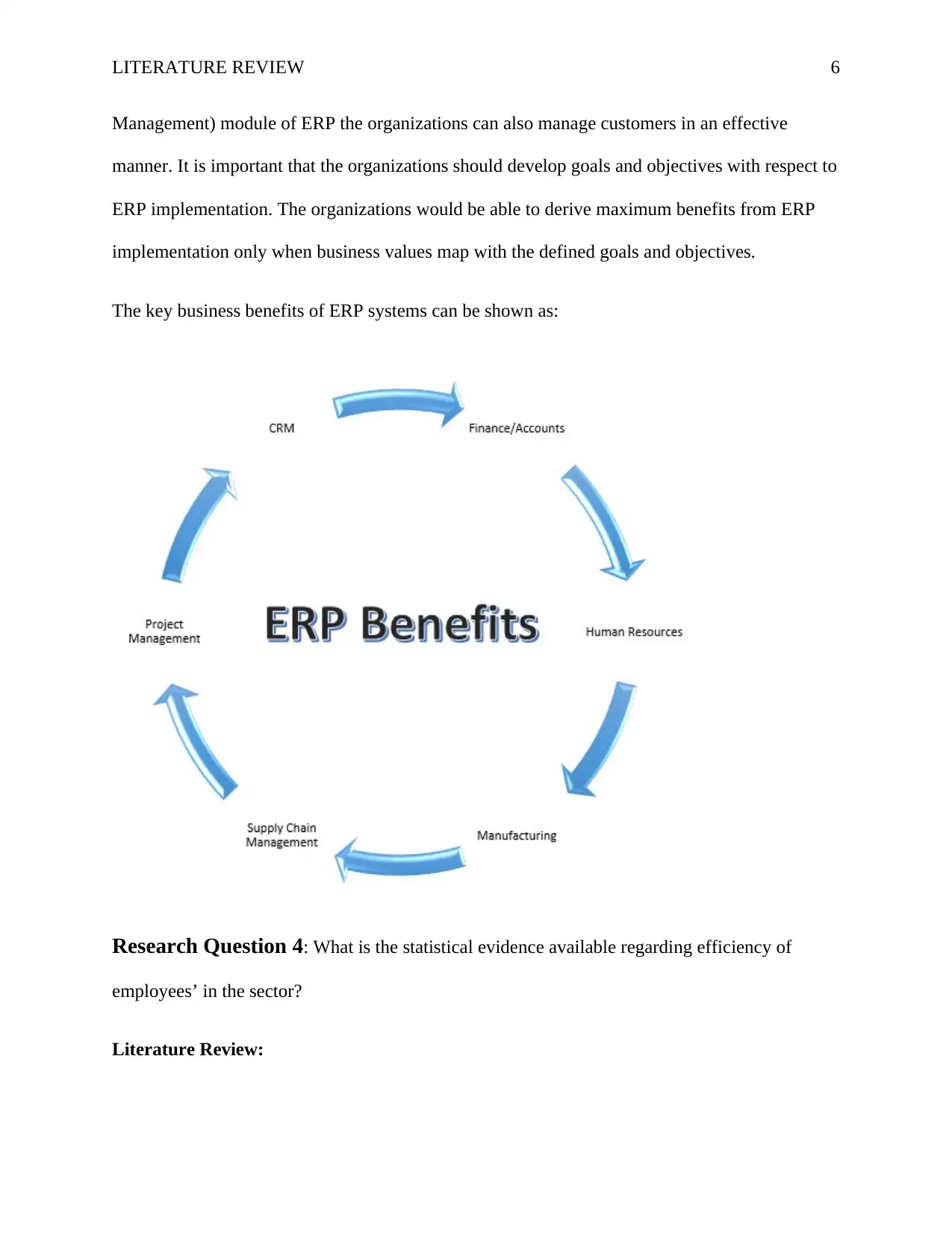
The key business benefits of ERP systems can be shown as:
Research Question 4: What is the statistical evidence available regarding efficiency of
employees’ in the sector?
Literature Review:
6
Management) module of ERP the organizations can also manage customers in an effective
manner. It is important that the organizations should develop goals and objectives with respect to
ERP implementation. The organizations would be able to derive maximum benefits from ERP
implementation only when business values map with the defined goals and objectives.
The key business benefits of ERP systems can be shown as:
Research Question 4: What is the statistical evidence available regarding efficiency of
employees’ in the sector?
Literature Review:
6
⊘ This is a preview!⊘
Do you want full access?
Subscribe today to unlock all pages.
Trusted by 1+ million students worldwide
LITERATURE REVIEW
The statistical evidence regarding efficient of employees in the telecommunication sector
could be seen with the key metrics like employee satisfaction index, customer satisfaction index,
employee productivity index, etc. The statistical evidence could also be observed in terms of the
stability index of the organizations in this sector. This evidence, assumes that an organization
exists in a stable environment, that it does not need to adapt to its environment, and that it does
not interact with its environment in a substantive way. Knutsen and Brock (2015) further note
that an organization utilizing a close system approach is likely to have a strong, vertical
hierarchy and a mechanistic structure. Given the speed at which change occurs in the
contemporary business environment, particularly in the area of communications technologies,
and the already significant changes to the business environment that have been caused by
globalization, it seems to me that employing elements of open systems theory, at least to some
extent, is virtually essential. And yet there remain successful organizations that operate
primarily or in part as closed systems.
Brynjolfsson & Saunders (2010) discussed the importance of using various metrics to
measure the efficiency of employees. It is believed that implementation of ERP system should
start with an assessment phase. In the assessment phase the organization should establish the key
metrics that would be used as a goal with the ERP implementation. The implementation of ERP
could be termed successful only when there is a significant improved in the metrics that were
established in the assessment phase. For example, it is expected that the customer satisfaction
index should increase after ERP implementation. Likewise the statistical evidence could be
found in other metrics like employee satisfaction index.
Research Question 5: How sale employees of telecommunication industry in Australia can
strive for increase in sales performance by using ERP software?
7
The statistical evidence regarding efficient of employees in the telecommunication sector
could be seen with the key metrics like employee satisfaction index, customer satisfaction index,
employee productivity index, etc. The statistical evidence could also be observed in terms of the
stability index of the organizations in this sector. This evidence, assumes that an organization
exists in a stable environment, that it does not need to adapt to its environment, and that it does
not interact with its environment in a substantive way. Knutsen and Brock (2015) further note
that an organization utilizing a close system approach is likely to have a strong, vertical
hierarchy and a mechanistic structure. Given the speed at which change occurs in the
contemporary business environment, particularly in the area of communications technologies,
and the already significant changes to the business environment that have been caused by
globalization, it seems to me that employing elements of open systems theory, at least to some
extent, is virtually essential. And yet there remain successful organizations that operate
primarily or in part as closed systems.
Brynjolfsson & Saunders (2010) discussed the importance of using various metrics to
measure the efficiency of employees. It is believed that implementation of ERP system should
start with an assessment phase. In the assessment phase the organization should establish the key
metrics that would be used as a goal with the ERP implementation. The implementation of ERP
could be termed successful only when there is a significant improved in the metrics that were
established in the assessment phase. For example, it is expected that the customer satisfaction
index should increase after ERP implementation. Likewise the statistical evidence could be
found in other metrics like employee satisfaction index.
Research Question 5: How sale employees of telecommunication industry in Australia can
strive for increase in sales performance by using ERP software?
7
Paraphrase This Document
Need a fresh take? Get an instant paraphrase of this document with our AI Paraphraser
LITERATURE REVIEW
Literature Review
Organizational leaders must manage the feedback received and adapt organizational
operations through ERP system in a manner that can optimize organizational processes (Karata
& El-Rayes, 2015). Karata and El-Rayes (2015) posited that managers must include in
organizational operations specific steps or sessions that identify those points raised from various
stakeholders as warranting attention and action. Without purposefully incorporating work
sessions or planning sessions focused on stakeholder feedback, organizations fail to benefit from
the rich intelligence provided by key constituents.
In the interactive stage the organizational response to stakeholders input is most
effective. This is because Lawrence and Weber (2014) state that in the interactive stage the
organization has an ongoing relationship and line of communication with stakeholders
continually to maintain respect and open communication. With this being so, the organization
can more effectively communicate responses or concerns to stakeholders being that trust and
loyalty has been established. Lawrence and Weber (2014) share that the inactive stage is where
stakeholders are ignored. This can be seen as the least desirable stage. With this being so a
response from the organization can be very valid being that communication is becoming active
between both the organization and stakeholders. Also, because this can be seen as effort being
put forth where stakeholders are not being ignored and both parties are coming together for the
grater good regardless of the lack of communication or relationship that exists.
Momoh & Roy (2010) highlighted that the sales performance of the company would
depend on number of factors. The organizations must figure out the interaction of ERP with the
sales cycle or customer touch points. It is expected that the sales performance would include if
the implementation of ERP products can improve customer touch point. The sales performance
8
Literature Review
Organizational leaders must manage the feedback received and adapt organizational
operations through ERP system in a manner that can optimize organizational processes (Karata
& El-Rayes, 2015). Karata and El-Rayes (2015) posited that managers must include in
organizational operations specific steps or sessions that identify those points raised from various
stakeholders as warranting attention and action. Without purposefully incorporating work
sessions or planning sessions focused on stakeholder feedback, organizations fail to benefit from
the rich intelligence provided by key constituents.
In the interactive stage the organizational response to stakeholders input is most
effective. This is because Lawrence and Weber (2014) state that in the interactive stage the
organization has an ongoing relationship and line of communication with stakeholders
continually to maintain respect and open communication. With this being so, the organization
can more effectively communicate responses or concerns to stakeholders being that trust and
loyalty has been established. Lawrence and Weber (2014) share that the inactive stage is where
stakeholders are ignored. This can be seen as the least desirable stage. With this being so a
response from the organization can be very valid being that communication is becoming active
between both the organization and stakeholders. Also, because this can be seen as effort being
put forth where stakeholders are not being ignored and both parties are coming together for the
grater good regardless of the lack of communication or relationship that exists.
Momoh & Roy (2010) highlighted that the sales performance of the company would
depend on number of factors. The organizations must figure out the interaction of ERP with the
sales cycle or customer touch points. It is expected that the sales performance would include if
the implementation of ERP products can improve customer touch point. The sales performance
8
LITERATURE REVIEW
could also be improved if the ERP system can improve the communication levels in the
organization. Therefore, one of the key objectives of ERP implementation is to overcome the
communication barrier and have a system of effective communication at workplace.
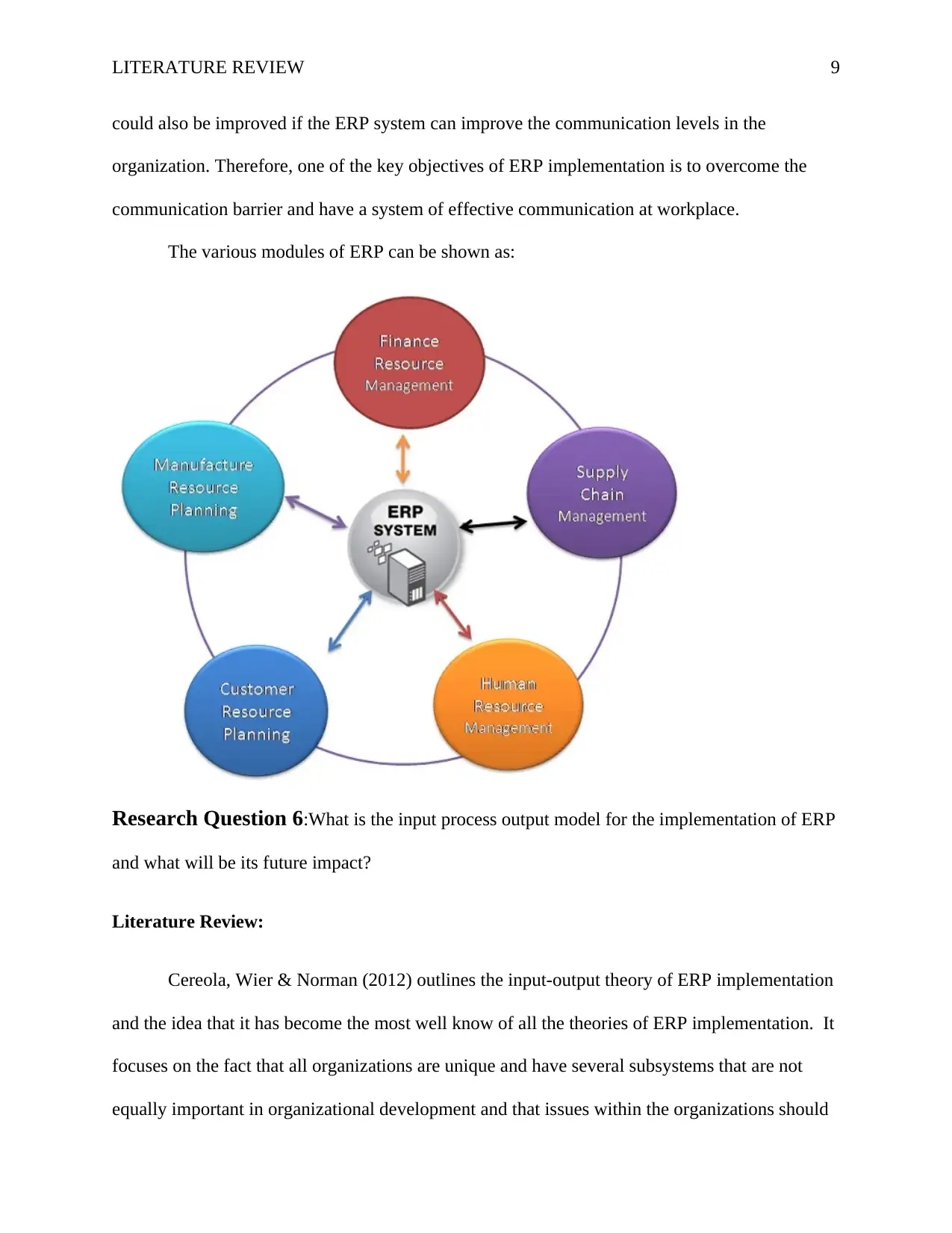
The various modules of ERP can be shown as:
Research Question 6:What is the input process output model for the implementation of ERP
and what will be its future impact?
Literature Review:
Cereola, Wier & Norman (2012) outlines the input-output theory of ERP implementation
and the idea that it has become the most well know of all the theories of ERP implementation. It
focuses on the fact that all organizations are unique and have several subsystems that are not
equally important in organizational development and that issues within the organizations should
9
could also be improved if the ERP system can improve the communication levels in the
organization. Therefore, one of the key objectives of ERP implementation is to overcome the
communication barrier and have a system of effective communication at workplace.
The various modules of ERP can be shown as:
Research Question 6:What is the input process output model for the implementation of ERP
and what will be its future impact?
Literature Review:
Cereola, Wier & Norman (2012) outlines the input-output theory of ERP implementation
and the idea that it has become the most well know of all the theories of ERP implementation. It
focuses on the fact that all organizations are unique and have several subsystems that are not
equally important in organizational development and that issues within the organizations should
9
⊘ This is a preview!⊘
Do you want full access?
Subscribe today to unlock all pages.
Trusted by 1+ million students worldwide
LITERATURE REVIEW
be handled based on this idea. This may pose a problem for some organizations in that no
subsystem is likely to be considered as being unimportant by them to the whole organization. In
other word the open systems theory can be seen as diminishing the relevancy of every subsystem
that exists within an organization. Many times a blended approach is taken on by organizations
because they have to implement different organizational strategies when changes occur in the
competitive circumstances, structural design, and experiences.
Powell & Riezebos (2013) argued that organizations could also use the ambidextrous
approach to implement the input process output model. It is the model used by a firm to
simultaneously achieve decentralization as well as centralized controls during the ERP
implementation. Ambidexterity is viewed as a structural issue targeting certain levels of
achievements. Organization uses this approach to put in place dual structures to alignment while
closely focusing on the adaptations of ERP (Daft, 2015). In established companies, ERP
implementation is only a disruptive innovation in a separate unit that can be pursued. The
ambidextrous approach assists in the creation of a separate unit for examining and pursuing new
opportunities as well as keeping the same management to be able to manage both the parent
company and the new unit of innovation (Stemberger, 2008).
In this approach, the management or leadership should possess the ability to attend to
the already existing procedures, services, products and all models as well as processes while still
giving support to the innovations that will eventually drive the organizations future (Daft, 2015).
Daft, (2015) provides examples of organizations such as Google releasing imperfect or
unfinished experiments to try and improve the existing business processes with ERP
implementation. This approach entails continual overseeing the key business while protecting the
emerging venture concurrently as it develops and grows. Executive leadership can apply this
10
be handled based on this idea. This may pose a problem for some organizations in that no
subsystem is likely to be considered as being unimportant by them to the whole organization. In
other word the open systems theory can be seen as diminishing the relevancy of every subsystem
that exists within an organization. Many times a blended approach is taken on by organizations
because they have to implement different organizational strategies when changes occur in the
competitive circumstances, structural design, and experiences.
Powell & Riezebos (2013) argued that organizations could also use the ambidextrous
approach to implement the input process output model. It is the model used by a firm to
simultaneously achieve decentralization as well as centralized controls during the ERP
implementation. Ambidexterity is viewed as a structural issue targeting certain levels of
achievements. Organization uses this approach to put in place dual structures to alignment while
closely focusing on the adaptations of ERP (Daft, 2015). In established companies, ERP
implementation is only a disruptive innovation in a separate unit that can be pursued. The
ambidextrous approach assists in the creation of a separate unit for examining and pursuing new
opportunities as well as keeping the same management to be able to manage both the parent
company and the new unit of innovation (Stemberger, 2008).
In this approach, the management or leadership should possess the ability to attend to
the already existing procedures, services, products and all models as well as processes while still
giving support to the innovations that will eventually drive the organizations future (Daft, 2015).
Daft, (2015) provides examples of organizations such as Google releasing imperfect or
unfinished experiments to try and improve the existing business processes with ERP
implementation. This approach entails continual overseeing the key business while protecting the
emerging venture concurrently as it develops and grows. Executive leadership can apply this
10
Paraphrase This Document
Need a fresh take? Get an instant paraphrase of this document with our AI Paraphraser
LITERATURE REVIEW
approach to form segregated business units that will help to explore and develop a breakthrough
of innovations while at the same time managing the existing business uninterrupted with
(Saunders, 2010). The teams that manage the project are encouraged to form their own
processes, cultures and structures but still connected to the other organization. Through this
approach, new opportunities are developed and presented to the market by the team of executive
as new business units and therefore slowly introduced into the existing units (Bober, 2014).
Introduction of another approach can only be useful if it does not interfere with the
processes in place immediately, the existing management and the people (Daft, 2015). This
approach should be spontaneous but not prompt development and implementation (Eldabi,
2008). If it may interfere with the gradual acceptance of the new innovation to any organization,
then it is not appropriate.
The ERP implementation process can be shown as:
11
approach to form segregated business units that will help to explore and develop a breakthrough
of innovations while at the same time managing the existing business uninterrupted with
(Saunders, 2010). The teams that manage the project are encouraged to form their own
processes, cultures and structures but still connected to the other organization. Through this
approach, new opportunities are developed and presented to the market by the team of executive
as new business units and therefore slowly introduced into the existing units (Bober, 2014).
Introduction of another approach can only be useful if it does not interfere with the
processes in place immediately, the existing management and the people (Daft, 2015). This
approach should be spontaneous but not prompt development and implementation (Eldabi,
2008). If it may interfere with the gradual acceptance of the new innovation to any organization,
then it is not appropriate.
The ERP implementation process can be shown as:
11
LITERATURE REVIEW
References
Al-Fawaz, K., Al-Salti, Z., & Eldabi, T. 2008. Critical success factors in ERP implementation: A
review.
Brynjolfsson, E., & Saunders, A. 2010. Wired for innovation: how information technology is
reshaping the economy.
Chen, C. C., Law, C., & Yang, S. C. 2009. Managing ERP implementation failure: a project
management perspective. Engineering Management, IEEE Transactions on, 56(1), 157-170.
Cereola, S. J., Wier, B., & Norman, C. S. 2012. Impact of top management team on firm
performance in small and medium-sized enterprises adopting commercial open-source
enterprise resource planning. Behaviour & Information Technology, 31(9), 889-907.
Daft, R. L. 2015. Organization theory and design (12th ed.) Mason, OH: South-Western,
Cengage Learning.
Dibrell, C., Davis, P. S., & Craig, J. 2008. Fueling innovation through information technology in
SMEs. Journal of small business management,46(2), 203-218.
Karatas, A., & El-Rayes, K. 2015. Evaluating the performance of sustainable development in
urban neighborhoods based on the feedback of multiple stakeholders. Sustainable Cities and
Society, 14, 374-382.
Knutsen, W., & Brock, K. 2014. Introductory Essay: From a Closed System to an Open System:
A Parallel Critical Review of the Intellectual Trajectories of Publicness and Nonprofitness.
Voluntas: International Journal Of Voluntary & Nonprofit Organizations, 25(5), 1113-1131
12
References
Al-Fawaz, K., Al-Salti, Z., & Eldabi, T. 2008. Critical success factors in ERP implementation: A
review.
Brynjolfsson, E., & Saunders, A. 2010. Wired for innovation: how information technology is
reshaping the economy.
Chen, C. C., Law, C., & Yang, S. C. 2009. Managing ERP implementation failure: a project
management perspective. Engineering Management, IEEE Transactions on, 56(1), 157-170.
Cereola, S. J., Wier, B., & Norman, C. S. 2012. Impact of top management team on firm
performance in small and medium-sized enterprises adopting commercial open-source
enterprise resource planning. Behaviour & Information Technology, 31(9), 889-907.
Daft, R. L. 2015. Organization theory and design (12th ed.) Mason, OH: South-Western,
Cengage Learning.
Dibrell, C., Davis, P. S., & Craig, J. 2008. Fueling innovation through information technology in
SMEs. Journal of small business management,46(2), 203-218.
Karatas, A., & El-Rayes, K. 2015. Evaluating the performance of sustainable development in
urban neighborhoods based on the feedback of multiple stakeholders. Sustainable Cities and
Society, 14, 374-382.
Knutsen, W., & Brock, K. 2014. Introductory Essay: From a Closed System to an Open System:
A Parallel Critical Review of the Intellectual Trajectories of Publicness and Nonprofitness.
Voluntas: International Journal Of Voluntary & Nonprofit Organizations, 25(5), 1113-1131
12
⊘ This is a preview!⊘
Do you want full access?
Subscribe today to unlock all pages.
Trusted by 1+ million students worldwide

1 out of 13


Related Documents


Your All-in-One AI-Powered Toolkit for Academic Success.
+13062052269
info@desklib.com
Available 24*7 on WhatsApp / Email
![[object Object]](/_next/static/media/star-bottom.7253800d.svg)
Unlock your academic potential
Copyright © 2020–2026 A2Z Services. All Rights Reserved. Developed and managed by ZUCOL.