PNUR124-Teaching Plan: Erythromycin for Infection Control & Dosage

Verified

Added on  2022/09/01

|2
|790
|24
Homework Assignment
AI Summary
This assignment presents a medication teaching plan focused on Erythromycin, designed to educate a patient (Mrs. W) about the medication's usage for infection management. The plan incorporates a humanistic and 21st-century skills learning theory, emphasizing cognitive development through innovative teaching methods. The teaching plan covers Erythromycin's history, effectiveness, dosage, timings, and potential side effects. Teaching strategies include visual presentations and positive communication to enhance understanding. Evaluation methods involve questioning and observation to assess the patient's learning progression and identify areas for improvement. The teaching resources include electronic database articles and national medicinal board documents related to Erythromycin management. This resource, contributed by a student, is available on Desklib, where students can find a variety of study tools, past papers, and solved assignments.
Document Page
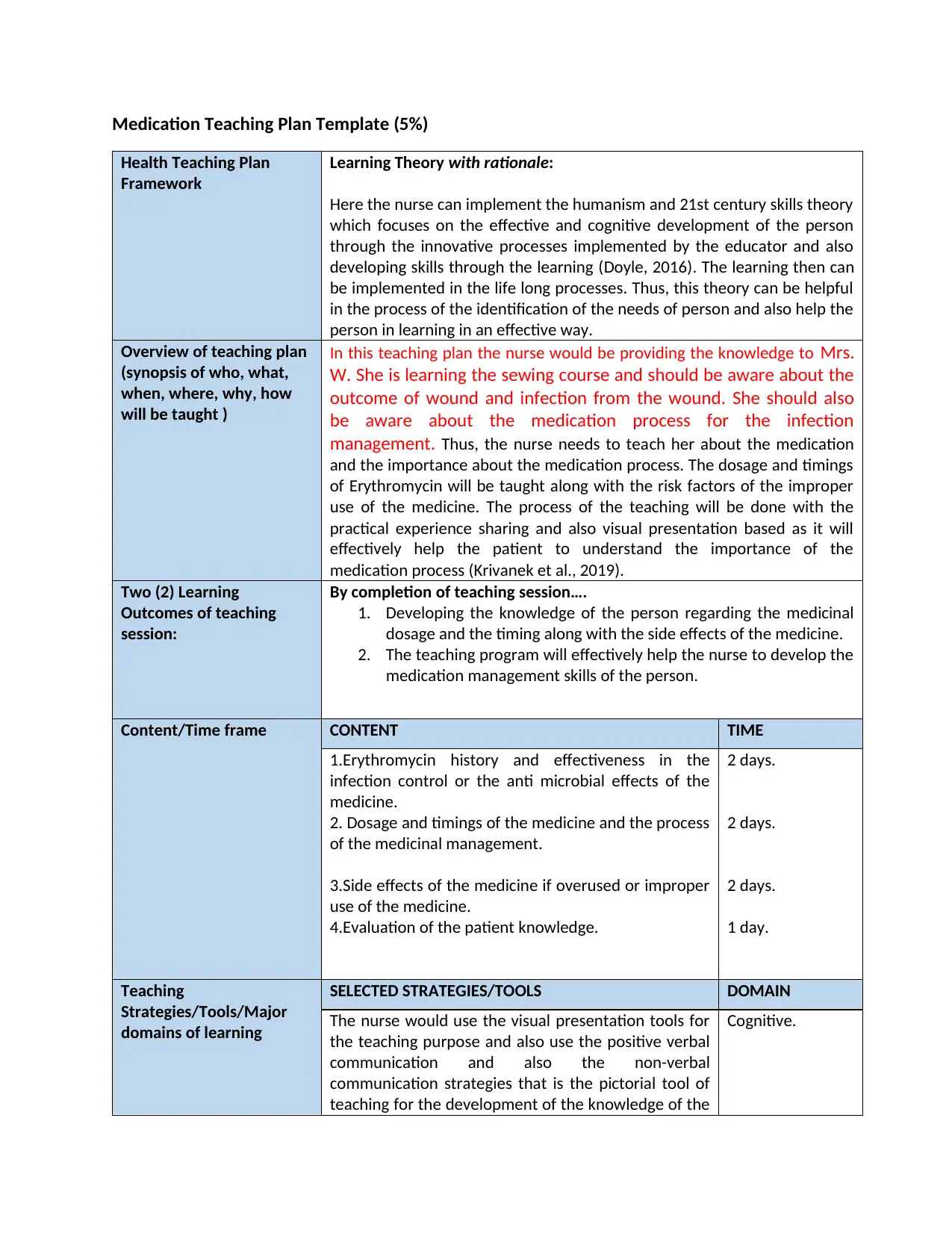
Medication Teaching Plan Template (5%)
Health Teaching Plan
Framework
Learning Theory with rationale:
Here the nurse can implement the humanism and 21st century skills theory
which focuses on the effective and cognitive development of the person
through the innovative processes implemented by the educator and also
developing skills through the learning (Doyle, 2016). The learning then can
be implemented in the life long processes. Thus, this theory can be helpful
in the process of the identification of the needs of person and also help the
person in learning in an effective way.
Overview of teaching plan
(synopsis of who, what,
when, where, why, how
will be taught )
In this teaching plan the nurse would be providing the knowledge to Mrs.
W. She is learning the sewing course and should be aware about the
outcome of wound and infection from the wound. She should also
be aware about the medication process for the infection
management. Thus, the nurse needs to teach her about the medication
and the importance about the medication process. The dosage and timings
of Erythromycin will be taught along with the risk factors of the improper
use of the medicine. The process of the teaching will be done with the
practical experience sharing and also visual presentation based as it will
effectively help the patient to understand the importance of the
medication process (Krivanek et al., 2019).
Two (2) Learning
Outcomes of teaching
session:
By completion of teaching session….
1. Developing the knowledge of the person regarding the medicinal
dosage and the timing along with the side effects of the medicine.
2. The teaching program will effectively help the nurse to develop the
medication management skills of the person.
Content/Time frame CONTENT TIME
1.Erythromycin history and effectiveness in the
infection control or the anti microbial effects of the
medicine.
2. Dosage and timings of the medicine and the process
of the medicinal management.
3.Side effects of the medicine if overused or improper
use of the medicine.
4.Evaluation of the patient knowledge.
2 days.
2 days.
2 days.
1 day.
Teaching
Strategies/Tools/Major
domains of learning
SELECTED STRATEGIES/TOOLS DOMAIN
The nurse would use the visual presentation tools for
the teaching purpose and also use the positive verbal
communication and also the non-verbal
communication strategies that is the pictorial tool of
teaching for the development of the knowledge of the
Cognitive.
tabler-icon-diamond-filled.svg

Paraphrase This Document

Need a fresh take? Get an instant paraphrase of this document with our AI Paraphraser
Document Page
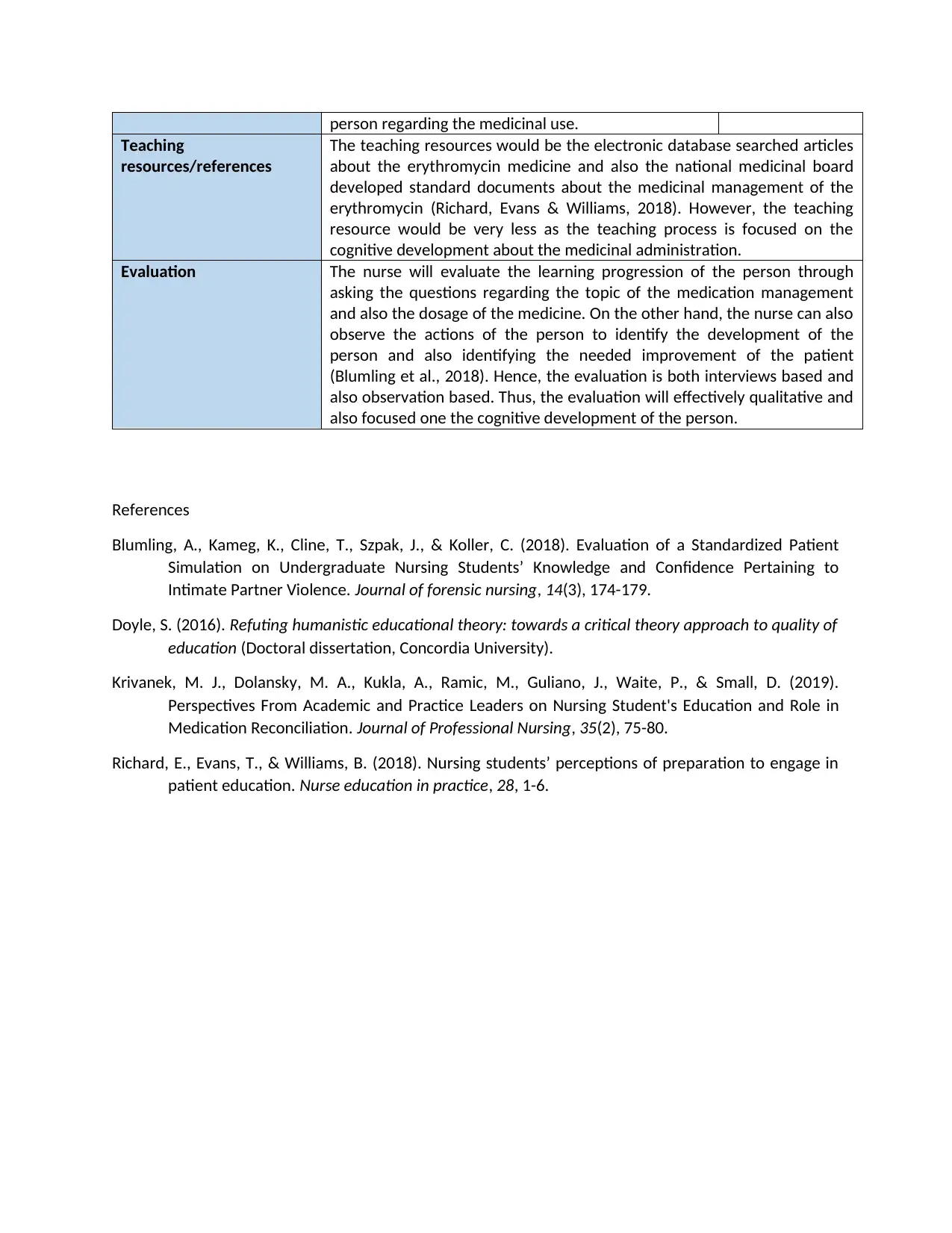
person regarding the medicinal use.
Teaching
resources/references
The teaching resources would be the electronic database searched articles
about the erythromycin medicine and also the national medicinal board
developed standard documents about the medicinal management of the
erythromycin (Richard, Evans & Williams, 2018). However, the teaching
resource would be very less as the teaching process is focused on the
cognitive development about the medicinal administration.
Evaluation The nurse will evaluate the learning progression of the person through
asking the questions regarding the topic of the medication management
and also the dosage of the medicine. On the other hand, the nurse can also
observe the actions of the person to identify the development of the
person and also identifying the needed improvement of the patient
(Blumling et al., 2018). Hence, the evaluation is both interviews based and
also observation based. Thus, the evaluation will effectively qualitative and
also focused one the cognitive development of the person.
References
Blumling, A., Kameg, K., Cline, T., Szpak, J., & Koller, C. (2018). Evaluation of a Standardized Patient
Simulation on Undergraduate Nursing Students’ Knowledge and Confidence Pertaining to
Intimate Partner Violence. Journal of forensic nursing, 14(3), 174-179.
Doyle, S. (2016). Refuting humanistic educational theory: towards a critical theory approach to quality of
education (Doctoral dissertation, Concordia University).
Krivanek, M. J., Dolansky, M. A., Kukla, A., Ramic, M., Guliano, J., Waite, P., & Small, D. (2019).
Perspectives From Academic and Practice Leaders on Nursing Student's Education and Role in
Medication Reconciliation. Journal of Professional Nursing, 35(2), 75-80.
Richard, E., Evans, T., & Williams, B. (2018). Nursing students’ perceptions of preparation to engage in
patient education. Nurse education in practice, 28, 1-6.
chevron_up_icon
1 out of 2
circle_padding
hide_on_mobile
zoom_out_icon
[object Object]