The Impact of Material ESG Issues on Business Development Strategies

Verified

Added on  2023/02/01

|5
|987
|48
Report
AI Summary
This report delves into the critical realm of Material ESG (Environmental, Social, and Governance) issues and their profound influence on business development strategies. It begins by defining the scope of material ESG concerns, ranging from environmental factors like emissions and resource management to social aspects like labor practices and community development, and governance aspects such as executive compensation. The report highlights the significance of these issues in shaping a company's financial performance and underscores the role of frameworks like those developed by the Sustainability Accounting Standards Board (SASB) in helping companies identify and address their material ESG concerns. The report also discusses the importance of innovation in product development and business models as a key factor in determining business strategy, citing examples of companies like Natura, Dow Chemical Company, and CLP Group, which have successfully integrated ESG considerations into their innovation processes. The report concludes by emphasizing the need for businesses to navigate the trade-offs between financial and ESG performance through innovative strategies, ultimately creating a strong base for sustainable business practices.
Document Page
Running Head: SPEECH
SPEECH
Name of the Student
Name of the University
Author Note
tabler-icon-diamond-filled.svg

Paraphrase This Document

Need a fresh take? Get an instant paraphrase of this document with our AI Paraphraser
Document Page
1SPEECH
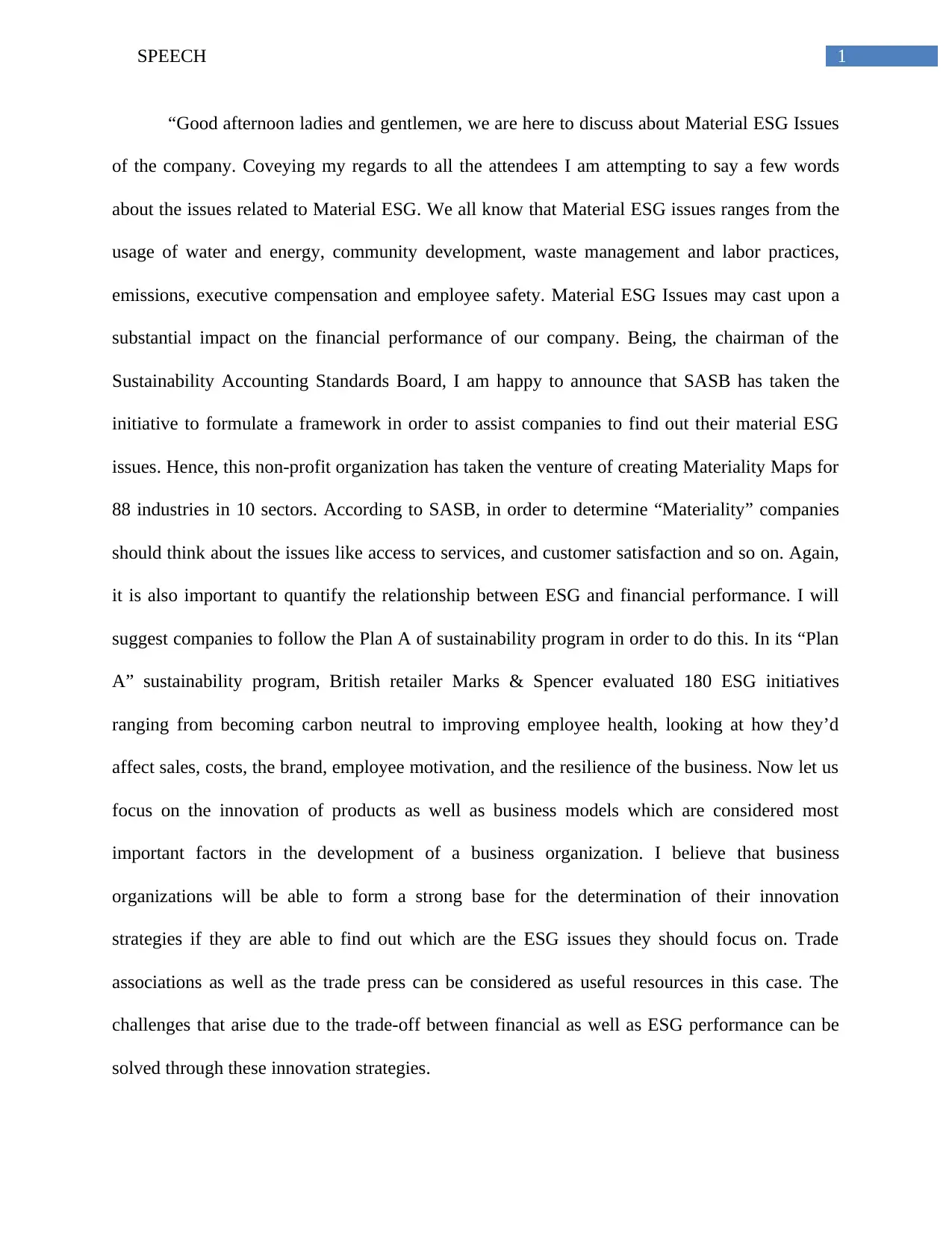
“Good afternoon ladies and gentlemen, we are here to discuss about Material ESG Issues
of the company. Coveying my regards to all the attendees I am attempting to say a few words
about the issues related to Material ESG. We all know that Material ESG issues ranges from the
usage of water and energy, community development, waste management and labor practices,
emissions, executive compensation and employee safety. Material ESG Issues may cast upon a
substantial impact on the financial performance of our company. Being, the chairman of the
Sustainability Accounting Standards Board, I am happy to announce that SASB has taken the
initiative to formulate a framework in order to assist companies to find out their material ESG
issues. Hence, this non-profit organization has taken the venture of creating Materiality Maps for
88 industries in 10 sectors. According to SASB, in order to determine “Materiality” companies
should think about the issues like access to services, and customer satisfaction and so on. Again,
it is also important to quantify the relationship between ESG and financial performance. I will
suggest companies to follow the Plan A of sustainability program in order to do this. In its “Plan
A” sustainability program, British retailer Marks & Spencer evaluated 180 ESG initiatives
ranging from becoming carbon neutral to improving employee health, looking at how they’d
affect sales, costs, the brand, employee motivation, and the resilience of the business. Now let us
focus on the innovation of products as well as business models which are considered most
important factors in the development of a business organization. I believe that business
organizations will be able to form a strong base for the determination of their innovation
strategies if they are able to find out which are the ESG issues they should focus on. Trade
associations as well as the trade press can be considered as useful resources in this case. The
challenges that arise due to the trade-off between financial as well as ESG performance can be
solved through these innovation strategies.
Document Page
2SPEECH
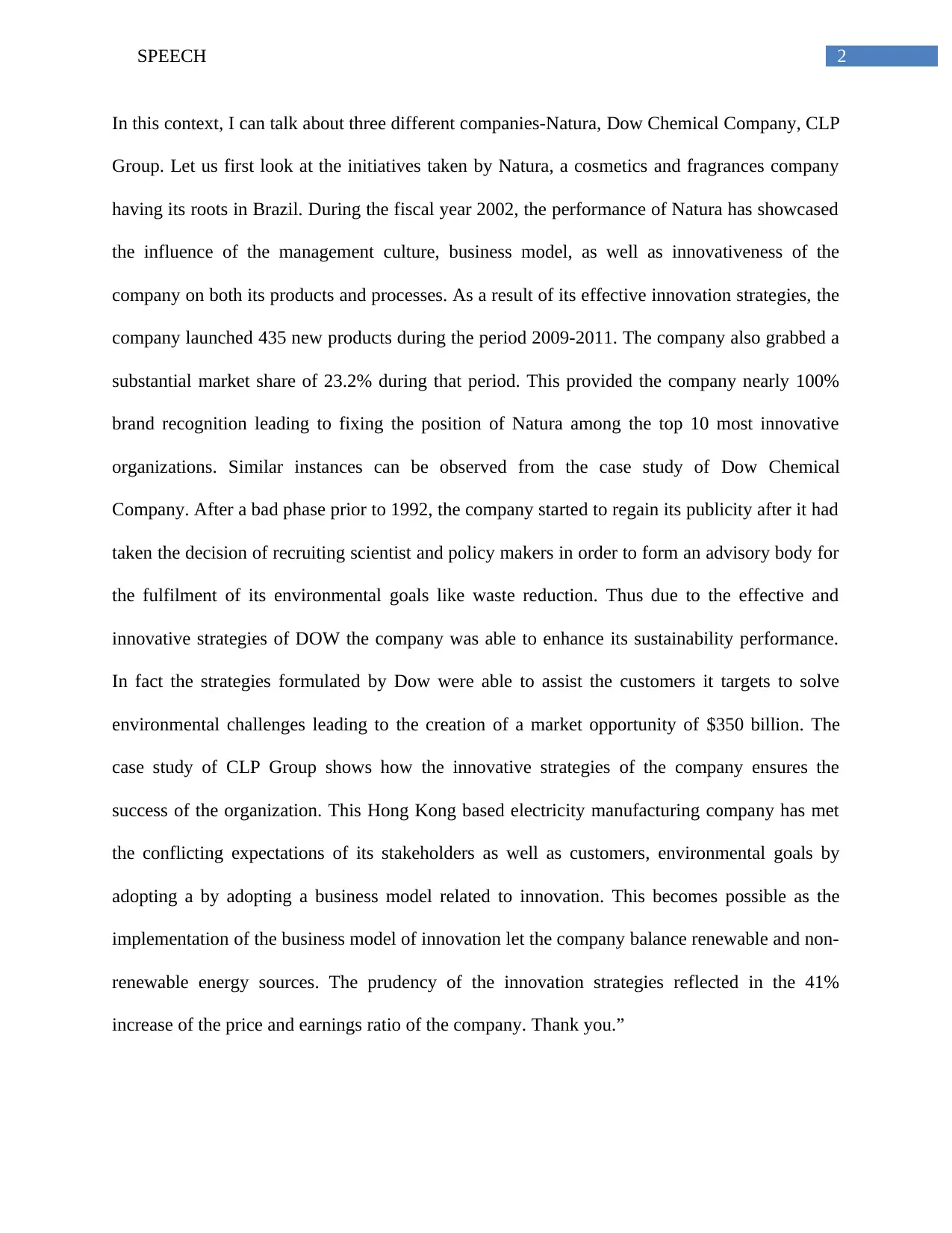
In this context, I can talk about three different companies-Natura, Dow Chemical Company, CLP
Group. Let us first look at the initiatives taken by Natura, a cosmetics and fragrances company
having its roots in Brazil. During the fiscal year 2002, the performance of Natura has showcased
the influence of the management culture, business model, as well as innovativeness of the
company on both its products and processes. As a result of its effective innovation strategies, the
company launched 435 new products during the period 2009-2011. The company also grabbed a
substantial market share of 23.2% during that period. This provided the company nearly 100%
brand recognition leading to fixing the position of Natura among the top 10 most innovative
organizations. Similar instances can be observed from the case study of Dow Chemical
Company. After a bad phase prior to 1992, the company started to regain its publicity after it had
taken the decision of recruiting scientist and policy makers in order to form an advisory body for
the fulfilment of its environmental goals like waste reduction. Thus due to the effective and
innovative strategies of DOW the company was able to enhance its sustainability performance.
In fact the strategies formulated by Dow were able to assist the customers it targets to solve
environmental challenges leading to the creation of a market opportunity of $350 billion. The
case study of CLP Group shows how the innovative strategies of the company ensures the
success of the organization. This Hong Kong based electricity manufacturing company has met
the conflicting expectations of its stakeholders as well as customers, environmental goals by
adopting a by adopting a business model related to innovation. This becomes possible as the
implementation of the business model of innovation let the company balance renewable and non-
renewable energy sources. The prudency of the innovation strategies reflected in the 41%
increase of the price and earnings ratio of the company. Thank you.”
Document Page
3SPEECH
Bibliography
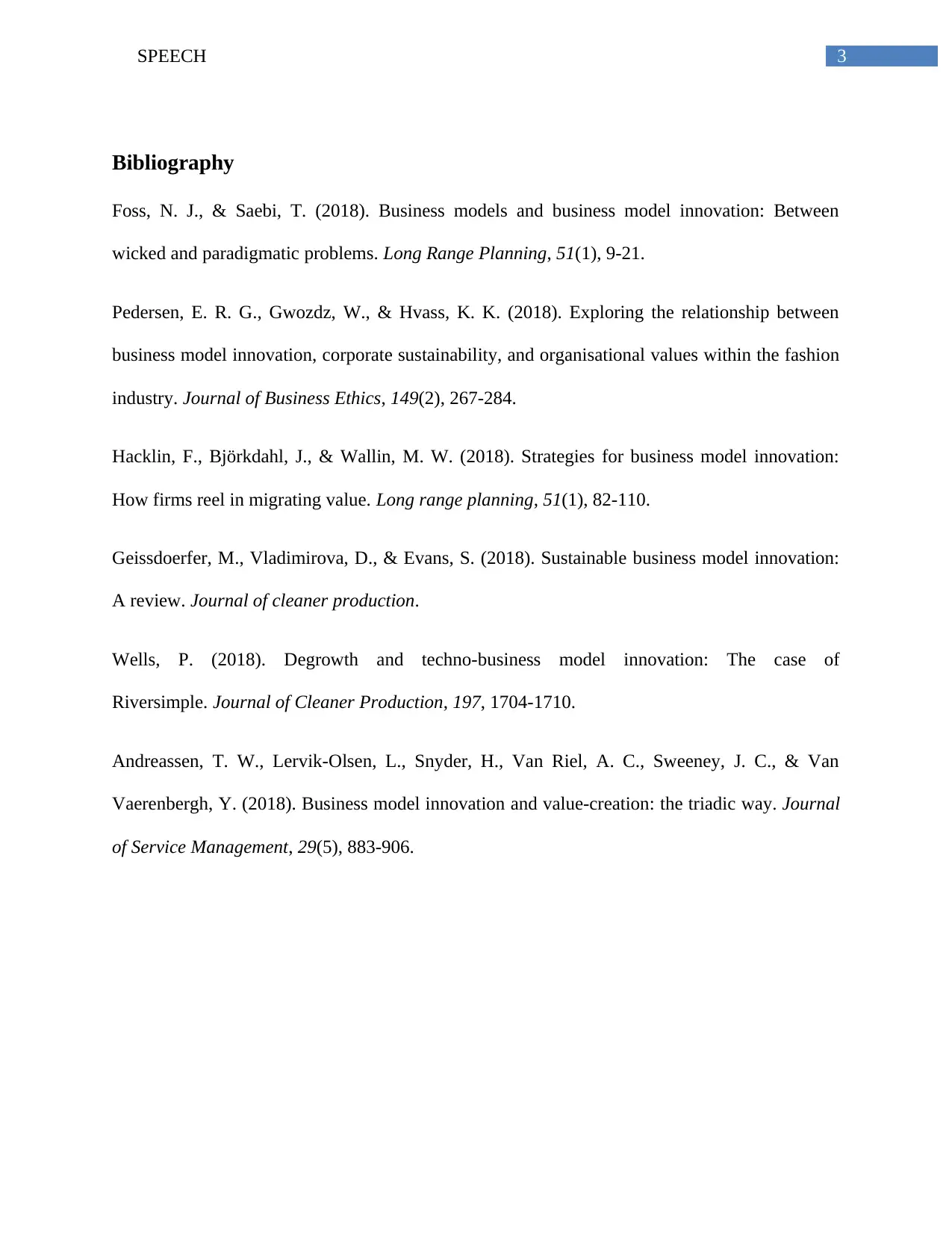
Foss, N. J., & Saebi, T. (2018). Business models and business model innovation: Between
wicked and paradigmatic problems. Long Range Planning, 51(1), 9-21.
Pedersen, E. R. G., Gwozdz, W., & Hvass, K. K. (2018). Exploring the relationship between
business model innovation, corporate sustainability, and organisational values within the fashion
industry. Journal of Business Ethics, 149(2), 267-284.
Hacklin, F., Björkdahl, J., & Wallin, M. W. (2018). Strategies for business model innovation:
How firms reel in migrating value. Long range planning, 51(1), 82-110.
Geissdoerfer, M., Vladimirova, D., & Evans, S. (2018). Sustainable business model innovation:
A review. Journal of cleaner production.
Wells, P. (2018). Degrowth and techno-business model innovation: The case of
Riversimple. Journal of Cleaner Production, 197, 1704-1710.
Andreassen, T. W., Lervik-Olsen, L., Snyder, H., Van Riel, A. C., Sweeney, J. C., & Van
Vaerenbergh, Y. (2018). Business model innovation and value-creation: the triadic way. Journal
of Service Management, 29(5), 883-906.
tabler-icon-diamond-filled.svg

Paraphrase This Document

Need a fresh take? Get an instant paraphrase of this document with our AI Paraphraser
Document Page
4SPEECH
.
chevron_up_icon
1 out of 5
circle_padding
hide_on_mobile
zoom_out_icon
[object Object]