Ethical Dilemma Analysis: Investment Consulting Associates Case Study

Verified

Added on  2023/01/17

|8
|2054
|26
Case Study
AI Summary
This case study analyzes an ethical dilemma faced by Harry Markham, a CFA working for Investment Consulting Associates (ICA), an investment advisory firm for pension funds. Markham discovers that the valuation of public sector pension fund liabilities is significantly understated compared to his financial analysis. This discrepancy presents an ethical dilemma: whether to disclose the accurate, higher liability figures, potentially upsetting clients and the firm, or to remain silent and maintain the status quo. The study explores the ethical implications through the lenses of consequentialism and virtue ethics, examining Markham's conflicting loyalties and the potential consequences of each decision. It considers two main alternatives: not disclosing the accurate liabilities, which could maintain trust and support but violates ethical standards, and disclosing the truth, which could rebuild integrity but risk negative consequences. The paper applies ethical frameworks, such as the rights approach, to suggest the best course of action for the firm, considering its long-term well-being, reputation, and the interests of its clients. The conclusion emphasizes the importance of ethical decision-making and transparency in the investment industry.
Document Page
Running head: CASE STUDY: BUSINESS ETHICS
CASE STUDY: BUSINESS ETHICS
Name of the student
Name of the University
Author Note
tabler-icon-diamond-filled.svg

Paraphrase This Document

Need a fresh take? Get an instant paraphrase of this document with our AI Paraphraser
Document Page
1CASE STUDY: BUSINESS ETHICS
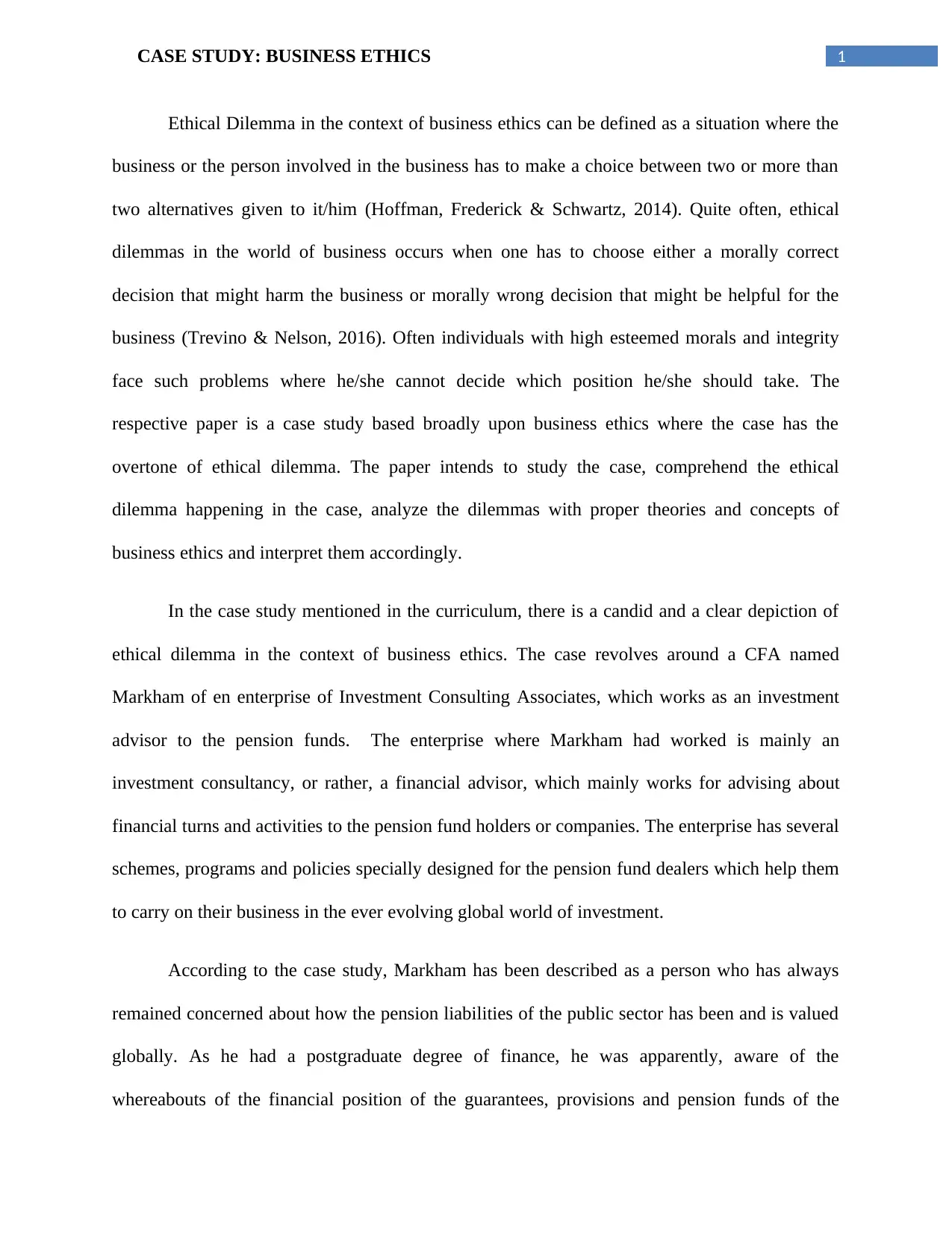
Ethical Dilemma in the context of business ethics can be defined as a situation where the
business or the person involved in the business has to make a choice between two or more than
two alternatives given to it/him (Hoffman, Frederick & Schwartz, 2014). Quite often, ethical
dilemmas in the world of business occurs when one has to choose either a morally correct
decision that might harm the business or morally wrong decision that might be helpful for the
business (Trevino & Nelson, 2016). Often individuals with high esteemed morals and integrity
face such problems where he/she cannot decide which position he/she should take. The
respective paper is a case study based broadly upon business ethics where the case has the
overtone of ethical dilemma. The paper intends to study the case, comprehend the ethical
dilemma happening in the case, analyze the dilemmas with proper theories and concepts of
business ethics and interpret them accordingly.
In the case study mentioned in the curriculum, there is a candid and a clear depiction of
ethical dilemma in the context of business ethics. The case revolves around a CFA named
Markham of en enterprise of Investment Consulting Associates, which works as an investment
advisor to the pension funds. The enterprise where Markham had worked is mainly an
investment consultancy, or rather, a financial advisor, which mainly works for advising about
financial turns and activities to the pension fund holders or companies. The enterprise has several
schemes, programs and policies specially designed for the pension fund dealers which help them
to carry on their business in the ever evolving global world of investment.
According to the case study, Markham has been described as a person who has always
remained concerned about how the pension liabilities of the public sector has been and is valued
globally. As he had a postgraduate degree of finance, he was apparently, aware of the
whereabouts of the financial position of the guarantees, provisions and pension funds of the
Document Page
2CASE STUDY: BUSINESS ETHICS
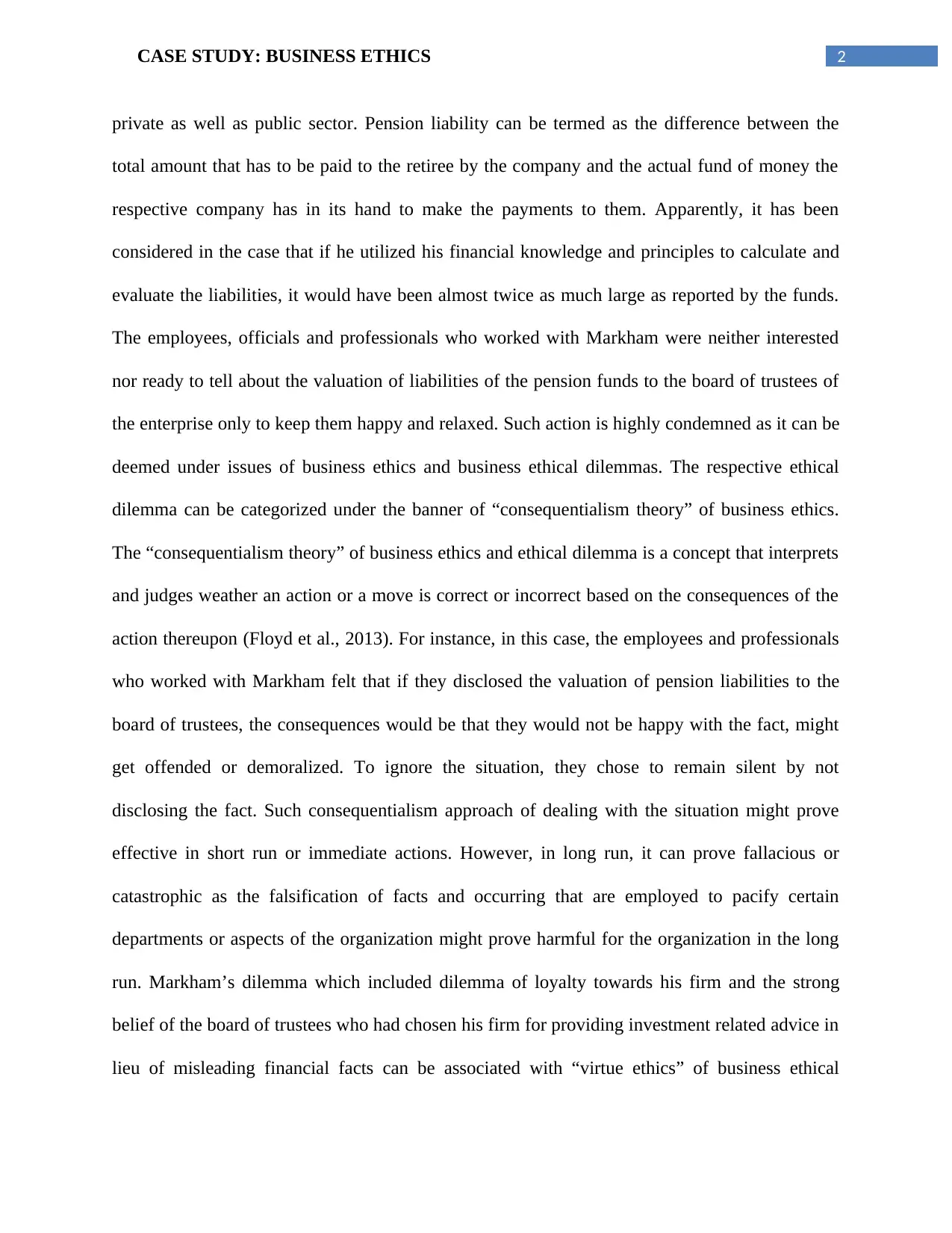
private as well as public sector. Pension liability can be termed as the difference between the
total amount that has to be paid to the retiree by the company and the actual fund of money the
respective company has in its hand to make the payments to them. Apparently, it has been
considered in the case that if he utilized his financial knowledge and principles to calculate and
evaluate the liabilities, it would have been almost twice as much large as reported by the funds.
The employees, officials and professionals who worked with Markham were neither interested
nor ready to tell about the valuation of liabilities of the pension funds to the board of trustees of
the enterprise only to keep them happy and relaxed. Such action is highly condemned as it can be
deemed under issues of business ethics and business ethical dilemmas. The respective ethical
dilemma can be categorized under the banner of “consequentialism theory” of business ethics.
The “consequentialism theory” of business ethics and ethical dilemma is a concept that interprets
and judges weather an action or a move is correct or incorrect based on the consequences of the
action thereupon (Floyd et al., 2013). For instance, in this case, the employees and professionals
who worked with Markham felt that if they disclosed the valuation of pension liabilities to the
board of trustees, the consequences would be that they would not be happy with the fact, might
get offended or demoralized. To ignore the situation, they chose to remain silent by not
disclosing the fact. Such consequentialism approach of dealing with the situation might prove
effective in short run or immediate actions. However, in long run, it can prove fallacious or
catastrophic as the falsification of facts and occurring that are employed to pacify certain
departments or aspects of the organization might prove harmful for the organization in the long
run. Markham’s dilemma which included dilemma of loyalty towards his firm and the strong
belief of the board of trustees who had chosen his firm for providing investment related advice in
lieu of misleading financial facts can be associated with “virtue ethics” of business ethical
Document Page
3CASE STUDY: BUSINESS ETHICS
dilemma. Virtue ethics can be broadly defined as the highlight on development of morals and
character of a corporate individual (McPherson, 2013). However, Markham faces virtue
dilemmas as according to him, falsification and covering of facts would only exhibit his moral
misconduct and dishonesty and prove him less in the organization and also within himself.
Markham’s self-actualization would be at stake (Crossan, Mazutis & Seijts, 2013).
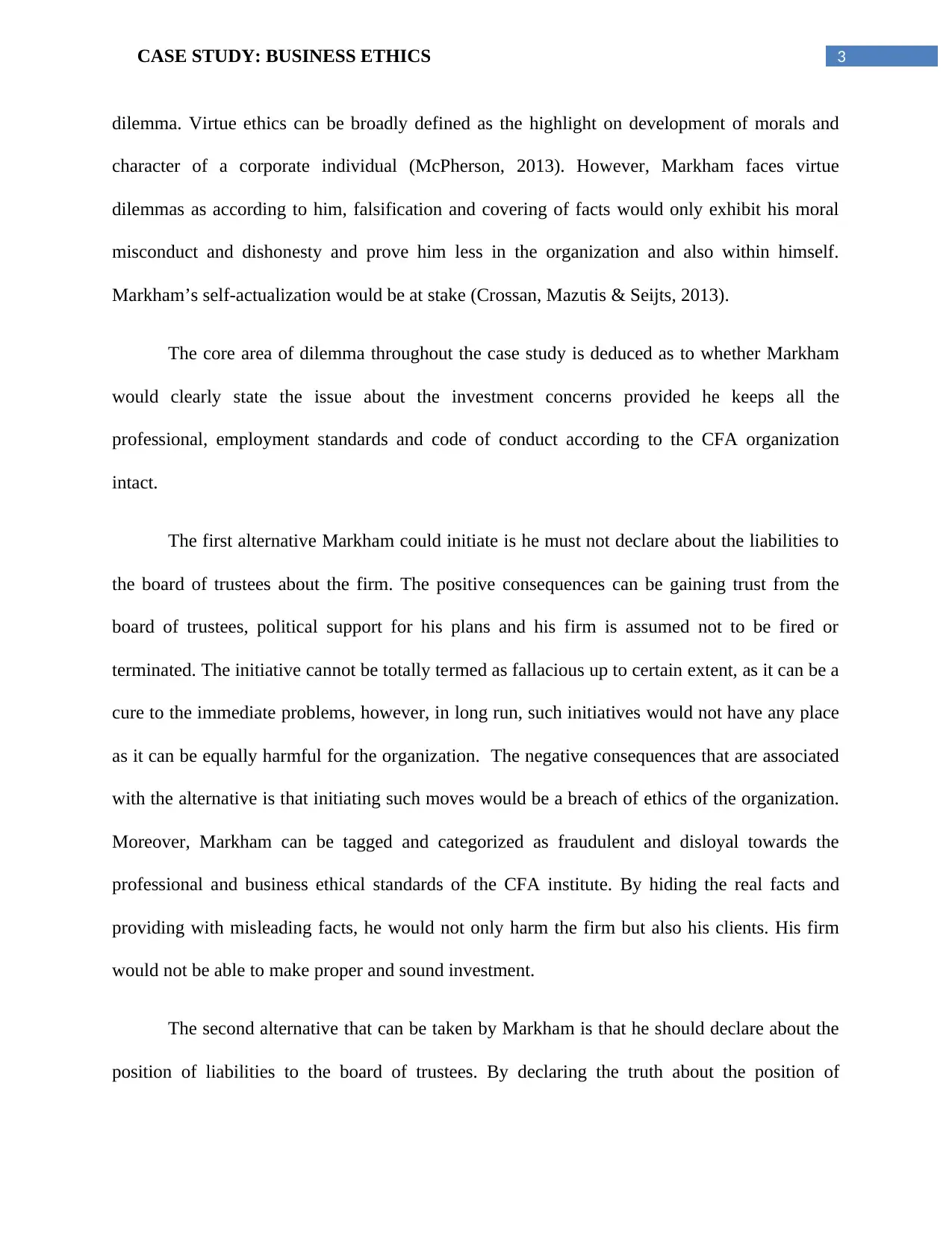
The core area of dilemma throughout the case study is deduced as to whether Markham
would clearly state the issue about the investment concerns provided he keeps all the
professional, employment standards and code of conduct according to the CFA organization
intact.
The first alternative Markham could initiate is he must not declare about the liabilities to
the board of trustees about the firm. The positive consequences can be gaining trust from the
board of trustees, political support for his plans and his firm is assumed not to be fired or
terminated. The initiative cannot be totally termed as fallacious up to certain extent, as it can be a
cure to the immediate problems, however, in long run, such initiatives would not have any place
as it can be equally harmful for the organization. The negative consequences that are associated
with the alternative is that initiating such moves would be a breach of ethics of the organization.
Moreover, Markham can be tagged and categorized as fraudulent and disloyal towards the
professional and business ethical standards of the CFA institute. By hiding the real facts and
providing with misleading facts, he would not only harm the firm but also his clients. His firm
would not be able to make proper and sound investment.
The second alternative that can be taken by Markham is that he should declare about the
position of liabilities to the board of trustees. By declaring the truth about the position of
tabler-icon-diamond-filled.svg

Paraphrase This Document

Need a fresh take? Get an instant paraphrase of this document with our AI Paraphraser
Document Page
4CASE STUDY: BUSINESS ETHICS
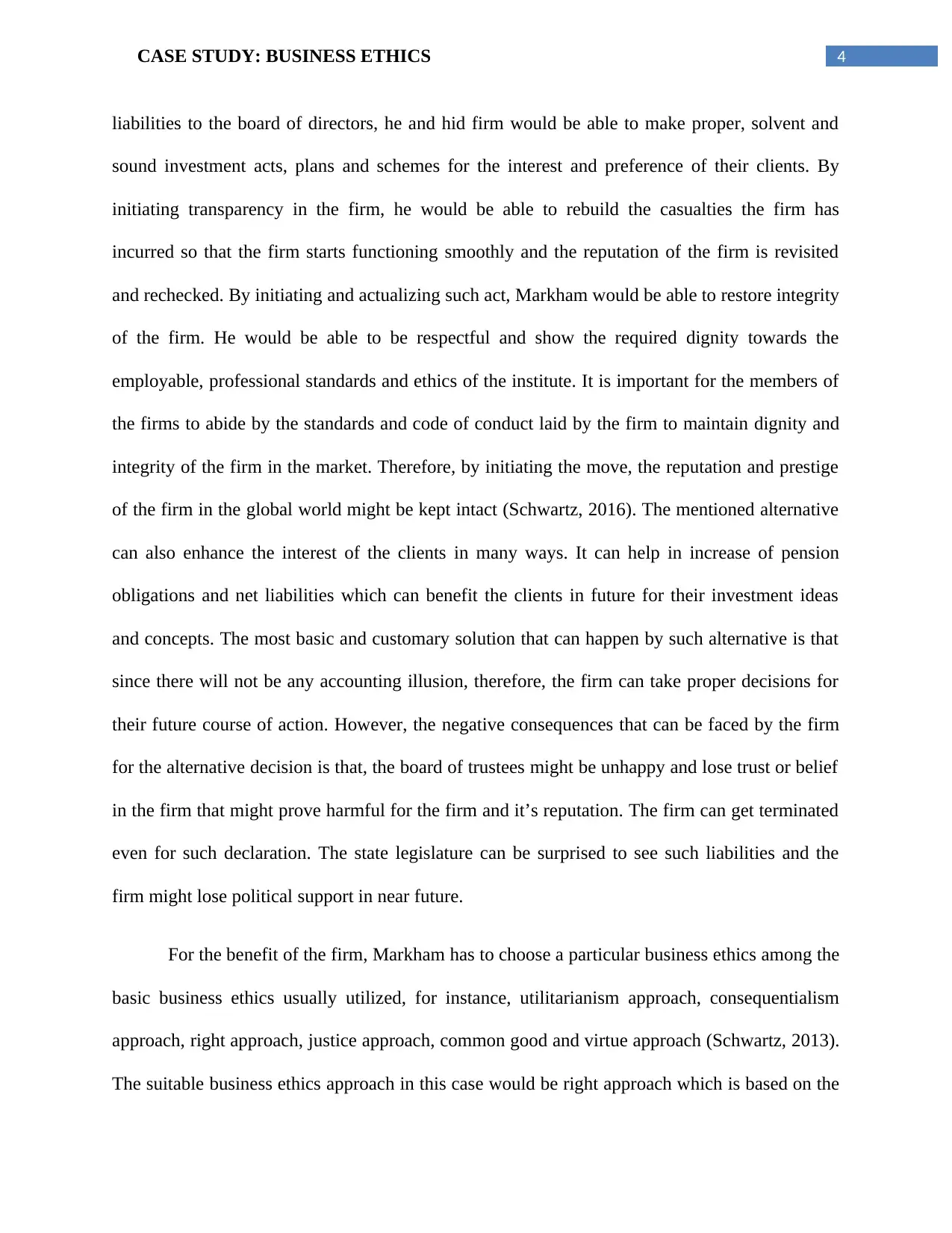
liabilities to the board of directors, he and hid firm would be able to make proper, solvent and
sound investment acts, plans and schemes for the interest and preference of their clients. By
initiating transparency in the firm, he would be able to rebuild the casualties the firm has
incurred so that the firm starts functioning smoothly and the reputation of the firm is revisited
and rechecked. By initiating and actualizing such act, Markham would be able to restore integrity
of the firm. He would be able to be respectful and show the required dignity towards the
employable, professional standards and ethics of the institute. It is important for the members of
the firms to abide by the standards and code of conduct laid by the firm to maintain dignity and
integrity of the firm in the market. Therefore, by initiating the move, the reputation and prestige
of the firm in the global world might be kept intact (Schwartz, 2016). The mentioned alternative
can also enhance the interest of the clients in many ways. It can help in increase of pension
obligations and net liabilities which can benefit the clients in future for their investment ideas
and concepts. The most basic and customary solution that can happen by such alternative is that
since there will not be any accounting illusion, therefore, the firm can take proper decisions for
their future course of action. However, the negative consequences that can be faced by the firm
for the alternative decision is that, the board of trustees might be unhappy and lose trust or belief
in the firm that might prove harmful for the firm and it’s reputation. The firm can get terminated
even for such declaration. The state legislature can be surprised to see such liabilities and the
firm might lose political support in near future.
For the benefit of the firm, Markham has to choose a particular business ethics among the
basic business ethics usually utilized, for instance, utilitarianism approach, consequentialism
approach, right approach, justice approach, common good and virtue approach (Schwartz, 2013).
The suitable business ethics approach in this case would be right approach which is based on the
Document Page
5CASE STUDY: BUSINESS ETHICS
concept that among the plethora of views, overviews and conflicting perspectives, the firm has to
choose the right decision for the interest and preferences of the clients among the alternatives
given to them (Buckley, 2013). Such ethical approach can prove beneficial and righteous for the
firm in the long run and that might ensure the well-being, prestige, power, democracy and
dignity of the firm in the global competitive market. Discount rate can be decreased or pension
fund can be unfunded along with increase in funds in the due course of time can be taken up by
the firm in this case to meet the casualties.
The respective paper is an introspection, analysis, interpretation and recommendation of
business ethics and actions or alternatives that can be taken up by a firm to tackle its casualties
with the help of a case study provided. The paper not just introspects but also uses various
theories and concepts of ethical dilemma and business ethics to reach the results thereafter.
Document Page
6CASE STUDY: BUSINESS ETHICS
References :
Buckley, M. (2013). A constructivist approach to business ethics. Journal of business ethics,
117(4), 695-706. Retrieved from: https://link.springer.com/article/10.1007/s10551-013-
1719-x
Crossan, M., Mazutis, D., & Seijts, G. (2013). In search of virtue: The role of virtues, values and
character strengths in ethical decision making. Journal of Business Ethics, 113(4), 567-581.
Retrieved from: https://link.springer.com/article/10.1007/s10551-013-1680-8
Floyd, L. A., Xu, F., Atkins, R., & Caldwell, C. (2013). Ethical outcomes and business ethics:
Toward improving business ethics education. Journal of business ethics, 117(4), 753-776.
Retieved from: https://link.springer.com/journal/10551/117/4/page/1
Hoffman, W. M., Frederick, R. E., & Schwartz, M. S. (Eds.). (2014). Business ethics: Readings
and cases in corporate morality. John Wiley & Sons.
McPherson, D. (2013). Vocational virtue ethics: Prospects for a virtue ethic approach to
business. Journal of business ethics, 116(2), 283-296. Retrieved from:
https://link.springer.com/journal/10551
Schwartz, M. S. (2013). Developing and sustaining an ethical corporate culture: The core
elements. Business Horizons, 56(1), 39-50. Retrieved from:
https://www.sciencedirect.com/science/article/pii/S0007681312001218
Schwartz, M. S. (2016). Ethical decision-making theory: An integrated approach. Journal of
Business Ethics, 139(4), 755-776. Retrieved from:
https://link.springer.com/article/10.1007/s10551-015-2886-8
tabler-icon-diamond-filled.svg

Paraphrase This Document

Need a fresh take? Get an instant paraphrase of this document with our AI Paraphraser
Document Page
7CASE STUDY: BUSINESS ETHICS
Trevino, L. K., & Nelson, K. A. (2016). Managing business ethics: Straight talk about how to do
it right. John Wiley & Sons.
chevron_up_icon
1 out of 8
circle_padding
hide_on_mobile
zoom_out_icon
[object Object]