ENGR9742 - Standards, Ethics & Compliance: Ethical Case Study Report
VerifiedAdded on 2023/06/03
|11
|2708
|285
Report
AI Summary
This report presents an ethical case study focusing on the professional conduct of an environmental engineer named Tim. Tim faces ethical dilemmas concerning data misrepresentation by corporate clients regarding pollutant levels. The report explores the ethical responsibilities of engineers, the risks and benefits associated with misrepresenting data, and the impact on stakeholders. It examines the implications of Tim's decisions, the importance of ethical behavior, and the potential consequences of acting unethically, including reputational risks. The report emphasizes the need for engineers to prioritize accurate data presentation and ethical practices, while also considering the pressures they may face from employers. The conclusion recommends that engineers should not support companies misrepresenting environmental data, despite potential short-term benefits, and highlights the increasing importance of ethical responsibilities in the engineering field.

Ethical Case study

Paraphrase This Document
Need a fresh take? Get an instant paraphrase of this document with our AI Paraphraser
Contents
Abstract.................................................................................................................................................3
Introduction...........................................................................................................................................3
Discussion..............................................................................................................................................4
Conclusion.............................................................................................................................................6
References.............................................................................................................................................7
Abstract.................................................................................................................................................3
Introduction...........................................................................................................................................3
Discussion..............................................................................................................................................4
Conclusion.............................................................................................................................................6
References.............................................................................................................................................7
Abstract
This case focuses on the ethical issues associated with the profession of Engineering. In this context a
case study approach has been used for clearly understanding the ethical issues that are faced by the
engineers. The ethics in engineering are the responsibility as well as ability of an engineer in
context of judging their decisions from the perspective of general wellbeing of the society.
This particular case indicates that the engineer presented the information that was not
accurate to Tim; this is known as the misrepresentation of the data. This is an ethical issue on
the part of technical expert who misrepresented the data. The misinterpretation of the
pollutant information cannot be considered as a sound technical reasoning. Tim faces the
ethical conflict in context acting against the data misrepresentation. The findings of this case
indicate that there is no right or wrong solution for the ethical issues but the engineers should
focus on adopting the ethical behaviour.
Introduction
Engineers are helping in the transformation of the science into the products that are useful for
the comfort of human beings. Engineering can be defined as something that is done by the
engineers. Engineering includes the application of mathematical methods, science and the
empirical evidences to the areas such as construction, innovation, design, machines, material,
processes etc. (asce 2017). Ethics can be defined as the moral principles that govern
behaviour of the person while conducting an activity. (engineersaustralia 2017). In
engineering the ethics are the moral issues that are confronted by the engineers and the
This case focuses on the ethical issues associated with the profession of Engineering. In this context a
case study approach has been used for clearly understanding the ethical issues that are faced by the
engineers. The ethics in engineering are the responsibility as well as ability of an engineer in
context of judging their decisions from the perspective of general wellbeing of the society.
This particular case indicates that the engineer presented the information that was not
accurate to Tim; this is known as the misrepresentation of the data. This is an ethical issue on
the part of technical expert who misrepresented the data. The misinterpretation of the
pollutant information cannot be considered as a sound technical reasoning. Tim faces the
ethical conflict in context acting against the data misrepresentation. The findings of this case
indicate that there is no right or wrong solution for the ethical issues but the engineers should
focus on adopting the ethical behaviour.
Introduction
Engineers are helping in the transformation of the science into the products that are useful for
the comfort of human beings. Engineering can be defined as something that is done by the
engineers. Engineering includes the application of mathematical methods, science and the
empirical evidences to the areas such as construction, innovation, design, machines, material,
processes etc. (asce 2017). Ethics can be defined as the moral principles that govern
behaviour of the person while conducting an activity. (engineersaustralia 2017). In
engineering the ethics are the moral issues that are confronted by the engineers and the
⊘ This is a preview!⊘
Do you want full access?
Subscribe today to unlock all pages.

Trusted by 1+ million students worldwide
engineering organizations while taking the important decisions. (Stappenbelt 2013) The
professional engineers have both the professional and personal obligations towards the
society so as to act in an ethical manner. (Santi 2000).The scope of engineering ethics
includes number of activities such as the Engineering as a social experimentation, global
issues and concerns, employer’s responsibility, rights of the engineers and ethical theories
and moral reasoning. (morganclaypool 2011) One of the best ways to understand ethics in
engineering is to understand it with the help of case study. This report is one of the efforts to
understand the engineering ethics with the help of case study. The focus will be on
understanding the relevant ethical factors, risks and benefits associated with the case.
The case is about Tim who is an environmental engineer at one of the consulting firms since
25 years. Tim is known for settling the disputes between the corporate clients. Tim critically
analyzes the technical data before pursuing the litigation. The focus of Tim usually is on the
distributions of solid particle pollution. This data is presented by the disputing parties in order
to help the parties on reaching to a compromise on the total cost associated with the
environmental cleanup. One of the examples to understand is that if there are two parties that
are separated with a strip of land; both the parties in this case fiscally contribute in keeping
the land free from the pollutants. (Rowden & Striebig 2004)
Tim however faced number of ethical issues while working as an environment. One day Tim
was contacted by the journalist regarding his experiences at the organization while managing
the clients. Tim disclosed some of the cases where he encountered the ethical issue of
misrepresentation of data. The companies presented the wrong information or the inaccurate
information about the levels of solid particle pollution in the surroundings of the company.
The technical experts who are the engineers misrepresent the data so as to make it seem that
the other party is responsible for the contamination of the large part. Tim at the ends of the
professional engineers have both the professional and personal obligations towards the
society so as to act in an ethical manner. (Santi 2000).The scope of engineering ethics
includes number of activities such as the Engineering as a social experimentation, global
issues and concerns, employer’s responsibility, rights of the engineers and ethical theories
and moral reasoning. (morganclaypool 2011) One of the best ways to understand ethics in
engineering is to understand it with the help of case study. This report is one of the efforts to
understand the engineering ethics with the help of case study. The focus will be on
understanding the relevant ethical factors, risks and benefits associated with the case.
The case is about Tim who is an environmental engineer at one of the consulting firms since
25 years. Tim is known for settling the disputes between the corporate clients. Tim critically
analyzes the technical data before pursuing the litigation. The focus of Tim usually is on the
distributions of solid particle pollution. This data is presented by the disputing parties in order
to help the parties on reaching to a compromise on the total cost associated with the
environmental cleanup. One of the examples to understand is that if there are two parties that
are separated with a strip of land; both the parties in this case fiscally contribute in keeping
the land free from the pollutants. (Rowden & Striebig 2004)
Tim however faced number of ethical issues while working as an environment. One day Tim
was contacted by the journalist regarding his experiences at the organization while managing
the clients. Tim disclosed some of the cases where he encountered the ethical issue of
misrepresentation of data. The companies presented the wrong information or the inaccurate
information about the levels of solid particle pollution in the surroundings of the company.
The technical experts who are the engineers misrepresent the data so as to make it seem that
the other party is responsible for the contamination of the large part. Tim at the ends of the
Paraphrase This Document
Need a fresh take? Get an instant paraphrase of this document with our AI Paraphraser
interview focused on the necessity of taking the ownership for the engineers by specifically
being honest towards the accurate presentation of data. (Wong 2015)
It will be also ethically wrong on the side of Tim to approve the data provided by the
engineer. According to the ethics of Engineers, they shall not misrepresent the information
associate with their employees, associates and employers. It is ethically relevant for Tim to
take a strict step against the misrepresentation of the information related to environment.
(Wareham, Panagiotis & Elefsiniotis 1996).
Discussion
In the past, the engineers’ have only focused on the use of traditional and technical solutions
associated with the environmental issues and social impact of solving the environmental
issues. The engineering ethics are now concerned with the responsibility and professionalism
of the engineers towards solving the environmental issues. (Hawrysz & Foltys 2016) Tim in
this context should not support the practices related to misinterpretation of the levels of solid
particle pollution in the surroundings. Tim should think of and adopt the best ways and
strategies that can help the engineers in adopting the ethical environmental practices. (Beder
1995)An increase in the levels of particle pollution in the surroundings is one of the major
environmental issues. Tim should not consider even the minor misrepresentation of the
environmental data so as to act as an ethical engineer. Engineers are however under the
pressure of their employers to consider the misrepresentation of the data for the false
information about the carbon emission or pollution. This is a huge pressure as the engineers
are also obliged to their employers to act as they are instructed. (Vesilind 1998)This is the
reason why number of engineers’ are using the false information and supporting the parties
that want to minimize their contribution in the pollution or emission using the inaccurate
information. This is one of the major ethical issues that are faced especially by the
being honest towards the accurate presentation of data. (Wong 2015)
It will be also ethically wrong on the side of Tim to approve the data provided by the
engineer. According to the ethics of Engineers, they shall not misrepresent the information
associate with their employees, associates and employers. It is ethically relevant for Tim to
take a strict step against the misrepresentation of the information related to environment.
(Wareham, Panagiotis & Elefsiniotis 1996).
Discussion
In the past, the engineers’ have only focused on the use of traditional and technical solutions
associated with the environmental issues and social impact of solving the environmental
issues. The engineering ethics are now concerned with the responsibility and professionalism
of the engineers towards solving the environmental issues. (Hawrysz & Foltys 2016) Tim in
this context should not support the practices related to misinterpretation of the levels of solid
particle pollution in the surroundings. Tim should think of and adopt the best ways and
strategies that can help the engineers in adopting the ethical environmental practices. (Beder
1995)An increase in the levels of particle pollution in the surroundings is one of the major
environmental issues. Tim should not consider even the minor misrepresentation of the
environmental data so as to act as an ethical engineer. Engineers are however under the
pressure of their employers to consider the misrepresentation of the data for the false
information about the carbon emission or pollution. This is a huge pressure as the engineers
are also obliged to their employers to act as they are instructed. (Vesilind 1998)This is the
reason why number of engineers’ are using the false information and supporting the parties
that want to minimize their contribution in the pollution or emission using the inaccurate
information. This is one of the major ethical issues that are faced especially by the
environmental engineers. Misrepresentation of the environmental data is favourable for the
employers but it is disadvantageous for the society and the employees. (Starrett 2005)
The misrepresentation of the environment data such as the levels of solid particle pollution in
the surroundings poses both risks and benefits. The benefits are for the employer or the
organizations that are making it seem that they are not contributing in the pollution of the
environment. The engineers’ and employees however come under the risk of performing their
job unethically. (Hawrysz & Foltys 2016). The employer or the organization that is
pressurizing its engineers or the employees to misrepresent the data about levels of pollutants
will also have some of the cost benefits. This is because the organization will not have to pay
for the increased level of pollutants in the environment. The parties that are under the risk in
such a scenario include the employees as well as the society. (Hersh 2000). The organizations
involved in the misrepresentation of the data are associated with one of the major risks-
reputational risk. The reputational risk is the ones that result from the damages that are
caused to the reputation of the firm. The reputational risks can result in the loss of revenue,
loss of employees, regulatory costs or reduce shareholder value. (Sumita Sindhi 2012).
.
The best practices in this case can be the reporting of the accurate data and implementation of
the practices that can help in reducing the levels of pollutants. This will help in protecting the
environment, fulfilling the ethical responsibilities towards the society and environment along
with building a positive image in the society. (Wareham, Panagiotis & Elefsiniotis 1996) Tim
should focus on encouraging the employer to present the accurate data on the pollutants level
and make them understand the positive aspects of using the practices that can reduce the
levels of pollutants in the surroundings. This will help the company in promoting the
sustainability and being ahead in the green curve. Further, if Tim is successful at
employers but it is disadvantageous for the society and the employees. (Starrett 2005)
The misrepresentation of the environment data such as the levels of solid particle pollution in
the surroundings poses both risks and benefits. The benefits are for the employer or the
organizations that are making it seem that they are not contributing in the pollution of the
environment. The engineers’ and employees however come under the risk of performing their
job unethically. (Hawrysz & Foltys 2016). The employer or the organization that is
pressurizing its engineers or the employees to misrepresent the data about levels of pollutants
will also have some of the cost benefits. This is because the organization will not have to pay
for the increased level of pollutants in the environment. The parties that are under the risk in
such a scenario include the employees as well as the society. (Hersh 2000). The organizations
involved in the misrepresentation of the data are associated with one of the major risks-
reputational risk. The reputational risk is the ones that result from the damages that are
caused to the reputation of the firm. The reputational risks can result in the loss of revenue,
loss of employees, regulatory costs or reduce shareholder value. (Sumita Sindhi 2012).
.
The best practices in this case can be the reporting of the accurate data and implementation of
the practices that can help in reducing the levels of pollutants. This will help in protecting the
environment, fulfilling the ethical responsibilities towards the society and environment along
with building a positive image in the society. (Wareham, Panagiotis & Elefsiniotis 1996) Tim
should focus on encouraging the employer to present the accurate data on the pollutants level
and make them understand the positive aspects of using the practices that can reduce the
levels of pollutants in the surroundings. This will help the company in promoting the
sustainability and being ahead in the green curve. Further, if Tim is successful at
⊘ This is a preview!⊘
Do you want full access?
Subscribe today to unlock all pages.
Trusted by 1+ million students worldwide
encouraging the employer to use the ethical practice for environmental protection then the
employees of the organization will also motivated towards working in the organization that is
socially and ethically responsible towards the environment. The employees of the
organization will feel safer in working in the environment that is complying to the
environmental rules, regulations and the policies. This is also one of the good ways of
reducing the turnover of the employees and building a positive image in the society.
(Hawrysz & Foltys 2016)
The case also has some negative implications such as the objection of Tim on the data that is
inaccurate may end up his relationship with his employer. This is one of the biggest fears of
all the engineers’ who want to behave ethically in their profession. Further the
misrepresentation of the information can also costs high to the organizations if a legal action
is taken against the same. This will severely affect the reputation of the organization in the
market and among its stakeholders. This indicates that there are both positive and negative
implications associated with the case of Tim.
There are practical and moral significance associated with the ethics in engineering. The
ethics in engineering can be related with the quality of decisions. For example: the decision
taken by Time to act ethically or unethically regarding the misrepresentation of the pollutant
data. The consequences of the decision taken by Tim have impact on number of parties
including the society, employees and the organization. Engineers like Tim face number of
ethical issues but there is not one particular solution for the ethical issue. (Wareham,
Panagiotis & Elefsiniotis 1996)However there are number of solutions for the ethical issue
some are right and the others are not appropriate. In order to be ethical in a profession the
focus of professionals should be on clearly differentiating the option and selecting the best
option that is ethically correct. Further, the engineers’ should also focus on going beyond the
ethics if there is not legal guideline or law associated with the solving the conflict. Ethics will
employees of the organization will also motivated towards working in the organization that is
socially and ethically responsible towards the environment. The employees of the
organization will feel safer in working in the environment that is complying to the
environmental rules, regulations and the policies. This is also one of the good ways of
reducing the turnover of the employees and building a positive image in the society.
(Hawrysz & Foltys 2016)
The case also has some negative implications such as the objection of Tim on the data that is
inaccurate may end up his relationship with his employer. This is one of the biggest fears of
all the engineers’ who want to behave ethically in their profession. Further the
misrepresentation of the information can also costs high to the organizations if a legal action
is taken against the same. This will severely affect the reputation of the organization in the
market and among its stakeholders. This indicates that there are both positive and negative
implications associated with the case of Tim.
There are practical and moral significance associated with the ethics in engineering. The
ethics in engineering can be related with the quality of decisions. For example: the decision
taken by Time to act ethically or unethically regarding the misrepresentation of the pollutant
data. The consequences of the decision taken by Tim have impact on number of parties
including the society, employees and the organization. Engineers like Tim face number of
ethical issues but there is not one particular solution for the ethical issue. (Wareham,
Panagiotis & Elefsiniotis 1996)However there are number of solutions for the ethical issue
some are right and the others are not appropriate. In order to be ethical in a profession the
focus of professionals should be on clearly differentiating the option and selecting the best
option that is ethically correct. Further, the engineers’ should also focus on going beyond the
ethics if there is not legal guideline or law associated with the solving the conflict. Ethics will
Paraphrase This Document
Need a fresh take? Get an instant paraphrase of this document with our AI Paraphraser
empower Tim and other engineers along with fostering a value of moral commitment and
conscientious among the engineers. (Alger 1958)
Conclusion
Ethical issues are common in almost every profession. The professionals get stuck in a
situation where they have to decide about acting ethically or unethically. The above case has
focused on one of the major ethical issues that are faced by the engineers’. The case indicates
that Tim faced an ethical issue regarding the disclosure of misrepresentation of data on
environmental pollution. In other words one of its clients represented the wrong information
about the pollutant level or the level of contamination for which the client organization was
responsible. Tim had an option of considering the misrepresentation a sound technical
reasoning and not a misrepresentation of the information. Tim had two choices of acting
ethically or acting unethically. Both the ethical and non ethical behaviours are associated with
some positive and negative implications. The case has clearly highlighted both these
implications for the organization and Tim. The ethical behaviours of Tim can help the
organization in being socially and environmentally responsible but it may have negative
impact on the employment of Tim. This is however a big question for Tim to act ethically or
unethically. It is recommended that Tim should not help the companies that misrepresent
their environmental data. This may help Tim for short term but it has negative consequences
for the long term reputation of Tim as an environment engineer. This is because he will
eventually develop an image of an unethical environment engineer.
conscientious among the engineers. (Alger 1958)
Conclusion
Ethical issues are common in almost every profession. The professionals get stuck in a
situation where they have to decide about acting ethically or unethically. The above case has
focused on one of the major ethical issues that are faced by the engineers’. The case indicates
that Tim faced an ethical issue regarding the disclosure of misrepresentation of data on
environmental pollution. In other words one of its clients represented the wrong information
about the pollutant level or the level of contamination for which the client organization was
responsible. Tim had an option of considering the misrepresentation a sound technical
reasoning and not a misrepresentation of the information. Tim had two choices of acting
ethically or acting unethically. Both the ethical and non ethical behaviours are associated with
some positive and negative implications. The case has clearly highlighted both these
implications for the organization and Tim. The ethical behaviours of Tim can help the
organization in being socially and environmentally responsible but it may have negative
impact on the employment of Tim. This is however a big question for Tim to act ethically or
unethically. It is recommended that Tim should not help the companies that misrepresent
their environmental data. This may help Tim for short term but it has negative consequences
for the long term reputation of Tim as an environment engineer. This is because he will
eventually develop an image of an unethical environment engineer.
There have been many changes in the organization of Tim regarding the use of environmental
practices and complying with the environmental ethics. Tim now focuses on critically
analyzing the environmental data of the clients without considering the issue of
misrepresentation of the data about the pollutants. The awareness regarding the ethical
responsibilities of engineers has increased and the focus is on using the ethical practices for
ensuring the welfare of the employees and society. The focus of Tim and his employer has
also increased because of the increasing importance of environmental ethics and
responsibilities for gaining a competitive advantage and an image of a socially and
environmentally responsible company. The organizations across the world are now focusing
on being ethical towards the environmental responsibilities. (Tajaama, Majanoja, Biraktarova
& Airola 2018). However there are still many small and large organizations that are not
behaving ethically and are no complying with the professional ethics. There is a crucial need
to raise the awareness of organizations regarding the professional ethics so as to maintain the
value and integrity of the professions such as engineering. (Rowden & Striebig 2004)The
above report has critically focused on the importance of ethics for the engineers and other
professions as well. The findings obtained from this case study can help number of
professionals and organizations in context of solving the ethical issues and maintaining the
integrity of their profession.
practices and complying with the environmental ethics. Tim now focuses on critically
analyzing the environmental data of the clients without considering the issue of
misrepresentation of the data about the pollutants. The awareness regarding the ethical
responsibilities of engineers has increased and the focus is on using the ethical practices for
ensuring the welfare of the employees and society. The focus of Tim and his employer has
also increased because of the increasing importance of environmental ethics and
responsibilities for gaining a competitive advantage and an image of a socially and
environmentally responsible company. The organizations across the world are now focusing
on being ethical towards the environmental responsibilities. (Tajaama, Majanoja, Biraktarova
& Airola 2018). However there are still many small and large organizations that are not
behaving ethically and are no complying with the professional ethics. There is a crucial need
to raise the awareness of organizations regarding the professional ethics so as to maintain the
value and integrity of the professions such as engineering. (Rowden & Striebig 2004)The
above report has critically focused on the importance of ethics for the engineers and other
professions as well. The findings obtained from this case study can help number of
professionals and organizations in context of solving the ethical issues and maintaining the
integrity of their profession.
⊘ This is a preview!⊘
Do you want full access?
Subscribe today to unlock all pages.
Trusted by 1+ million students worldwide
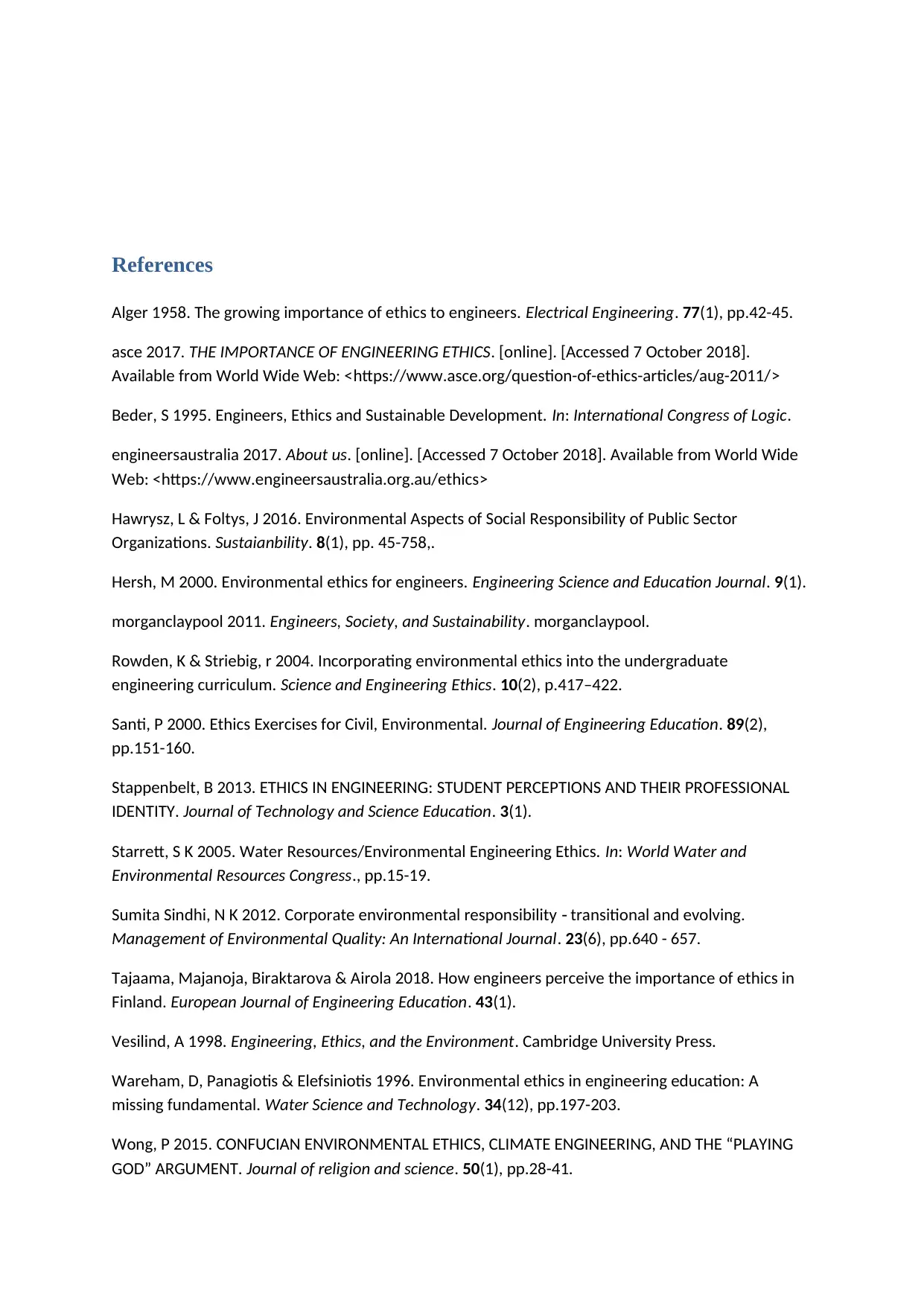
References
Alger 1958. The growing importance of ethics to engineers. Electrical Engineering. 77(1), pp.42-45.
asce 2017. THE IMPORTANCE OF ENGINEERING ETHICS. [online]. [Accessed 7 October 2018].
Available from World Wide Web: <https://www.asce.org/question-of-ethics-articles/aug-2011/>
Beder, S 1995. Engineers, Ethics and Sustainable Development. In: International Congress of Logic.
engineersaustralia 2017. About us. [online]. [Accessed 7 October 2018]. Available from World Wide
Web: <https://www.engineersaustralia.org.au/ethics>
Hawrysz, L & Foltys, J 2016. Environmental Aspects of Social Responsibility of Public Sector
Organizations. Sustaianbility. 8(1), pp. 45-758,.
Hersh, M 2000. Environmental ethics for engineers. Engineering Science and Education Journal. 9(1).
morganclaypool 2011. Engineers, Society, and Sustainability. morganclaypool.
Rowden, K & Striebig, r 2004. Incorporating environmental ethics into the undergraduate
engineering curriculum. Science and Engineering Ethics. 10(2), p.417–422.
Santi, P 2000. Ethics Exercises for Civil, Environmental. Journal of Engineering Education. 89(2),
pp.151-160.
Stappenbelt, B 2013. ETHICS IN ENGINEERING: STUDENT PERCEPTIONS AND THEIR PROFESSIONAL
IDENTITY. Journal of Technology and Science Education. 3(1).
Starrett, S K 2005. Water Resources/Environmental Engineering Ethics. In: World Water and
Environmental Resources Congress., pp.15-19.
Sumita Sindhi, N K 2012. Corporate environmental responsibility transitional and evolving.‐
Management of Environmental Quality: An International Journal. 23(6), pp.640 - 657.
Tajaama, Majanoja, Biraktarova & Airola 2018. How engineers perceive the importance of ethics in
Finland. European Journal of Engineering Education. 43(1).
Vesilind, A 1998. Engineering, Ethics, and the Environment. Cambridge University Press.
Wareham, D, Panagiotis & Elefsiniotis 1996. Environmental ethics in engineering education: A
missing fundamental. Water Science and Technology. 34(12), pp.197-203.
Wong, P 2015. CONFUCIAN ENVIRONMENTAL ETHICS, CLIMATE ENGINEERING, AND THE “PLAYING
GOD” ARGUMENT. Journal of religion and science. 50(1), pp.28-41.
Alger 1958. The growing importance of ethics to engineers. Electrical Engineering. 77(1), pp.42-45.
asce 2017. THE IMPORTANCE OF ENGINEERING ETHICS. [online]. [Accessed 7 October 2018].
Available from World Wide Web: <https://www.asce.org/question-of-ethics-articles/aug-2011/>
Beder, S 1995. Engineers, Ethics and Sustainable Development. In: International Congress of Logic.
engineersaustralia 2017. About us. [online]. [Accessed 7 October 2018]. Available from World Wide
Web: <https://www.engineersaustralia.org.au/ethics>
Hawrysz, L & Foltys, J 2016. Environmental Aspects of Social Responsibility of Public Sector
Organizations. Sustaianbility. 8(1), pp. 45-758,.
Hersh, M 2000. Environmental ethics for engineers. Engineering Science and Education Journal. 9(1).
morganclaypool 2011. Engineers, Society, and Sustainability. morganclaypool.
Rowden, K & Striebig, r 2004. Incorporating environmental ethics into the undergraduate
engineering curriculum. Science and Engineering Ethics. 10(2), p.417–422.
Santi, P 2000. Ethics Exercises for Civil, Environmental. Journal of Engineering Education. 89(2),
pp.151-160.
Stappenbelt, B 2013. ETHICS IN ENGINEERING: STUDENT PERCEPTIONS AND THEIR PROFESSIONAL
IDENTITY. Journal of Technology and Science Education. 3(1).
Starrett, S K 2005. Water Resources/Environmental Engineering Ethics. In: World Water and
Environmental Resources Congress., pp.15-19.
Sumita Sindhi, N K 2012. Corporate environmental responsibility transitional and evolving.‐
Management of Environmental Quality: An International Journal. 23(6), pp.640 - 657.
Tajaama, Majanoja, Biraktarova & Airola 2018. How engineers perceive the importance of ethics in
Finland. European Journal of Engineering Education. 43(1).
Vesilind, A 1998. Engineering, Ethics, and the Environment. Cambridge University Press.
Wareham, D, Panagiotis & Elefsiniotis 1996. Environmental ethics in engineering education: A
missing fundamental. Water Science and Technology. 34(12), pp.197-203.
Wong, P 2015. CONFUCIAN ENVIRONMENTAL ETHICS, CLIMATE ENGINEERING, AND THE “PLAYING
GOD” ARGUMENT. Journal of religion and science. 50(1), pp.28-41.
Paraphrase This Document
Need a fresh take? Get an instant paraphrase of this document with our AI Paraphraser


1 out of 11


Related Documents


Your All-in-One AI-Powered Toolkit for Academic Success.
+13062052269
info@desklib.com
Available 24*7 on WhatsApp / Email
![[object Object]](/_next/static/media/star-bottom.7253800d.svg)
Unlock your academic potential
Copyright © 2020–2026 A2Z Services. All Rights Reserved. Developed and managed by ZUCOL.