Ethical Decision-Making Scenario Analysis in Hotel Industry Practices
VerifiedAdded on  2023/05/31
|6
|1808
|479
Essay
AI Summary
This essay provides an in-depth analysis of ethical decision-making within the hospitality industry, specifically focusing on the challenges related to supplier relationships. It examines a scenario where hotels face the dilemma of sourcing raw materials from suppliers who may engage in unethical practices to offer lower costs. The essay explores the barriers to ethical decision-making, such as overvaluing outcomes, and applies a transitional ethical business model to the scenario, outlining steps from identifying the problem to considering various courses of action and their consequences. The discussion also emphasizes the importance of understanding unintended consequences and complex adaptive systems when making broad decisions. The essay highlights the need for hotels to prioritize ethical sourcing, even if it means higher costs, to maintain a positive brand image and corporate responsibility. The analysis includes references to relevant academic sources, supporting the arguments with research and insights into ethical business practices.
Decision Making
NAME OF STUDENT:
NAME OF COLLEGE:
AUTHORS NOTE:
Running head: DECISION MAKING
NAME OF STUDENT:
NAME OF COLLEGE:
AUTHORS NOTE:
Running head: DECISION MAKING
Paraphrase This Document
Need a fresh take? Get an instant paraphrase of this document with our AI Paraphraser

DECISION MAKING
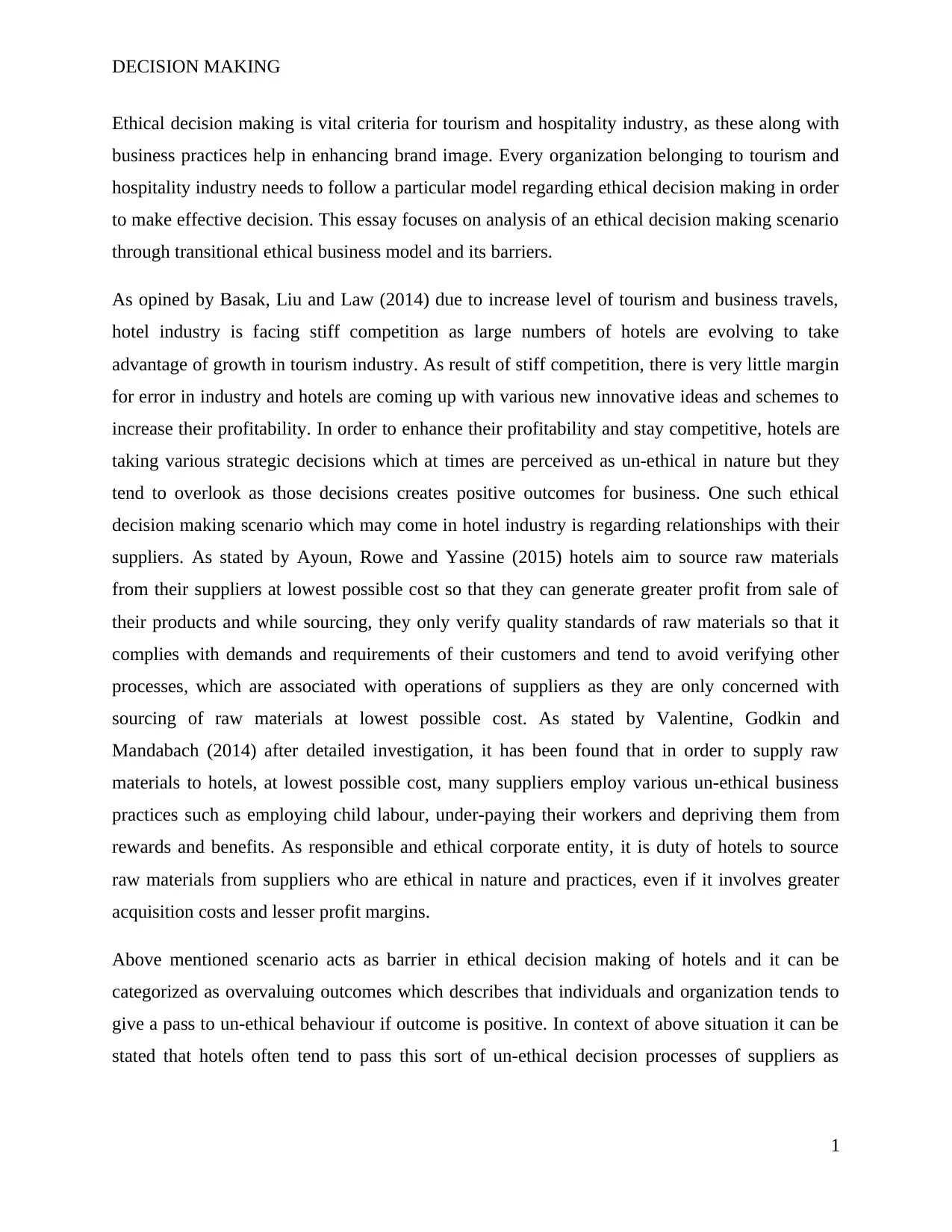
Ethical decision making is vital criteria for tourism and hospitality industry, as these along with
business practices help in enhancing brand image. Every organization belonging to tourism and
hospitality industry needs to follow a particular model regarding ethical decision making in order
to make effective decision. This essay focuses on analysis of an ethical decision making scenario
through transitional ethical business model and its barriers.
As opined by Basak, Liu and Law (2014) due to increase level of tourism and business travels,
hotel industry is facing stiff competition as large numbers of hotels are evolving to take
advantage of growth in tourism industry. As result of stiff competition, there is very little margin
for error in industry and hotels are coming up with various new innovative ideas and schemes to
increase their profitability. In order to enhance their profitability and stay competitive, hotels are
taking various strategic decisions which at times are perceived as un-ethical in nature but they
tend to overlook as those decisions creates positive outcomes for business. One such ethical
decision making scenario which may come in hotel industry is regarding relationships with their
suppliers. As stated by Ayoun, Rowe and Yassine (2015) hotels aim to source raw materials
from their suppliers at lowest possible cost so that they can generate greater profit from sale of
their products and while sourcing, they only verify quality standards of raw materials so that it
complies with demands and requirements of their customers and tend to avoid verifying other
processes, which are associated with operations of suppliers as they are only concerned with
sourcing of raw materials at lowest possible cost. As stated by Valentine, Godkin and
Mandabach (2014) after detailed investigation, it has been found that in order to supply raw
materials to hotels, at lowest possible cost, many suppliers employ various un-ethical business
practices such as employing child labour, under-paying their workers and depriving them from
rewards and benefits. As responsible and ethical corporate entity, it is duty of hotels to source
raw materials from suppliers who are ethical in nature and practices, even if it involves greater
acquisition costs and lesser profit margins.
Above mentioned scenario acts as barrier in ethical decision making of hotels and it can be
categorized as overvaluing outcomes which describes that individuals and organization tends to
give a pass to un-ethical behaviour if outcome is positive. In context of above situation it can be
stated that hotels often tend to pass this sort of un-ethical decision processes of suppliers as
1
Ethical decision making is vital criteria for tourism and hospitality industry, as these along with
business practices help in enhancing brand image. Every organization belonging to tourism and
hospitality industry needs to follow a particular model regarding ethical decision making in order
to make effective decision. This essay focuses on analysis of an ethical decision making scenario
through transitional ethical business model and its barriers.
As opined by Basak, Liu and Law (2014) due to increase level of tourism and business travels,
hotel industry is facing stiff competition as large numbers of hotels are evolving to take
advantage of growth in tourism industry. As result of stiff competition, there is very little margin
for error in industry and hotels are coming up with various new innovative ideas and schemes to
increase their profitability. In order to enhance their profitability and stay competitive, hotels are
taking various strategic decisions which at times are perceived as un-ethical in nature but they
tend to overlook as those decisions creates positive outcomes for business. One such ethical
decision making scenario which may come in hotel industry is regarding relationships with their
suppliers. As stated by Ayoun, Rowe and Yassine (2015) hotels aim to source raw materials
from their suppliers at lowest possible cost so that they can generate greater profit from sale of
their products and while sourcing, they only verify quality standards of raw materials so that it
complies with demands and requirements of their customers and tend to avoid verifying other
processes, which are associated with operations of suppliers as they are only concerned with
sourcing of raw materials at lowest possible cost. As stated by Valentine, Godkin and
Mandabach (2014) after detailed investigation, it has been found that in order to supply raw
materials to hotels, at lowest possible cost, many suppliers employ various un-ethical business
practices such as employing child labour, under-paying their workers and depriving them from
rewards and benefits. As responsible and ethical corporate entity, it is duty of hotels to source
raw materials from suppliers who are ethical in nature and practices, even if it involves greater
acquisition costs and lesser profit margins.
Above mentioned scenario acts as barrier in ethical decision making of hotels and it can be
categorized as overvaluing outcomes which describes that individuals and organization tends to
give a pass to un-ethical behaviour if outcome is positive. In context of above situation it can be
stated that hotels often tend to pass this sort of un-ethical decision processes of suppliers as
1

DECISION MAKING
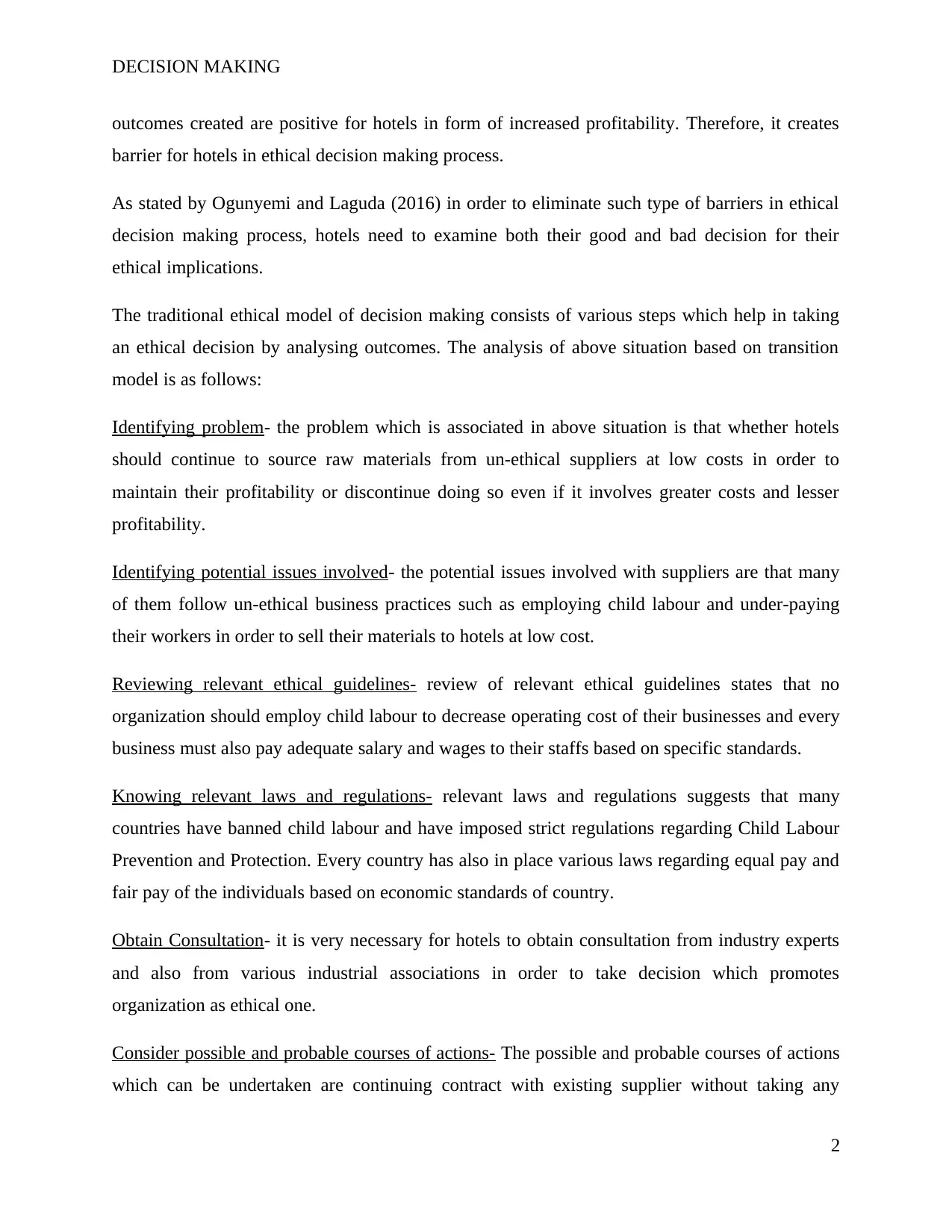
outcomes created are positive for hotels in form of increased profitability. Therefore, it creates
barrier for hotels in ethical decision making process.
As stated by Ogunyemi and Laguda (2016) in order to eliminate such type of barriers in ethical
decision making process, hotels need to examine both their good and bad decision for their
ethical implications.
The traditional ethical model of decision making consists of various steps which help in taking
an ethical decision by analysing outcomes. The analysis of above situation based on transition
model is as follows:
Identifying problem- the problem which is associated in above situation is that whether hotels
should continue to source raw materials from un-ethical suppliers at low costs in order to
maintain their profitability or discontinue doing so even if it involves greater costs and lesser
profitability.
Identifying potential issues involved- the potential issues involved with suppliers are that many
of them follow un-ethical business practices such as employing child labour and under-paying
their workers in order to sell their materials to hotels at low cost.
Reviewing relevant ethical guidelines- review of relevant ethical guidelines states that no
organization should employ child labour to decrease operating cost of their businesses and every
business must also pay adequate salary and wages to their staffs based on specific standards.
Knowing relevant laws and regulations- relevant laws and regulations suggests that many
countries have banned child labour and have imposed strict regulations regarding Child Labour
Prevention and Protection. Every country has also in place various laws regarding equal pay and
fair pay of the individuals based on economic standards of country.
Obtain Consultation- it is very necessary for hotels to obtain consultation from industry experts
and also from various industrial associations in order to take decision which promotes
organization as ethical one.
Consider possible and probable courses of actions- The possible and probable courses of actions
which can be undertaken are continuing contract with existing supplier without taking any
2
outcomes created are positive for hotels in form of increased profitability. Therefore, it creates
barrier for hotels in ethical decision making process.
As stated by Ogunyemi and Laguda (2016) in order to eliminate such type of barriers in ethical
decision making process, hotels need to examine both their good and bad decision for their
ethical implications.
The traditional ethical model of decision making consists of various steps which help in taking
an ethical decision by analysing outcomes. The analysis of above situation based on transition
model is as follows:
Identifying problem- the problem which is associated in above situation is that whether hotels
should continue to source raw materials from un-ethical suppliers at low costs in order to
maintain their profitability or discontinue doing so even if it involves greater costs and lesser
profitability.
Identifying potential issues involved- the potential issues involved with suppliers are that many
of them follow un-ethical business practices such as employing child labour and under-paying
their workers in order to sell their materials to hotels at low cost.
Reviewing relevant ethical guidelines- review of relevant ethical guidelines states that no
organization should employ child labour to decrease operating cost of their businesses and every
business must also pay adequate salary and wages to their staffs based on specific standards.
Knowing relevant laws and regulations- relevant laws and regulations suggests that many
countries have banned child labour and have imposed strict regulations regarding Child Labour
Prevention and Protection. Every country has also in place various laws regarding equal pay and
fair pay of the individuals based on economic standards of country.
Obtain Consultation- it is very necessary for hotels to obtain consultation from industry experts
and also from various industrial associations in order to take decision which promotes
organization as ethical one.
Consider possible and probable courses of actions- The possible and probable courses of actions
which can be undertaken are continuing contract with existing supplier without taking any
2
⊘ This is a preview!⊘
Do you want full access?
Subscribe today to unlock all pages.

Trusted by 1+ million students worldwide

DECISION MAKING
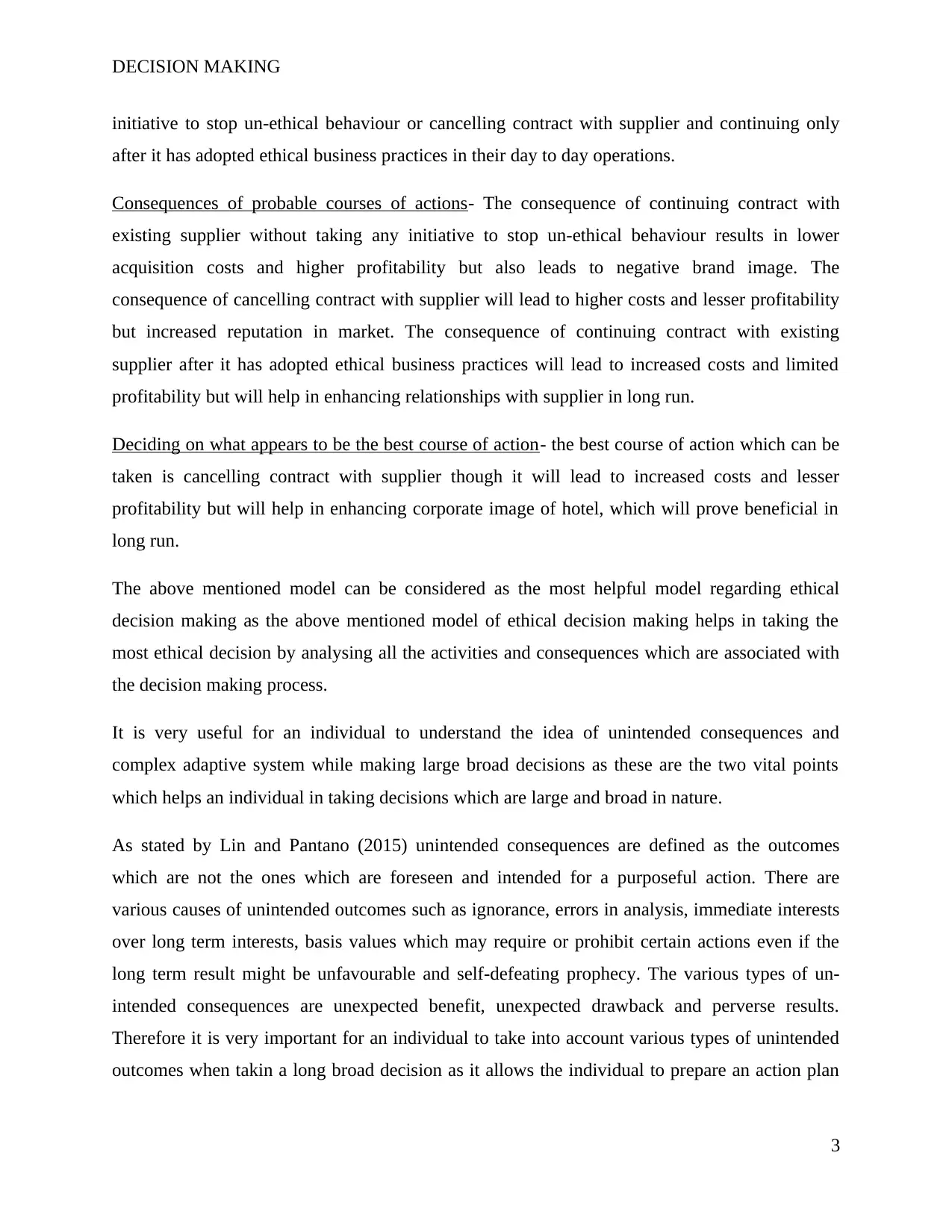
initiative to stop un-ethical behaviour or cancelling contract with supplier and continuing only
after it has adopted ethical business practices in their day to day operations.
Consequences of probable courses of actions- The consequence of continuing contract with
existing supplier without taking any initiative to stop un-ethical behaviour results in lower
acquisition costs and higher profitability but also leads to negative brand image. The
consequence of cancelling contract with supplier will lead to higher costs and lesser profitability
but increased reputation in market. The consequence of continuing contract with existing
supplier after it has adopted ethical business practices will lead to increased costs and limited
profitability but will help in enhancing relationships with supplier in long run.
Deciding on what appears to be the best course of action- the best course of action which can be
taken is cancelling contract with supplier though it will lead to increased costs and lesser
profitability but will help in enhancing corporate image of hotel, which will prove beneficial in
long run.
The above mentioned model can be considered as the most helpful model regarding ethical
decision making as the above mentioned model of ethical decision making helps in taking the
most ethical decision by analysing all the activities and consequences which are associated with
the decision making process.
It is very useful for an individual to understand the idea of unintended consequences and
complex adaptive system while making large broad decisions as these are the two vital points
which helps an individual in taking decisions which are large and broad in nature.
As stated by Lin and Pantano (2015) unintended consequences are defined as the outcomes
which are not the ones which are foreseen and intended for a purposeful action. There are
various causes of unintended outcomes such as ignorance, errors in analysis, immediate interests
over long term interests, basis values which may require or prohibit certain actions even if the
long term result might be unfavourable and self-defeating prophecy. The various types of un-
intended consequences are unexpected benefit, unexpected drawback and perverse results.
Therefore it is very important for an individual to take into account various types of unintended
outcomes when takin a long broad decision as it allows the individual to prepare an action plan
3
initiative to stop un-ethical behaviour or cancelling contract with supplier and continuing only
after it has adopted ethical business practices in their day to day operations.
Consequences of probable courses of actions- The consequence of continuing contract with
existing supplier without taking any initiative to stop un-ethical behaviour results in lower
acquisition costs and higher profitability but also leads to negative brand image. The
consequence of cancelling contract with supplier will lead to higher costs and lesser profitability
but increased reputation in market. The consequence of continuing contract with existing
supplier after it has adopted ethical business practices will lead to increased costs and limited
profitability but will help in enhancing relationships with supplier in long run.
Deciding on what appears to be the best course of action- the best course of action which can be
taken is cancelling contract with supplier though it will lead to increased costs and lesser
profitability but will help in enhancing corporate image of hotel, which will prove beneficial in
long run.
The above mentioned model can be considered as the most helpful model regarding ethical
decision making as the above mentioned model of ethical decision making helps in taking the
most ethical decision by analysing all the activities and consequences which are associated with
the decision making process.
It is very useful for an individual to understand the idea of unintended consequences and
complex adaptive system while making large broad decisions as these are the two vital points
which helps an individual in taking decisions which are large and broad in nature.
As stated by Lin and Pantano (2015) unintended consequences are defined as the outcomes
which are not the ones which are foreseen and intended for a purposeful action. There are
various causes of unintended outcomes such as ignorance, errors in analysis, immediate interests
over long term interests, basis values which may require or prohibit certain actions even if the
long term result might be unfavourable and self-defeating prophecy. The various types of un-
intended consequences are unexpected benefit, unexpected drawback and perverse results.
Therefore it is very important for an individual to take into account various types of unintended
outcomes when takin a long broad decision as it allows the individual to prepare an action plan
3
Paraphrase This Document
Need a fresh take? Get an instant paraphrase of this document with our AI Paraphraser

DECISION MAKING
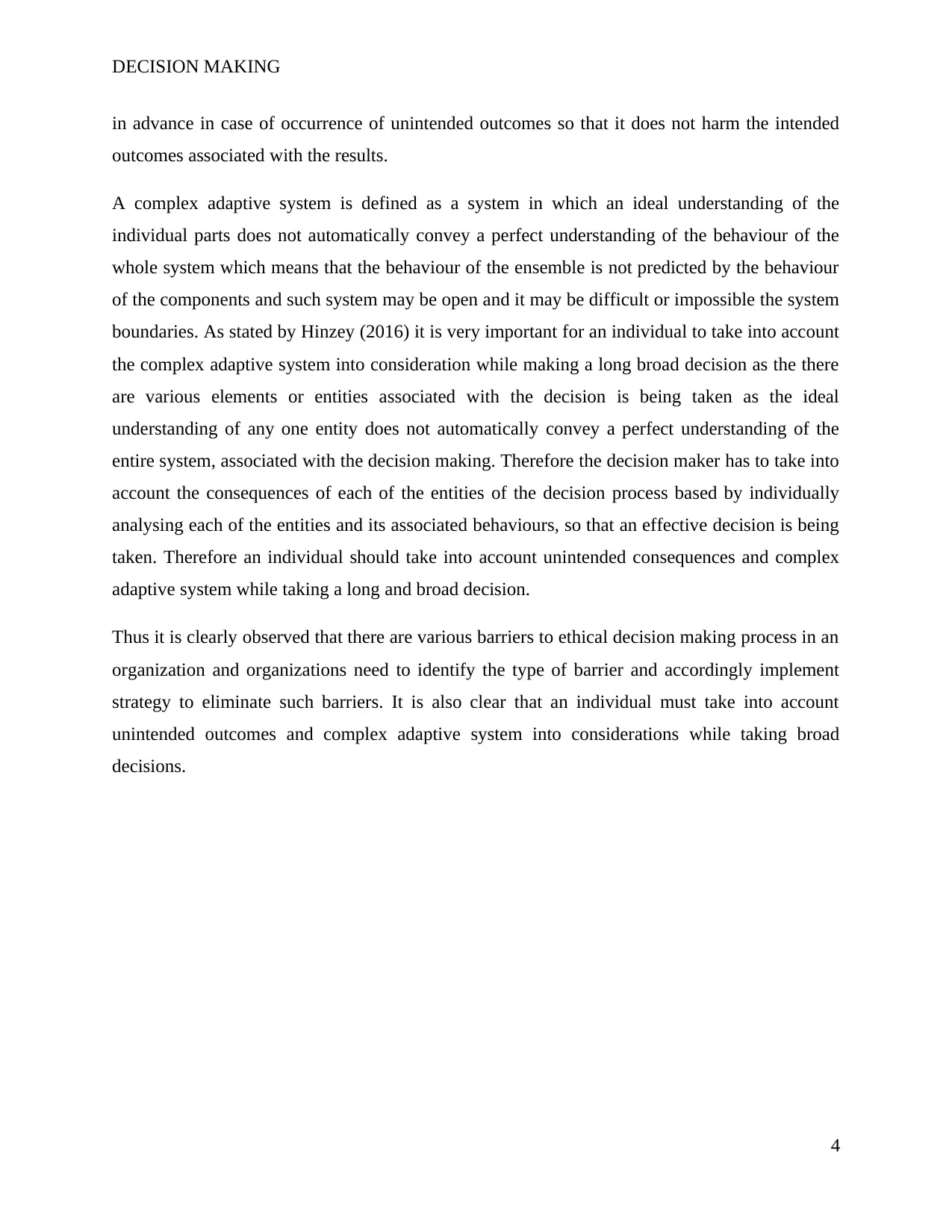
in advance in case of occurrence of unintended outcomes so that it does not harm the intended
outcomes associated with the results.
A complex adaptive system is defined as a system in which an ideal understanding of the
individual parts does not automatically convey a perfect understanding of the behaviour of the
whole system which means that the behaviour of the ensemble is not predicted by the behaviour
of the components and such system may be open and it may be difficult or impossible the system
boundaries. As stated by Hinzey (2016) it is very important for an individual to take into account
the complex adaptive system into consideration while making a long broad decision as the there
are various elements or entities associated with the decision is being taken as the ideal
understanding of any one entity does not automatically convey a perfect understanding of the
entire system, associated with the decision making. Therefore the decision maker has to take into
account the consequences of each of the entities of the decision process based by individually
analysing each of the entities and its associated behaviours, so that an effective decision is being
taken. Therefore an individual should take into account unintended consequences and complex
adaptive system while taking a long and broad decision.
Thus it is clearly observed that there are various barriers to ethical decision making process in an
organization and organizations need to identify the type of barrier and accordingly implement
strategy to eliminate such barriers. It is also clear that an individual must take into account
unintended outcomes and complex adaptive system into considerations while taking broad
decisions.
4
in advance in case of occurrence of unintended outcomes so that it does not harm the intended
outcomes associated with the results.
A complex adaptive system is defined as a system in which an ideal understanding of the
individual parts does not automatically convey a perfect understanding of the behaviour of the
whole system which means that the behaviour of the ensemble is not predicted by the behaviour
of the components and such system may be open and it may be difficult or impossible the system
boundaries. As stated by Hinzey (2016) it is very important for an individual to take into account
the complex adaptive system into consideration while making a long broad decision as the there
are various elements or entities associated with the decision is being taken as the ideal
understanding of any one entity does not automatically convey a perfect understanding of the
entire system, associated with the decision making. Therefore the decision maker has to take into
account the consequences of each of the entities of the decision process based by individually
analysing each of the entities and its associated behaviours, so that an effective decision is being
taken. Therefore an individual should take into account unintended consequences and complex
adaptive system while taking a long and broad decision.
Thus it is clearly observed that there are various barriers to ethical decision making process in an
organization and organizations need to identify the type of barrier and accordingly implement
strategy to eliminate such barriers. It is also clear that an individual must take into account
unintended outcomes and complex adaptive system into considerations while taking broad
decisions.
4

DECISION MAKING
References
Ayoun, B., Rowe, L., and Yassine, F. (2015). Is workplace spirituality associated with business
ethics? International Journal of Contemporary Hospitality Management, [Online] 27(5), 938-
957. Available at doi:http://dx.doi.org/10.1108/IJCHM-01-2014-0018 Accessed as on
24/11/2018
Basak, D. G., Liu, W., and Law, R. (2014). Can setting hotel rate restrictions help balance the
interest of hotels and customers? International Journal of Contemporary Hospitality
Management, [Online] 26(6), 948-973. Available at doi:http://dx.doi.org/10.1108/IJCHM-01-
2013-0020 Accessed as on 24/11/2018
Hinzey, A. L. (2016). Exploring how complexity leader behaviors shape the connectivity of
agents within a complex adaptive system: A case study. Business Premium Collection. [Online]
Available at https://search.proquest.com/docview/1778511334?accountid=30552 Accessed as on
24/11/2018
Lin, W., and Pantano, J. (2015). The unintended: Negative outcomes over the life cycle. Journal
of Population Economics, [Online] 28(2), 479-508. Available at
doi:http://dx.doi.org/10.1007/s00148-014-0530-z Accessed as on 24/11/2018
Ogunyemi, K., and Laguda, E. (2016). Ethics, workforce practices and sustainability by
multinationals in nigeria. Worldwide Hospitality and Tourism Themes, [Online] 8(2), 158-181.
Available at https://search.proquest.com/docview/1826811358?accountid=30552 Accessed as on
24/11/2018
Valentine, S., Godkin, L., and Mandabach, K. (2014). Ethical employment context and ethical
decision-making in hospitality organizations. Journal of Quality Assurance in Hospitality &
Tourism, [Online] 15(3), 227. Available at https://search.proquest.com/docview/1552877553?
accountid=30552 Accessed as on 24/11/2018
5
References
Ayoun, B., Rowe, L., and Yassine, F. (2015). Is workplace spirituality associated with business
ethics? International Journal of Contemporary Hospitality Management, [Online] 27(5), 938-
957. Available at doi:http://dx.doi.org/10.1108/IJCHM-01-2014-0018 Accessed as on
24/11/2018
Basak, D. G., Liu, W., and Law, R. (2014). Can setting hotel rate restrictions help balance the
interest of hotels and customers? International Journal of Contemporary Hospitality
Management, [Online] 26(6), 948-973. Available at doi:http://dx.doi.org/10.1108/IJCHM-01-
2013-0020 Accessed as on 24/11/2018
Hinzey, A. L. (2016). Exploring how complexity leader behaviors shape the connectivity of
agents within a complex adaptive system: A case study. Business Premium Collection. [Online]
Available at https://search.proquest.com/docview/1778511334?accountid=30552 Accessed as on
24/11/2018
Lin, W., and Pantano, J. (2015). The unintended: Negative outcomes over the life cycle. Journal
of Population Economics, [Online] 28(2), 479-508. Available at
doi:http://dx.doi.org/10.1007/s00148-014-0530-z Accessed as on 24/11/2018
Ogunyemi, K., and Laguda, E. (2016). Ethics, workforce practices and sustainability by
multinationals in nigeria. Worldwide Hospitality and Tourism Themes, [Online] 8(2), 158-181.
Available at https://search.proquest.com/docview/1826811358?accountid=30552 Accessed as on
24/11/2018
Valentine, S., Godkin, L., and Mandabach, K. (2014). Ethical employment context and ethical
decision-making in hospitality organizations. Journal of Quality Assurance in Hospitality &
Tourism, [Online] 15(3), 227. Available at https://search.proquest.com/docview/1552877553?
accountid=30552 Accessed as on 24/11/2018
5
⊘ This is a preview!⊘
Do you want full access?
Subscribe today to unlock all pages.

Trusted by 1+ million students worldwide
1 out of 6
Related Documents
Your All-in-One AI-Powered Toolkit for Academic Success.
 +13062052269
info@desklib.com
Available 24*7 on WhatsApp / Email
Unlock your academic potential
Copyright © 2020–2025 A2Z Services. All Rights Reserved. Developed and managed by ZUCOL.