Document Falsification: Ethical Analysis in the University Setting
VerifiedAdded on 2020/03/01
|10
|2777
|109
Essay
AI Summary
This essay examines the ethical issues surrounding document falsification, particularly plagiarism and the use of assignment help services, within a university setting. It explores the motivations behind students seeking external assistance, such as difficulty, time constraints, or lack of motivation. The analysis delves into both personal and professional ethics, highlighting the conflict between students' responsibilities and institutional policies. The essay discusses ethical issues from societal, industry, company, and individual perspectives, using consequentialism, deontology, and virtue ethics to evaluate the practice. The paper concludes that document falsification is unethical, emphasizing the importance of academic integrity and the long-term negative consequences for students who engage in such practices. The essay underscores the importance of students understanding and upholding ethical standards to foster a culture of honesty and learning within educational institutions. This assignment is available on Desklib, a platform offering past papers and solved assignments for students.
Running Head: DOCUMENT FALSIFICATION
Document Falsification
Student’s name
Name of the Institute
Document Falsification
Student’s name
Name of the Institute

Paraphrase This Document
Need a fresh take? Get an instant paraphrase of this document with our AI Paraphraser
DOCUMENT FALSIFICATION
Introduction
It would be correct to say that plagiarism is an important issue across the universities.
Generally speaking there could be intended or unintended plagiarism. However, an increased
extend of plagiarism for university students is document falsification. There are various cases
and chances of document falsification. In a classical sense, university students can get their
assignments done from other sources. The students would in turn pay the organizations or
individuals to get their assignment done. The problem for universities is that they cannot
determine if student has done the assignment or someone else has done it (Bakhtiyari & Salehi,
2014). The students would pay for the genuine content so that it passes the check of plagiarism
software. It is observed that In the University sector individuals and businesses are offering
assignment writing services to students, in effect writing an essay or report to published
assessment criteria, for a fee, which the student then falsely submits it as his or her own work
(Prinsloo & Slade, 2013). There are various ethical questions around this sort of document
falsification. Is it ethical at the end of student to get assignment help from other people? Or, is it
ethical for people to write the assignments for students?
While, it is important to discuss the above questions, it is equally important to understand
the key drivers or motivation for student to get the work done from other sources. Obviously,
students have to pay for these services, then why do students take these services. One of the
reasons is that assignment is too difficult, or students does not have time to complete the task or
the third reason could be that student does not have an attitude or will to complete the task and
he or she is looking for shortcuts (Drumwright & Murphy, 2014). The objective of this paper is
to discuss this type of document falsification with respect to various ethical theories and models.
Introduction
It would be correct to say that plagiarism is an important issue across the universities.
Generally speaking there could be intended or unintended plagiarism. However, an increased
extend of plagiarism for university students is document falsification. There are various cases
and chances of document falsification. In a classical sense, university students can get their
assignments done from other sources. The students would in turn pay the organizations or
individuals to get their assignment done. The problem for universities is that they cannot
determine if student has done the assignment or someone else has done it (Bakhtiyari & Salehi,
2014). The students would pay for the genuine content so that it passes the check of plagiarism
software. It is observed that In the University sector individuals and businesses are offering
assignment writing services to students, in effect writing an essay or report to published
assessment criteria, for a fee, which the student then falsely submits it as his or her own work
(Prinsloo & Slade, 2013). There are various ethical questions around this sort of document
falsification. Is it ethical at the end of student to get assignment help from other people? Or, is it
ethical for people to write the assignments for students?
While, it is important to discuss the above questions, it is equally important to understand
the key drivers or motivation for student to get the work done from other sources. Obviously,
students have to pay for these services, then why do students take these services. One of the
reasons is that assignment is too difficult, or students does not have time to complete the task or
the third reason could be that student does not have an attitude or will to complete the task and
he or she is looking for shortcuts (Drumwright & Murphy, 2014). The objective of this paper is
to discuss this type of document falsification with respect to various ethical theories and models.
DOCUMENT FALSIFICATION
Analysis
It is not a very uncommon practice for students to get the work done from other sources.
It is correct that it raises various ethical questions. However, students still engage in these
practices. The practice of a student paying for someone to write an assignment and then
submitting it as their own work is indeed an ethical issue. This is an ethical issue because
students are expected to complete their work by themselves. The entire idea of students getting
education in universities is to learn and gain knowledge (Fusch & Ness, 2017). The knowledge
does not come just by enrolling in different courses. The knowledge comes when students work
hard and learn the concepts. The assignments and assessments are important for students to learn
the concepts. Therefore, it is important that students should not get trapped in the issues of
document falsification. The ethical issues involved in the scenario of plagiarism can be discussed
with respect to personal issues and professional issues. Professional ethics are a set of guidelines
that protect your professional identity through strict rules learned through the teachings of an
institution (Yadav & Rawal, 2016). Personal ethics, on the other hand, is personal moral qualities
learned through the interactions of friends and family which exemplify honesty, care, and
sincerity. The issue of plagiarism and taking assignment help from other sources is a mix of
personal ethical issue and professional ethical issue. It is a personal ethical issue and students are
expected to show high moral standards. It is believed that students are the building blocks of
society and therefore, students must have high ethical and moral values. At the same time, the
issue of plagiarism and taking assignment help from other sources is also an issue of professional
ethics (Vehvilainen & Lofstrom, 2017). It is an issue of professional ethics because the
professional entity, universities in this case, does not allow or does not expect students to engage
in any sort of plagiarism issue. In fact, the professional body, university administration in this
Analysis
It is not a very uncommon practice for students to get the work done from other sources.
It is correct that it raises various ethical questions. However, students still engage in these
practices. The practice of a student paying for someone to write an assignment and then
submitting it as their own work is indeed an ethical issue. This is an ethical issue because
students are expected to complete their work by themselves. The entire idea of students getting
education in universities is to learn and gain knowledge (Fusch & Ness, 2017). The knowledge
does not come just by enrolling in different courses. The knowledge comes when students work
hard and learn the concepts. The assignments and assessments are important for students to learn
the concepts. Therefore, it is important that students should not get trapped in the issues of
document falsification. The ethical issues involved in the scenario of plagiarism can be discussed
with respect to personal issues and professional issues. Professional ethics are a set of guidelines
that protect your professional identity through strict rules learned through the teachings of an
institution (Yadav & Rawal, 2016). Personal ethics, on the other hand, is personal moral qualities
learned through the interactions of friends and family which exemplify honesty, care, and
sincerity. The issue of plagiarism and taking assignment help from other sources is a mix of
personal ethical issue and professional ethical issue. It is a personal ethical issue and students are
expected to show high moral standards. It is believed that students are the building blocks of
society and therefore, students must have high ethical and moral values. At the same time, the
issue of plagiarism and taking assignment help from other sources is also an issue of professional
ethics (Vehvilainen & Lofstrom, 2017). It is an issue of professional ethics because the
professional entity, universities in this case, does not allow or does not expect students to engage
in any sort of plagiarism issue. In fact, the professional body, university administration in this
⊘ This is a preview!⊘
Do you want full access?
Subscribe today to unlock all pages.

Trusted by 1+ million students worldwide
DOCUMENT FALSIFICATION
case, have strict policies around plagiarism and students can even be disqualified from course in
case of plagiarism. Having said that, it is also true that some sort of plagiarism could be
acceptable. For example, is students are writing an essay on ethics and they want to define the
term, ‘utilitarianism ethics’. It may not make much senses to change the definition of a term
(Nam & Weaver, 2015). In this case, student may want to use the definition, ‘as it is’. However,
in this case, it is important that student must give the proper reference to the definition. The
underlying inference is that student must give reference to the sources from where he or she is
taking the definition. As a thumb rule, it can be said that a plagiarism score up to 10% is fine. In
fact, there are various universities that consider the issue of plagiarism only when the score of
plagiarism software is more than 10% (Engel, 2016).
From the organizations’ point of view it is indeed unethical to offer this type of services.
By indulging in any sort of this service, organizations are giving a platform to students where
they can compromise on their moral values. The business sense of doing business would suggest
that if there is a demand, there should be a supply (Valentine, 2006). However, in case of
demand also, the supply of this kind of services does not justify the ethical concerns. It would be
interesting to analyze the organizational ethical issues with respect to four levels of business
ethics. The four levels of business ethics could be applied in this case as:
The society level: At the societal level, we ask questions about the basic institutions in a society.
Is it ethical correct to have a system where students get the assignment help from other
individuals or organizations? The societal view would suggest that it is not ethical for students
get the assignment help from other individuals or organizations because it can create a bad
culture in the society where people are not honest (Engel, 2016).
case, have strict policies around plagiarism and students can even be disqualified from course in
case of plagiarism. Having said that, it is also true that some sort of plagiarism could be
acceptable. For example, is students are writing an essay on ethics and they want to define the
term, ‘utilitarianism ethics’. It may not make much senses to change the definition of a term
(Nam & Weaver, 2015). In this case, student may want to use the definition, ‘as it is’. However,
in this case, it is important that student must give the proper reference to the definition. The
underlying inference is that student must give reference to the sources from where he or she is
taking the definition. As a thumb rule, it can be said that a plagiarism score up to 10% is fine. In
fact, there are various universities that consider the issue of plagiarism only when the score of
plagiarism software is more than 10% (Engel, 2016).
From the organizations’ point of view it is indeed unethical to offer this type of services.
By indulging in any sort of this service, organizations are giving a platform to students where
they can compromise on their moral values. The business sense of doing business would suggest
that if there is a demand, there should be a supply (Valentine, 2006). However, in case of
demand also, the supply of this kind of services does not justify the ethical concerns. It would be
interesting to analyze the organizational ethical issues with respect to four levels of business
ethics. The four levels of business ethics could be applied in this case as:
The society level: At the societal level, we ask questions about the basic institutions in a society.
Is it ethical correct to have a system where students get the assignment help from other
individuals or organizations? The societal view would suggest that it is not ethical for students
get the assignment help from other individuals or organizations because it can create a bad
culture in the society where people are not honest (Engel, 2016).
Paraphrase This Document
Need a fresh take? Get an instant paraphrase of this document with our AI Paraphraser
DOCUMENT FALSIFICATION
The industry level or the stakeholder level: At the industry level, we ask questions about how
a company should deal with the external groups affected by its decisions, as well as how the
stakeholders should deal with the company. Is it ethical correct to have a system where students
get the assignment help from other individuals or organizations? The industry level view would
suggest that it may not be ethical to get assignment help from other sources. However, the
intensity of unethical behavior or moral values is less in the industry level as compared to
societal level (Scanlon, 2013). At the stakeholder level, this practice is not ethical because it is
doing more harm than good.
The company level or the level of internal policy: At the company level or at the organization
level, the ethical issues is discussed with respect to organization mission, business, growth and
development. The question to ponder would remain same in this case, is it ethical correct to have
a system where students get the assignment help from other individuals or organizations? The
analysis at the company level would suggest that this issue may not a grave ethical issue. The
main objective or the corporate objective of any business is to make profits. It is correct that the
organizations must practice the path of corporate social responsibility. However, CSR cannot be
practiced at the expense of profitability and revenue (Nam & Weaver, 2015). However, the sense
of doing business would suggest that organizations should conduct business in the area that is not
harmful to society at large and it appears that the industry of assignment help is harmful to
society.
The individual manager level or at personal level: At the individual level, we ask questions
about how people should treat one another within an organization. The question to ponder would
be same, is it ethical correct to have a system where students get the assignment help from other
The industry level or the stakeholder level: At the industry level, we ask questions about how
a company should deal with the external groups affected by its decisions, as well as how the
stakeholders should deal with the company. Is it ethical correct to have a system where students
get the assignment help from other individuals or organizations? The industry level view would
suggest that it may not be ethical to get assignment help from other sources. However, the
intensity of unethical behavior or moral values is less in the industry level as compared to
societal level (Scanlon, 2013). At the stakeholder level, this practice is not ethical because it is
doing more harm than good.
The company level or the level of internal policy: At the company level or at the organization
level, the ethical issues is discussed with respect to organization mission, business, growth and
development. The question to ponder would remain same in this case, is it ethical correct to have
a system where students get the assignment help from other individuals or organizations? The
analysis at the company level would suggest that this issue may not a grave ethical issue. The
main objective or the corporate objective of any business is to make profits. It is correct that the
organizations must practice the path of corporate social responsibility. However, CSR cannot be
practiced at the expense of profitability and revenue (Nam & Weaver, 2015). However, the sense
of doing business would suggest that organizations should conduct business in the area that is not
harmful to society at large and it appears that the industry of assignment help is harmful to
society.
The individual manager level or at personal level: At the individual level, we ask questions
about how people should treat one another within an organization. The question to ponder would
be same, is it ethical correct to have a system where students get the assignment help from other
DOCUMENT FALSIFICATION
individuals or organizations? In this case the answer would be no. It cannot be ethical at the
individual level to involve in any sort of assignment help.
As a part of a responsible society, all the stakeholders must remain connected to a single
point of view of problem. The single view of the problem is that it is a serious ethical issue to
take or to give any sort of assignment help (Robinson, 2014). Therefore, it is important that
organizations, individuals, and students must refrain from this.
The question, is it ethical correct to have a system where students get the assignment help
from other individuals or organizations, could also be discussed with respect to various ethical
theories. The discussion from the perspective of three key ethical theories can be discussed as:
Consequentialism theory of ethics: Consequentialism is the class of normative ethical theories
holding that the consequences of one's conduct are the ultimate basis for any judgment about the
rightness or wrongness of that conduct (Rossi & Sleat, 2014). Here the consequences are not
good as students would not be able to learn anything if he or she engages himself or herself in
assignment help practices. Therefore, the Consequentialism theory would suggest that it is not
ethical correct to have a system where students get the assignment help from other individuals or
organizations (Martinez & Wueste, 2016).
Deontology theory of ethics: In moral philosophy, deontological ethics or deontology is the
normative ethical position that judges the morality of an action based on rules. The university
rules would clearly suggest that students must not conduct any sort of cheating practice.
Therefore, it would be correct to say that the deontology theory of ethics would advocate that it
is not ethical correct to have a system where students get the assignment help from other
individuals or organizations. The university rules do not allow or does not expect students to
individuals or organizations? In this case the answer would be no. It cannot be ethical at the
individual level to involve in any sort of assignment help.
As a part of a responsible society, all the stakeholders must remain connected to a single
point of view of problem. The single view of the problem is that it is a serious ethical issue to
take or to give any sort of assignment help (Robinson, 2014). Therefore, it is important that
organizations, individuals, and students must refrain from this.
The question, is it ethical correct to have a system where students get the assignment help
from other individuals or organizations, could also be discussed with respect to various ethical
theories. The discussion from the perspective of three key ethical theories can be discussed as:
Consequentialism theory of ethics: Consequentialism is the class of normative ethical theories
holding that the consequences of one's conduct are the ultimate basis for any judgment about the
rightness or wrongness of that conduct (Rossi & Sleat, 2014). Here the consequences are not
good as students would not be able to learn anything if he or she engages himself or herself in
assignment help practices. Therefore, the Consequentialism theory would suggest that it is not
ethical correct to have a system where students get the assignment help from other individuals or
organizations (Martinez & Wueste, 2016).
Deontology theory of ethics: In moral philosophy, deontological ethics or deontology is the
normative ethical position that judges the morality of an action based on rules. The university
rules would clearly suggest that students must not conduct any sort of cheating practice.
Therefore, it would be correct to say that the deontology theory of ethics would advocate that it
is not ethical correct to have a system where students get the assignment help from other
individuals or organizations. The university rules do not allow or does not expect students to
⊘ This is a preview!⊘
Do you want full access?
Subscribe today to unlock all pages.
Trusted by 1+ million students worldwide
DOCUMENT FALSIFICATION
engage in any sort of plagiarism issue. In fact, the professional body, university administration in
this case, have strict policies around plagiarism and students can even be failed from course in
case of plagiarism.
Virtue ethics: The virtue theory of ethics is slightly different as it is an approach to Ethics that
emphasizes an individual's character as the key element of ethical thinking. It can be said that
virtue ethics theory would keep it open for interpretation at individual level (Abasi & Akbari,
2006). It can be said that the virtue ethics theory would also suggest that it is not ethical to have a
system where students get the assignment help from other individuals or organizations. However,
the individuals can take their own decision with respect to this.
The basic model of intent, action and outcome would suggest that the outcome would not
be very good if students engage themselves in any sort of cheating practice. The intent of the
students could be to save time or save efforts (Larkham & Manns, 2002). The action of the
students is to contact the organizations or the individuals that provide assignment help and the
outcome of this is that students end up paying for assignments and they do not learn from the
course concepts. This basic model suggests that intent and action of students ultimately results in
bad outcome (Lau & Yuen, 2013).
Conclusion
The above paper discusses if it is ethical to have a system where students get the
assignment help from other individuals or organizations. With the above discussion, it can be
said that it is not an ethical practice. The paper discusses the issue from various ethical models
and theories. Almost, all the models and theories suggest that the outcome is not good in long
term. Therefore, students should not use these practices.
engage in any sort of plagiarism issue. In fact, the professional body, university administration in
this case, have strict policies around plagiarism and students can even be failed from course in
case of plagiarism.
Virtue ethics: The virtue theory of ethics is slightly different as it is an approach to Ethics that
emphasizes an individual's character as the key element of ethical thinking. It can be said that
virtue ethics theory would keep it open for interpretation at individual level (Abasi & Akbari,
2006). It can be said that the virtue ethics theory would also suggest that it is not ethical to have a
system where students get the assignment help from other individuals or organizations. However,
the individuals can take their own decision with respect to this.
The basic model of intent, action and outcome would suggest that the outcome would not
be very good if students engage themselves in any sort of cheating practice. The intent of the
students could be to save time or save efforts (Larkham & Manns, 2002). The action of the
students is to contact the organizations or the individuals that provide assignment help and the
outcome of this is that students end up paying for assignments and they do not learn from the
course concepts. This basic model suggests that intent and action of students ultimately results in
bad outcome (Lau & Yuen, 2013).
Conclusion
The above paper discusses if it is ethical to have a system where students get the
assignment help from other individuals or organizations. With the above discussion, it can be
said that it is not an ethical practice. The paper discusses the issue from various ethical models
and theories. Almost, all the models and theories suggest that the outcome is not good in long
term. Therefore, students should not use these practices.
Paraphrase This Document
Need a fresh take? Get an instant paraphrase of this document with our AI Paraphraser
DOCUMENT FALSIFICATION
DOCUMENT FALSIFICATION
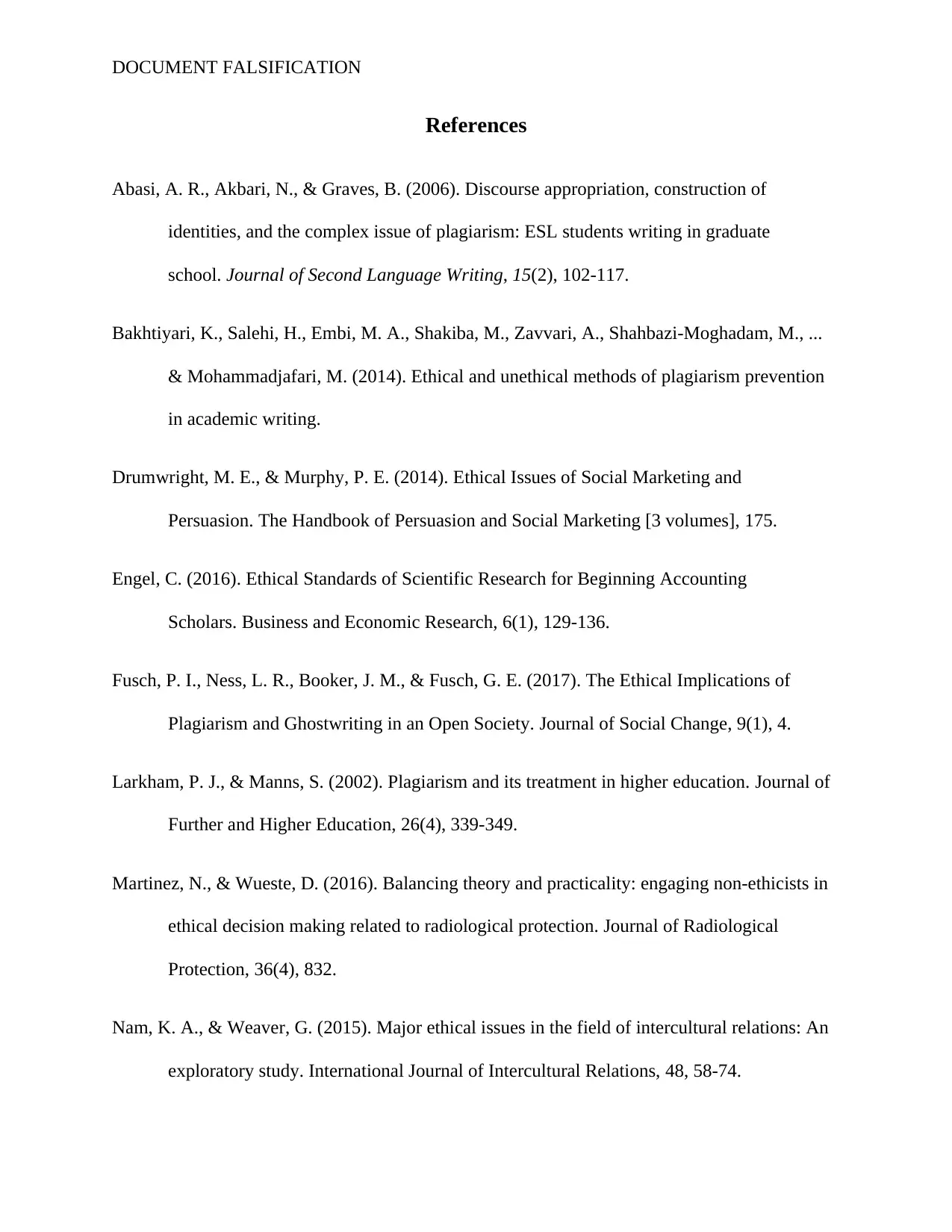
References
Abasi, A. R., Akbari, N., & Graves, B. (2006). Discourse appropriation, construction of
identities, and the complex issue of plagiarism: ESL students writing in graduate
school. Journal of Second Language Writing, 15(2), 102-117.
Bakhtiyari, K., Salehi, H., Embi, M. A., Shakiba, M., Zavvari, A., Shahbazi-Moghadam, M., ...
& Mohammadjafari, M. (2014). Ethical and unethical methods of plagiarism prevention
in academic writing.
Drumwright, M. E., & Murphy, P. E. (2014). Ethical Issues of Social Marketing and
Persuasion. The Handbook of Persuasion and Social Marketing [3 volumes], 175.
Engel, C. (2016). Ethical Standards of Scientific Research for Beginning Accounting
Scholars. Business and Economic Research, 6(1), 129-136.
Fusch, P. I., Ness, L. R., Booker, J. M., & Fusch, G. E. (2017). The Ethical Implications of
Plagiarism and Ghostwriting in an Open Society. Journal of Social Change, 9(1), 4.
Larkham, P. J., & Manns, S. (2002). Plagiarism and its treatment in higher education. Journal of
Further and Higher Education, 26(4), 339-349.
Martinez, N., & Wueste, D. (2016). Balancing theory and practicality: engaging non-ethicists in
ethical decision making related to radiological protection. Journal of Radiological
Protection, 36(4), 832.
Nam, K. A., & Weaver, G. (2015). Major ethical issues in the field of intercultural relations: An
exploratory study. International Journal of Intercultural Relations, 48, 58-74.
References
Abasi, A. R., Akbari, N., & Graves, B. (2006). Discourse appropriation, construction of
identities, and the complex issue of plagiarism: ESL students writing in graduate
school. Journal of Second Language Writing, 15(2), 102-117.
Bakhtiyari, K., Salehi, H., Embi, M. A., Shakiba, M., Zavvari, A., Shahbazi-Moghadam, M., ...
& Mohammadjafari, M. (2014). Ethical and unethical methods of plagiarism prevention
in academic writing.
Drumwright, M. E., & Murphy, P. E. (2014). Ethical Issues of Social Marketing and
Persuasion. The Handbook of Persuasion and Social Marketing [3 volumes], 175.
Engel, C. (2016). Ethical Standards of Scientific Research for Beginning Accounting
Scholars. Business and Economic Research, 6(1), 129-136.
Fusch, P. I., Ness, L. R., Booker, J. M., & Fusch, G. E. (2017). The Ethical Implications of
Plagiarism and Ghostwriting in an Open Society. Journal of Social Change, 9(1), 4.
Larkham, P. J., & Manns, S. (2002). Plagiarism and its treatment in higher education. Journal of
Further and Higher Education, 26(4), 339-349.
Martinez, N., & Wueste, D. (2016). Balancing theory and practicality: engaging non-ethicists in
ethical decision making related to radiological protection. Journal of Radiological
Protection, 36(4), 832.
Nam, K. A., & Weaver, G. (2015). Major ethical issues in the field of intercultural relations: An
exploratory study. International Journal of Intercultural Relations, 48, 58-74.
⊘ This is a preview!⊘
Do you want full access?
Subscribe today to unlock all pages.
Trusted by 1+ million students worldwide
DOCUMENT FALSIFICATION
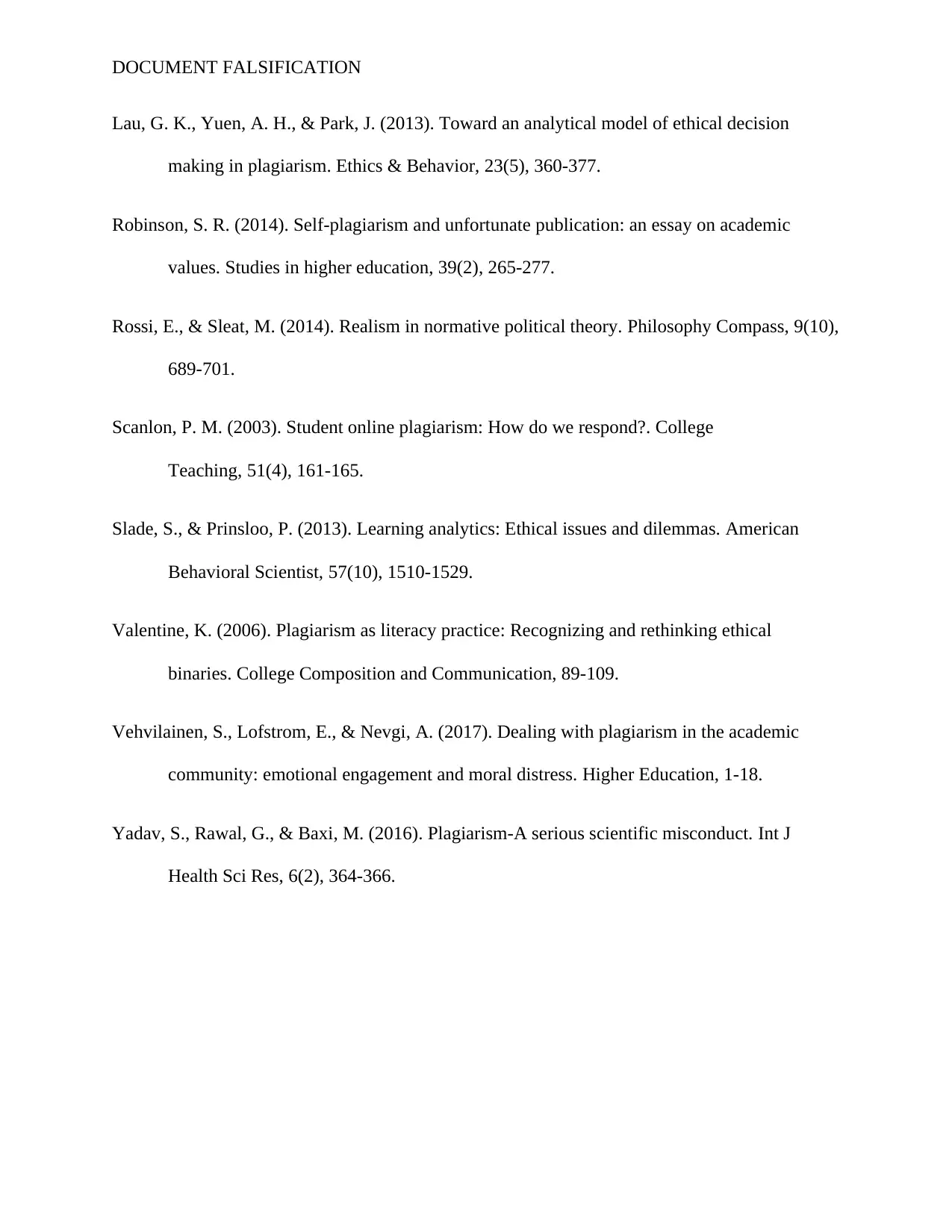
Lau, G. K., Yuen, A. H., & Park, J. (2013). Toward an analytical model of ethical decision
making in plagiarism. Ethics & Behavior, 23(5), 360-377.
Robinson, S. R. (2014). Self-plagiarism and unfortunate publication: an essay on academic
values. Studies in higher education, 39(2), 265-277.
Rossi, E., & Sleat, M. (2014). Realism in normative political theory. Philosophy Compass, 9(10),
689-701.
Scanlon, P. M. (2003). Student online plagiarism: How do we respond?. College
Teaching, 51(4), 161-165.
Slade, S., & Prinsloo, P. (2013). Learning analytics: Ethical issues and dilemmas. American
Behavioral Scientist, 57(10), 1510-1529.
Valentine, K. (2006). Plagiarism as literacy practice: Recognizing and rethinking ethical
binaries. College Composition and Communication, 89-109.
Vehvilainen, S., Lofstrom, E., & Nevgi, A. (2017). Dealing with plagiarism in the academic
community: emotional engagement and moral distress. Higher Education, 1-18.
Yadav, S., Rawal, G., & Baxi, M. (2016). Plagiarism-A serious scientific misconduct. Int J
Health Sci Res, 6(2), 364-366.
Lau, G. K., Yuen, A. H., & Park, J. (2013). Toward an analytical model of ethical decision
making in plagiarism. Ethics & Behavior, 23(5), 360-377.
Robinson, S. R. (2014). Self-plagiarism and unfortunate publication: an essay on academic
values. Studies in higher education, 39(2), 265-277.
Rossi, E., & Sleat, M. (2014). Realism in normative political theory. Philosophy Compass, 9(10),
689-701.
Scanlon, P. M. (2003). Student online plagiarism: How do we respond?. College
Teaching, 51(4), 161-165.
Slade, S., & Prinsloo, P. (2013). Learning analytics: Ethical issues and dilemmas. American
Behavioral Scientist, 57(10), 1510-1529.
Valentine, K. (2006). Plagiarism as literacy practice: Recognizing and rethinking ethical
binaries. College Composition and Communication, 89-109.
Vehvilainen, S., Lofstrom, E., & Nevgi, A. (2017). Dealing with plagiarism in the academic
community: emotional engagement and moral distress. Higher Education, 1-18.
Yadav, S., Rawal, G., & Baxi, M. (2016). Plagiarism-A serious scientific misconduct. Int J
Health Sci Res, 6(2), 364-366.

1 out of 10


Related Documents


Your All-in-One AI-Powered Toolkit for Academic Success.
+13062052269
info@desklib.com
Available 24*7 on WhatsApp / Email
![[object Object]](/_next/static/media/star-bottom.7253800d.svg)
Unlock your academic potential
Copyright © 2020–2026 A2Z Services. All Rights Reserved. Developed and managed by ZUCOL.