Accounting Ethics and Professional Conduct: Case Study Analysis
VerifiedAdded on 2020/04/21
|8
|1362
|85
Report
AI Summary
This report examines ethical issues in accounting through the analysis of two case studies, labeled A and B. The assessment focuses on applying three categories of ethical theory: teleological, deontological, and virtual ethics. Case A explores the ethical dilemmas faced by John Young, considering issues of confidentiality, credibility, and competence within the context of the IESBA code of ethics. Case B delves into the actions of Mr. Paul Kelly, assessing integrity, competence, and the ethical value of fortitude. The report provides detailed analyses of each case, identifying relevant ethical issues and categorizing them according to the ethical frameworks. The conclusion emphasizes the importance of ethics in management accounting and the significance of adhering to ethical codes of conduct for organizational success. The report references relevant literature and provides a comprehensive overview of the ethical considerations in the accounting profession.
Name of student:
Registration number:
Unit Title:
Unit Code:
Name of supervisor:
Date Due:
Registration number:
Unit Title:
Unit Code:
Name of supervisor:
Date Due:
Paraphrase This Document
Need a fresh take? Get an instant paraphrase of this document with our AI Paraphraser

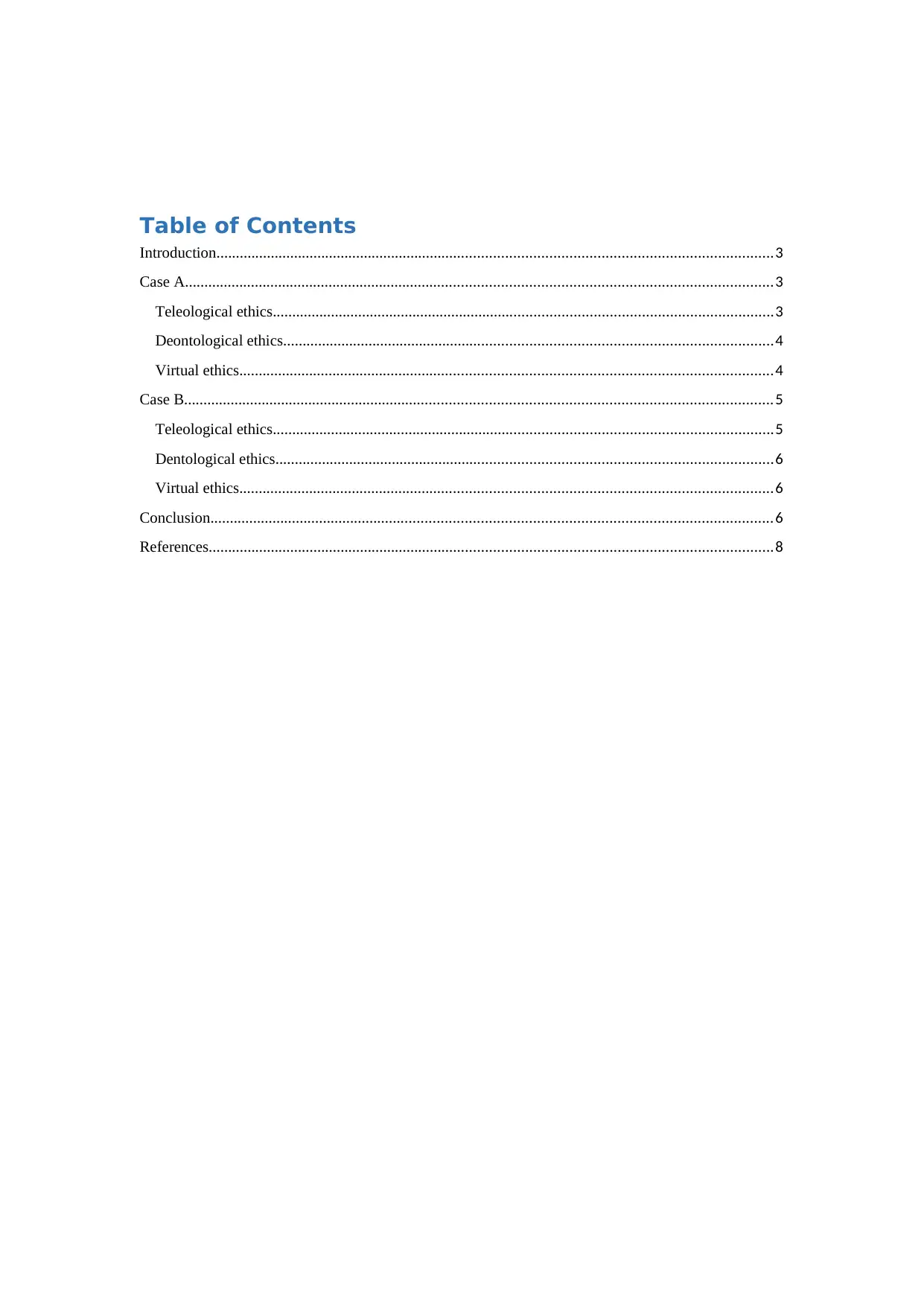
Table of Contents
Introduction.............................................................................................................................................3
Case A.....................................................................................................................................................3
Teleological ethics...............................................................................................................................3
Deontological ethics............................................................................................................................4
Virtual ethics.......................................................................................................................................4
Case B.....................................................................................................................................................5
Teleological ethics...............................................................................................................................5
Dentological ethics..............................................................................................................................6
Virtual ethics.......................................................................................................................................6
Conclusion..............................................................................................................................................6
References...............................................................................................................................................8
Introduction.............................................................................................................................................3
Case A.....................................................................................................................................................3
Teleological ethics...............................................................................................................................3
Deontological ethics............................................................................................................................4
Virtual ethics.......................................................................................................................................4
Case B.....................................................................................................................................................5
Teleological ethics...............................................................................................................................5
Dentological ethics..............................................................................................................................6
Virtual ethics.......................................................................................................................................6
Conclusion..............................................................................................................................................6
References...............................................................................................................................................8

Introduction
This task discusses the various ethics that are relevant in auditing and accounting. The
ethics are classified into three categories which includes teleological, deontological
and virtue ethics. This assessment discusses the ethics that are relevant in Case study
A while categorizing them in the categories identified above.
Case A
Teleological ethics
Teleological ethics are the types of ethics that describe an ethical perspective where
the righteousness or wrongness of an action is determined by the outcomes whether
they are good or bad. One of the teleological ethics that are relevant in the case of
John Young who works for Leston Corporation is Section 130 which deals with of
confidentiality (Hancock, Phil and Peter , 2015). A professional accountant should not
share information acquired as a result of professional or business relations and should
not disclose such information to third parties unless under their consent or there is
legal or professional duty to disclose . John had information about a competitor and
he decided not to inform the board which could have used this information to make a
better and informed decision. In this perspective, John should have disclosed the
information since the consequences of the disclosure are expected to be good and he
does not have an obligation towards the competitor since the information was not
obtained through professional or business relations.
This task discusses the various ethics that are relevant in auditing and accounting. The
ethics are classified into three categories which includes teleological, deontological
and virtue ethics. This assessment discusses the ethics that are relevant in Case study
A while categorizing them in the categories identified above.
Case A
Teleological ethics
Teleological ethics are the types of ethics that describe an ethical perspective where
the righteousness or wrongness of an action is determined by the outcomes whether
they are good or bad. One of the teleological ethics that are relevant in the case of
John Young who works for Leston Corporation is Section 130 which deals with of
confidentiality (Hancock, Phil and Peter , 2015). A professional accountant should not
share information acquired as a result of professional or business relations and should
not disclose such information to third parties unless under their consent or there is
legal or professional duty to disclose . John had information about a competitor and
he decided not to inform the board which could have used this information to make a
better and informed decision. In this perspective, John should have disclosed the
information since the consequences of the disclosure are expected to be good and he
does not have an obligation towards the competitor since the information was not
obtained through professional or business relations.
⊘ This is a preview!⊘
Do you want full access?
Subscribe today to unlock all pages.

Trusted by 1+ million students worldwide

Deontological ethics
Deontological ethics are based on duties and rights of management accountants. Most
of the ethics in the accountants’ code of ethics lie under this category. Under section
140 of the code of ethics, credibility is one of the ethics issue that is relevant to case
A. Credibility is the quality of being trustworthy and being and inspiring people to
have the confidence to believe in you. This ethical issue is very relevant in
management accounting. John Young is found to lack credibility since he cannot be
trusted to make decisions that are in the best interest of the company he is working
for. The information he possessed about the competitor could be very useful in
making the decisions by the board and hence the decision to withhold the information
means that he lacks credibility.
The other ethical issue relevant in this assessment is that of competence which section
130 of the IESBA code of ethics is. Competence is about having the right kind of
skills and knowledge to perform a particular task perfectly (Cunningham et al.,
2015).John is seen as not competent in performing his roles and responsibility at the
Leston Corporation. John is the chief financial officer of Leston Corporation but is not
seen to provide information or make decisions that would the board get the company
out of the financial crisis it is currently facing.
Virtual ethics
Virtual ethics emphasizes is a theoretical approach to ethics which emphasizes on an
individual`s character as key to ethical thinking and actions. Different people have
different characters and this influences their thinking and behavior which also directly
affects their ethical behavior in an organization (Cunningham et al., 2015). One of the
virtual ethics that can be identified in Case A is that of Justice. John can be described
as being just because the failure to reveal the information is an act of fairness to the
Deontological ethics are based on duties and rights of management accountants. Most
of the ethics in the accountants’ code of ethics lie under this category. Under section
140 of the code of ethics, credibility is one of the ethics issue that is relevant to case
A. Credibility is the quality of being trustworthy and being and inspiring people to
have the confidence to believe in you. This ethical issue is very relevant in
management accounting. John Young is found to lack credibility since he cannot be
trusted to make decisions that are in the best interest of the company he is working
for. The information he possessed about the competitor could be very useful in
making the decisions by the board and hence the decision to withhold the information
means that he lacks credibility.
The other ethical issue relevant in this assessment is that of competence which section
130 of the IESBA code of ethics is. Competence is about having the right kind of
skills and knowledge to perform a particular task perfectly (Cunningham et al.,
2015).John is seen as not competent in performing his roles and responsibility at the
Leston Corporation. John is the chief financial officer of Leston Corporation but is not
seen to provide information or make decisions that would the board get the company
out of the financial crisis it is currently facing.
Virtual ethics
Virtual ethics emphasizes is a theoretical approach to ethics which emphasizes on an
individual`s character as key to ethical thinking and actions. Different people have
different characters and this influences their thinking and behavior which also directly
affects their ethical behavior in an organization (Cunningham et al., 2015). One of the
virtual ethics that can be identified in Case A is that of Justice. John can be described
as being just because the failure to reveal the information is an act of fairness to the
Paraphrase This Document
Need a fresh take? Get an instant paraphrase of this document with our AI Paraphraser

competitor. Justice can be defined as the characteristic if just or fair. It is because of
John`s character that he saw it as being unfair to use the competitors confidential
information to make decision that would benefit his own company and hence decided
against providing the information.
Case B
Introduction
Case study B discusses how Mr Paul Kelly, the purchasing manager of QBX company
purchased fester, a raw material in manufacture of fertilizer at a low favorable price.
Mr Kelly decided to buy the raw material due to very low price despite the fact that he
was fully aware the product was of lower grade. The lower grade fester increased
usage in manufacturing but did not affect the quality of the fertilizer manufactured.
There are various ethical issues that can be derived from this case study and they are
discussed.
Teleological ethics
The teleological ethical issues in this case are those that are determined by the
outcome depending on whether it is good or bad (Hancock, Phil and Peter , 2015).
The major teleological ethical issue in this case is integrity. Integrity as an ethical
issue is defined as the steadfast adherence to a strict moral or ethical code of conduct.
Integrity is discussed in section 110 of the IESBA code of ethics.Management
accountants are required to be forthright and honest with client. Failure by the
John`s character that he saw it as being unfair to use the competitors confidential
information to make decision that would benefit his own company and hence decided
against providing the information.
Case B
Introduction
Case study B discusses how Mr Paul Kelly, the purchasing manager of QBX company
purchased fester, a raw material in manufacture of fertilizer at a low favorable price.
Mr Kelly decided to buy the raw material due to very low price despite the fact that he
was fully aware the product was of lower grade. The lower grade fester increased
usage in manufacturing but did not affect the quality of the fertilizer manufactured.
There are various ethical issues that can be derived from this case study and they are
discussed.
Teleological ethics
The teleological ethical issues in this case are those that are determined by the
outcome depending on whether it is good or bad (Hancock, Phil and Peter , 2015).
The major teleological ethical issue in this case is integrity. Integrity as an ethical
issue is defined as the steadfast adherence to a strict moral or ethical code of conduct.
Integrity is discussed in section 110 of the IESBA code of ethics.Management
accountants are required to be forthright and honest with client. Failure by the

purchasing manager to disclose to the senior managers of the company and the
customers of change in raw material means that he lacks the requisite integrity.
Dentological ethics
Competence is another ethical issue that can be identified in the case study and its
under section 130 of the IESBA code of ethics. Competence is having the right level
and type of skills and knowledge to perform tasks and activities well. Mr Paul Kelly
has the right skills and knowledge to perform his job as the purchasing manager of
QBX. One of his main responsibilities is to seek for cheaper high quality supplies that
reduce costs for the organization and he was able to do precisely that.
The issue of credibility is also relevant in case B and it is discussed under section 130
of the ethics code. Credibility is the quality of being reliable and trusted by the
organization, the customers, and all the stakeholders of the organization. Mr Paul
Kelly is credible since QBX can rely upon him to perform his tasks in the
organization as expected. He can be depended upon to make decisions that are in the
best interests of the company.
Virtual ethics
The ethical value of fortitude can also be identified in case B. Fortitude is the ability
to make the right decision in when faced by a tough situation (Hancock, Phil and
Peter , 2015). Mr Paul made a wrong decision by deciding to purchase lower quality
raw material which had detrimental effects on the environment. The decision to use a
cheaper raw material without the approval of the management also means that the
budget of the company will be defied and customer will have been shortchanged since
they are not aware of the change. Mr Paul therefore lacks fortitude which is an
important ethic in accounting.
customers of change in raw material means that he lacks the requisite integrity.
Dentological ethics
Competence is another ethical issue that can be identified in the case study and its
under section 130 of the IESBA code of ethics. Competence is having the right level
and type of skills and knowledge to perform tasks and activities well. Mr Paul Kelly
has the right skills and knowledge to perform his job as the purchasing manager of
QBX. One of his main responsibilities is to seek for cheaper high quality supplies that
reduce costs for the organization and he was able to do precisely that.
The issue of credibility is also relevant in case B and it is discussed under section 130
of the ethics code. Credibility is the quality of being reliable and trusted by the
organization, the customers, and all the stakeholders of the organization. Mr Paul
Kelly is credible since QBX can rely upon him to perform his tasks in the
organization as expected. He can be depended upon to make decisions that are in the
best interests of the company.
Virtual ethics
The ethical value of fortitude can also be identified in case B. Fortitude is the ability
to make the right decision in when faced by a tough situation (Hancock, Phil and
Peter , 2015). Mr Paul made a wrong decision by deciding to purchase lower quality
raw material which had detrimental effects on the environment. The decision to use a
cheaper raw material without the approval of the management also means that the
budget of the company will be defied and customer will have been shortchanged since
they are not aware of the change. Mr Paul therefore lacks fortitude which is an
important ethic in accounting.
⊘ This is a preview!⊘
Do you want full access?
Subscribe today to unlock all pages.

Trusted by 1+ million students worldwide

Conclusion
Ethics are very important in management accounting just like in any other profession.
Ethics is a code of conduct or behavior that is designed to govern the actions and
behaviors of group of people in an organization. Strict adherence to the code of ethics
is crucial to the success of every organization. The paper evaluates ethical issues in
management accounting using the three categories of ethical theory. The categories of
ethical theory used include deontological ethics, teleological ethics, and virtual ethics.
The ethical issues identifiable in case A and B are identified and explained using the
criteria identified above.
Ethics are very important in management accounting just like in any other profession.
Ethics is a code of conduct or behavior that is designed to govern the actions and
behaviors of group of people in an organization. Strict adherence to the code of ethics
is crucial to the success of every organization. The paper evaluates ethical issues in
management accounting using the three categories of ethical theory. The categories of
ethical theory used include deontological ethics, teleological ethics, and virtual ethics.
The ethical issues identifiable in case A and B are identified and explained using the
criteria identified above.
Paraphrase This Document
Need a fresh take? Get an instant paraphrase of this document with our AI Paraphraser

References
Cunningham, Billie M., John D Bazlley, Marie Kavanagh, Loren A Nikkolai, Sharelle
Simmons, and Geoff Slaughter. 2015. Accounting: information for business
decisions. www.managementjournal.info/download1.php?f=250105.pdf
Hancock, Phil, M. E. Bazley, and Peter Robinson. 2015. Contemporary accounting: a
strategic approach for
users.https://www.ifac.org/system/files/publications/files/ifac-code-of-
ethics-for.pdf
Cunningham, Billie M., John D Bazlley, Marie Kavanagh, Loren A Nikkolai, Sharelle
Simmons, and Geoff Slaughter. 2015. Accounting: information for business
decisions. www.managementjournal.info/download1.php?f=250105.pdf
Hancock, Phil, M. E. Bazley, and Peter Robinson. 2015. Contemporary accounting: a
strategic approach for
users.https://www.ifac.org/system/files/publications/files/ifac-code-of-
ethics-for.pdf
1 out of 8
Related Documents
Your All-in-One AI-Powered Toolkit for Academic Success.
+13062052269
info@desklib.com
Available 24*7 on WhatsApp / Email
Unlock your academic potential
Copyright © 2020–2026 A2Z Services. All Rights Reserved. Developed and managed by ZUCOL.