Analysis of Ethical Issues in Management Research: AI Applications

Verified

Added on  2022/11/23

|14
|2326
|52
Report
AI Summary
This report analyzes the ethical dimensions of Artificial Intelligence (AI) within business environments, focusing on a review of relevant literature. The study examines the increasing use of AI across organizations and its implications, including ethical concerns. The methodology involves tracing methods used in the literature through charts. The analysis covers article authorship, identified ethical parameters, article methodology, research instruments, and analysis methods. The findings highlight ethical considerations such as ethical regulation, judgment, and system utilization. Recommendations emphasize better planning and integration of AI with organizational personnel, with a focus on ethical practices and data security. The conclusion underscores AI's rapid development and its integration into business operations, emphasizing the importance of ethical guidelines and responsible data handling. The report also includes a detailed literature review and analysis of various research methodologies, results, and recommendations from the selected articles. The report provides an in-depth analysis of 10 scholarly articles, covering various aspects of AI implementation in management, including ethical considerations, research methodologies, and recommendations for responsible AI usage. The report offers insights into the ethical dimensions of AI and its impact on organizational environments, providing a comprehensive overview of the subject matter.
Document Page
Running head: ETHICAL ISSUES IN MANAGEMENT RESEARCH
ETHICAL ISSUES IN MANAGEMENT RESEARCH
Name of the Student
Name of the University
Author Note
tabler-icon-diamond-filled.svg

Paraphrase This Document

Need a fresh take? Get an instant paraphrase of this document with our AI Paraphraser
Document Page
1ETHICAL ISSUES IN MANAGEMENT RESEARCH
Part A:
Abstract
The study is focused towards exploring the ethical dimensions that are connected with the
implementation of Artificial Intelligence in business environments. The focus in on evaluating
the relevant literatures that are present concerning the subject matter. The comprehensive
understanding of the various literary works related to AI have been made. Subsequently, the
methods utilized by all the separate literatures have been traced through the usage of charts. AI is
increasingly being used across the organizational environments and the significance of the same
towards organizations and the ethical concerns that seem to affect them are considered for
wholesome analysis of the subject matter.
Document Page
2ETHICAL ISSUES IN MANAGEMENT RESEARCH
Table of Contents
Part A:..............................................................................................................................................1
Introduction......................................................................................................................................3
Methodology....................................................................................................................................5
Results..............................................................................................................................................5
Article Authorship.......................................................................................................................5
Identified Ethical Parameters.......................................................................................................7
Article Methodology....................................................................................................................8
Research Instruments...................................................................................................................9
Analysis method..........................................................................................................................9
Recommendation.......................................................................................................................10
Conclusion.....................................................................................................................................10
References......................................................................................................................................12
Document Page
3ETHICAL ISSUES IN MANAGEMENT RESEARCH
Introduction
The focus of the study is the usage of Artificial intelligence to determine the effectiveness
of various business functions. The report is focused towards understanding the various ethical
perspectives that guide the usage of AI in businesses. The literatures have been consulted as they
have provided essential information about the subject matter. It is important to note that
businesses are very significantly affected by the usage of artificial intelligence in the present
world. This has also affected the prospects of workers in the future as many of the earlier work
functions of the employees have been automated. The usage of artificial intelligence have
increased in businesses rapidly over the last few years. More and more functions have been
automatized as a result of the same. It is important to note that AI has long been used to improve
the production functions of manufacturing organizations. The various articles have been
considered to understand the ethical perspectives consideringartificial intelligence.
Literature Review
Ethical aspects that tend to affect the usage of artificial intelligence applied in various
management areas tend to focus more on the implications of artificial intelligence on the
organizations.Walker (2019) opines that AI intelligence are slowly reaching the creativity level
of the human. There is still a long way to go but in the near future the AIs can match human
creativity potential. The ethical implications that can be pointed out are in regards to how much
the management of businesses can incline on the Artificial Intelligences. The more application of
AI can in the near future actually make people lose jobs. Artificial intelligence in the distant
future can be used to replace all the major functions of the organizations. Thus, it is no longer
simply limited to the blue collar and the service jobs but much wider and encompassing even the
tabler-icon-diamond-filled.svg

Paraphrase This Document

Need a fresh take? Get an instant paraphrase of this document with our AI Paraphraser
Document Page
4ETHICAL ISSUES IN MANAGEMENT RESEARCH
job roles of the higher management (Pega, 2019). This can be a major ethical concern moving
forwards. Maleszak andZaskórski(2015) opine that AI can be integrated with the database
systems of any organization to enhance its performance. The evolution of the AI systems can
also take place effectively through this method. Erdélyi and Goldsmith (2018) are of the view
that organizations should immediately focus on implementing AI ethics policies for regulating
the usage of AI across organizations. There is also the huge gap that is being created by the
larger organizations that are making better networks through AIs and the smaller organizations
with lower financial backing that are lagging behind. Better equipped organizations are utilizing
better AI and moving forward creating a significant rift in the industry. It has to be remembered
that Artificial intelligence is causing significant ethical issues in industries that have many larger
players that are present in a competing environment. It is important to note that the
organizational factors are greatly impacted by the application of Artificial intelligence
(Ransbotham et al., 2017). This brings to notice the ethical implications of the factors that
determine the importance of the Artificial intelligences. There are several ethical dimensions that
affect the implementation of artificial intelligence in organizational environments. It can be said
that AI is becoming increasingly relevant in organizational environments. There is also a threat
of implementing AI towards unethically obtaining or using the Artificial intelligences (Wang et
al., 2016). Ethical standards are very important when considering the ethical usage of the
artificial intelligences. It is important that organizations focus more on using AT for better more
positive purposes. Hence, it can be said that as AI continue to expand across the large corporate
sectors of the world various ethical dimensions tend to affect its growth (Semmler& Rose, 2017).
Artificial Intelligence cannot be taken for granted and has to be used in the most ethically correct
Document Page
5ETHICAL ISSUES IN MANAGEMENT RESEARCH
ways possible. Artificial intelligence has many ethical implications attached to it that has to be
essentially considered for making the most from their implementation purposes.
Methodology
The previous researches have used various research methodologies to understand the
ethical dimensions essentially related to artificial intelligence. Most of the researches have been
qualitative in nature. However, many of the researches have also taken into consideration
quantitative methodologies to generate significant opinionated understanding of the subject
matter. In essence, the research methods have taken into consideration the data that have
emerged from the various sources of organizational management to form essential platforms for
developing deeper understandings of the ethical factors that affect organizational
implementations of artificial intelligence. The study has utilized these researches to form an
effective understanding of the ethical aspects that are significant in the field of AI utilization
across the various business environments. The study has focused on considering the comparative
understandings that can be derived from the understanding of all the separate works that have
been considered.The various methods that have been utilized in the study have been put forwards
for the more effective understanding of the subject matter. The articles have been put into charts
with various information being displayed to create a better scope for understanding their
combined and separate value.
Results
The various aspects connected with the research would be provided separately through
the tables.
Document Page
6ETHICAL ISSUES IN MANAGEMENT RESEARCH
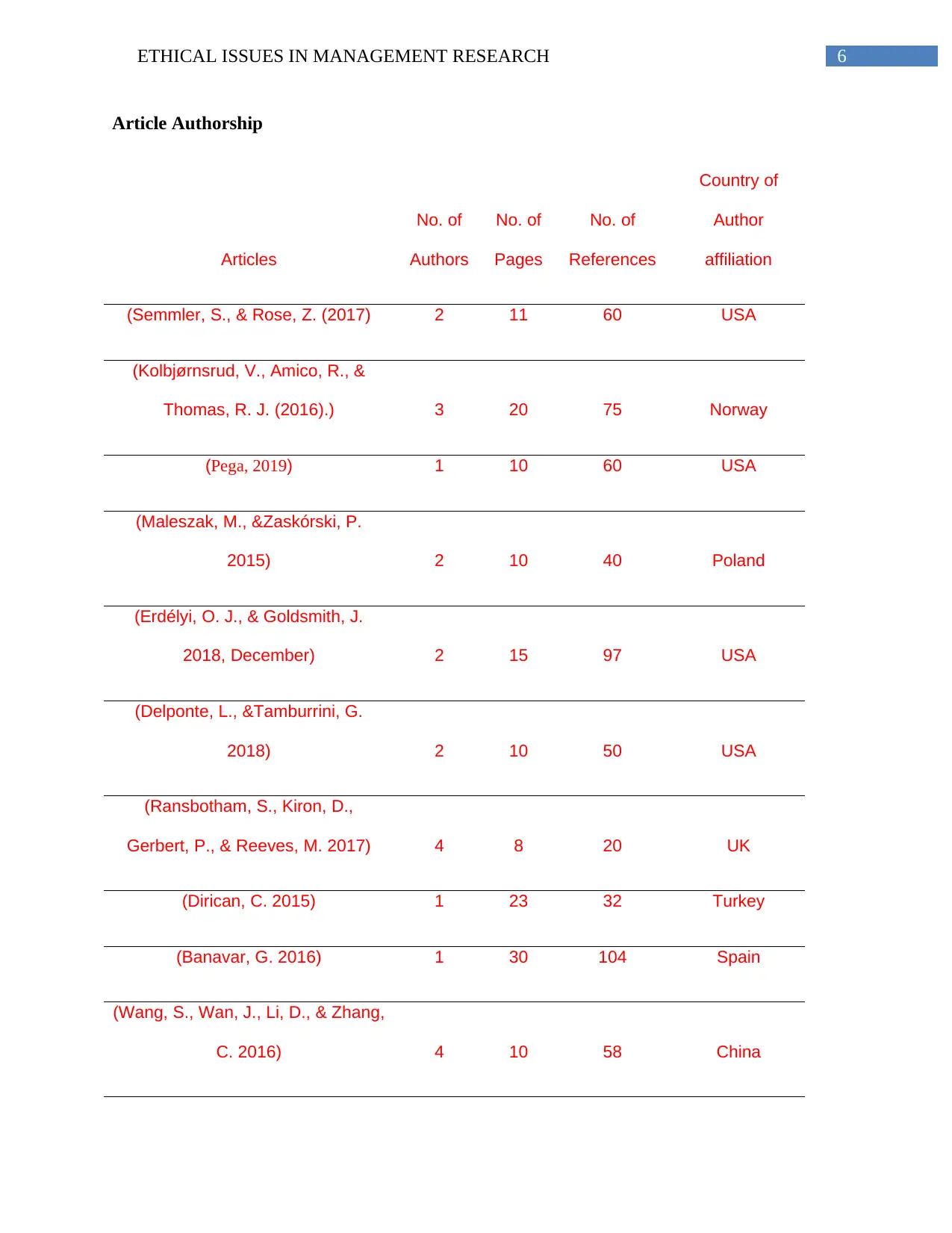
Article Authorship
Articles
No. of
Authors
No. of
Pages
No. of
References
Country of
Author
affiliation
(Semmler, S., & Rose, Z. (2017) 2 11 60 USA
(Kolbjørnsrud, V., Amico, R., &
Thomas, R. J. (2016).) 3 20 75 Norway
(Pega, 2019) 1 10 60 USA
(Maleszak, M., &Zaskórski, P.
2015) 2 10 40 Poland
(Erdélyi, O. J., & Goldsmith, J.
2018, December) 2 15 97 USA
(Delponte, L., &Tamburrini, G.
2018) 2 10 50 USA
(Ransbotham, S., Kiron, D.,
Gerbert, P., & Reeves, M. 2017) 4 8 20 UK
(Dirican, C. 2015) 1 23 32 Turkey
(Banavar, G. 2016) 1 30 104 Spain
(Wang, S., Wan, J., Li, D., & Zhang,
C. 2016) 4 10 58 China
tabler-icon-diamond-filled.svg

Paraphrase This Document

Need a fresh take? Get an instant paraphrase of this document with our AI Paraphraser
Document Page
7ETHICAL ISSUES IN MANAGEMENT RESEARCH
Total 22 157 596
Average 2.2 15.7 59.6
The articles had an average of 2.2 authors. The average number of pages were 15.7. The
information sources however were significant in number. The information sources were 59.6 in
average.
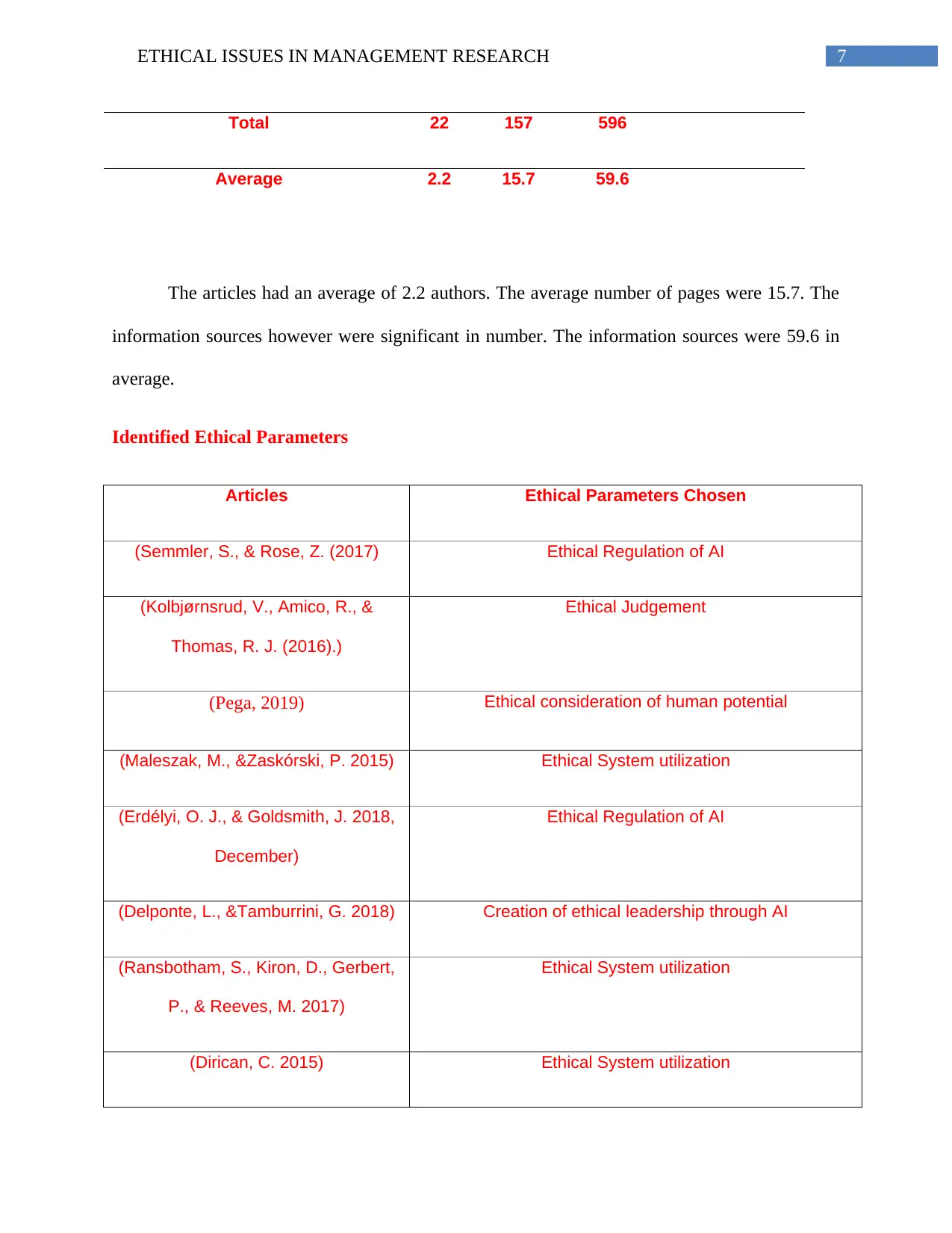
Identified Ethical Parameters
Articles Ethical Parameters Chosen
(Semmler, S., & Rose, Z. (2017) Ethical Regulation of AI
(Kolbjørnsrud, V., Amico, R., &
Thomas, R. J. (2016).)
Ethical Judgement
(Pega, 2019) Ethical consideration of human potential
(Maleszak, M., &Zaskórski, P. 2015) Ethical System utilization
(Erdélyi, O. J., & Goldsmith, J. 2018,
December)
Ethical Regulation of AI
(Delponte, L., &Tamburrini, G. 2018) Creation of ethical leadership through AI
(Ransbotham, S., Kiron, D., Gerbert,
P., & Reeves, M. 2017)
Ethical System utilization
(Dirican, C. 2015) Ethical System utilization
Document Page
8ETHICAL ISSUES IN MANAGEMENT RESEARCH
(Banavar, G. 2016) Establishment of trust systems
(Wang, S., Wan, J., Li, D., & Zhang,
C. 2016)
Implementing ethical AI frameworks
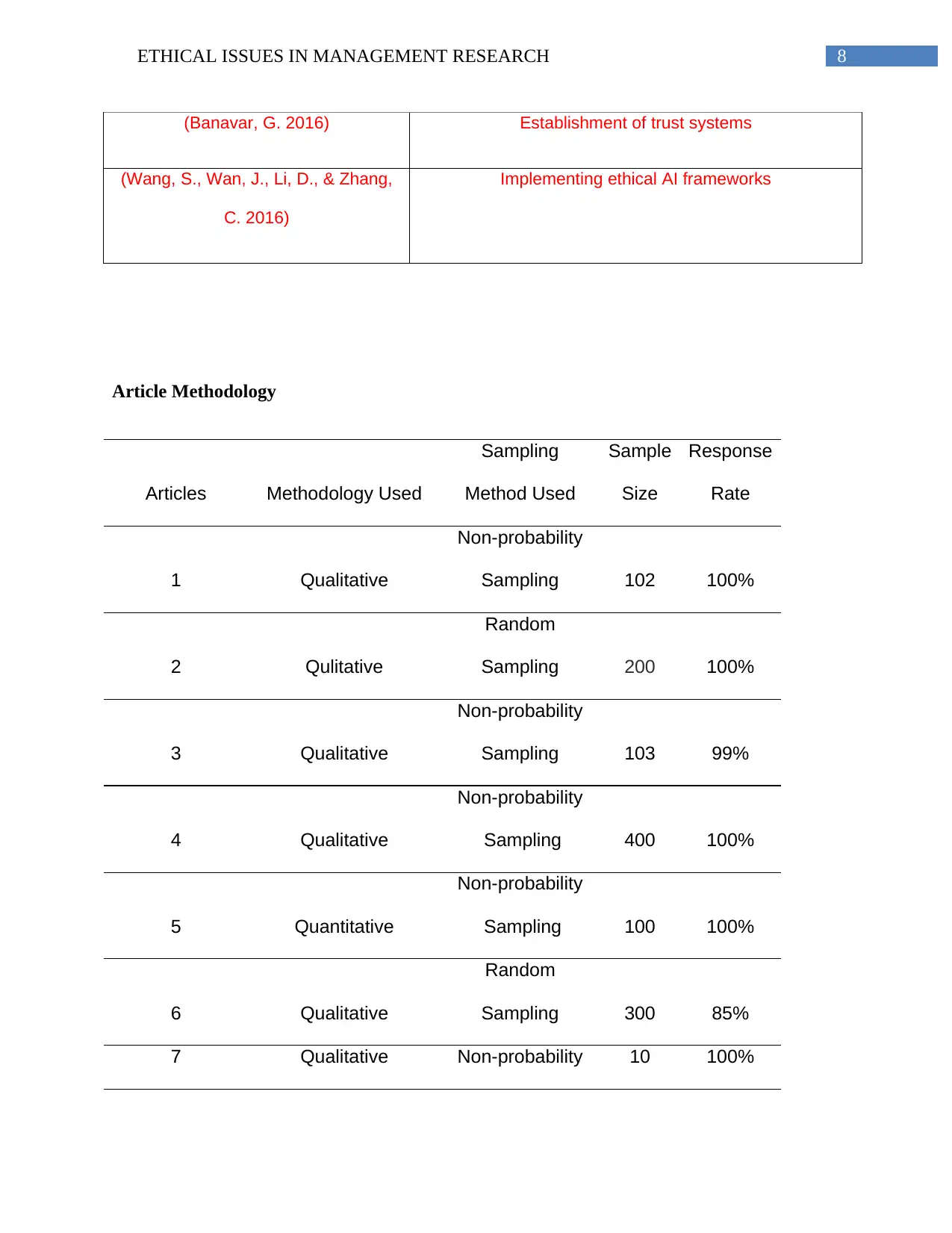
Article Methodology
Articles Methodology Used
Sampling
Method Used
Sample
Size
Response
Rate
1 Qualitative
Non-probability
Sampling 102 100%
2 Qulitative
Random
Sampling 200 100%
3 Qualitative
Non-probability
Sampling 103 99%
4 Qualitative
Non-probability
Sampling 400 100%
5 Quantitative
Non-probability
Sampling 100 100%
6 Qualitative
Random
Sampling 300 85%
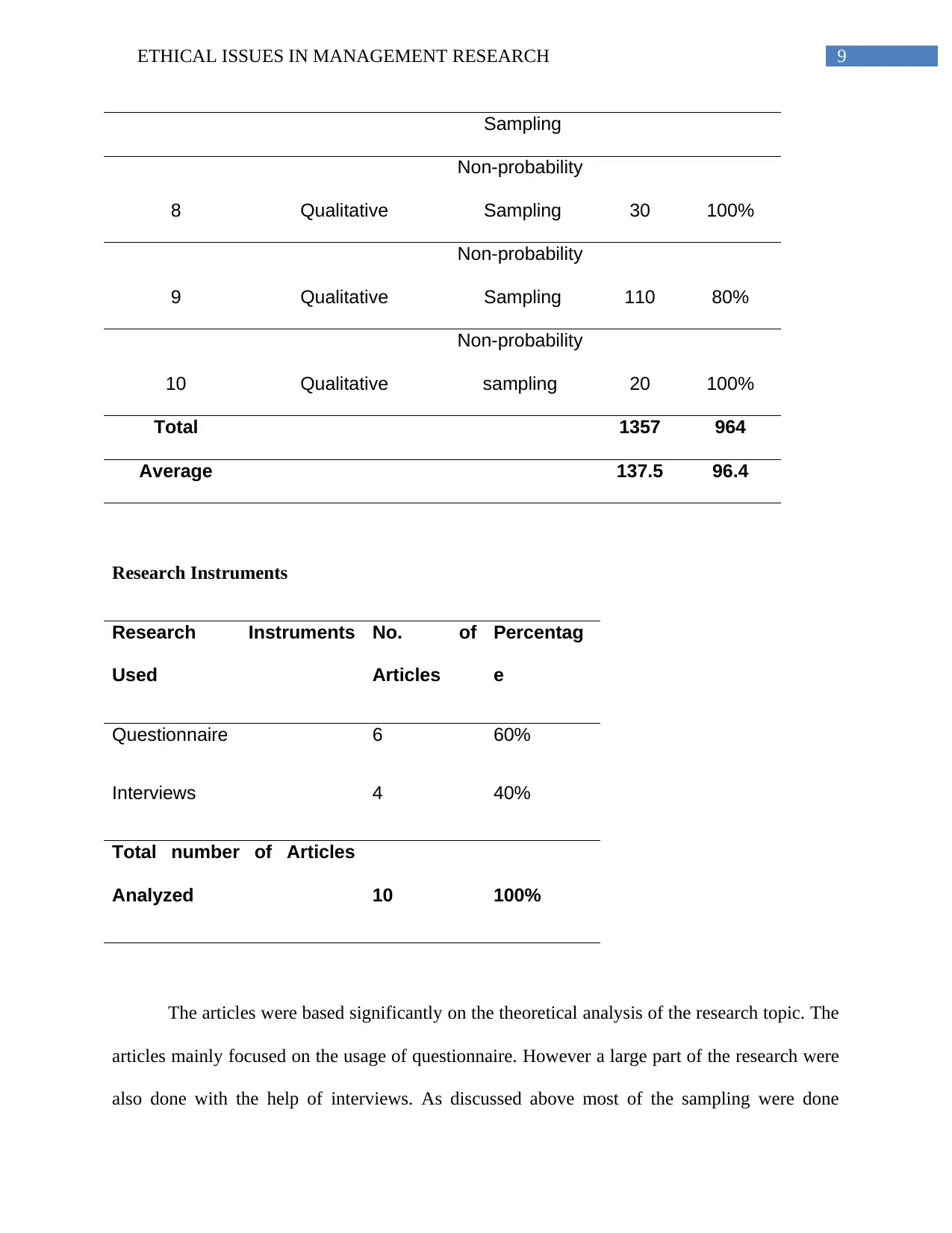
7 Qualitative Non-probability 10 100%
Document Page
9ETHICAL ISSUES IN MANAGEMENT RESEARCH
Sampling
8 Qualitative
Non-probability
Sampling 30 100%
9 Qualitative
Non-probability
Sampling 110 80%
10 Qualitative
Non-probability
sampling 20 100%
Total 1357 964
Average 137.5 96.4
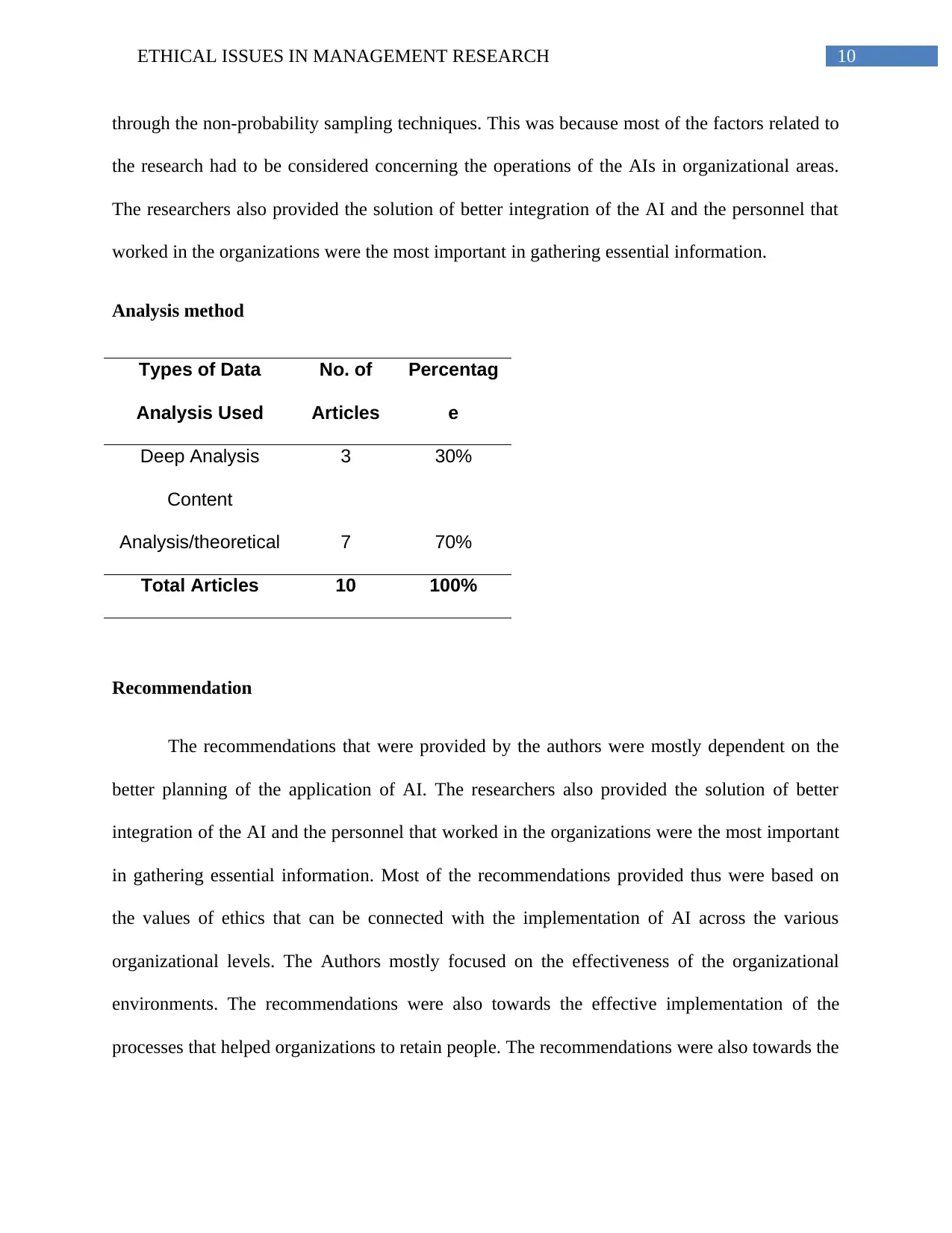
Research Instruments
Used
No. of
Articles
Percentag
e
Questionnaire 6 60%
Interviews 4 40%
Total number of Articles
Analyzed 10 100%
The articles were based significantly on the theoretical analysis of the research topic. The
articles mainly focused on the usage of questionnaire. However a large part of the research were
also done with the help of interviews. As discussed above most of the sampling were done
tabler-icon-diamond-filled.svg

Paraphrase This Document

Need a fresh take? Get an instant paraphrase of this document with our AI Paraphraser
Document Page
10ETHICAL ISSUES IN MANAGEMENT RESEARCH
through the non-probability sampling techniques. This was because most of the factors related to
the research had to be considered concerning the operations of the AIs in organizational areas.
The researchers also provided the solution of better integration of the AI and the personnel that
worked in the organizations were the most important in gathering essential information.
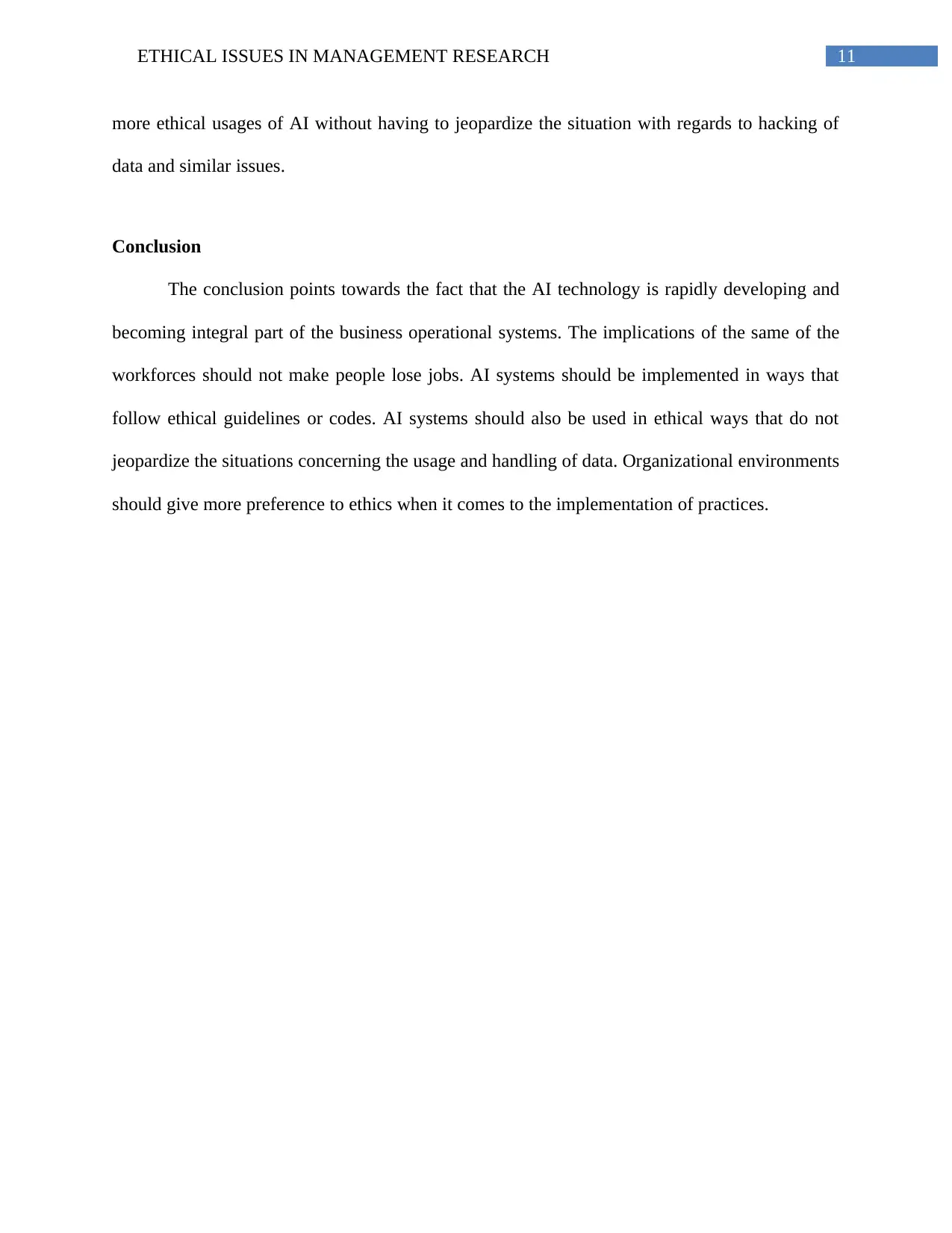
Analysis method
Types of Data
Analysis Used
No. of
Articles
Percentag
e
Deep Analysis 3 30%
Content
Analysis/theoretical 7 70%
Total Articles 10 100%
Recommendation
The recommendations that were provided by the authors were mostly dependent on the
better planning of the application of AI. The researchers also provided the solution of better
integration of the AI and the personnel that worked in the organizations were the most important
in gathering essential information. Most of the recommendations provided thus were based on
the values of ethics that can be connected with the implementation of AI across the various
organizational levels. The Authors mostly focused on the effectiveness of the organizational
environments. The recommendations were also towards the effective implementation of the
processes that helped organizations to retain people. The recommendations were also towards the
Document Page
11ETHICAL ISSUES IN MANAGEMENT RESEARCH
more ethical usages of AI without having to jeopardize the situation with regards to hacking of
data and similar issues.
Conclusion
The conclusion points towards the fact that the AI technology is rapidly developing and
becoming integral part of the business operational systems. The implications of the same of the
workforces should not make people lose jobs. AI systems should be implemented in ways that
follow ethical guidelines or codes. AI systems should also be used in ethical ways that do not
jeopardize the situations concerning the usage and handling of data. Organizational environments
should give more preference to ethics when it comes to the implementation of practices.
chevron_up_icon
1 out of 14
circle_padding
hide_on_mobile
zoom_out_icon
[object Object]