A Comprehensive Analysis of Ethical Issues, Conflicts and Dilemmas

Verified

Added on  2023/06/11

|8
|1815
|371
Essay
AI Summary
This essay delves into the critical aspects of business ethics, emphasizing the importance of ethical principles in organizational decision-making. It highlights ethical obligations such as honest practices, safe working conditions, and avoiding conflicts of interest, while also addressing common ethical issues like workplace discrimination, poor working conditions, whistleblowing, nondisclosure, and questionable accounting practices. The essay further explores ethical conflicts and dilemmas, underscoring the need for a structured ethical decision-making framework. It concludes by reinforcing the significance of ethics in fostering business success and provides a guideline for making sound ethical choices, emphasizing the importance of considering all stakeholders and reflecting on the outcomes of decisions. The document is available on Desklib, a platform offering a wealth of study resources, including past papers and solved assignments, for students.
Document Page
1
BUSINESS ETHICS
Name
Subject
Date
tabler-icon-diamond-filled.svg

Paraphrase This Document

Need a fresh take? Get an instant paraphrase of this document with our AI Paraphraser
Document Page
Name 2
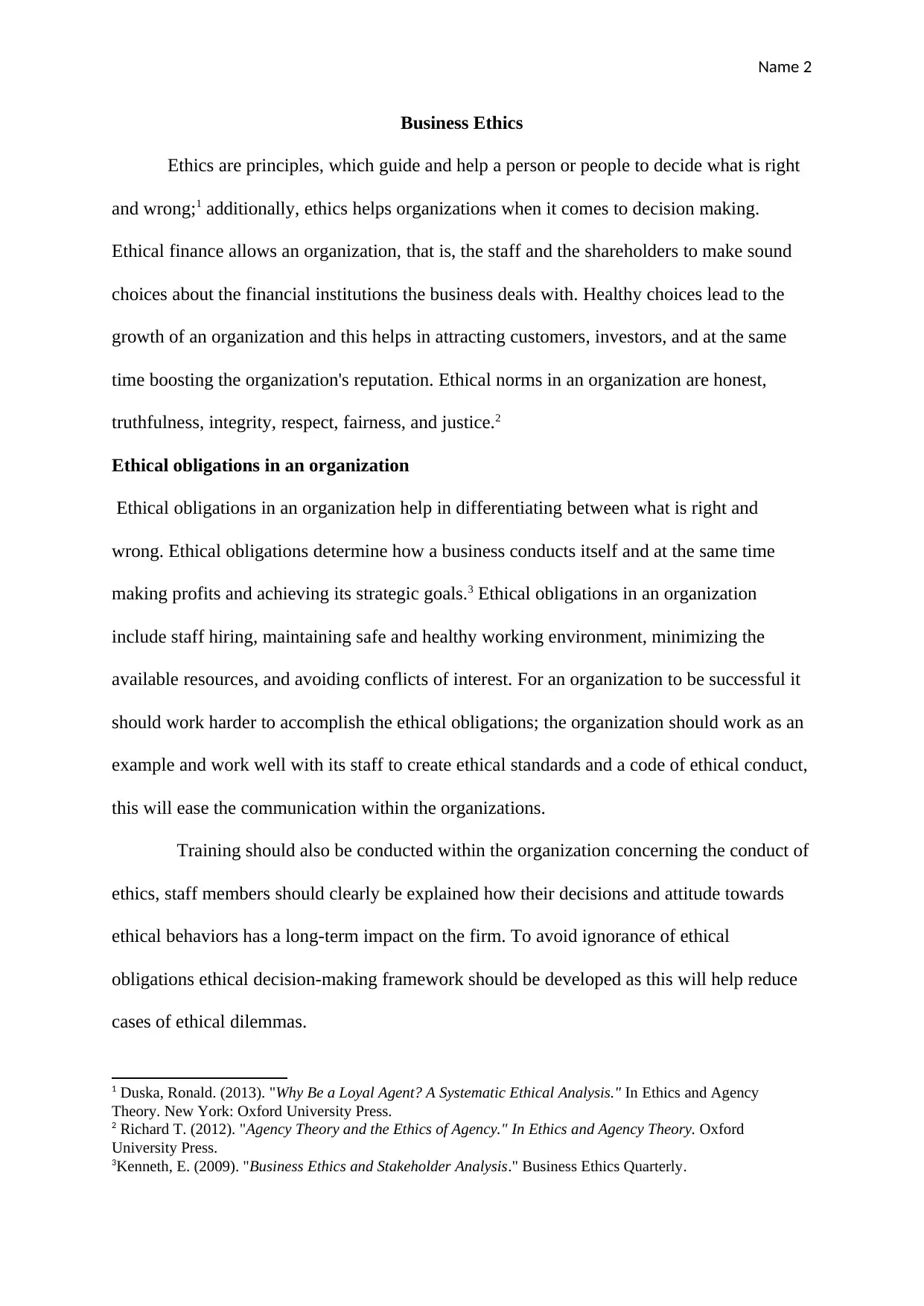
Business Ethics
Ethics are principles, which guide and help a person or people to decide what is right
and wrong;1 additionally, ethics helps organizations when it comes to decision making.
Ethical finance allows an organization, that is, the staff and the shareholders to make sound
choices about the financial institutions the business deals with. Healthy choices lead to the
growth of an organization and this helps in attracting customers, investors, and at the same
time boosting the organization's reputation. Ethical norms in an organization are honest,
truthfulness, integrity, respect, fairness, and justice.2
Ethical obligations in an organization
Ethical obligations in an organization help in differentiating between what is right and
wrong. Ethical obligations determine how a business conducts itself and at the same time
making profits and achieving its strategic goals.3 Ethical obligations in an organization
include staff hiring, maintaining safe and healthy working environment, minimizing the
available resources, and avoiding conflicts of interest. For an organization to be successful it
should work harder to accomplish the ethical obligations; the organization should work as an
example and work well with its staff to create ethical standards and a code of ethical conduct,
this will ease the communication within the organizations.
Training should also be conducted within the organization concerning the conduct of
ethics, staff members should clearly be explained how their decisions and attitude towards
ethical behaviors has a long-term impact on the firm. To avoid ignorance of ethical
obligations ethical decision-making framework should be developed as this will help reduce
cases of ethical dilemmas.
1 Duska, Ronald. (2013). "Why Be a Loyal Agent? A Systematic Ethical Analysis." In Ethics and Agency
Theory. New York: Oxford University Press.
2 Richard T. (2012). "Agency Theory and the Ethics of Agency." In Ethics and Agency Theory. Oxford
University Press.
3Kenneth, E. (2009). "Business Ethics and Stakeholder Analysis." Business Ethics Quarterly.
Document Page
Name 3
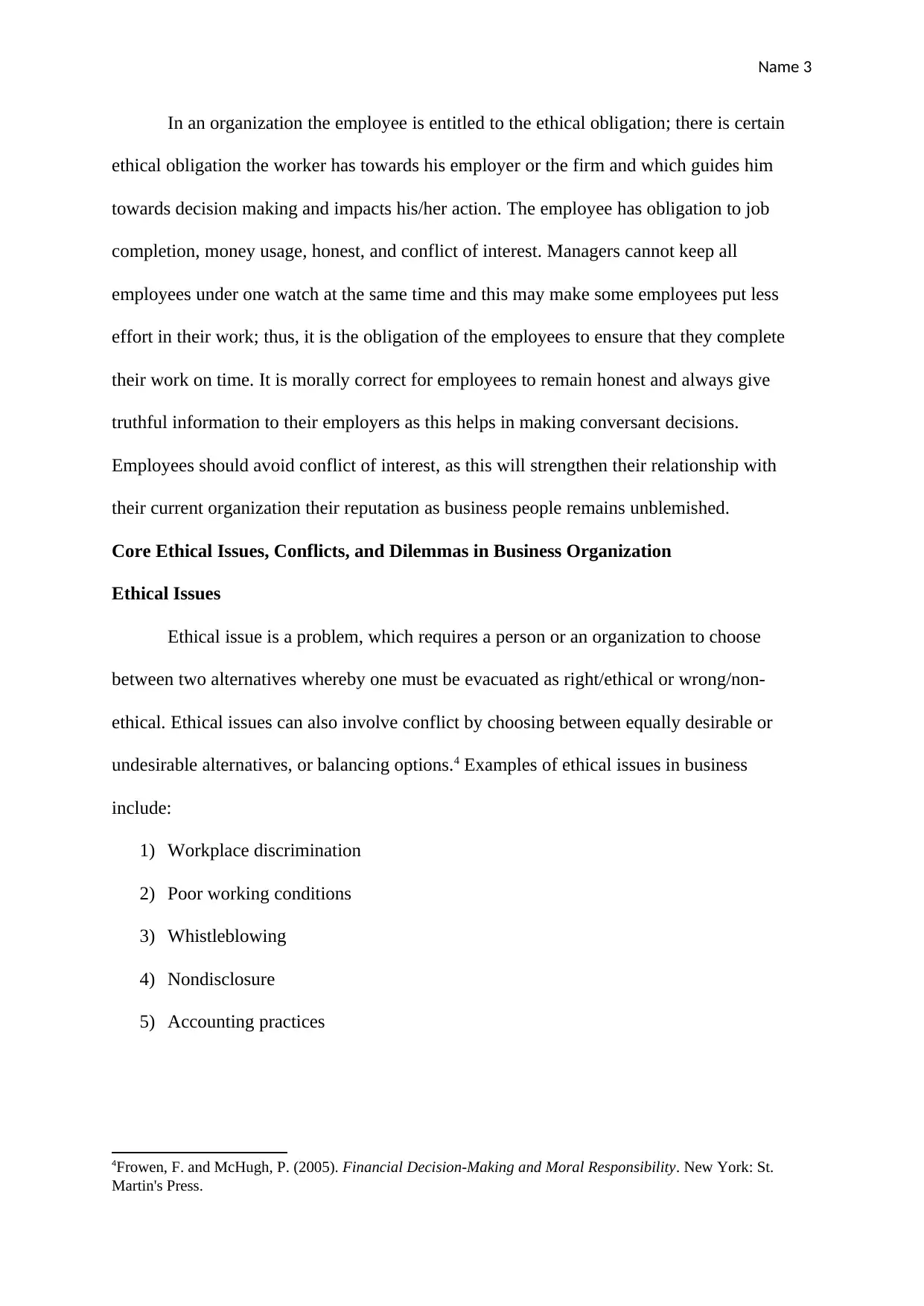
In an organization the employee is entitled to the ethical obligation; there is certain
ethical obligation the worker has towards his employer or the firm and which guides him
towards decision making and impacts his/her action. The employee has obligation to job
completion, money usage, honest, and conflict of interest. Managers cannot keep all
employees under one watch at the same time and this may make some employees put less
effort in their work; thus, it is the obligation of the employees to ensure that they complete
their work on time. It is morally correct for employees to remain honest and always give
truthful information to their employers as this helps in making conversant decisions.
Employees should avoid conflict of interest, as this will strengthen their relationship with
their current organization their reputation as business people remains unblemished.
Core Ethical Issues, Conflicts, and Dilemmas in Business Organization
Ethical Issues
Ethical issue is a problem, which requires a person or an organization to choose
between two alternatives whereby one must be evacuated as right/ethical or wrong/non-
ethical. Ethical issues can also involve conflict by choosing between equally desirable or
undesirable alternatives, or balancing options.4 Examples of ethical issues in business
include:
1) Workplace discrimination
2) Poor working conditions
3) Whistleblowing
4) Nondisclosure
5) Accounting practices
4Frowen, F. and McHugh, P. (2005). Financial Decision-Making and Moral Responsibility. New York: St.
Martin's Press.
Document Page
Name 4
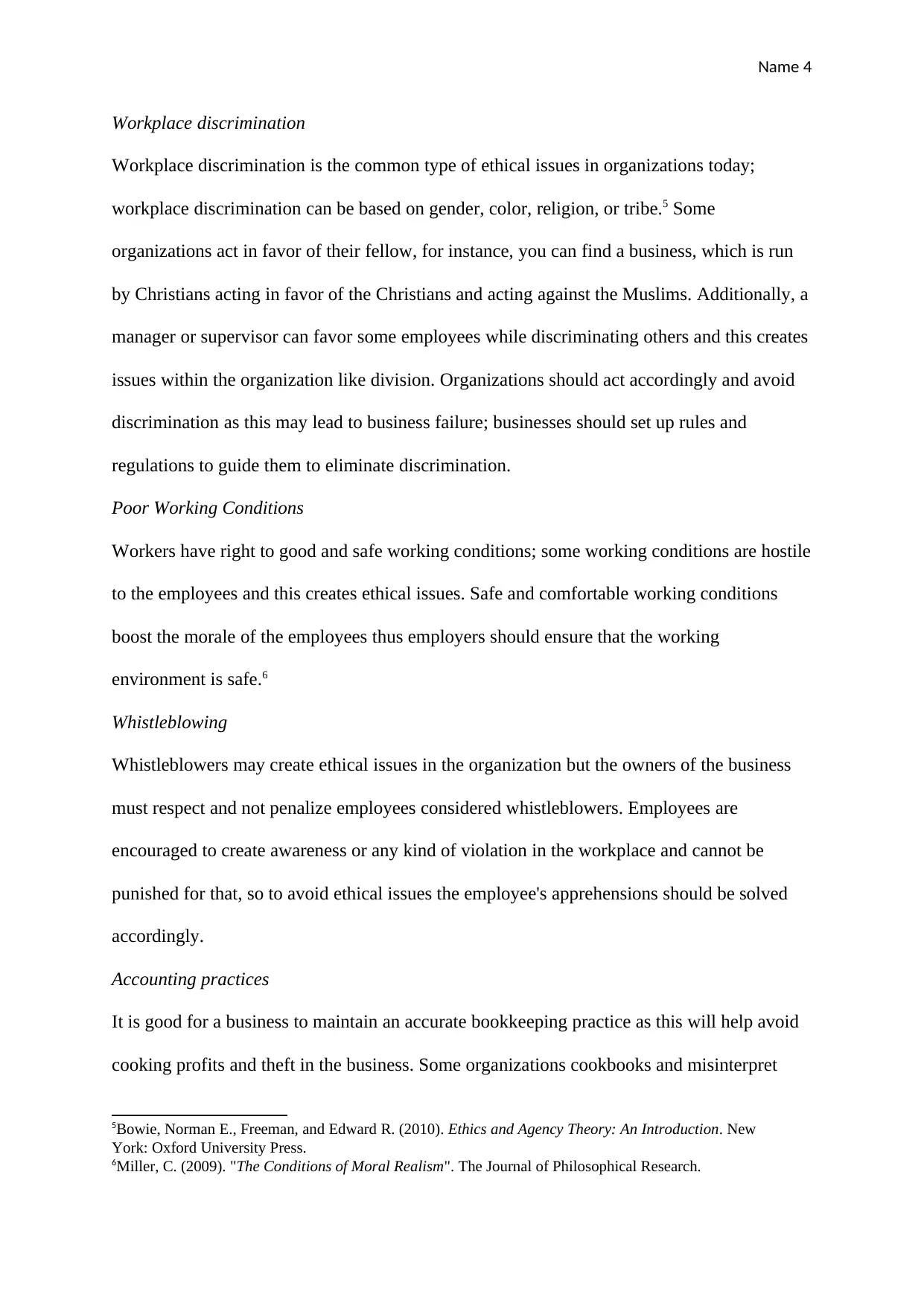
Workplace discrimination
Workplace discrimination is the common type of ethical issues in organizations today;
workplace discrimination can be based on gender, color, religion, or tribe.5 Some
organizations act in favor of their fellow, for instance, you can find a business, which is run
by Christians acting in favor of the Christians and acting against the Muslims. Additionally, a
manager or supervisor can favor some employees while discriminating others and this creates
issues within the organization like division. Organizations should act accordingly and avoid
discrimination as this may lead to business failure; businesses should set up rules and
regulations to guide them to eliminate discrimination.
Poor Working Conditions
Workers have right to good and safe working conditions; some working conditions are hostile
to the employees and this creates ethical issues. Safe and comfortable working conditions
boost the morale of the employees thus employers should ensure that the working
environment is safe.6
Whistleblowing
Whistleblowers may create ethical issues in the organization but the owners of the business
must respect and not penalize employees considered whistleblowers. Employees are
encouraged to create awareness or any kind of violation in the workplace and cannot be
punished for that, so to avoid ethical issues the employee's apprehensions should be solved
accordingly.
Accounting practices
It is good for a business to maintain an accurate bookkeeping practice as this will help avoid
cooking profits and theft in the business. Some organizations cookbooks and misinterpret
5Bowie, Norman E., Freeman, and Edward R. (2010). Ethics and Agency Theory: An Introduction. New
York: Oxford University Press.
6Miller, C. (2009). "The Conditions of Moral Realism". The Journal of Philosophical Research.
tabler-icon-diamond-filled.svg

Paraphrase This Document

Need a fresh take? Get an instant paraphrase of this document with our AI Paraphraser
Document Page
Name 5
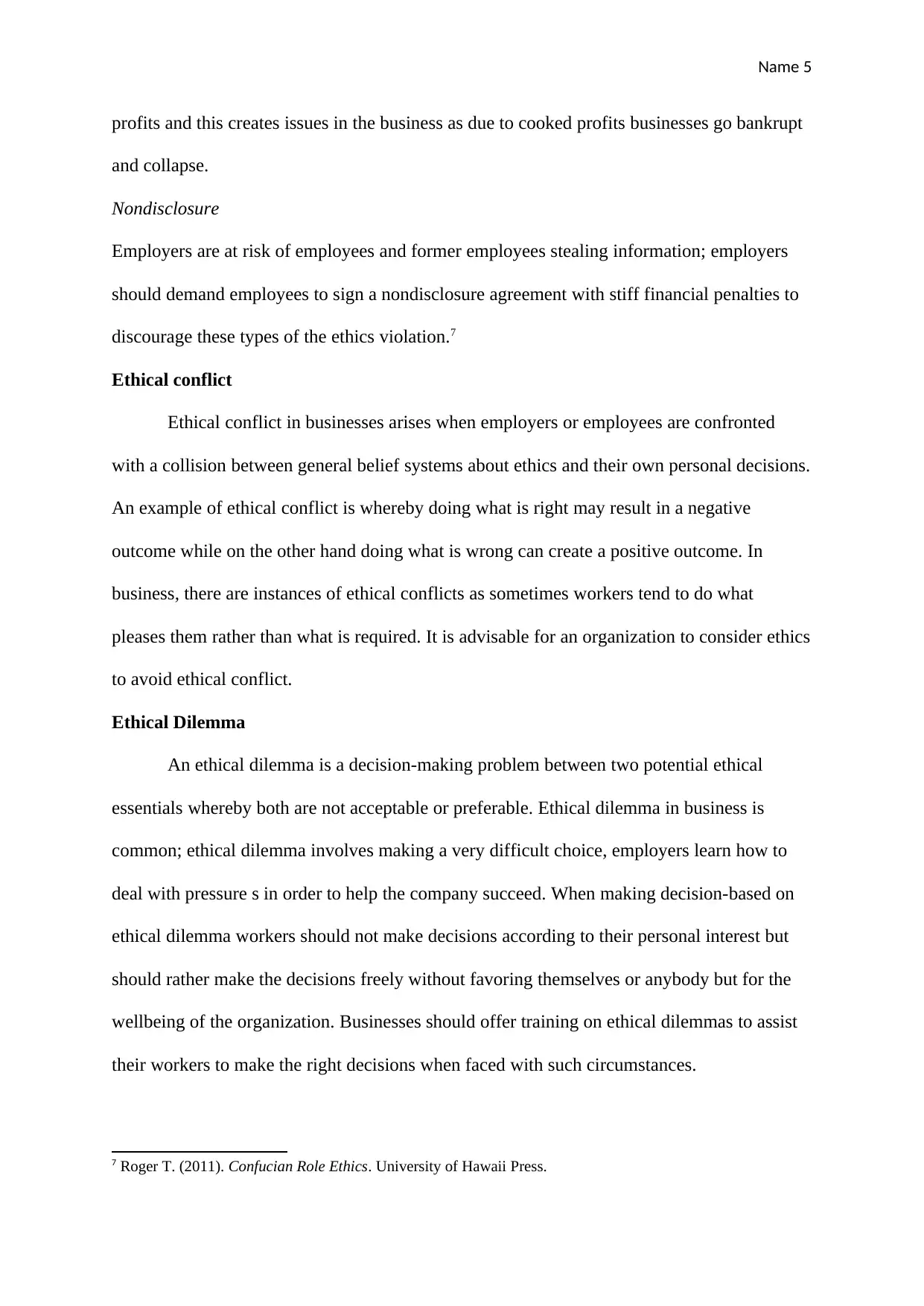
profits and this creates issues in the business as due to cooked profits businesses go bankrupt
and collapse.
Nondisclosure
Employers are at risk of employees and former employees stealing information; employers
should demand employees to sign a nondisclosure agreement with stiff financial penalties to
discourage these types of the ethics violation.7
Ethical conflict
Ethical conflict in businesses arises when employers or employees are confronted
with a collision between general belief systems about ethics and their own personal decisions.
An example of ethical conflict is whereby doing what is right may result in a negative
outcome while on the other hand doing what is wrong can create a positive outcome. In
business, there are instances of ethical conflicts as sometimes workers tend to do what
pleases them rather than what is required. It is advisable for an organization to consider ethics
to avoid ethical conflict.
Ethical Dilemma
An ethical dilemma is a decision-making problem between two potential ethical
essentials whereby both are not acceptable or preferable. Ethical dilemma in business is
common; ethical dilemma involves making a very difficult choice, employers learn how to
deal with pressure s in order to help the company succeed. When making decision-based on
ethical dilemma workers should not make decisions according to their personal interest but
should rather make the decisions freely without favoring themselves or anybody but for the
wellbeing of the organization. Businesses should offer training on ethical dilemmas to assist
their workers to make the right decisions when faced with such circumstances.
7 Roger T. (2011). Confucian Role Ethics. University of Hawaii Press.
Document Page
Name 6
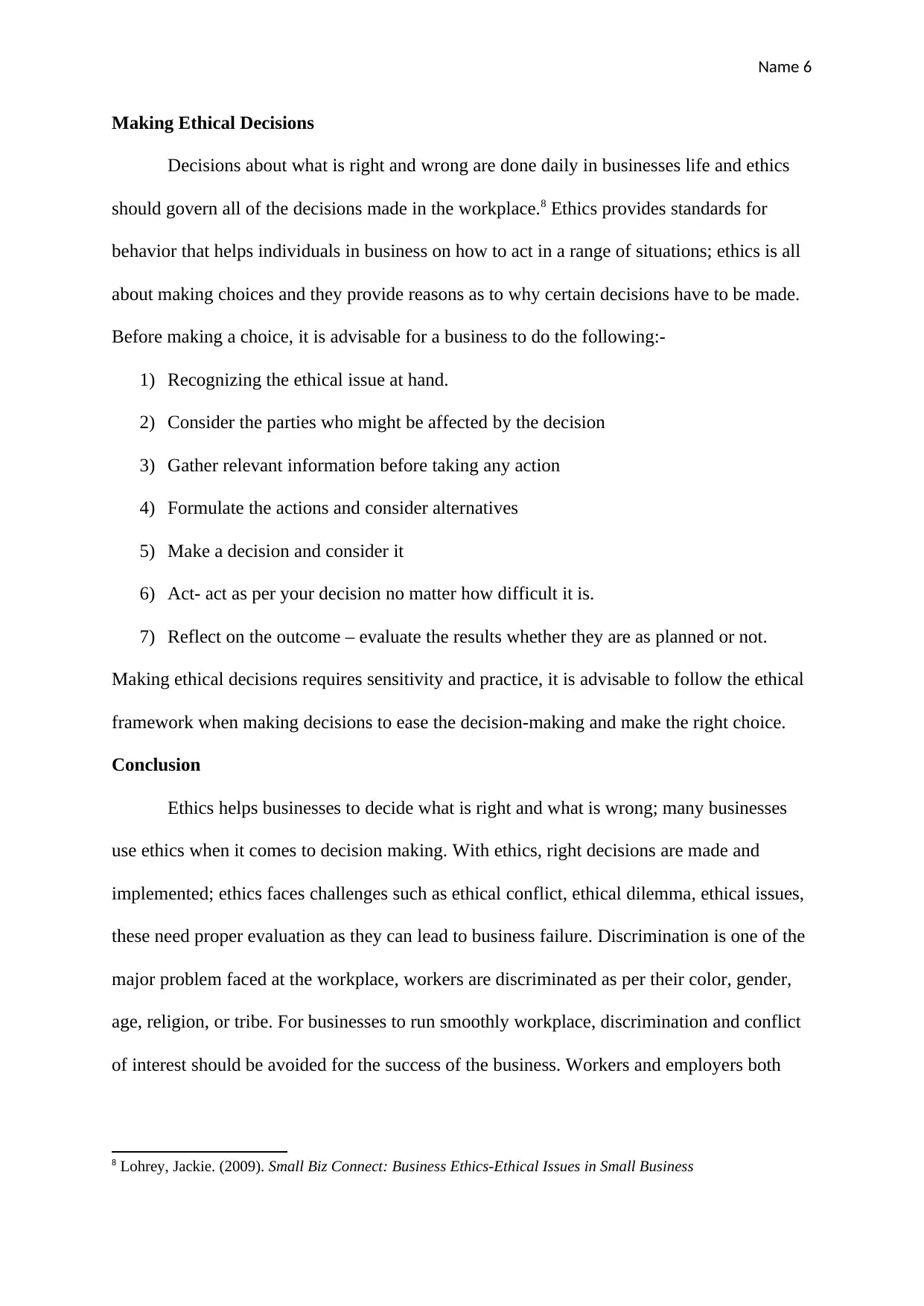
Making Ethical Decisions
Decisions about what is right and wrong are done daily in businesses life and ethics
should govern all of the decisions made in the workplace.8 Ethics provides standards for
behavior that helps individuals in business on how to act in a range of situations; ethics is all
about making choices and they provide reasons as to why certain decisions have to be made.
Before making a choice, it is advisable for a business to do the following:-
1) Recognizing the ethical issue at hand.
2) Consider the parties who might be affected by the decision
3) Gather relevant information before taking any action
4) Formulate the actions and consider alternatives
5) Make a decision and consider it
6) Act- act as per your decision no matter how difficult it is.
7) Reflect on the outcome – evaluate the results whether they are as planned or not.
Making ethical decisions requires sensitivity and practice, it is advisable to follow the ethical
framework when making decisions to ease the decision-making and make the right choice.
Conclusion
Ethics helps businesses to decide what is right and what is wrong; many businesses
use ethics when it comes to decision making. With ethics, right decisions are made and
implemented; ethics faces challenges such as ethical conflict, ethical dilemma, ethical issues,
these need proper evaluation as they can lead to business failure. Discrimination is one of the
major problem faced at the workplace, workers are discriminated as per their color, gender,
age, religion, or tribe. For businesses to run smoothly workplace, discrimination and conflict
of interest should be avoided for the success of the business. Workers and employers both
8 Lohrey, Jackie. (2009). Small Biz Connect: Business Ethics-Ethical Issues in Small Business
Document Page
Name 7
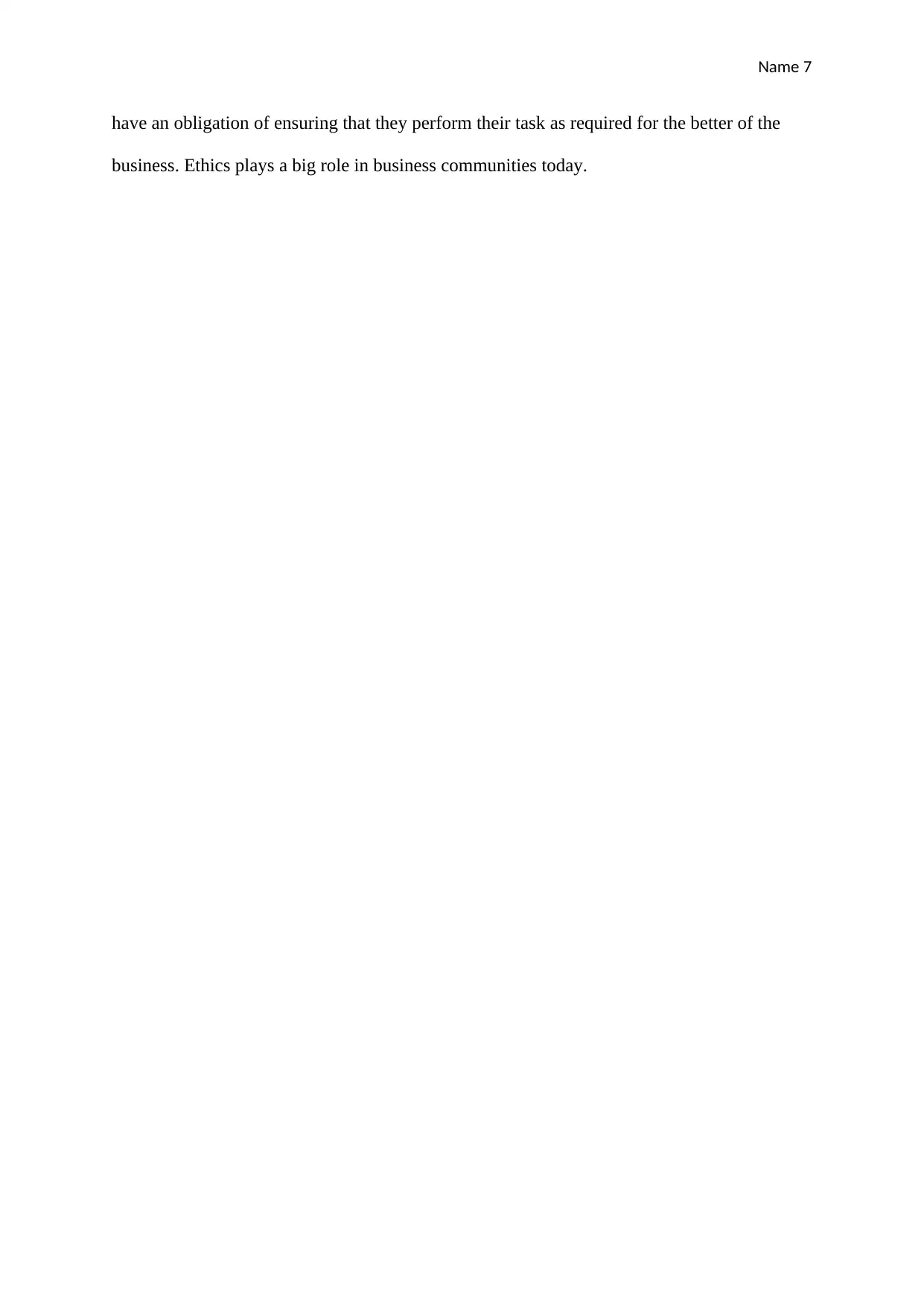
have an obligation of ensuring that they perform their task as required for the better of the
business. Ethics plays a big role in business communities today.
tabler-icon-diamond-filled.svg

Paraphrase This Document

Need a fresh take? Get an instant paraphrase of this document with our AI Paraphraser
Document Page
Name 8
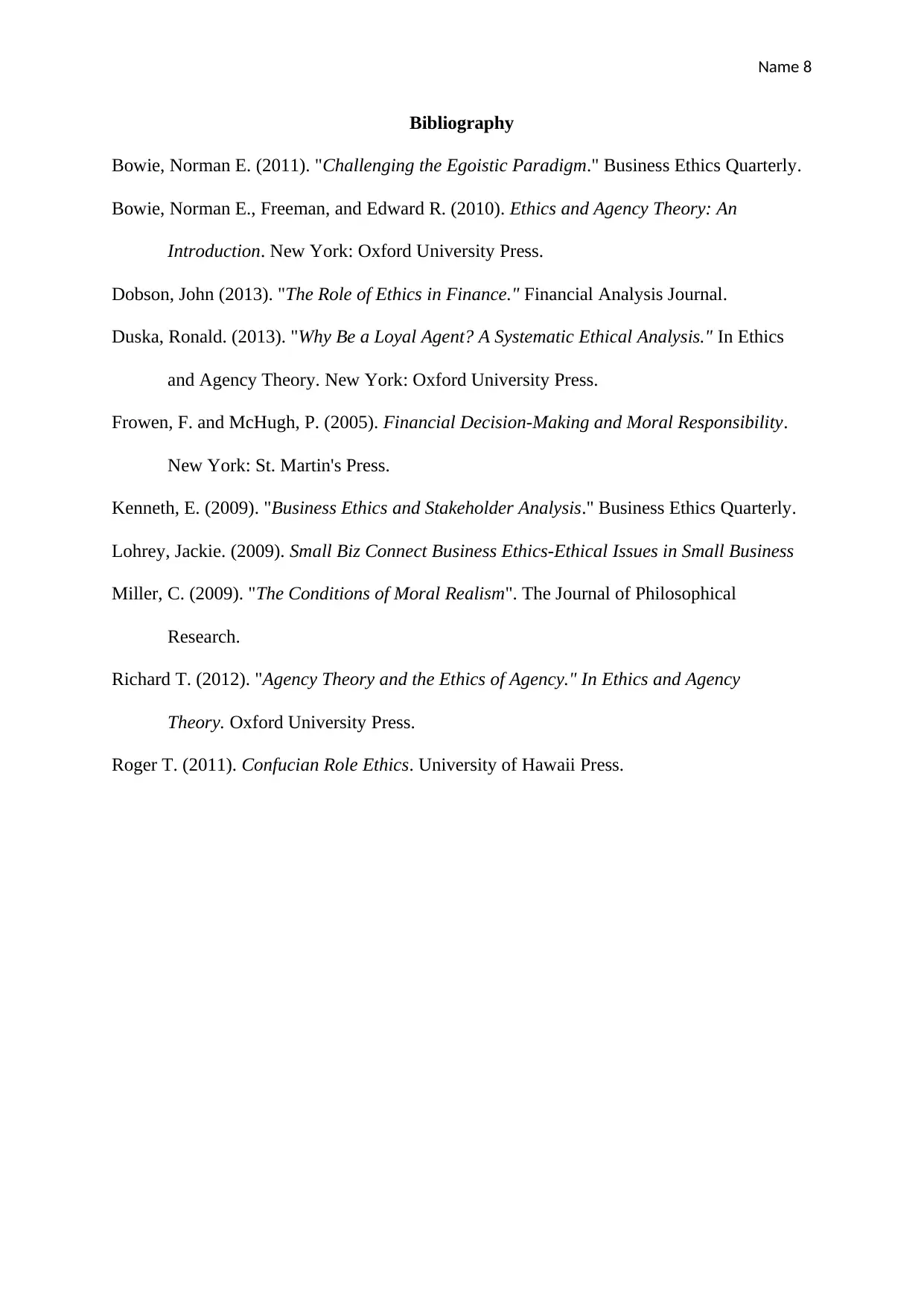
Bibliography
Bowie, Norman E. (2011). "Challenging the Egoistic Paradigm." Business Ethics Quarterly.
Bowie, Norman E., Freeman, and Edward R. (2010). Ethics and Agency Theory: An
Introduction. New York: Oxford University Press.
Dobson, John (2013). "The Role of Ethics in Finance." Financial Analysis Journal.
Duska, Ronald. (2013). "Why Be a Loyal Agent? A Systematic Ethical Analysis." In Ethics
and Agency Theory. New York: Oxford University Press.
Frowen, F. and McHugh, P. (2005). Financial Decision-Making and Moral Responsibility.
New York: St. Martin's Press.
Kenneth, E. (2009). "Business Ethics and Stakeholder Analysis." Business Ethics Quarterly.
Lohrey, Jackie. (2009). Small Biz Connect Business Ethics-Ethical Issues in Small Business
Miller, C. (2009). "The Conditions of Moral Realism". The Journal of Philosophical
Research.
Richard T. (2012). "Agency Theory and the Ethics of Agency." In Ethics and Agency
Theory. Oxford University Press.
Roger T. (2011). Confucian Role Ethics. University of Hawaii Press.
chevron_up_icon
1 out of 8
circle_padding
hide_on_mobile
zoom_out_icon
[object Object]