A Scholarly Analysis of Ethical Issues in Cancer Care Continuum
VerifiedAdded on 2023/06/05
|9
|2190
|291
Essay
AI Summary
This essay provides a detailed analysis of the ethical issues encountered in cancer care, focusing on the challenges during treatment, maintenance therapy, and disease recurrence. It highlights the ethical dilemmas arising from communication gaps, end-of-life decisions like euthanasia, and the complexities of clinical trials. The discussion covers the importance of truth-telling, respecting patient preferences, and the difficulties in making decisions when treatment outcomes are uncertain. The essay also addresses the ethical considerations surrounding cancer recurrence and the implications for prior treatment strategies. It concludes by emphasizing the need for healthcare providers to navigate these ethical challenges with a focus on patient well-being and informed decision-making. Desklib offers similar solved assignments for students.

Running head: SCHOLARLY PAPER
Scholarly Paper
Name of the Student:
Name of the University:
Author Note:
Scholarly Paper
Name of the Student:
Name of the University:
Author Note:

Paraphrase This Document
Need a fresh take? Get an instant paraphrase of this document with our AI Paraphraser
1SCHOLARLY PAPER
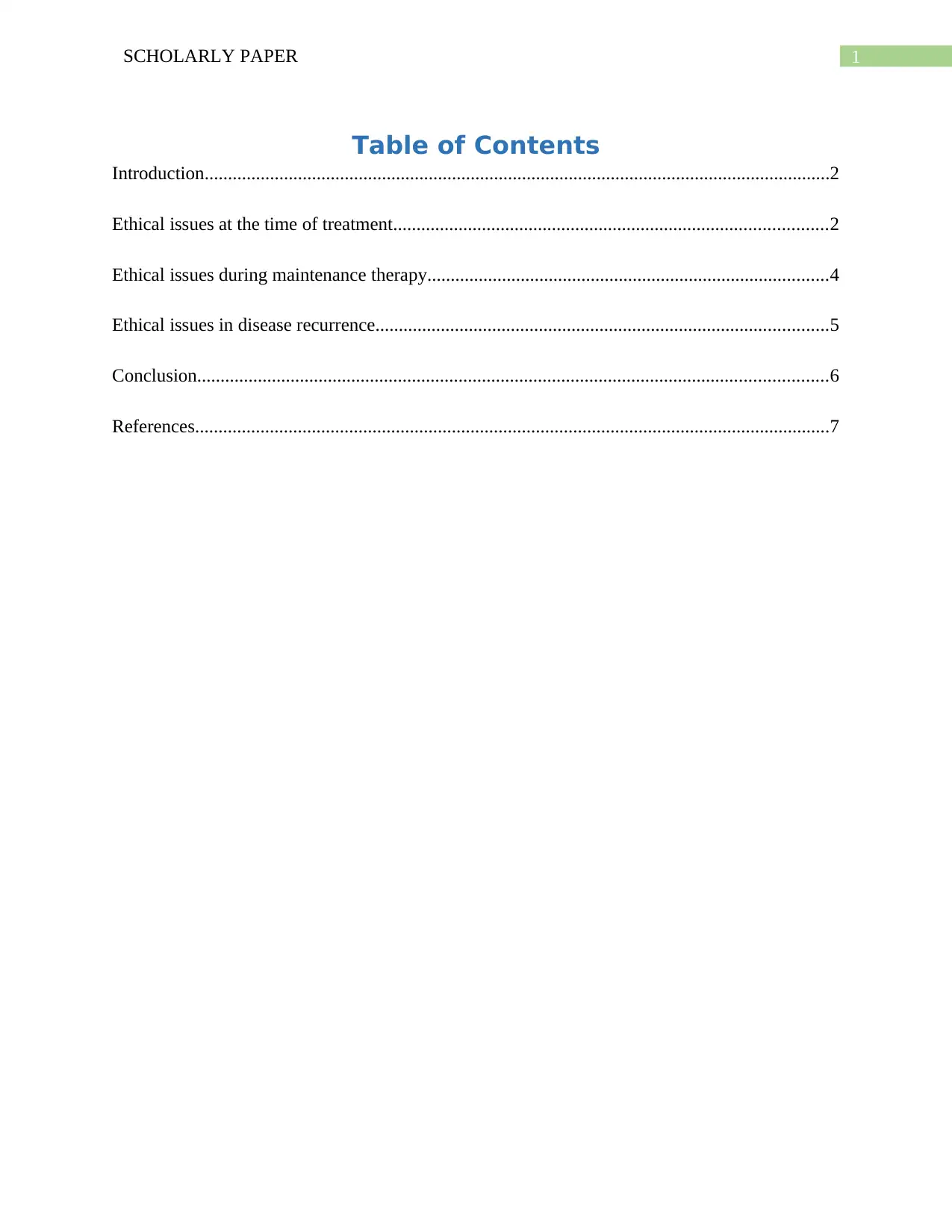
Table of Contents
Introduction......................................................................................................................................2
Ethical issues at the time of treatment.............................................................................................2
Ethical issues during maintenance therapy......................................................................................4
Ethical issues in disease recurrence.................................................................................................5
Conclusion.......................................................................................................................................6
References........................................................................................................................................7
Table of Contents
Introduction......................................................................................................................................2
Ethical issues at the time of treatment.............................................................................................2
Ethical issues during maintenance therapy......................................................................................4
Ethical issues in disease recurrence.................................................................................................5
Conclusion.......................................................................................................................................6
References........................................................................................................................................7
2SCHOLARLY PAPER
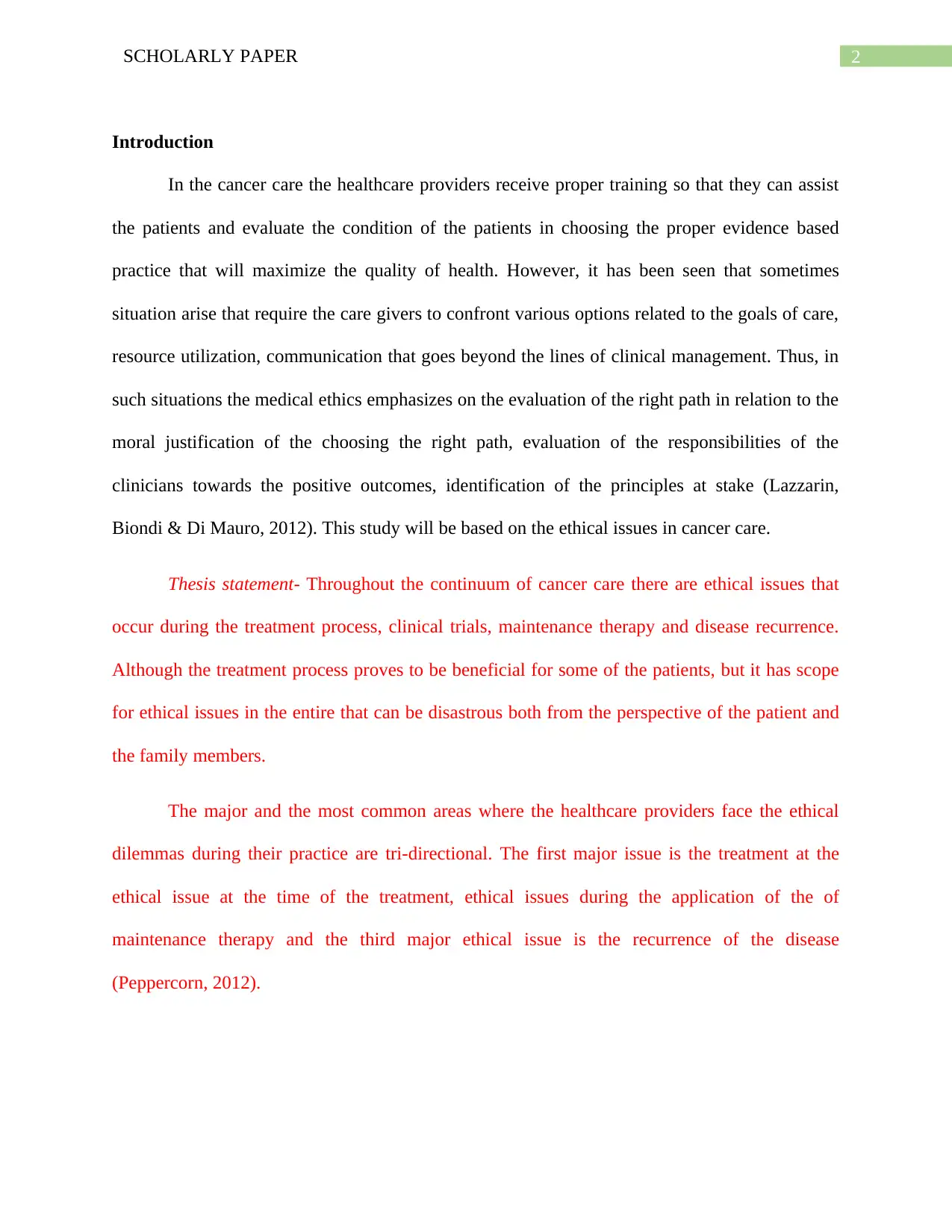
Introduction
In the cancer care the healthcare providers receive proper training so that they can assist
the patients and evaluate the condition of the patients in choosing the proper evidence based
practice that will maximize the quality of health. However, it has been seen that sometimes
situation arise that require the care givers to confront various options related to the goals of care,
resource utilization, communication that goes beyond the lines of clinical management. Thus, in
such situations the medical ethics emphasizes on the evaluation of the right path in relation to the
moral justification of the choosing the right path, evaluation of the responsibilities of the
clinicians towards the positive outcomes, identification of the principles at stake (Lazzarin,
Biondi & Di Mauro, 2012). This study will be based on the ethical issues in cancer care.
Thesis statement- Throughout the continuum of cancer care there are ethical issues that
occur during the treatment process, clinical trials, maintenance therapy and disease recurrence.
Although the treatment process proves to be beneficial for some of the patients, but it has scope
for ethical issues in the entire that can be disastrous both from the perspective of the patient and
the family members.
The major and the most common areas where the healthcare providers face the ethical
dilemmas during their practice are tri-directional. The first major issue is the treatment at the
ethical issue at the time of the treatment, ethical issues during the application of the of
maintenance therapy and the third major ethical issue is the recurrence of the disease
(Peppercorn, 2012).
Introduction
In the cancer care the healthcare providers receive proper training so that they can assist
the patients and evaluate the condition of the patients in choosing the proper evidence based
practice that will maximize the quality of health. However, it has been seen that sometimes
situation arise that require the care givers to confront various options related to the goals of care,
resource utilization, communication that goes beyond the lines of clinical management. Thus, in
such situations the medical ethics emphasizes on the evaluation of the right path in relation to the
moral justification of the choosing the right path, evaluation of the responsibilities of the
clinicians towards the positive outcomes, identification of the principles at stake (Lazzarin,
Biondi & Di Mauro, 2012). This study will be based on the ethical issues in cancer care.
Thesis statement- Throughout the continuum of cancer care there are ethical issues that
occur during the treatment process, clinical trials, maintenance therapy and disease recurrence.
Although the treatment process proves to be beneficial for some of the patients, but it has scope
for ethical issues in the entire that can be disastrous both from the perspective of the patient and
the family members.
The major and the most common areas where the healthcare providers face the ethical
dilemmas during their practice are tri-directional. The first major issue is the treatment at the
ethical issue at the time of the treatment, ethical issues during the application of the of
maintenance therapy and the third major ethical issue is the recurrence of the disease
(Peppercorn, 2012).
⊘ This is a preview!⊘
Do you want full access?
Subscribe today to unlock all pages.

Trusted by 1+ million students worldwide
3SCHOLARLY PAPER
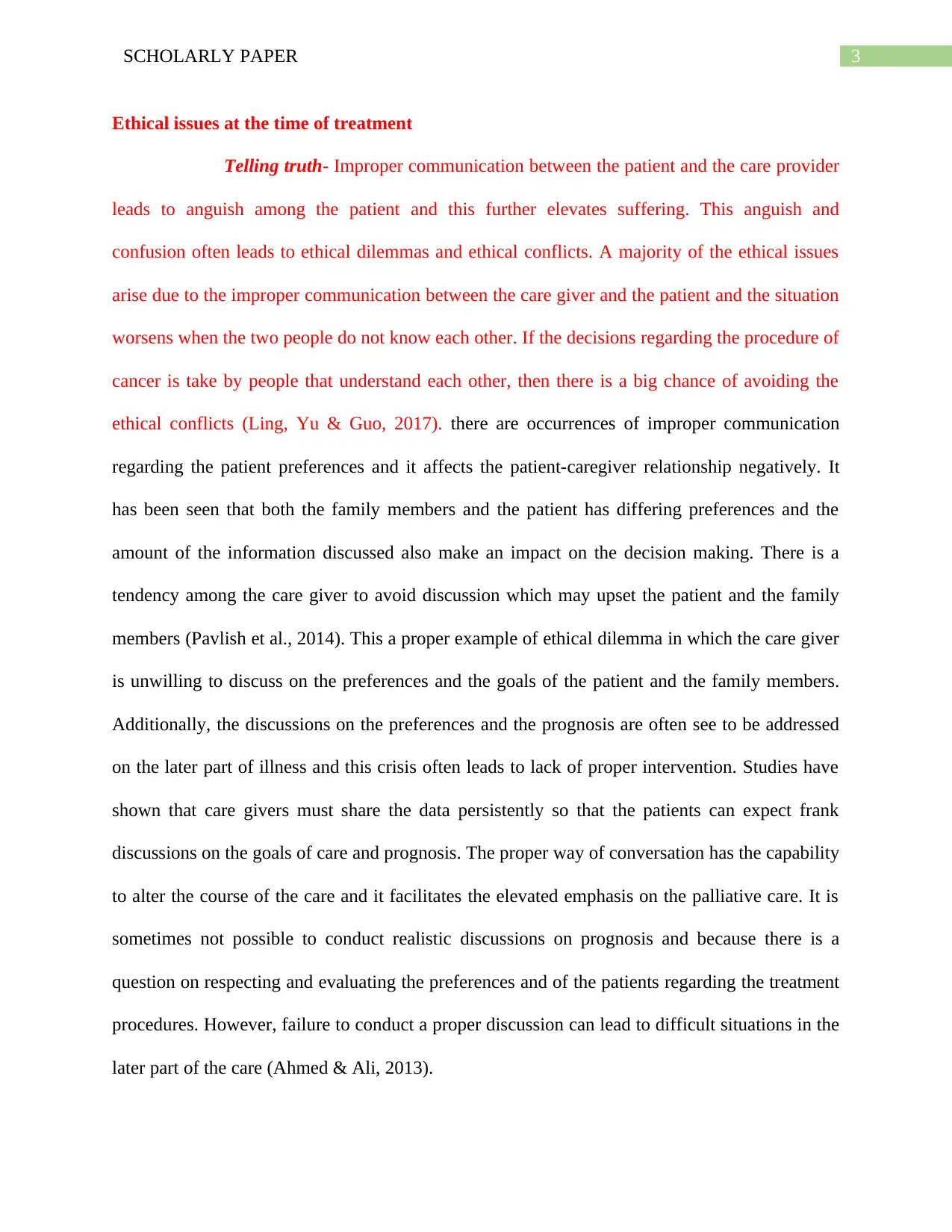
Ethical issues at the time of treatment
Telling truth- Improper communication between the patient and the care provider
leads to anguish among the patient and this further elevates suffering. This anguish and
confusion often leads to ethical dilemmas and ethical conflicts. A majority of the ethical issues
arise due to the improper communication between the care giver and the patient and the situation
worsens when the two people do not know each other. If the decisions regarding the procedure of
cancer is take by people that understand each other, then there is a big chance of avoiding the
ethical conflicts (Ling, Yu & Guo, 2017). there are occurrences of improper communication
regarding the patient preferences and it affects the patient-caregiver relationship negatively. It
has been seen that both the family members and the patient has differing preferences and the
amount of the information discussed also make an impact on the decision making. There is a
tendency among the care giver to avoid discussion which may upset the patient and the family
members (Pavlish et al., 2014). This a proper example of ethical dilemma in which the care giver
is unwilling to discuss on the preferences and the goals of the patient and the family members.
Additionally, the discussions on the preferences and the prognosis are often see to be addressed
on the later part of illness and this crisis often leads to lack of proper intervention. Studies have
shown that care givers must share the data persistently so that the patients can expect frank
discussions on the goals of care and prognosis. The proper way of conversation has the capability
to alter the course of the care and it facilitates the elevated emphasis on the palliative care. It is
sometimes not possible to conduct realistic discussions on prognosis and because there is a
question on respecting and evaluating the preferences and of the patients regarding the treatment
procedures. However, failure to conduct a proper discussion can lead to difficult situations in the
later part of the care (Ahmed & Ali, 2013).
Ethical issues at the time of treatment
Telling truth- Improper communication between the patient and the care provider
leads to anguish among the patient and this further elevates suffering. This anguish and
confusion often leads to ethical dilemmas and ethical conflicts. A majority of the ethical issues
arise due to the improper communication between the care giver and the patient and the situation
worsens when the two people do not know each other. If the decisions regarding the procedure of
cancer is take by people that understand each other, then there is a big chance of avoiding the
ethical conflicts (Ling, Yu & Guo, 2017). there are occurrences of improper communication
regarding the patient preferences and it affects the patient-caregiver relationship negatively. It
has been seen that both the family members and the patient has differing preferences and the
amount of the information discussed also make an impact on the decision making. There is a
tendency among the care giver to avoid discussion which may upset the patient and the family
members (Pavlish et al., 2014). This a proper example of ethical dilemma in which the care giver
is unwilling to discuss on the preferences and the goals of the patient and the family members.
Additionally, the discussions on the preferences and the prognosis are often see to be addressed
on the later part of illness and this crisis often leads to lack of proper intervention. Studies have
shown that care givers must share the data persistently so that the patients can expect frank
discussions on the goals of care and prognosis. The proper way of conversation has the capability
to alter the course of the care and it facilitates the elevated emphasis on the palliative care. It is
sometimes not possible to conduct realistic discussions on prognosis and because there is a
question on respecting and evaluating the preferences and of the patients regarding the treatment
procedures. However, failure to conduct a proper discussion can lead to difficult situations in the
later part of the care (Ahmed & Ali, 2013).
Paraphrase This Document
Need a fresh take? Get an instant paraphrase of this document with our AI Paraphraser
4SCHOLARLY PAPER
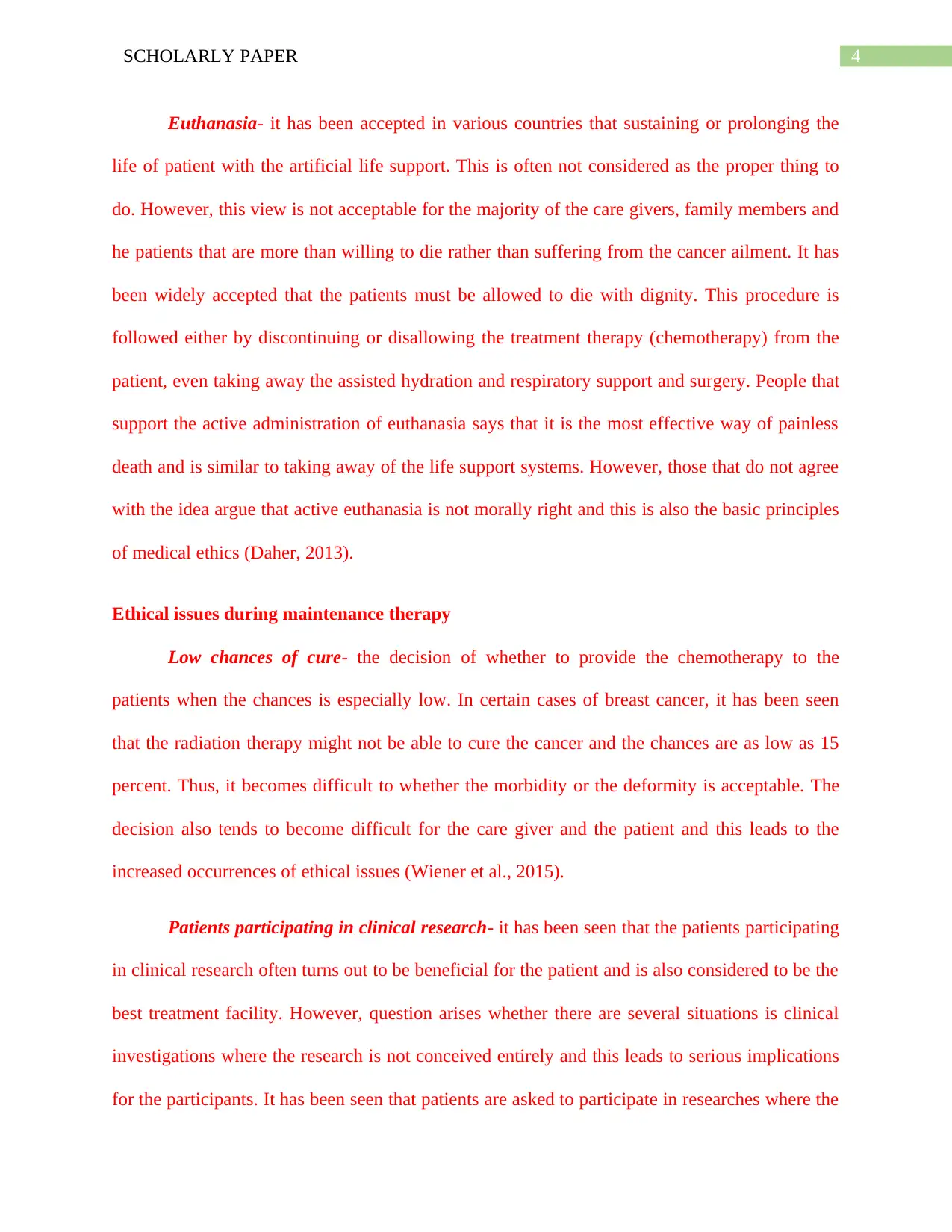
Euthanasia- it has been accepted in various countries that sustaining or prolonging the
life of patient with the artificial life support. This is often not considered as the proper thing to
do. However, this view is not acceptable for the majority of the care givers, family members and
he patients that are more than willing to die rather than suffering from the cancer ailment. It has
been widely accepted that the patients must be allowed to die with dignity. This procedure is
followed either by discontinuing or disallowing the treatment therapy (chemotherapy) from the
patient, even taking away the assisted hydration and respiratory support and surgery. People that
support the active administration of euthanasia says that it is the most effective way of painless
death and is similar to taking away of the life support systems. However, those that do not agree
with the idea argue that active euthanasia is not morally right and this is also the basic principles
of medical ethics (Daher, 2013).
Ethical issues during maintenance therapy
Low chances of cure- the decision of whether to provide the chemotherapy to the
patients when the chances is especially low. In certain cases of breast cancer, it has been seen
that the radiation therapy might not be able to cure the cancer and the chances are as low as 15
percent. Thus, it becomes difficult to whether the morbidity or the deformity is acceptable. The
decision also tends to become difficult for the care giver and the patient and this leads to the
increased occurrences of ethical issues (Wiener et al., 2015).
Patients participating in clinical research- it has been seen that the patients participating
in clinical research often turns out to be beneficial for the patient and is also considered to be the
best treatment facility. However, question arises whether there are several situations is clinical
investigations where the research is not conceived entirely and this leads to serious implications
for the participants. It has been seen that patients are asked to participate in researches where the
Euthanasia- it has been accepted in various countries that sustaining or prolonging the
life of patient with the artificial life support. This is often not considered as the proper thing to
do. However, this view is not acceptable for the majority of the care givers, family members and
he patients that are more than willing to die rather than suffering from the cancer ailment. It has
been widely accepted that the patients must be allowed to die with dignity. This procedure is
followed either by discontinuing or disallowing the treatment therapy (chemotherapy) from the
patient, even taking away the assisted hydration and respiratory support and surgery. People that
support the active administration of euthanasia says that it is the most effective way of painless
death and is similar to taking away of the life support systems. However, those that do not agree
with the idea argue that active euthanasia is not morally right and this is also the basic principles
of medical ethics (Daher, 2013).
Ethical issues during maintenance therapy
Low chances of cure- the decision of whether to provide the chemotherapy to the
patients when the chances is especially low. In certain cases of breast cancer, it has been seen
that the radiation therapy might not be able to cure the cancer and the chances are as low as 15
percent. Thus, it becomes difficult to whether the morbidity or the deformity is acceptable. The
decision also tends to become difficult for the care giver and the patient and this leads to the
increased occurrences of ethical issues (Wiener et al., 2015).
Patients participating in clinical research- it has been seen that the patients participating
in clinical research often turns out to be beneficial for the patient and is also considered to be the
best treatment facility. However, question arises whether there are several situations is clinical
investigations where the research is not conceived entirely and this leads to serious implications
for the participants. It has been seen that patients are asked to participate in researches where the
5SCHOLARLY PAPER
scenarios are very trivial and the patients did not much from the experiments. There are studies
that confirmed that the patients that participated in such studies have received any benefits and
the conditions of the control patients even turned out to be disastrous (Weeks et al., 2012).
Search for the new and effective treatments- There are certain cancer cases where there
is no known care and it has led to the increase in clinical researches that include the such cancer
patients. In majority of the cases it has been noticed that an effective treatment strategy is not
known and the patients readily agree to participate in the curative therapy. This type of treatment
is carried in patient for whom the prognosis is properly known. The knowledge of the prognosis
often leads to knowing the end result and probably the outcome of the treatment procedure. In
such cases ethical issues arise and it becomes extremely difficult to involve the patients into the
treatment procedures (Bertier et al., 2016).
Search for the new treatment procedures- the drugs that are new and the effects are
poorly known, in such conditions the effect and the end result of the treatment procedure is not
known. In such cases involving a patient that do not have the hopes of recovery or improvement.
In such cases involving the patients into the study will be entirely a voluntary act. Thus, the side
effects of the drug must be communicated to the patients. However, such processes are not seen
during the process of treatment and this leads to ethical issues and dilemmas (Kim & Prasad,
2015).
Ethical issues in disease recurrence
Cancer recurrence can be described as the recurrence of cancer even after the treatment is
done. The recurrence of cancer is evident by the fact that it shows on the place where it has
previously occurred. The recurrence of cancer can be described as a logical expression due to the
scenarios are very trivial and the patients did not much from the experiments. There are studies
that confirmed that the patients that participated in such studies have received any benefits and
the conditions of the control patients even turned out to be disastrous (Weeks et al., 2012).
Search for the new and effective treatments- There are certain cancer cases where there
is no known care and it has led to the increase in clinical researches that include the such cancer
patients. In majority of the cases it has been noticed that an effective treatment strategy is not
known and the patients readily agree to participate in the curative therapy. This type of treatment
is carried in patient for whom the prognosis is properly known. The knowledge of the prognosis
often leads to knowing the end result and probably the outcome of the treatment procedure. In
such cases ethical issues arise and it becomes extremely difficult to involve the patients into the
treatment procedures (Bertier et al., 2016).
Search for the new treatment procedures- the drugs that are new and the effects are
poorly known, in such conditions the effect and the end result of the treatment procedure is not
known. In such cases involving a patient that do not have the hopes of recovery or improvement.
In such cases involving the patients into the study will be entirely a voluntary act. Thus, the side
effects of the drug must be communicated to the patients. However, such processes are not seen
during the process of treatment and this leads to ethical issues and dilemmas (Kim & Prasad,
2015).
Ethical issues in disease recurrence
Cancer recurrence can be described as the recurrence of cancer even after the treatment is
done. The recurrence of cancer is evident by the fact that it shows on the place where it has
previously occurred. The recurrence of cancer can be described as a logical expression due to the
⊘ This is a preview!⊘
Do you want full access?
Subscribe today to unlock all pages.
Trusted by 1+ million students worldwide
6SCHOLARLY PAPER
tendency of the cancer cells and the certain type of the cancer like breast cancer that can recur
depending on the type of the treatment. The recurrence of the cancer in the same place can lead
to an ethical issue due to the fact that proper follow up plan is not maintained or the cancer
therapy was not performed properly. The recurrence of cancer questions that very base of the
treatment procedure and the way it was proceeded in the past. This even questions the
diagnostics and the way it was carried out (Simard et al., 2013).
Conclusion
From the above discussion it can be concluded that the major and the most
common areas where the healthcare providers face the ethical dilemmas during their practice are
tri-directional. The first major issue is the treatment at the ethical issue at the time of the
treatment, ethical issues during the application of the of maintenance therapy and the third major
ethical issue is the recurrence of the disease. The report emphasized on the continuum of cancer
care and the ethical issues that occur during the treatment process, clinical trials, maintenance
therapy and disease recurrence. Although the treatment process proves to be beneficial for some
of the patients, but it has scope for ethical issues in the entire that can be disastrous both from the
perspective of the patient and the family members.
tendency of the cancer cells and the certain type of the cancer like breast cancer that can recur
depending on the type of the treatment. The recurrence of the cancer in the same place can lead
to an ethical issue due to the fact that proper follow up plan is not maintained or the cancer
therapy was not performed properly. The recurrence of cancer questions that very base of the
treatment procedure and the way it was proceeded in the past. This even questions the
diagnostics and the way it was carried out (Simard et al., 2013).
Conclusion
From the above discussion it can be concluded that the major and the most
common areas where the healthcare providers face the ethical dilemmas during their practice are
tri-directional. The first major issue is the treatment at the ethical issue at the time of the
treatment, ethical issues during the application of the of maintenance therapy and the third major
ethical issue is the recurrence of the disease. The report emphasized on the continuum of cancer
care and the ethical issues that occur during the treatment process, clinical trials, maintenance
therapy and disease recurrence. Although the treatment process proves to be beneficial for some
of the patients, but it has scope for ethical issues in the entire that can be disastrous both from the
perspective of the patient and the family members.
Paraphrase This Document
Need a fresh take? Get an instant paraphrase of this document with our AI Paraphraser
7SCHOLARLY PAPER
References
Ahmed, Y., & Ali, T. (2013). End of life ethics in cancer patients: Conflicts and dilemmas.
International Journal of Medical Research, 1(2), 7-12.
Bertier, G., Carrot-Zhang, J., Ragoussis, V., & Joly, Y. (2016). Integrating precision cancer
medicine into healthcare—policy, practice, and research challenges. Genome medicine,
8(1), 108.
Daher, M. (2013). Ethical issues in the geriatric patient with advanced cancer ‘living to the end’.
Annals of oncology, 24(suppl_7), vii55-vii58.
Kim, C., & Prasad, V. (2015). Cancer drugs approved on the basis of a surrogate end point and
subsequent overall survival: an analysis of 5 years of US Food and Drug Administration
approvals. JAMA internal medicine, 175(12), 1992-1994.
Lazzarin, M., Biondi, A., & Di Mauro, S. (2012). Moral distress in nurses in oncology and
haematology units. Nursing Ethics, 19(2), 183-195.
Ling, D. L., Yu, H. J., & Guo, H. L. (2017). Truth-telling, decision-making, and ethics among
cancer patients in nursing practice in China. Nursing ethics, 0969733017739783.
Pavlish, C., Brown-Saltzman, K., Jakel, P., & Fine, A. (2014). The nature of ethical conflicts and
the meaning of moral community in oncology practice. In Oncology Nursing Forum
(Vol. 41, No. 2).
Peppercorn, J. (2012). Ethics of ongoing cancer care for patients making risky decisions. Journal
of oncology practice, 8(5), e111-e113.
References
Ahmed, Y., & Ali, T. (2013). End of life ethics in cancer patients: Conflicts and dilemmas.
International Journal of Medical Research, 1(2), 7-12.
Bertier, G., Carrot-Zhang, J., Ragoussis, V., & Joly, Y. (2016). Integrating precision cancer
medicine into healthcare—policy, practice, and research challenges. Genome medicine,
8(1), 108.
Daher, M. (2013). Ethical issues in the geriatric patient with advanced cancer ‘living to the end’.
Annals of oncology, 24(suppl_7), vii55-vii58.
Kim, C., & Prasad, V. (2015). Cancer drugs approved on the basis of a surrogate end point and
subsequent overall survival: an analysis of 5 years of US Food and Drug Administration
approvals. JAMA internal medicine, 175(12), 1992-1994.
Lazzarin, M., Biondi, A., & Di Mauro, S. (2012). Moral distress in nurses in oncology and
haematology units. Nursing Ethics, 19(2), 183-195.
Ling, D. L., Yu, H. J., & Guo, H. L. (2017). Truth-telling, decision-making, and ethics among
cancer patients in nursing practice in China. Nursing ethics, 0969733017739783.
Pavlish, C., Brown-Saltzman, K., Jakel, P., & Fine, A. (2014). The nature of ethical conflicts and
the meaning of moral community in oncology practice. In Oncology Nursing Forum
(Vol. 41, No. 2).
Peppercorn, J. (2012). Ethics of ongoing cancer care for patients making risky decisions. Journal
of oncology practice, 8(5), e111-e113.
8SCHOLARLY PAPER
Simard, S., Thewes, B., Humphris, G., Dixon, M., Hayden, C., Mireskandari, S., & Ozakinci, G.
(2013). Fear of cancer recurrence in adult cancer survivors: a systematic review of
quantitative studies. Journal of Cancer Survivorship, 7(3), 300-322.
Weeks, J. C., Catalano, P. J., Cronin, A., Finkelman, M. D., Mack, J. W., Keating, N. L., &
Schrag, D. (2012). Patients' expectations about effects of chemotherapy for advanced
cancer. New England Journal of Medicine, 367(17), 1616-1625.
Wiener, L., Weaver, M. S., Bell, C. J., & Sansom-Daly, U. M. (2015). Threading the cloak:
palliative care education for care providers of adolescents and young adults with cancer.
Clinical oncology in adolescents and young adults, 5, 1.
Simard, S., Thewes, B., Humphris, G., Dixon, M., Hayden, C., Mireskandari, S., & Ozakinci, G.
(2013). Fear of cancer recurrence in adult cancer survivors: a systematic review of
quantitative studies. Journal of Cancer Survivorship, 7(3), 300-322.
Weeks, J. C., Catalano, P. J., Cronin, A., Finkelman, M. D., Mack, J. W., Keating, N. L., &
Schrag, D. (2012). Patients' expectations about effects of chemotherapy for advanced
cancer. New England Journal of Medicine, 367(17), 1616-1625.
Wiener, L., Weaver, M. S., Bell, C. J., & Sansom-Daly, U. M. (2015). Threading the cloak:
palliative care education for care providers of adolescents and young adults with cancer.
Clinical oncology in adolescents and young adults, 5, 1.
⊘ This is a preview!⊘
Do you want full access?
Subscribe today to unlock all pages.
Trusted by 1+ million students worldwide

1 out of 9


Related Documents


Your All-in-One AI-Powered Toolkit for Academic Success.
+13062052269
info@desklib.com
Available 24*7 on WhatsApp / Email
![[object Object]](/_next/static/media/star-bottom.7253800d.svg)
Unlock your academic potential
Copyright © 2020–2026 A2Z Services. All Rights Reserved. Developed and managed by ZUCOL.