An Analysis of Ethical Issues in Criminology Research: A Report

Verified

Added on  2020/02/05

|1
|1522
|119
Report
AI Summary
This report delves into the ethical considerations inherent in criminology research. It highlights various ethical dilemmas faced by researchers, including issues related to eliciting sensitive information, coercive potentials, and the consequences of knowing participant behaviors. The report discusses conflicts of interest, confidentiality concerns, and the possibility of subpoenas, emphasizing the importance of ethical guidelines in data collection and analysis. It references key academic sources and examines how researchers navigate challenges such as data fabrication, plagiarism, and the qualifications of experts. The report underscores the need for researchers to assess ethical aspects before conducting research to ensure the integrity of their findings and protect the rights of participants. The report also touches on the historical context of travel and tourism, as well as the evolution of ethical considerations in various fields, emphasizing the importance of ethical research practices.
Document Page
In the early age, cultural aspects, learning languages and travelling challenges restricted (Capacci, Scorcu and Vici, 2015). In 14 century
Christopher Columbus sailed westward and vasco da gama cruised to country for earn money then business travel has been integral part of
tourism industry(Cave and Brown 2012).
Early tourism started with Nomads who travelled around the world in search of
food and shelter. Main intension of this traveller is to gathered food and traded around the world and gave rise to the barter system (Capacci,
Scorcu and Vici, 2015). 1500 BC is marked as the era when the Europeans visited pyramids and thus developed the tourism for pilgrimage. Early
tourism started with Nomads who travelled around the world in search of food and shelter. Main intension of this traveller is to gathered food
and traded around the world and gave rise to the barter system (Capacci, Scorcu and Vici, 2015). 1500 BC is marked as the era when the
Europeans visited pyramids and thus developed the tourism for pilgrimage.
Ethical issues in Criminology Research
Research ethics in criminology is accessible and therefore researchers while carrying out such research faces varied types of ethical issues
that impacts upon them seriously. However, there are different ethical issues while carrying out criminology research. Thus, it harms
researcher in different forms as they need to research specific to the nature of research.
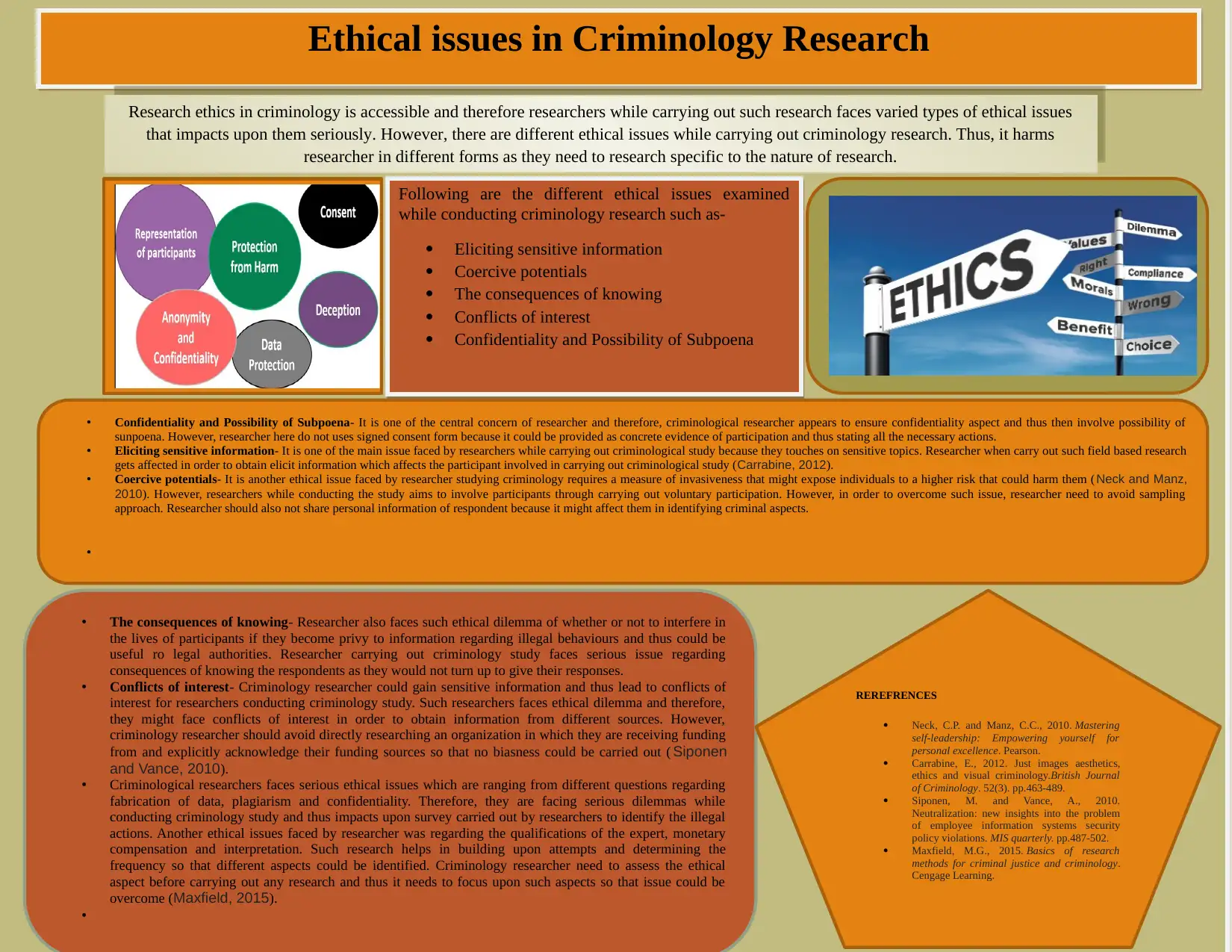
Following are the different ethical issues examined
while conducting criminology research such as-
Eliciting sensitive information
Coercive potentials
The consequences of knowing
Conflicts of interest
Confidentiality and Possibility of Subpoena
Confidentiality and Possibility of Subpoena- It is one of the central concern of researcher and therefore, criminological researcher appears to ensure confidentiality aspect and thus then involve possibility of
sunpoena. However, researcher here do not uses signed consent form because it could be provided as concrete evidence of participation and thus stating all the necessary actions.
Eliciting sensitive information- It is one of the main issue faced by researchers while carrying out criminological study because they touches on sensitive topics. Researcher when carry out such field based research
gets affected in order to obtain elicit information which affects the participant involved in carrying out criminological study (Carrabine, 2012).
Coercive potentials- It is another ethical issue faced by researcher studying criminology requires a measure of invasiveness that might expose individuals to a higher risk that could harm them ( Neck and Manz,
2010). However, researchers while conducting the study aims to involve participants through carrying out voluntary participation. However, in order to overcome such issue, researcher need to avoid sampling
approach. Researcher should also not share personal information of respondent because it might affect them in identifying criminal aspects.

The consequences of knowing- Researcher also faces such ethical dilemma of whether or not to interfere in
the lives of participants if they become privy to information regarding illegal behaviours and thus could be
useful ro legal authorities. Researcher carrying out criminology study faces serious issue regarding
consequences of knowing the respondents as they would not turn up to give their responses.
Conflicts of interest- Criminology researcher could gain sensitive information and thus lead to conflicts of
interest for researchers conducting criminology study. Such researchers faces ethical dilemma and therefore,
they might face conflicts of interest in order to obtain information from different sources. However,
criminology researcher should avoid directly researching an organization in which they are receiving funding
from and explicitly acknowledge their funding sources so that no biasness could be carried out ( Siponen
and Vance, 2010).
Criminological researchers faces serious ethical issues which are ranging from different questions regarding
fabrication of data, plagiarism and confidentiality. Therefore, they are facing serious dilemmas while
conducting criminology study and thus impacts upon survey carried out by researchers to identify the illegal
actions. Another ethical issues faced by researcher was regarding the qualifications of the expert, monetary
compensation and interpretation. Such research helps in building upon attempts and determining the
frequency so that different aspects could be identified. Criminology researcher need to assess the ethical
aspect before carrying out any research and thus it needs to focus upon such aspects so that issue could be
overcome (Maxfield, 2015).

REREFRENCES
Neck, C.P. and Manz, C.C., 2010. Mastering
self-leadership: Empowering yourself for
personal excellence. Pearson.
Carrabine, E., 2012. Just images aesthetics,
ethics and visual criminology.British Journal
of Criminology. 52(3). pp.463-489.
Siponen, M. and Vance, A., 2010.
Neutralization: new insights into the problem
of employee information systems security
policy violations. MIS quarterly. pp.487-502.
Maxfield, M.G., 2015. Basics of research
methods for criminal justice and criminology.
Cengage Learning.
tabler-icon-diamond-filled.svg

Paraphrase This Document

Need a fresh take? Get an instant paraphrase of this document with our AI Paraphraser
[object Object]