Nursing Ethics: Analyzing a Case Study & Professional Practice
VerifiedAdded on 2023/06/05
|9
|2195
|335
Essay
AI Summary
This essay analyzes a case study involving Arthur, a patient with a history of epilepsy, and the ethical dilemmas faced by a registered nurse when the patient's daughter requests a do-not-resuscitate order without the patient's consent. The analysis identifies key ethical issues, including lack of patient consent, compromised patient advocacy, justice, and patient dignity. It further examines the relevant professional codes of ethics, legal policies, and healthcare principles, such as patient autonomy, beneficence, and non-maleficence. The essay recommends educating the patient about their condition, engaging in collaborative decision-making with supervisors and healthcare professionals, and obtaining legal permission before undertaking any action that could be construed as euthanasia. The goal is to strengthen professional practice and ensure ethical considerations are paramount in complex cases.
Running head: NURSING ASSIGNMENT
NURSING ASSIGNMENT
Name of the Student:
Name of the University:
Author Note:
NURSING ASSIGNMENT
Name of the Student:
Name of the University:
Author Note:

Paraphrase This Document
Need a fresh take? Get an instant paraphrase of this document with our AI Paraphraser
1NURSING ASSIGNMENT
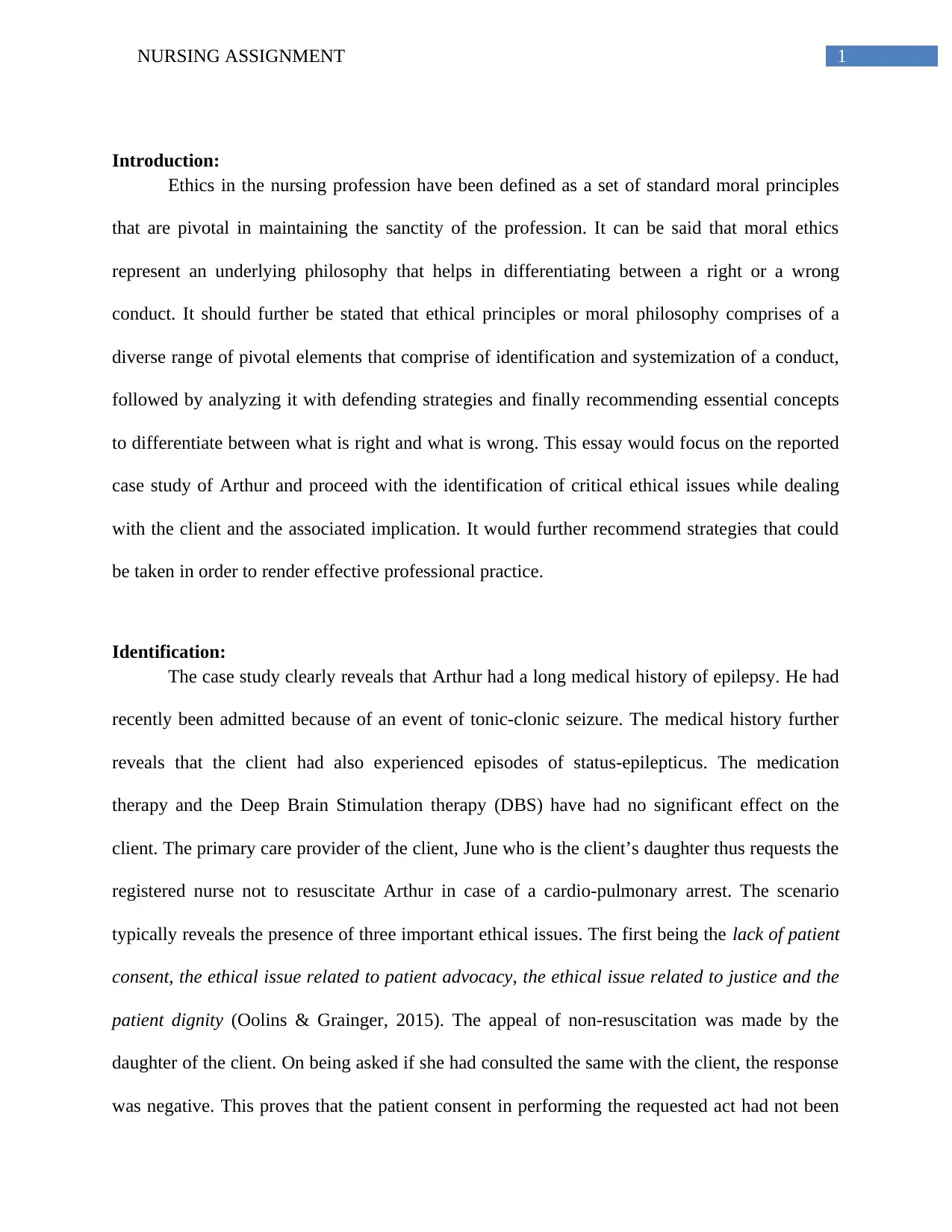
Introduction:
Ethics in the nursing profession have been defined as a set of standard moral principles
that are pivotal in maintaining the sanctity of the profession. It can be said that moral ethics
represent an underlying philosophy that helps in differentiating between a right or a wrong
conduct. It should further be stated that ethical principles or moral philosophy comprises of a
diverse range of pivotal elements that comprise of identification and systemization of a conduct,
followed by analyzing it with defending strategies and finally recommending essential concepts
to differentiate between what is right and what is wrong. This essay would focus on the reported
case study of Arthur and proceed with the identification of critical ethical issues while dealing
with the client and the associated implication. It would further recommend strategies that could
be taken in order to render effective professional practice.
Identification:
The case study clearly reveals that Arthur had a long medical history of epilepsy. He had
recently been admitted because of an event of tonic-clonic seizure. The medical history further
reveals that the client had also experienced episodes of status-epilepticus. The medication
therapy and the Deep Brain Stimulation therapy (DBS) have had no significant effect on the
client. The primary care provider of the client, June who is the client’s daughter thus requests the
registered nurse not to resuscitate Arthur in case of a cardio-pulmonary arrest. The scenario
typically reveals the presence of three important ethical issues. The first being the lack of patient
consent, the ethical issue related to patient advocacy, the ethical issue related to justice and the
patient dignity (Oolins & Grainger, 2015). The appeal of non-resuscitation was made by the
daughter of the client. On being asked if she had consulted the same with the client, the response
was negative. This proves that the patient consent in performing the requested act had not been
Introduction:
Ethics in the nursing profession have been defined as a set of standard moral principles
that are pivotal in maintaining the sanctity of the profession. It can be said that moral ethics
represent an underlying philosophy that helps in differentiating between a right or a wrong
conduct. It should further be stated that ethical principles or moral philosophy comprises of a
diverse range of pivotal elements that comprise of identification and systemization of a conduct,
followed by analyzing it with defending strategies and finally recommending essential concepts
to differentiate between what is right and what is wrong. This essay would focus on the reported
case study of Arthur and proceed with the identification of critical ethical issues while dealing
with the client and the associated implication. It would further recommend strategies that could
be taken in order to render effective professional practice.
Identification:
The case study clearly reveals that Arthur had a long medical history of epilepsy. He had
recently been admitted because of an event of tonic-clonic seizure. The medical history further
reveals that the client had also experienced episodes of status-epilepticus. The medication
therapy and the Deep Brain Stimulation therapy (DBS) have had no significant effect on the
client. The primary care provider of the client, June who is the client’s daughter thus requests the
registered nurse not to resuscitate Arthur in case of a cardio-pulmonary arrest. The scenario
typically reveals the presence of three important ethical issues. The first being the lack of patient
consent, the ethical issue related to patient advocacy, the ethical issue related to justice and the
patient dignity (Oolins & Grainger, 2015). The appeal of non-resuscitation was made by the
daughter of the client. On being asked if she had consulted the same with the client, the response
was negative. This proves that the patient consent in performing the requested act had not been

2NURSING ASSIGNMENT
sought by the primary care provider. At the same time, the situation had only been portrayed in
alignment to the client’s daughter’s perspective. Hence, it can be said that there is nil evidence of
patient advocacy. Further, the conscience of the registered nurse should aim at delivering justice
after analyzing the case scenario. It should also be noted that the case scenario presents an
example of compromising the patient dignity. It has been reported in studies that the first step to
provide an efficient patient-centered care is to reasonably identify the ethical issues and proceed
with the analysis of the ethical issues in relation to the professional guidelines (Kerridge et al.,
2013). Therefore, the ethical issues identified in the case scenario must be analyzed and
evaluated with the professional ethics before undertaking a clinical decision.
Analysis:
The notion of human dignity and human rights:
Human dignity and human rights advocate the choices that individuals can make for
themselves. It should be noted here that individuals irrespective of their physical or mental health
condition are entitled to live a life as per their expectation. Hence, the request made by June does
not reflect the consent of the patient in undergoing the process. In addition to this, the case
further reveals complete violation of the human rights law as guaranteed by the United Nations.
According to the human rights law, each individual is subjected to a right to life, liberty and
personal security which under no circumstance should be compromised with (Sanggaran et al.,
2014). The case also violated the Australian health care rights that guarantee to the citizens of
Australia the right to, health and healthcare, confidentiality, consent, cultural liberty and the right
to be treated with dignity and respect (Foley & Christensen, 2016). Therefore, it can be stated
that the spirit of the notion of human rights and laws must be complied with under any critical
circumstance or it would lead to fatal legal consequences.
sought by the primary care provider. At the same time, the situation had only been portrayed in
alignment to the client’s daughter’s perspective. Hence, it can be said that there is nil evidence of
patient advocacy. Further, the conscience of the registered nurse should aim at delivering justice
after analyzing the case scenario. It should also be noted that the case scenario presents an
example of compromising the patient dignity. It has been reported in studies that the first step to
provide an efficient patient-centered care is to reasonably identify the ethical issues and proceed
with the analysis of the ethical issues in relation to the professional guidelines (Kerridge et al.,
2013). Therefore, the ethical issues identified in the case scenario must be analyzed and
evaluated with the professional ethics before undertaking a clinical decision.
Analysis:
The notion of human dignity and human rights:
Human dignity and human rights advocate the choices that individuals can make for
themselves. It should be noted here that individuals irrespective of their physical or mental health
condition are entitled to live a life as per their expectation. Hence, the request made by June does
not reflect the consent of the patient in undergoing the process. In addition to this, the case
further reveals complete violation of the human rights law as guaranteed by the United Nations.
According to the human rights law, each individual is subjected to a right to life, liberty and
personal security which under no circumstance should be compromised with (Sanggaran et al.,
2014). The case also violated the Australian health care rights that guarantee to the citizens of
Australia the right to, health and healthcare, confidentiality, consent, cultural liberty and the right
to be treated with dignity and respect (Foley & Christensen, 2016). Therefore, it can be stated
that the spirit of the notion of human rights and laws must be complied with under any critical
circumstance or it would lead to fatal legal consequences.
⊘ This is a preview!⊘
Do you want full access?
Subscribe today to unlock all pages.

Trusted by 1+ million students worldwide
3NURSING ASSIGNMENT
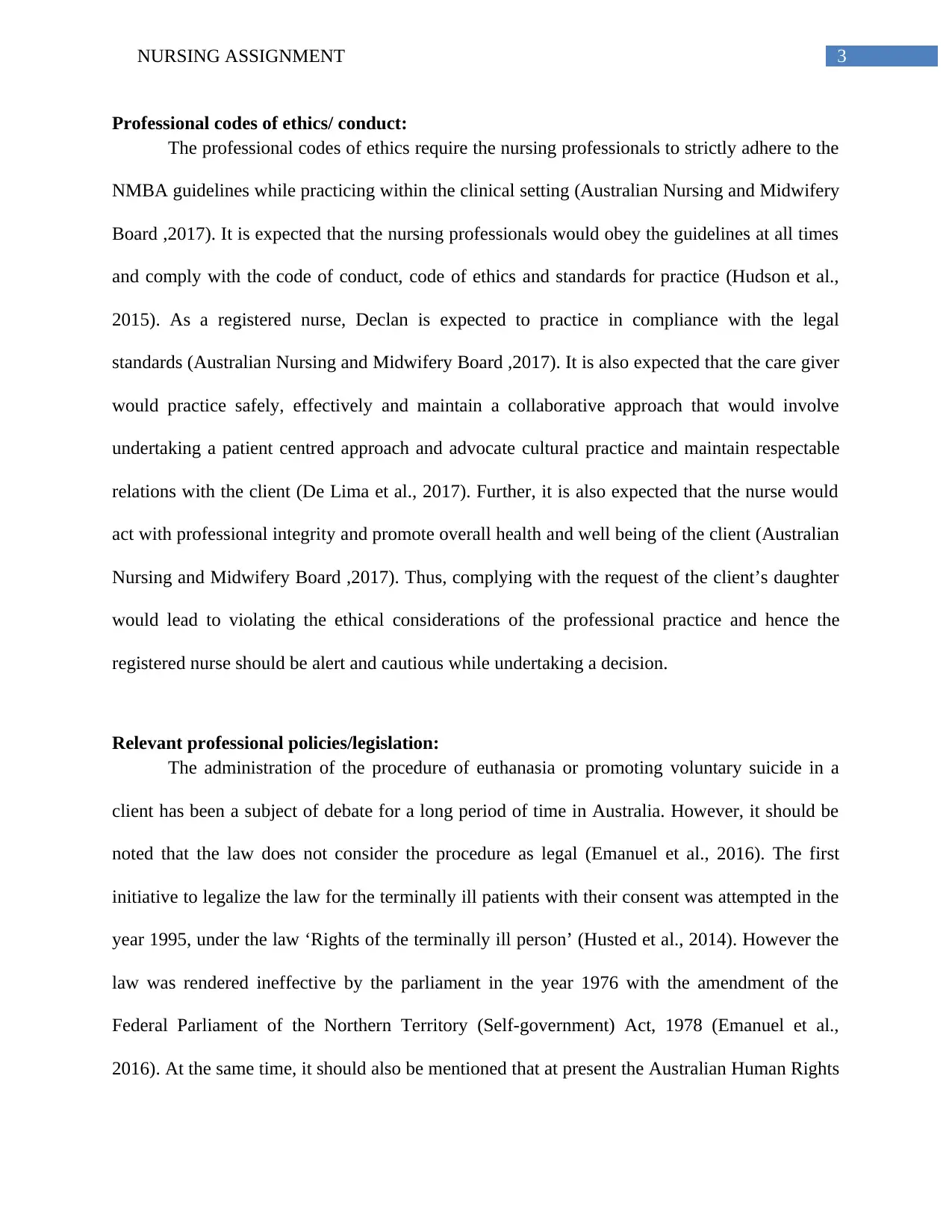
Professional codes of ethics/ conduct:
The professional codes of ethics require the nursing professionals to strictly adhere to the
NMBA guidelines while practicing within the clinical setting (Australian Nursing and Midwifery
Board ,2017). It is expected that the nursing professionals would obey the guidelines at all times
and comply with the code of conduct, code of ethics and standards for practice (Hudson et al.,
2015). As a registered nurse, Declan is expected to practice in compliance with the legal
standards (Australian Nursing and Midwifery Board ,2017). It is also expected that the care giver
would practice safely, effectively and maintain a collaborative approach that would involve
undertaking a patient centred approach and advocate cultural practice and maintain respectable
relations with the client (De Lima et al., 2017). Further, it is also expected that the nurse would
act with professional integrity and promote overall health and well being of the client (Australian
Nursing and Midwifery Board ,2017). Thus, complying with the request of the client’s daughter
would lead to violating the ethical considerations of the professional practice and hence the
registered nurse should be alert and cautious while undertaking a decision.
Relevant professional policies/legislation:
The administration of the procedure of euthanasia or promoting voluntary suicide in a
client has been a subject of debate for a long period of time in Australia. However, it should be
noted that the law does not consider the procedure as legal (Emanuel et al., 2016). The first
initiative to legalize the law for the terminally ill patients with their consent was attempted in the
year 1995, under the law ‘Rights of the terminally ill person’ (Husted et al., 2014). However the
law was rendered ineffective by the parliament in the year 1976 with the amendment of the
Federal Parliament of the Northern Territory (Self-government) Act, 1978 (Emanuel et al.,
2016). At the same time, it should also be mentioned that at present the Australian Human Rights
Professional codes of ethics/ conduct:
The professional codes of ethics require the nursing professionals to strictly adhere to the
NMBA guidelines while practicing within the clinical setting (Australian Nursing and Midwifery
Board ,2017). It is expected that the nursing professionals would obey the guidelines at all times
and comply with the code of conduct, code of ethics and standards for practice (Hudson et al.,
2015). As a registered nurse, Declan is expected to practice in compliance with the legal
standards (Australian Nursing and Midwifery Board ,2017). It is also expected that the care giver
would practice safely, effectively and maintain a collaborative approach that would involve
undertaking a patient centred approach and advocate cultural practice and maintain respectable
relations with the client (De Lima et al., 2017). Further, it is also expected that the nurse would
act with professional integrity and promote overall health and well being of the client (Australian
Nursing and Midwifery Board ,2017). Thus, complying with the request of the client’s daughter
would lead to violating the ethical considerations of the professional practice and hence the
registered nurse should be alert and cautious while undertaking a decision.
Relevant professional policies/legislation:
The administration of the procedure of euthanasia or promoting voluntary suicide in a
client has been a subject of debate for a long period of time in Australia. However, it should be
noted that the law does not consider the procedure as legal (Emanuel et al., 2016). The first
initiative to legalize the law for the terminally ill patients with their consent was attempted in the
year 1995, under the law ‘Rights of the terminally ill person’ (Husted et al., 2014). However the
law was rendered ineffective by the parliament in the year 1976 with the amendment of the
Federal Parliament of the Northern Territory (Self-government) Act, 1978 (Emanuel et al.,
2016). At the same time, it should also be mentioned that at present the Australian Human Rights
Paraphrase This Document
Need a fresh take? Get an instant paraphrase of this document with our AI Paraphraser
4NURSING ASSIGNMENT
commission does not have any legal projects on Euthanasia. Hence, the process is illegal and is
strongly condemned by the government and might even lead to serious legal actions.
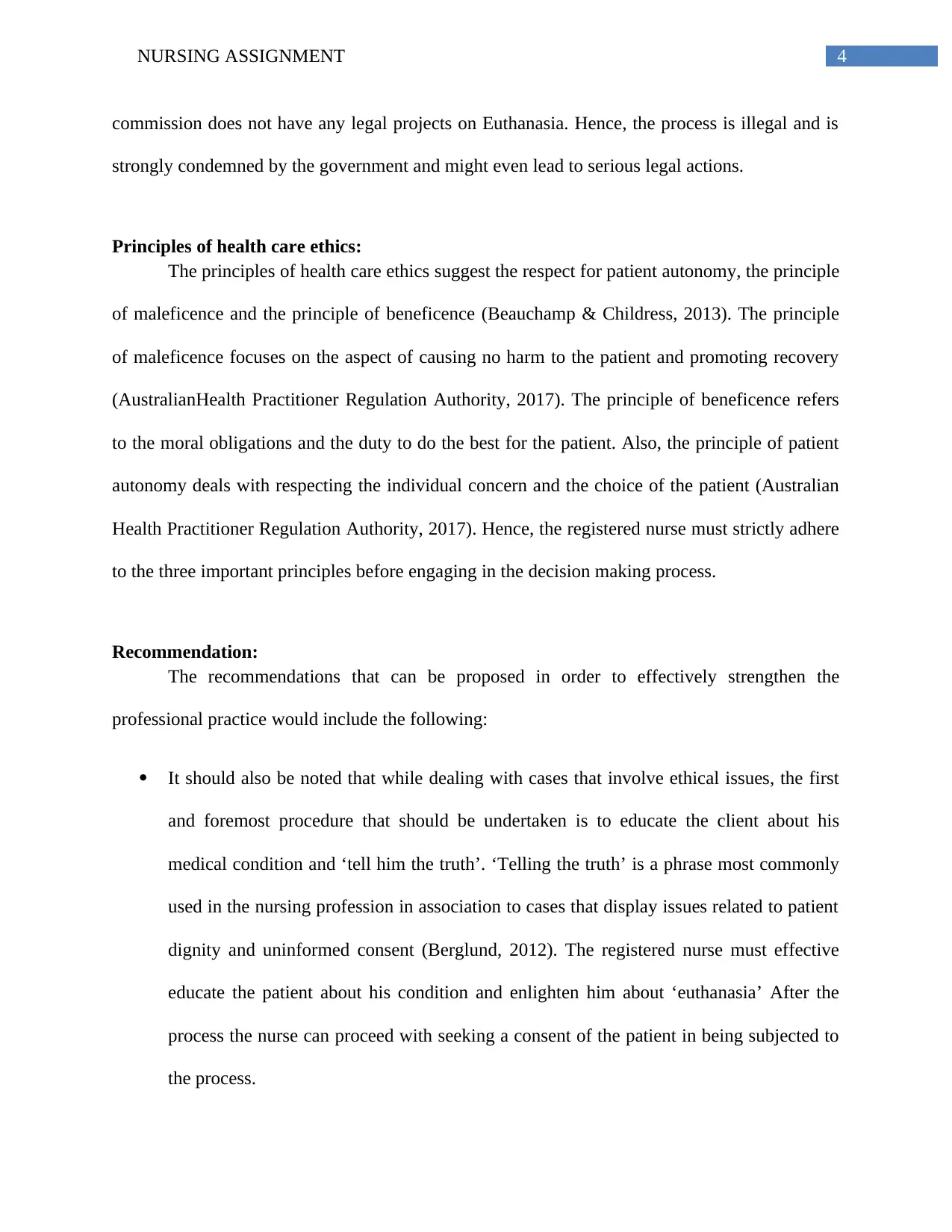
Principles of health care ethics:
The principles of health care ethics suggest the respect for patient autonomy, the principle
of maleficence and the principle of beneficence (Beauchamp & Childress, 2013). The principle
of maleficence focuses on the aspect of causing no harm to the patient and promoting recovery
(AustralianHealth Practitioner Regulation Authority, 2017). The principle of beneficence refers
to the moral obligations and the duty to do the best for the patient. Also, the principle of patient
autonomy deals with respecting the individual concern and the choice of the patient (Australian
Health Practitioner Regulation Authority, 2017). Hence, the registered nurse must strictly adhere
to the three important principles before engaging in the decision making process.
Recommendation:
The recommendations that can be proposed in order to effectively strengthen the
professional practice would include the following:
It should also be noted that while dealing with cases that involve ethical issues, the first
and foremost procedure that should be undertaken is to educate the client about his
medical condition and ‘tell him the truth’. ‘Telling the truth’ is a phrase most commonly
used in the nursing profession in association to cases that display issues related to patient
dignity and uninformed consent (Berglund, 2012). The registered nurse must effective
educate the patient about his condition and enlighten him about ‘euthanasia’ After the
process the nurse can proceed with seeking a consent of the patient in being subjected to
the process.
commission does not have any legal projects on Euthanasia. Hence, the process is illegal and is
strongly condemned by the government and might even lead to serious legal actions.
Principles of health care ethics:
The principles of health care ethics suggest the respect for patient autonomy, the principle
of maleficence and the principle of beneficence (Beauchamp & Childress, 2013). The principle
of maleficence focuses on the aspect of causing no harm to the patient and promoting recovery
(AustralianHealth Practitioner Regulation Authority, 2017). The principle of beneficence refers
to the moral obligations and the duty to do the best for the patient. Also, the principle of patient
autonomy deals with respecting the individual concern and the choice of the patient (Australian
Health Practitioner Regulation Authority, 2017). Hence, the registered nurse must strictly adhere
to the three important principles before engaging in the decision making process.
Recommendation:
The recommendations that can be proposed in order to effectively strengthen the
professional practice would include the following:
It should also be noted that while dealing with cases that involve ethical issues, the first
and foremost procedure that should be undertaken is to educate the client about his
medical condition and ‘tell him the truth’. ‘Telling the truth’ is a phrase most commonly
used in the nursing profession in association to cases that display issues related to patient
dignity and uninformed consent (Berglund, 2012). The registered nurse must effective
educate the patient about his condition and enlighten him about ‘euthanasia’ After the
process the nurse can proceed with seeking a consent of the patient in being subjected to
the process.
5NURSING ASSIGNMENT
The registered nurse must proceed with an effective decision making process. It can be
suggested that a formal discussion with the supervisors and other health care
professionals in charge of taking of Arthur must discuss the scenario and develop a
decision in collaboration
A thorough analysis of the existing laws and health care policies in relation to euthanasia
and obtaining a legal permission from the court of law is extremely important. Further, a
legal permission must be sought of the ministry of health, NSW. A thorough review and
analysis of the previous cases can help in effectively strengthening the level of
professional practice.
Hence, it can be expected that on complying with the proposed recommendation
strategies, the decision making ability of the registered nurse would be enhanced. Further, it
would also help in developing a clear in-sight into the process in which critical cases
involving ethical complexities are managed with convenience.
The registered nurse must proceed with an effective decision making process. It can be
suggested that a formal discussion with the supervisors and other health care
professionals in charge of taking of Arthur must discuss the scenario and develop a
decision in collaboration
A thorough analysis of the existing laws and health care policies in relation to euthanasia
and obtaining a legal permission from the court of law is extremely important. Further, a
legal permission must be sought of the ministry of health, NSW. A thorough review and
analysis of the previous cases can help in effectively strengthening the level of
professional practice.
Hence, it can be expected that on complying with the proposed recommendation
strategies, the decision making ability of the registered nurse would be enhanced. Further, it
would also help in developing a clear in-sight into the process in which critical cases
involving ethical complexities are managed with convenience.
⊘ This is a preview!⊘
Do you want full access?
Subscribe today to unlock all pages.
Trusted by 1+ million students worldwide
6NURSING ASSIGNMENT
Conclusion:
Therefore to conclude, it should be stated that critical cases involving ethical
complexities are common in the nursing professional. These circumstances have often been
reported to elicit a professional dilemma in the nursing professionals entitled to take care of the
patients. A number of ethical models in nursing have tried to identify the different ethical issues
encountered while dealing with patients and their family members. It is important to note here
that as a registered nurse the primary goal is to provide a holistic care to the patient and advocate
patient rights. Hence, it is suggested that educating the patient about the existing medical
condition and obtaining an informed consent are areas of high priority. After obtaining a consent,
the nursing professional should engage in a collaborative decision making process that would
involve the experienced supervisors, physician and other health care professionals in charge of
taking care of the client. Finally, only after obtaining a legal permit from the court of human
rights and the ministry of health an effective decision should be undertaken that involves serious
ethical consideration issues such as administering euthanasia.
Conclusion:
Therefore to conclude, it should be stated that critical cases involving ethical
complexities are common in the nursing professional. These circumstances have often been
reported to elicit a professional dilemma in the nursing professionals entitled to take care of the
patients. A number of ethical models in nursing have tried to identify the different ethical issues
encountered while dealing with patients and their family members. It is important to note here
that as a registered nurse the primary goal is to provide a holistic care to the patient and advocate
patient rights. Hence, it is suggested that educating the patient about the existing medical
condition and obtaining an informed consent are areas of high priority. After obtaining a consent,
the nursing professional should engage in a collaborative decision making process that would
involve the experienced supervisors, physician and other health care professionals in charge of
taking care of the client. Finally, only after obtaining a legal permit from the court of human
rights and the ministry of health an effective decision should be undertaken that involves serious
ethical consideration issues such as administering euthanasia.
Paraphrase This Document
Need a fresh take? Get an instant paraphrase of this document with our AI Paraphraser
7NURSING ASSIGNMENT
References:
Australian Institute of Family Studies(2016). Mandatory Reporting of Child Abuse and Neglect.
Retrieved from: https://aifs.gov.au/cfca/publications/mandatory-reporting-childabuse-
and-neglect
Australian Nursing and Midwifery Board (2017). Position statement on nurses, midwives and
vaccination. Retrieved from: http://www.nursingmidwiferyboard.gov.au/Codes-
GuidelinesStatements/Position- Statements/vaccination.aspx
AustralianHealth Practitioner Regulation Authority (2017). Court and Tribunal Decisions.
Retrieved from: http://www.ahpra.gov.au/publications/tribunal-decisions.aspx
Beauchamp, T. & Childress, J. (2013). Principles of Biomedical Ethics (7th ed). New York:
Oxford.pp.60
Berglund, C. (2012). Ethics for Health Care (4th ed). South Melbourne: Oxford.pp.127
De Lima, L., Woodruff, R., Pettus, K., Downing, J., Buitrago, R., Munyoro, E., ... & Radbruch,
L. (2017). International Association for Hospice and Palliative Care position statement:
euthanasia and physician-assisted suicide. Journal of palliative medicine, 20(1), 8-14.
Freegard, H. & Isted, L. (2012). Ethical Practice for Health Professionals. South Melbourne:
Cengage.pp.87
Foley, M. & Christensen, M. (2016). Negligence and the Duty of Care: a case study discussion.
Singapore Nursing Journal, 43 (1): 7-11
References:
Australian Institute of Family Studies(2016). Mandatory Reporting of Child Abuse and Neglect.
Retrieved from: https://aifs.gov.au/cfca/publications/mandatory-reporting-childabuse-
and-neglect
Australian Nursing and Midwifery Board (2017). Position statement on nurses, midwives and
vaccination. Retrieved from: http://www.nursingmidwiferyboard.gov.au/Codes-
GuidelinesStatements/Position- Statements/vaccination.aspx
AustralianHealth Practitioner Regulation Authority (2017). Court and Tribunal Decisions.
Retrieved from: http://www.ahpra.gov.au/publications/tribunal-decisions.aspx
Beauchamp, T. & Childress, J. (2013). Principles of Biomedical Ethics (7th ed). New York:
Oxford.pp.60
Berglund, C. (2012). Ethics for Health Care (4th ed). South Melbourne: Oxford.pp.127
De Lima, L., Woodruff, R., Pettus, K., Downing, J., Buitrago, R., Munyoro, E., ... & Radbruch,
L. (2017). International Association for Hospice and Palliative Care position statement:
euthanasia and physician-assisted suicide. Journal of palliative medicine, 20(1), 8-14.
Freegard, H. & Isted, L. (2012). Ethical Practice for Health Professionals. South Melbourne:
Cengage.pp.87
Foley, M. & Christensen, M. (2016). Negligence and the Duty of Care: a case study discussion.
Singapore Nursing Journal, 43 (1): 7-11
8NURSING ASSIGNMENT
Hudson, P., Hudson, R., Philip, J., Boughey, M., Kelly, B., & Hertogh, C. (2015). Legalizing
physician-assisted suicide and/or euthanasia: Pragmatic implications. Palliative &
supportive care, 13(5), 1399-1409.
Husted, G., Husted, J., Scotto, C., & Wolf, K. (2014). Bioethical Decision-Making in Nursing
(5th edn). New York: Springer Publishing Co.pp.111-123
Kerridge, I., Lowe, M. & Stewart, C. (2013). Ethics and Law for the health professions.
Annandale NSW: the Federation Press. pp 127
Ozolins, J. & Grainger, J. (2015). Foundations of Healthcare Ethics: Theory to Practice. South
Melbourne: CUP.pp.45
Sanggaran, J.P., Ferguson, G., & Haire, G. (2014) Ethical Challenges for doctors working in
immigration detention. Medical Journal of Australia, 201 (7): 377-378. doi:
10.5694/mja14.01014
Hudson, P., Hudson, R., Philip, J., Boughey, M., Kelly, B., & Hertogh, C. (2015). Legalizing
physician-assisted suicide and/or euthanasia: Pragmatic implications. Palliative &
supportive care, 13(5), 1399-1409.
Husted, G., Husted, J., Scotto, C., & Wolf, K. (2014). Bioethical Decision-Making in Nursing
(5th edn). New York: Springer Publishing Co.pp.111-123
Kerridge, I., Lowe, M. & Stewart, C. (2013). Ethics and Law for the health professions.
Annandale NSW: the Federation Press. pp 127
Ozolins, J. & Grainger, J. (2015). Foundations of Healthcare Ethics: Theory to Practice. South
Melbourne: CUP.pp.45
Sanggaran, J.P., Ferguson, G., & Haire, G. (2014) Ethical Challenges for doctors working in
immigration detention. Medical Journal of Australia, 201 (7): 377-378. doi:
10.5694/mja14.01014
⊘ This is a preview!⊘
Do you want full access?
Subscribe today to unlock all pages.
Trusted by 1+ million students worldwide

1 out of 9


Related Documents


Your All-in-One AI-Powered Toolkit for Academic Success.
+13062052269
info@desklib.com
Available 24*7 on WhatsApp / Email
![[object Object]](/_next/static/media/star-bottom.7253800d.svg)
Unlock your academic potential
Copyright © 2020–2026 A2Z Services. All Rights Reserved. Developed and managed by ZUCOL.