Report on Ethical Leadership, Moral Entrepreneurship, and Outcomes

Verified

Added on  2022/11/16

|5
|607
|86
Report
AI Summary
This report delves into the concept of ethical leadership, critically examining the widely used definition by Brown et al. (2005) and its limitations. It highlights the significance of moral entrepreneurship as a crucial component of ethical leadership, expanding the scope beyond the traditional moral person and moral manager framework. The report emphasizes the need for a social development approach and proactive leadership, advocating for studies on corporate social responsibility. It introduces moral entrepreneurship, its antecedents, and its outcomes, including the creation of new ethical norms and positive impacts on the community and shareholder trust, as highlighted by Kaptein (2017). The report references various studies, including Freeman (2016), Frisch and Huppenbauer (2014), Hitlin and Vaisey (2013), Smith et al. (2016), and Yasir and Mohamad (2016), to support its analysis and conclusions.
Document Page
Running head: ETHICAL LEADERSHIP
ETHICAL LEADERSHIP
Name of the Student
Name of the University
Author Note
tabler-icon-diamond-filled.svg

Paraphrase This Document

Need a fresh take? Get an instant paraphrase of this document with our AI Paraphraser
Document Page
1ETHICAL LEADERSHIP
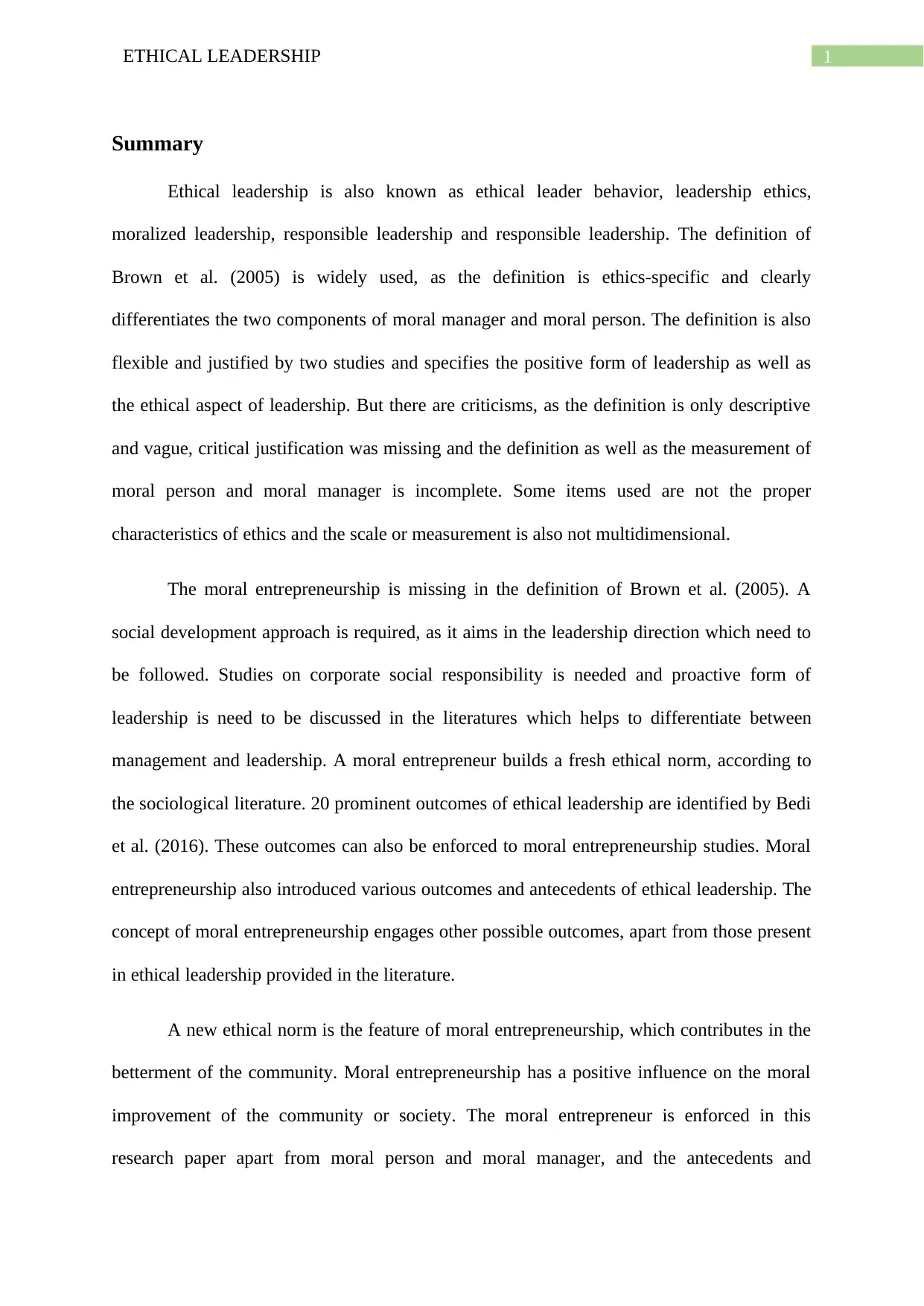
Summary
Ethical leadership is also known as ethical leader behavior, leadership ethics,
moralized leadership, responsible leadership and responsible leadership. The definition of
Brown et al. (2005) is widely used, as the definition is ethics-specific and clearly
differentiates the two components of moral manager and moral person. The definition is also
flexible and justified by two studies and specifies the positive form of leadership as well as
the ethical aspect of leadership. But there are criticisms, as the definition is only descriptive
and vague, critical justification was missing and the definition as well as the measurement of
moral person and moral manager is incomplete. Some items used are not the proper
characteristics of ethics and the scale or measurement is also not multidimensional.
The moral entrepreneurship is missing in the definition of Brown et al. (2005). A
social development approach is required, as it aims in the leadership direction which need to
be followed. Studies on corporate social responsibility is needed and proactive form of
leadership is need to be discussed in the literatures which helps to differentiate between
management and leadership. A moral entrepreneur builds a fresh ethical norm, according to
the sociological literature. 20 prominent outcomes of ethical leadership are identified by Bedi
et al. (2016). These outcomes can also be enforced to moral entrepreneurship studies. Moral
entrepreneurship also introduced various outcomes and antecedents of ethical leadership. The
concept of moral entrepreneurship engages other possible outcomes, apart from those present
in ethical leadership provided in the literature.
A new ethical norm is the feature of moral entrepreneurship, which contributes in the
betterment of the community. Moral entrepreneurship has a positive influence on the moral
improvement of the community or society. The moral entrepreneur is enforced in this
research paper apart from moral person and moral manager, and the antecedents and
Document Page
2ETHICAL LEADERSHIP
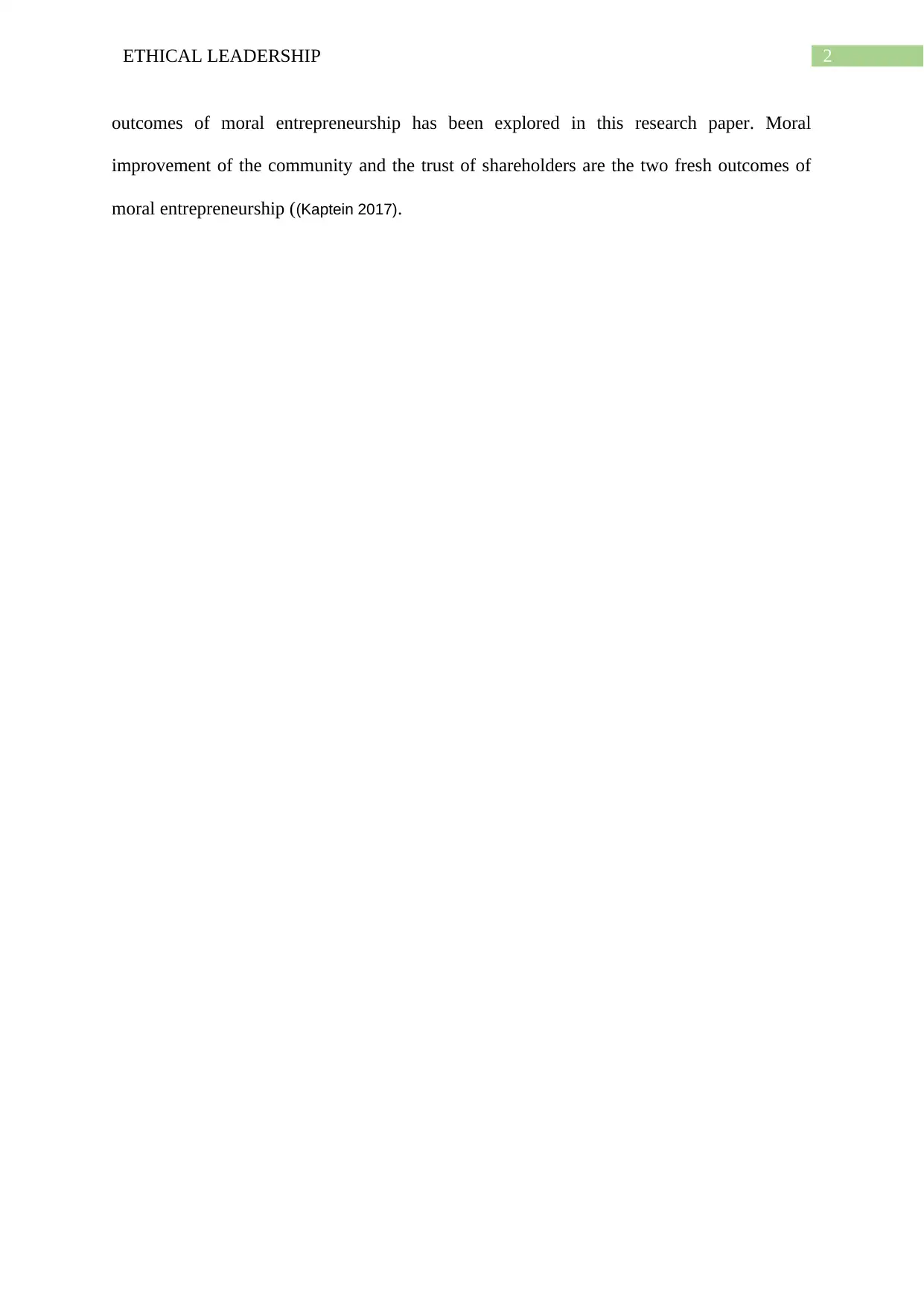
outcomes of moral entrepreneurship has been explored in this research paper. Moral
improvement of the community and the trust of shareholders are the two fresh outcomes of
moral entrepreneurship ((Kaptein 2017).
Document Page
3ETHICAL LEADERSHIP
References
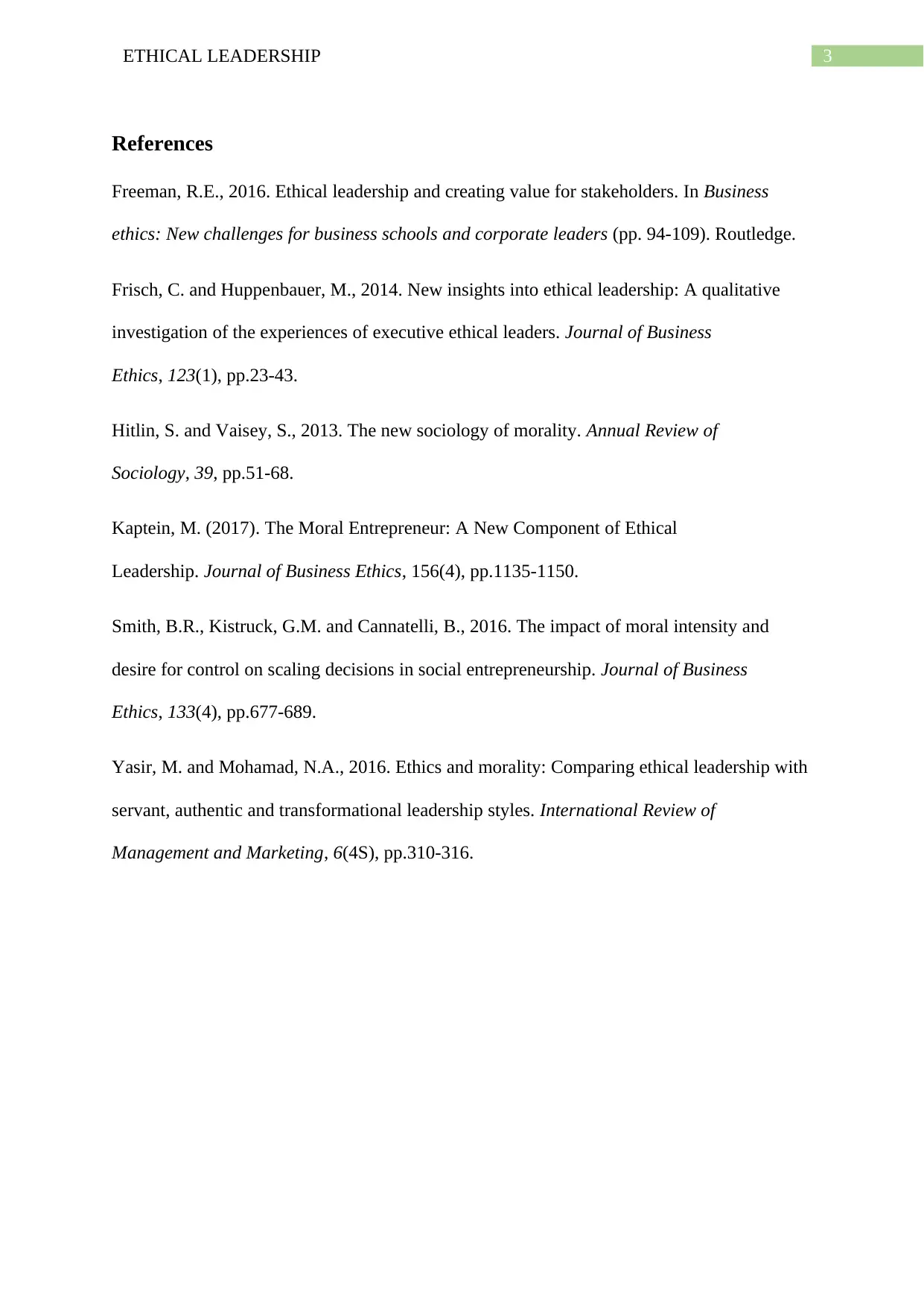
Freeman, R.E., 2016. Ethical leadership and creating value for stakeholders. In Business
ethics: New challenges for business schools and corporate leaders (pp. 94-109). Routledge.
Frisch, C. and Huppenbauer, M., 2014. New insights into ethical leadership: A qualitative
investigation of the experiences of executive ethical leaders. Journal of Business
Ethics, 123(1), pp.23-43.
Hitlin, S. and Vaisey, S., 2013. The new sociology of morality. Annual Review of
Sociology, 39, pp.51-68.
Kaptein, M. (2017). The Moral Entrepreneur: A New Component of Ethical
Leadership. Journal of Business Ethics, 156(4), pp.1135-1150.
Smith, B.R., Kistruck, G.M. and Cannatelli, B., 2016. The impact of moral intensity and
desire for control on scaling decisions in social entrepreneurship. Journal of Business
Ethics, 133(4), pp.677-689.
Yasir, M. and Mohamad, N.A., 2016. Ethics and morality: Comparing ethical leadership with
servant, authentic and transformational leadership styles. International Review of
Management and Marketing, 6(4S), pp.310-316.
tabler-icon-diamond-filled.svg

Paraphrase This Document

Need a fresh take? Get an instant paraphrase of this document with our AI Paraphraser
Document Page
4ETHICAL LEADERSHIP
chevron_up_icon
1 out of 5
circle_padding
hide_on_mobile
zoom_out_icon
[object Object]