Business Ethics and Responsible Management: NHS Case Study
VerifiedAdded on 2020/10/22
|12
|3857
|99
Report
AI Summary
This report examines the ethical challenges faced by the National Health Service (NHS) in the United Kingdom, specifically focusing on conflicts of interest arising from gifts and interactions between healthcare professionals and pharmaceutical companies. The report begins with an introduction to business ethics and the context of the NHS, highlighting the ethical dilemma of senior medical professionals receiving gifts. It identifies key stakeholders and their concerns regarding transparency and fairness. Part 1 delves into the ethical dilemma, stakeholder identification, and provides recommendations for policy modifications, such as limiting gifts. The report then applies utilitarianism and deontological ethical theories to the case, analyzing the consequences of actions and adherence to moral duties. The report also elaborates on the qualities needed for ethical leadership and the importance of creating an ethical organization. The conclusion summarizes the key findings and reinforces the need for ethical practices within the NHS to maintain stakeholder trust and ensure responsible management.
Business Ethics & Responsible
Management-Case3 NHS and
conflict of interest
Management-Case3 NHS and
conflict of interest

Paraphrase This Document
Need a fresh take? Get an instant paraphrase of this document with our AI Paraphraser
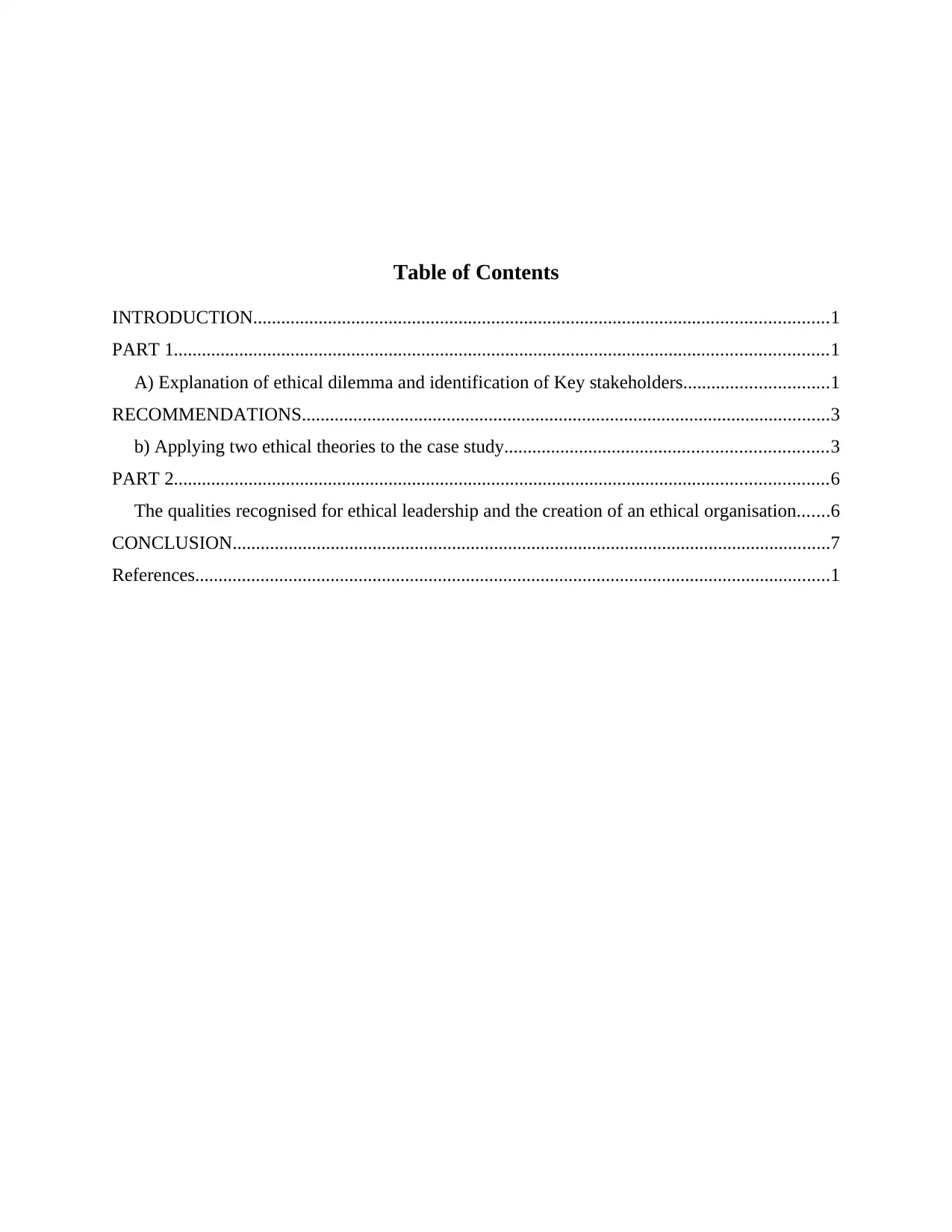
Table of Contents
INTRODUCTION...........................................................................................................................1
PART 1............................................................................................................................................1
A) Explanation of ethical dilemma and identification of Key stakeholders...............................1
RECOMMENDATIONS.................................................................................................................3
b) Applying two ethical theories to the case study.....................................................................3
PART 2............................................................................................................................................6
The qualities recognised for ethical leadership and the creation of an ethical organisation.......6
CONCLUSION................................................................................................................................7
References........................................................................................................................................1
INTRODUCTION...........................................................................................................................1
PART 1............................................................................................................................................1
A) Explanation of ethical dilemma and identification of Key stakeholders...............................1
RECOMMENDATIONS.................................................................................................................3
b) Applying two ethical theories to the case study.....................................................................3
PART 2............................................................................................................................................6
The qualities recognised for ethical leadership and the creation of an ethical organisation.......6
CONCLUSION................................................................................................................................7
References........................................................................................................................................1

⊘ This is a preview!⊘
Do you want full access?
Subscribe today to unlock all pages.

Trusted by 1+ million students worldwide
INTRODUCTION
Business ethics are considered as the code of practices that instructs employees the way
in which they are required to perform business activities and behave in different organisational
situation. It also includes some ethical values of company as well as its manager whose main
objective is to attain organisational goals without compromising with their principles. This
present report is based on case study of NHS regarding gifts receiving unethical from
pharmaceuticalists and conflicts of interest. National Health services is healthcare industry is
headquartered in England, United Kingdom and founded in 1948 by Aneurin Bevan. This report
is going to discuss about stakeholders for NHS case study and ethical dilemma related to it. It
also explains about ethical theories that will be helpful in judging ethics of the stated situations.
At last, it also elaborates quality which are required by the ethical manager to manage with
organisational situations..
PART 1
A) Explanation of ethical dilemma and identification of Key stakeholders
The purpose of this report is to explore the latest trends in healthcare and medical centres.
The major objective of this report is related to the concern about NHS being an ethical company
and the dilemma involving conflict of interests. It has a specific reference to increasing
awareness about employing ethics in medical practices after a number of scandals were exposed
by the Daily Telegraph (NHS nursing staff face crackdown on perceived conflicts of interest,
2018). These scandals got under limelight after a number of healthcare and medical professionals
were caught taking funds and having quality time and dinner with drug companies and
professionals (Shen, 2011). These individuals from drug firms asked senior health professionals
to switch the drugs being used by them while treating and prescribing patient with the medicines
provided by these pharmaceuticalists. This ethical dilemma holds significance as many
healthcare professionals, general practitioners and medical centre persons are now getting
involved in dishonest practices and proposing and making use of such drugs which are given by
professionals who offer them expensive gifts and luxurious experience. The ethical dilemma
described herein is set in reflection of the role of business entity in relation to society and
environment.
1
Business ethics are considered as the code of practices that instructs employees the way
in which they are required to perform business activities and behave in different organisational
situation. It also includes some ethical values of company as well as its manager whose main
objective is to attain organisational goals without compromising with their principles. This
present report is based on case study of NHS regarding gifts receiving unethical from
pharmaceuticalists and conflicts of interest. National Health services is healthcare industry is
headquartered in England, United Kingdom and founded in 1948 by Aneurin Bevan. This report
is going to discuss about stakeholders for NHS case study and ethical dilemma related to it. It
also explains about ethical theories that will be helpful in judging ethics of the stated situations.
At last, it also elaborates quality which are required by the ethical manager to manage with
organisational situations..
PART 1
A) Explanation of ethical dilemma and identification of Key stakeholders
The purpose of this report is to explore the latest trends in healthcare and medical centres.
The major objective of this report is related to the concern about NHS being an ethical company
and the dilemma involving conflict of interests. It has a specific reference to increasing
awareness about employing ethics in medical practices after a number of scandals were exposed
by the Daily Telegraph (NHS nursing staff face crackdown on perceived conflicts of interest,
2018). These scandals got under limelight after a number of healthcare and medical professionals
were caught taking funds and having quality time and dinner with drug companies and
professionals (Shen, 2011). These individuals from drug firms asked senior health professionals
to switch the drugs being used by them while treating and prescribing patient with the medicines
provided by these pharmaceuticalists. This ethical dilemma holds significance as many
healthcare professionals, general practitioners and medical centre persons are now getting
involved in dishonest practices and proposing and making use of such drugs which are given by
professionals who offer them expensive gifts and luxurious experience. The ethical dilemma
described herein is set in reflection of the role of business entity in relation to society and
environment.
1
Paraphrase This Document
Need a fresh take? Get an instant paraphrase of this document with our AI Paraphraser
This report is written from middle manager of NHS and is addressed to the senior
managers with an aim to make them aware about a new trend of unethical practices in hospital
and medical care centres by senior healthcare officials. This report revolves around the ethical
dilemma “Should senior medical professionals who decide the drugs get taken out for a fancy
dinner and ignore it later?”. Considering this dilemma is necessary so as to ensure that health
care officials and doctors who makes decisions about which drug would be used in hospitals and
medical centres do not get indulged in immoral and unethical practices (Trevino and Nelson,
2016). Also, this report is related to the ethical dilemma which questions the assurance by senior
healthcare officials that they will not get engaged in any practice, process or technique that
conflicts with the interests of stakeholders of NHS (NHS ban on staff receiving gifts worth more
than £50 in crackdown, 2018). Furthermore, this is directed towards providing assistance to
senior managers of medical institutions so as to make sure that nobody amongst the staff of
hospitals and medical centres make use of ethical means to carry out practices and procedures.
Corporate social responsibility (CSR) is an ethical act where businesses give their
contribution towards sustainable development and producing an overall positive and everlasting
impact upon society. This is done in a way that ensures maximum benefits for the various
stakeholders of the organisation. In modern time, this concept is becoming increasingly
significant in two folded ways: one is in terms of avoiding risks of indulging in unethical
practices along with avoiding any legal or local community interference in the practices and
conduct of operations of entity (Ulrich and Sarasin, 2012). The other is getting involved in CSR
initiatives provides a strategic and competitive edge to businesses that are a part of society and
are successful in gaining widespread acceptance from customers, local community, government,
society and healthcare professional bodies. It is being largely noticed that nowadays, people are
increasingly becoming aware of corporate social responsibility and the need and requirement
behind entities, especially healthcare centres to understand the demarcation between what is right
and wrong in terms of practices and procedures in hospitals and medical units. This aspect holds
importance as complying with the ethical and legal requirements reflects that NHS is carrying
out operations within the norms prescribed by law and society (Weiss, 2014). Although adoption
of CSR initiatives largely help an entity in carrying out the functions of hospitals and medical
centres ethically and legally and maintains the corporate image and position of company, it is
also noticed that many professionals believe that engaging in corporate social responsibilities
2
managers with an aim to make them aware about a new trend of unethical practices in hospital
and medical care centres by senior healthcare officials. This report revolves around the ethical
dilemma “Should senior medical professionals who decide the drugs get taken out for a fancy
dinner and ignore it later?”. Considering this dilemma is necessary so as to ensure that health
care officials and doctors who makes decisions about which drug would be used in hospitals and
medical centres do not get indulged in immoral and unethical practices (Trevino and Nelson,
2016). Also, this report is related to the ethical dilemma which questions the assurance by senior
healthcare officials that they will not get engaged in any practice, process or technique that
conflicts with the interests of stakeholders of NHS (NHS ban on staff receiving gifts worth more
than £50 in crackdown, 2018). Furthermore, this is directed towards providing assistance to
senior managers of medical institutions so as to make sure that nobody amongst the staff of
hospitals and medical centres make use of ethical means to carry out practices and procedures.
Corporate social responsibility (CSR) is an ethical act where businesses give their
contribution towards sustainable development and producing an overall positive and everlasting
impact upon society. This is done in a way that ensures maximum benefits for the various
stakeholders of the organisation. In modern time, this concept is becoming increasingly
significant in two folded ways: one is in terms of avoiding risks of indulging in unethical
practices along with avoiding any legal or local community interference in the practices and
conduct of operations of entity (Ulrich and Sarasin, 2012). The other is getting involved in CSR
initiatives provides a strategic and competitive edge to businesses that are a part of society and
are successful in gaining widespread acceptance from customers, local community, government,
society and healthcare professional bodies. It is being largely noticed that nowadays, people are
increasingly becoming aware of corporate social responsibility and the need and requirement
behind entities, especially healthcare centres to understand the demarcation between what is right
and wrong in terms of practices and procedures in hospitals and medical units. This aspect holds
importance as complying with the ethical and legal requirements reflects that NHS is carrying
out operations within the norms prescribed by law and society (Weiss, 2014). Although adoption
of CSR initiatives largely help an entity in carrying out the functions of hospitals and medical
centres ethically and legally and maintains the corporate image and position of company, it is
also noticed that many professionals believe that engaging in corporate social responsibilities
2
may have some counter effects. Indulging in social duties makes an entity accountable to society
yet it gets diverted from the original objective of NHS to deliver health care services to a large
number of people as adopting these practices will increase the overall cost of operations of
organisation.
The unethical practice of receiving gifts from pharmaceuticalists and drug firm has
affected many stakeholders of NHS. Such stakeholders are people, local NHS organisations,
government, health and care federations, royal colleges and professional groups, patients, public
groups, policy organisations and Medical Association etc. As the faith and belief of all these
stakeholders lies in honest, transparent and fair practices adopted by NHS, the unethical practice
of senior medical officers and professionals has defamed the whole medical industry. This
impacted negatively on their image and also they led down stakeholders as well (Voegtlin, Patzer
and Scherer, 2012).
RECOMMENDATIONS
With the help of above mentioned information, it is recommended that NHS needs to
make modifications as per the requirements among policies so that nurses and other staff cannot
get gift more than £50. With the help of this, it can easily be said that organisation may perform
well and it will also aid in developing right amount of interests of clients that were previously
gifted to staff more than £50. it is also recommended that, NHS also required to follow CSR in
order to work in an most effectively considering all the ethics. Through this, maximum benefits
could easily be gained by NHS in specific time frame. On the other hand, it is also suggested that
healthcare providers needs to deliver every single information to government on their earnings.
With the help of this, they might start delivering paying right amount of taxes.
b) Applying two ethical theories to the case study
UTILITARIANISM
Utilitarianism can be understood as a theory where an individual, organisation or a group
needs to act in a way where maximisation of good needed to be delivered to a huge number of
people. Since National Health Services (NHS), went through a number of scandals that were
related to conflicts of interests (Amann and et. al., 2011). Here, many cases came in front where
staff was rapidly taking gifts in monitory terms from their clients more than £50. Authorities (Sir
Malcolm Grant) decided to ban people who were taking more than suggested amount. In this
3
yet it gets diverted from the original objective of NHS to deliver health care services to a large
number of people as adopting these practices will increase the overall cost of operations of
organisation.
The unethical practice of receiving gifts from pharmaceuticalists and drug firm has
affected many stakeholders of NHS. Such stakeholders are people, local NHS organisations,
government, health and care federations, royal colleges and professional groups, patients, public
groups, policy organisations and Medical Association etc. As the faith and belief of all these
stakeholders lies in honest, transparent and fair practices adopted by NHS, the unethical practice
of senior medical officers and professionals has defamed the whole medical industry. This
impacted negatively on their image and also they led down stakeholders as well (Voegtlin, Patzer
and Scherer, 2012).
RECOMMENDATIONS
With the help of above mentioned information, it is recommended that NHS needs to
make modifications as per the requirements among policies so that nurses and other staff cannot
get gift more than £50. With the help of this, it can easily be said that organisation may perform
well and it will also aid in developing right amount of interests of clients that were previously
gifted to staff more than £50. it is also recommended that, NHS also required to follow CSR in
order to work in an most effectively considering all the ethics. Through this, maximum benefits
could easily be gained by NHS in specific time frame. On the other hand, it is also suggested that
healthcare providers needs to deliver every single information to government on their earnings.
With the help of this, they might start delivering paying right amount of taxes.
b) Applying two ethical theories to the case study
UTILITARIANISM
Utilitarianism can be understood as a theory where an individual, organisation or a group
needs to act in a way where maximisation of good needed to be delivered to a huge number of
people. Since National Health Services (NHS), went through a number of scandals that were
related to conflicts of interests (Amann and et. al., 2011). Here, many cases came in front where
staff was rapidly taking gifts in monitory terms from their clients more than £50. Authorities (Sir
Malcolm Grant) decided to ban people who were taking more than suggested amount. In this
3
⊘ This is a preview!⊘
Do you want full access?
Subscribe today to unlock all pages.
Trusted by 1+ million students worldwide
situation when it was much required for NHS organisation to run a register which lists potential
conflicts of interest held by staff like hospitality received, involvement in sponsored events and
private business interests.
Here, utilitarianism can be utilised which aid in considering both right and wrong solely
on consequences that were linked with a few policy in order to reduce a number of other actions
which could lead to increase in conflicts of interests. Apart from this, it moves beyond the scope
of individual's own interests and takes into account the interests of others. Apart from this, idea
which was being developed by authorities of National Health Services was to create a register so
that data or the knowledge could be kept or stored for a longer period of time which was linked
with involvement in sponsored events and private business interests.
Winners in present case could be identified as stakeholders that were getting affected the
most by all the scandals, like those pharmaceutical companies that were not linked with
healthcare providers or the private practitioners. Using this theory of utilitarianism of ethics,
could aid directly in giving equal opportunities to every single pharmaceutical organisation to
work with them (Crane and Matten, 2016). This could directly aid in reaching to an all new level
and could help NHS in going through all the conflicts in specific time frame. On the other hand,
the basic principle of utility is applied directly to each alternative act in a situation of choice. The
right act is then defined as the one which brings about the best results. Here, authorities have
kept their focus on offering right and equal amount of opportunities to pharmaceutical firms that
were offering medication with low prices as well with same salts. Away with this, policy was
also made by NHS to stop private practitioners who were working with National Health Services
at a level where they can charge to patients in a limit. This could be considered as a loosing
condition because, it has been analysed that doctors were receiving more than £100,000 per year
from pharmaceutical companies with whom they were linked and their was no authentic
information was also presented of the money made. This led authorities to develop strict policies
against the wrong doings which increased conflicts of interests. This impacted negatively on
overall ethics which were being followed by NHS in past.
DEONTOLOGICAL THEORY OF ETHICS
Deontological theory of ethics emphasise on morality of human actions and duty. It helps
to differentiate between what is right and wrong (Dierksmeier, 2011). Cost, uncertainty and
4
conflicts of interest held by staff like hospitality received, involvement in sponsored events and
private business interests.
Here, utilitarianism can be utilised which aid in considering both right and wrong solely
on consequences that were linked with a few policy in order to reduce a number of other actions
which could lead to increase in conflicts of interests. Apart from this, it moves beyond the scope
of individual's own interests and takes into account the interests of others. Apart from this, idea
which was being developed by authorities of National Health Services was to create a register so
that data or the knowledge could be kept or stored for a longer period of time which was linked
with involvement in sponsored events and private business interests.
Winners in present case could be identified as stakeholders that were getting affected the
most by all the scandals, like those pharmaceutical companies that were not linked with
healthcare providers or the private practitioners. Using this theory of utilitarianism of ethics,
could aid directly in giving equal opportunities to every single pharmaceutical organisation to
work with them (Crane and Matten, 2016). This could directly aid in reaching to an all new level
and could help NHS in going through all the conflicts in specific time frame. On the other hand,
the basic principle of utility is applied directly to each alternative act in a situation of choice. The
right act is then defined as the one which brings about the best results. Here, authorities have
kept their focus on offering right and equal amount of opportunities to pharmaceutical firms that
were offering medication with low prices as well with same salts. Away with this, policy was
also made by NHS to stop private practitioners who were working with National Health Services
at a level where they can charge to patients in a limit. This could be considered as a loosing
condition because, it has been analysed that doctors were receiving more than £100,000 per year
from pharmaceutical companies with whom they were linked and their was no authentic
information was also presented of the money made. This led authorities to develop strict policies
against the wrong doings which increased conflicts of interests. This impacted negatively on
overall ethics which were being followed by NHS in past.
DEONTOLOGICAL THEORY OF ETHICS
Deontological theory of ethics emphasise on morality of human actions and duty. It helps
to differentiate between what is right and wrong (Dierksmeier, 2011). Cost, uncertainty and
4
Paraphrase This Document
Need a fresh take? Get an instant paraphrase of this document with our AI Paraphraser
subjectivity is not involved in this as certain rules are made which are meant to be followed.
Checklist is created with certain points, if checklist is complete then it means work is successful.
NHS should apply this theory of ethics in which people follow certain rules and
regulations to accomplish their duties. It helps to acknowledge whether a duty performed by
employees is ethical or not. NHS can use this theory to focus on patients and their benefits rather
then individual or employers benefits. Deontology states that some actions may not be morally
right but result can be good, NHS can use this theory for sake of patients.
Let us suppose that patient is suffering from a disease and is cured by ailment given by
doctor and gives him reward, for patient it is right as he paid reward when he got well but on
behalf of doctor it is not morally right, if doctor every time received some reward then he will
become habitual of this and will start demanding (De George, 2011). For such cases, NHS
banned reward more than 50 pounds but some cases were found where reward was more than
specified amount and it became important for them to eliminate such kind of practices. So NHS
should use this theory to remove such kind of practices and should address all rules. Various
scenarios occurred within NHS where employees are given reward beyond 50 pounds and
doctors received a huge amount from pharmaceuticals. Payment of ten millions is received from
doctors but it was not known from where it was coming. It was difficult for NHS to analyse bills
of hospitality when large conferences were held and this all lead to morality issues. To avoid
such kind of situations NHS should use deontological theories and all problems should be
mentioned to attain stability and morality.
Foremost concern should be on patients so rules should me made by taking them into
concern. Well-being of humans should be top priority and should not be source of extra income
for any employee not even from pharmaceutical industries. Patients should be treated as per
disease and should not be given any kind of extra treatment for earning extra amount. All these
factors should be highlighted by NHS while making use of this theory.
NHS should use this theory to determine what is right and do it because it is right,
determines what is wrong and do not do it as it is wrong. This theory is based on principle of
humanity in which everyone is considered equal and worth of protection,so NHS can use this
theory as they also deals with well-being of patients (Godemann and et. al., 2014). Moral values
do not change with time, they are recognised. NHS can make guidelines related with moral
decisions rather than calculation of outcomes so that transparency, openness and consistency can
5
Checklist is created with certain points, if checklist is complete then it means work is successful.
NHS should apply this theory of ethics in which people follow certain rules and
regulations to accomplish their duties. It helps to acknowledge whether a duty performed by
employees is ethical or not. NHS can use this theory to focus on patients and their benefits rather
then individual or employers benefits. Deontology states that some actions may not be morally
right but result can be good, NHS can use this theory for sake of patients.
Let us suppose that patient is suffering from a disease and is cured by ailment given by
doctor and gives him reward, for patient it is right as he paid reward when he got well but on
behalf of doctor it is not morally right, if doctor every time received some reward then he will
become habitual of this and will start demanding (De George, 2011). For such cases, NHS
banned reward more than 50 pounds but some cases were found where reward was more than
specified amount and it became important for them to eliminate such kind of practices. So NHS
should use this theory to remove such kind of practices and should address all rules. Various
scenarios occurred within NHS where employees are given reward beyond 50 pounds and
doctors received a huge amount from pharmaceuticals. Payment of ten millions is received from
doctors but it was not known from where it was coming. It was difficult for NHS to analyse bills
of hospitality when large conferences were held and this all lead to morality issues. To avoid
such kind of situations NHS should use deontological theories and all problems should be
mentioned to attain stability and morality.
Foremost concern should be on patients so rules should me made by taking them into
concern. Well-being of humans should be top priority and should not be source of extra income
for any employee not even from pharmaceutical industries. Patients should be treated as per
disease and should not be given any kind of extra treatment for earning extra amount. All these
factors should be highlighted by NHS while making use of this theory.
NHS should use this theory to determine what is right and do it because it is right,
determines what is wrong and do not do it as it is wrong. This theory is based on principle of
humanity in which everyone is considered equal and worth of protection,so NHS can use this
theory as they also deals with well-being of patients (Godemann and et. al., 2014). Moral values
do not change with time, they are recognised. NHS can make guidelines related with moral
decisions rather than calculation of outcomes so that transparency, openness and consistency can
5
be handled. Henceforth, it can easily be said that, using these two theories may aid in developing
the belief of clients again which was impacted negatively because of a scandals.
PART 2
The qualities recognised for ethical leadership and the creation of an ethical organisation
Ethical leader refers to the individual who gives priority to their own beliefs and values
while execute their work responsibility. This concept is directly related to honesty, fairness, trust
etc. which motivates an individual or leader to work but only within ethical boundaries. It has
been analysed that there are numerous of situations in working environment which develops the
need of ethical leader in order to attain their targeted goals and objective of business organisation
(Hibbert and Cunliffe, 2015). As being an ethical manager of an organisation it is essential for
me to own certain qualities which will help me managing my job responsibilities in business
organisation. I have analysed that sometimes its difficult for me perform my responsibilities that
creates a dilemma between me and my work. This problem generally occurs because of my some
own ethical values which forces me to work within these boundaries but at the same time I have
realise that it is not always possible for me to manage the situation according to demand of
organisational work. I have realised that many times unwillingly I am adopting some unethical
techniques to maximise profitability of organisation but when it comes to analyse overall
ourtcomes I have observed that unethical working pattern also creates negative brand image of
business organisation. Some of these qualities of ethical leadership are described as below:
Honesty: It is one of the essential trait that reflects that it important for every ethical
manager to remain honest and loyal with their work. It involves maintaining transparency
with the follower in order to make them realise that every work is done in an effective
manner.
Focus on team building: In this quality of a ethical leadership, it can be said that its
important for the leader to mainly focus on providing best working environment to team
mates. This can only be done by creating some team building activities which will create
strong bond among team members. As a result, it will be helpful in attaining targeted
goals and objective of employees in less period of time (Hoffman Frederick and
Schwartz, 2014). Ultimately, it also contributes in the achievement of targeted
organisation goals. It can be said that an ethical manager is required to not only focus on
6
the belief of clients again which was impacted negatively because of a scandals.
PART 2
The qualities recognised for ethical leadership and the creation of an ethical organisation
Ethical leader refers to the individual who gives priority to their own beliefs and values
while execute their work responsibility. This concept is directly related to honesty, fairness, trust
etc. which motivates an individual or leader to work but only within ethical boundaries. It has
been analysed that there are numerous of situations in working environment which develops the
need of ethical leader in order to attain their targeted goals and objective of business organisation
(Hibbert and Cunliffe, 2015). As being an ethical manager of an organisation it is essential for
me to own certain qualities which will help me managing my job responsibilities in business
organisation. I have analysed that sometimes its difficult for me perform my responsibilities that
creates a dilemma between me and my work. This problem generally occurs because of my some
own ethical values which forces me to work within these boundaries but at the same time I have
realise that it is not always possible for me to manage the situation according to demand of
organisational work. I have realised that many times unwillingly I am adopting some unethical
techniques to maximise profitability of organisation but when it comes to analyse overall
ourtcomes I have observed that unethical working pattern also creates negative brand image of
business organisation. Some of these qualities of ethical leadership are described as below:
Honesty: It is one of the essential trait that reflects that it important for every ethical
manager to remain honest and loyal with their work. It involves maintaining transparency
with the follower in order to make them realise that every work is done in an effective
manner.
Focus on team building: In this quality of a ethical leadership, it can be said that its
important for the leader to mainly focus on providing best working environment to team
mates. This can only be done by creating some team building activities which will create
strong bond among team members. As a result, it will be helpful in attaining targeted
goals and objective of employees in less period of time (Hoffman Frederick and
Schwartz, 2014). Ultimately, it also contributes in the achievement of targeted
organisation goals. It can be said that an ethical manager is required to not only focus on
6
⊘ This is a preview!⊘
Do you want full access?
Subscribe today to unlock all pages.
Trusted by 1+ million students worldwide
their organisational goal but they also focus on goals, objective and growth of team
members.
Value driven decision- making: This quality of ethical manager states that decision
should be taken by consulting with all team mates in order to take better decisions. All of
the decisions are required to be taken in such a format that does not exceed criteria of
ethical values.
As per the above stated qualities of ethical manager, it has been realised by me that
according to the changing demand and requirement of organisation it is important for me to
adapt these qualities in order to become an ethical leader with appropriate ethical leadership
traits.
Apart from this, I have also observed that according to requirement of modern working
pattern it is important for me as well as other ethical manager to develop high standards of
personal values and organisational values in order to create an ethical environment for working
staff. This environment will motivate employees to perform their business activities without
compromising with companies values (Idowu, Capaldi and Gupta, 2013). For example: It is
important for working staff of NHS to not sell expired medicines as it may harm user a lot. This
may also lead to some high level of medical emergency or it may also cause death. It can be said
that, it is the responsibility of ethical manager of this hospital to deliver right code of practices
and conduct to employees. These code of conduct will guide each and every employee to execute
their work role within the criteria of organisational value. As a result, employees will not
perform any unethical which may impact negatively over the goodwill of same organisation.
In addition to this, as per overall analysis it has been realised by me that there are
numerous of situation which develops the need of ethical manager in business organisation so
that they could execute their planned activities in right manner (Myers, 2013). It can be said that
negative brand image of company as well as wrong code of conducts generates the need of
ethical manager as they are the only one who could business activities along with the
coordination of profitability ratio. I have also observed that an effective ethical manager owns
capability to execute business activities in right manner by maintaining satisfaction level of
employees too.
7
members.
Value driven decision- making: This quality of ethical manager states that decision
should be taken by consulting with all team mates in order to take better decisions. All of
the decisions are required to be taken in such a format that does not exceed criteria of
ethical values.
As per the above stated qualities of ethical manager, it has been realised by me that
according to the changing demand and requirement of organisation it is important for me to
adapt these qualities in order to become an ethical leader with appropriate ethical leadership
traits.
Apart from this, I have also observed that according to requirement of modern working
pattern it is important for me as well as other ethical manager to develop high standards of
personal values and organisational values in order to create an ethical environment for working
staff. This environment will motivate employees to perform their business activities without
compromising with companies values (Idowu, Capaldi and Gupta, 2013). For example: It is
important for working staff of NHS to not sell expired medicines as it may harm user a lot. This
may also lead to some high level of medical emergency or it may also cause death. It can be said
that, it is the responsibility of ethical manager of this hospital to deliver right code of practices
and conduct to employees. These code of conduct will guide each and every employee to execute
their work role within the criteria of organisational value. As a result, employees will not
perform any unethical which may impact negatively over the goodwill of same organisation.
In addition to this, as per overall analysis it has been realised by me that there are
numerous of situation which develops the need of ethical manager in business organisation so
that they could execute their planned activities in right manner (Myers, 2013). It can be said that
negative brand image of company as well as wrong code of conducts generates the need of
ethical manager as they are the only one who could business activities along with the
coordination of profitability ratio. I have also observed that an effective ethical manager owns
capability to execute business activities in right manner by maintaining satisfaction level of
employees too.
7
Paraphrase This Document
Need a fresh take? Get an instant paraphrase of this document with our AI Paraphraser
CONCLUSION
As per the above specified report it has been concluded that business ethics refers to the
corporate ethics that are considered by an ethical manager while dealing with organisational
situations or problems. It has been realised Utilitarianism and Deontological are the two of main
theory which contributes in dealing with the situation which are faced by organisation. Along
with this, it can be said that an effective ethical manager is the one who owns quality of honesty,
team building capability etc. These traits are beneficial in achieving organisational as well as
personal goals of team members. As per evaluation it can be said that if an organisation is
owning an ethical manager then they can achieve their targeted goals and objectives by
maintaining decorum of brand name of company. It also contributes in influencing interest of
team members in performing business activities in more effective manner without compromising
with ethical values.
8
As per the above specified report it has been concluded that business ethics refers to the
corporate ethics that are considered by an ethical manager while dealing with organisational
situations or problems. It has been realised Utilitarianism and Deontological are the two of main
theory which contributes in dealing with the situation which are faced by organisation. Along
with this, it can be said that an effective ethical manager is the one who owns quality of honesty,
team building capability etc. These traits are beneficial in achieving organisational as well as
personal goals of team members. As per evaluation it can be said that if an organisation is
owning an ethical manager then they can achieve their targeted goals and objectives by
maintaining decorum of brand name of company. It also contributes in influencing interest of
team members in performing business activities in more effective manner without compromising
with ethical values.
8
References
Books and Journals
Amann, W. and et. al., 2011.Business schools under fire: Humanistic management education as
the way forward(p. 472). Palgrave Macmillan.
Crane, A. and Matten, D., 2016.Business ethics: Managing corporate citizenship and
sustainability in the age of globalization. Oxford University Press.
De George, R. T., 2011.Business ethics. Pearson Education India.
Dierksmeier, C., 2011. The freedom–responsibility nexus in management philosophy and
business ethics.Journal of Business Ethics,101(2), pp.263-283.
Godemann, J. and et. al., 2014. United Nations supported principles for responsible management
education: purpose, progress and prospects.Journal of Cleaner Production,62, pp.16-23.
Hibbert, P. and Cunliffe, A., 2015. Responsible management: Engaging moral reflexive practice
through threshold concepts.Journal of business ethics,127(1), pp.177-188.
Hoffman, W. M., Frederick, R. E. and Schwartz, M. S. eds., 2014.Business ethics: Readings and
cases in corporate morality. John Wiley & Sons.
Idowu, S. O., Capaldi, N., Zu, L. and Gupta, A. D., 2013.Encyclopedia of corporate social
responsibility(Vol. 21). New York: Springer.
Myers, M. D., 2013.Qualitative research in business and management. Sage.
Shen, J., 2011. Developing the concept of socially responsible international human resource
management.The International Journal of human resource management,22(06),
pp.1351-1363.
Trevino, L. K. and Nelson, K. A., 2016.Managing business ethics: Straight talk about how to do
it right. John Wiley & Sons.
Ulrich, P. and Sarasin, C. eds., 2012.Facing public interest: The ethical challenge to business
policy and corporate communications(Vol. 8). Springer Science & Business Media.
Voegtlin, C., Patzer, M. and Scherer, A. G., 2012. Responsible leadership in global business: A
new approach to leadership and its multi-level outcomes.Journal of Business
Ethics,105(1), pp.1-16.
Weiss, J. W., 2014.Business ethics: A stakeholder and issues management approach. Berrett-
Koehler Publishers.
Wood, D. J. and et. al., 2015.Global Business Citizenship: A Transformative Framework for
Ethics and Sustainable Capitalism: A Transformative Framework for Ethics and
Sustainable Capitalism. Routledge.
Online
NHS nursing staff face crackdown on perceived conflicts of interest. 2018. [Online]. Available
Through:<https://www.nursingtimes.net/news/policies-and-guidance/nhs-nurses-face-
crackdown-on-accepting-gifts/7010825.article>.
NHS ban on staff receiving gifts worth more than £50 in crackdown. 2018. [Online]. Available
Through:<https://www.telegraph.co.uk/news/2016/09/20/nhs-ban-on-staff-receiving-
gifts-worth-more-than-50-in-crackdown/>.
Books and Journals
Amann, W. and et. al., 2011.Business schools under fire: Humanistic management education as
the way forward(p. 472). Palgrave Macmillan.
Crane, A. and Matten, D., 2016.Business ethics: Managing corporate citizenship and
sustainability in the age of globalization. Oxford University Press.
De George, R. T., 2011.Business ethics. Pearson Education India.
Dierksmeier, C., 2011. The freedom–responsibility nexus in management philosophy and
business ethics.Journal of Business Ethics,101(2), pp.263-283.
Godemann, J. and et. al., 2014. United Nations supported principles for responsible management
education: purpose, progress and prospects.Journal of Cleaner Production,62, pp.16-23.
Hibbert, P. and Cunliffe, A., 2015. Responsible management: Engaging moral reflexive practice
through threshold concepts.Journal of business ethics,127(1), pp.177-188.
Hoffman, W. M., Frederick, R. E. and Schwartz, M. S. eds., 2014.Business ethics: Readings and
cases in corporate morality. John Wiley & Sons.
Idowu, S. O., Capaldi, N., Zu, L. and Gupta, A. D., 2013.Encyclopedia of corporate social
responsibility(Vol. 21). New York: Springer.
Myers, M. D., 2013.Qualitative research in business and management. Sage.
Shen, J., 2011. Developing the concept of socially responsible international human resource
management.The International Journal of human resource management,22(06),
pp.1351-1363.
Trevino, L. K. and Nelson, K. A., 2016.Managing business ethics: Straight talk about how to do
it right. John Wiley & Sons.
Ulrich, P. and Sarasin, C. eds., 2012.Facing public interest: The ethical challenge to business
policy and corporate communications(Vol. 8). Springer Science & Business Media.
Voegtlin, C., Patzer, M. and Scherer, A. G., 2012. Responsible leadership in global business: A
new approach to leadership and its multi-level outcomes.Journal of Business
Ethics,105(1), pp.1-16.
Weiss, J. W., 2014.Business ethics: A stakeholder and issues management approach. Berrett-
Koehler Publishers.
Wood, D. J. and et. al., 2015.Global Business Citizenship: A Transformative Framework for
Ethics and Sustainable Capitalism: A Transformative Framework for Ethics and
Sustainable Capitalism. Routledge.
Online
NHS nursing staff face crackdown on perceived conflicts of interest. 2018. [Online]. Available
Through:<https://www.nursingtimes.net/news/policies-and-guidance/nhs-nurses-face-
crackdown-on-accepting-gifts/7010825.article>.
NHS ban on staff receiving gifts worth more than £50 in crackdown. 2018. [Online]. Available
Through:<https://www.telegraph.co.uk/news/2016/09/20/nhs-ban-on-staff-receiving-
gifts-worth-more-than-50-in-crackdown/>.
⊘ This is a preview!⊘
Do you want full access?
Subscribe today to unlock all pages.
Trusted by 1+ million students worldwide

1 out of 12


Related Documents


Your All-in-One AI-Powered Toolkit for Academic Success.
+13062052269
info@desklib.com
Available 24*7 on WhatsApp / Email
![[object Object]](/_next/static/media/star-bottom.7253800d.svg)
Unlock your academic potential
Copyright © 2020–2026 A2Z Services. All Rights Reserved. Developed and managed by ZUCOL.