Alex Case: Ethical, Legal Dimensions of End-of-Life Decision Making
VerifiedAdded on 2024/05/23
|8
|2020
|93
Case Study
AI Summary
This case study examines the ethical and legal dilemmas surrounding the care of Alex, a 55-year-old Aboriginal male with lung cancer and multiple metastases. The central conflict arises from differing opinions within Alex's family regarding morphine administration, complicated by questions of power of attorney and patient autonomy. The analysis delves into the legal framework governing medical decision-making for incapacitated patients, particularly concerning the rights of the designated power of attorney. It also explores the ethical principles underpinning palliative care, emphasizing the importance of balancing patient comfort, autonomy, and dignity with legal and familial considerations. Goals for resolving the issues include establishing clear communication within the family, verifying legal documentation, and educating all parties about the benefits of palliative care. The study concludes that proper decision-making requires a legally authorized attorney and respect for the patient's wishes, ensuring appropriate care and a dignified end-of-life experience. Desklib provides access to similar case studies and resources for students.

Contents
Introduction...........................................................................................................................................3
Conclusion.............................................................................................................................................7
References.............................................................................................................................................8
1
Introduction...........................................................................................................................................3
Conclusion.............................................................................................................................................7
References.............................................................................................................................................8
1
Paraphrase This Document
Need a fresh take? Get an instant paraphrase of this document with our AI Paraphraser

Introduction
The report presents the case of an aboriginal 55 years old male, Alex who
is suffering from lung cancer and multiple metastases. He has a fall at
home recently and presented at hospital with pain and breathlessness.
Initially he refused to take morphine but later he got convinced for the
same. His condition is worsening each day and he had reached to a point
where he is not able to take any decisions for himself. As his treatment
was going on and morphine was administered, his daughter Mary showed
up and raised a concern regarding administration of morphine against his
will. Here, the case presented is having two key issues that have to be
dealt. The legal issue arises regarding the decision making of the Alex’s
treatment and the clinical issue is to improve the quality of life of Alex at
his end stages of life.
2
The report presents the case of an aboriginal 55 years old male, Alex who
is suffering from lung cancer and multiple metastases. He has a fall at
home recently and presented at hospital with pain and breathlessness.
Initially he refused to take morphine but later he got convinced for the
same. His condition is worsening each day and he had reached to a point
where he is not able to take any decisions for himself. As his treatment
was going on and morphine was administered, his daughter Mary showed
up and raised a concern regarding administration of morphine against his
will. Here, the case presented is having two key issues that have to be
dealt. The legal issue arises regarding the decision making of the Alex’s
treatment and the clinical issue is to improve the quality of life of Alex at
his end stages of life.
2

The issues identified in this case are not only clinical or medical but it also
has a legal aspect which is to be resolved and a proper care plan is to be
subjected for the patient. The major ethical and legal issue is that Alex’s
daughter is against morphine administration saying that she has the
power of attorney of Alex while Jimmy presents the opinion that this
decision can only be done by his mother as she holds the power of
attorney. As per the Australian law, at times when a patient cannot make
decision for himself, the one who has the power of attorney will do so.
Further, it is considered a major policy of healthcare services to take the
choices and preferences of patient and caretaker into consideration. Thus,
despite of knowing that morphine would ease the symptoms for Alex and
would improve the quality of life for his remaining days, the healthcare
service providers are stucked in a legal situation and are unable to make
prompt decisions for Alex.
Another issue is clinical one where Alex’s situation is deteriorating and he
needs immediate care and treatment services to have a pain free
comfortable time. If Mary’s request is considered and morphine is stopped
then Alex will have great amount of pain and discomfort in end stages of
his life. Even the continuous administration of the drug without the
consent of authorized individual is not legal and will not be entertained by
the hospital staff. The issues regarding the administration of drugs and so
can arise due to ill awareness and wrong assumptions by the patient and
their family. As in given case Alex thought morphine would create such a
drowsy effect that he will not be able to talk to his family in his end stage.
When he was given assurance and proper education regarding the drug
use he willingly accepted the treatment, so now making decision of
discontinuing the treatment on previous aspects is neither ethical nor
legal (Fainsinger, Tapper and Bruera, 1993.)
Every person who is diagnosed with the fatal diseases or life threatening
disorders where the person cannot take valid decisions regarding his
treatment and medical interventions he has certain rights according to the
Right of Terminally Ill Act, 1995 (Orentlicher, 1990). According to this act a
3
has a legal aspect which is to be resolved and a proper care plan is to be
subjected for the patient. The major ethical and legal issue is that Alex’s
daughter is against morphine administration saying that she has the
power of attorney of Alex while Jimmy presents the opinion that this
decision can only be done by his mother as she holds the power of
attorney. As per the Australian law, at times when a patient cannot make
decision for himself, the one who has the power of attorney will do so.
Further, it is considered a major policy of healthcare services to take the
choices and preferences of patient and caretaker into consideration. Thus,
despite of knowing that morphine would ease the symptoms for Alex and
would improve the quality of life for his remaining days, the healthcare
service providers are stucked in a legal situation and are unable to make
prompt decisions for Alex.
Another issue is clinical one where Alex’s situation is deteriorating and he
needs immediate care and treatment services to have a pain free
comfortable time. If Mary’s request is considered and morphine is stopped
then Alex will have great amount of pain and discomfort in end stages of
his life. Even the continuous administration of the drug without the
consent of authorized individual is not legal and will not be entertained by
the hospital staff. The issues regarding the administration of drugs and so
can arise due to ill awareness and wrong assumptions by the patient and
their family. As in given case Alex thought morphine would create such a
drowsy effect that he will not be able to talk to his family in his end stage.
When he was given assurance and proper education regarding the drug
use he willingly accepted the treatment, so now making decision of
discontinuing the treatment on previous aspects is neither ethical nor
legal (Fainsinger, Tapper and Bruera, 1993.)
Every person who is diagnosed with the fatal diseases or life threatening
disorders where the person cannot take valid decisions regarding his
treatment and medical interventions he has certain rights according to the
Right of Terminally Ill Act, 1995 (Orentlicher, 1990). According to this act a
3
⊘ This is a preview!⊘
Do you want full access?
Subscribe today to unlock all pages.

Trusted by 1+ million students worldwide

person can give his power of attorney that is a signed legally authorized
document to give the rights for making medical and legal decisions on his
behalf when he is unable to do so due to illness. This law states that when
a patient is ill and needs decisions to be carried for medical intervention it
is only the right of the power of attorney holder to take decisions for the
patient’s health and well-being. In given case the power of attorney is with
the patient’s wife and she is solely responsible for making decisions for
him. According to the Terminally Ill Law, it is only the nominated person
whose decisions will be entertained by the health and social care and no
other person can make decisions for the patient (Bruera et al, 2000).
The other issue encountered was more of to preserve the ethics of
palliative care to the patient. in end stages of life the main aim of health
and social care is to promote as much possible comfort and relief from
pain and other symptoms of disease to grant patient ease in end of life
stages and phases. Here the concern regarding the stoppage of morphine
to the patient by his daughter makes it a conflictive statement in between
the palliative care process. Without proper understanding and knowledge
a person may get involved in taking wrong decisions for the patient. The
foundation of medical and nursing ethics are built on six main aspects that
are- autonomy, beneficence, non-maleficence, justice, dignity and honesty
(Gillon, 1994. ) These ethics are to be addressed to cover the concept of
palliative care and health care. During palliative care it becomes difficult
to maintain all of the ethical aspects hand in hand as patient are on
terminally ill stage and wants to end his life possibly sooner. This conflicts
with the non-maleficence part of ethical consideration but it readily
encourages the maintenance of dignity and autonomy of the patient
(Coulehan and Williams, 2003).
Goals for identified issues and actions taken to meet these goals-
The goals can be oriented and set to resolve the issues raised by the legal
and clinical considerations of the family and health care. These goals will
help to improve the situation by making the family less distress and take
better decision for the patient.
4
document to give the rights for making medical and legal decisions on his
behalf when he is unable to do so due to illness. This law states that when
a patient is ill and needs decisions to be carried for medical intervention it
is only the right of the power of attorney holder to take decisions for the
patient’s health and well-being. In given case the power of attorney is with
the patient’s wife and she is solely responsible for making decisions for
him. According to the Terminally Ill Law, it is only the nominated person
whose decisions will be entertained by the health and social care and no
other person can make decisions for the patient (Bruera et al, 2000).
The other issue encountered was more of to preserve the ethics of
palliative care to the patient. in end stages of life the main aim of health
and social care is to promote as much possible comfort and relief from
pain and other symptoms of disease to grant patient ease in end of life
stages and phases. Here the concern regarding the stoppage of morphine
to the patient by his daughter makes it a conflictive statement in between
the palliative care process. Without proper understanding and knowledge
a person may get involved in taking wrong decisions for the patient. The
foundation of medical and nursing ethics are built on six main aspects that
are- autonomy, beneficence, non-maleficence, justice, dignity and honesty
(Gillon, 1994. ) These ethics are to be addressed to cover the concept of
palliative care and health care. During palliative care it becomes difficult
to maintain all of the ethical aspects hand in hand as patient are on
terminally ill stage and wants to end his life possibly sooner. This conflicts
with the non-maleficence part of ethical consideration but it readily
encourages the maintenance of dignity and autonomy of the patient
(Coulehan and Williams, 2003).
Goals for identified issues and actions taken to meet these goals-
The goals can be oriented and set to resolve the issues raised by the legal
and clinical considerations of the family and health care. These goals will
help to improve the situation by making the family less distress and take
better decision for the patient.
4
Paraphrase This Document
Need a fresh take? Get an instant paraphrase of this document with our AI Paraphraser

Establish a proper communication within the family to check the legal
documentation and the opinion of every family member to be addressed
and hear properly. This will make the family understand the situation and
allow the healthcare team to assess the original legal documentation
required to authorize the family member to be the guardian of nominee of
power of attorney for the patient (Aoun et al, 2005.) Proper
communication with the daughter and the son of the patient including the
wife of the patient will make them understand the need to make
collaborative decision to ensure better and easy ending phases to the
patient. While revising the documents nurse also found that the patient
has signed for no CPR and no ICU admission forms at end stages of life
which makes it evident he wanted to have natural death as its course
without any mechanical setup to increase the span. These things are well
interacted with the family that will make them understand that respecting
patient’s wishes and also taking in consideration his acceptance for
palliative care before making decision is important. Documents are to be
checked and legally verified and the person authorized by the patient will
have the final say in the decision making for the administration of
morphine and palliative care to Alex. Establishing better understanding
among the family members regarding the palliative treatment and its
benefits to the patient will help them in taking better and proper decisions
for the patient (Frommelt, 2003). Addressing all the six ethical values
described above is important while discussing the condition with the
family and making them understand the need and requirement of care.
The main goal of the palliative care treatment is to enhance the remaining
quality of life of the patient with using medical and nursing interventions
that will ease the symptoms of disease and make patient suffer less
(Harris, 2006).These goals are been targeted when the patient is willing
for accepting and the family is also open to the palliative care treatment
given to the patient. as in this case patient firstly was not aware of the
palliative care treatment and its benefits later when he was explained he
accepted the treatment. The question arise when his daughter raise the
same issue in his terminal stage when he is not fit to make any decisions
5
documentation and the opinion of every family member to be addressed
and hear properly. This will make the family understand the situation and
allow the healthcare team to assess the original legal documentation
required to authorize the family member to be the guardian of nominee of
power of attorney for the patient (Aoun et al, 2005.) Proper
communication with the daughter and the son of the patient including the
wife of the patient will make them understand the need to make
collaborative decision to ensure better and easy ending phases to the
patient. While revising the documents nurse also found that the patient
has signed for no CPR and no ICU admission forms at end stages of life
which makes it evident he wanted to have natural death as its course
without any mechanical setup to increase the span. These things are well
interacted with the family that will make them understand that respecting
patient’s wishes and also taking in consideration his acceptance for
palliative care before making decision is important. Documents are to be
checked and legally verified and the person authorized by the patient will
have the final say in the decision making for the administration of
morphine and palliative care to Alex. Establishing better understanding
among the family members regarding the palliative treatment and its
benefits to the patient will help them in taking better and proper decisions
for the patient (Frommelt, 2003). Addressing all the six ethical values
described above is important while discussing the condition with the
family and making them understand the need and requirement of care.
The main goal of the palliative care treatment is to enhance the remaining
quality of life of the patient with using medical and nursing interventions
that will ease the symptoms of disease and make patient suffer less
(Harris, 2006).These goals are been targeted when the patient is willing
for accepting and the family is also open to the palliative care treatment
given to the patient. as in this case patient firstly was not aware of the
palliative care treatment and its benefits later when he was explained he
accepted the treatment. The question arise when his daughter raise the
same issue in his terminal stage when he is not fit to make any decisions
5

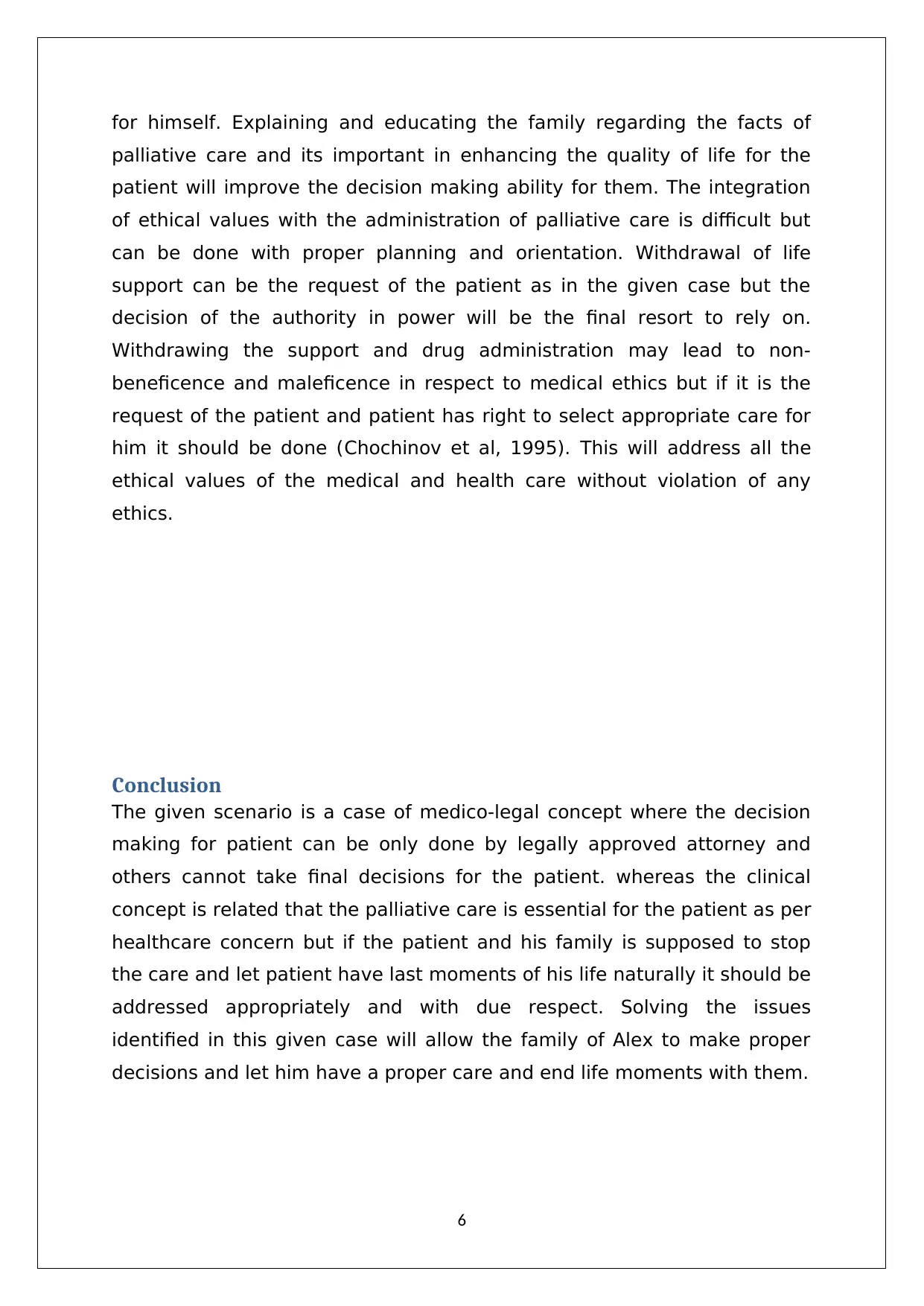
for himself. Explaining and educating the family regarding the facts of
palliative care and its important in enhancing the quality of life for the
patient will improve the decision making ability for them. The integration
of ethical values with the administration of palliative care is difficult but
can be done with proper planning and orientation. Withdrawal of life
support can be the request of the patient as in the given case but the
decision of the authority in power will be the final resort to rely on.
Withdrawing the support and drug administration may lead to non-
beneficence and maleficence in respect to medical ethics but if it is the
request of the patient and patient has right to select appropriate care for
him it should be done (Chochinov et al, 1995). This will address all the
ethical values of the medical and health care without violation of any
ethics.
Conclusion
The given scenario is a case of medico-legal concept where the decision
making for patient can be only done by legally approved attorney and
others cannot take final decisions for the patient. whereas the clinical
concept is related that the palliative care is essential for the patient as per
healthcare concern but if the patient and his family is supposed to stop
the care and let patient have last moments of his life naturally it should be
addressed appropriately and with due respect. Solving the issues
identified in this given case will allow the family of Alex to make proper
decisions and let him have a proper care and end life moments with them.
6
palliative care and its important in enhancing the quality of life for the
patient will improve the decision making ability for them. The integration
of ethical values with the administration of palliative care is difficult but
can be done with proper planning and orientation. Withdrawal of life
support can be the request of the patient as in the given case but the
decision of the authority in power will be the final resort to rely on.
Withdrawing the support and drug administration may lead to non-
beneficence and maleficence in respect to medical ethics but if it is the
request of the patient and patient has right to select appropriate care for
him it should be done (Chochinov et al, 1995). This will address all the
ethical values of the medical and health care without violation of any
ethics.
Conclusion
The given scenario is a case of medico-legal concept where the decision
making for patient can be only done by legally approved attorney and
others cannot take final decisions for the patient. whereas the clinical
concept is related that the palliative care is essential for the patient as per
healthcare concern but if the patient and his family is supposed to stop
the care and let patient have last moments of his life naturally it should be
addressed appropriately and with due respect. Solving the issues
identified in this given case will allow the family of Alex to make proper
decisions and let him have a proper care and end life moments with them.
6
⊘ This is a preview!⊘
Do you want full access?
Subscribe today to unlock all pages.

Trusted by 1+ million students worldwide

References
Aoun, S.M., Kristjanson, L.J., Currow, D.C. and Hudson, P.L., 2005.
Caregiving for the terminally ill: at what cost?.Palliative medicine, 19(7),
pp.551-555.
Bruera, E., Neumann, C.M., Mazzocato, C., Stiefel, F. and Sala, R.,
2000.Attitudes and beliefs of palliative care physicians regarding
communication with terminally ill cancer patients.Palliative medicine,
14(4), pp.287-298.
Chochinov, H.M., Wilson, K.G., Enns, M. and Mowchun, N., 1995.Desire for
death in the terminally ill. The American Journal of Psychiatry, 152(8),
p.1185.
Coulehan, J. and Williams, P.C., 2003.Conflicting professional values in
medical education.Cambridge Quarterly of Healthcare Ethics, 12(1), pp.7-
20.
7
Aoun, S.M., Kristjanson, L.J., Currow, D.C. and Hudson, P.L., 2005.
Caregiving for the terminally ill: at what cost?.Palliative medicine, 19(7),
pp.551-555.
Bruera, E., Neumann, C.M., Mazzocato, C., Stiefel, F. and Sala, R.,
2000.Attitudes and beliefs of palliative care physicians regarding
communication with terminally ill cancer patients.Palliative medicine,
14(4), pp.287-298.
Chochinov, H.M., Wilson, K.G., Enns, M. and Mowchun, N., 1995.Desire for
death in the terminally ill. The American Journal of Psychiatry, 152(8),
p.1185.
Coulehan, J. and Williams, P.C., 2003.Conflicting professional values in
medical education.Cambridge Quarterly of Healthcare Ethics, 12(1), pp.7-
20.
7
Paraphrase This Document
Need a fresh take? Get an instant paraphrase of this document with our AI Paraphraser

Ellershaw, J. and Ward, C., 2003. Care of the dying patient: the last hours
or days of life. BMJ: British Medical Journal, 326(7379), p.30.
Fainsinger, R.L., Tapper, M. and Bruera, E., 1993.A perspective on the
management of delirium in terminally ill patients on a palliative care
unit.Journal of palliative care.
Frommelt, K.H.M., 2003. Attitudes toward care of the terminally ill: an
educational intervention. American Journal of Hospice and Palliative
Medicine®, 20(1), pp.13-22.
Gillon, R., 1994. Medical ethics: four principles plus attention to scope.
BMJ: British Medical Journal, 309(6948), p.184.
Harris, J., 2006. The value of life: an introduction to medical ethics.
Routledge.
Orentlicher, D., 1990. From the Office of the General Counsel. Advance
medical directives. Jama, 263(17), p.2365.
8
or days of life. BMJ: British Medical Journal, 326(7379), p.30.
Fainsinger, R.L., Tapper, M. and Bruera, E., 1993.A perspective on the
management of delirium in terminally ill patients on a palliative care
unit.Journal of palliative care.
Frommelt, K.H.M., 2003. Attitudes toward care of the terminally ill: an
educational intervention. American Journal of Hospice and Palliative
Medicine®, 20(1), pp.13-22.
Gillon, R., 1994. Medical ethics: four principles plus attention to scope.
BMJ: British Medical Journal, 309(6948), p.184.
Harris, J., 2006. The value of life: an introduction to medical ethics.
Routledge.
Orentlicher, D., 1990. From the Office of the General Counsel. Advance
medical directives. Jama, 263(17), p.2365.
8
1 out of 8
Related Documents
Your All-in-One AI-Powered Toolkit for Academic Success.
+13062052269
info@desklib.com
Available 24*7 on WhatsApp / Email
Unlock your academic potential
Copyright © 2020–2025 A2Z Services. All Rights Reserved. Developed and managed by ZUCOL.