Analysis of Ethical Issues in Healthcare Decision Making

Verified

Added on  2021/06/17

|8
|2222
|65
Case Study
AI Summary
This case study examines ethical issues in a healthcare research scenario involving Justin and Daisy, who offered financial incentives and used fraudulent means to fund a study on Parkinson's disease. The analysis identifies violations of ethical principles such as beneficence, non-maleficence, patient autonomy, and professional codes of conduct. The researchers' actions, including offering payments to participants and making false claims, are scrutinized. The study also highlights the importance of informed consent, transparency, and the potential impact of research misconduct on patient care and public trust. Recommendations include increased awareness of ethical guidelines, the establishment of oversight bodies, and providing support for researchers. The conclusion emphasizes the need for healthcare professionals to identify and address ethical dilemmas, ensuring patient rights and upholding professional standards.
Document Page
Running head: ETHICAL ISSUES 1
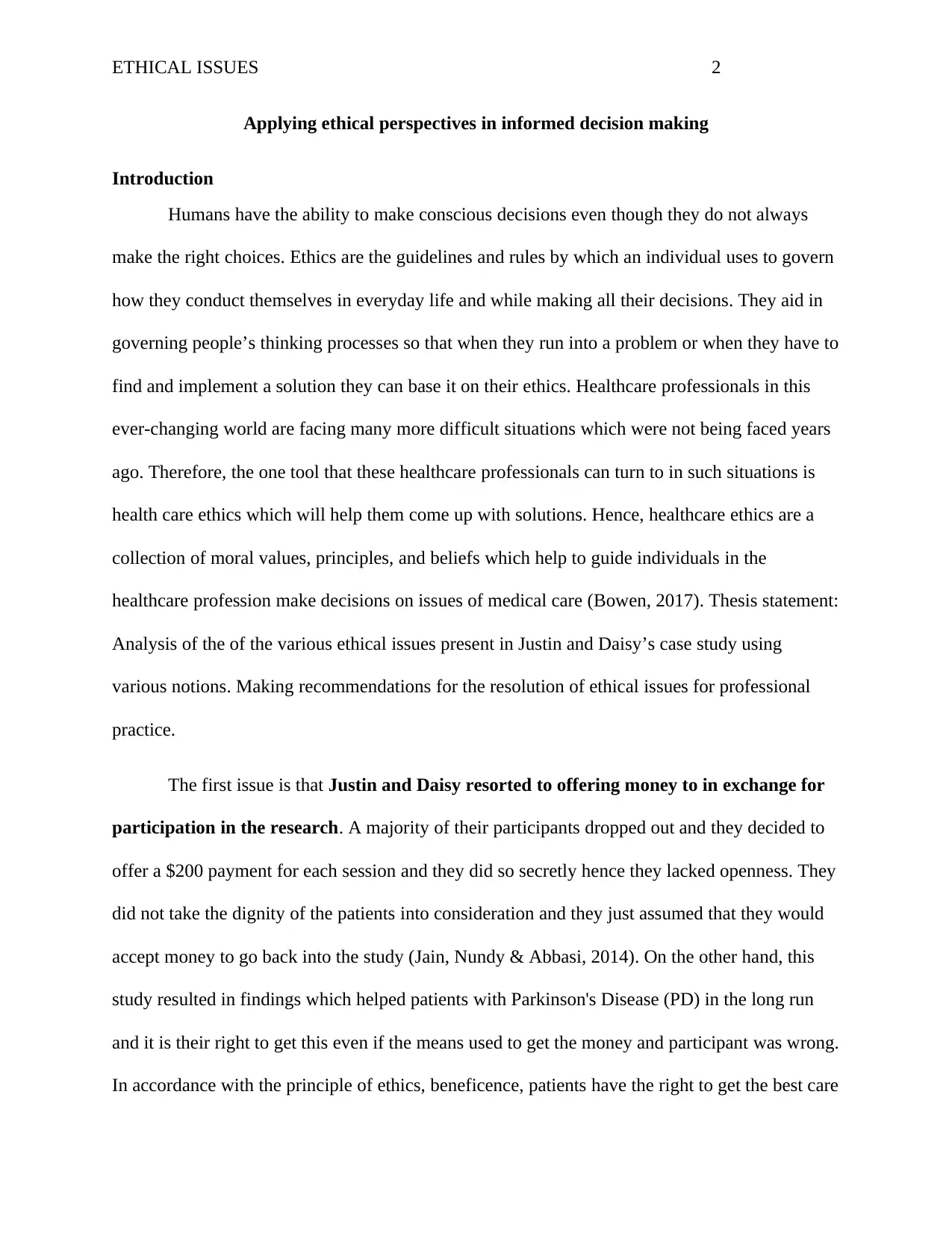
Applying Ethical Perspectives in Informed Decision Making
Name
Institutional Affiliation
tabler-icon-diamond-filled.svg

Paraphrase This Document

Need a fresh take? Get an instant paraphrase of this document with our AI Paraphraser
Document Page
ETHICAL ISSUES 2
Applying ethical perspectives in informed decision making
Introduction
Humans have the ability to make conscious decisions even though they do not always
make the right choices. Ethics are the guidelines and rules by which an individual uses to govern
how they conduct themselves in everyday life and while making all their decisions. They aid in
governing people’s thinking processes so that when they run into a problem or when they have to
find and implement a solution they can base it on their ethics. Healthcare professionals in this
ever-changing world are facing many more difficult situations which were not being faced years
ago. Therefore, the one tool that these healthcare professionals can turn to in such situations is
health care ethics which will help them come up with solutions. Hence, healthcare ethics are a
collection of moral values, principles, and beliefs which help to guide individuals in the
healthcare profession make decisions on issues of medical care (Bowen, 2017). Thesis statement:
Analysis of the of the various ethical issues present in Justin and Daisy’s case study using
various notions. Making recommendations for the resolution of ethical issues for professional
practice.
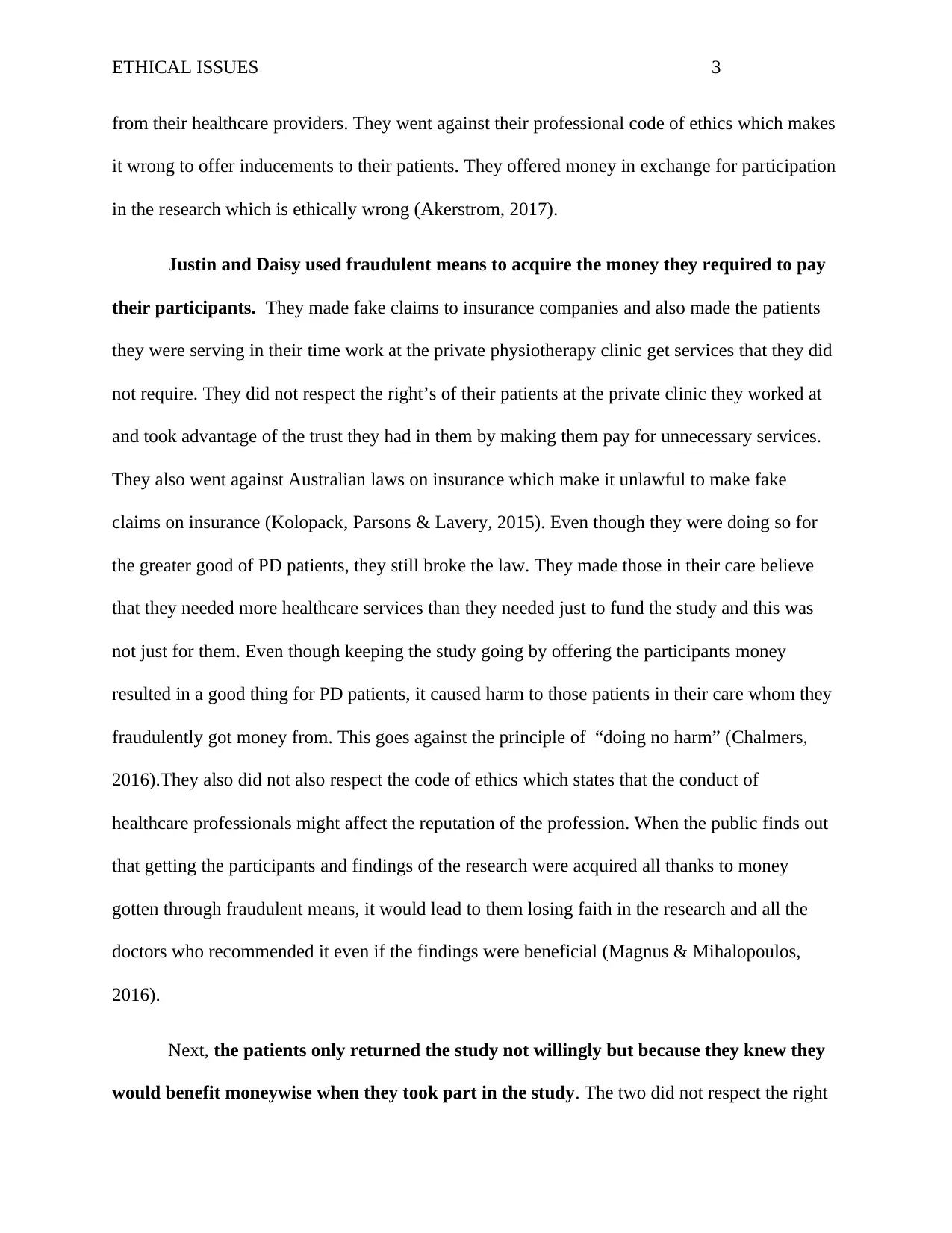
The first issue is that Justin and Daisy resorted to offering money to in exchange for
participation in the research. A majority of their participants dropped out and they decided to
offer a $200 payment for each session and they did so secretly hence they lacked openness. They
did not take the dignity of the patients into consideration and they just assumed that they would
accept money to go back into the study (Jain, Nundy & Abbasi, 2014). On the other hand, this
study resulted in findings which helped patients with Parkinson's Disease (PD) in the long run
and it is their right to get this even if the means used to get the money and participant was wrong.
In accordance with the principle of ethics, beneficence, patients have the right to get the best care
Document Page
ETHICAL ISSUES 3
from their healthcare providers. They went against their professional code of ethics which makes
it wrong to offer inducements to their patients. They offered money in exchange for participation
in the research which is ethically wrong (Akerstrom, 2017).
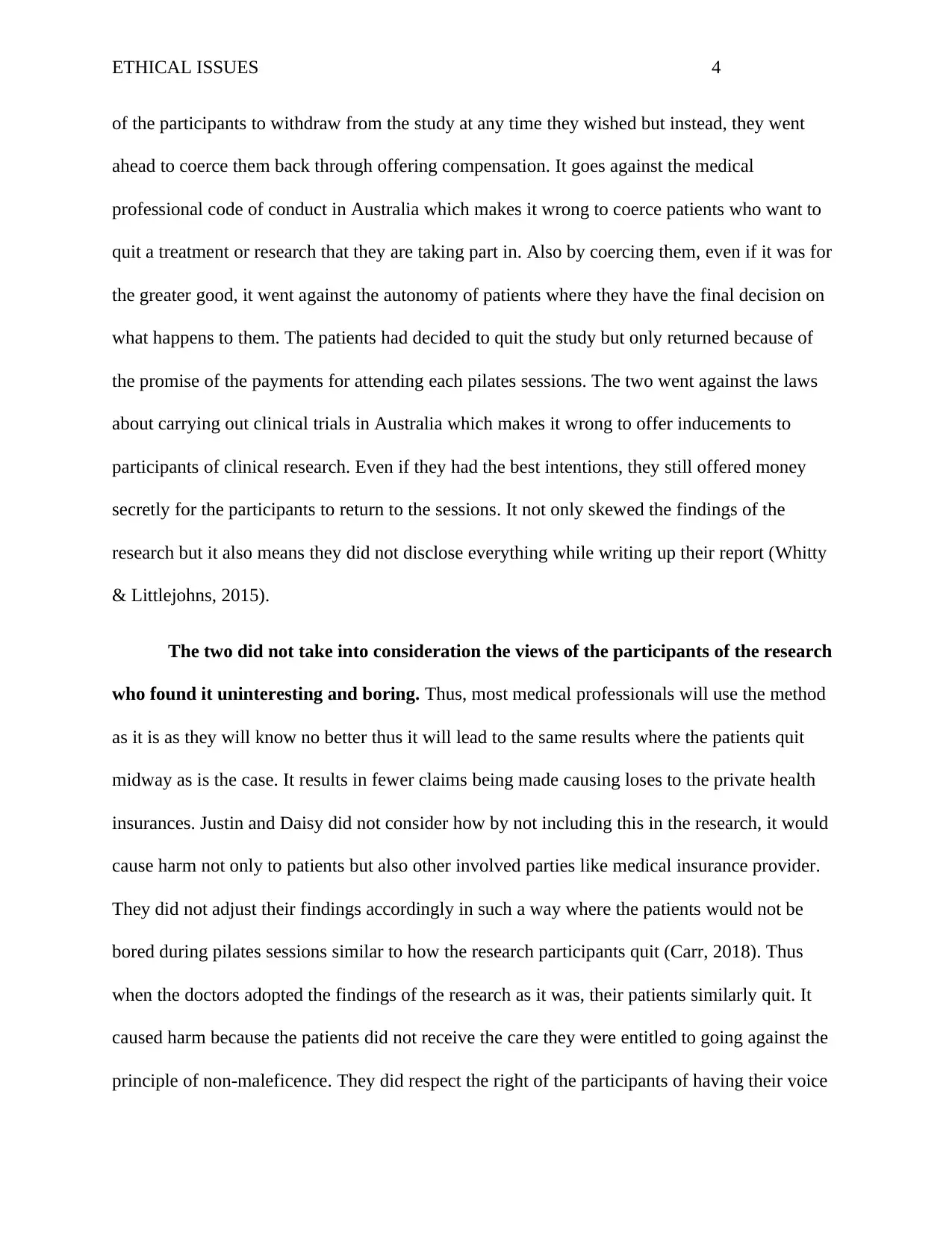
Justin and Daisy used fraudulent means to acquire the money they required to pay
their participants. They made fake claims to insurance companies and also made the patients
they were serving in their time work at the private physiotherapy clinic get services that they did
not require. They did not respect the right’s of their patients at the private clinic they worked at
and took advantage of the trust they had in them by making them pay for unnecessary services.
They also went against Australian laws on insurance which make it unlawful to make fake
claims on insurance (Kolopack, Parsons & Lavery, 2015). Even though they were doing so for
the greater good of PD patients, they still broke the law. They made those in their care believe
that they needed more healthcare services than they needed just to fund the study and this was
not just for them. Even though keeping the study going by offering the participants money
resulted in a good thing for PD patients, it caused harm to those patients in their care whom they
fraudulently got money from. This goes against the principle of “doing no harm” (Chalmers,
2016).They also did not also respect the code of ethics which states that the conduct of
healthcare professionals might affect the reputation of the profession. When the public finds out
that getting the participants and findings of the research were acquired all thanks to money
gotten through fraudulent means, it would lead to them losing faith in the research and all the
doctors who recommended it even if the findings were beneficial (Magnus & Mihalopoulos,
2016).
Next, the patients only returned the study not willingly but because they knew they
would benefit moneywise when they took part in the study. The two did not respect the right
Document Page
ETHICAL ISSUES 4
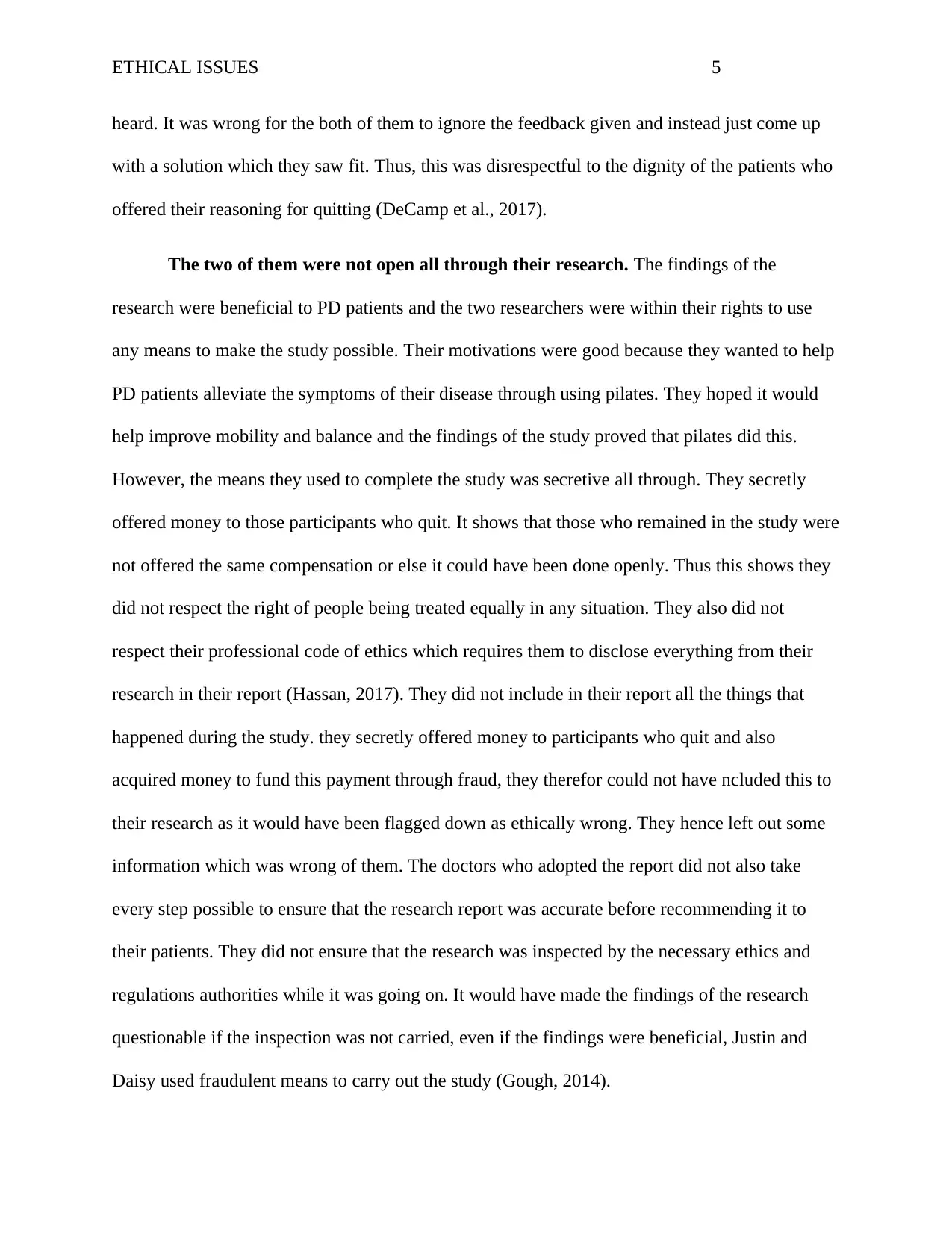
of the participants to withdraw from the study at any time they wished but instead, they went
ahead to coerce them back through offering compensation. It goes against the medical
professional code of conduct in Australia which makes it wrong to coerce patients who want to
quit a treatment or research that they are taking part in. Also by coercing them, even if it was for
the greater good, it went against the autonomy of patients where they have the final decision on
what happens to them. The patients had decided to quit the study but only returned because of
the promise of the payments for attending each pilates sessions. The two went against the laws
about carrying out clinical trials in Australia which makes it wrong to offer inducements to
participants of clinical research. Even if they had the best intentions, they still offered money
secretly for the participants to return to the sessions. It not only skewed the findings of the
research but it also means they did not disclose everything while writing up their report (Whitty
& Littlejohns, 2015).
The two did not take into consideration the views of the participants of the research
who found it uninteresting and boring. Thus, most medical professionals will use the method
as it is as they will know no better thus it will lead to the same results where the patients quit
midway as is the case. It results in fewer claims being made causing loses to the private health
insurances. Justin and Daisy did not consider how by not including this in the research, it would
cause harm not only to patients but also other involved parties like medical insurance provider.
They did not adjust their findings accordingly in such a way where the patients would not be
bored during pilates sessions similar to how the research participants quit (Carr, 2018). Thus
when the doctors adopted the findings of the research as it was, their patients similarly quit. It
caused harm because the patients did not receive the care they were entitled to going against the
principle of non-maleficence. They did respect the right of the participants of having their voice
tabler-icon-diamond-filled.svg

Paraphrase This Document

Need a fresh take? Get an instant paraphrase of this document with our AI Paraphraser
Document Page
ETHICAL ISSUES 5
heard. It was wrong for the both of them to ignore the feedback given and instead just come up
with a solution which they saw fit. Thus, this was disrespectful to the dignity of the patients who
offered their reasoning for quitting (DeCamp et al., 2017).
The two of them were not open all through their research. The findings of the
research were beneficial to PD patients and the two researchers were within their rights to use
any means to make the study possible. Their motivations were good because they wanted to help
PD patients alleviate the symptoms of their disease through using pilates. They hoped it would
help improve mobility and balance and the findings of the study proved that pilates did this.
However, the means they used to complete the study was secretive all through. They secretly
offered money to those participants who quit. It shows that those who remained in the study were
not offered the same compensation or else it could have been done openly. Thus this shows they
did not respect the right of people being treated equally in any situation. They also did not
respect their professional code of ethics which requires them to disclose everything from their
research in their report (Hassan, 2017). They did not include in their report all the things that
happened during the study. they secretly offered money to participants who quit and also
acquired money to fund this payment through fraud, they therefor could not have ncluded this to
their research as it would have been flagged down as ethically wrong. They hence left out some
information which was wrong of them. The doctors who adopted the report did not also take
every step possible to ensure that the research report was accurate before recommending it to
their patients. They did not ensure that the research was inspected by the necessary ethics and
regulations authorities while it was going on. It would have made the findings of the research
questionable if the inspection was not carried, even if the findings were beneficial, Justin and
Daisy used fraudulent means to carry out the study (Gough, 2014).
Document Page
ETHICAL ISSUES 6
Recommendations. First, all medical professionals even clinical researchers should be
aware of the code of ethics they are supposed to abide by, the policies concerning their fields and
the consequences they would face and they should know of all the principles of healthcare ethics.
There should also be people who are tasked with overseeing all aspects of the medical profession
including researching and enforcing any regulations, codes, and principles necessary (Kolopack,
Parsons & Lavery, 2015). Finally, there should be clear ways set for those conducting research to
cope with the stresses of conduction them. It is a known fact that doing research is quite stressful
and people cope with it differently. Therefore, therapists and lessons on how to cope with stress
associated with doing research should be made readily availabe (Runciman, Merry & Walton,
2017).
Conclusion.
In conclusion, healthcare ethics occur quite frequently while medical professionals are
carrying out the different duties and therefore they should be able to deal with them. They should
first be able to identify these ethical issues and then come up with solutions that follow the
various code of ethics, principles of health care ethics, dignity and rights of their patients, and the
policies that exist and are relevant to their profession. The above case had various ethical issues
which were identified and analyzed in depth. I made recommendations which, in my opinion,
should be put to use in the field when facing similar ethical issues. Nevertheless, further case
studies must be analyzed so that more solutions and recommendations can be formulated.
Document Page
ETHICAL ISSUES 7
References
Akerstrom, M. (2017). Suspicious gifts: bribery, morality, and professional ethics. Routledge.
Bowen, R. T. (2017). What Is Ethics? In Ethics and the Practice of Forensic Science, Second
Edition (pp. 19-36). CRC Press.
Carr, D. (Ed.). (2018). Cultivating Moral Character and Virtue in Professional Practice.
Routledge.
Chalmers, D. (2016). International medical research regulation: from ethics to law. In First Do
No Harm (pp. 97-116). Routledge.
DeCamp, M., Crump, J. A., Sugarman, J., Todd, T., Walker, X., & Ali, A. (2017). 13 Existing
and emerging ethical standards in global health education. Global Health Experiential
Education: From Theory to Practice.
Gough, I. R. (2014). The significance of Good Medical Practice: a code of conduct for doctors in
Australia. The Medical journal of Australia, 200(3), 148-149.
Hassan, M. M. U. (2017). Good Medical Practice (Duties of a Registered Doctor). Anwer Khan
Modern Medical College Journal, 7(2), 4-5.
Jain, A., Nundy, S., & Abbasi, K. (2014). Corruption: medicine’s dirty open secret.
Kolopack, P. A., Parsons, J. A., & Lavery, J. V. (2015). What makes community engagement
effective?: lessons from the Eliminate Dengue Program in Queensland Australia. PLoS
neglected tropical diseases, 9(4), e0003713.
Magnus, A., & Mihalopoulos, C. (2016). Cost-benefit analyses of treatments recommended in
Australian clinical practice guidelines. Trauma-related stress in Australia, 55.
tabler-icon-diamond-filled.svg

Paraphrase This Document

Need a fresh take? Get an instant paraphrase of this document with our AI Paraphraser
Document Page
ETHICAL ISSUES 8
Runciman, B., Merry, A., & Walton, M. (2017). Safety and ethics in healthcare: a guide to
getting it right. CRC Press.
Whitty, J. A., & Littlejohns, P. (2015). Social values and health priority setting in Australia: an
analysis applied to the context of health technology assessment. Health Policy, 119(2),
127-136.
chevron_up_icon
1 out of 8
circle_padding
hide_on_mobile
zoom_out_icon
[object Object]