Applying Ethical Theory: Case Study Analysis, University Assignment

Verified

Added on  2023/04/23

|9
|2154
|423
Essay
AI Summary
This essay analyzes a case study of China's social credit system through the lens of four classical ethical theories: utilitarianism, deontology, contract theory, and virtue ethics. The introduction provides background on the social credit system and its implications. The discussion section delves into each ethical theory, applying them to the case study to evaluate its ethical dimensions. Utilitarianism is examined in terms of its potential benefits for the majority, while deontology focuses on the duties and obligations involved. The contract theory explores the social agreements and implicit rules at play, and virtue ethics assesses the character and motivations of those involved. The essay concludes with a summary of the findings and recommendations based on the ethical analysis, emphasizing the complex interplay of ethical considerations in the context of the social credit system. The essay uses the analysis to provide recommendations on the case study, providing a comprehensive overview of the topic and the different ethical considerations. The essay uses the analysis to provide recommendations on the case study, providing a comprehensive overview of the topic and the different ethical considerations. The essay also includes a reference list in the APA format.
Document Page
Running head: APPLYING ETHICAL THEORY
Applying Ethical Theory
Name of the Student
Name of the University
Author Note:
tabler-icon-diamond-filled.svg

Paraphrase This Document

Need a fresh take? Get an instant paraphrase of this document with our AI Paraphraser
Document Page
1APPLYING ETHICAL THEORY
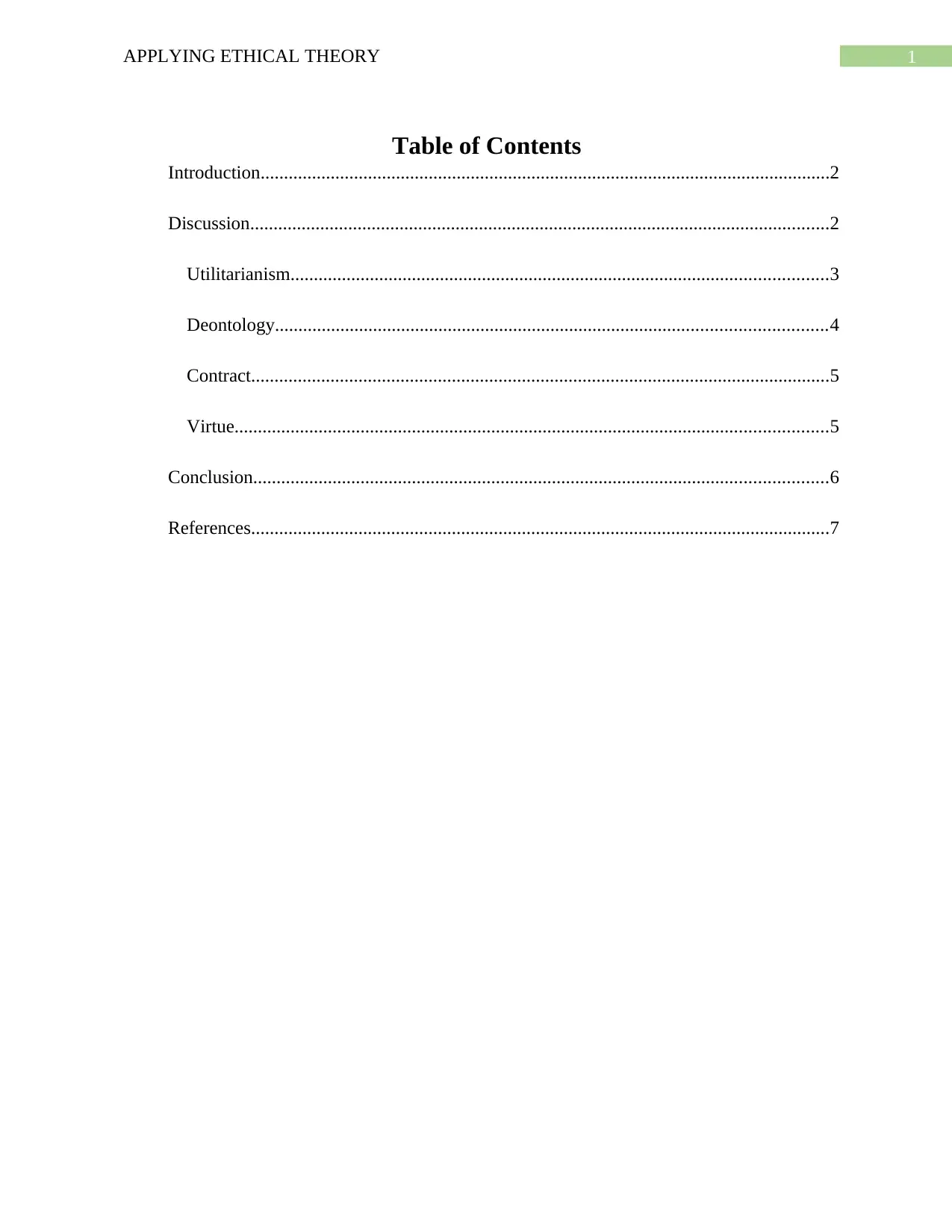
Table of Contents
Introduction..........................................................................................................................2
Discussion............................................................................................................................2
Utilitarianism...................................................................................................................3
Deontology......................................................................................................................4
Contract............................................................................................................................5
Virtue...............................................................................................................................5
Conclusion...........................................................................................................................6
References............................................................................................................................7
Document Page
2APPLYING ETHICAL THEORY
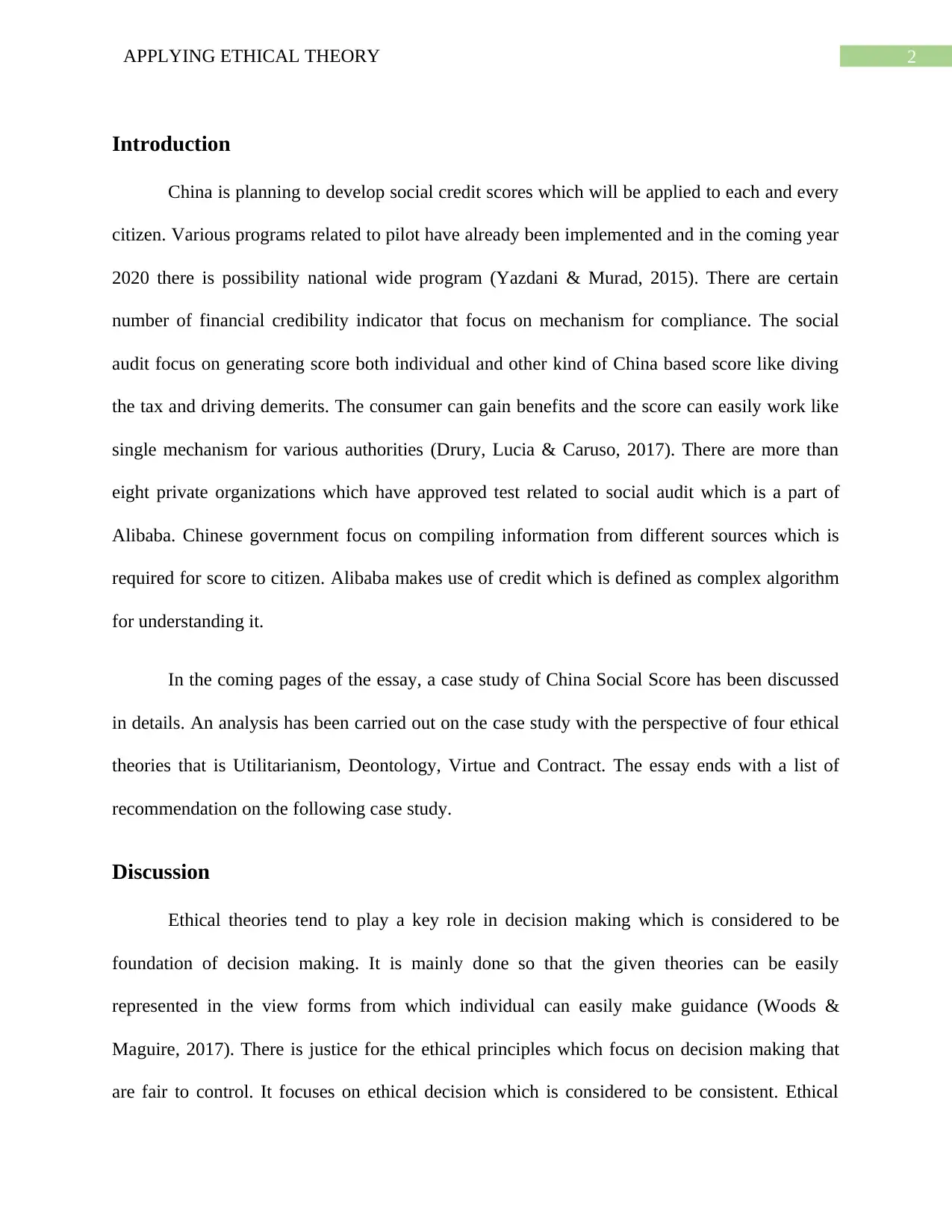
Introduction
China is planning to develop social credit scores which will be applied to each and every
citizen. Various programs related to pilot have already been implemented and in the coming year
2020 there is possibility national wide program (Yazdani & Murad, 2015). There are certain
number of financial credibility indicator that focus on mechanism for compliance. The social
audit focus on generating score both individual and other kind of China based score like diving
the tax and driving demerits. The consumer can gain benefits and the score can easily work like
single mechanism for various authorities (Drury, Lucia & Caruso, 2017). There are more than
eight private organizations which have approved test related to social audit which is a part of
Alibaba. Chinese government focus on compiling information from different sources which is
required for score to citizen. Alibaba makes use of credit which is defined as complex algorithm
for understanding it.
In the coming pages of the essay, a case study of China Social Score has been discussed
in details. An analysis has been carried out on the case study with the perspective of four ethical
theories that is Utilitarianism, Deontology, Virtue and Contract. The essay ends with a list of
recommendation on the following case study.
Discussion
Ethical theories tend to play a key role in decision making which is considered to be
foundation of decision making. It is mainly done so that the given theories can be easily
represented in the view forms from which individual can easily make guidance (Woods &
Maguire, 2017). There is justice for the ethical principles which focus on decision making that
are fair to control. It focuses on ethical decision which is considered to be consistent. Ethical
Document Page
3APPLYING ETHICAL THEORY
theories focus on large number of things like understanding circumstances which can be easily
identified.
Utilitarianism
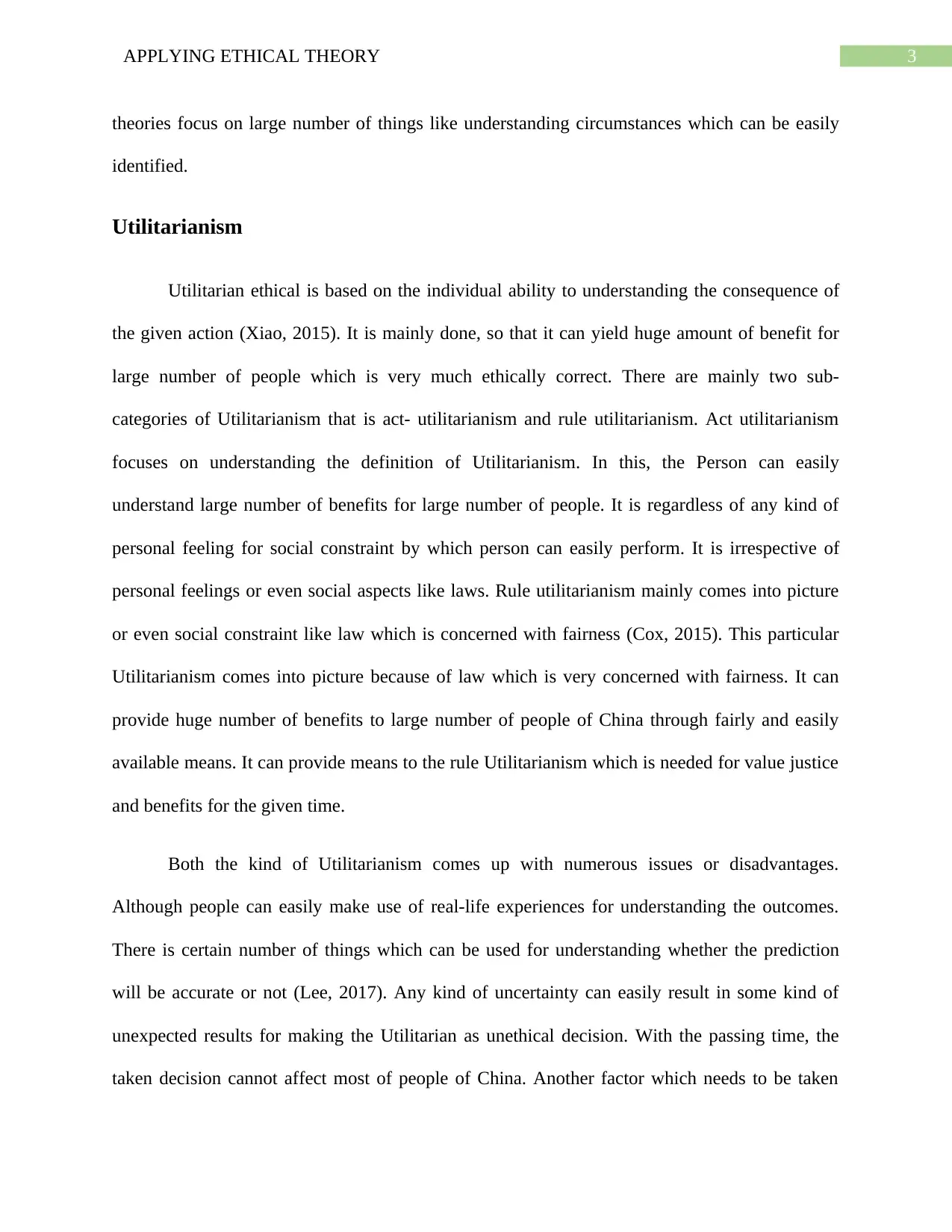
Utilitarian ethical is based on the individual ability to understanding the consequence of
the given action (Xiao, 2015). It is mainly done, so that it can yield huge amount of benefit for
large number of people which is very much ethically correct. There are mainly two sub-
categories of Utilitarianism that is act- utilitarianism and rule utilitarianism. Act utilitarianism
focuses on understanding the definition of Utilitarianism. In this, the Person can easily
understand large number of benefits for large number of people. It is regardless of any kind of
personal feeling for social constraint by which person can easily perform. It is irrespective of
personal feelings or even social aspects like laws. Rule utilitarianism mainly comes into picture
or even social constraint like law which is concerned with fairness (Cox, 2015). This particular
Utilitarianism comes into picture because of law which is very concerned with fairness. It can
provide huge number of benefits to large number of people of China through fairly and easily
available means. It can provide means to the rule Utilitarianism which is needed for value justice
and benefits for the given time.
Both the kind of Utilitarianism comes up with numerous issues or disadvantages.
Although people can easily make use of real-life experiences for understanding the outcomes.
There is certain number of things which can be used for understanding whether the prediction
will be accurate or not (Lee, 2017). Any kind of uncertainty can easily result in some kind of
unexpected results for making the Utilitarian as unethical decision. With the passing time, the
taken decision cannot affect most of people of China. Another factor which needs to be taken
tabler-icon-diamond-filled.svg

Paraphrase This Document

Need a fresh take? Get an instant paraphrase of this document with our AI Paraphraser
Document Page
4APPLYING ETHICAL THEORY
into account that Utilitarian for understanding their concern along with its ability. It is mainly
done with comparison of different kind of consequences which is provided on same given scale.
It is mainly done by understanding the comparing gains like money (Nichols, 2015). It is
compared with any kind of intangible gains like happiness which makes qualities for different
kind of qualities to very large extent.
The act of Utilitarian focus on achieving decision which is needed for getting maximum
number of good result. It mainly focuses on some kind of individual gain which needs to gain
benefit from large number of people (Sen, 2017). The fact can be easily concluded that
Utilitarianism which is not very concerned with justice. It can easily provide benefit for different
individual. It can easily lead to some kind of solution which can provide benefit to large number
of people. Apart from this, there are large number of Utilitarian decision which tends to occur on
the individual phase. It can easily result in huge number of changes in the given condition.
Deontology
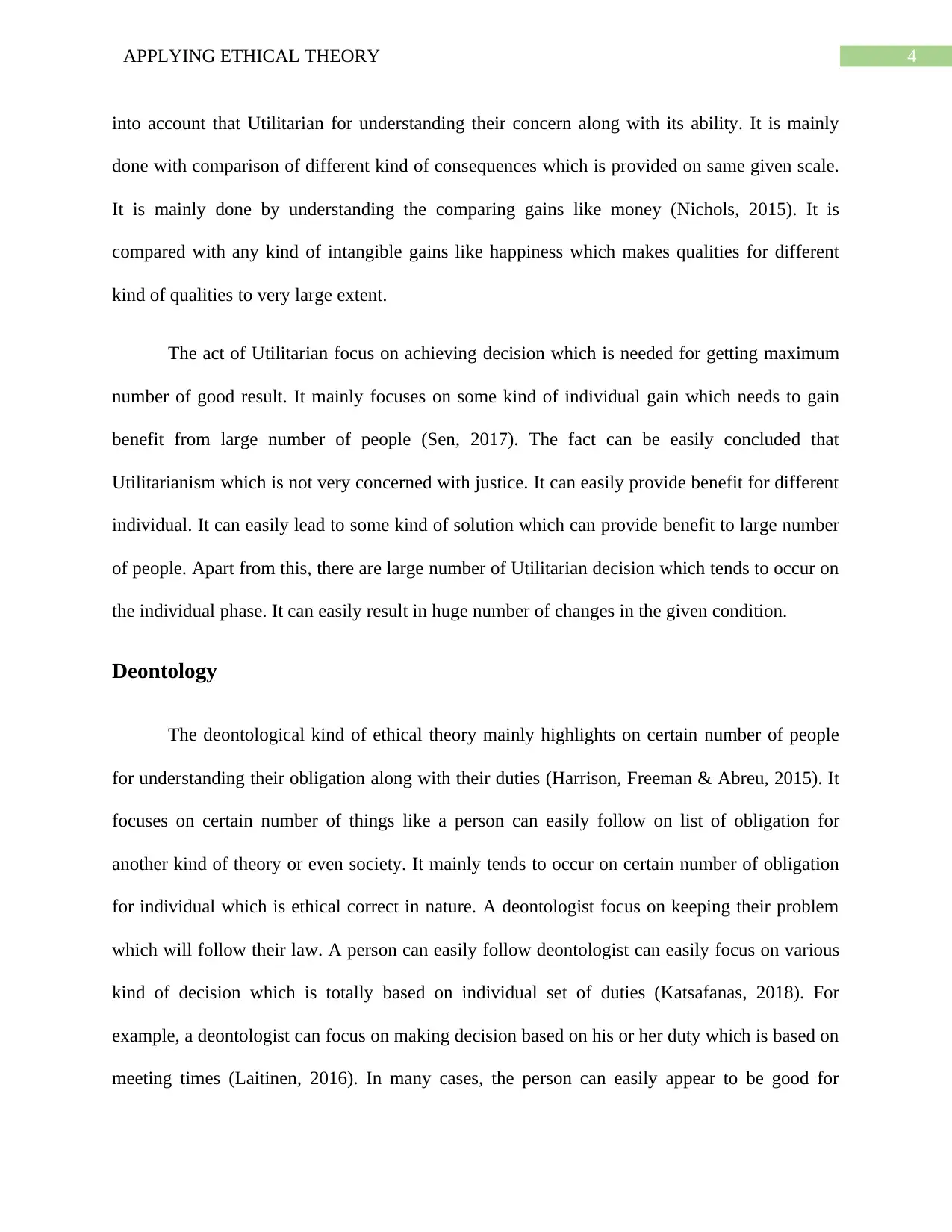
The deontological kind of ethical theory mainly highlights on certain number of people
for understanding their obligation along with their duties (Harrison, Freeman & Abreu, 2015). It
focuses on certain number of things like a person can easily follow on list of obligation for
another kind of theory or even society. It mainly tends to occur on certain number of obligation
for individual which is ethical correct in nature. A deontologist focus on keeping their problem
which will follow their law. A person can easily follow deontologist can easily focus on various
kind of decision which is totally based on individual set of duties (Katsafanas, 2018). For
example, a deontologist can focus on making decision based on his or her duty which is based on
meeting times (Laitinen, 2016). In many cases, the person can easily appear to be good for
Document Page
5APPLYING ETHICAL THEORY
choosing concerning their duty. In some case, a person can easily make conflict concerning their
duties.
Contract
According to this theory, people who are living in the society are by the established moral
and political values. Social contract tends to come with certain laws and even implicit which is
hard to speak (Norlock, 2016). In the article of CNBC, both kinds of article tends to highlight the
present benefits which can be achieved from the implementation of social credit system of
China. It comes up with potential drawbacks which are related to both privacy and social
controls. The Chinese social media can easily reflect on some popular discussion which is
brainstorming in nature (Sen, 2017). It can easily result in improving the bicycle share scheme.
Planning outline agrees to the fact that social credit score is considered to be effective way for
strengthening the social sincerity. It can ultimately result in trust in Chinese society along with
reducing the social contradictions.
Virtue
The virtue ethical theory is all about judging a person by his or her character instead of
their action. It can be easily used for deviating from his or her normal behaviour. It can easily
take up the normal behavior of the person, motivation and lastly reputation (Harrison, Freeman
& Abreu, 2015). It can easily motivate their account ranging which is considered to be ethical. If
anyhow, a person receives a plagiarized is detected then it can be later detected by a peer. Only
peer has the knowledge to have an understanding concerning the character of the person. It can
be judge as per the friendly nature. The plagiarizer can follow certain number of rules which are
good and can be judge as per the need. The peer can easily follow certain number of rules which
Document Page
6APPLYING ETHICAL THEORY
is considered to be good. Peer can easily encounter the given plagiarized for analyzing his friend
in more efficiently (Katsafanas, 2018). The plagiarizer can easily follow certain number of rules
and good standing among their colleagues. Peer can easily encounter the plagiarized passage
which is required for judging the whole thing in lenient way. The fact can be easily encountered
that the researcher had a late night which is all about forgetting the credit source. Along with
this, the person can easily judge on the reputation of misconduct which can be judge for
plagiarized work. It can take place as a result of consistent unethical behaviour in the past.
The virtue theory comes up with certain number of issues which can affect the
consideration for moral behaviour. Scientist who has made a mistake in the past can easily result
in late night story (Laitinen, 2016). A researcher can focus on understanding sudden amount of
changes that are moral and immoral where the character cannot be noticed.
Conclusion
The above pages of the report mainly help in concluding the fact that the report is all
about China social credit score. In the above pages of the report, a case study of China social
credit score has been discussed in details. The case study in the following link has been
described by four ethical theories that are Utilitarianism, deontology, contract and lastly virtue.
The plan of adopting credit score system has been approved by eight private organizations. The
subsidiary of Alibaba organization has also approved it. In the case study, an idea has been
provided concerning the present benefits of social credit system. Apart from this, the article
highlights, any kind of drawbacks which are related to social and private. A proper scan on the
social media of china merely highlighted Sesame Credit. It mainly involved people
brainstorming which should improve the scheme of bicycle share.
tabler-icon-diamond-filled.svg

Paraphrase This Document

Need a fresh take? Get an instant paraphrase of this document with our AI Paraphraser
Document Page
7APPLYING ETHICAL THEORY
References
Cox, J. G. (2015). Reframing Ethical Theory, Pedagogy, and Legislation to Bias Open Source
AGI Towards Friendliness and Wisdom. Journal of Evolution and Technology, 25(2), 39-
54.
Drury, M., Lucia, J., & Caruso, V. (2017). Autonomous Vehicles: An Ethical Theory to Guide
Their Future.
Harrison, J. S., Freeman, R. E., & Abreu, M. C. S. D. (2015). Stakeholder theory as an ethical
approach to effective management: Applying the theory to multiple contexts. Revista
brasileira de gestão de negócios, 17(55), 858-869.
Katsafanas, P. (2018). The Antichrist as a guide to Nietzsche’s mature ethical theory. In The
Nietzschean Mind (pp. 95-114). Routledge.
Laitinen, A. (2016). Hegelian Constructivism in Ethical Theory?. I that is We and We that is I”.
Perspectives on Contemporary Hegel: Social Ontology, Recognition, Naturalism, and the
Critique of Kantian Constructivism, 127-146.
Lee, C. (2017). Mind as Conceptual Structure: On Ethical Theory of CI Lewis’s Conceptual
Pragmatism.
Nichols, R. (2015). Early Confucianism is a System for Social-Functional Influence and
Probably Does Not Represent a Normative Ethical Theory. Dao, 14(4), 499-520.
Norlock, K. J. (2016). The Challenges of Extreme Moral Stress: Claudia Card's Contributions to
the Formation of Nonideal Ethical Theory. Metaphilosophy, 47(4-5), 488-503.
Document Page
8APPLYING ETHICAL THEORY
Sen, A. (2017). Elements of a theory of human rights. In Justice and the Capabilities
Approach (pp. 221-262). Routledge.
Woods, J., & Maguire, B. (2017). Model Theory, Hume's Dictum, and the Priority of Ethical
Theory.
Xiao, Y. (2015). The Structure of Ethical Theory in Early Chinese Philosophy. The Routledge
companion to virtue ethics, 471.
Yazdani, N., & Murad, H. S. (2015). Toward an ethical theory of organizing. Journal of
Business Ethics, 127(2), 399-417.
chevron_up_icon
1 out of 9
circle_padding
hide_on_mobile
zoom_out_icon
[object Object]