Analysis of Ethical Learning and Barriers at Commonwealth Bank

Verified

Added on  2021/04/21

|4
|608
|64
Report
AI Summary
This report focuses on the ethical learning of Commonwealth Bank, examining the barriers that hinder its ethical development. The study identifies issues such as employee misconduct, hierarchical management structures, and customer service problems as significant obstacles. The report highlights the impact of unethical behavior on the bank's reputation and financial performance. To address these challenges, the report suggests implementing a participative management style, improving online services, and establishing a disciplinary committee. An ethical training plan is also presented, including basic introduction training, workshops, executive training, and subjective specific sessions to enhance ethical awareness and practices within the bank. The recommendations aim to improve ethical learning and promote a more ethical organizational culture.
Document Page
Running head: THE LEARNING ORGANIZATION
The learning organization
Name of the Student:
Name of the University:
Author’s note:
tabler-icon-diamond-filled.svg

Paraphrase This Document

Need a fresh take? Get an instant paraphrase of this document with our AI Paraphraser
Document Page
1
THE LEARNING ORGANIZATION
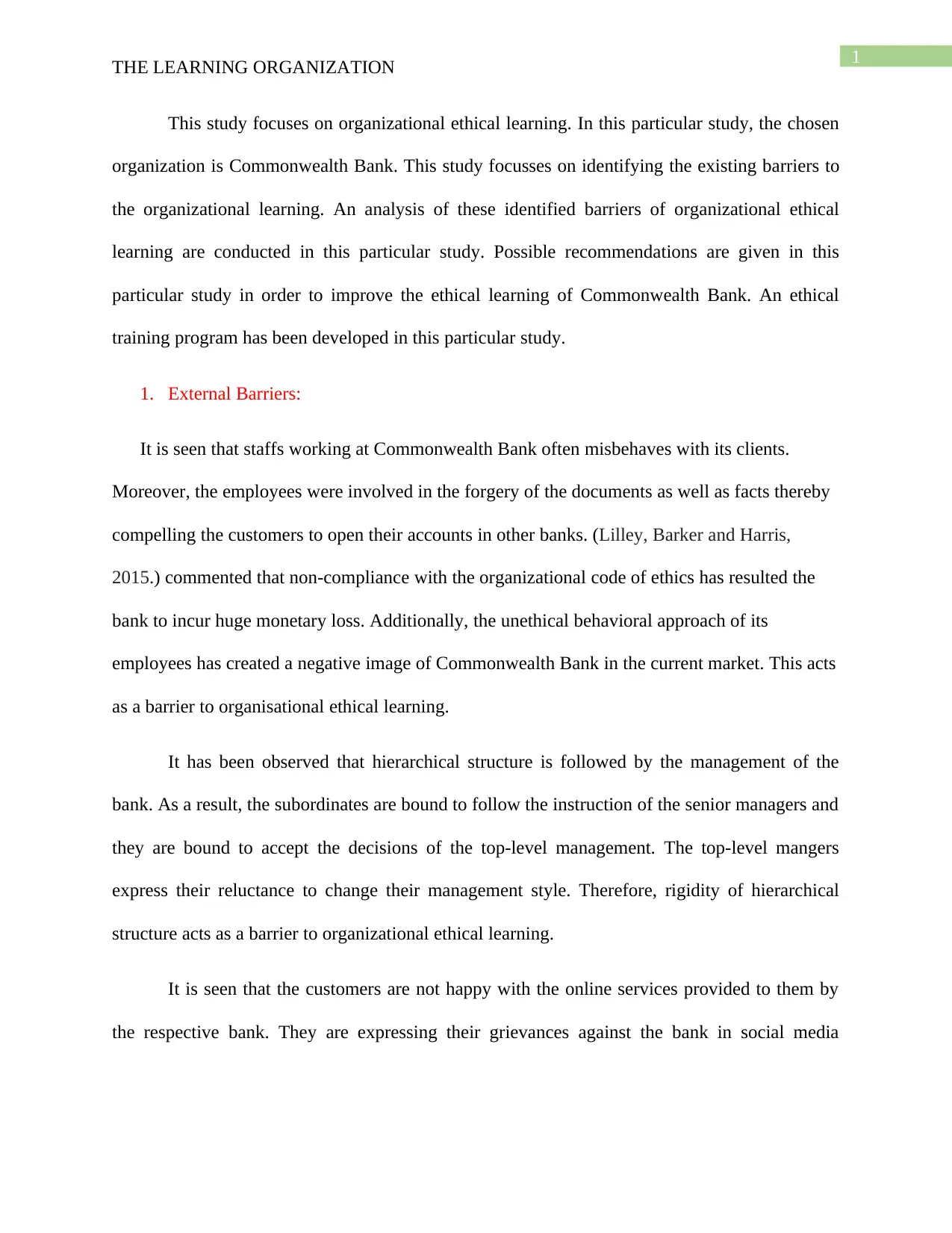
This study focuses on organizational ethical learning. In this particular study, the chosen
organization is Commonwealth Bank. This study focusses on identifying the existing barriers to
the organizational learning. An analysis of these identified barriers of organizational ethical
learning are conducted in this particular study. Possible recommendations are given in this
particular study in order to improve the ethical learning of Commonwealth Bank. An ethical
training program has been developed in this particular study.
1. External Barriers:
It is seen that staffs working at Commonwealth Bank often misbehaves with its clients.
Moreover, the employees were involved in the forgery of the documents as well as facts thereby
compelling the customers to open their accounts in other banks. (Lilley, Barker and Harris,
2015.) commented that non-compliance with the organizational code of ethics has resulted the
bank to incur huge monetary loss. Additionally, the unethical behavioral approach of its
employees has created a negative image of Commonwealth Bank in the current market. This acts
as a barrier to organisational ethical learning.
It has been observed that hierarchical structure is followed by the management of the
bank. As a result, the subordinates are bound to follow the instruction of the senior managers and
they are bound to accept the decisions of the top-level management. The top-level mangers
express their reluctance to change their management style. Therefore, rigidity of hierarchical
structure acts as a barrier to organizational ethical learning.
It is seen that the customers are not happy with the online services provided to them by
the respective bank. They are expressing their grievances against the bank in social media
Document Page
2
THE LEARNING ORGANIZATION
thereby ruining the reputation of this bank. This is one of the major barriers to organizational
ethical learning (Brunetto et al. 2015).
2. Recommendations
There is a need for the bank managers to adopt participative style of management where
employees can share their opinion freely without any hesitation. There is also a need for the bank
to introduce a toll-free number where customers can contact the branches in order to avail the
online services. In order to avail this facility, the contact number and account number should be
registered with the bank. A separate committee will be established for undertaking the
disciplinary action against the guilty person involved in the forgery of the documents or
misbehaving with clients (Brunetto et al. 2015).
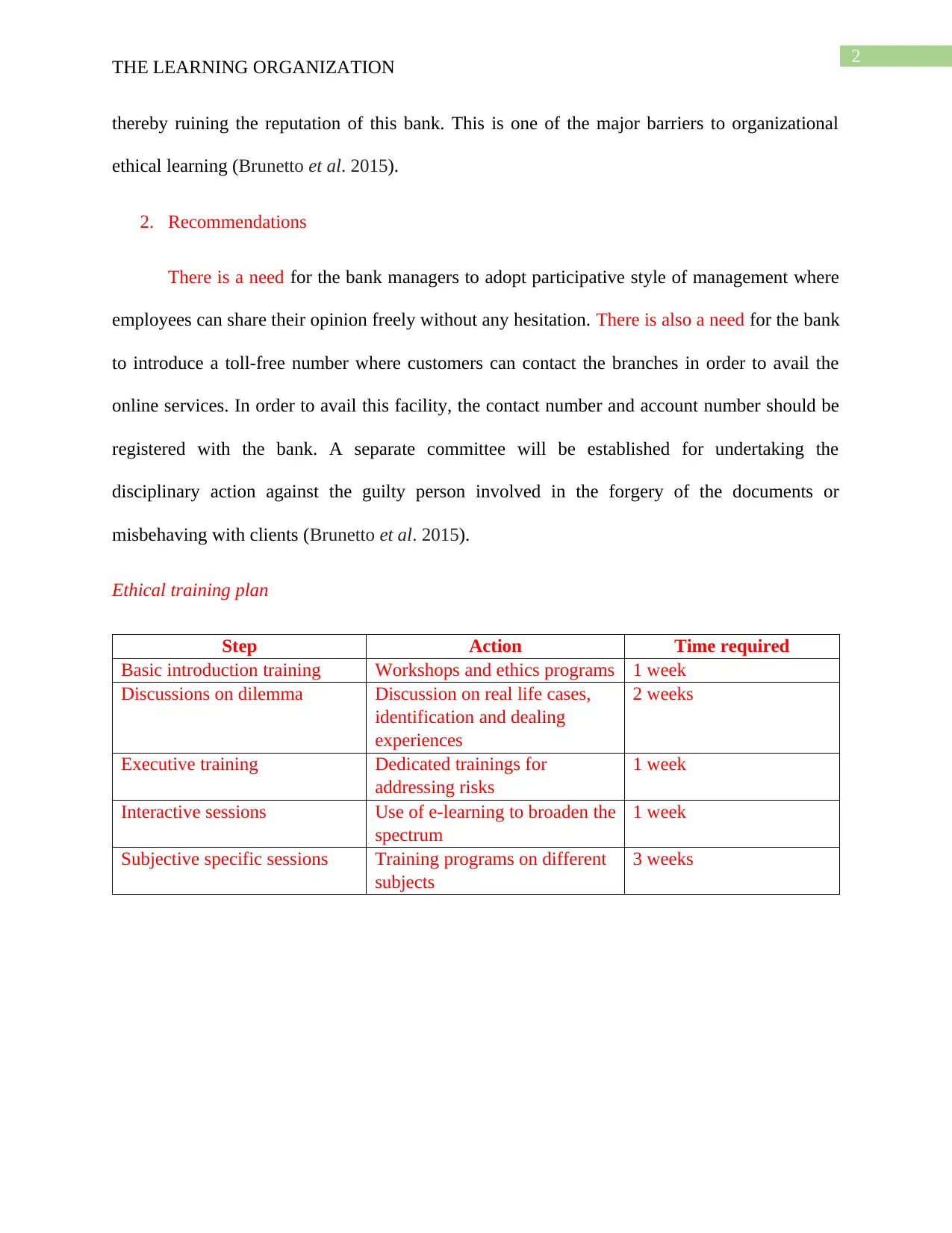
Ethical training plan
Step Action Time required
Basic introduction training Workshops and ethics programs 1 week
Discussions on dilemma Discussion on real life cases,
identification and dealing
experiences
2 weeks
Executive training Dedicated trainings for
addressing risks
1 week
Interactive sessions Use of e-learning to broaden the
spectrum
1 week
Subjective specific sessions Training programs on different
subjects
3 weeks
Document Page
3
THE LEARNING ORGANIZATION
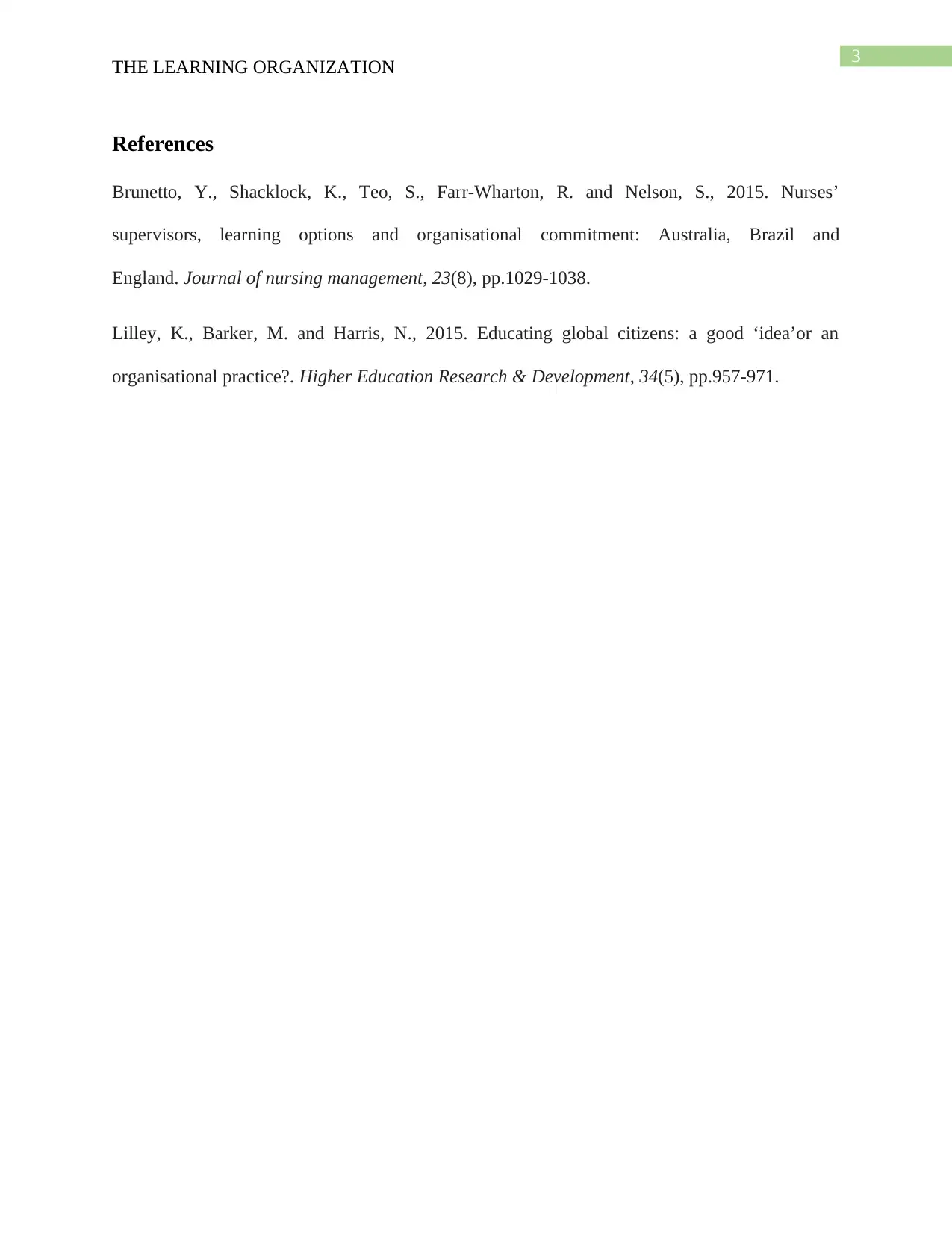
References
Brunetto, Y., Shacklock, K., Teo, S., Farr‐Wharton, R. and Nelson, S., 2015. Nurses’
supervisors, learning options and organisational commitment: Australia, Brazil and
England. Journal of nursing management, 23(8), pp.1029-1038.
Lilley, K., Barker, M. and Harris, N., 2015. Educating global citizens: a good ‘idea’or an
organisational practice?. Higher Education Research & Development, 34(5), pp.957-971.
chevron_up_icon
1 out of 4
circle_padding
hide_on_mobile
zoom_out_icon
[object Object]