SOC10236 - Ethical Implications of Body Shaming: A Media Analysis
VerifiedAdded on 2023/06/13
|9
|1490
|393
Essay
AI Summary
This essay provides a consequential ethical analysis of body shaming in media and advertising. It explores the ethical issues surrounding the promotion of health interventions and the impact of media on public perceptions of body image. The essay delves into the controversy of body shaming, particularly its effects on women, and discusses the psychological consequences of fat shaming, including discrimination, marginalization, and depression. It also examines the prevalence of body shaming across genders, its impact on self-esteem, and the complexities of body positivity. Furthermore, the essay critiques the lack of attention to race and gender in public discussions of body shaming and applies utilitarian theory to analyze the positive and negative consequences of this practice. The essay concludes by advocating for policies to protect the dignity and human rights of individuals, regardless of their body size or shape and highlights the need to stop judging people based on appearances. Desklib provides more resources like this to aid in student learning.
Running head: CONSEQUENTIAL ETHICAL ANALYSIS
Consequential ethical analysis
Name of the Student
Name of the University
Author Note
Consequential ethical analysis
Name of the Student
Name of the University
Author Note
Paraphrase This Document
Need a fresh take? Get an instant paraphrase of this document with our AI Paraphraser

CONSEQUENTIAL ETHICAL ANALYSIS
Table of Contents
Assignment 1..............................................................................................................................2
(a)...............................................................................................................................................2
(b)...............................................................................................................................................2
(c)...............................................................................................................................................2
(d)...............................................................................................................................................4
(e)...............................................................................................................................................4
(f)................................................................................................................................................5
References..................................................................................................................................6
Table of Contents
Assignment 1..............................................................................................................................2
(a)...............................................................................................................................................2
(b)...............................................................................................................................................2
(c)...............................................................................................................................................2
(d)...............................................................................................................................................4
(e)...............................................................................................................................................4
(f)................................................................................................................................................5
References..................................................................................................................................6

CONSEQUENTIAL ETHICAL ANALYSIS
Assignment 1
(a)
Is the concept of body shaming ethical in media and advertisement?
(b)
The promotion of health interventions in the advertisement these days raises ethical
issues since media influences the lifestyle and views of the common people. The question of
ethics of body shaming in the media is a growing concern. Media channels have been
promoting obesity in the name of awareness. People suffering from obesity, huge and curvy
figures are often getting offended. This controversy has affected the women mostly since
women are more conscious about their appearance rather than men. Body shaming or fat-
shaming that is widely practiced in the media or advertising channels is actually worsening
the scenario (Davis2015). The ethical problem of body shaming is important since making
people feel bad about their personalities, bodies and appearance demotivates and dishearten
them. People with obesity feels discriminated, marginalized and are more getting into
depression and stay obese. According to the World Health Organization ( WHO), Obesity is
considered to be an epidemic throughout the world. People suffering from obesity have a
higher risk of getting affected by life-threatening diseases and illness. The ethics of body
shaming is a big question and should be analyzed to further extent since it is leading to public
shaming and depression among individuals. People are getting offended in the media by
various types of obesity advertisements.
(c)
Assignment 1
(a)
Is the concept of body shaming ethical in media and advertisement?
(b)
The promotion of health interventions in the advertisement these days raises ethical
issues since media influences the lifestyle and views of the common people. The question of
ethics of body shaming in the media is a growing concern. Media channels have been
promoting obesity in the name of awareness. People suffering from obesity, huge and curvy
figures are often getting offended. This controversy has affected the women mostly since
women are more conscious about their appearance rather than men. Body shaming or fat-
shaming that is widely practiced in the media or advertising channels is actually worsening
the scenario (Davis2015). The ethical problem of body shaming is important since making
people feel bad about their personalities, bodies and appearance demotivates and dishearten
them. People with obesity feels discriminated, marginalized and are more getting into
depression and stay obese. According to the World Health Organization ( WHO), Obesity is
considered to be an epidemic throughout the world. People suffering from obesity have a
higher risk of getting affected by life-threatening diseases and illness. The ethics of body
shaming is a big question and should be analyzed to further extent since it is leading to public
shaming and depression among individuals. People are getting offended in the media by
various types of obesity advertisements.
(c)
⊘ This is a preview!⊘
Do you want full access?
Subscribe today to unlock all pages.

Trusted by 1+ million students worldwide

CONSEQUENTIAL ETHICAL ANALYSIS
Media broadcast of obesity and fat shaming does not help an individual to lose
weight. They feel discriminated, stigmatized which further leads to certain psychological
factors. Body shaming affects everyone. Some of the major facts that are relevant to the issue
are:
• Both women and men are body shamed (Gaffney2017) - Several surveys reported
that both men and women face body shaming. Women reported of being criticized for
their butts and absence of muscle tones while men reported of being criticized for the
lack of chiseled abs and good physique.
• Body shaming affects women and the harassment tends to haunt women longer-
Women tends to be more aware about their figures and appearances. They are more
prone to consistent body shaming as they age while men start to get confident about
their body (Gailey2014).
• Experience does not always provide empathy- It is often seen that people who
have been bullied and shamed for their bodies in the past, do not stand up for
someone who is being bullied (Linand McFerran2016).
• Body shaming from the close ones- Body shaming embarrassments from family
members and partners are hurting. Women are mostly being shamed about their body
and this behavior from their significant others can adversely affect their psychological
thought process (Gaffney2017). They often suffer from lack of self-confidence and
self-esteem.
• Skinny shaming is just as worse as fat shaming – The world favors the slim body
types since it is visually appealing. People in the media house prefer skinny girls over
the curvy ones for acting or for any advertisements since they have a nice physique to
Media broadcast of obesity and fat shaming does not help an individual to lose
weight. They feel discriminated, stigmatized which further leads to certain psychological
factors. Body shaming affects everyone. Some of the major facts that are relevant to the issue
are:
• Both women and men are body shamed (Gaffney2017) - Several surveys reported
that both men and women face body shaming. Women reported of being criticized for
their butts and absence of muscle tones while men reported of being criticized for the
lack of chiseled abs and good physique.
• Body shaming affects women and the harassment tends to haunt women longer-
Women tends to be more aware about their figures and appearances. They are more
prone to consistent body shaming as they age while men start to get confident about
their body (Gailey2014).
• Experience does not always provide empathy- It is often seen that people who
have been bullied and shamed for their bodies in the past, do not stand up for
someone who is being bullied (Linand McFerran2016).
• Body shaming from the close ones- Body shaming embarrassments from family
members and partners are hurting. Women are mostly being shamed about their body
and this behavior from their significant others can adversely affect their psychological
thought process (Gaffney2017). They often suffer from lack of self-confidence and
self-esteem.
• Skinny shaming is just as worse as fat shaming – The world favors the slim body
types since it is visually appealing. People in the media house prefer skinny girls over
the curvy ones for acting or for any advertisements since they have a nice physique to
Paraphrase This Document
Need a fresh take? Get an instant paraphrase of this document with our AI Paraphraser

CONSEQUENTIAL ETHICAL ANALYSIS
show off. But complementing someone as skinny or similar to a stick is also a form of
body shaming (Begganand DeAngelis2015).
• Body shaming due to discrimination- The concept of body shaming and body
positivity is complicated to overcome and achieve (Huang et al. 2015). Curvy girls are
often eliminated from the role of models or actors due to their overweight and curvy
figures. The film industry always prefers skinny girls throughout the decades.
(d)
Publically available information regarding the ethical issue of body shaming misses
out two of the major points.
Body shaming is deeply connected with race and gender in the context of media and public
relations. Darker overweight women are the major victims of body shaming in the media
(Yancy2016). It is often seen that darker obesity women are victims of mockery in the social
media.
The fat acceptance movement has gained support and it is even evident in governmental
policies. This is because not all people feel the same about the body shaming concept.
According to some controversies, fat shaming is a tool that should be used as an alternative to
drugs and fat surgeries for the reduction of obesity among normal population.
(e)
The utilitarian theory of act utilitarianism explains that an action becomes ethically
and morally correct when it useful and beneficial for the greatest number of people. The
ethical issues of body shaming are an alarming topic of controversy (Mill2016). Act
show off. But complementing someone as skinny or similar to a stick is also a form of
body shaming (Begganand DeAngelis2015).
• Body shaming due to discrimination- The concept of body shaming and body
positivity is complicated to overcome and achieve (Huang et al. 2015). Curvy girls are
often eliminated from the role of models or actors due to their overweight and curvy
figures. The film industry always prefers skinny girls throughout the decades.
(d)
Publically available information regarding the ethical issue of body shaming misses
out two of the major points.
Body shaming is deeply connected with race and gender in the context of media and public
relations. Darker overweight women are the major victims of body shaming in the media
(Yancy2016). It is often seen that darker obesity women are victims of mockery in the social
media.
The fat acceptance movement has gained support and it is even evident in governmental
policies. This is because not all people feel the same about the body shaming concept.
According to some controversies, fat shaming is a tool that should be used as an alternative to
drugs and fat surgeries for the reduction of obesity among normal population.
(e)
The utilitarian theory of act utilitarianism explains that an action becomes ethically
and morally correct when it useful and beneficial for the greatest number of people. The
ethical issues of body shaming are an alarming topic of controversy (Mill2016). Act

CONSEQUENTIAL ETHICAL ANALYSIS
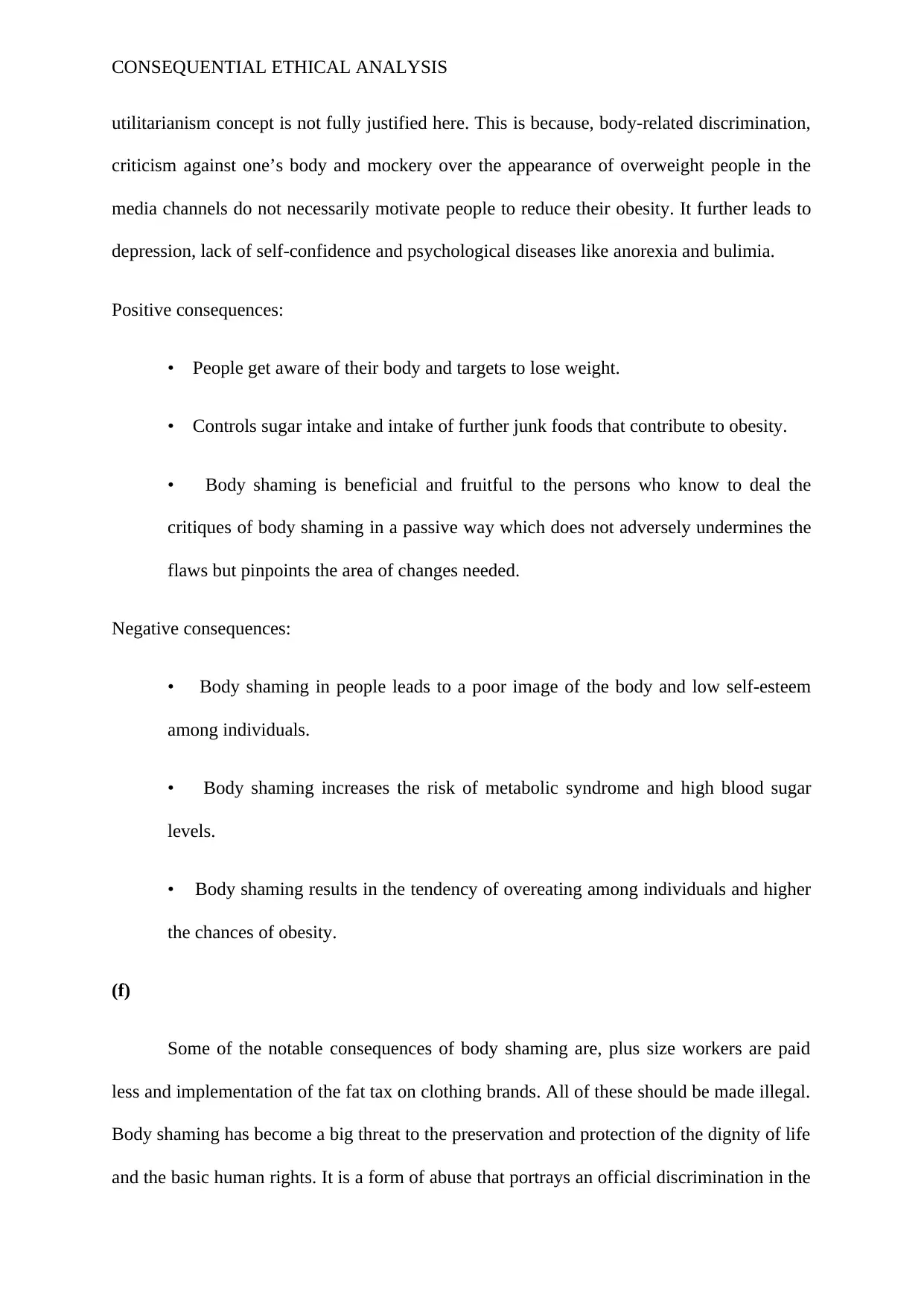
utilitarianism concept is not fully justified here. This is because, body-related discrimination,
criticism against one’s body and mockery over the appearance of overweight people in the
media channels do not necessarily motivate people to reduce their obesity. It further leads to
depression, lack of self-confidence and psychological diseases like anorexia and bulimia.
Positive consequences:
• People get aware of their body and targets to lose weight.
• Controls sugar intake and intake of further junk foods that contribute to obesity.
• Body shaming is beneficial and fruitful to the persons who know to deal the
critiques of body shaming in a passive way which does not adversely undermines the
flaws but pinpoints the area of changes needed.
Negative consequences:
• Body shaming in people leads to a poor image of the body and low self-esteem
among individuals.
• Body shaming increases the risk of metabolic syndrome and high blood sugar
levels.
• Body shaming results in the tendency of overeating among individuals and higher
the chances of obesity.
(f)
Some of the notable consequences of body shaming are, plus size workers are paid
less and implementation of the fat tax on clothing brands. All of these should be made illegal.
Body shaming has become a big threat to the preservation and protection of the dignity of life
and the basic human rights. It is a form of abuse that portrays an official discrimination in the
utilitarianism concept is not fully justified here. This is because, body-related discrimination,
criticism against one’s body and mockery over the appearance of overweight people in the
media channels do not necessarily motivate people to reduce their obesity. It further leads to
depression, lack of self-confidence and psychological diseases like anorexia and bulimia.
Positive consequences:
• People get aware of their body and targets to lose weight.
• Controls sugar intake and intake of further junk foods that contribute to obesity.
• Body shaming is beneficial and fruitful to the persons who know to deal the
critiques of body shaming in a passive way which does not adversely undermines the
flaws but pinpoints the area of changes needed.
Negative consequences:
• Body shaming in people leads to a poor image of the body and low self-esteem
among individuals.
• Body shaming increases the risk of metabolic syndrome and high blood sugar
levels.
• Body shaming results in the tendency of overeating among individuals and higher
the chances of obesity.
(f)
Some of the notable consequences of body shaming are, plus size workers are paid
less and implementation of the fat tax on clothing brands. All of these should be made illegal.
Body shaming has become a big threat to the preservation and protection of the dignity of life
and the basic human rights. It is a form of abuse that portrays an official discrimination in the
⊘ This is a preview!⊘
Do you want full access?
Subscribe today to unlock all pages.

Trusted by 1+ million students worldwide

CONSEQUENTIAL ETHICAL ANALYSIS
field of law. Body shaming is a heinous and uncivilized act. It is important to note that all
people in the world are created differently (Huang et al. 2015). This meaningless way of
judging people in the civilized societies should be stopped and new policies should be
introduced. Men or women, black or white all are beautiful in their own way.
field of law. Body shaming is a heinous and uncivilized act. It is important to note that all
people in the world are created differently (Huang et al. 2015). This meaningless way of
judging people in the civilized societies should be stopped and new policies should be
introduced. Men or women, black or white all are beautiful in their own way.
Paraphrase This Document
Need a fresh take? Get an instant paraphrase of this document with our AI Paraphraser

CONSEQUENTIAL ETHICAL ANALYSIS
References
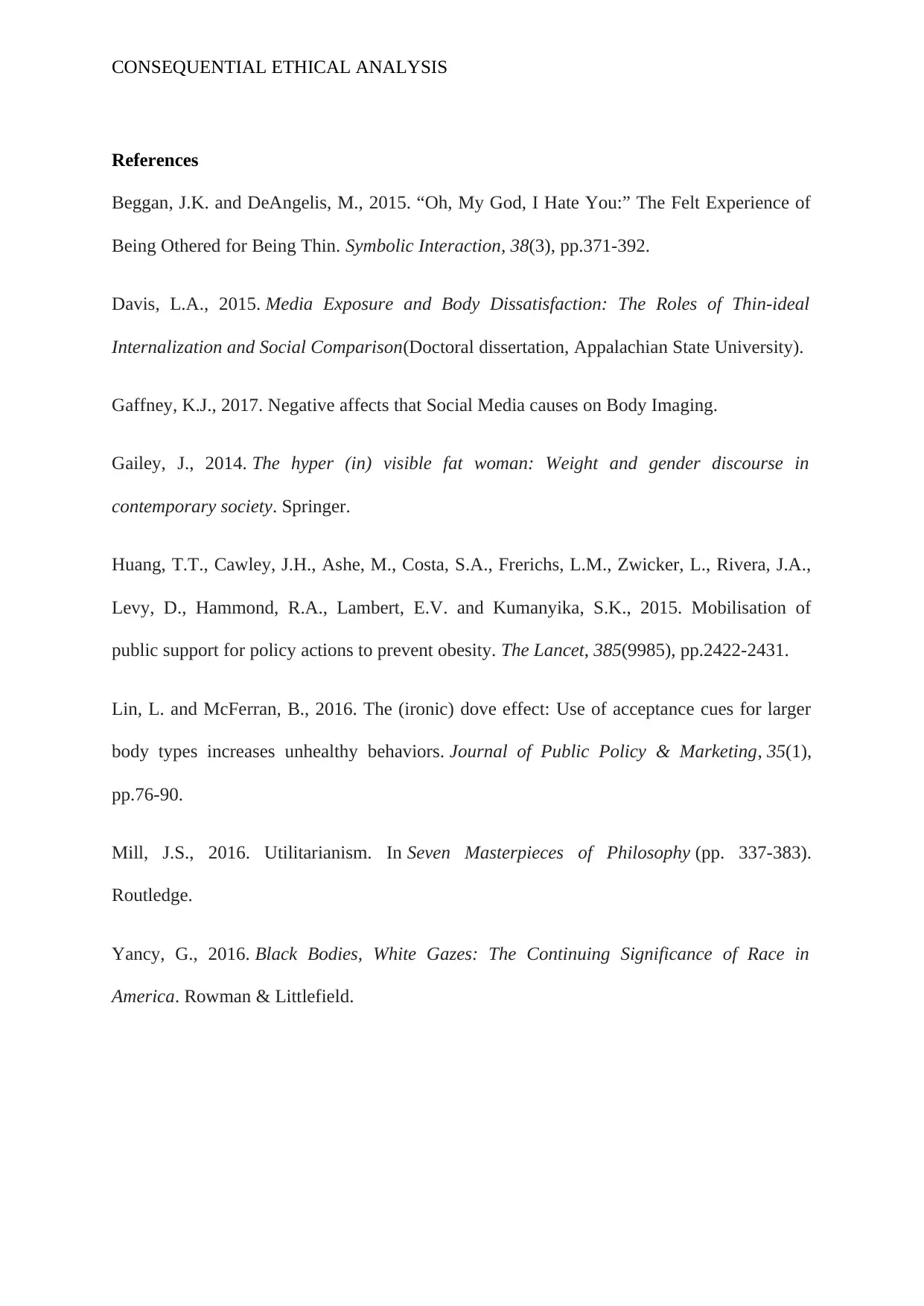
Beggan, J.K. and DeAngelis, M., 2015. “Oh, My God, I Hate You:” The Felt Experience of
Being Othered for Being Thin. Symbolic Interaction, 38(3), pp.371-392.
Davis, L.A., 2015. Media Exposure and Body Dissatisfaction: The Roles of Thin-ideal
Internalization and Social Comparison(Doctoral dissertation, Appalachian State University).
Gaffney, K.J., 2017. Negative affects that Social Media causes on Body Imaging.
Gailey, J., 2014. The hyper (in) visible fat woman: Weight and gender discourse in
contemporary society. Springer.
Huang, T.T., Cawley, J.H., Ashe, M., Costa, S.A., Frerichs, L.M., Zwicker, L., Rivera, J.A.,
Levy, D., Hammond, R.A., Lambert, E.V. and Kumanyika, S.K., 2015. Mobilisation of
public support for policy actions to prevent obesity. The Lancet, 385(9985), pp.2422-2431.
Lin, L. and McFerran, B., 2016. The (ironic) dove effect: Use of acceptance cues for larger
body types increases unhealthy behaviors. Journal of Public Policy & Marketing, 35(1),
pp.76-90.
Mill, J.S., 2016. Utilitarianism. In Seven Masterpieces of Philosophy (pp. 337-383).
Routledge.
Yancy, G., 2016. Black Bodies, White Gazes: The Continuing Significance of Race in
America. Rowman & Littlefield.
References
Beggan, J.K. and DeAngelis, M., 2015. “Oh, My God, I Hate You:” The Felt Experience of
Being Othered for Being Thin. Symbolic Interaction, 38(3), pp.371-392.
Davis, L.A., 2015. Media Exposure and Body Dissatisfaction: The Roles of Thin-ideal
Internalization and Social Comparison(Doctoral dissertation, Appalachian State University).
Gaffney, K.J., 2017. Negative affects that Social Media causes on Body Imaging.
Gailey, J., 2014. The hyper (in) visible fat woman: Weight and gender discourse in
contemporary society. Springer.
Huang, T.T., Cawley, J.H., Ashe, M., Costa, S.A., Frerichs, L.M., Zwicker, L., Rivera, J.A.,
Levy, D., Hammond, R.A., Lambert, E.V. and Kumanyika, S.K., 2015. Mobilisation of
public support for policy actions to prevent obesity. The Lancet, 385(9985), pp.2422-2431.
Lin, L. and McFerran, B., 2016. The (ironic) dove effect: Use of acceptance cues for larger
body types increases unhealthy behaviors. Journal of Public Policy & Marketing, 35(1),
pp.76-90.
Mill, J.S., 2016. Utilitarianism. In Seven Masterpieces of Philosophy (pp. 337-383).
Routledge.
Yancy, G., 2016. Black Bodies, White Gazes: The Continuing Significance of Race in
America. Rowman & Littlefield.

CONSEQUENTIAL ETHICAL ANALYSIS
⊘ This is a preview!⊘
Do you want full access?
Subscribe today to unlock all pages.

Trusted by 1+ million students worldwide
1 out of 9
Related Documents
Your All-in-One AI-Powered Toolkit for Academic Success.
+13062052269
info@desklib.com
Available 24*7 on WhatsApp / Email
Unlock your academic potential
Copyright © 2020–2025 A2Z Services. All Rights Reserved. Developed and managed by ZUCOL.