SUSS SCO101 Ethics Case Study: Google's China Market Entry

Verified

Added on  2022/12/18

|4
|774
|50
Case Study
AI Summary
This case study delves into the ethical complexities surrounding Google's potential entry into the Chinese market, specifically addressing the dilemma of adhering to the Chinese government's censorship policies versus upholding the company's commitment to the free flow of information. The analysis explores the ethical viewpoints of Google and the Chinese government, examining the moral implications of censorship and its impact on human rights. The paper applies ethical frameworks, including Kant's theory of duty-based morality and utilitarianism, to evaluate Google's potential actions and their alignment with ethical principles. It also considers the limitations and challenges of applying these philosophical approaches in a real-world business scenario, offering a comprehensive understanding of the ethical considerations involved.
Document Page
Running head: ETHICS
Ethics
Name of the Student:
Name of the University:
Author Note:
tabler-icon-diamond-filled.svg

Paraphrase This Document

Need a fresh take? Get an instant paraphrase of this document with our AI Paraphraser
Document Page
1ETHICS
Ethical case study
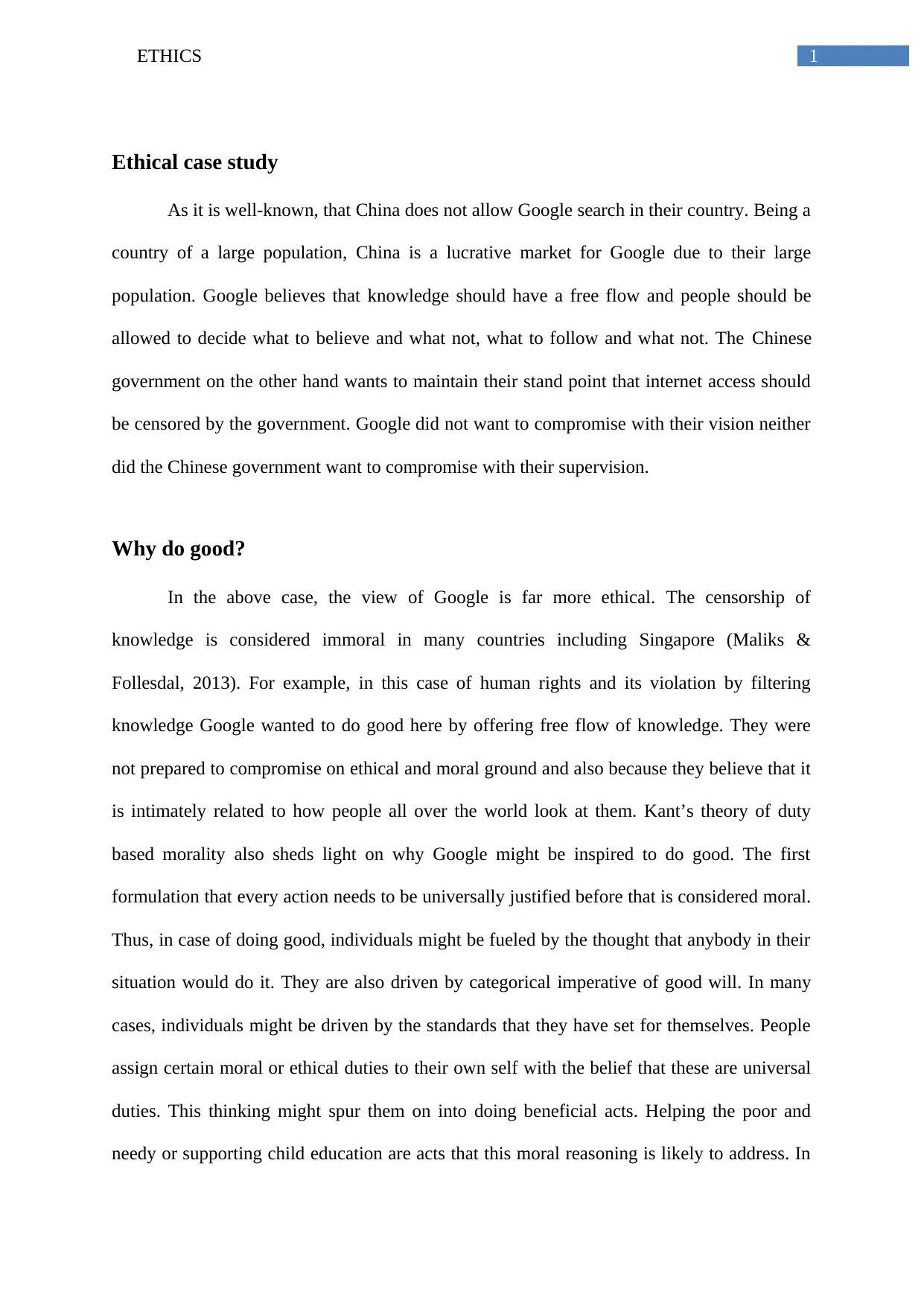
As it is well-known, that China does not allow Google search in their country. Being a
country of a large population, China is a lucrative market for Google due to their large
population. Google believes that knowledge should have a free flow and people should be
allowed to decide what to believe and what not, what to follow and what not. The Chinese
government on the other hand wants to maintain their stand point that internet access should
be censored by the government. Google did not want to compromise with their vision neither
did the Chinese government want to compromise with their supervision.
Why do good?
In the above case, the view of Google is far more ethical. The censorship of
knowledge is considered immoral in many countries including Singapore (Maliks &
Follesdal, 2013). For example, in this case of human rights and its violation by filtering
knowledge Google wanted to do good here by offering free flow of knowledge. They were
not prepared to compromise on ethical and moral ground and also because they believe that it
is intimately related to how people all over the world look at them. Kant’s theory of duty
based morality also sheds light on why Google might be inspired to do good. The first
formulation that every action needs to be universally justified before that is considered moral.
Thus, in case of doing good, individuals might be fueled by the thought that anybody in their
situation would do it. They are also driven by categorical imperative of good will. In many
cases, individuals might be driven by the standards that they have set for themselves. People
assign certain moral or ethical duties to their own self with the belief that these are universal
duties. This thinking might spur them on into doing beneficial acts. Helping the poor and
needy or supporting child education are acts that this moral reasoning is likely to address. In
Document Page
2ETHICS
case of Google’s position in China, they are driven by their values of doing good for the
global community.
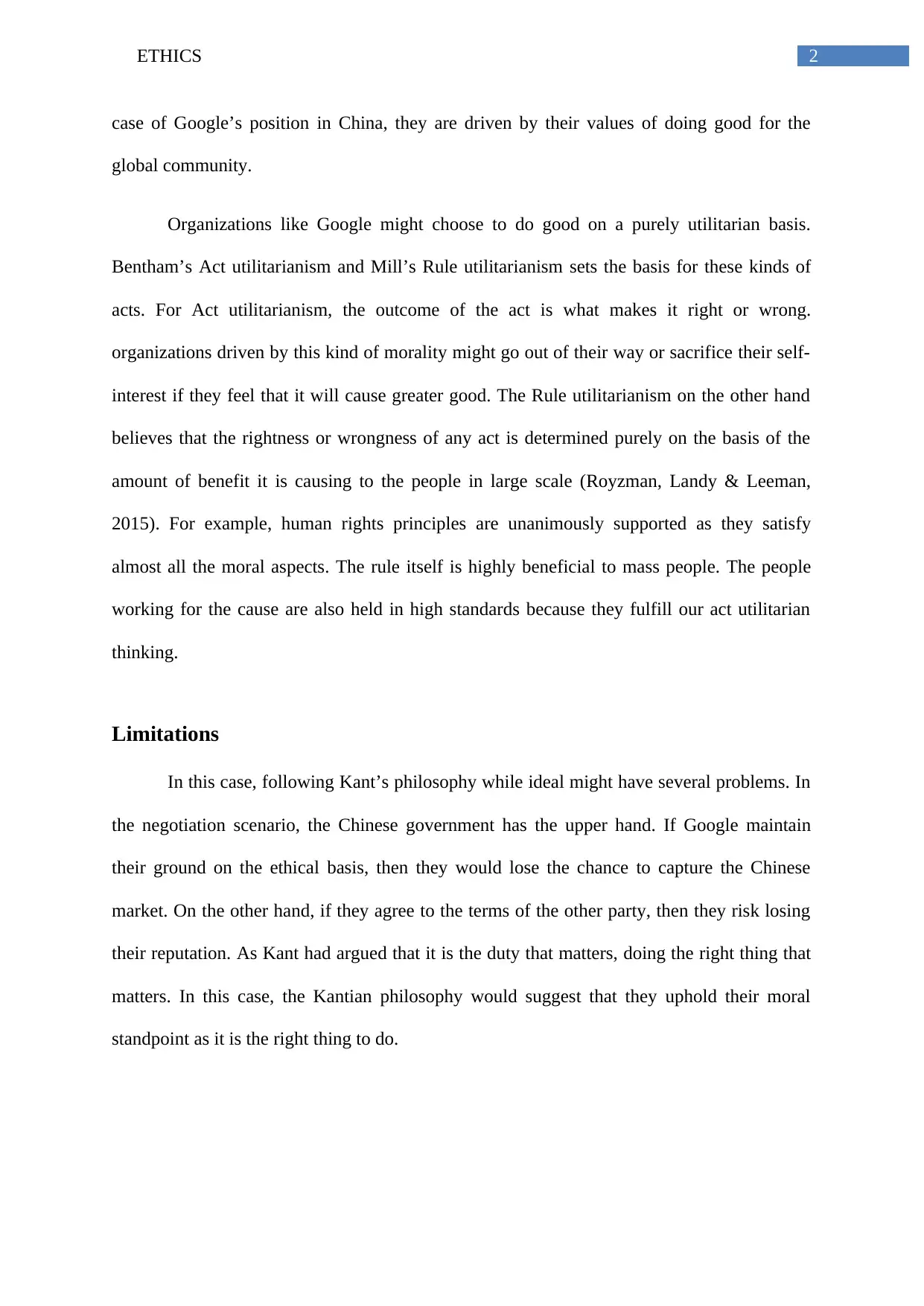
Organizations like Google might choose to do good on a purely utilitarian basis.
Bentham’s Act utilitarianism and Mill’s Rule utilitarianism sets the basis for these kinds of
acts. For Act utilitarianism, the outcome of the act is what makes it right or wrong.
organizations driven by this kind of morality might go out of their way or sacrifice their self-
interest if they feel that it will cause greater good. The Rule utilitarianism on the other hand
believes that the rightness or wrongness of any act is determined purely on the basis of the
amount of benefit it is causing to the people in large scale (Royzman, Landy & Leeman,
2015). For example, human rights principles are unanimously supported as they satisfy
almost all the moral aspects. The rule itself is highly beneficial to mass people. The people
working for the cause are also held in high standards because they fulfill our act utilitarian
thinking.
Limitations
In this case, following Kant’s philosophy while ideal might have several problems. In
the negotiation scenario, the Chinese government has the upper hand. If Google maintain
their ground on the ethical basis, then they would lose the chance to capture the Chinese
market. On the other hand, if they agree to the terms of the other party, then they risk losing
their reputation. As Kant had argued that it is the duty that matters, doing the right thing that
matters. In this case, the Kantian philosophy would suggest that they uphold their moral
standpoint as it is the right thing to do.
Document Page
3ETHICS
References
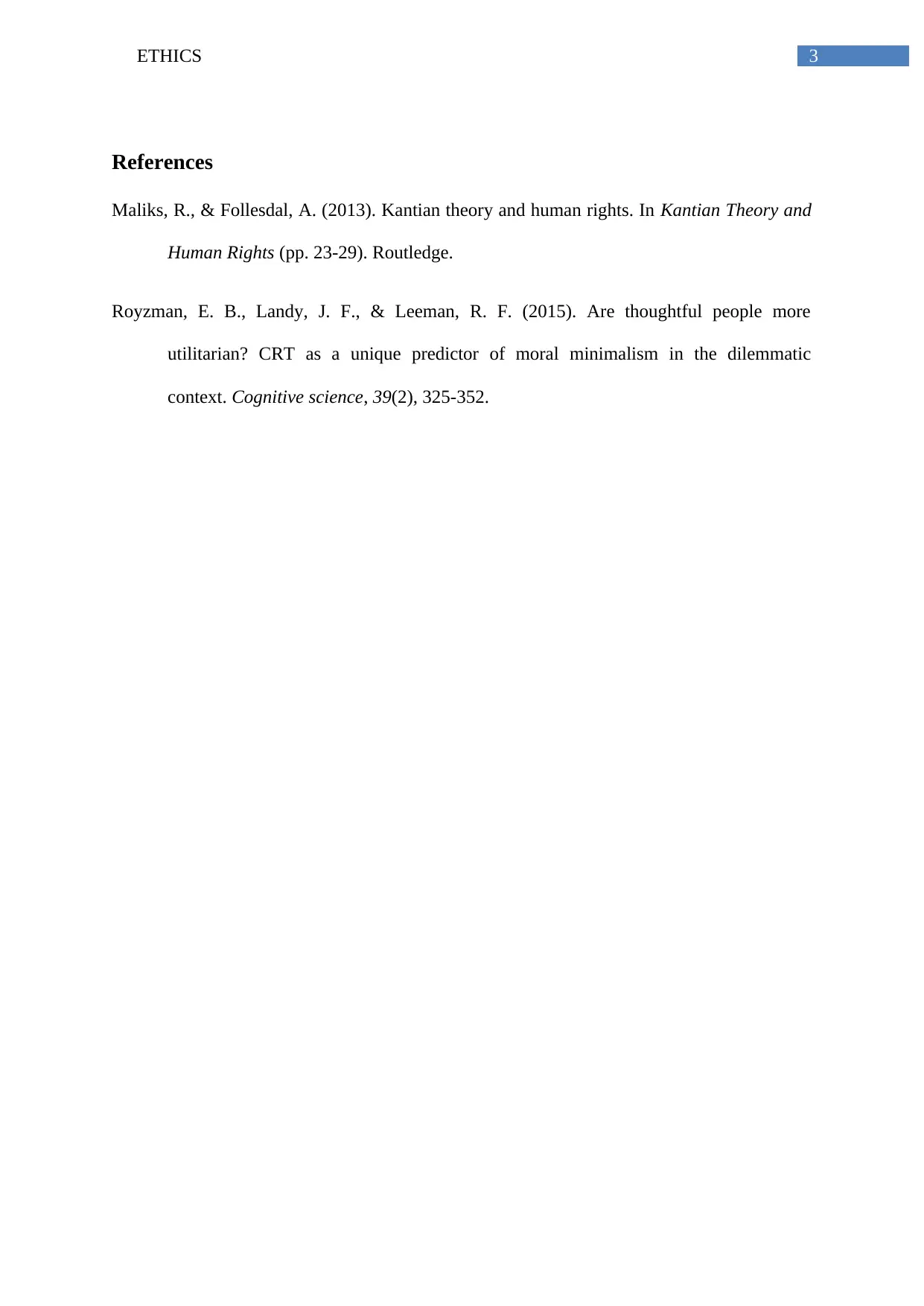
Maliks, R., & Follesdal, A. (2013). Kantian theory and human rights. In Kantian Theory and
Human Rights (pp. 23-29). Routledge.
Royzman, E. B., Landy, J. F., & Leeman, R. F. (2015). Are thoughtful people more
utilitarian? CRT as a unique predictor of moral minimalism in the dilemmatic
context. Cognitive science, 39(2), 325-352.
chevron_up_icon
1 out of 4
circle_padding
hide_on_mobile
zoom_out_icon
[object Object]