Document Falsification: Ethical Implications in Business and Education
VerifiedAdded on 2020/03/04
|12
|3120
|141
Essay
AI Summary
This essay delves into the multifaceted issue of document falsification, analyzing its ethical implications within both business and academic contexts. It explores the concept of business ethics, sustainability, and various ethical theories such as consequentialism, deontology, and virtue ethics, providing a comprehensive framework for understanding the complexities of the subject. The essay examines the practice of document falsification, particularly in educational settings, and contrasts it with established ethical principles, including MacDonald's four levels of business ethics. It also investigates the consequences faced by students involved in such unethical practices, highlighting the impact on their academic careers and professional development. The analysis underscores the importance of ethical conduct and academic integrity, providing insights into the detrimental effects of document falsification on individuals, organizations, and society as a whole.
Running Head: DOCUMENT FALSIFICATION
Document Falsification
Students’ Name
Affiliate Institution
Document Falsification
Students’ Name
Affiliate Institution

Paraphrase This Document
Need a fresh take? Get an instant paraphrase of this document with our AI Paraphraser
DOCUMENT FALSIFICATION 2
Introduction
Ethics is an aspect that is studied all across different professionalisms and fields.
Business ethics, therefore, refers to company standards, sets of values, principles, and norms that
are formed with the aim of governing the actions and behavior of an individual in a place
(Bridgman, 2012). It examines morals or immoral problems that arise in the business
environment. These ethics originate from people, organizational statements or the legal system.
Examples of common business ethics are honesty, integrity, loyalty, fairness, leadership, and
responsibility. On the other hand, business sustainability refers to the management and
coordination of all environmental, social and financial aspects to provide an ethical, successful
business (Baker, 2015). Business sustainability is considered to be in three categories. These
include; corporate culture that incorporates the principles of every business decisions.
Community or social that ensures that the business offers sustainable services to the society by
giving back to them, either through charitable donations or offering internship the young
members of the society.
The environmental aspect ensures that the business is committed to greener friendly
environment. The environmental issue is achievable by decreasing or eliminating the destructive
environmental omissions (Choi et al., 2015). Every individual affects the sustainability of
business in a market place either positively or negatively. This article, therefore, examines the
business ethical issues, sustainability elements, theories, and concepts behind document
falsification. It takes into account to the MacDonald’s ethical levels and in contrast to other
primary business ethics. It also examines the consequence that befalls a student that commits the
cheating.
Introduction
Ethics is an aspect that is studied all across different professionalisms and fields.
Business ethics, therefore, refers to company standards, sets of values, principles, and norms that
are formed with the aim of governing the actions and behavior of an individual in a place
(Bridgman, 2012). It examines morals or immoral problems that arise in the business
environment. These ethics originate from people, organizational statements or the legal system.
Examples of common business ethics are honesty, integrity, loyalty, fairness, leadership, and
responsibility. On the other hand, business sustainability refers to the management and
coordination of all environmental, social and financial aspects to provide an ethical, successful
business (Baker, 2015). Business sustainability is considered to be in three categories. These
include; corporate culture that incorporates the principles of every business decisions.
Community or social that ensures that the business offers sustainable services to the society by
giving back to them, either through charitable donations or offering internship the young
members of the society.
The environmental aspect ensures that the business is committed to greener friendly
environment. The environmental issue is achievable by decreasing or eliminating the destructive
environmental omissions (Choi et al., 2015). Every individual affects the sustainability of
business in a market place either positively or negatively. This article, therefore, examines the
business ethical issues, sustainability elements, theories, and concepts behind document
falsification. It takes into account to the MacDonald’s ethical levels and in contrast to other
primary business ethics. It also examines the consequence that befalls a student that commits the
cheating.
DOCUMENT FALSIFICATION 3
In a systematic study, Vazquez (2016) denotes that a falsified document in accordance
with Section 250 of the Australian Crime Act, is one that is purported to have been altered or
made by an individual who did not work on the document, on the authority of an individual who
is not authorized to have the document, in a place or on a date where and when it was not made
respectively, in terms, the document was not made in at the original document preparation.
Document falsification and the increasing fraud challenge it offers to the business
community
Document falsification is very paramount in most of the local and international colleges
and universities among other academic institutions (McCabe, 2015). According to this study,
document forgery is the process by which student in conjunction with unauthorized organization
or individual obtains a particular document to present to the university as a genuine academic
work. University and college students are prone to these types of practices. Students who are
pursuing their degrees or masters program tend to pay some organizations or individuals to
undertake their research work or their faculty assignments. They then submit them to the
lectures. Under the University Academic and Policy Law, document falsification is a crime, and
unethical that calls for punishment for the student for both the student and the organization that
offers the service.
The ethical idea behind student submitting assignments done b others at a small fee
The document falsification practiced by students is not ethical. The practice is considered
to be an academic dishonesty (Huang, 2016). It contradicts the research and academic ethics
drawn by the University Academic Board. The university academic and research ethics dictates
In a systematic study, Vazquez (2016) denotes that a falsified document in accordance
with Section 250 of the Australian Crime Act, is one that is purported to have been altered or
made by an individual who did not work on the document, on the authority of an individual who
is not authorized to have the document, in a place or on a date where and when it was not made
respectively, in terms, the document was not made in at the original document preparation.
Document falsification and the increasing fraud challenge it offers to the business
community
Document falsification is very paramount in most of the local and international colleges
and universities among other academic institutions (McCabe, 2015). According to this study,
document forgery is the process by which student in conjunction with unauthorized organization
or individual obtains a particular document to present to the university as a genuine academic
work. University and college students are prone to these types of practices. Students who are
pursuing their degrees or masters program tend to pay some organizations or individuals to
undertake their research work or their faculty assignments. They then submit them to the
lectures. Under the University Academic and Policy Law, document falsification is a crime, and
unethical that calls for punishment for the student for both the student and the organization that
offers the service.
The ethical idea behind student submitting assignments done b others at a small fee
The document falsification practiced by students is not ethical. The practice is considered
to be an academic dishonesty (Huang, 2016). It contradicts the research and academic ethics
drawn by the University Academic Board. The university academic and research ethics dictates
⊘ This is a preview!⊘
Do you want full access?
Subscribe today to unlock all pages.

Trusted by 1+ million students worldwide
DOCUMENT FALSIFICATION 4
that every student should do their research publication. They should not take somebody’s work
and present as their own. The ethics dictate that there should be no collaboration in doing
individual work, such as copying during the exam or asking for assistance in the form of
payment to undertake the student’s role during the research work. They should ensure the
originality of the academic work. Therefore, the practice is deceitful, and any academic
certificate gained through it should be revocable.
The unethical idea behind organization offering this type of service on the basis of
MacDonald’s four levels of business ethics
Ethical of document falsification by an organization is unethical. Business groups always
have one objective; to make money, nevertheless, the money should be made by the set business
ethics. According to the MacDonald’s four levels of business ethics, it is unethical to for an
organization to offer document falsification to the university students to present as their
academic work (Dominici, 2017). The MacDonald four levels of business ethics are personal
level, organizational level, national level and international level.
The personal level is also known as an individual level, a level where one must always
participate in decision-making taking into account of what is right to do in different
circumstances (Papish, 2016). At this level, honesty is paramount to the individual. One must be
able to admit either in committing a wrong, making an honest mistake, or making a bad decision.
The personal level calls for personal responsibility for any decision made. Therefore according to
MacDonald personal level business ethics, it is unacceptable for an organization to offer such
services to students who are pursuing their academic program since it contradicts with the
Academic Regulations. The organizational level looks at the ethical action of the organization. It
that every student should do their research publication. They should not take somebody’s work
and present as their own. The ethics dictate that there should be no collaboration in doing
individual work, such as copying during the exam or asking for assistance in the form of
payment to undertake the student’s role during the research work. They should ensure the
originality of the academic work. Therefore, the practice is deceitful, and any academic
certificate gained through it should be revocable.
The unethical idea behind organization offering this type of service on the basis of
MacDonald’s four levels of business ethics
Ethical of document falsification by an organization is unethical. Business groups always
have one objective; to make money, nevertheless, the money should be made by the set business
ethics. According to the MacDonald’s four levels of business ethics, it is unethical to for an
organization to offer document falsification to the university students to present as their
academic work (Dominici, 2017). The MacDonald four levels of business ethics are personal
level, organizational level, national level and international level.
The personal level is also known as an individual level, a level where one must always
participate in decision-making taking into account of what is right to do in different
circumstances (Papish, 2016). At this level, honesty is paramount to the individual. One must be
able to admit either in committing a wrong, making an honest mistake, or making a bad decision.
The personal level calls for personal responsibility for any decision made. Therefore according to
MacDonald personal level business ethics, it is unacceptable for an organization to offer such
services to students who are pursuing their academic program since it contradicts with the
Academic Regulations. The organizational level looks at the ethical action of the organization. It
Paraphrase This Document
Need a fresh take? Get an instant paraphrase of this document with our AI Paraphraser
DOCUMENT FALSIFICATION 5
states that any mistake committed by a body is as a result of the decision made within the
organization. Organization values should bring benefits to both the stakeholder and the society.
When an organization receives payment from a student to do what is illegal like falsifying an
academic work, and then it is being termed as corruptible.
National level ethics dwells on the societal expectations such as good business behavior
(Papish, 2016). It dictates that a business should play a fair ground that conforms to the law of
the country. Business, therefore, is not expected to accept bribery or any other form of cash that
is against the law for it to thrive. Therefore an organization that receives money from university
students to assist them in falsifying academic documents is committing a crime that should be
punishable. The practice will not only affect the student’s academic but will also put the
reputation of such an organization in question.
International level entails all aspects across the national boundary to curb the problems
that affect the world academic institutions as a whole (McCabe, 2015). These efforts aim at
addressing all global sustainability of every ethical behavior for the benefit of the students, their
future career, and the community as well. However, when an organization practices document
falsification to the university students, it tends to undermine millennium goals that are set by the
international organizations and academic institutions to offer high-quality education to every
individual. The practice will offer a significant number of poor professionalism and law integrity
graduates.
A contrast of the practice from the perspective of consequentialism, deontology and
virtue ethics theories
states that any mistake committed by a body is as a result of the decision made within the
organization. Organization values should bring benefits to both the stakeholder and the society.
When an organization receives payment from a student to do what is illegal like falsifying an
academic work, and then it is being termed as corruptible.
National level ethics dwells on the societal expectations such as good business behavior
(Papish, 2016). It dictates that a business should play a fair ground that conforms to the law of
the country. Business, therefore, is not expected to accept bribery or any other form of cash that
is against the law for it to thrive. Therefore an organization that receives money from university
students to assist them in falsifying academic documents is committing a crime that should be
punishable. The practice will not only affect the student’s academic but will also put the
reputation of such an organization in question.
International level entails all aspects across the national boundary to curb the problems
that affect the world academic institutions as a whole (McCabe, 2015). These efforts aim at
addressing all global sustainability of every ethical behavior for the benefit of the students, their
future career, and the community as well. However, when an organization practices document
falsification to the university students, it tends to undermine millennium goals that are set by the
international organizations and academic institutions to offer high-quality education to every
individual. The practice will offer a significant number of poor professionalism and law integrity
graduates.
A contrast of the practice from the perspective of consequentialism, deontology and
virtue ethics theories
DOCUMENT FALSIFICATION 6
There are major ethical theories adopted by various business organizations both large and
small in the local and international level. These ethical principles include consequentialism,
deontology and virtue ethics as pointed out by (Moraes, Carrigan, Bosangit, Ferreira, &
McGrath, 2015). Consequentialism is a moral philosophy that dictates that whatever one does
depend on whatever happens afterward (Kahn, 2012). Consequentialism is the act of worrying
more about the result than the action itself. As a result, a morally right action will ultimately lead
to good result without taking into account of the means from the consequentialist point of view.
In other words, it says that if a goal is morally right, then the method of achieving the goal is
acceptable (Morgan et al., 2015). For instance, every student in the university has the urge of
scoring high points. In academic, therefore, according to the theory, the student is obliged to
score the high marks without looking at the method used to get the marks, hence the student will
opt to seek assistance from the organization that offers document falsifications and presents it to
the lecture on their work. In the end, if not detected, the student will score high marks and be
awarded marks or their degree. There are two different types of consequentialism. These are;
Utilitarianism that states individual should stress more on human-being while Hedonism stresses
more on human pleasure and satisfaction.
The deontological ethical theory asserts that every employee should stick to their
obligations and duties when making any ethical decision that can have a direct or indirect effect
on an individual or organization (Saja, 2013). According to this study, the individual adopting
the theory need to follow and uphold the recommended ethical obligations since this is what is
considered morally upright by the business. The theory argues that anything good must be good
in itself and good without qualification. For example, an organization offering assistance on
There are major ethical theories adopted by various business organizations both large and
small in the local and international level. These ethical principles include consequentialism,
deontology and virtue ethics as pointed out by (Moraes, Carrigan, Bosangit, Ferreira, &
McGrath, 2015). Consequentialism is a moral philosophy that dictates that whatever one does
depend on whatever happens afterward (Kahn, 2012). Consequentialism is the act of worrying
more about the result than the action itself. As a result, a morally right action will ultimately lead
to good result without taking into account of the means from the consequentialist point of view.
In other words, it says that if a goal is morally right, then the method of achieving the goal is
acceptable (Morgan et al., 2015). For instance, every student in the university has the urge of
scoring high points. In academic, therefore, according to the theory, the student is obliged to
score the high marks without looking at the method used to get the marks, hence the student will
opt to seek assistance from the organization that offers document falsifications and presents it to
the lecture on their work. In the end, if not detected, the student will score high marks and be
awarded marks or their degree. There are two different types of consequentialism. These are;
Utilitarianism that states individual should stress more on human-being while Hedonism stresses
more on human pleasure and satisfaction.
The deontological ethical theory asserts that every employee should stick to their
obligations and duties when making any ethical decision that can have a direct or indirect effect
on an individual or organization (Saja, 2013). According to this study, the individual adopting
the theory need to follow and uphold the recommended ethical obligations since this is what is
considered morally upright by the business. The theory argues that anything good must be good
in itself and good without qualification. For example, an organization offering assistance on
⊘ This is a preview!⊘
Do you want full access?
Subscribe today to unlock all pages.
Trusted by 1+ million students worldwide
DOCUMENT FALSIFICATION 7
research work to a university student will adhere to the terms offered to the student and the
organization.
Deontology offers both parties a good ground for their self-interest. According to Moraes
et al. (2015), students often get there work done and obtain their degree without purely
qualifying for them while the organization can make money without upholding business ethics.
Nonetheless, it has got a negative attribute. The negative characteristic is that both parties break
the laws. The students are not honest in their academic presentation, and the organization is not
being honest and ethical in the activities and services it offers as it core function to the students.
The deontology ethic does not focus its benefit to the diverse society but to an individual, the
student that seeks aid in the academic work. The organization practices this without thinking of
the consequences it will have to the general society.
The virtue ethical theory, also known as character-based ethics insists on judging an
individual character rather than the actions they comprehend (Papish, 2016). The theory
provides guidance on the roles and behaviors a person should strive to achieve. In this theory,
people are more interested in assessing the character of an individual other than the goodness or
badness of a particular action. The virtue ethics requires one to engage in a business that doesn't
contradict it. For instance, if a student acquires an academic work through the help of an
organization, it may be detected by the lecture. If it happens that the lecture knows the character
of the student as better than other students, the lecturer will judge the student more leniently than
a student who always performs worst than other colleagues.
Unlike other business ethics, the virtue ethic does not take into consideration of the
change of one’s character from real moral to immoral. An honest student may suddenly become
dishonest unnoticed. The virtue ethic theory differs with other business ethics such as
research work to a university student will adhere to the terms offered to the student and the
organization.
Deontology offers both parties a good ground for their self-interest. According to Moraes
et al. (2015), students often get there work done and obtain their degree without purely
qualifying for them while the organization can make money without upholding business ethics.
Nonetheless, it has got a negative attribute. The negative characteristic is that both parties break
the laws. The students are not honest in their academic presentation, and the organization is not
being honest and ethical in the activities and services it offers as it core function to the students.
The deontology ethic does not focus its benefit to the diverse society but to an individual, the
student that seeks aid in the academic work. The organization practices this without thinking of
the consequences it will have to the general society.
The virtue ethical theory, also known as character-based ethics insists on judging an
individual character rather than the actions they comprehend (Papish, 2016). The theory
provides guidance on the roles and behaviors a person should strive to achieve. In this theory,
people are more interested in assessing the character of an individual other than the goodness or
badness of a particular action. The virtue ethics requires one to engage in a business that doesn't
contradict it. For instance, if a student acquires an academic work through the help of an
organization, it may be detected by the lecture. If it happens that the lecture knows the character
of the student as better than other students, the lecturer will judge the student more leniently than
a student who always performs worst than other colleagues.
Unlike other business ethics, the virtue ethic does not take into consideration of the
change of one’s character from real moral to immoral. An honest student may suddenly become
dishonest unnoticed. The virtue ethic theory differs with other business ethics such as
Paraphrase This Document
Need a fresh take? Get an instant paraphrase of this document with our AI Paraphraser
DOCUMENT FALSIFICATION 8
accountability, where one should be accountable for their action. In this case, neither the
organization nor the student will be responsible. It also does not consider the safety of the
student and the society as a whole. The student might be unlucky and get detected by the
lecturer. That will lead to a disciplinary case whereby the student might be suspended from the
faculty for not less than two academic years or get expelled from the university. The student will
either gets expulsion or not but will eventually be in the society with little trust and poor
professionalism.
Consequences that might be considerable to students who engage in such practices
Document falsification is a crime and has implications for any students who participate
in such activities as pointed out by Thomson (2010). There are always set rules and policies in
every university that addresses such issues. These practices do destroy not only the student's
ambition but also affects the integrity of the university as a whole, an aspect that as well affects
the qualification and development of the student in their future career. Document falsification,
therefore, has various consequences and penalties depending on the level of which the student
has committed the academic dishonesty as well as the policy of every institution offering the
learning services to the students.
In some institutions, the students are often forced to repeat the assignment with or
without grade reduction. The student may also get a zero grading. Other institutions also ensure
that the he student found guilty of the act is suspended from the faculty for a period not less than
two academic years. The students may as well be expellable from the university, and the
student’s degree may be revoked by the academic disciplinary board. In a systematic study, /////
accountability, where one should be accountable for their action. In this case, neither the
organization nor the student will be responsible. It also does not consider the safety of the
student and the society as a whole. The student might be unlucky and get detected by the
lecturer. That will lead to a disciplinary case whereby the student might be suspended from the
faculty for not less than two academic years or get expelled from the university. The student will
either gets expulsion or not but will eventually be in the society with little trust and poor
professionalism.
Consequences that might be considerable to students who engage in such practices
Document falsification is a crime and has implications for any students who participate
in such activities as pointed out by Thomson (2010). There are always set rules and policies in
every university that addresses such issues. These practices do destroy not only the student's
ambition but also affects the integrity of the university as a whole, an aspect that as well affects
the qualification and development of the student in their future career. Document falsification,
therefore, has various consequences and penalties depending on the level of which the student
has committed the academic dishonesty as well as the policy of every institution offering the
learning services to the students.
In some institutions, the students are often forced to repeat the assignment with or
without grade reduction. The student may also get a zero grading. Other institutions also ensure
that the he student found guilty of the act is suspended from the faculty for a period not less than
two academic years. The students may as well be expellable from the university, and the
student’s degree may be revoked by the academic disciplinary board. In a systematic study, /////
DOCUMENT FALSIFICATION 9
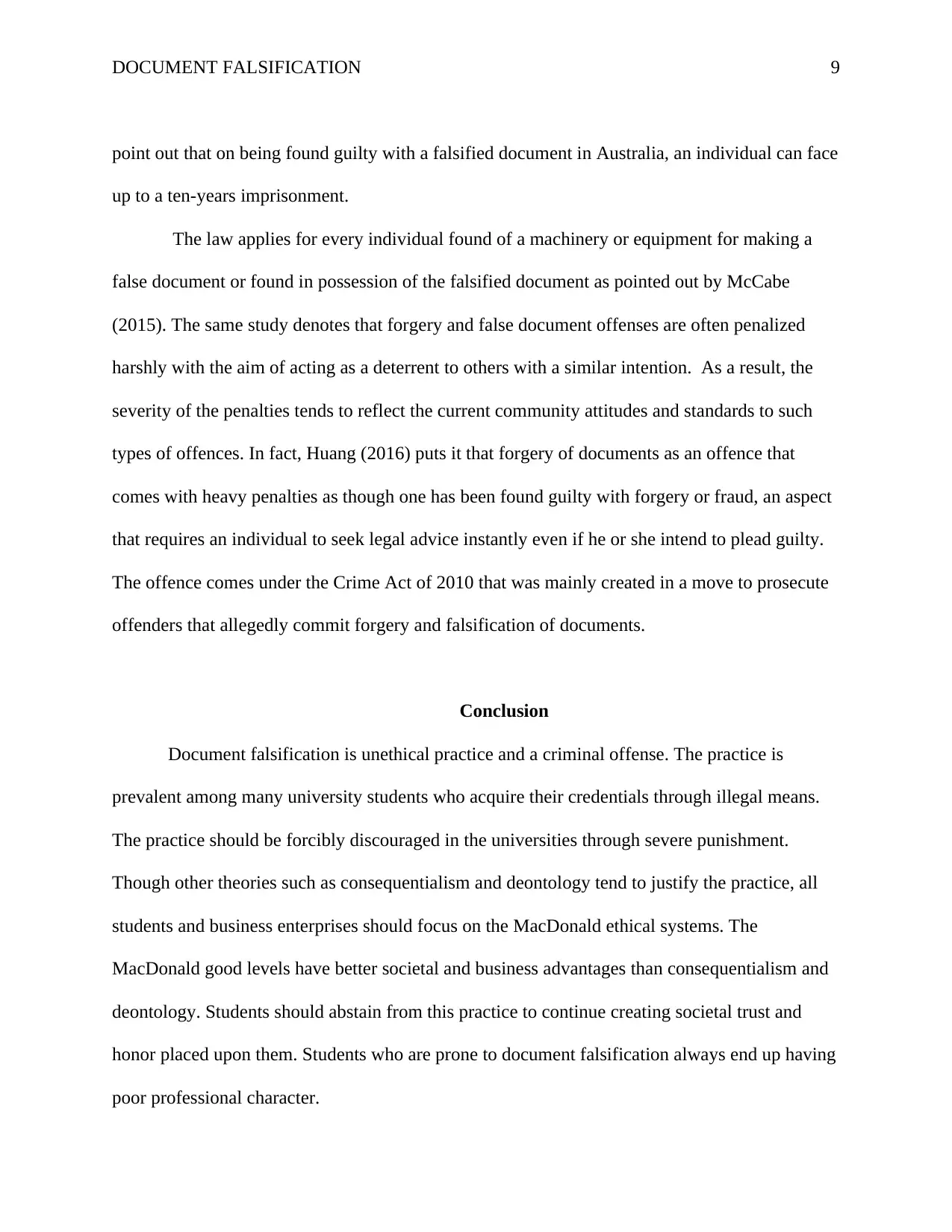
point out that on being found guilty with a falsified document in Australia, an individual can face
up to a ten-years imprisonment.
The law applies for every individual found of a machinery or equipment for making a
false document or found in possession of the falsified document as pointed out by McCabe
(2015). The same study denotes that forgery and false document offenses are often penalized
harshly with the aim of acting as a deterrent to others with a similar intention. As a result, the
severity of the penalties tends to reflect the current community attitudes and standards to such
types of offences. In fact, Huang (2016) puts it that forgery of documents as an offence that
comes with heavy penalties as though one has been found guilty with forgery or fraud, an aspect
that requires an individual to seek legal advice instantly even if he or she intend to plead guilty.
The offence comes under the Crime Act of 2010 that was mainly created in a move to prosecute
offenders that allegedly commit forgery and falsification of documents.
Conclusion
Document falsification is unethical practice and a criminal offense. The practice is
prevalent among many university students who acquire their credentials through illegal means.
The practice should be forcibly discouraged in the universities through severe punishment.
Though other theories such as consequentialism and deontology tend to justify the practice, all
students and business enterprises should focus on the MacDonald ethical systems. The
MacDonald good levels have better societal and business advantages than consequentialism and
deontology. Students should abstain from this practice to continue creating societal trust and
honor placed upon them. Students who are prone to document falsification always end up having
poor professional character.
point out that on being found guilty with a falsified document in Australia, an individual can face
up to a ten-years imprisonment.
The law applies for every individual found of a machinery or equipment for making a
false document or found in possession of the falsified document as pointed out by McCabe
(2015). The same study denotes that forgery and false document offenses are often penalized
harshly with the aim of acting as a deterrent to others with a similar intention. As a result, the
severity of the penalties tends to reflect the current community attitudes and standards to such
types of offences. In fact, Huang (2016) puts it that forgery of documents as an offence that
comes with heavy penalties as though one has been found guilty with forgery or fraud, an aspect
that requires an individual to seek legal advice instantly even if he or she intend to plead guilty.
The offence comes under the Crime Act of 2010 that was mainly created in a move to prosecute
offenders that allegedly commit forgery and falsification of documents.
Conclusion
Document falsification is unethical practice and a criminal offense. The practice is
prevalent among many university students who acquire their credentials through illegal means.
The practice should be forcibly discouraged in the universities through severe punishment.
Though other theories such as consequentialism and deontology tend to justify the practice, all
students and business enterprises should focus on the MacDonald ethical systems. The
MacDonald good levels have better societal and business advantages than consequentialism and
deontology. Students should abstain from this practice to continue creating societal trust and
honor placed upon them. Students who are prone to document falsification always end up having
poor professional character.
⊘ This is a preview!⊘
Do you want full access?
Subscribe today to unlock all pages.
Trusted by 1+ million students worldwide
DOCUMENT FALSIFICATION 10
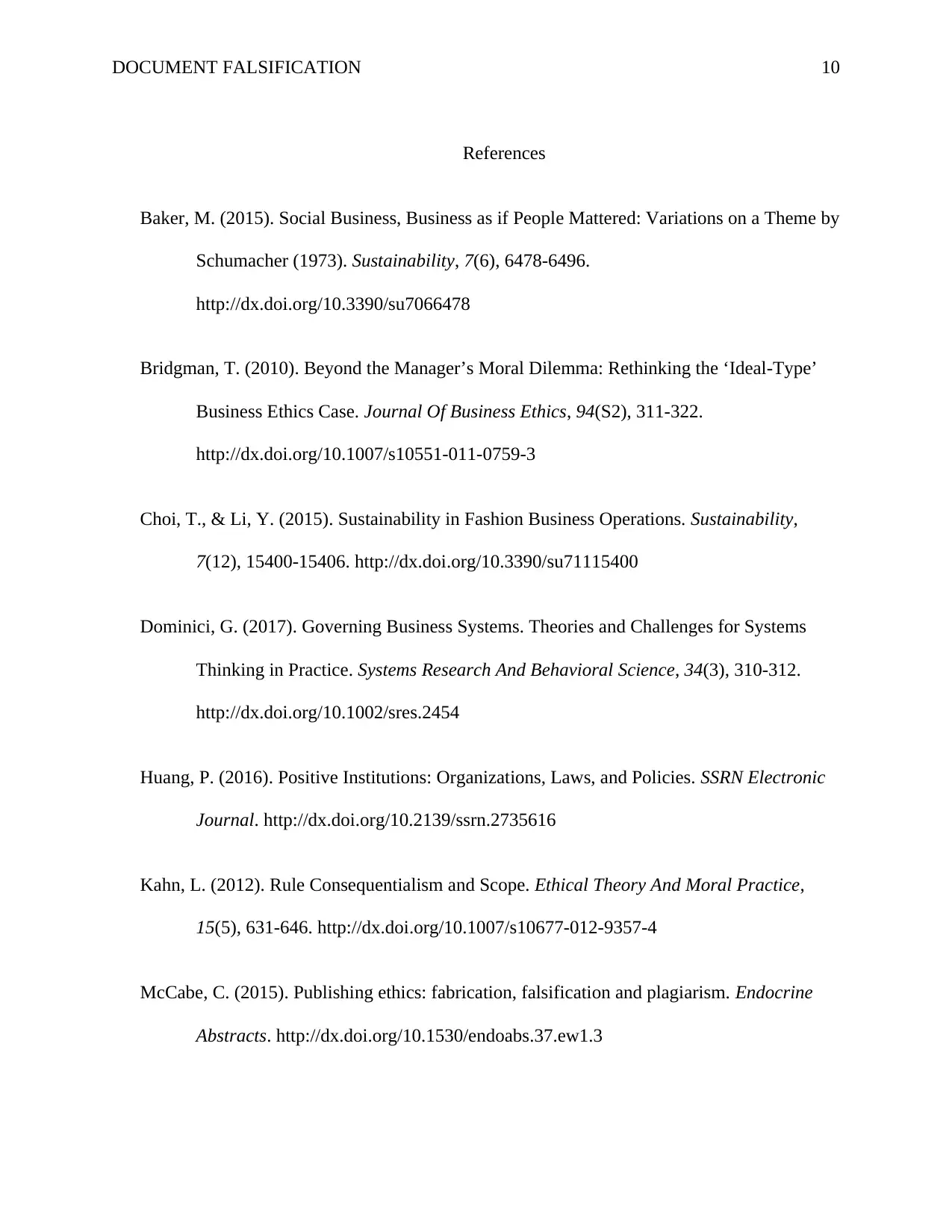
References
Baker, M. (2015). Social Business, Business as if People Mattered: Variations on a Theme by
Schumacher (1973). Sustainability, 7(6), 6478-6496.
http://dx.doi.org/10.3390/su7066478
Bridgman, T. (2010). Beyond the Manager’s Moral Dilemma: Rethinking the ‘Ideal-Type’
Business Ethics Case. Journal Of Business Ethics, 94(S2), 311-322.
http://dx.doi.org/10.1007/s10551-011-0759-3
Choi, T., & Li, Y. (2015). Sustainability in Fashion Business Operations. Sustainability,
7(12), 15400-15406. http://dx.doi.org/10.3390/su71115400
Dominici, G. (2017). Governing Business Systems. Theories and Challenges for Systems
Thinking in Practice. Systems Research And Behavioral Science, 34(3), 310-312.
http://dx.doi.org/10.1002/sres.2454
Huang, P. (2016). Positive Institutions: Organizations, Laws, and Policies. SSRN Electronic
Journal. http://dx.doi.org/10.2139/ssrn.2735616
Kahn, L. (2012). Rule Consequentialism and Scope. Ethical Theory And Moral Practice,
15(5), 631-646. http://dx.doi.org/10.1007/s10677-012-9357-4
McCabe, C. (2015). Publishing ethics: fabrication, falsification and plagiarism. Endocrine
Abstracts. http://dx.doi.org/10.1530/endoabs.37.ew1.3
References
Baker, M. (2015). Social Business, Business as if People Mattered: Variations on a Theme by
Schumacher (1973). Sustainability, 7(6), 6478-6496.
http://dx.doi.org/10.3390/su7066478
Bridgman, T. (2010). Beyond the Manager’s Moral Dilemma: Rethinking the ‘Ideal-Type’
Business Ethics Case. Journal Of Business Ethics, 94(S2), 311-322.
http://dx.doi.org/10.1007/s10551-011-0759-3
Choi, T., & Li, Y. (2015). Sustainability in Fashion Business Operations. Sustainability,
7(12), 15400-15406. http://dx.doi.org/10.3390/su71115400
Dominici, G. (2017). Governing Business Systems. Theories and Challenges for Systems
Thinking in Practice. Systems Research And Behavioral Science, 34(3), 310-312.
http://dx.doi.org/10.1002/sres.2454
Huang, P. (2016). Positive Institutions: Organizations, Laws, and Policies. SSRN Electronic
Journal. http://dx.doi.org/10.2139/ssrn.2735616
Kahn, L. (2012). Rule Consequentialism and Scope. Ethical Theory And Moral Practice,
15(5), 631-646. http://dx.doi.org/10.1007/s10677-012-9357-4
McCabe, C. (2015). Publishing ethics: fabrication, falsification and plagiarism. Endocrine
Abstracts. http://dx.doi.org/10.1530/endoabs.37.ew1.3
Paraphrase This Document
Need a fresh take? Get an instant paraphrase of this document with our AI Paraphraser
DOCUMENT FALSIFICATION 11
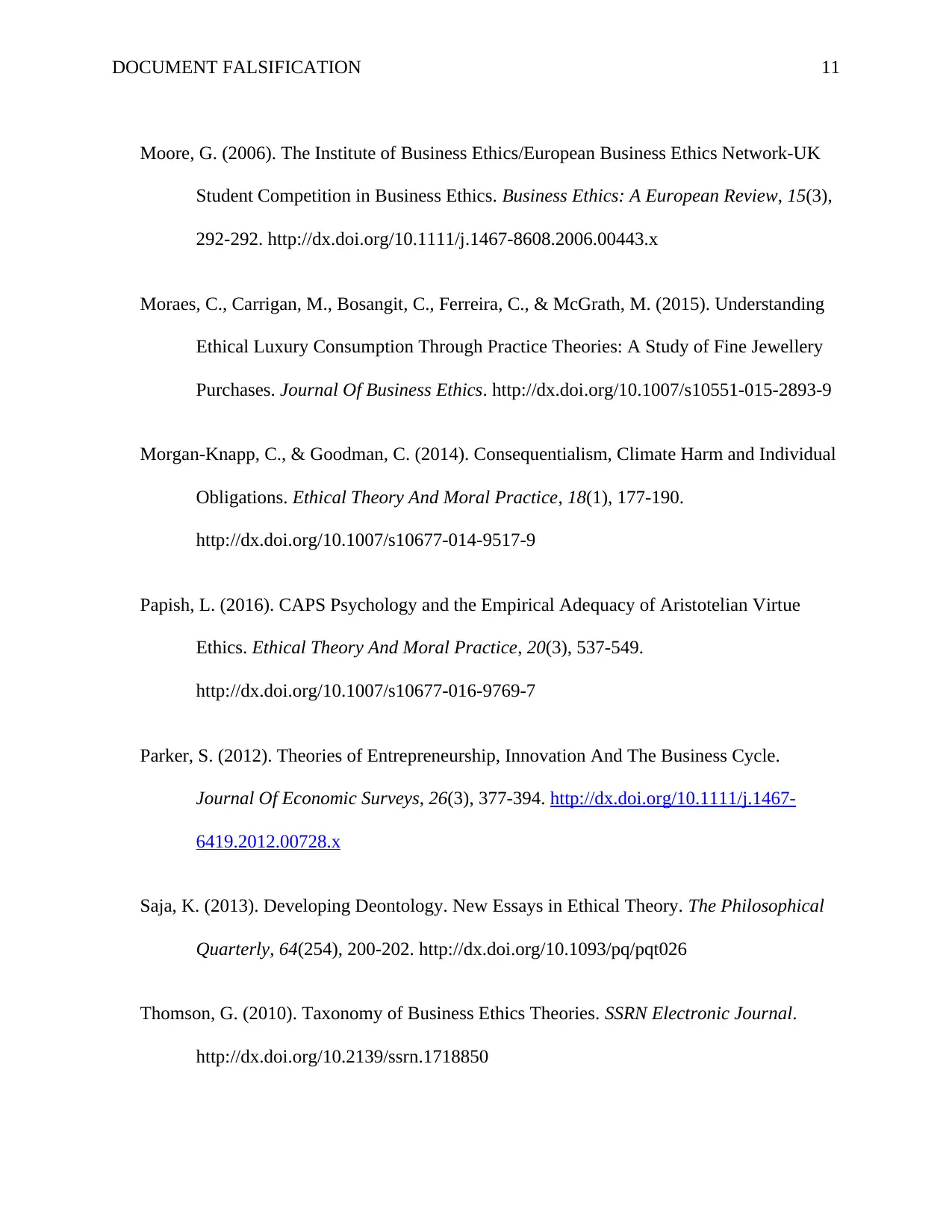
Moore, G. (2006). The Institute of Business Ethics/European Business Ethics Network-UK
Student Competition in Business Ethics. Business Ethics: A European Review, 15(3),
292-292. http://dx.doi.org/10.1111/j.1467-8608.2006.00443.x
Moraes, C., Carrigan, M., Bosangit, C., Ferreira, C., & McGrath, M. (2015). Understanding
Ethical Luxury Consumption Through Practice Theories: A Study of Fine Jewellery
Purchases. Journal Of Business Ethics. http://dx.doi.org/10.1007/s10551-015-2893-9
Morgan-Knapp, C., & Goodman, C. (2014). Consequentialism, Climate Harm and Individual
Obligations. Ethical Theory And Moral Practice, 18(1), 177-190.
http://dx.doi.org/10.1007/s10677-014-9517-9
Papish, L. (2016). CAPS Psychology and the Empirical Adequacy of Aristotelian Virtue
Ethics. Ethical Theory And Moral Practice, 20(3), 537-549.
http://dx.doi.org/10.1007/s10677-016-9769-7
Parker, S. (2012). Theories of Entrepreneurship, Innovation And The Business Cycle.
Journal Of Economic Surveys, 26(3), 377-394. http://dx.doi.org/10.1111/j.1467-
6419.2012.00728.x
Saja, K. (2013). Developing Deontology. New Essays in Ethical Theory. The Philosophical
Quarterly, 64(254), 200-202. http://dx.doi.org/10.1093/pq/pqt026
Thomson, G. (2010). Taxonomy of Business Ethics Theories. SSRN Electronic Journal.
http://dx.doi.org/10.2139/ssrn.1718850
Moore, G. (2006). The Institute of Business Ethics/European Business Ethics Network-UK
Student Competition in Business Ethics. Business Ethics: A European Review, 15(3),
292-292. http://dx.doi.org/10.1111/j.1467-8608.2006.00443.x
Moraes, C., Carrigan, M., Bosangit, C., Ferreira, C., & McGrath, M. (2015). Understanding
Ethical Luxury Consumption Through Practice Theories: A Study of Fine Jewellery
Purchases. Journal Of Business Ethics. http://dx.doi.org/10.1007/s10551-015-2893-9
Morgan-Knapp, C., & Goodman, C. (2014). Consequentialism, Climate Harm and Individual
Obligations. Ethical Theory And Moral Practice, 18(1), 177-190.
http://dx.doi.org/10.1007/s10677-014-9517-9
Papish, L. (2016). CAPS Psychology and the Empirical Adequacy of Aristotelian Virtue
Ethics. Ethical Theory And Moral Practice, 20(3), 537-549.
http://dx.doi.org/10.1007/s10677-016-9769-7
Parker, S. (2012). Theories of Entrepreneurship, Innovation And The Business Cycle.
Journal Of Economic Surveys, 26(3), 377-394. http://dx.doi.org/10.1111/j.1467-
6419.2012.00728.x
Saja, K. (2013). Developing Deontology. New Essays in Ethical Theory. The Philosophical
Quarterly, 64(254), 200-202. http://dx.doi.org/10.1093/pq/pqt026
Thomson, G. (2010). Taxonomy of Business Ethics Theories. SSRN Electronic Journal.
http://dx.doi.org/10.2139/ssrn.1718850
DOCUMENT FALSIFICATION 12
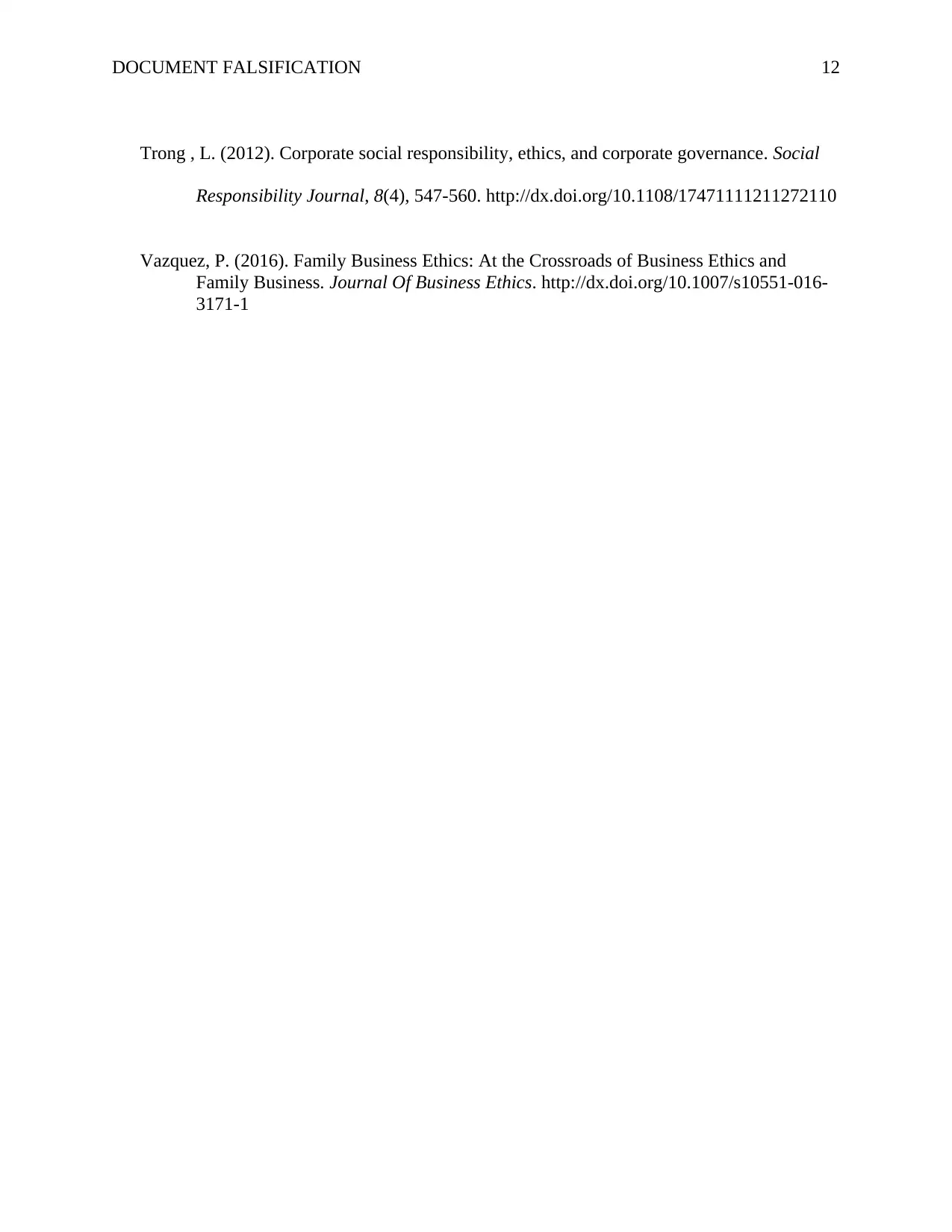
Trong , L. (2012). Corporate social responsibility, ethics, and corporate governance. Social
Responsibility Journal, 8(4), 547-560. http://dx.doi.org/10.1108/17471111211272110
Vazquez, P. (2016). Family Business Ethics: At the Crossroads of Business Ethics and
Family Business. Journal Of Business Ethics. http://dx.doi.org/10.1007/s10551-016-
3171-1
Trong , L. (2012). Corporate social responsibility, ethics, and corporate governance. Social
Responsibility Journal, 8(4), 547-560. http://dx.doi.org/10.1108/17471111211272110
Vazquez, P. (2016). Family Business Ethics: At the Crossroads of Business Ethics and
Family Business. Journal Of Business Ethics. http://dx.doi.org/10.1007/s10551-016-
3171-1
⊘ This is a preview!⊘
Do you want full access?
Subscribe today to unlock all pages.
Trusted by 1+ million students worldwide

1 out of 12


Related Documents


Your All-in-One AI-Powered Toolkit for Academic Success.
+13062052269
info@desklib.com
Available 24*7 on WhatsApp / Email
![[object Object]](/_next/static/media/star-bottom.7253800d.svg)
Unlock your academic potential
Copyright © 2020–2026 A2Z Services. All Rights Reserved. Developed and managed by ZUCOL.