Ethics, Governance, and Sustainability: Business Policy Report

Verified

Added on  2022/09/14

|4
|740
|50
Report
AI Summary
This report delves into the critical intersection of ethics, governance, and sustainability within the business landscape. It emphasizes the importance of public policy in shaping business strategies and ensuring long-term viability, arguing for a proactive role of businesses in policy development to integrate stakeholder interests. The report then transitions to a discussion of sustainable business models, using Interface Carpets as a case study. It highlights Interface's commitment to sustainability through carbon-neutral floors, recycling initiatives, and the incorporation of natural capitalism principles. The company's success is attributed to leadership, employee training, research, and financial scrutiny, underscoring the potential of sustainable practices to drive both environmental and economic benefits. The report concludes by underscoring the importance of integrating sustainability into all aspects of a business's operations and culture, and providing a detailed analysis of the business models for sustainability.
Document Page
Running head: ETHICS, GOVERNANCE AND SUSTAINABILITY
ETHICS, GOVERNANCE AND SUSTAINABILITY
Name of the student
Name of the University
Author note
tabler-icon-diamond-filled.svg

Paraphrase This Document

Need a fresh take? Get an instant paraphrase of this document with our AI Paraphraser
Document Page
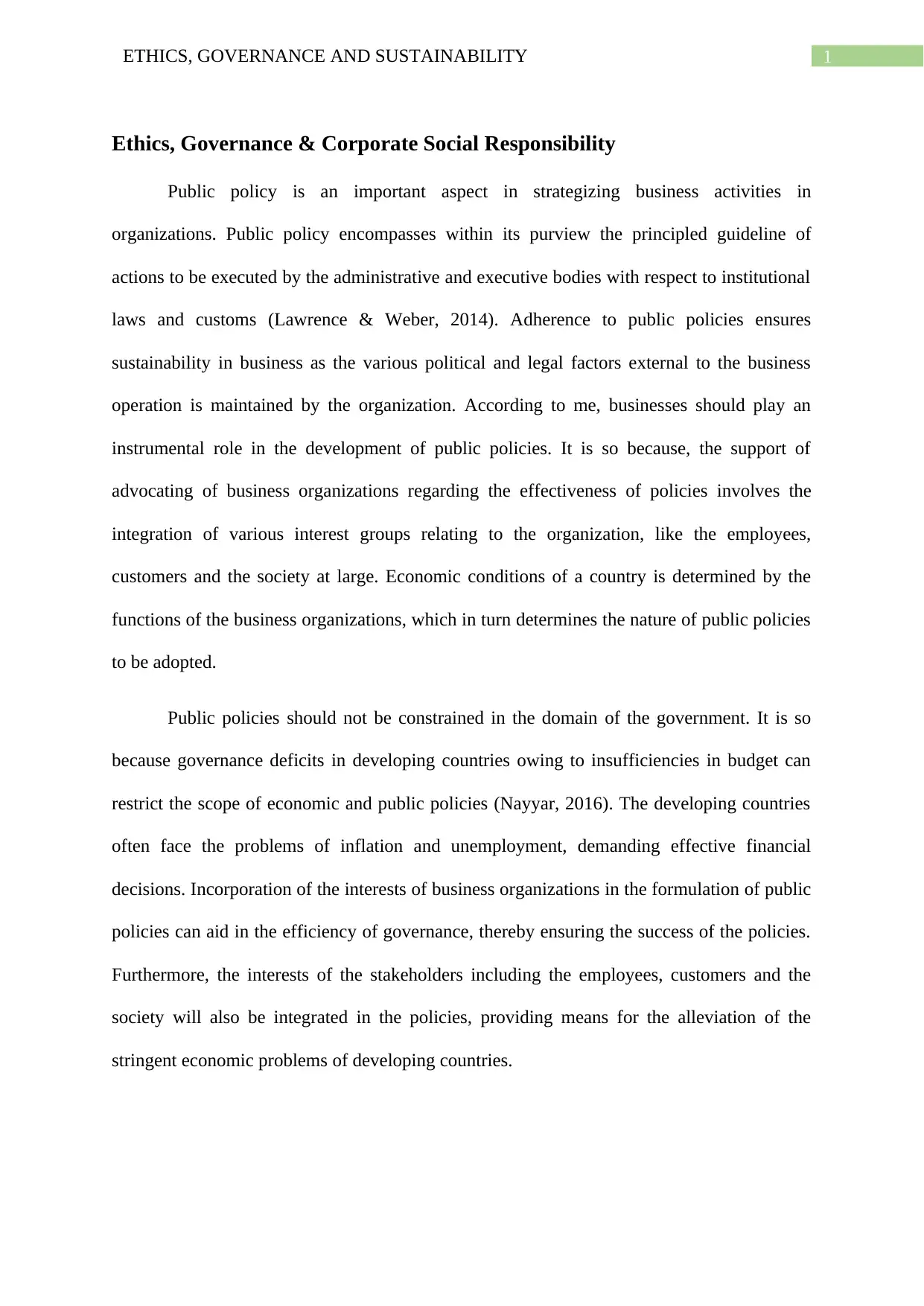
1ETHICS, GOVERNANCE AND SUSTAINABILITY
Ethics, Governance & Corporate Social Responsibility
Public policy is an important aspect in strategizing business activities in
organizations. Public policy encompasses within its purview the principled guideline of
actions to be executed by the administrative and executive bodies with respect to institutional
laws and customs (Lawrence & Weber, 2014). Adherence to public policies ensures
sustainability in business as the various political and legal factors external to the business
operation is maintained by the organization. According to me, businesses should play an
instrumental role in the development of public policies. It is so because, the support of
advocating of business organizations regarding the effectiveness of policies involves the
integration of various interest groups relating to the organization, like the employees,
customers and the society at large. Economic conditions of a country is determined by the
functions of the business organizations, which in turn determines the nature of public policies
to be adopted.
Public policies should not be constrained in the domain of the government. It is so
because governance deficits in developing countries owing to insufficiencies in budget can
restrict the scope of economic and public policies (Nayyar, 2016). The developing countries
often face the problems of inflation and unemployment, demanding effective financial
decisions. Incorporation of the interests of business organizations in the formulation of public
policies can aid in the efficiency of governance, thereby ensuring the success of the policies.
Furthermore, the interests of the stakeholders including the employees, customers and the
society will also be integrated in the policies, providing means for the alleviation of the
stringent economic problems of developing countries.
Document Page
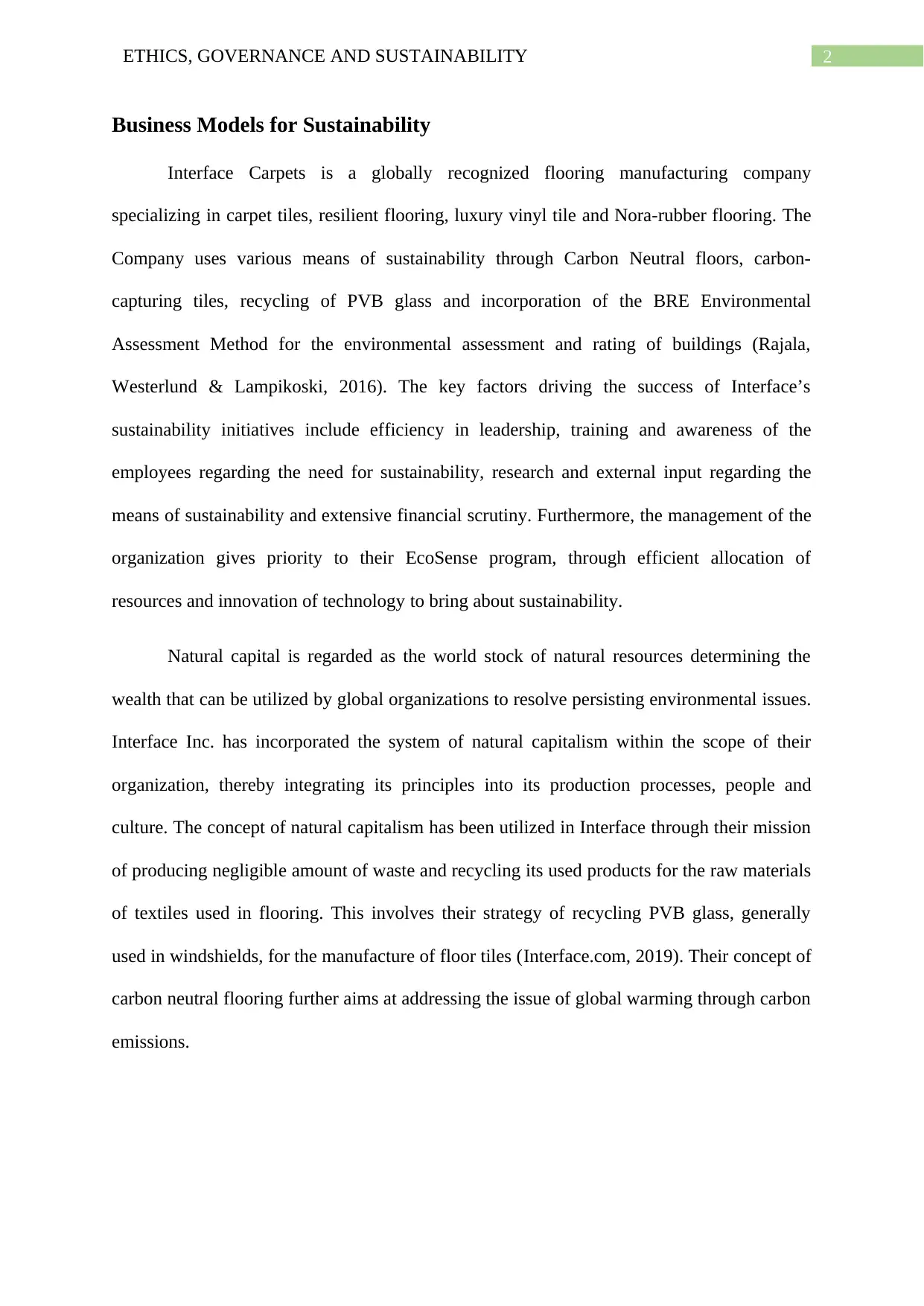
2ETHICS, GOVERNANCE AND SUSTAINABILITY
Business Models for Sustainability
Interface Carpets is a globally recognized flooring manufacturing company
specializing in carpet tiles, resilient flooring, luxury vinyl tile and Nora-rubber flooring. The
Company uses various means of sustainability through Carbon Neutral floors, carbon-
capturing tiles, recycling of PVB glass and incorporation of the BRE Environmental
Assessment Method for the environmental assessment and rating of buildings (Rajala,
Westerlund & Lampikoski, 2016). The key factors driving the success of Interface’s
sustainability initiatives include efficiency in leadership, training and awareness of the
employees regarding the need for sustainability, research and external input regarding the
means of sustainability and extensive financial scrutiny. Furthermore, the management of the
organization gives priority to their EcoSense program, through efficient allocation of
resources and innovation of technology to bring about sustainability.
Natural capital is regarded as the world stock of natural resources determining the
wealth that can be utilized by global organizations to resolve persisting environmental issues.
Interface Inc. has incorporated the system of natural capitalism within the scope of their
organization, thereby integrating its principles into its production processes, people and
culture. The concept of natural capitalism has been utilized in Interface through their mission
of producing negligible amount of waste and recycling its used products for the raw materials
of textiles used in flooring. This involves their strategy of recycling PVB glass, generally
used in windshields, for the manufacture of floor tiles (Interface.com, 2019). Their concept of
carbon neutral flooring further aims at addressing the issue of global warming through carbon
emissions.
Document Page
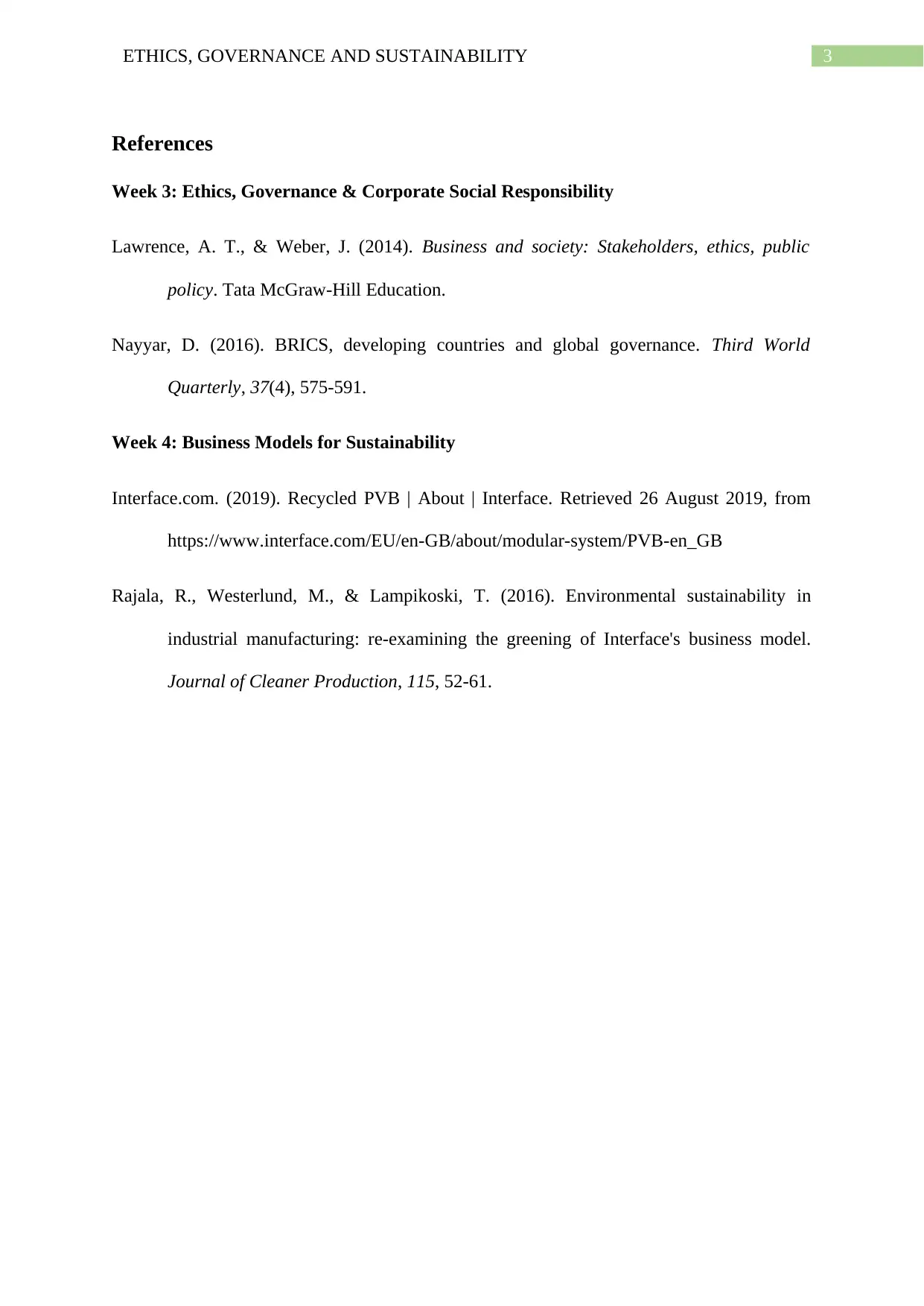
3ETHICS, GOVERNANCE AND SUSTAINABILITY
References
Week 3: Ethics, Governance & Corporate Social Responsibility
Lawrence, A. T., & Weber, J. (2014). Business and society: Stakeholders, ethics, public
policy. Tata McGraw-Hill Education.
Nayyar, D. (2016). BRICS, developing countries and global governance. Third World
Quarterly, 37(4), 575-591.
Week 4: Business Models for Sustainability
Interface.com. (2019). Recycled PVB | About | Interface. Retrieved 26 August 2019, from
https://www.interface.com/EU/en-GB/about/modular-system/PVB-en_GB
Rajala, R., Westerlund, M., & Lampikoski, T. (2016). Environmental sustainability in
industrial manufacturing: re-examining the greening of Interface's business model.
Journal of Cleaner Production, 115, 52-61.
chevron_up_icon
1 out of 4
circle_padding
hide_on_mobile
zoom_out_icon
[object Object]