Case Study: Ethical and Legal Environment - Business Decisions

Verified

Added on  2022/12/02

|5
|1072
|167
Case Study
AI Summary
This case study delves into the ethical and legal dilemmas faced by Ardnanck Plastic Incorporation concerning environmental regulations and stakeholder interests. The analysis examines the roles of key stakeholders, including the plant manager, company executives, employees, the environment, and governmental bodies such as the EPA and the Mexican government. The legal analysis focuses on the Clean Air Act and Toxic Torts, highlighting the company's non-compliance with EPA standards. The ethical analysis applies four ethical theories—categorical imperative, utilitarianism, rights theory, and justice theory—to evaluate the proposed decision of relocating the plant to Mexico. The study concludes with a recommendation to address the smokestack emissions through a solution that complies with EPA standards, ensuring environmental safety, job retention, and minimal negative impacts on stakeholders. The case emphasizes the importance of ethical decision-making in business, particularly in relation to environmental responsibility and stakeholder well-being.
Document Page
Running head: ETHICS AND LEGAL ENVIRONMENT 1
Ethics and Legal Environment
Name
Institutional Affiliation
tabler-icon-diamond-filled.svg

Paraphrase This Document

Need a fresh take? Get an instant paraphrase of this document with our AI Paraphraser
Document Page
ETHICS AND LEGAL ENVIRONMENT 2
Ethics and Legal Environment
Introduction
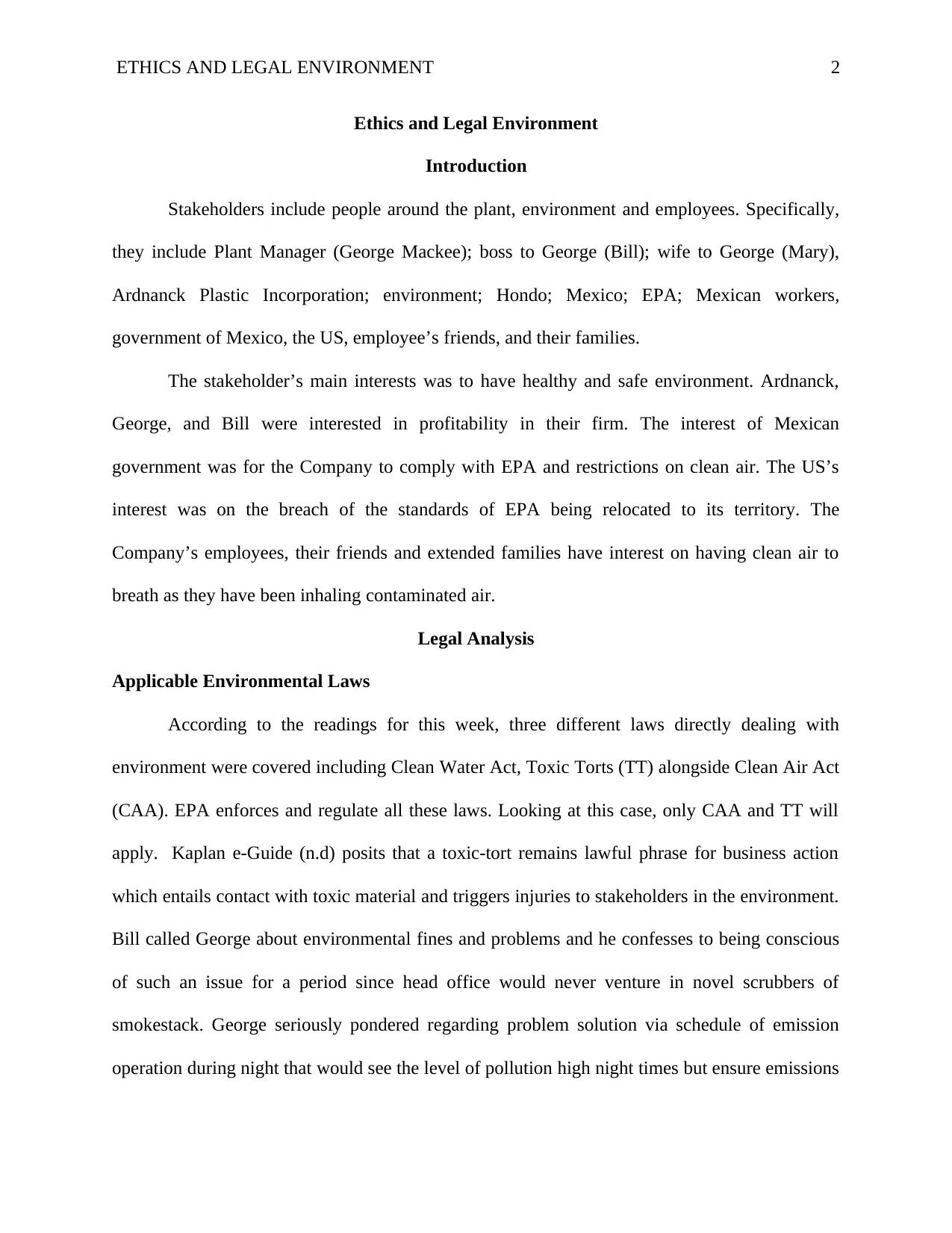
Stakeholders include people around the plant, environment and employees. Specifically,
they include Plant Manager (George Mackee); boss to George (Bill); wife to George (Mary),
Ardnanck Plastic Incorporation; environment; Hondo; Mexico; EPA; Mexican workers,
government of Mexico, the US, employee’s friends, and their families.
The stakeholder’s main interests was to have healthy and safe environment. Ardnanck,
George, and Bill were interested in profitability in their firm. The interest of Mexican
government was for the Company to comply with EPA and restrictions on clean air. The US’s
interest was on the breach of the standards of EPA being relocated to its territory. The
Company’s employees, their friends and extended families have interest on having clean air to
breath as they have been inhaling contaminated air.
Legal Analysis
Applicable Environmental Laws
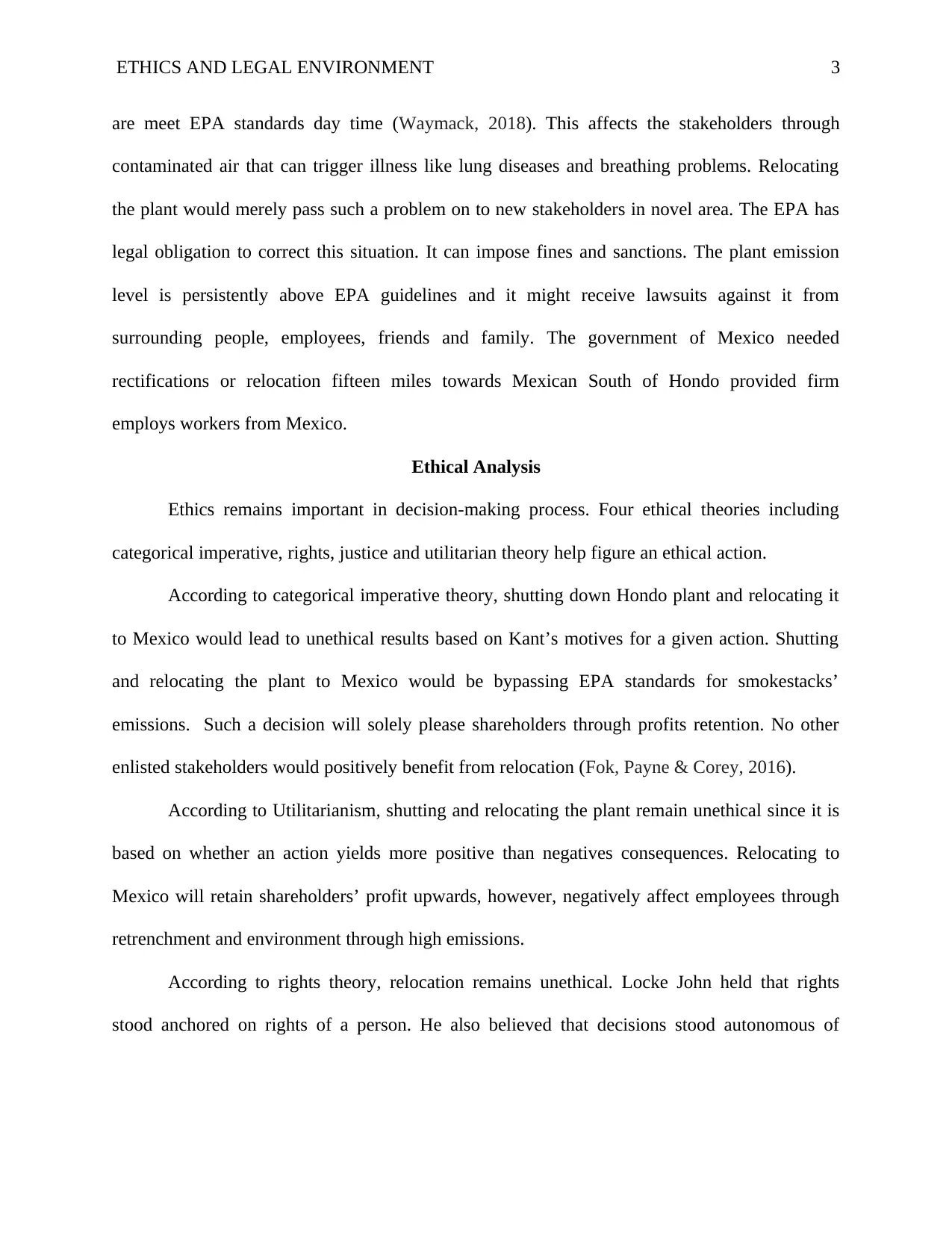
According to the readings for this week, three different laws directly dealing with
environment were covered including Clean Water Act, Toxic Torts (TT) alongside Clean Air Act
(CAA). EPA enforces and regulate all these laws. Looking at this case, only CAA and TT will
apply. Kaplan e-Guide (n.d) posits that a toxic-tort remains lawful phrase for business action
which entails contact with toxic material and triggers injuries to stakeholders in the environment.
Bill called George about environmental fines and problems and he confesses to being conscious
of such an issue for a period since head office would never venture in novel scrubbers of
smokestack. George seriously pondered regarding problem solution via schedule of emission
operation during night that would see the level of pollution high night times but ensure emissions
Document Page
ETHICS AND LEGAL ENVIRONMENT 3
are meet EPA standards day time (Waymack, 2018). This affects the stakeholders through
contaminated air that can trigger illness like lung diseases and breathing problems. Relocating
the plant would merely pass such a problem on to new stakeholders in novel area. The EPA has
legal obligation to correct this situation. It can impose fines and sanctions. The plant emission
level is persistently above EPA guidelines and it might receive lawsuits against it from
surrounding people, employees, friends and family. The government of Mexico needed
rectifications or relocation fifteen miles towards Mexican South of Hondo provided firm
employs workers from Mexico.
Ethical Analysis
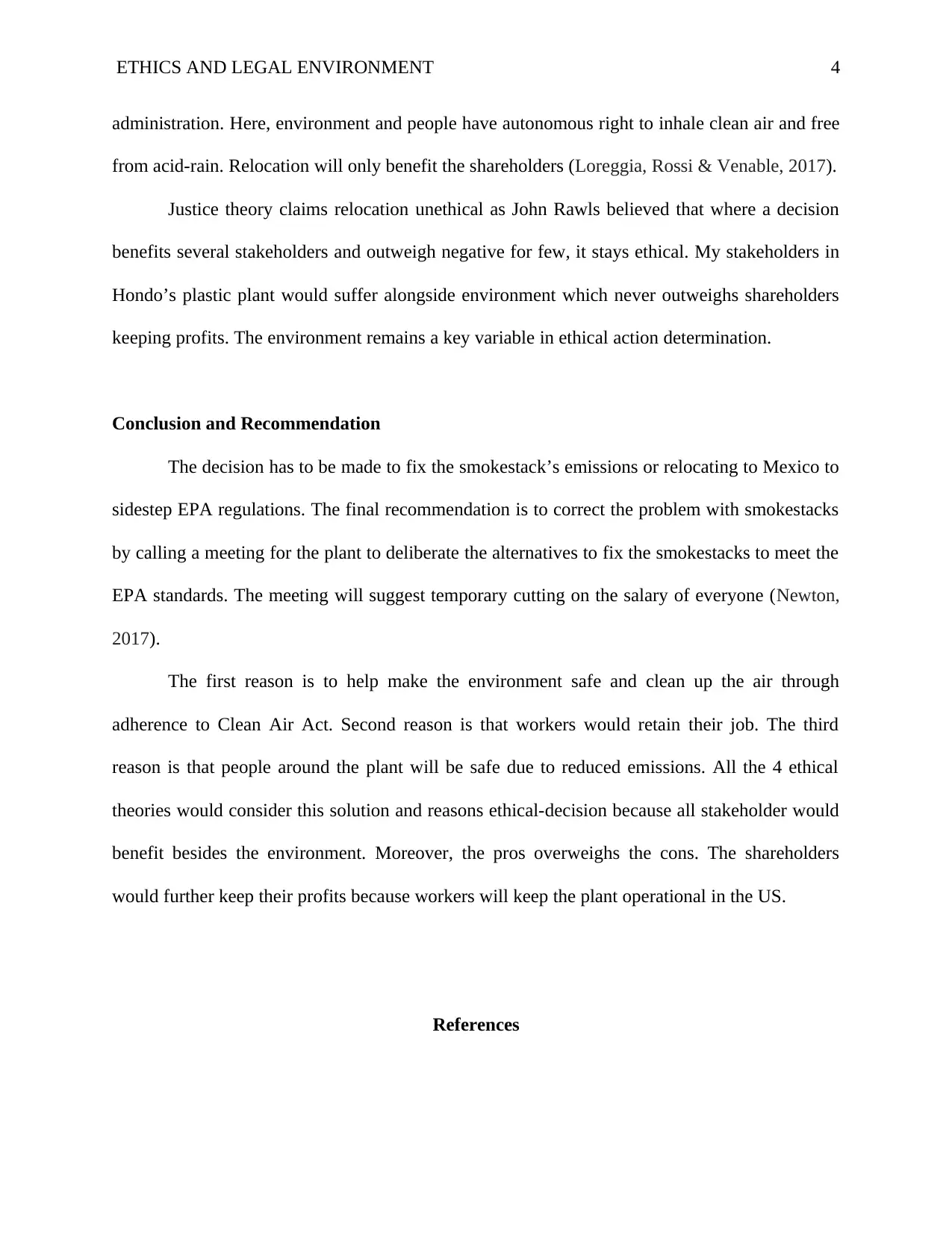
Ethics remains important in decision-making process. Four ethical theories including
categorical imperative, rights, justice and utilitarian theory help figure an ethical action.
According to categorical imperative theory, shutting down Hondo plant and relocating it
to Mexico would lead to unethical results based on Kant’s motives for a given action. Shutting
and relocating the plant to Mexico would be bypassing EPA standards for smokestacks’
emissions. Such a decision will solely please shareholders through profits retention. No other
enlisted stakeholders would positively benefit from relocation (Fok, Payne & Corey, 2016).
According to Utilitarianism, shutting and relocating the plant remain unethical since it is
based on whether an action yields more positive than negatives consequences. Relocating to
Mexico will retain shareholders’ profit upwards, however, negatively affect employees through
retrenchment and environment through high emissions.
According to rights theory, relocation remains unethical. Locke John held that rights
stood anchored on rights of a person. He also believed that decisions stood autonomous of
Document Page
ETHICS AND LEGAL ENVIRONMENT 4
administration. Here, environment and people have autonomous right to inhale clean air and free
from acid-rain. Relocation will only benefit the shareholders (Loreggia, Rossi & Venable, 2017).
Justice theory claims relocation unethical as John Rawls believed that where a decision
benefits several stakeholders and outweigh negative for few, it stays ethical. My stakeholders in
Hondo’s plastic plant would suffer alongside environment which never outweighs shareholders
keeping profits. The environment remains a key variable in ethical action determination.
Conclusion and Recommendation
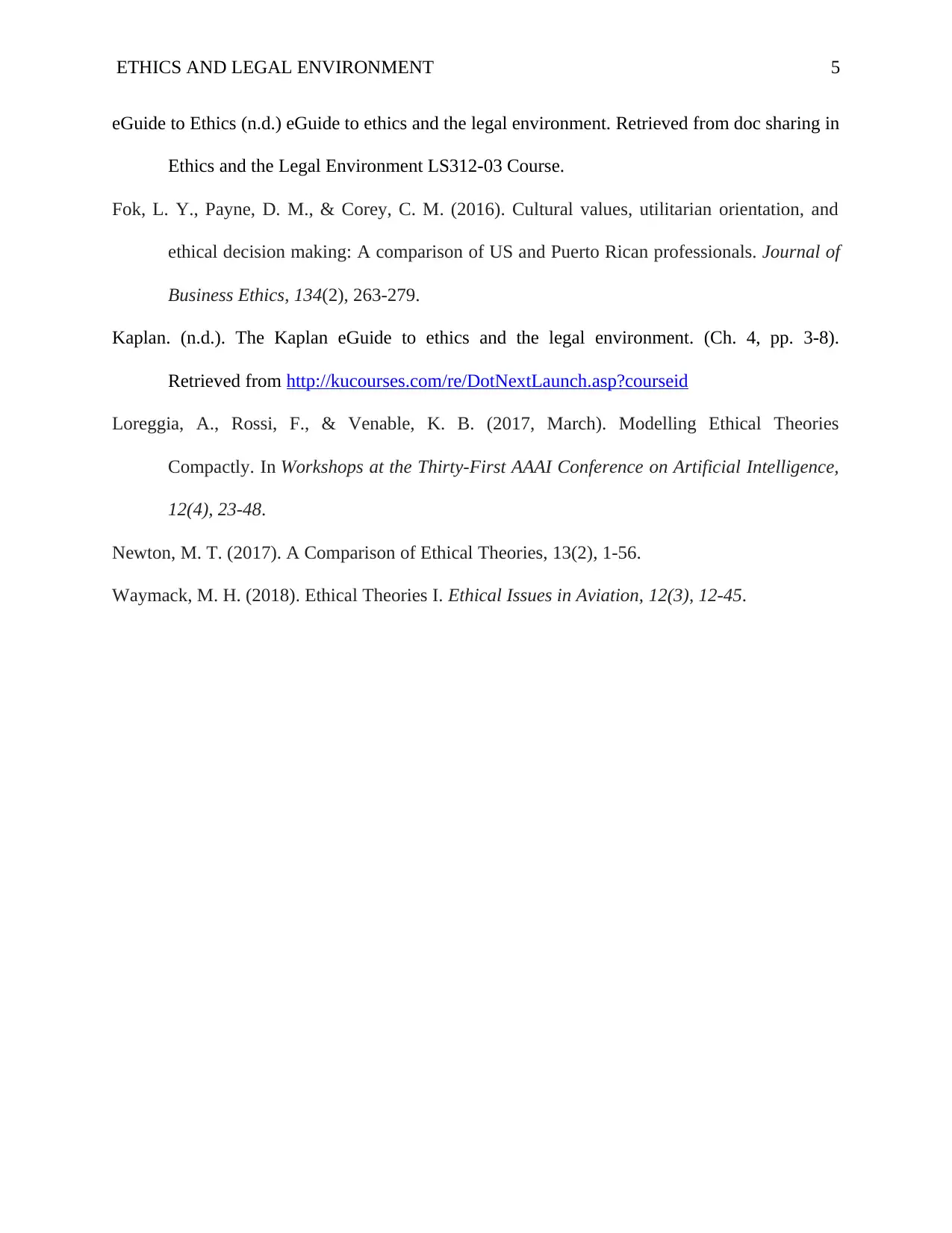
The decision has to be made to fix the smokestack’s emissions or relocating to Mexico to
sidestep EPA regulations. The final recommendation is to correct the problem with smokestacks
by calling a meeting for the plant to deliberate the alternatives to fix the smokestacks to meet the
EPA standards. The meeting will suggest temporary cutting on the salary of everyone (Newton,
2017).
The first reason is to help make the environment safe and clean up the air through
adherence to Clean Air Act. Second reason is that workers would retain their job. The third
reason is that people around the plant will be safe due to reduced emissions. All the 4 ethical
theories would consider this solution and reasons ethical-decision because all stakeholder would
benefit besides the environment. Moreover, the pros overweighs the cons. The shareholders
would further keep their profits because workers will keep the plant operational in the US.
References
tabler-icon-diamond-filled.svg

Paraphrase This Document

Need a fresh take? Get an instant paraphrase of this document with our AI Paraphraser
Document Page
ETHICS AND LEGAL ENVIRONMENT 5
eGuide to Ethics (n.d.) eGuide to ethics and the legal environment. Retrieved from doc sharing in
Ethics and the Legal Environment LS312-03 Course.
Fok, L. Y., Payne, D. M., & Corey, C. M. (2016). Cultural values, utilitarian orientation, and
ethical decision making: A comparison of US and Puerto Rican professionals. Journal of
Business Ethics, 134(2), 263-279.
Kaplan. (n.d.). The Kaplan eGuide to ethics and the legal environment. (Ch. 4, pp. 3-8).
Retrieved from http://kucourses.com/re/DotNextLaunch.asp?courseid
Loreggia, A., Rossi, F., & Venable, K. B. (2017, March). Modelling Ethical Theories
Compactly. In Workshops at the Thirty-First AAAI Conference on Artificial Intelligence,
12(4), 23-48.
Newton, M. T. (2017). A Comparison of Ethical Theories, 13(2), 1-56.
Waymack, M. H. (2018). Ethical Theories I. Ethical Issues in Aviation, 12(3), 12-45.
chevron_up_icon
1 out of 5
circle_padding
hide_on_mobile
zoom_out_icon
[object Object]