Ethics in Research: Planning, Communication, and Misconduct
VerifiedAdded on 2023/06/07
|13
|3003
|491
Essay
AI Summary
This essay, prepared for the SLE761 Research Planning & Communication course, explores the critical role of ethics in research, emphasizing the importance of ethical conduct and integrity. Part 1 of the essay defines research ethics, its significance, and the ethical guidelines in Australia. It delves into key ethical issues, such as data protection, confidentiality, and the coordination among different departments, using a study on plastic pollution in the Great Barrier Reef as an example. Part 2 presents a case study on scientific misconduct, focusing on a retracted BMC Medicine publication concerning the flu vaccine. The essay discusses the nature of the misconduct, its impact on public health, and the relevant ethical codes in Canada, highlighting the importance of ethical research practices to maintain public trust and ensure the validity of scientific findings. The essay emphasizes adhering to ethical guidelines and the potential consequences of ethical breaches in research.
Research Planning & Communication
Ethics Essay
Student Name:
Student Code:
Subject Name:
Subject Code:
Date Due:
Professor Name:
Trimester Two, 2018
1
Ethics Essay
Student Name:
Student Code:
Subject Name:
Subject Code:
Date Due:
Professor Name:
Trimester Two, 2018
1

Paraphrase This Document
Need a fresh take? Get an instant paraphrase of this document with our AI Paraphraser
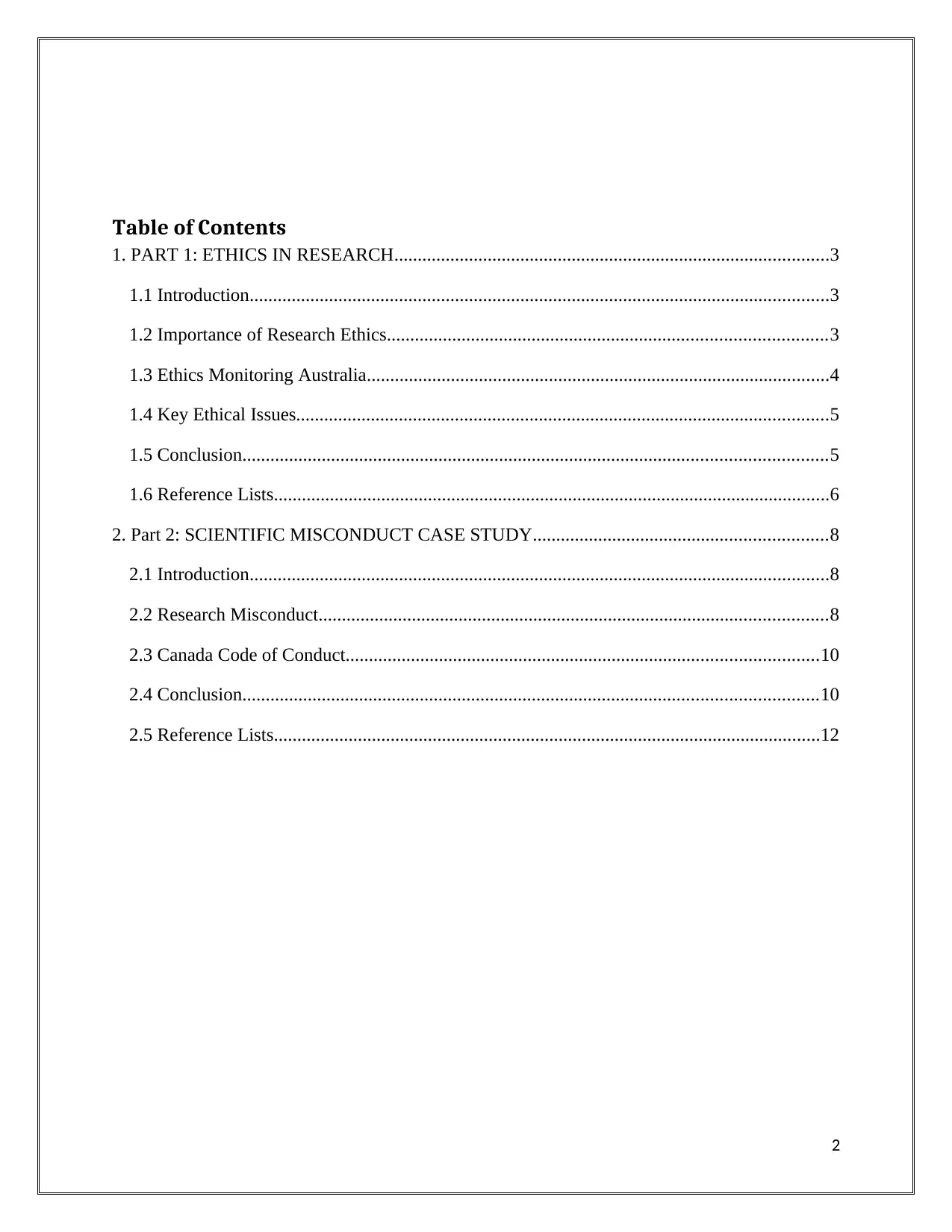
Table of Contents
1. PART 1: ETHICS IN RESEARCH.............................................................................................3
1.1 Introduction............................................................................................................................3
1.2 Importance of Research Ethics..............................................................................................3
1.3 Ethics Monitoring Australia...................................................................................................4
1.4 Key Ethical Issues..................................................................................................................5
1.5 Conclusion.............................................................................................................................5
1.6 Reference Lists.......................................................................................................................6
2. Part 2: SCIENTIFIC MISCONDUCT CASE STUDY...............................................................8
2.1 Introduction............................................................................................................................8
2.2 Research Misconduct.............................................................................................................8
2.3 Canada Code of Conduct.....................................................................................................10
2.4 Conclusion...........................................................................................................................10
2.5 Reference Lists.....................................................................................................................12
2
1. PART 1: ETHICS IN RESEARCH.............................................................................................3
1.1 Introduction............................................................................................................................3
1.2 Importance of Research Ethics..............................................................................................3
1.3 Ethics Monitoring Australia...................................................................................................4
1.4 Key Ethical Issues..................................................................................................................5
1.5 Conclusion.............................................................................................................................5
1.6 Reference Lists.......................................................................................................................6
2. Part 2: SCIENTIFIC MISCONDUCT CASE STUDY...............................................................8
2.1 Introduction............................................................................................................................8
2.2 Research Misconduct.............................................................................................................8
2.3 Canada Code of Conduct.....................................................................................................10
2.4 Conclusion...........................................................................................................................10
2.5 Reference Lists.....................................................................................................................12
2
1. PART 1: ETHICS IN RESEARCH
1.1 Introduction
An ethical norm as a way of not causing harm is learnt at school or church or in other
social setting (Gillan & Pickerill, 2012). While the moral conduct of deciding upon the right or
the wrong is learnt during the human life, individuals interpret and apply them according to their
understanding, values and through experiences. Ethics can be defined as a code of conduct that
governs behaviours. Almost every profession, discipline, activities have their set of ethical
principles that matches their goals. Similarly ethical conduct applies in the area of research as
well (Oliver, 2010). Ethical principles application ensures promotion of knowledge, truth and in
avoiding errors such as fabricating or falsification or misrepresentation.
1.2 Importance of Research Ethics
The role of ethics is considerable in research, as research requires coordinating and
cooperating between varied different institutions, people and disciplines, ethical principles aids
in collaboration. Ethical principles of accountability, trust, fairness and mutual respect ensures
conducting such research (Alderson & Morrow, 2011). Various ethical norms within research
which promotes protection of intellectual property while collaborating, includes patenting
policies, copyright, authorship, peer review and so on. In the case of research undertaken for
Assignment 3, the topic of Plastic Pollution of destroying Corals in Great Barrier Reef, ethical
norms will have tremendous considerations. In the research topic, I will need to coordinate
between Ocean Scientists department, local community and government data (Resnik, 2011).
While dealing with enormous volumes of information, I need to ensure that there is no
falsification of data and the true picture can be represented with utmost fairness. All names of
participants within the research will be kept confidential, and they will be explained regarding
3
1.1 Introduction
An ethical norm as a way of not causing harm is learnt at school or church or in other
social setting (Gillan & Pickerill, 2012). While the moral conduct of deciding upon the right or
the wrong is learnt during the human life, individuals interpret and apply them according to their
understanding, values and through experiences. Ethics can be defined as a code of conduct that
governs behaviours. Almost every profession, discipline, activities have their set of ethical
principles that matches their goals. Similarly ethical conduct applies in the area of research as
well (Oliver, 2010). Ethical principles application ensures promotion of knowledge, truth and in
avoiding errors such as fabricating or falsification or misrepresentation.
1.2 Importance of Research Ethics
The role of ethics is considerable in research, as research requires coordinating and
cooperating between varied different institutions, people and disciplines, ethical principles aids
in collaboration. Ethical principles of accountability, trust, fairness and mutual respect ensures
conducting such research (Alderson & Morrow, 2011). Various ethical norms within research
which promotes protection of intellectual property while collaborating, includes patenting
policies, copyright, authorship, peer review and so on. In the case of research undertaken for
Assignment 3, the topic of Plastic Pollution of destroying Corals in Great Barrier Reef, ethical
norms will have tremendous considerations. In the research topic, I will need to coordinate
between Ocean Scientists department, local community and government data (Resnik, 2011).
While dealing with enormous volumes of information, I need to ensure that there is no
falsification of data and the true picture can be represented with utmost fairness. All names of
participants within the research will be kept confidential, and they will be explained regarding
3
⊘ This is a preview!⊘
Do you want full access?
Subscribe today to unlock all pages.

Trusted by 1+ million students worldwide
the research with its possible impacts prior to their taking part in the study. There will be no
coercion on any participant to undertake part in the study (McMillan & Schumacher, 2010).
Ethical norms hold the researcher accountable to public, this is essential for scientific
research which has impact on general public. Most important role of ethical norm in research is
that it allows building public support in research. Funding for a research project can be raised in
case the public considers the research to be integral and having social value (Faden, Kass,
Goodman, Pronovost, Tunis & Beauchamp, 2013). Lastly, ethics in research is able to promote
varied types of social and moral values, which can be seen as human rights, animal welfare and
similar other topic areas.
1.3 Ethics Monitoring Australia
Importance of ethics in research cannot be overstated; hence there are pertinent
guidelines that promote research integrity (RI) within Australia (Brown & Mitchell, 2010). As
the scope of my study is within Australia, I will be considering the various guidelines which
need to be followed in Australia. In Australia, the Research Integrity (RI) guideline is decided by
the Commonwealth. It is done by means of NHMRC, Australian Universities and ARC. These
guidelines are a must in cases of all Commonwealth funded organizations and its general
responsibilities are well-defined in the Australian Code for the Responsible Conduct of Research
(2018). Its general principles include promotion of honesty and integrity, good stewardship
regarding usage of public resources. It also includes respect for human research participants,
environment and animals. It encompasses acknowledging other’s role within the scope of the
research. For my project apart from this guideline, I will need to get approval for Biosafety and
Biosecurity along with Human Research Ethics. Legal issues that I will need to deal with will
include Sponsorship and contracts, the subsequently privacy laws according to Privacy Act 1988.
4
coercion on any participant to undertake part in the study (McMillan & Schumacher, 2010).
Ethical norms hold the researcher accountable to public, this is essential for scientific
research which has impact on general public. Most important role of ethical norm in research is
that it allows building public support in research. Funding for a research project can be raised in
case the public considers the research to be integral and having social value (Faden, Kass,
Goodman, Pronovost, Tunis & Beauchamp, 2013). Lastly, ethics in research is able to promote
varied types of social and moral values, which can be seen as human rights, animal welfare and
similar other topic areas.
1.3 Ethics Monitoring Australia
Importance of ethics in research cannot be overstated; hence there are pertinent
guidelines that promote research integrity (RI) within Australia (Brown & Mitchell, 2010). As
the scope of my study is within Australia, I will be considering the various guidelines which
need to be followed in Australia. In Australia, the Research Integrity (RI) guideline is decided by
the Commonwealth. It is done by means of NHMRC, Australian Universities and ARC. These
guidelines are a must in cases of all Commonwealth funded organizations and its general
responsibilities are well-defined in the Australian Code for the Responsible Conduct of Research
(2018). Its general principles include promotion of honesty and integrity, good stewardship
regarding usage of public resources. It also includes respect for human research participants,
environment and animals. It encompasses acknowledging other’s role within the scope of the
research. For my project apart from this guideline, I will need to get approval for Biosafety and
Biosecurity along with Human Research Ethics. Legal issues that I will need to deal with will
include Sponsorship and contracts, the subsequently privacy laws according to Privacy Act 1988.
4
Paraphrase This Document
Need a fresh take? Get an instant paraphrase of this document with our AI Paraphraser
I will need to obtain Data Management authorship according to the Australian code by applying
for Responsibilities of Institutions (R8).
1.4 Key Ethical Issues
While ethics is considered to be important in research, a scholar’s role is to ensure key
ethical areas that might come up during the course of the study. In the study selected by me,
Plastic Pollution in Great Barrier Reef, I have been able to understand key ethical challenge that
I might face. Some of the areas include, data protection, preserving confidentiality, coordinating
amongst departments and getting funded for my study (Hollway, 2018). Discussing each
challenge can reveal in-depth nature of the causes. Dealing with crucial and critical data such as
marine and corals lost within specific time period, amount of plastic entering ocean and other
critical data can easily be stolen. Though I will aim at protecting them, but while data sharing
such crucial information has chances of getting lost or even tampered. The topic I will deal with
can be regarded as a hot topic as there is significant amount of earning from tourism and fishing
activity in the Great Barrier Reef. The research needs to collect data from varied sources, while
explaining the topic to participants, there remains a possibility that the confidentiality of the
project might be lost. When I am conducting my study, I need to ensure that these key ethical
concerns can be mitigated and handled in an appropriate manner by me.
1.5 Conclusion
Ethics play a major role in research and scholars needs to adhere to ethical guidelines
while conducting their research. Every country and discipline has their own sets of ethical
conduct and guidelines that has to be followed, to ensure that no ethical challenges are faced.
Research Integrity allows scholars to take into knowledge any ethical concern that might arise in
the process of conducting research, the devising strategies to overcome them.
5
for Responsibilities of Institutions (R8).
1.4 Key Ethical Issues
While ethics is considered to be important in research, a scholar’s role is to ensure key
ethical areas that might come up during the course of the study. In the study selected by me,
Plastic Pollution in Great Barrier Reef, I have been able to understand key ethical challenge that
I might face. Some of the areas include, data protection, preserving confidentiality, coordinating
amongst departments and getting funded for my study (Hollway, 2018). Discussing each
challenge can reveal in-depth nature of the causes. Dealing with crucial and critical data such as
marine and corals lost within specific time period, amount of plastic entering ocean and other
critical data can easily be stolen. Though I will aim at protecting them, but while data sharing
such crucial information has chances of getting lost or even tampered. The topic I will deal with
can be regarded as a hot topic as there is significant amount of earning from tourism and fishing
activity in the Great Barrier Reef. The research needs to collect data from varied sources, while
explaining the topic to participants, there remains a possibility that the confidentiality of the
project might be lost. When I am conducting my study, I need to ensure that these key ethical
concerns can be mitigated and handled in an appropriate manner by me.
1.5 Conclusion
Ethics play a major role in research and scholars needs to adhere to ethical guidelines
while conducting their research. Every country and discipline has their own sets of ethical
conduct and guidelines that has to be followed, to ensure that no ethical challenges are faced.
Research Integrity allows scholars to take into knowledge any ethical concern that might arise in
the process of conducting research, the devising strategies to overcome them.
5
1.6 Reference Lists
Alderson, P. and Morrow, V., 2011. The ethics of research with children and young people: A
practical handbook. Sage Publications Ltd. Referred on 11th August 2018 from
https://books.google.co.in/books?
hl=en&lr=&id=ozX2i1u71isC&oi=fnd&pg=PP1&dq=importance+of+ethics+in+research&ots=
WwG7nzYo65&sig=CuqDtxLhzA41cFMw5eYzvc5ZgCY#v=onepage&q=importance%20of
%20ethics%20in%20research&f=false
Brown, M.E. and Mitchell, M.S., 2010. Ethical and unethical leadership: Exploring new avenues
for future research. Business Ethics Quarterly, 20(4), pp.583-616. Referred on 18th August 2018
from https://www.cambridge.org/core/journals/business-ethics-quarterly/article/ethical-and-
unethical-leadership-exploring-new-avenues-for-future-research/
073D6C535E7D86680F9C15E3E95C9E9D
Faden, R.R., Kass, N.E., Goodman, S.N., Pronovost, P., Tunis, S. and Beauchamp, T.L., 2013.
An ethics framework for a learning health care system: a departure from traditional research
ethics and clinical ethics. Hastings Center Report, 43(s1), pp.S16-S27. Referred on 8th August
2018 from https://onlinelibrary.wiley.com/doi/abs/10.1002/hast.134
Gillan, K. and Pickerill, J., 2012. The difficult and hopeful ethics of research on, and with, social
movements. Social Movement Studies, 11(2), pp.133-143. Referred on 5th August 2018 from
https://www.tandfonline.com/doi/abs/10.1080/14742837.2012.664890
Hollway, W., 2018. The importance of relational thinking in the practice of psycho-social
research: Ontology, epistemology, methodology, and ethics. In Object relations and social
relations (pp. 137-161). Routledge. Referred on 2nd September 2018 from
https://www.taylorfrancis.com/books/e/9780429902437/chapters/10.4324%2F9780429477669-7
McMillan, J.H. and Schumacher, S., 2010. Research in Education: Evidence-Based Inquiry,
MyEducationLab Series. Pearson. Referred on 20th August 2018 from https://eric.ed.gov/?
id=ED577250
Oliver, P., 2010. The student's guide to research ethics. McGraw-Hill Education (UK). Referred
on 30th August 2018 from https://books.google.co.in/books?
6
Alderson, P. and Morrow, V., 2011. The ethics of research with children and young people: A
practical handbook. Sage Publications Ltd. Referred on 11th August 2018 from
https://books.google.co.in/books?
hl=en&lr=&id=ozX2i1u71isC&oi=fnd&pg=PP1&dq=importance+of+ethics+in+research&ots=
WwG7nzYo65&sig=CuqDtxLhzA41cFMw5eYzvc5ZgCY#v=onepage&q=importance%20of
%20ethics%20in%20research&f=false
Brown, M.E. and Mitchell, M.S., 2010. Ethical and unethical leadership: Exploring new avenues
for future research. Business Ethics Quarterly, 20(4), pp.583-616. Referred on 18th August 2018
from https://www.cambridge.org/core/journals/business-ethics-quarterly/article/ethical-and-
unethical-leadership-exploring-new-avenues-for-future-research/
073D6C535E7D86680F9C15E3E95C9E9D
Faden, R.R., Kass, N.E., Goodman, S.N., Pronovost, P., Tunis, S. and Beauchamp, T.L., 2013.
An ethics framework for a learning health care system: a departure from traditional research
ethics and clinical ethics. Hastings Center Report, 43(s1), pp.S16-S27. Referred on 8th August
2018 from https://onlinelibrary.wiley.com/doi/abs/10.1002/hast.134
Gillan, K. and Pickerill, J., 2012. The difficult and hopeful ethics of research on, and with, social
movements. Social Movement Studies, 11(2), pp.133-143. Referred on 5th August 2018 from
https://www.tandfonline.com/doi/abs/10.1080/14742837.2012.664890
Hollway, W., 2018. The importance of relational thinking in the practice of psycho-social
research: Ontology, epistemology, methodology, and ethics. In Object relations and social
relations (pp. 137-161). Routledge. Referred on 2nd September 2018 from
https://www.taylorfrancis.com/books/e/9780429902437/chapters/10.4324%2F9780429477669-7
McMillan, J.H. and Schumacher, S., 2010. Research in Education: Evidence-Based Inquiry,
MyEducationLab Series. Pearson. Referred on 20th August 2018 from https://eric.ed.gov/?
id=ED577250
Oliver, P., 2010. The student's guide to research ethics. McGraw-Hill Education (UK). Referred
on 30th August 2018 from https://books.google.co.in/books?
6
⊘ This is a preview!⊘
Do you want full access?
Subscribe today to unlock all pages.
Trusted by 1+ million students worldwide
hl=en&lr=&id=WIuNij1aGtoC&oi=fnd&pg=PP1&dq=importance+of+ethics+in+research&ots=
hKSBVh-zPg&sig=aB1dlAPUfKuYN8lOSBt_0rWmRjo#v=onepage&q=importance%20of
%20ethics%20in%20research&f=false
Resnik, D.B., 2011. What is ethics in research & why is it important. National Institute of
Environmental Health Sciences, pp.1-10. Referred on 28th August 2018 from
https://www.veronaschools.org/cms/lib02/NJ01001379/Centricity/Domain/588/What%20is
%20Ethics%20in%20Research%20Why%20is%20it%20Important.pdf
7
hKSBVh-zPg&sig=aB1dlAPUfKuYN8lOSBt_0rWmRjo#v=onepage&q=importance%20of
%20ethics%20in%20research&f=false
Resnik, D.B., 2011. What is ethics in research & why is it important. National Institute of
Environmental Health Sciences, pp.1-10. Referred on 28th August 2018 from
https://www.veronaschools.org/cms/lib02/NJ01001379/Centricity/Domain/588/What%20is
%20Ethics%20in%20Research%20Why%20is%20it%20Important.pdf
7
Paraphrase This Document
Need a fresh take? Get an instant paraphrase of this document with our AI Paraphraser
2. Part 2: SCIENTIFIC MISCONDUCT CASE STUDY
2.1 Introduction
Scientific research includes broader scope of ethics that needs to be adhered with
(Dhaliwal, Singh & Bhatia, 2010). Biological scientific research having impact on the public
requires greater compliance to be undertaken by the research committee to avoid possibilities of
error. There are many scientific researches that lead to scientific misconduct, which can be
evaluated better in the light of Conduct of Research applied within their country. The scope of
current scientific misconduct case has been selected from retractionwatch.com and is regarding a
publication by the BMC Medicine in the year 2017 for flu vaccine (Fanelli, 2013). The ethical
boards of Canada and its principles have been discussed in the current preview.
2.2 Research Misconduct
The never-ending controversy regarding flu vaccine has gained tremendous momentum at the
moment, with specially Bryna Warshawsky commenting on it. BMC Medicine reported that
while publishing regarding cases and effectiveness related to flu vaccine, various authors had
varied views (Fanelli, 2010). But most authors were seen to include or omit stances that could
affect the final conclusion regarding the study. Meaning the study could not allow arriving at
specific conclusion as to whether one should take the vaccine or not. While prior to the case
being reported, most authors supported flu vaccine being taken post the reporting of this case
most authors retracted. Bryna Washawsky, medical director of communicable disease at Public
Health Ontario in Canada changed conclusion made by her and her team members. This is a
grave ethical misconduct as flu is a prevalent disease in Canada’s weather with thousands of
adult, children and older population suffering from it each year (Ajuwon & Kass, 2008). Public
spending and private spending on flu in Canada amounts to tremendous costs, with the 3500
8
2.1 Introduction
Scientific research includes broader scope of ethics that needs to be adhered with
(Dhaliwal, Singh & Bhatia, 2010). Biological scientific research having impact on the public
requires greater compliance to be undertaken by the research committee to avoid possibilities of
error. There are many scientific researches that lead to scientific misconduct, which can be
evaluated better in the light of Conduct of Research applied within their country. The scope of
current scientific misconduct case has been selected from retractionwatch.com and is regarding a
publication by the BMC Medicine in the year 2017 for flu vaccine (Fanelli, 2013). The ethical
boards of Canada and its principles have been discussed in the current preview.
2.2 Research Misconduct
The never-ending controversy regarding flu vaccine has gained tremendous momentum at the
moment, with specially Bryna Warshawsky commenting on it. BMC Medicine reported that
while publishing regarding cases and effectiveness related to flu vaccine, various authors had
varied views (Fanelli, 2010). But most authors were seen to include or omit stances that could
affect the final conclusion regarding the study. Meaning the study could not allow arriving at
specific conclusion as to whether one should take the vaccine or not. While prior to the case
being reported, most authors supported flu vaccine being taken post the reporting of this case
most authors retracted. Bryna Washawsky, medical director of communicable disease at Public
Health Ontario in Canada changed conclusion made by her and her team members. This is a
grave ethical misconduct as flu is a prevalent disease in Canada’s weather with thousands of
adult, children and older population suffering from it each year (Ajuwon & Kass, 2008). Public
spending and private spending on flu in Canada amounts to tremendous costs, with the 3500
8
deaths each year from it. It is estimated that one-third of Canadians over the age of 12 got flu in
the period that the publication was made. Nova Scotia seeing the highest possible increase in rate
of people getting vaccinated while in Ontario the rate decreased considerably. Apart from older
people and children, adult population also saw considerable rise in rate of vaccination. Those
who had chronic conditions faced more critical attack from the disease. Thus, the seasonal flu
affected Canada similar like previous years and the article failed to make any considerable
progress towards treatment of the disease.
With millions of people and doctors depending on the publications made in scientific
journals, scholars cannot just toy around with the conclusion regarding effectiveness of the flu
vaccine. Scientists acted terrified regarding the public vaccine that they themselves played
around with the research findings (Hofmann, Myhr & Holm, 2013). When asked questions, they
reverted that their findings were misinterpreted by the general public and themselves. They also
provided a meta-analysis graph as a supplement. This cannot be justified as scientists conducting
research are held responsible for their findings and in this case they refused to provide or validate
their findings in an appropriate manner (Okonta & Rossouw, 2013). Medical related errors are
one of the highest possible ethical issue that can arise in scientific misconduct. Depending upon
decision taken in medical research, there are steps decided and medicines taken. While direct
impact from it cannot be accessed, there might be tremendous amounts of indirect impacts. It
need not be over-emphasized that depending upon the latest publication in the BMC, many
doctors including patients decided not to take the flu vaccine. This might have impacted health of
so many individuals, even caused their death. The whole impact of publishing the journal
becomes unfruitful when scientists are unable to give conclusive decisions regarding usage of a
drug. Flu vaccine is an important vaccine in cold prone countries such as Canada and can be
9
the period that the publication was made. Nova Scotia seeing the highest possible increase in rate
of people getting vaccinated while in Ontario the rate decreased considerably. Apart from older
people and children, adult population also saw considerable rise in rate of vaccination. Those
who had chronic conditions faced more critical attack from the disease. Thus, the seasonal flu
affected Canada similar like previous years and the article failed to make any considerable
progress towards treatment of the disease.
With millions of people and doctors depending on the publications made in scientific
journals, scholars cannot just toy around with the conclusion regarding effectiveness of the flu
vaccine. Scientists acted terrified regarding the public vaccine that they themselves played
around with the research findings (Hofmann, Myhr & Holm, 2013). When asked questions, they
reverted that their findings were misinterpreted by the general public and themselves. They also
provided a meta-analysis graph as a supplement. This cannot be justified as scientists conducting
research are held responsible for their findings and in this case they refused to provide or validate
their findings in an appropriate manner (Okonta & Rossouw, 2013). Medical related errors are
one of the highest possible ethical issue that can arise in scientific misconduct. Depending upon
decision taken in medical research, there are steps decided and medicines taken. While direct
impact from it cannot be accessed, there might be tremendous amounts of indirect impacts. It
need not be over-emphasized that depending upon the latest publication in the BMC, many
doctors including patients decided not to take the flu vaccine. This might have impacted health of
so many individuals, even caused their death. The whole impact of publishing the journal
becomes unfruitful when scientists are unable to give conclusive decisions regarding usage of a
drug. Flu vaccine is an important vaccine in cold prone countries such as Canada and can be
9
⊘ This is a preview!⊘
Do you want full access?
Subscribe today to unlock all pages.
Trusted by 1+ million students worldwide
easily transferred. Old people and children susceptible to the disease can get seriously ill with
their immune response weakened.
2.3 Canada Code of Conduct
The publication took place in Canada, hence it becomes pertinent to evaluate relevant
codes of ethics within Canada (Neale, Dailey & Abrams, 2010). In Canada, there are three
federal research agencies SSHRC, CIHR and NSERC, who have created an Integrated Advisory
Panel on Research Ethics. The different departments aim at promoting ethical conduct in
research collaboratively, which includes human participants. The Panel takes responsibility for
interpreting, developing and implementing Tri-Council Policy Statement for Ethical Conduct for
Research Involving Humans (TCPS). These stringent regulations has to be followed while
conducting research. The bodies keep updating and regulating new measures for the purpose of
integrating better standards in ethics. However, in the current case, the bodies permission was
obtained but much steps could not be taken for the purpose of arriving at conclusive decision
related to the study (Walker, Sykes, Hemmelgarn & Quan, 2010). Canada has stringent
regulations in regards to adherence to research ethics however, the BMC journal publication
done by scientists have totally excluded its scopes and purview. This reveals that scientists, who
had undertaken the research, had carefully planned and excluded certain criteria’s so that they
could have their own way in the study. Hence, it can be clearly said that the scientists had
excluded scope of ethics within their research, impacting a larger crowd.
2.4 Conclusion
It can be said that scientists hold greater responsibility towards the society, therefore their
study has to be ethnically guided. In cases of scientific misconduct, public and even funding
10
their immune response weakened.
2.3 Canada Code of Conduct
The publication took place in Canada, hence it becomes pertinent to evaluate relevant
codes of ethics within Canada (Neale, Dailey & Abrams, 2010). In Canada, there are three
federal research agencies SSHRC, CIHR and NSERC, who have created an Integrated Advisory
Panel on Research Ethics. The different departments aim at promoting ethical conduct in
research collaboratively, which includes human participants. The Panel takes responsibility for
interpreting, developing and implementing Tri-Council Policy Statement for Ethical Conduct for
Research Involving Humans (TCPS). These stringent regulations has to be followed while
conducting research. The bodies keep updating and regulating new measures for the purpose of
integrating better standards in ethics. However, in the current case, the bodies permission was
obtained but much steps could not be taken for the purpose of arriving at conclusive decision
related to the study (Walker, Sykes, Hemmelgarn & Quan, 2010). Canada has stringent
regulations in regards to adherence to research ethics however, the BMC journal publication
done by scientists have totally excluded its scopes and purview. This reveals that scientists, who
had undertaken the research, had carefully planned and excluded certain criteria’s so that they
could have their own way in the study. Hence, it can be clearly said that the scientists had
excluded scope of ethics within their research, impacting a larger crowd.
2.4 Conclusion
It can be said that scientists hold greater responsibility towards the society, therefore their
study has to be ethnically guided. In cases of scientific misconduct, public and even funding
10
Paraphrase This Document
Need a fresh take? Get an instant paraphrase of this document with our AI Paraphraser
agencies might lose their trust upon scientists. Therefore, scientists while deliberating their
findings needs to give clear and well-defined prospects and guidelines obtained from their
studies. This would allow a better future and prospect for the entire society.
11
findings needs to give clear and well-defined prospects and guidelines obtained from their
studies. This would allow a better future and prospect for the entire society.
11
2.5 Reference Lists
Ajuwon, A.J. and Kass, N., 2008. Outcome of a research ethics training workshop among
clinicians and scientists in a Nigerian university. BMC Medical Ethics, 9(1), p.1. Referred on 7th
August 2018 from https://bmcmedethics.biomedcentral.com/articles/10.1186/1472-6939-9-1
Dhaliwal, U., Singh, N. and Bhatia, A., 2010. Masters theses from a university medical college:
Publication in indexed scientific journals. Indian journal of ophthalmology, 58(2), p.101.
Referred on 20th August 2018 from https://www.ncbi.nlm.nih.gov/pmc/articles/PMC2854438/
Fanelli, D., 2010. Do pressures to publish increase scientists' bias? An empirical support from
US States Data. PloS one, 5(4), p.e10271. Referred on 1th August 2018 from
https://journals.plos.org/plosone/article?id=10.1371/journal.pone.0010271
Fanelli, D., 2013. Redefine misconduct as distorted reporting. Nature, 494(7436), p.149.
Referred on 6th August 2018 from
https://journals.plos.org/plosone/article?id=10.1371/journal.pone.0127556
Hofmann, B., Myhr, A.I. and Holm, S., 2013. Scientific dishonesty—a nationwide survey of
doctoral students in Norway. BMC medical ethics, 14(1), p.3. Referred on 16th August 2018 from
https://bmcmedethics.biomedcentral.com/articles/10.1186/1472-6939-14-3
Neale, A.V., Dailey, R.K. and Abrams, J., 2010. Analysis of citations to biomedical articles
affected by scientific misconduct. Science and Engineering Ethics, 16(2), pp.251-261. Referred
on 4th August 2018 from https://link.springer.com/article/10.1007/s11948-009-9151-4
Okonta, P. and Rossouw, T., 2013. Prevalence of Scientific Misconduct Among a Group of
Researchers in N igeria. Developing world bioethics, 13(3), pp.149-157. Referred on 9th August
2018 from https://onlinelibrary.wiley.com/doi/abs/10.1111/j.1471-8847.2012.00339.x
Walker, R.L., Sykes, L., Hemmelgarn, B.R. and Quan, H., 2010. Authors' opinions on
publication in relation to annual performance assessment. BMC medical education, 10(1), p.21.
Referred on 30th August 2018 from
https://bmcmededuc.biomedcentral.com/articles/10.1186/1472-6920-10-21
12
Ajuwon, A.J. and Kass, N., 2008. Outcome of a research ethics training workshop among
clinicians and scientists in a Nigerian university. BMC Medical Ethics, 9(1), p.1. Referred on 7th
August 2018 from https://bmcmedethics.biomedcentral.com/articles/10.1186/1472-6939-9-1
Dhaliwal, U., Singh, N. and Bhatia, A., 2010. Masters theses from a university medical college:
Publication in indexed scientific journals. Indian journal of ophthalmology, 58(2), p.101.
Referred on 20th August 2018 from https://www.ncbi.nlm.nih.gov/pmc/articles/PMC2854438/
Fanelli, D., 2010. Do pressures to publish increase scientists' bias? An empirical support from
US States Data. PloS one, 5(4), p.e10271. Referred on 1th August 2018 from
https://journals.plos.org/plosone/article?id=10.1371/journal.pone.0010271
Fanelli, D., 2013. Redefine misconduct as distorted reporting. Nature, 494(7436), p.149.
Referred on 6th August 2018 from
https://journals.plos.org/plosone/article?id=10.1371/journal.pone.0127556
Hofmann, B., Myhr, A.I. and Holm, S., 2013. Scientific dishonesty—a nationwide survey of
doctoral students in Norway. BMC medical ethics, 14(1), p.3. Referred on 16th August 2018 from
https://bmcmedethics.biomedcentral.com/articles/10.1186/1472-6939-14-3
Neale, A.V., Dailey, R.K. and Abrams, J., 2010. Analysis of citations to biomedical articles
affected by scientific misconduct. Science and Engineering Ethics, 16(2), pp.251-261. Referred
on 4th August 2018 from https://link.springer.com/article/10.1007/s11948-009-9151-4
Okonta, P. and Rossouw, T., 2013. Prevalence of Scientific Misconduct Among a Group of
Researchers in N igeria. Developing world bioethics, 13(3), pp.149-157. Referred on 9th August
2018 from https://onlinelibrary.wiley.com/doi/abs/10.1111/j.1471-8847.2012.00339.x
Walker, R.L., Sykes, L., Hemmelgarn, B.R. and Quan, H., 2010. Authors' opinions on
publication in relation to annual performance assessment. BMC medical education, 10(1), p.21.
Referred on 30th August 2018 from
https://bmcmededuc.biomedcentral.com/articles/10.1186/1472-6920-10-21
12
⊘ This is a preview!⊘
Do you want full access?
Subscribe today to unlock all pages.
Trusted by 1+ million students worldwide

1 out of 13


Related Documents


Your All-in-One AI-Powered Toolkit for Academic Success.
+13062052269
info@desklib.com
Available 24*7 on WhatsApp / Email
![[object Object]](/_next/static/media/star-bottom.7253800d.svg)
Unlock your academic potential
Copyright © 2020–2026 A2Z Services. All Rights Reserved. Developed and managed by ZUCOL.